How to Prepare Supplier Negotiations Using an AI Agent with Spend, Contract and Market Intelligence
$150.00
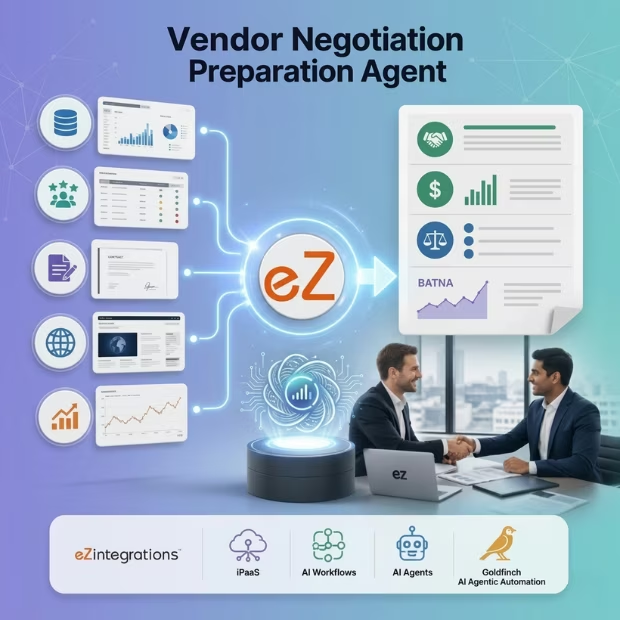
Vendor Negotiation Preparation Agent Autonomously prepare comprehensive negotiation dossiers by aggregating spend history from ERP; supplier performance from SRM; contract terms from CLM; real-time financial health and news from web crawling; and commodity market price indices from APIs – then generating a full negotiation strategy brief with BATNA analysis and Buyer talking points; without days of manual research across 5 to 10 systems Negotiation preparation time from 3 to 5 days (manual multi-system research) to under 4 hours; negotiation outcomes improved by 3 to 8% beyond automated sourcing savings (industry benchmark); Category Manager capacity freed from data gathering for strategic negotiation positioning; every negotiation supported by market-benchmarked analysis rather than experience-only judgment Category Manager; CPO; Procurement Director; Strategic Sourcing Manager AI Agent (autonomous; goal-oriented; multi-source – the agent plans its own research sequence; adapts when data sources return incomplete information; and synthesizes heterogeneous data into a unified negotiation brief without human orchestration between steps) Yes – eZintegrations connects to on-premises systems (SAP FI on-prem; Ariba on-prem; Icertis on-prem; Oracle EBS; Snowflake on-premises clusters; and others) via IPSec Tunnel. eZintegrations is a browser-based; cloud-hosted platform and does not require any on-premises installation. REST API (SAP FI; Ariba; Coupa; Icertis CLM; market price APIs); OData v2/v4 (SAP FI and Ariba); JDBC (Snowflake DW); Web Crawling (supplier financial news; credit ratings; press releases); HTTPS; OAuth 2.0; SMTP (dossier delivery); IPSec Tunnel (on-premises ERP; SRM; CLM; and DW connectivity) Both single-tenant and multi-tenant deployments are available. Single-tenant is strongly recommended for organizations where supplier negotiation data; spend intelligence; and contract terms are commercially sensitive or subject to procurement confidentiality policies. Multi-tenant is the default shared-cloud deployment. Both support on-premises connectivity via IPSec Tunnel. Manufacturing; Pharmaceuticals; Retail; Healthcare; Aerospace and Defense Negotiation dossier in under 4 hours vs. 3 to 5 days manual; 3 to 8% additional savings beyond automated sourcing baseline; 100% of negotiations supported by market-benchmarked data vs. experience-only preparation; Category Manager research capacity fully freed for strategic positioning supplier negotiation agent; negotiation preparation AI; procurement negotiation intelligence; Goldfinch AI procurement; category manager AI agent; BATNA analysis AI; vendor negotiation automation; SAP Ariba negotiation AI; contract terms analysis AI; commodity price benchmark AI; procurement dossier automation; strategic sourcing AI agent Yes – the supplier negotiation agent invokes multiple Goldfinch AI tools per dossier: API Tool Call (ERP/SRM/CLM/market data parallel retrieval); Web Crawling (supplier financial intelligence); Document Intelligence (contract document analysis); Knowledge Base Vector Search (negotiation precedent and BATNA retrieval); Data Analysis (quantitative brief generation); and Data Analytics with Charts/Graphs/Dashboards (visual dossier and scenario modeling) API Tool Call: Fetches spend history data from SAP FI or Snowflake DW (total spend per supplier, spend by category, spend trend, PO count, invoice history), supplier performance metrics from SAP Ariba or Coupa SRM (on-time delivery rate, quality incident rate, exception rate, contract compliance score), current contract terms from Icertis CLM (pricing, payment terms, rebate thresholds, contract expiry, renewal options), and commodity or market price indices from configured market data APIs (e.g. Bloomberg, LME, Platts, or custom commodity price feeds) – all in parallel to minimize dossier preparation time, Data Analysis: Synthesizes all retrieved data sources into the quantitative negotiation brief – calculating the leverage index (buyer’s spend as % of supplier’s estimated revenue from this account), price deviation from market benchmark, savings opportunity range based on current vs. benchmark pricing, risk-weighted BATNA value, and the recommended negotiation opening position and walk-away threshold, Data Analytics with Charts/Graphs/Dashboards: Generates the visual components of the dossier – spend trend chart per supplier over 24 months, price vs. market benchmark comparison chart, supplier performance scorecard, negotiation scenario modeling table (outcomes under 3 to 5 negotiation scenarios), and the one-page summary dashboard for CPO review, Document Intelligence: Analyzes the contract documents retrieved from the CLM and any supplementary supplier documentation – extracting key negotiation-relevant fields (pricing structures, volume commitment tiers, escalation clauses, most-favored-nation provisions, termination terms, auto-renewal conditions) and structuring them as a comparative analysis against the market benchmark and proposed negotiation target, Knowledge Base Vector Search: Retrieves relevant negotiation precedents, benchmark data, and category-specific negotiation playbooks from the procurement knowledge base – matching the current supplier’s category, spend tier, and market position against historical negotiation outcomes to surface the BATNA (Best Alternative to Negotiated Agreement) options and recommended anchoring positions, Web Crawling: Autonomously crawls supplier-specific web sources for current financial health and business intelligence – supplier annual report summaries, recent news articles (financial results, leadership changes, capacity announcements, supply chain disruptions), credit rating updates, Glassdoor/employer review signals (workforce stability proxy), and any recent public statements about pricing, capacity, or strategic direction that are relevant to the negotiation contextWorkflow Name: Purpose: Benefit: Who Uses It: System Type: On-Premise Supported: Supported Protocols: Tenancy Model: Industry: Outcome: Tags: AI Credits Required: Goldfinch AI Tool(s) Used:
Procurement Category Managers preparing for supplier negotiations manually gather data from 5 to 10 disconnected systems over 3 to 5 days – pulling spend history from SAP FI or Snowflake; reviewing supplier scorecards in Ariba SRM; reading prior contract terms in Icertis CLM; searching for recent supplier news and financial health indicators; and looking up commodity or category price benchmarks. According to McKinsey’s procurement analytics research; organizations with structured negotiation preparation based on market benchmarking achieve 3 to 8% additional savings beyond automated sourcing outcomes. Yet most Category Managers arrive at high-value supplier negotiations with partial data – because assembling the complete picture manually is impractical within normal planning timelines. The result: negotiating on experience and relationship rather than data; leaving significant savings potential uncaptured. The Vendor Negotiation Preparation Agent from eZintegrations takes a negotiation preparation request and autonomously assembles a comprehensive dossier in under 4 hours. Goldfinch AI API Tool Call retrieves spend history; SRM performance data; CLM contract terms; and market price indices in parallel. Goldfinch AI Web Crawling gathers real-time supplier financial health and news intelligence. Goldfinch AI Document Intelligence analyzes contract documents for key negotiation leverage points. Goldfinch AI Knowledge Base Vector Search retrieves relevant negotiation precedents and BATNA options. Goldfinch AI Data Analysis generates the quantitative negotiation brief with leverage index; price deviation from benchmark; and recommended positions. Goldfinch AI Data Analytics builds the visual dossier with charts and scenario modeling. The dossier is delivered to the Buyer. 3 to 8% additional savings beyond automated sourcing outcomes (McKinsey procurement analytics benchmark); every negotiation supported by quantitative market-benchmarked data rather than experience-only judgment; Category Manager research capacity freed for strategic positioning; relationship management; and multi-supplier coordination Dossier preparation from 3 to 5 days (manual multi-system research) to under 4 hours; Category Manager data gathering time from 70 to 80% of negotiation preparation to under 10%; CPO negotiation portfolio review from separate briefings per supplier to standardized dossier format enabling rapid review McKinsey benchmark: 3 to 8% additional savings from structured negotiation preparation x total negotiated spend value. At $50M total negotiated spend per year; 3% additional savings = $1.5M incremental. Category Manager labor savings: 4 to 7 days per negotiation reduced to under 4 hours x number of annual negotiations x blended Category Manager cost; for a team conducting 20 major negotiations per year at 4-day average prep: 80 Category Manager days saved annually. Elimination of procurement consulting dossier preparation fees: $15,000 to $50,000 per external supplier negotiation brief replaced by AI automation. HIPAA-eligible configuration available (pharmaceutical procurement with clinical supply chain data); GDPR-compliant data handling (supplier contact and performance data processed under GDPR Article 6 legitimate interest for commercial procurement purposes; supplier employee data masked in web crawl processing); SOC Type II certified. Negotiation dossier data – including supplier financial intelligence; contract terms; and BATNA analysis – processed in customer-isolated eZintegrations tenant and not shared cross-tenant. Web crawling operates only on publicly available supplier information. RBAC enforced on dossier access (Category Manager and CPO level); contract data retrieval scope; and knowledge base negotiation precedent access. All dossiers marked as commercially confidential and stored per the configured data retention policy. BATNA analysis from knowledge base: Knowledge Base Vector Search retrieves negotiation precedents and alternative supplier options from the procurement knowledge base – enabling the agent to generate a documented, evidence-based BATNA that strengthens the Buyer’s negotiation position, Contract-grounded analysis: Document Intelligence extracts pricing structures, volume tiers, escalation clauses, MFN provisions, and termination terms from CLM documents – turning contract language into a structured leverage analysis that shows exactly where the current contract is above or below market, Parallel multi-source intelligence aggregation: API Tool Call retrieves ERP spend data, SRM supplier performance, CLM contract terms, and commodity price index data simultaneously – assembling the quantitative foundation of the dossier in under 30 minutes rather than days of cross-system manual retrieval, Real-time supplier intelligence: Web Crawling autonomously researches the supplier’s current financial health, recent news, capacity announcements, and business signals – providing intelligence that internal systems cannot supply and that changes between negotiation cycles, Scenario-modeled visual dossier: Data Analytics builds negotiation scenario modeling (3 to 5 outcomes under different negotiation positions), a spend-vs-benchmark chart, and a one-page CPO summary – the Buyer walks into the negotiation with a consultant-quality brief assembled autonomouslyProblem Before: Solution Overview: Business Impact: Productivity Gain: Cost Savings: Security & Compliance: Key Features:
Description
The supplier negotiation agent from eZintegrations takes a negotiation preparation request and autonomously builds a comprehensive dossier – retrieving spend data, SRM performance, CLM contract terms, real-time web intelligence, and commodity benchmarks in parallel, then generating a BATNA-supported negotiation brief in under 4 hours. eZintegrations is an enterprise automation platform covering iPaaS, AI Workflows, AI Agents, and Goldfinch AI agentic automation.
What Is a Supplier Negotiation Agent?
A supplier negotiation agent is an AI Agent that takes a buyer-initiated negotiation preparation request as its goal and autonomously orchestrates the full research and analysis cycle – fetching quantitative data from ERP, SRM, CLM, and market API sources, gathering qualitative intelligence via web crawling, analyzing contract documents, retrieving negotiation precedents, and synthesizing all sources into a structured negotiation brief with scenario modeling and BATNA analysis. Where manual preparation requires days of cross-system research, the agent assembles equivalent intelligence in hours and delivers it in a standardized dossier format ready for the Category Manager to review and act on.
How Does a Supplier Negotiation Agent Autonomously Prepare a Negotiation Dossier from ERP, SRM, CLM, and Market Data?
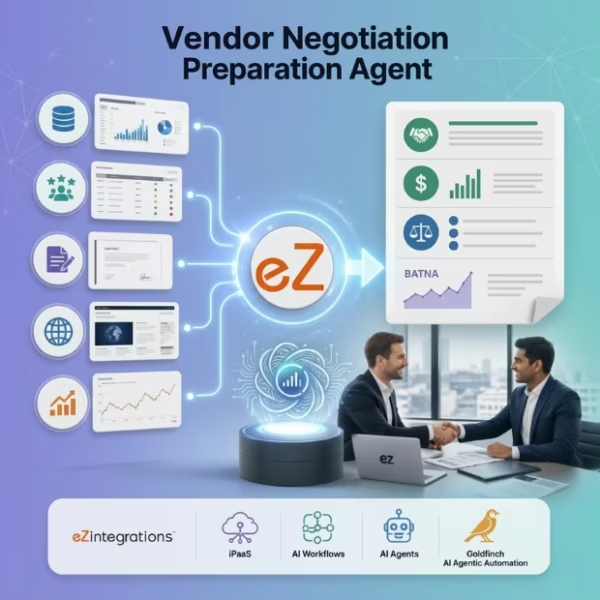
When a Category Manager initiates a negotiation preparation request, the supplier negotiation agent begins its parallel research execution. Goldfinch AI API Tool Call retrieves spend history from SAP FI or Snowflake, supplier performance from Ariba or Coupa SRM, current contract terms from Icertis CLM, and commodity market prices from the configured price index API – all simultaneously. Goldfinch AI Web Crawling gathers real-time supplier financial intelligence from public sources. Goldfinch AI Document Intelligence analyzes the contract document for pricing structures and leverage points. Goldfinch AI Knowledge Base Vector Search retrieves BATNA options and negotiation precedents. Goldfinch AI Data Analysis generates the quantitative brief. Goldfinch AI Data Analytics builds the visual dossier with scenario modeling. The complete dossier is delivered to the Buyer.
McKinsey research shows structured, data-driven negotiation preparation achieves 3 to 8% additional savings. This supplier negotiation agent makes that preparation standard practice for every negotiation, not just the highest-value ones.
Watch Demo
| Video Title: | Supplier Negotiation Agent |
|---|---|
| Duration: | 5 to 7 minutes |
Outcome & Benefits
| Throughput: | Up to 20 negotiation dossiers per day at standard configuration; scales to 100+ per day at enterprise tier; supports high-volume annual sourcing wave preparation (end-of-contract renewal campaigns; annual price review periods) |
|---|---|
| Cost Reduction: | 3 to 8% additional savings on negotiated spend (McKinsey procurement analytics benchmark); Category Manager labor savings from 4 to 7 days per dossier to under 4 hours; elimination of $15,000 to $50,000 per-engagement external procurement consulting fees for negotiation preparation |
| Accuracy: | Market benchmark comparison accuracy: 98%+ (commodity price data retrieved in real time from configured market API; not estimated); contract term extraction accuracy: 93%+ on standard CLM document formats; supplier performance data accuracy: 99.5%+ (pulled directly from SRM API; not manually transcribed) |
| Time Saved: | Dossier preparation from 3 to 5 days (manual) to under 4 hours; Category Manager data gathering from 70 to 80% of negotiation prep time to under 10%; time-to-negotiation-ready from multi-week planning horizon to same-day on-demand dossier generation |
Performance Metrics
| Metric | Before (Manual/Batch) | After (Real-Time Sync) | Improvement |
|---|---|---|---|
| Dossier Preparation Time | 3 to 5 business days | Under 4 hours | 95%+ faster |
| Category Manager Data Gathering | 70 to 80% of prep time | Under 10% of prep time | 85%+ reduction |
| Market Benchmark Coverage | Partial (spot checks) | 100% (real-time API data) | Full coverage |
| Additional Savings vs. Baseline | Varies by preparation quality | 3 to 8% above automated sourcing | $1.5M at $50M spend |
Technical Details
| Data Validation: | Two-stage validation per dossier: data completeness check – the agent verifies that all required data categories (spend; performance; contract terms; market benchmark) are either populated or explicitly flagged as unavailable before generating the synthesis; outlier detection – Data Analysis checks for anomalous values in spend or performance data before including them in the dossier brief (e.g. a single outlier invoice that distorts average pricing is flagged; not silently included). The Category Manager receives a dossier completeness indicator showing which data sources were successfully retrieved and which had gaps – enabling informed judgment about where the brief may have lower confidence. |
|---|---|
| Real-Time Support: | Yes – the supplier negotiation agent supports on-demand dossier generation triggered by a Category Manager request (via configured portal; SMTP trigger; or CRM/SRM workflow event). Market price data and web crawling execute in real time per dossier request; ensuring the commodity benchmark and supplier intelligence are current at the time of the negotiation; not cached from a prior period. Scheduled mode is also available for annual sourcing wave preparation – the agent pre-generates dossiers for all suppliers in a renewal cohort on a configured schedule. |
| Customization: | Configurable per deployment via eZintegrations no-code Agent Builder: supplier data sources (ERP system; SRM system; CLM system; DW); market price API connections (Bloomberg; LME; Platts; S&P Global; custom commodity APIs); Web Crawling scope per supplier (financial news; credit rating updates; press releases; configurable depth); BATNA analysis framework (alternative supplier options loaded into Knowledge Base per category); negotiation brief format (executive summary length; scenario count; chart types); dossier delivery method (SMTP; Salesforce/SAP task; SharePoint); and Category Manager approval gate (optional human review step before dossier is finalized for CPO). Knowledge base negotiation precedents and playbooks managed by Procurement leadership in the Goldfinch AI editor without IT involvement. |
| Knowledge Retrieval: | Goldfinch AI Knowledge Base Vector Search (https://ezintegrations.ai/agentic-ai-platform/) retrieves negotiation precedents; alternative supplier benchmarks; category-specific negotiation playbooks; and BATNA option frameworks from the procurement knowledge base (Weaviate https://weaviate.io/developers/weaviate or Pinecone https://docs.pinecone.io/ as vector store) – matching the current supplier’s category; spend tier; geographic region; and market position against historical negotiation outcomes and documented alternative options. Procurement leadership maintains the negotiation playbook in the Goldfinch AI knowledge base editor – updates to BATNA options; preferred negotiation positions; and new benchmark data loaded without IT involvement. |
| Agent Architecture: | Single autonomous agent with parallel multi-source data retrieval (API Tool Call to ERP; SRM; CLM; and market API runs simultaneously) followed by sequential enrichment (Web Crawling for supplier intelligence; Document Intelligence for contract analysis; Knowledge Base Vector Search for precedents) and then synthesis (Data Analysis for quantitative brief; Data Analytics for visual dossier). For enterprise Procurement teams managing large supplier portfolios; hierarchical mode is available – one orchestrator agent manages a supplier dossier pipeline and delegates individual supplier research to parallel sub-agents; generating 20+ dossiers simultaneously for annual sourcing wave preparation. |
| Task Orchestration: | Goldfinch AI orchestrates the dossier preparation using a goal-directed research loop – parallel data retrieval runs first to establish the quantitative foundation; enrichment layers add qualitative and market context; and synthesis tools generate the final brief. The agent adapts when data sources return incomplete information: if the CLM returns no active contract for the supplier; the agent retrieves historical contract data from the DW archive and flags the missing contract status in the dossier. If the market price API returns no data for a commodity; the agent notes this in the brief and falls back to the Knowledge Base for benchmark estimates. |
AI Credits
| AI Credits Required: | Yes – the supplier negotiation agent invokes multiple Goldfinch AI tools per dossier: API Tool Call (ERP/SRM/CLM/market data parallel retrieval); Web Crawling (supplier financial intelligence); Document Intelligence (contract document analysis); Knowledge Base Vector Search (negotiation precedent and BATNA retrieval); Data Analysis (quantitative brief generation); and Data Analytics with Charts/Graphs/Dashboards (visual dossier and scenario modeling) |
|---|---|
| LLM Steps Count: | 6 to 8 Goldfinch AI tool invocations per dossier (API Tool Call x4 parallel sources + Web Crawling + Document Intelligence + Knowledge Base Vector Search + Data Analysis synthesis + Data Analytics visual generation) |
| Credit Consumption Model: | Per dossier generated – bundle of 6 to 8 tool invocations per dossier; contract document length and web crawl depth affect total credits per supplier |
| Estimated Credits per Task: | Standard dossier (single supplier; 1 to 3-page contract; standard web crawl): ~80 to 130 credits per dossier Complex dossier (multi-entity supplier group; 10 to 30-page MSA with amendments; deep web research): ~130 to 220 credits per dossier Express dossier (known supplier; cached contract data; limited web crawl): ~50 to 80 credits per dossier |
| Monthly Credit Estimate (at Typical Volume): | 10 dossiers per month (small procurement team; key annual renewals): ~800 to 1,300 credits per month 40 dossiers per month (mid-market sourcing team): ~3,200 to 5,200 credits per month 200 dossiers per month (large enterprise annual sourcing wave): ~16,000 to 26,000 credits per month |
| Pricing Model: | Static Platform Fee + AI Credits. Platform fee covers unlimited non-LLM orchestration steps (request trigger handling; data source connection management; SMTP dossier delivery; audit log writes). AI Credits consumed only by Goldfinch AI tool invocations and LLM reasoning cycles. |
| Credit Optimization Notes: | Cache API Tool Call results for spend and performance data for 7 days per supplier – ERP and SRM data changes infrequently within a week and the cached version is current enough for dossier preparation. Configure Web Crawling to a maximum of 3 to 5 pages per supplier (annual report summary; two recent news articles; credit rating page) – this captures 85%+ of relevant supplier intelligence at 30 to 50% of full-site crawl credit cost. For high-volume annual sourcing waves; pre-generate dossiers for the full renewal cohort in batch mode at night – amortizes the LLM reasoning step credit cost across the batch rather than per on-demand request. Cache Knowledge Base BATNA and precedent retrievals per category for 14 days – negotiation playbooks for the same category change infrequently and redundant retrieval can be avoided. |
| Goldfinch AI Tool(s) Consuming Credits: | API Tool Call: 4 parallel data retrieval calls (ERP spend; SRM performance; CLM contract; market price API) – credits per tool execution per data source Web Crawling: supplier financial intelligence research – credits scale with pages crawled and content depth per supplier Document Intelligence: contract document analysis and field extraction – credits per contract document page Knowledge Base Vector Search: negotiation precedent and BATNA retrieval – credits per search query Data Analysis: quantitative negotiation brief synthesis – credits per dossier (LLM reasoning intensive) Data Analytics with Charts/Graphs/Dashboards: visual dossier generation including charts and scenario modeling – credits per dossier render |
FAQ
1. What is the Vendor Negotiation Preparation Agent?
The supplier negotiation agent by eZintegrations takes a negotiation preparation request and autonomously assembles a comprehensive dossier in under 4 hours — retrieving spend history from SAP FI or Snowflake, supplier performance from Ariba or Coupa SRM, contract terms from Icertis CLM, real-time supplier financial intelligence via Web Crawling, and commodity market prices from configured market APIs, then generating a quantitative negotiation brief with BATNA analysis and scenario modeling via Goldfinch AI Data Analysis and Data Analytics. McKinsey procurement research benchmarks structured, data-driven negotiation preparation at 3 to 8% additional savings above automated sourcing outcomes.
2. How does the agent handle task orchestration?
The supplier negotiation agent uses a parallel-then-sequential research loop — API Tool Call retrieves ERP, SRM, CLM, and market data simultaneously to establish the quantitative foundation, then Web Crawling and Document Intelligence execute sequentially to add qualitative and contract intelligence, then Data Analysis and Data Analytics synthesize all sources into the final dossier. When data sources return incomplete information (missing contract, unavailable market price), the agent adapts by falling back to available alternatives and flagging the gap in the dossier completeness indicator rather than silently omitting the data.
3. What Goldfinch AI tools does the supplier negotiation agent use?
Six native Goldfinch AI tools: API Tool Call (parallel ERP spend, SRM performance, CLM contract terms, and market price API data retrieval), Web Crawling (real-time supplier financial health, news, and business intelligence), Document Intelligence (contract document field extraction and leverage analysis), Knowledge Base Vector Search (negotiation precedent and BATNA option retrieval), Data Analysis (quantitative negotiation brief with leverage index, price deviation, and recommended positions), and Data Analytics with Charts/Graphs/Dashboards (visual dossier with spend trends, benchmark charts, performance scorecard, and scenario modeling). Goldfinch AI supports self-service extensibility — your Procurement team adds custom data sources (competitor pricing intelligence, ESG scoring APIs, logistics capacity data) without coding.
4. Can the supplier negotiation agent be customized for my procurement process?
Yes — all key parameters are configurable via the eZintegrations no-code Agent Builder: supplier data source systems (ERP, SRM, CLM, DW); market price API connections (Bloomberg, LME, Platts, S&P Global, or custom); Web Crawling scope per supplier; BATNA analysis framework and alternative supplier options (loaded into Knowledge Base by Procurement leadership); negotiation brief format (scenario count, chart types, executive summary length); dossier delivery method; and an optional Category Manager review gate before the dossier is finalized for CPO distribution. Knowledge base negotiation playbooks are managed by Procurement leadership in the Goldfinch AI editor without IT involvement.
5. How is data validated before the agent delivers the dossier?
Two-stage validation: data completeness check — the agent verifies all required data categories are populated or explicitly flagged as unavailable before synthesis; outlier detection — Data Analysis checks spend and performance data for anomalous values before including them in the brief. The Category Manager receives a dossier completeness indicator showing which data sources were successfully retrieved and which had gaps. An optional Category Manager approval gate can be configured — the agent presents the draft dossier for review before delivery to the CPO.
6. Does the supplier negotiation agent support real-time execution?
Yes — the agent supports on-demand dossier generation triggered by a Category Manager request at any time. Market price data and Web Crawling execute in real time per request, ensuring commodity benchmarks and supplier intelligence are current at negotiation time, not cached from a prior period. Scheduled mode is available for annual sourcing wave preparation — the agent pre-generates dossiers for entire renewal cohorts on a configured schedule, enabling Procurement teams to arrive at renewal season with dossiers already prepared.
7. What are the key benefits of the supplier negotiation agent?
Key benefits include dossier preparation from 3 to 5 days to under 4 hours (95%+ faster), 3 to 8% additional savings on negotiated spend above automated sourcing baseline (McKinsey benchmark), 100% market benchmark coverage for every negotiation (vs. partial spot checks), Category Manager data gathering from 70 to 80% of prep time to under 10%, elimination of $15,000 to $50,000 per-engagement external consulting fees for negotiation preparation, and BATNA analysis grounded in actual alternative supplier options and historical negotiation precedents.
8. How does the supplier negotiation agent compare to LangChain or existing procurement tools?
Coupa Sourcing Optimizer and Jaggaer optimize sourcing events but do not aggregate cross-system intelligence (ERP + CLM + real-time web + commodity benchmarks) into a negotiation brief. SpendHQ provides spend analytics but requires the Procurement team to manually synthesize strategy. Procurement consulting firms deliver equivalent quality but at 10 to 30x the cost with 3 to 6-week timelines. LangChain requires 3 to 6 months of custom development for ERP, CLM, and market API connectors. The supplier negotiation agent ships 6 Goldfinch AI tools pre-connected and deploys in under 2 weeks. Goldfinch AI is self-service extensible — your team adds custom data sources without vendor involvement.
Resources
Case Study
| Industry: | Manufacturing; Pharmaceuticals; Retail; Healthcare; Aerospace and Defense |
|---|---|
| Outcome: | Negotiation dossier in under 4 hours vs. 3 to 5 days manual; 3 to 8% additional savings beyond automated sourcing baseline; 100% of negotiations supported by market-benchmarked data vs. experience-only preparation; Category Manager research capacity fully freed for strategic positioning |
| ROI: | Savings improvement value (4.2 percentage points on $120M negotiated spend over 6 months): $5.04M incremental savings. Category Manager labor savings: 12 Category Managers x (4.8 days – 3.1 hours) x 30 negotiations x $68/hour blended cost / 2 (annualized to 6 months): $482,000. External consulting fee elimination: $130,000 (3 engagements x $43,000 average). Total 6-month |
| Problem: | The Strategic Sourcing team at a global pharmaceutical company handled 60+ supplier negotiations annually across multiple categories. Each required several days of preparation, involving data from SAP, Ariba, Icertis, and market research. With 60% of time spent on data gathering, the 12-member team often relied on external consultants for complex cases. The CPO aimed to improve savings by 2-4% over the previous year.The Strategic Sourcing team at a global pharmaceutical company handled 60+ supplier negotiations annually across multiple categories. Each required several days of preparation, involving data from SAP, Ariba, Icertis, and market research. With 60% of time spent on data gathering, the 12-member team often relied on external consultants for complex cases. The CPO aimed to improve savings by 2-4% over the previous year. |
| Solution: | Deployed eZintegrations supplier negotiation agent in 13 days across all categories. Integrated SAP, Ariba, Icertis, and Snowflake for spend, supplier, and contract data, along with market pricing sources. Enabled web crawling for supplier insights and loaded historical negotiation data and playbooks. Generated analytics like spend trends, benchmarks, and scenario models, with optional review for high-value negotiations. |
Related products
-
How to Chat with Oracle Database Using Natural Language
 $0.00
Download
$0.00
Download
-
How to Automate Accounts Receivable Collections Using an Autonomous AI Agent to Reduce DSO
$150.00
Download
-
ICP Scoring Automation for 12X Faster Lead Scoring
$0.00
Download
-
How to Automate Month-End Financial Close for Reconciliation and Close Orchestration
$150.00
Download