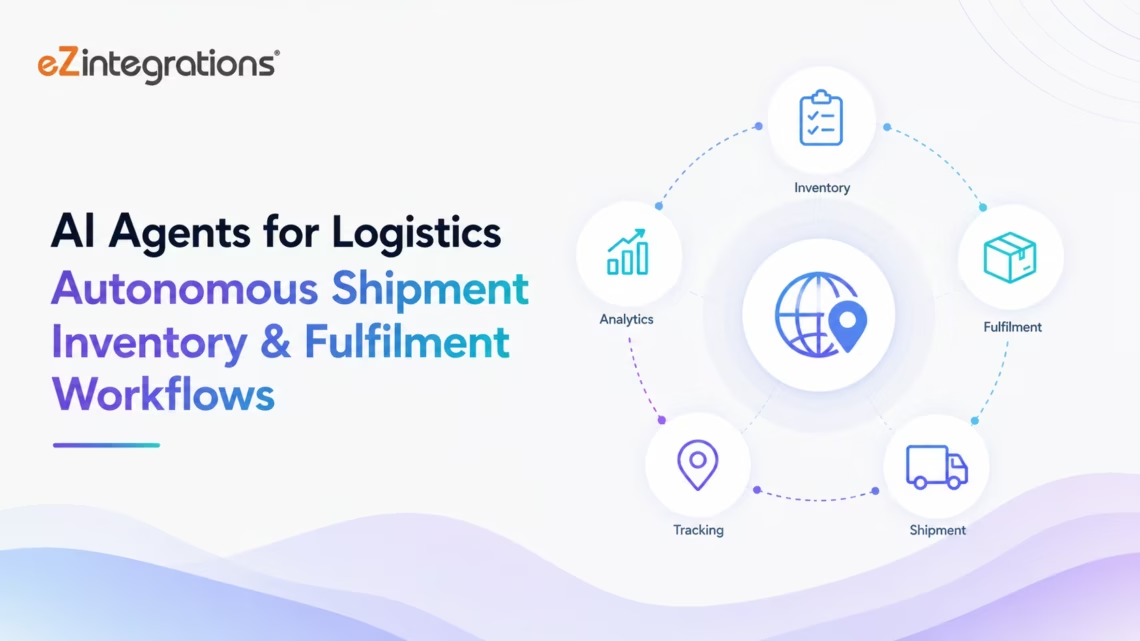
AI Agents for Logistics: Autonomous Shipment Inventory & Fulfilment Workflows
June 9, 2026AI agents for logistics are autonomous, multi-step reasoning systems aligned with Intelligent agent principles that handle complex shipment, inventory, and fulfilment exceptions end-to-end: retrieving carrier tracking data, reading logistics documents, querying WMS and ERP systems, applying business rules, and routing pre-packaged resolution recommendations to operations teams for final approval. eZintegrations deploys logistics AI agents with 9 native enterprise tools, configurable confidence thresholds, and human-in-the-loop gates: handling shipment exceptions, carrier claims, inventory replenishment anomalies, and 3PL coordination failures autonomously across your full carrier and warehouse network.
TL;DR
- Logistics operations run on exception management, consistent with McKinsey & Company research on AI agents in logistics and supply chain operations. Most of the high-value work your operations team does is not running standard processes: it is investigating why something went wrong, assembling the information needed to resolve it, and routing the resolution to the right person. That investigation and assembly work is precisely what AI agents do faster, more consistently, and at larger scale than humans.
- eZintegrations’ Level 3 AI Agents deploy 9 native enterprise tools: Knowledge Base Vector Search, Document Intelligence, Data Analysis, Data Analytics, Web Crawling, Watcher Tools, API Tool Call, Integration Workflow as Tool, and Integration Flow as MCP: to autonomously investigate logistics exceptions across your WMS, TMS, ERP, and carrier network.
- Five logistics AI agents in this guide: the Shipment Exception Investigation Agent, the Carrier Claims Management Agent, the Inventory Replenishment Anomaly Agent, the 3PL Performance and Exception Agent, and the Fulfilment Exception Resolution Agent.
- Level 4 Goldfinch AI coordinates these agents into a continuous logistics operations intelligence network, giving your VP of Logistics and COO natural language access to live operational data via Chat UI.
- Deployment: 10-14 days per agent using Automation Hub templates, including knowledge base configuration, carrier and WMS API connection validation, and confidence threshold calibration.
What Logistics AI Agents Actually Do (and the Line Between Agent and Workflow)
Before deploying AI agents in logistics, it helps to be precise about what distinguishes an agent from an enhanced workflow, reflecting Gartner perspectives on AI agent adoption in supply chain operations: because the distinction determines which problems each tool solves.
A Level 1 iPaaS workflow does a predetermined thing when a trigger fires. An order arrives from Shopify: the workflow creates an order in the WMS. A shipment tracking event arrives: the workflow updates the ERP status. Deterministic, reliable, fast. This is covered in the logistics integration platform guide.
A Level 2 AI Workflow adds intelligence at specific predetermined steps. The freight invoice arrives, Document Intelligence extracts the line items, LLM Classification compares to the contract, the workflow routes accordingly. The AI does a specific job at a specific point; the workflow sequence is fixed. This is covered in the supply chain AI workflow guide.
A Level 3 AI Agent receives a goal, not a script. “Investigate why this shipment is delayed and determine the best resolution path.” The agent then decides what to investigate first, what to check next based on what it finds, and how to assemble the resolution recommendation. It adapts based on findings. It uses multiple tools in an order it determines based on what it discovers.
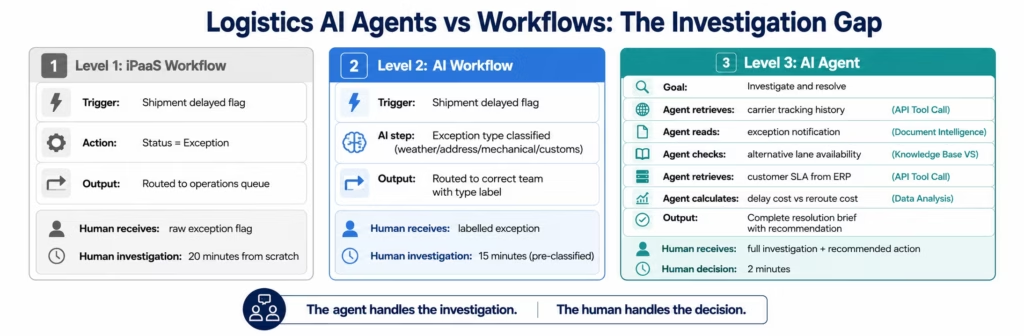
The practical logistics difference:
Level 1 workflow: shipment flagged as delayed → status updated to “exception” → routed to operations queue. The exception sits in the queue until a human investigates.
Level 2 AI workflow: shipment flagged as delayed → Document Intelligence reads the carrier exception notification → LLM classifies the exception type (weather, mechanical, address, customs) → routed to the appropriate operations team with the exception type pre-labelled. Faster routing, same investigation workload.
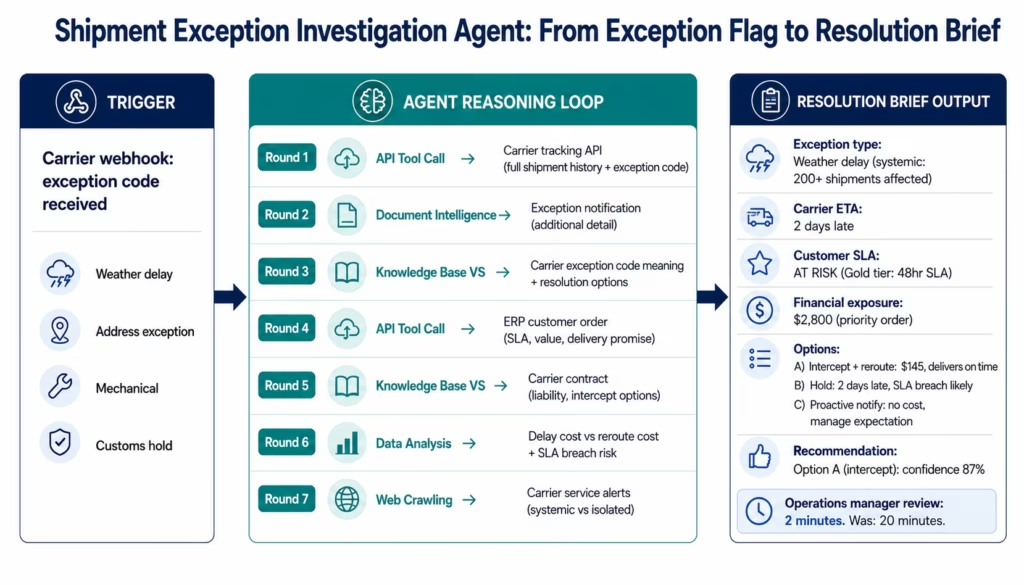
Level 3 AI agent: shipment flagged as delayed → agent retrieves carrier tracking history via API Tool Call → reads carrier exception notification via Document Intelligence → checks if alternative carrier lanes are available via Knowledge Base Vector Search → retrieves customer order SLA from ERP → calculates financial exposure of delay versus reroute cost via Data Analysis → routes a structured resolution brief: exception type, root cause, delivery estimate, customer SLA impact, recommended action (intercept, reroute, proactive notify, or claim after delivery). The operations manager makes a 2-minute decision from a complete information package instead of a 20-minute investigation from scratch.
That is the agent difference. Not faster routing: complete autonomous investigation before the human ever sees the exception.
Before vs After: The AI Agent Transformation in Logistics
| Exception Type | Before AI Agents | After AI Agents |
|---|---|---|
| Shipment delay exception | Ops manager manually retrieves carrier tracking, reads exception, calculates SLA impact (20 min) | Shipment Exception Agent delivers complete resolution brief with SLA impact and recommended action (2 min review) |
| Carrier damage claim | Logistics team assembles BOL, tracking history, photos, invoice, claim form (45-60 min per claim) | Carrier Claims Agent retrieves all documents, assembles complete claim package (5 min review) |
| Carrier loss investigation | Team contacts carrier, traces through chain of custody manually (1-3 days) | Claims Agent retrieves full chain-of-custody tracking history, files trace request via carrier API, monitors response |
| Inventory replenishment anomaly | Analyst manually retrieves item master, demand history, supplier lead time, open POs (15-20 min per item) | Replenishment Anomaly Agent retrieves all data sources, calculates updated parameter recommendation (3 min review) |
| 3PL performance exception | Operations reviews monthly 3PL scorecard, issues identified 30 days late | 3PL Agent monitors every shipment in real time, surfaces SLA breach pattern within 48 hours of emergence |
| 3PL invoice dispute | AP manually compares 3PL billing against contracted rates per service type (30-45 min per dispute) | 3PL Agent retrieves contract terms, compares each billing line, flags variances with contract clause reference |
| Fulfilment backorder resolution | Customer service checks WMS, ERP, and supplier systems manually, calls customer (25-30 min) | Fulfilment Agent retrieves inventory across all locations, identifies alternative fulfilment path, routes resolution |
| Split-ship decision | Operations manually evaluates whether to ship partial or hold for complete order (15 min per decision) | Fulfilment Agent evaluates inventory, customer SLA, split-ship cost, and routes recommendation |
| Address exception handling | Ops team manually contacts customer or carrier, updates address, re-tenders (30-40 min) | Address Exception Agent flags, retrieves correct address from order history, routes correction via carrier API |
| Returns routing decision | Returns team manually determines: restock, repair, liquidate, or dispose (15 min per return) | Returns Agent reads condition report, checks restocking rules, routes disposition recommendation |
The 9 Native Tools Logistics AI Agents Use
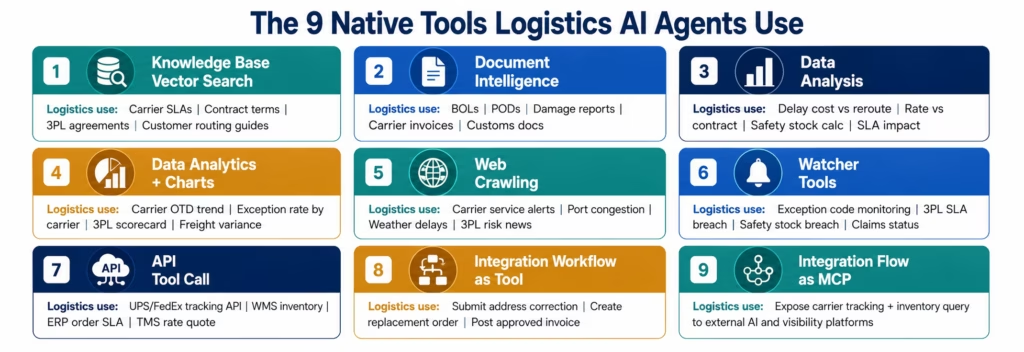
eZintegrations’ Level 3 AI Agents operate through 9 native enterprise tools, aligned with broader logistics technology and automation trends tracked by ARC Advisory Group. Understanding each tool’s logistics application makes clear why agents produce better exception resolution than human investigation alone: they use more data sources, faster, and more consistently.
1. Knowledge Base Vector Search Searches your configured knowledge bases using semantic similarity. In logistics: the carrier SLA and service guide knowledge base (what does UPS Worldwide Express actually promise for a pickup in Chicago destined for London?), the carrier contract terms library (what does your negotiated rate card say about residential delivery surcharges?), the 3PL service level agreement library (what are the pick-pack SLAs at your East Coast 3PL?), and the customer routing guide library (do any customers have specific carrier preferences or restrictions?).
2. Document Intelligence Reads unstructured logistics documents. In logistics: carrier exception notifications, BOLs, PODs (proof of delivery), damage inspection reports, 3PL billing invoices, customs entry documents, carrier rate confirmation sheets, and supplier ASNs. Reads across formats: EDI messages, PDF documents, image scans, and portal extracts.
3. Data Analysis Performs structured data calculations. In logistics: calculating the financial exposure of a delay versus the cost of intercepting and rerouting, comparing 3PL billing line items against contracted rates, calculating updated safety stock requirements from revised lead time data, computing carrier on-time performance deviation from historical baseline.
4. Data Analytics with Charts/Graphs/Dashboards Generates visual summaries. In logistics: carrier on-time delivery trend by lane, exception rate by carrier and exception type, 3PL performance scorecard, freight cost variance by carrier and service level.
5. Web Crawling Retrieves content from web sources. In logistics: carrier service alerts and weather-related delay advisories from carrier websites, port congestion and customs delay advisories from relevant government and industry sources, 3PL bankruptcy or operational disruption news for risk monitoring.
6. Watcher Tools Monitors systems and triggers when conditions are met. In logistics: monitoring carrier tracking APIs for specific exception codes (damage, loss, weather hold, address exception), monitoring 3PL shipment confirmation feeds for SLA breach triggers, monitoring inventory levels for safety stock breach across WMS instances, monitoring carrier portal for claims status updates.
7. API Tool Call calls configured API connectors such as UPS carrier tracking and shipping APIs. In logistics: the UPS Tracking API call that retrieves the full tracking history for a shipment, the WMS API call that retrieves current inventory availability across all warehouse locations, the ERP API call that retrieves the customer order’s SLA commitment and order value, the TMS API call that retrieves the original rate quote for the shipment.
8. Integration Workflow as Tool Runs a Level 1 workflow as an agent tool. In logistics: the agent triggers the “submit address correction to carrier” workflow, the “create replacement shipment order in WMS” workflow, or the “post approved freight invoice to AP” workflow as part of its investigation and resolution sequence.
9. Integration Flow as MCP Exposes logistics integration capabilities to external AI systems via Model Context Protocol. In logistics: allows your organisation’s customer-facing AI tools or supply chain visibility platforms to call eZintegrations’ carrier tracking and inventory query capabilities as part of their own reasoning.
Logistics AI Agent 1: Shipment Exception Investigation Agent
Every logistics operation has an exception queue. Shipments flagged for delay, address issues, delivery failures, weather holds, and customs clearance problems land in this queue every morning. In most operations, the ops team works through this queue manually: pulling up the carrier tracking portal, reading the exception, looking up the customer order, calculating the delivery impact, and deciding what to do.
The Shipment Exception Investigation Agent eliminates the manual investigation step. Every exception is pre-investigated before it reaches the operations team.
Agent goal: “Investigate this shipment exception, determine the root cause, assess the customer impact, and identify the optimal resolution path.”
Agent investigation sequence (adaptive):
The agent starts by calling the carrier tracking API (API Tool Call) to retrieve the full shipment history: every scan event from pickup to the current exception, the carrier’s exception code, and any carrier-provided estimated resolution date.
It reads the exception notification document if present (Document Intelligence): some carriers provide structured exception notifications with additional detail beyond the tracking event code.
It checks the carrier’s service guide knowledge base (Knowledge Base Vector Search) for the specific exception code: what does this exception code mean for this carrier on this service type? What is the carrier’s standard resolution timeline? What options exist for the shipper (intercept, redirect, hold at location)?
It retrieves the customer order from the ERP (API Tool Call): the promised delivery date, the customer’s SLA tier, the order value, and any special handling notes.
It retrieves the carrier contract terms (Knowledge Base Vector Search) for applicable provisions: does the shipper have contractual recourse for this exception type? Is a service failure claim available?
It performs the resolution analysis (Data Analysis): what is the financial exposure if the shipment delivers late? What does intercept and reroute cost versus the late delivery risk? Is the exception type covered by carrier liability?
If weather or external event: it checks current carrier service alerts (Web Crawling) to understand whether the delay is systemic (affecting many shipments) or isolated.
The agent produces a structured exception brief for the operations manager:
- Exception type and root cause
- Current carrier status and estimated delivery
- Customer SLA status (on-track, at-risk, breached)
- Financial exposure of delay
- Available resolution options with cost estimate
- Recommended action with supporting rationale
- Confidence score on the recommendation
The operations manager reviews in 2 minutes and takes action. Previously: 20 minutes of investigation, then the decision.
Logistics AI Agent 2: Carrier Claims Management Agent
When a carrier damages or loses a shipment, the claims process is straightforward in principle and laborious in practice. You need: the original Bill of Lading, the carrier’s pickup confirmation, the tracking history showing the exception event, any damage inspection documentation, the commercial invoice for the shipment value, and the carrier’s claim form with specific fields.
Assembling this from a TMS, a carrier portal, an ERP, and potentially a warehouse management system takes 45-60 minutes per claim. For a mid-size shipper with 20-30 carrier exceptions per month, this is 15-30 hours of monthly claims management labour.
Carrier Claims Management Agent: loss and damage:
When a delivery exception with a damage or loss code arrives via carrier tracking webhook or is flagged from a POD that notes a shortage or damage:
API Tool Call (TMS): retrieves the original shipment record: BOL number, carrier, service type, origin, destination, pickup date, declared value, weight, and dimensions.
API Tool Call (carrier tracking): retrieves the full tracking event history, identifying the specific exception event (damage at destination scan, shortage noted at delivery, or lost: last scan was X days ago with no subsequent events).
Document Intelligence: reads any damage inspection report or POD exception notation, extracting the damage description, the quantity affected, and any carrier agent notes.
API Tool Call (ERP): retrieves the commercial invoice for the shipment: the product value per unit, the total shipment value, and the customer invoice number for reference.
Knowledge Base Vector Search (carrier contract): retrieves the applicable liability limit for this carrier, service type, and commodity: what is the maximum claimable amount? What documentation is required for this claim type?
Integration Workflow as Tool: calls the “generate carrier claim form” workflow, which pre-populates the carrier’s claim form with all retrieved data and generates a PDF package.
The agent routes the complete claim package to the logistics manager: the pre-populated claim form, the BOL, the tracking history, the damage documentation, and the commercial invoice: organised and ready to submit. The logistics manager reviews in 5 minutes and submits.
What this changes for a 20-claim/month operation: 15-30 hours of monthly claims assembly → 2-3 hours of claims review. Claims are filed faster, with more complete documentation, leading to better recovery rates. Claims that were previously deprioritised due to assembly time are now filed routinely.
Logistics AI Agent 3: Inventory Replenishment Anomaly Agent
Inventory replenishment planning runs on parameters: safety stock, reorder points, reorder quantities, and supplier lead times. These parameters are set when a product is introduced and are supposed to be reviewed periodically. In practice, most operations teams review them when a stockout or overstock event makes the problem visible: by which point the damage is already done.
The Inventory Replenishment Anomaly Agent monitors for conditions where the current parameters are producing wrong recommendations and flags them before they cause operational problems.
Trigger conditions the Watcher Tool monitors:
- Items with current safety stock below the calculated requirement given actual recent lead time variability
- Items where the demand rate has shifted by more than 20% over the trailing 8 weeks but the reorder point has not been updated
- Items with open POs that will arrive after the projected stockout date given current inventory and demand rate
- Items where the supplier’s confirmed lead time on the most recent PO differs materially from the lead time in the item master
When any of these conditions is detected:
API Tool Call (ERP item master): retrieves the current safety stock setting, reorder point, reorder quantity, and lead time parameters.
API Tool Call (demand history): retrieves 52 weeks of weekly demand, demand variability (standard deviation), seasonal indices, and the demand trend over the trailing 8 weeks.
API Tool Call (supplier record): retrieves the supplier’s actual lead times from the trailing 6 months of PO history, identifying the mean, the variability, and the trend.
API Tool Call (open PO status): retrieves any open purchase orders for this item: quantities, confirmed delivery dates, and current status.
Data Analysis: calculates the updated safety stock requirement using the current demand variability and the actual supplier lead time distribution. Computes the projected stockout date given current inventory, demand rate, and inbound PO timing. Identifies whether the open PO arrives before or after the projected stockout.
The agent routes a structured replenishment brief: the anomaly type, the current settings, the recommended updated parameters, the supporting data, and the urgency (days until projected stockout if no action is taken). For time-critical situations (projected stockout within 7 days), the brief is flagged urgent and also triggers a notification to the procurement manager.
The inventory analyst reviews in 3 minutes and approves or adjusts the parameter change. Previously: 15-20 minutes of multi-system data assembly for each exception.
Logistics AI Agent 4: 3PL Performance and Exception Agent
Organisations using third-party logistics providers face a visibility challenge: 3PL performance problems are often discovered after the fact, from customer complaints or monthly scorecards, rather than in time to take corrective action. By the time the monthly scorecard shows that the East Coast 3PL has been missing pick-pack SLAs for 3 weeks, dozens of customer orders have been affected.
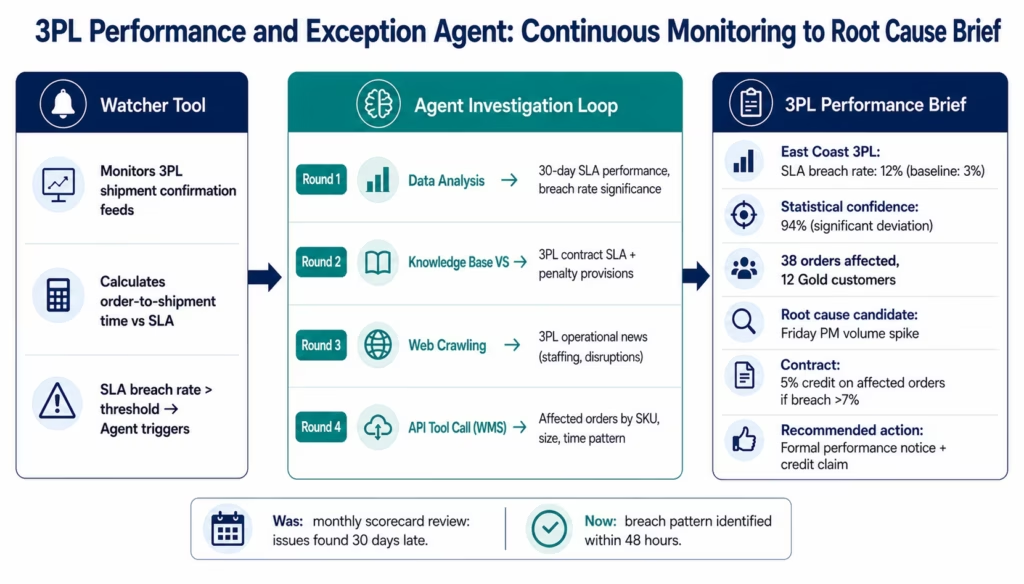
The 3PL Performance and Exception Agent monitors 3PL performance continuously and surfaces issues within 48 hours of their emergence.
Continuous SLA monitoring:
The Watcher Tool monitors outbound shipment confirmation feeds from each 3PL. For every order, it calculates the time from order receipt to shipment confirmation and compares against the contractual pick-pack SLA. Orders shipped outside the SLA window are flagged immediately. When the daily SLA breach rate for a 3PL exceeds the threshold (configurable: typically 5% above baseline), the agent triggers an investigation.
3PL exception investigation sequence:
Data Analysis: retrieves the trailing 30-day SLA performance data for the 3PL and identifies whether the current breach rate represents a statistically significant deviation from historical performance or normal variance.
Knowledge Base Vector Search (3PL contract): retrieves the contractual SLA terms, the applicable penalty or credit provisions, and any notice requirements for SLA breach claims.
Web Crawling: checks for any news or announcements about the 3PL: staffing issues, operational disruptions, facility closures, or weather events affecting their operations.
API Tool Call (WMS): retrieves the specific orders that missed SLA and identifies any common characteristics: specific SKUs, order sizes, destination regions, or time-of-day patterns that might indicate the root cause.
The agent produces a 3PL performance brief: the SLA breach rate, the statistical significance assessment, the orders affected and their customer impact, the contract terms for breach recourse, and the possible root causes identified. The operations director reviews and initiates either a formal 3PL performance discussion or a credit claim based on the agent’s brief.
3PL invoice audit:
For 3PL billing, the agent compares each line of the 3PL’s monthly invoice against the contracted rate card: per-pick fees, per-unit storage fees, value-added service rates, and any minimum volume commitments. Document Intelligence reads the 3PL invoice, Data Analysis compares against the contracted rates from the Knowledge Base, and variances are flagged with the specific contract clause reference.
Logistics AI Agent 5: Fulfilment Exception Resolution Agent
Fulfilment exceptions are the customer-facing failures: a customer places an order that cannot be fulfilled as promised because inventory is not available at the expected warehouse, a split-ship creates two delivery dates when the customer expected one, a backorder has no clear resolution date, or a returns decision is needed that will affect the customer’s replacement order.
Each of these requires the operations or customer service team to look across multiple systems, make a judgment call, and communicate with the customer. The Fulfilment Exception Resolution Agent handles the multi-system lookup and the initial resolution path analysis, so the human handles only the judgment and the customer communication.
Backorder resolution investigation:
When an order cannot be fulfilled from the primary warehouse:
API Tool Call (WMS network): queries inventory availability across all warehouse locations and 3PL partners for the backordered SKU.
API Tool Call (ERP: open POs): retrieves any open purchase orders for the backordered item: quantities and confirmed delivery dates.
API Tool Call (customer order): retrieves the customer’s requested delivery date, their SLA tier, and any customer-specific fulfilment requirements (e.g., specific carriers, single-ship requirement, drop-ship restrictions).
Data Analysis: evaluates the available fulfilment options: ship from an alternate warehouse (what is the cost and delivery time difference?), split-ship from two locations (does the customer allow split-ship?), wait for incoming PO (when does it arrive versus the customer’s required date?), or substitute an acceptable alternative product (is there a compatible SKU in stock?).
Knowledge Base Vector Search (customer routing guide): checks customer-specific routing rules and carrier requirements that affect the alternative fulfilment options.
The agent routes a structured resolution brief: the backorder status, the available options with cost and delivery time for each, the customer’s SLA position, and a recommended path. The operations or customer service team makes the call in 3 minutes rather than 25.
Returns disposition decision:
When a returned item arrives at the warehouse:
Document Intelligence reads the return merchandise authorisation and any condition notes from the warehouse receiving team.
Knowledge Base Vector Search retrieves the returns policy for this product category and condition: is this SKU resellable as new, refurbishable, liquidatable, or disposable?
API Tool Call (ERP): retrieves the original order value and the cost of the item to determine whether refurbishment is economically justified.
Data Analysis: calculates the return on each disposition path (restock at full value, liquidate at discount, refurbish and restock, dispose) and identifies the optimal path given the item’s condition and value.
The disposition recommendation routes to the returns team with the economic analysis attached. The decision that previously took 15 minutes of policy lookup and mental math takes 2 minutes of reviewing an AI-prepared recommendation.
Level 4: Goldfinch AI for Logistics Operations Intelligence
Individual AI agents handle individual exception types. Goldfinch AI coordinates multiple agents simultaneously and gives logistics executives natural language access to live operational intelligence.
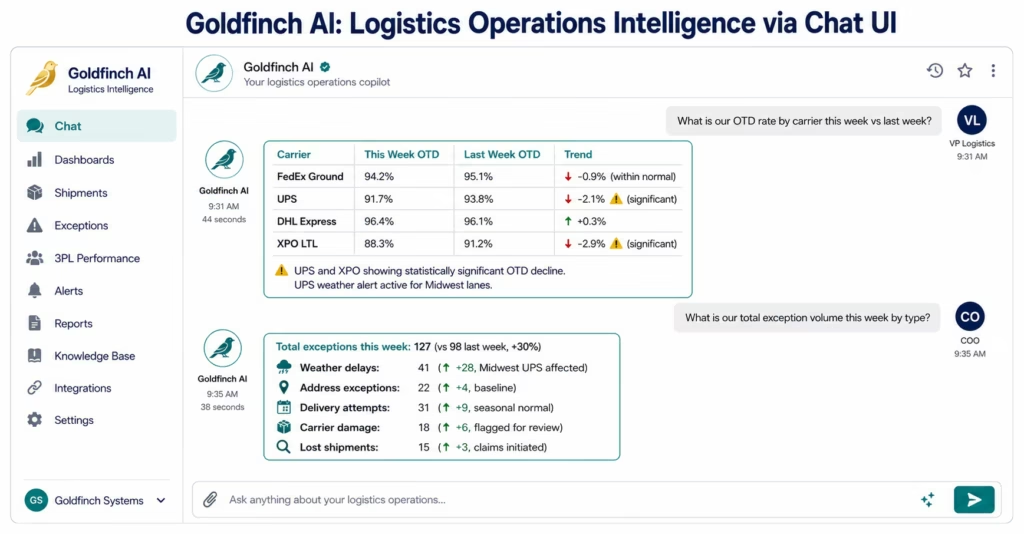
Operations intelligence via Chat UI:
VP of Logistics: “What is our on-time delivery rate by carrier this week, and which carriers are trending worse than last week?”
Goldfinch AI dispatches a carrier performance agent that queries TMS shipment data, calculates OTD rate by carrier, runs week-over-week comparison, and identifies statistically significant declines. Formatted answer with carrier ranking and trend flags in under 60 seconds.
COO: “What is our total exception volume this week versus last week, and which exception types are increasing?”
Goldfinch AI queries the exception log across all carriers and WMS instances, runs the comparison analysis, and returns a breakdown by exception type with trend direction. 45 seconds.
VP of Supply Chain: “Which of our 3PLs have had SLA breaches in the last 30 days, and what is the total at-risk order value?”
Goldfinch AI queries the 3PL performance monitoring data, retrieves the affected order values from the ERP, and returns a ranked 3PL performance summary with financial exposure. 55 seconds.
Workflow Node: automated weekly operations brief:
Every Sunday night, the Goldfinch AI Workflow Node coordinates: a carrier performance agent, an exception volume agent, a 3PL SLA compliance agent, and an inventory health agent. The coordinator synthesises findings into a structured Monday operations brief for the logistics team: delivered before the first shift starts, without requiring anyone to request it.
Key Outcomes and Results
Logistics organisations deploying AI agents across shipment exception, carrier claims, inventory replenishment, and 3PL performance report measurable improvements within 45-75 days:
Shipment Exception Management:
- Per-exception investigation time: 20 minutes → 2 minutes (AI pre-investigation)
- Daily exception capacity per ops specialist: 15-20 exceptions → 80-100 exceptions
- Exception-to-resolution time: reduced by 60-70% through faster investigation
- Customer SLA breach rate: reduced by 20-35% through faster detection and reroute decisions
Carrier Claims:
- Per-claim assembly time: 45-60 minutes → 5 minutes (AI agent)
- Monthly claims filing rate: limited by assembly time → all eligible exceptions filed
- Claims documentation completeness: improved through systematic multi-system retrieval
- Claims recovery rate: 15-25% improvement from faster filing and more complete documentation
Inventory Replenishment:
- Per-exception investigation time: 15-20 minutes → 3 minutes
- Stockout events from parameter drift: reduced by 40-60% through continuous monitoring
- Safety stock accuracy: continuously validated versus periodically reviewed
- Parameter update cycle: from quarterly review to continuous agent monitoring
3PL Performance Monitoring:
- SLA breach detection lag: 30 days (monthly scorecard) → 48 hours (continuous agent)
- 3PL invoice variance identification: spot-check → systematic (100% of invoices checked)
- 3PL billing overpayment recovery: 1-2% of total 3PL spend identified as recoverable
Fulfilment Exception Resolution:
- Backorder resolution research time: 25-30 minutes → 3 minutes
- Returns disposition decision time: 15 minutes → 2 minutes
- Customer communication lead time: reduced as operations team works from pre-researched resolution options
Executive Intelligence:
- VP/COO report request-to-answer: 2-4 hours (analyst) → 30-60 seconds (Chat UI)
- Monday operations brief: manual assembly (1-2 hours) → automated (Workflow Node, Sunday night)
How to Get Started
Step 1: Choose your highest-volume exception type
Count the number of exceptions your operations team handles per day for each type: shipment delays, carrier damage/loss, inventory replenishment anomalies, 3PL SLA breaches, and fulfilment backorders. The type with the highest daily volume multiplied by the current investigation time per exception is your first AI agent deployment.
Step 2: Build your knowledge bases
AI agents are only as good as the knowledge they can search. Before deploying the Shipment Exception Agent: load your carrier SLAs and service guides into the carrier SLA knowledge base, and your carrier contracts into the carrier contract knowledge base. Before deploying the 3PL Agent: load your 3PL SLA agreements and rate cards. The Automation Hub templates include the knowledge base structures: you populate them with your organisation’s specific contracts and service guides.
Step 3: Import the AI agent template from the Automation Hub
Visit the Automation Hub and import the logistics AI agent template for your target exception type. Configure your carrier API connections (UPS, FedEx, DHL via the pre-configured carrier connectors), your WMS connection (Manhattan, Blue Yonder, SAP EWM, or other), and your ERP connection (SAP, Oracle, NetSuite).
Step 4: Calibrate confidence thresholds
Run the agent against a sample of real exceptions from the past 30 days. Compare agent resolution briefs against what your ops team actually did for those exceptions. Set the confidence threshold at the level where the agent’s recommendations align with experienced operations judgment. Exceptions below the threshold route to a human review queue with the agent’s partial investigation as context.
Step 5: Activate with dual-run validation
Run the AI agent alongside the existing manual process for two weeks. Operations specialists compare their manual investigation outcomes against the agent’s pre-investigation briefs for the same exceptions. Measure: how often does the agent’s recommended action match what the human decided? Track the override rate and adjust knowledge base content or thresholds based on discrepancies before full activation.
Import a logistics AI agent template from the Automation Hub and have your first logistics AI agent live within two weeks.
FAQs
Logistics AI agents are goal-directed autonomous systems that receive a specific exception goal such as investigating a delayed shipment, assembling a damage claim, or assessing an inventory anomaly. The agent uses enterprise tools to complete the investigation: querying carrier tracking APIs, reading logistics documents, searching SLA and contract knowledge bases, calculating financial impact, and routing pre-assembled resolution briefs to operations teams for final decision. Unlike rule-based workflows that follow predetermined steps, agents adapt their investigation based on what they discover. All processing runs within eZintegrations' SOC 2 Type II certified infrastructure with configurable human-in-the-loop gates before any action is taken.
Standard Automation Hub logistics AI agent templates typically go live in 10-14 days from import to production activation. Carrier API connection configuration for UPS, FedEx, and DHL takes 2-3 days. WMS and ERP connection configuration takes 2-3 days. Knowledge base population with carrier SLAs and contracts takes 2-3 days. Confidence threshold calibration against representative sample exceptions takes 2-3 days. Dual-run validation before full production activation takes 2-3 days. A full logistics AI agent programme covering shipment exceptions, carrier claims, 3PL monitoring, and fulfilment exceptions typically takes 8-14 weeks.
Yes. AI agent API Tool Call is pre-configured for UPS Tracking, Shipping, and Rating APIs; FedEx Track, Ship, and Rate APIs; DHL Express, eCommerce, and Freight APIs; USPS; XPO; Echo Global; and regional LTL carriers. Each carrier connector is pre-configured with the carrier's authentication scheme, rate limit handling, and the correct endpoint structure. The Watcher Tool is pre-configured with the standard carrier exception codes for each major carrier. For carriers not already in the API Catalog, the universal REST connector supports any carrier with a REST tracking API.
AI workflows (Level 2) handle high-volume, consistent logistics inputs with AI embedded at specific processing steps. For example, a carrier invoice arrives, Document Intelligence extracts the fields, LLM Classification categorises the variance type, and the workflow routes it according to predefined logic. AI agents (Level 3) handle complex exceptions requiring adaptive investigation. A Shipment Exception Agent receives an exception and independently decides which sources to query and in what order based on what it discovers: adjusting its investigation if it finds a weather event, customer SLA commitment, or carrier intercept option. Workflows are optimised for predictable high-volume processing; agents are designed for exception investigation requiring multi-source reasoning.
No, by design. Every eZintegrations logistics AI agent includes a human-in-the-loop gate before any external action such as submitting an intercept request, filing a carrier claim, updating a replenishment parameter, or initiating a 3PL credit claim. The agent investigates and assembles the recommendation package; the operations specialist reviews and authorises the action. If the agent's confidence falls below the configured threshold, the case routes to a human review queue instead of the standard operations queue. This governance model reflects logistics risk management best practices and preserves accountability for consequential operational decisions.
Goldfinch AI provides two executive interfaces for logistics operations. The Chat UI supports natural language queries answered from live TMS, WMS, and ERP data in under 60 seconds, such as 'What is our OTD rate by carrier this week?' or 'Which 3PLs have had SLA breaches this month?' The Workflow Node runs scheduled intelligence programmes autonomously: for example, a Sunday-night coordinator dispatches parallel worker agents across carrier performance, exception volume, 3PL SLA compliance, and inventory health data, then synthesises the findings into a Monday morning operations intelligence brief. Both interfaces operate within eZintegrations' governance framework with full audit trails for every query and workflow execution.1. How do AI agents work in logistics operations?
2. How long does it take to set up a logistics AI agent?
3. Does eZintegrations work with UPS, FedEx, DHL, and other carrier APIs for AI agent investigation?
4. What is the difference between a logistics AI workflow and a logistics AI agent?
5. Can logistics AI agents operate without human approval before taking action?
6. How does Goldfinch AI work for logistics executive reporting?
Conclusion: Operations Teams That Investigate Less, Decide More
The most expensive resource in a logistics operation is not warehouse space or carrier rates. It is the time your operations specialists spend assembling information before they can make a decision. Every exception investigation that takes 20 minutes when the decision itself takes 2 minutes represents a 10-to-1 inefficiency ratio between information gathering and judgment.
AI agents for logistics do not replace the decisions. They eliminate the information gathering that precedes them.
The Shipment Exception Agent delivers a complete investigation brief before the ops manager touches the exception. The Carrier Claims Agent assembles the full documentation package before the logistics manager opens the claim. The 3PL Performance Agent surfaces an SLA breach pattern 28 days before the monthly scorecard would have shown it. The Fulfilment Agent maps all backorder resolution paths before the customer service rep gets on the phone.
The ops manager still decides whether to intercept or hold. The logistics manager still reviews and submits the claim. The customer service rep still speaks with the customer. The agent handles the 18 minutes that should never have been human work.
eZintegrations deploys these agents with the enterprise architecture logistics operations require: SOC 2 Type II certified infrastructure : and for pharmaceutical or healthcare supply chain organisations where shipment data includes patient or prescription information, HIPAA-compliant integration with a signed BAA is also available, configurable human-in-the-loop gates, confidence-based escalation, immutable audit trails, and pre-built carrier and WMS API connections ready to activate from Automation Hub templates.
Import a logistics AI agent template from the Automation Hub and have your first logistics AI agent live within two weeks.
Book a free demo and bring your highest-volume exception type. We will show you what an AI agent investigation looks like for your specific carrier and WMS environment.