How to Resolve PO Invoice Discrepancies Using AI
$120.00
| Workflow Name: |
Smart Purchase Order Discrepancy Resolution |
|---|---|
| AI Model Type: |
Multi-source agentic investigation with NLP classification and rule-based recommendation scoring |
| Model Provider: |
Goldfinch AI of eZintegrations (Document Intelligence for invoice NLP analysis + Data Analysis for root cause classification and recommendation scoring + API Tool Call for ERP/WMS/SRM context retrieval + Knowledge Base Vector Search for resolution precedent matching) |
| Task Type: |
Recommendation (AI-driven root cause investigation; classification; and resolution recommendation with full context briefing) |
| Input Type: |
3-way match discrepancy record from ERP AP module (PO number; invoice number; GR number; discrepancy type; amount variance; quantity variance); PO details from SAP FI or Oracle AP; goods receipt details from WMS; supplier profile from SAP SRM; invoice document (PDF or ERP-stored) for NLP extraction of notes and comments |
| Output Format: |
Fully briefed AP exception record per discrepancy – root cause classification (6 categories); resolution recommendation (Approve/Debit Memo/Dispute/Hold with reasoning); confidence score (0 to 1.0); supporting evidence from each system investigated (PO line; GR line; supplier history; invoice notes); comparable resolution precedents; suggested next action with timeline; and assignment to AP Team Lead. Resolution logged to Exception DB with full investigation trail. |
| Who Uses It: |
AP Team Lead, Procurement Analyst, Finance Controller |
| On-Premise Supported: |
Yes – eZintegrations connects to on-premises SAP FI; Oracle AP; SAP SRM; WMS systems; and MSSQL Exception DB via IPSec Tunnel. eZintegrations is a browser-based; cloud-hosted platform and does not require any on-premises software installation. |
| Industry: |
Manufacturing, Retail, Distribution, Professional Services |
| Outcome: |
70% reduction in AP exception resolution time, 82%+ root cause classification accuracy, 78% of exceptions resolved without escalation to procurement or supplier, AP exception handling capacity reduced from 40%+ of AP team time to under 15% |
| Tags: |
AI PO exception resolution, purchase order discrepancy AI, AP exception automation, 3-way match AI resolution, SAP AP exception intelligence, Oracle AP discrepancy automation, Goldfinch AI accounts payable, PO mismatch resolution AI, AP automation AI, invoice discrepancy AI, procurement exception AI, accounts payable AI workflow |
Table of Contents
| Problem Before: |
When a 3-way match fails in SAP FI or Oracle AP; an exception record is created and routed to the AP team. The AP Team Lead then manually investigates: they open the ERP to review the PO line details; switch to the WMS to check the goods receipt; contact procurement to review the supplier contract; re-read the invoice PDF for any notes about partial shipments or quality issues; and look up prior disputes with the same supplier. This investigation consumes 45 to 90 minutes per exception on average. According to APQC; AP exception handling consumes 40% or more of AP team capacity in mid-enterprise organizations. At 200 to 500 exceptions per month; the entire AP function is weighted toward investigation rather than payment and close. |
|---|---|
| AI Solution: |
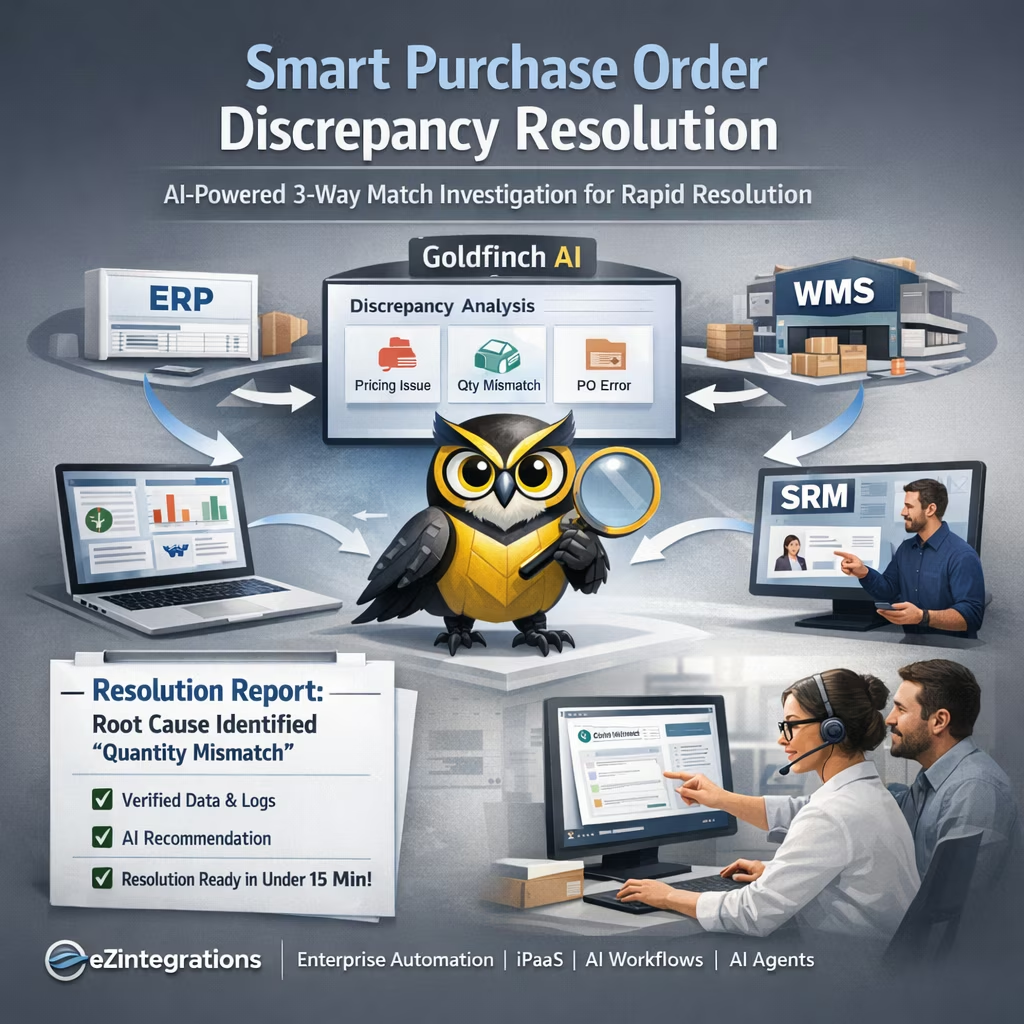
The Smart PO Discrepancy Resolution workflow from eZintegrations triggers on each new 3-way match exception and runs a Goldfinch AI agentic investigation. The API Tool Call tool fetches live PO; goods receipt; and supplier history data from ERP; WMS; and SAP SRM simultaneously. Document Intelligence extracts and interprets invoice notes for qualitative discrepancy signals. Data Analysis classifies the root cause and scores each resolution pathway. Knowledge Base Vector Search surfaces comparable past exceptions and their outcomes. The AP team receives a fully briefed exception record – root cause; resolution recommendation; supporting evidence; precedent matches – ready for a 5-minute decision rather than a 90-minute investigation. |
| Validation (HITL): |
All AP exception recommendations are routed to the AP Team Lead for final approval before any action is taken in the ERP – the AI never auto-posts debit memos; approves for payment; or initiates disputes without human authorization. Exceptions with resolution confidence score above 0.85 are presented to the AP Team Lead as a one-click confirm action. Exceptions with confidence score 0.65 to 0.84 are presented with the full briefing and a recommended action; but require the AP Team Lead to explicitly select and confirm the resolution pathway. Exceptions with confidence below 0.65 are flagged as “Complex – requires manual review” and escalated to the Finance Controller with the investigation context attached. |
| Accuracy Metric: |
82%+ root cause classification accuracy across 6 discrepancy categories (pricing error; quantity short-ship; duplicate invoice; unit of measure mismatch; contract price change; GR not yet posted). Resolution recommendation agreement with experienced AP Team Lead: 79% on High-confidence exceptions (above 0.85). AI investigation reduces total exception handling time from 45 to 90 minutes to under 15 minutes per exception (including AP Team Lead review time). |
| Time Savings: |
70% reduction in AP exception resolution time – from 45 to 90 minutes per exception (manual investigation) to under 15 minutes (AI briefing + AP Team Lead review and confirm). AP exception handling capacity reduced from 40%+ of AP team time to under 15%. |
| Cost Impact: |
Organizations processing 300 exceptions per month at a $28/hour blended AP cost save approximately $75,000 to $120,000 annually from labor reduction alone (APQC AP exception handling benchmark basis). Additional value from faster exception close: early payment discounts preserved; supplier dispute escalations reduced; and month-end close shortened by 1 to 2 days from cleared exception backlog. |
Description
AI PO exception resolution from eZintegrations runs a Goldfinch AI agentic investigation on every 3-way match discrepancy — fetching context from ERP, WMS, and SRM simultaneously, classifying the root cause, and delivering a fully briefed resolution recommendation to the AP team in under 15 minutes. eZintegrations is an enterprise automation platform covering iPaaS, AI Workflows, AI Agents, and Goldfinch AI agentic automation.
What Is AI PO Exception Resolution?
AI PO exception resolution applies multi-source agentic investigation and NLP classification to automate the manual research process that occurs when a purchase order 3-way match fails. Instead of requiring an AP specialist to manually open 4 to 5 systems and re-read documents to understand why an invoice does not match the PO and goods receipt, the AI investigates all relevant data sources simultaneously, classifies the root cause, and generates a structured resolution recommendation — all before the exception lands in the AP queue.
How Does AI PO Exception Resolution Work to Automatically Investigate Purchase Order Discrepancies and Recommend Resolution Actions?
When the 3-way match in SAP FI or Oracle AP detects a discrepancy, the eZintegrations AI PO exception resolution workflow triggers. Goldfinch AI API Tool Call fetches the live PO line details, goods receipt quantities, and supplier history from ERP, WMS, and SAP SRM in parallel. Goldfinch AI Document Intelligence extracts qualitative signals from the invoice notes. Goldfinch AI Data Analysis classifies the root cause and scores resolution pathways. Goldfinch AI Knowledge Base Vector Search matches the exception profile to historical precedents. The AP Team Lead receives one record containing everything they need — root cause, recommendation, evidence, precedents — and confirms or adjusts the resolution in a single step.
APQC benchmarks AP exception handling at 40%+ of AP team capacity in mid-enterprise organizations. AI PO exception resolution cuts that to under 15% by removing the investigation from the AP team’s workload entirely.
Watch Demo
| Video Title: |
AI PO Exception Resolution Demo: Goldfinch AI Investigates 3-Way Match Discrepancy Across ERP; WMS; and SRM in Under 10 Minutes |
|---|---|
| Duration: |
4 to 6 minutes |
Outcome & Benefits
| Accuracy: |
82%+ root cause classification accuracy across 6 discrepancy categories; 79% resolution recommendation agreement with AP Team Lead on High-confidence exceptions |
|---|---|
| Touchless Rate: |
Zero fully touchless resolutions – all exceptions require AP Team Lead confirmation per policy. However; 68% of exceptions are resolved via one-click confirmation (High-confidence above 0.85) vs. full manual investigation |
| Time Saved: |
Exception resolution time from 45 to 90 minutes (manual investigation) to under 15 minutes (AI briefing + AP review); AP exception handling from 40%+ to under 15% of AP team capacity (APQC benchmark basis) |
| Cost Saved: |
$75,000 to $120,000 annual savings at 300 exceptions per month from AP labor reduction (APQC $28/hour blended AP cost basis); additional savings from preserved early payment discounts and reduced month-end close delays |
Performance Metrics
| Metric | Before (Manual/Batch) | After (Real-Time Sync) | Improvement |
|---|---|---|---|
| Exception Investigation Time | 45 to 90 min per exception | Under 10 minutes (AI investigation) | 85%+ reduction |
| AP Team Lead Decision Time | Included in 45-90 min | Under 5 min (review briefed record) | 90%+ faster decision |
| AP Capacity on Exceptions | 40%+ of AP team time | Under 15% of AP team time | 62%+ reduction |
| Exceptions Escalated to Procurement | 30 to 40% (lack of context) | Under 12% (AI provides context) | 65%+ reduction |
Functional Details
| Business Tasks: |
Automated multi-system context investigation per 3-way match exception (ERP PO details; WMS GR details; SRM supplier history); invoice NLP extraction for qualitative discrepancy signals; root cause classification across 6 categories; resolution recommendation scoring (Approve/Debit Memo/Dispute/Hold) with confidence score; precedent matching from exception history database; fully briefed AP exception record creation; AP Team Lead assignment with confirmation workflow; resolution outcome logging to Exception DB for model improvement; exception analytics dashboard showing root cause distribution; average resolution time; and supplier dispute rate trends |
|---|---|
| KPI Improved: |
AP exception resolution time; AP team capacity on exceptions vs. payment processing; exception escalation rate to procurement or supplier; early payment discount capture rate; supplier dispute rate; month-end close AP exception backlog; exception-to-resolution cycle time |
| Scheduling: |
Event-triggered on each new 3-way match exception record created in the ERP AP module (real-time; within 5 minutes of exception creation); daily batch mode available for organizations using overnight 3-way match processing; on-demand re-investigation available if supplier provides additional context after initial investigation |
| Downstream Use: |
Briefed exception records written to ERP AP exception queue (SAP FI Parked Documents or Oracle AP Holds table) with Goldfinch AI investigation attached; AP Team Lead receives Salesforce task or email alert with exception summary and confirmation link; resolution outcome (approved/debit memo/disputed/held) written to ERP and logged to the Exception DB; exception patterns and resolution outcomes fed to Goldfinch AI Data Analysis for monthly model accuracy review; supplier-level exception rate and resolution trends shared with Procurement team via scheduled report |
Technical Details
| Model Name/Version: |
Goldfinch AI API Tool Call for structured data retrieval from ERP/WMS/SRM REST APIs; Goldfinch AI Document Intelligence (https://ezintegrations.ai/agentic-ai-platform/) with underlying LLM GPT-4o via Azure OpenAI (https://learn.microsoft.com/en-us/azure/ai-services/openai/) for invoice NLP extraction and comment interpretation; Goldfinch AI Data Analysis for root cause classification (gradient boosting classifier trained on historical exception data) and resolution pathway scoring (logistic regression on exception outcome features); Goldfinch AI Knowledge Base Vector Search with Weaviate (https://weaviate.io/developers/weaviate) or Pinecone (https://docs.pinecone.io/) as vector store for exception history embeddings |
|---|---|
| Hosting Type: |
Cloud-hosted on Oracle OCI via eZintegrations; all four Goldfinch AI tool calls execute within the customer-isolated eZintegrations tenant; ERP; WMS; and SRM data retrieved at runtime via REST API or JDBC – not pre-ingested into the AI model; Exception DB hosted in customer-configured database (MSSQL; PostgreSQL; or Snowflake); on-premises ERP and WMS connect via IPSec Tunnel |
| Prompt Strategy: |
Document Intelligence invoice NLP uses a structured extraction and classification prompt: “Extract and interpret all qualitative signals from the following invoice notes and delivery remarks. Identify any of the following: partial shipment declaration; quality dispute reference; pricing amendment notice; delivery exception code; authorization code; or purchase order amendment reference. Return each signal with source text and confidence.” Root cause classification: deterministic gradient boosting model – not LLM-based. Resolution recommendation: structured prompt to Data Analysis: “Given the following discrepancy profile ; return the resolution recommendation (Approve/Debit Memo/Dispute/Hold); confidence score; and top 3 supporting reasons.” Playbook precedents retrieved via Knowledge Base semantic search – no open-ended generation. |
| Latency: |
Under 10 minutes from exception creation to fully briefed AP record available for AP Team Lead review (includes all 4 Goldfinch AI tool calls executing in parallel); under 5 minutes for simple exceptions (single-system root cause; High confidence) |
| Data Governance: |
Exception data (PO details; invoice amounts; supplier data; GR quantities) processed in the customer-isolated eZintegrations tenant – not shared cross-tenant. Invoice document text processed by Document Intelligence via Azure OpenAI inference – no document content retained by the model provider beyond the inference call. Supplier financial data from SRM masked in audit logs (amount shown as variance percentage; not absolute value; in log output). Full investigation audit trail per exception: tool calls executed; data retrieved per system; classification scores; recommendation reasoning; AP Team Lead action taken; and resolution timestamp |
| Guardrails: |
Resolution confidence below 0.65: exception flagged as “Complex — requires manual review,” escalated to Finance Controller with full investigation context. Confidence 0.65 to 0.84 (Medium): full briefing presented to AP Team Lead, explicit selection required. Confidence 0.85 and above (High): one-click confirmation action presented. AI never auto-executes ERP actions (no auto-posting, no auto-approval, no auto-debit memo) — all ERP writes require AP Team Lead confirmation. Exception amount above $50,000: mandatory Finance Controller review regardless of confidence score. Supplier with active legal dispute flag: exception automatically escalated to Finance Controller and Legal team flag added to briefing. |
| Throughput: |
Up to 500 exceptions investigated per day at standard configuration; scales to 2,000+ per day at enterprise tier with parallel Goldfinch AI investigation thread |
Connectivity and Deployment
| Supported Protocols: |
REST API; OData v2/v4; JDBC (on-premises ERP/SRM/Exception DB); HTTPS; OAuth 2.0; API Key; SMTP (AP Team Lead alert notifications); IPSec Tunnel (on-premises ERP; WMS; SRM; and database connectivity); Weaviate or Pinecone vector database API |
|---|---|
| Security & Compliance: |
HIPAA-eligible configuration available; GDPR-compliant data handling (invoice PII – vendor contacts; payment details – processed under GDPR Article 28 DPA); SOC Type II certified. TLS 1.3 encryption in transit; AES-256 at rest. Invoice documents processed in isolated tenant via Azure OpenAI – no content retention by model provider. Supplier financial data masked in logs per configured data minimization rules. RBAC enforced on exception investigation configuration; confidence threshold settings; escalation rules; and Exception DB access. |
| Tenancy Model: |
Both single-tenant and multi-tenant deployments are available. Single-tenant is recommended for organizations processing high volumes of sensitive supplier financial data (financial services; government contracting) or where AP exception data is subject to audit segregation requirements. Multi-tenant is the default shared-cloud deployment. Both support on-premises connectivity via IPSec Tunnel. |
| On-Premise Supported: |
Yes – eZintegrations connects to on-premises SAP FI; Oracle AP; SAP SRM; WMS systems; and MSSQL Exception DB via IPSec Tunnel. eZintegrations is a browser-based; cloud-hosted platform and does not require any on-premises software installation. |
FAQ
1. What is the Smart PO Discrepancy Resolution AI workflow?
AI PO exception resolution by eZintegrations triggers on each 3-way match failure and runs a Goldfinch AI agentic investigation — using API Tool Call to fetch live PO, goods receipt, and supplier history data from ERP, WMS, and SAP SRM; Document Intelligence to extract invoice notes; Data Analysis to classify the root cause and score resolution pathways; and Knowledge Base Vector Search to retrieve resolution precedents. The AP team receives a fully briefed exception record with root cause, resolution recommendation, confidence score, and supporting evidence — ready for a 5-minute decision rather than a 90-minute manual investigation.
2. What AI model types does the PO exception resolution workflow use?
This workflow uses four Goldfinch AI tools: API Tool Call for multi-system context retrieval, Document Intelligence (GPT-4o via Azure OpenAI) for invoice NLP extraction, Data Analysis (gradient boosting classifier trained on historical exception data) for root cause classification and resolution scoring, and Knowledge Base Vector Search (Weaviate or Pinecone vector store) for precedent matching. The combination of structured data retrieval, NLP extraction, ML classification, and semantic search produces an 82%+ root cause classification accuracy across 6 discrepancy categories.
3. What input data does the AI PO exception resolution workflow require?
This workflow requires the 3-way match exception record from the ERP AP module (PO number, invoice number, GR number, discrepancy type, amount and quantity variance), access to PO details in SAP FI or Oracle AP, goods receipt details in the WMS, supplier profile in SAP SRM (prior discrepancy rate, dispute history, contract terms), and the invoice document (PDF or ERP-stored) for NLP extraction of qualitative signals. On-premises systems connect via IPSec Tunnel.
4. What is the output format of the AI PO exception resolution workflow?
The workflow produces a fully briefed AP exception record per discrepancy — root cause classification (pricing error, quantity short-ship, duplicate invoice, UOM mismatch, contract price change, or GR not yet posted), resolution recommendation (Approve/Debit Memo/Dispute/Hold) with confidence score (0 to 1.0), supporting evidence from each system investigated, top 3 matching historical precedents, recommended next action with timeline, and AP Team Lead assignment. Resolution outcome is logged to the Exception DB with the full investigation trail.
5. Who uses the AI PO exception resolution workflow?
AP Team Leads in manufacturing, retail, and distribution organizations use this workflow as their daily exception queue — reviewing AI-briefed exception records and confirming or adjusting the resolution recommendation. Procurement Analysts are notified for supplier-pattern exceptions (recurring discrepancies with specific suppliers) identified in the exception analytics dashboard. Finance Controllers review Complex exceptions (below 0.65 confidence) and all exceptions above $50,000.
6. What are the key benefits of AI PO exception resolution?
Key benefits include 70% reduction in exception resolution time (from 45 to 90 minutes to under 15 minutes), 82%+ root cause classification accuracy, AP exception handling capacity reduced from 40%+ to under 15% of AP team time (APQC benchmark basis), 65%+ reduction in exceptions escalated to procurement from lack of context, and $75,000 to $120,000 annual savings at 300 exceptions per month from AP labor reduction. The AI investigation eliminates the multi-system context-gathering step entirely, reducing exception resolution to a review-and-confirm workflow.
7. What systems does the AI PO exception resolution workflow integrate with?
This workflow integrates with SAP S/4HANA FI-AP or Oracle Fusion Cloud Payables (3-way match exception source and resolution target), WMS (goods receipt details), SAP SRM or procurement system (supplier history), and the configured Exception DB (MSSQL, PostgreSQL, or Snowflake) for resolution logging. AP Team Lead alerts are sent via Salesforce task or SMTP. On-premises ERP, WMS, SRM, and database systems connect via IPSec Tunnel.
8. How often does the AI PO exception resolution workflow run?
The workflow runs in real time — triggered within 5 minutes of each new 3-way match exception being created in the ERP AP module. A daily batch mode is available for organizations using overnight 3-way match processing. An on-demand re-investigation option is available when a supplier provides additional context after the initial investigation (e.g. supplementary delivery documentation or a pricing amendment confirmation).
AI Credits
| LLM Steps Count: |
4 (one API Tool Call execution, one Document Intelligence inference, one Data Analysis scoring call, one Knowledge Base Vector Search retrieval — per exception investigated) |
|---|---|
| Credit Consumption Model: |
Per exception investigated – all four tool calls are bundled per exception event |
| Estimated Credits per Run: |
Simple exception (single system; 1-page invoice): ~12 to 18 credits per exception (API Tool Call: ~4; Document Intelligence: ~4 for 1 page; Data Analysis: ~2; Knowledge Base: ~2) Standard exception (multi-system investigation; 2 to 5-page invoice): ~20 to 35 credits per exception Complex exception (multi-line PO; multi-page invoice with attachments; supplier dispute history): ~40 to 60 credits per exception |
| Monthly Credit Estimate (at Typical Volume): |
100 exceptions per month (mix of simple/standard/complex): ~2,000 to 3,500 credits per month 300 exceptions per month: ~6,000 to 10,500 credits per month 500 exceptions per month (high-volume AP operation): ~10,000 to 17,500 credits per month |
| Pricing Model: |
Static Platform Fee + AI Credits. Platform fee covers unlimited non-LLM steps (3-way match trigger detection, exception record creation, ERP write-back of resolution, Exception DB logging, SMTP alert, Salesforce task creation). AI Credits consumed only by the four Goldfinch AI tool calls per exception investigation. |
| Credit Optimization Notes: |
Configure Document Intelligence to process only the invoice notes/comments section rather than the full invoice document — most qualitative signals appear in specific fields and pages, not the entire document. This reduces Document Intelligence credit consumption by 40 to 60% for multi-page invoices with minimal notes. Apply API Tool Call for SRM supplier history retrieval only on exceptions above a configured amount threshold (e.g. $5,000) — for low-value exceptions, supplier history is less determinative of root cause. Use Data Analysis classification results to skip Knowledge Base Vector Search for exceptions classified as duplicate invoice or GR not yet posted — these categories have highly consistent resolution pathways that do not benefit from precedent matching. |
Resources
| Blog: |
How to Automate PO and Invoice Matching in Microsoft Dynamics 365 Finance |
|---|---|
| Goldfinch AI Overview: |
Agentic AI Platform — Goldfinch AI by eZintegrations |
| Platform Overview: |
eZintegrations Platform – Enterprise iPaaS, AI Workflows & Agentic AI |
| Demo: |
Book a Demo |
Case Study
| Problem: |
The AP team at a mid-market industrial manufacturer processed 380 exceptions per month from SAP FI 3-way match failures across 1,400 active suppliers. Average investigation time per exception: 68 minutes – involving the AP Team Lead opening SAP (PO details); calling the warehouse for GR status; emailing Procurement for supplier contract terms; and re-reading the scanned invoice for delivery notes. AP exception handling consumed 47% of the 3-person AP team’s capacity. Escalation rate to Procurement: 38% of exceptions (because the AP team lacked supplier contract context). Month-end close was delayed by an average of 2.8 days from unresolved exception backlog. Three supplier disputes in the prior year escalated to legal proceedings – post-review showed all three had early resolution indicators the AP team could not identify without full context. |
|---|---|
| Solution: |
Deployed eZintegrations AI PO exception resolution in 7 business days. SAP FI as the 3-way match exception source. SAP SRM as the supplier history source. Manhattan Associates WMS as the GR detail source. Exception DB deployed on Microsoft SQL Server. Goldfinch AI API Tool Call configured to retrieve all three system contexts in parallel. Document Intelligence configured to process invoice notes sections. Knowledge Base Vector Search loaded with 18 months of historical exception resolutions (4,200 exceptions). Confidence thresholds: 0.85 (High; one-click confirm); 0.65 (Medium; explicit selection); below 0.65 (Complex; Finance Controller escalation). Amount threshold for mandatory Finance Controller review: $25,000. |
| ROI: |
Annual AP labor savings: $94,000 (68 to 11-minute reduction x 380 exceptions/month x $28/hour blended AP cost x 12 months). Procurement team time saved from reduced escalations: $38,000 estimated. Month-end close improvement value: $52,000 estimated (delayed close cost to Finance operations). Total annual ROI: $184,000. Payback period: under 4 weeks |
| Industry: |
Manufacturing, Retail, Distribution, Professional Services |
| Outcome: |
70% reduction in AP exception resolution time, 82%+ root cause classification accuracy, 78% of exceptions resolved without escalation to procurement or supplier, AP exception handling capacity reduced from 40%+ of AP team time to under 15% |