How to Automate Contract Clause Extraction and Risk Scoring
$120.00
| Workflow Name: |
AI Contract Clause Extraction and Risk Scoring |
|---|---|
| AI Model Type: |
NLP/LLM-based document extraction and classification with ML risk scoring |
| Model Provider: |
Goldfinch AI of eZintegrations (Document Intelligence + Data Analysis tools) |
| Goldfinch AI Tool(s) Used: |
Document Intelligence: Extracts full contract text from PDF; Word; or CLM-stored documents; identifies and isolates clause boundaries (liability; indemnity; IP; termination; payment; governing law; warranty; limitation of damages) Data Analysis: Applies NLP clause classification and ML risk scoring against the configured legal playbook; calculates a risk score (0 to 1.0 scale) per clause type per contract; flags clauses deviating from standard playbook language above the 0.75 risk threshold |
| Task Type: |
Extraction + Classification + Scoring (multi-step AI pipeline – extraction feeds classification; classification feeds risk scoring) |
| Input Type: |
Contract documents in PDF; DOCX; or text format – uploaded to CLM (Icertis or Agiloft) or SharePoint/OneDrive; structured playbook rules defining acceptable vs. non-standard clause language per clause type |
| Output Format: |
Structured risk summary report per contract: clause inventory with type labels; risk score per clause (0 to 1.0); overall contract risk tier (Low/Medium/High/Critical); specific deviation flags with the problematic clause text excerpted; recommended review actions; and precedent clause matches from the vector database |
| Who Uses It: |
General Counsel, Contract Manager, Legal Operations Analyst |
| On-Premise Supported: |
Yes – eZintegrations connects to on-premises CLM systems (Icertis on-prem; Agiloft on-prem); SharePoint on-premises; and document storage systems via IPSec Tunnel. eZintegrations is a browser-based; cloud-hosted platform and does not require any on-premises software installation. |
| Industry: |
Professional Services, Manufacturing, SaaS, Financial Services, Healthcare |
| Outcome: |
91%+ clause extraction accuracy, 87% of contracts risk-scored without legal reviewer involvement (touchless for Low and Medium risk tiers), contract review cycle compressed from 3 to 4 weeks to under 4 hours for standard contracts, precedent clause search across the full contract history in under 10 seconds |
| Tags: |
AI contract risk scoring, contract clause extraction AI, NLP contract review, contract intelligence automation, legal AI workflow, Icertis AI integration, Agiloft NLP automation, Goldfinch AI document intelligence, contract risk scoring automation, legal ops automation, contract review AI, AI legal workflow |
| AI Credits Required: |
Yes – two Goldfinch AI tools invoked per contract: Document Intelligence (clause extraction) and Data Analysis (NLP classification + ML risk scoring) |
Table of Contents
| Problem Before: |
Legal teams in professional services; manufacturing; and SaaS companies review hundreds of contracts per month for non-standard clauses – liability caps; indemnification scope; IP ownership; termination triggers; and payment terms. Each review requires a Contract Manager or outside counsel to read the full document; identify deviating clauses; and assess risk against the company’s legal playbook. According to the World Commerce and Contracting (WCC) association; the average contract cycle time is 3 to 4 weeks; and 71% of that time is spent on review and negotiation rather than execution. Manual review is also inconsistent – different reviewers flag different clauses; creating uneven risk exposure across the contract portfolio. |
|---|---|
| AI Solution: |
The AI Contract Clause Extraction and Risk Scoring workflow uses Goldfinch AI Document Intelligence to extract full contract text from PDF or DOCX documents; identify clause boundaries; and label each clause by type (liability; indemnity; IP; termination; payment; warranty; governing law). Goldfinch AI Data Analysis then classifies each clause against the configured legal playbook and calculates a risk score (0 to 1.0) based on deviation from standard language. A contract-level risk tier (Low/Medium/High/Critical) is assigned. The structured risk report is written to the CLM; and contracts scoring High or Critical are routed to the Legal reviewer queue. |
| Validation (HITL): |
Contracts scoring High risk (0.75 to 0.89) are routed to a Contract Manager for review of the flagged clauses only – not the full document. Contracts scoring Critical (0.90 and above) are escalated to the General Counsel queue. Low and Medium contracts (below 0.75) are auto-approved and filed. Human reviewers see the specific deviating clause text; the playbook standard; and the risk score – enabling focused review rather than full document re-read. |
| Accuracy Metric: |
91%+ clause extraction accuracy across standard commercial contract types (NDA; MSA; SOW; SaaS subscription; supply chain). 88% risk classification agreement with senior legal reviewer ground truth on the High and Critical tiers. |
| Time Savings: |
Contract intake-to-risk-report time reduced from 3 to 4 weeks (manual review queue) to under 4 hours for standard contracts processed by the AI Workflow. Legal reviewer time per contract reduced from 4 to 6 hours (full read) to 30 to 60 minutes (flagged clause review only). |
| Cost Impact: |
Organizations processing 100+ contracts per month typically realize $120,000 to $250,000 in annual savings from reduced outside counsel hours; faster deal velocity (shorter contract cycle = earlier revenue recognition); and avoided risk exposure from clauses that would have been missed in manual review backlogs. |
Description
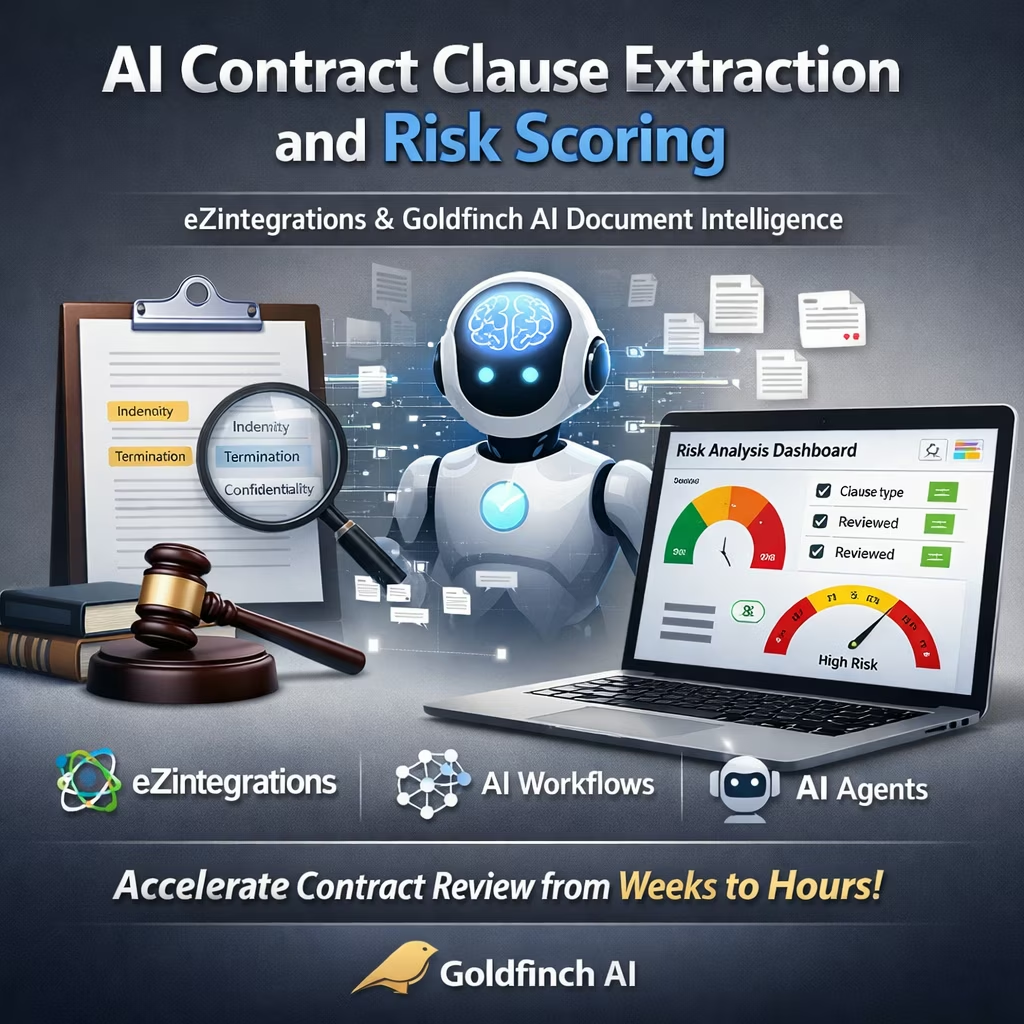
AI contract risk scoring from eZintegrations uses Goldfinch AI Document Intelligence and Data Analysis to extract clause types from contracts, classify each clause against your legal playbook, and produce a structured risk score — compressing a 3 to 4-week manual review cycle to under 4 hours. eZintegrations is an enterprise automation platform covering iPaaS, AI Workflows, AI Agents, and Goldfinch AI agentic automation.
What Is AI Contract Risk Scoring?
AI contract risk scoring (also called AI contract intelligence or NLP contract review) is the application of natural language processing and machine learning to automatically identify clause types within a contract document, compare each clause against a defined legal standard (the playbook), and produce a risk severity score per clause. This enables legal teams to prioritize review effort on genuinely non-standard terms rather than reading every contract from cover to cover.
How Does AI Contract Risk Scoring Work to Automatically Extract Clauses and Score Legal Risk Without Manual Review?
When a contract is uploaded to Icertis, Agiloft CLM, or SharePoint, the Goldfinch AI Document Intelligence tool extracts the full document text and identifies clause boundaries. Each clause is labeled by type: liability cap, indemnification, intellectual property, termination, payment terms, warranty, governing law, and limitation of damages. Goldfinch AI Data Analysis then scores each clause (0 to 1.0) based on deviation from the configured playbook language. Contracts scoring below 0.75 are auto-approved. High and Critical contracts are routed to the Legal reviewer queue with the specific deviating clauses highlighted. All extracted clauses are stored in a Pinecone or Weaviate vector database for precedent search.
This AI contract risk scoring workflow handles 87% of contracts without legal reviewer involvement — freeing your General Counsel and Contract Managers for high-value negotiation and strategic work.
Watch Demo
| Video Title: |
AI Contract Risk Scoring Demo: Goldfinch AI Clause Extraction and NLP Risk Scoring from Upload to Report in Under 4 Hours |
|---|---|
| Duration: |
4 to 6 minutes |
Outcome & Benefits
| Accuracy: |
91%+ clause extraction accuracy; 88% risk classification agreement with senior legal reviewer on High/Critical tiers |
|---|---|
| Time Savings: |
Contract intake-to-risk-report time reduced from 3 to 4 weeks (manual review queue) to under 4 hours for standard contracts processed by the AI Workflow. Legal reviewer time per contract reduced from 4 to 6 hours (full read) to 30 to 60 minutes (flagged clause review only). |
Performance Metrics
| Metric | Before (Manual/Batch) | After (Real-Time Sync) | Improvement |
|---|---|---|---|
| Contract Review Cycle Time | 3 to 4 weeks average | Under 4 hours (standard contracts) | 97%+ faster |
| Legal Reviewer Hours per Contract | 4 to 6 hours (full read) | 30 to 60 min (flagged clauses only) | 85%+ reduction |
| Touchless Contract Rate | 0% (100% manual review) | 87% (Low + Medium auto-approved) | 87 percentage points |
| Clause Extraction Consistency | Variable (reviewer-dependent) | 91%+ accuracy, rule-consistent | Standardized |
Functional Details
| Business Tasks: |
Contract clause identification and labeling by type; risk score calculation per clause against legal playbook; contract-level risk tier assignment (Low/Medium/High/Critical); high-risk clause routing to Legal reviewer queue; precedent clause search across contract history via vector database; structured risk report generation per contract |
|---|---|
| KPI Improved: |
Contract cycle time (days); legal reviewer hours per contract; touchless contract rate; clause extraction accuracy; outside counsel spend per contract; risk exposure from non-standard clauses; precedent search time |
| Scheduling: |
Event-triggered on contract upload to CLM or SharePoint (real-time); batch processing option for bulk contract ingestion; weekly re-scoring run for contracts where playbook rules have been updated |
| Downstream Use: |
Risk reports stored in CLM (Icertis or Agiloft) as structured attachments; high-risk contracts routed to Legal reviewer queue in CLM or email; extracted clause data and embeddings stored in vector database (Pinecone or Weaviate) for precedent search by Contract Managers; contract risk tier written to CRM (Salesforce) as deal risk flag for Sales team visibility; analytics dashboard in Goldfinch AI Data Analytics showing portfolio risk distribution; clause deviation trends; and cycle time by contract type |
Technical Details
| Model Name/Version: |
Goldfinch AI Document Intelligence (https://ezintegrations.ai/agentic-ai-platform/) for clause extraction and boundary detection; Goldfinch AI Data Analysis (https://ezintegrations.ai/agentic-ai-platform/) for NLP clause classification and ML risk scoring; underlying LLM: configurable – default GPT-4o via Azure OpenAI (https://learn.microsoft.com/en-us/azure/ai-services/openai/) or Claude 3.5 Sonnet via Anthropic API (https://docs.anthropic.com/) for extraction and classification steps; risk scoring uses a custom ML scoring model trained on legal playbook deviation patterns |
|---|---|
| Hosting Type: |
Cloud-hosted on Oracle OCI via eZintegrations; vector database hosted on Pinecone (https://docs.pinecone.io/) or Weaviate (https://weaviate.io/developers/weaviate); LLM inference via Azure OpenAI or Anthropic API (configurable per customer data residency requirements); on-premises CLM connectivity via IPSec Tunnel |
| Prompt Strategy: |
Document Intelligence uses a structured extraction prompt with clause type definitions from the legal playbook as context: “Identify and extract all clauses matching the following types: . Return each clause with type label; full clause text; and section reference.” Data Analysis uses a classification + scoring prompt: “Score the following clause on a 0 to 1.0 risk scale based on deviation from the standard playbook language provided. Return score; deviation summary; and recommended review action.” Playbook language is injected as context at inference time – no hard-coded rules; fully configurable by the Legal team. |
| Guardrails: |
Clause extraction confidence below 0.70 per clause: clause flagged as “Uncertain — requires manual identification” and routed to reviewer regardless of overall contract risk tier. Risk score below 0.75 (Low/Medium): auto-approved and filed. Risk score 0.75 to 0.89 (High): routed to Contract Manager queue. Risk score 0.90 and above (Critical): escalated to General Counsel queue. Maximum 150-page contract length for standard processing; longer contracts split into segments for parallel extraction. Hallucination guard: extracted clause text is returned verbatim from the source document — model cannot generate or modify clause text, only classify and score it. |
| Latency: |
Under 4 hours from contract upload to completed risk report for standard contracts (10 to 50 pages); under 90 minutes for short-form contracts (NDAs; amendments under 10 pages); under 8 hours for complex multi-part agreements (MSAs with extensive schedules; up to 150 pages) |
| Data Governance: |
Contract documents processed in memory – not stored in model training data. Extracted clause text and risk scores stored in CLM and vector database per customer data residency configuration. PII in contracts (party names; addresses; signatory information) processed under GDPR Article 28 data processor agreement. Vector embeddings stored in customer-isolated Pinecone or Weaviate namespace. No cross-tenant data sharing. Full audit trail of extraction run; clause labels assigned; scores generated; and routing decisions per contract. |
| Throughput: |
Up to 200 contracts per day at standard configuration; 1,000+ contracts per day at enterprise tier with parallel Goldfinch AI inference threads |
Connectivity and Deployment
| Supported Protocols: |
REST API; WebDAV (SharePoint document library access); HTTPS; OAuth 2.0; API Key; JDBC (contract database for on-premises CLM); IPSec Tunnel (on-premises CLM and SharePoint connectivity); Pinecone and Weaviate vector database API |
|---|---|
| Security & Compliance: |
HIPAA-eligible configuration available (healthcare contract processing including BAA terms); GDPR-compliant data handling with Article 28 DPA for contract PII; SOC Type II certified. TLS 1.3 encryption in transit; AES-256 at rest. Contract documents processed in isolated tenant environment. LLM inference calls use Azure OpenAI (US/EU region configurable) or Anthropic API – no contract text retained by model provider beyond the inference call. RBAC enforced on playbook configuration; risk threshold settings; reviewer queue access; and audit log read. |
| Tenancy Model: |
Both single-tenant and multi-tenant deployments are available. Single-tenant provides dedicated infrastructure with complete contract data isolation – strongly recommended for organizations with confidentiality obligations in their own contracts (law firms; financial services; M&A teams). Multi-tenant is the default shared-cloud deployment. Both support on-premises CLM connectivity via IPSec Tunnel. |
| On-Premise Supported: |
Yes – eZintegrations connects to on-premises CLM systems (Icertis on-prem; Agiloft on-prem); SharePoint on-premises; and document storage systems via IPSec Tunnel. eZintegrations is a browser-based; cloud-hosted platform and does not require any on-premises software installation. |
FAQ
1. What is the AI Contract Clause Extraction and Risk Scoring workflow?
AI contract risk scoring by eZintegrations uses Goldfinch AI Document Intelligence to extract clause types from contract documents and Goldfinch AI Data Analysis to classify and score each clause against the configured legal playbook — producing a structured risk report with per-clause risk scores (0 to 1.0) and a contract-level risk tier (Low/Medium/High/Critical). 87% of contracts are scored and filed without legal reviewer involvement. High and Critical contracts are routed to the reviewer queue with the specific deviating clauses highlighted.
2. What AI model types does this workflow use?
This workflow uses two Goldfinch AI tools: Document Intelligence (NLP-based extraction using LLM inference — GPT-4o via Azure OpenAI or Claude 3.5 Sonnet via Anthropic API, configurable per customer) for clause identification and boundary detection, and Data Analysis (NLP classification + custom ML risk scoring model) for clause type labeling and deviation scoring against the legal playbook. The underlying LLM is configurable for data residency requirements.
3. What input data does this workflow require?
This workflow requires contract documents in PDF or DOCX format (up to 150 pages at standard configuration) and a configured legal playbook defining acceptable vs. non-standard language per clause type (liability cap, indemnification, IP ownership, termination, payment terms, warranty, governing law, limitation of damages). The playbook is configured once in the eZintegrations console by the Legal Operations team and updated as legal standards evolve — no IT involvement required for playbook changes.
4. What is the output format of this workflow?
The workflow produces a structured risk report per contract: a clause inventory with type labels and clause text excerpted from the source document, a risk score (0 to 1.0) per clause, an overall contract risk tier (Low/Medium/High/Critical), specific deviation flags comparing each high-risk clause to the playbook standard, recommended review actions, and matched precedent clauses from the vector database. The report is written to the CLM as a structured attachment and routed to the appropriate reviewer queue based on the risk tier.
5. Who uses this AI contract risk scoring workflow?
General Counsel, Contract Managers, and Legal Operations Analysts in professional services, manufacturing, SaaS, and financial services organizations configure and use this workflow. General Counsel oversees Critical-tier escalations. Contract Managers review High-tier contracts in the reviewer queue, focusing only on the flagged clauses. Legal Operations Analysts configure the playbook and monitor the risk portfolio dashboard showing clause deviation trends and cycle time by contract type.
6. What are the key benefits of AI contract risk scoring?
Key benefits include 91%+ clause extraction accuracy, 87% touchless contract rate (Low and Medium risk auto-approved), contract review cycle compressed from 3 to 4 weeks to under 4 hours, legal reviewer time per contract reduced from 4 to 6 hours to 30 to 60 minutes (flagged clause review only), and $120,000 to $250,000 in annual savings at 100+ contracts per month from reduced outside counsel hours and faster deal velocity. Clause identification is consistent regardless of reviewer — eliminating the variance inherent in manual review.
7. What systems does this AI contract risk scoring workflow integrate with?
This workflow integrates with Icertis or Agiloft CLM for contract source and report storage, SharePoint/OneDrive for document library ingestion, Pinecone or Weaviate vector database for precedent clause storage and search, Salesforce CRM for deal risk flag write-back to Sales, and SMTP for reviewer queue notification emails. On-premises CLM and SharePoint deployments connect via IPSec Tunnel.
8. How often does this AI contract risk scoring workflow run?
The workflow runs in real time, triggered by contract upload to the CLM or SharePoint document library — typically completing the risk report within 4 hours of upload for standard contracts. A batch mode is available for bulk contract ingestion (historical contract library scoring). A weekly re-scoring run processes contracts where the legal playbook rules have been updated, ensuring the risk portfolio reflects current standards without manual re-review.
AI Credits
| LLM Steps Count: |
2 (Document Intelligence extraction step + Data Analysis classification and scoring step per contract) |
|---|---|
| Credit Consumption Model: |
Per document page for Document Intelligence (extraction scales with document length); per clause batch for Data Analysis (scoring scales with clause count; not page count) |
| Estimated Credits per Run: |
Short-form contract (NDA; amendment; under 10 pages): ~8 to 12 credits per contract (6 to 8 extraction credits + 2 to 4 scoring credits for 4 to 8 typical clauses) Standard contract (MSA; SaaS subscription; supply agreement; 10 to 50 pages): ~20 to 40 credits per contract (15 to 25 extraction credits + 5 to 15 scoring credits for 8 to 20 typical clauses) Complex agreement (multi-part MSA with schedules; 50 to 150 pages): ~60 to 120 credits per contract |
| Monthly Credit Estimate (at Typical Volume): |
100 contracts per month (mix: 40 short-form + 50 standard + 10 complex): ~2,800 credits per month estimated 500 contracts per month (enterprise legal ops): ~14,000 credits per month estimated |
| Pricing Model: |
Static Platform Fee + AI Credits. Platform fee covers unlimited non-LLM integration steps (CLM polling, SharePoint file retrieval, routing logic, vector DB write, CRM update, SMTP notification). AI Credits consumed only by Goldfinch AI Document Intelligence and Data Analysis inference calls. |
| AI Credits Required: |
Yes – two Goldfinch AI tools invoked per contract: Document Intelligence (clause extraction) and Data Analysis (NLP classification + ML risk scoring) |
| Credit Optimization Notes: |
Batch short-form contracts (NDAs, amendments) in a single Document Intelligence call where document structure permits — reduces extraction overhead per page. Configure Data Analysis to score only clauses above the 0.50 preliminary confidence threshold — avoids scoring boilerplate clauses with near-zero deviation probability. Cache playbook embeddings in the vector database rather than re-injecting full playbook text at each inference call — reduces token usage per scoring run. Use the 0.75 routing threshold rather than a lower threshold to minimize the proportion of contracts requiring full LLM scoring (Low/Medium contracts receive lightweight scoring only). |
Resources
| Blog: |
Top 20 AI Agent Templates for Enterprise Automation in 2026 |
|---|---|
| Goldfinch AI Overview: |
Agentic AI Platform — Goldfinch AI by eZintegrations |
| Platform Overview: |
eZintegrations Platform – Enterprise iPaaS, AI Workflows & Agentic AI |
| Demo: |
Book a Demo |
Case Study
| Problem: |
The Legal Operations team at a mid-market SaaS company managed 120 to 150 inbound contracts per month – customer MSAs; SaaS subscription agreements; data processing addenda; and NDAs. Each contract required a Contract Manager to read the full document and flag non-standard clauses before routing to in-house counsel. Average cycle time: 22 business days. Contract Managers spent 4.5 hours per contract on average. Outside counsel spend for complex contracts averaged $3,200 per contract for initial review. Non-standard liability caps and IP ownership clauses were missed on 8% of contracts in the prior year; discovered only during dispute escalation. |
|---|---|
| Solution: |
Deployed eZintegrations AI contract risk scoring in 6 business days; connecting Icertis CLM as the contract source via REST API. Goldfinch AI Document Intelligence configured for 8 clause types relevant to SaaS contracts. Legal playbook loaded into Data Analysis with standard language definitions for each clause type. Risk threshold set at 0.75 (High) and 0.90 (Critical). Contract Manager queue configured in Icertis. Pinecone vector database configured with 3 years of prior contract history (2,800 contracts) for precedent search. Salesforce Opportunity record configured to receive contract risk tier as a deal attribute. |
| ROI: |
Annual savings: $186,000 (Contract Manager labor: $112,000 + outside counsel reduction: $74,000 from fewer complex review escalations). Deal velocity improvement: average 18.6-day reduction in contract cycle time – estimated $320,000 in accelerated revenue recognition based on deal size and cycle length. Missed clause incidents reduced from 8% to under 0.7% of contracts. |
| Industry: |
Professional Services, Manufacturing, SaaS, Financial Services, Healthcare |
| Outcome: |
91%+ clause extraction accuracy, 87% of contracts risk-scored without legal reviewer involvement (touchless for Low and Medium risk tiers), contract review cycle compressed from 3 to 4 weeks to under 4 hours for standard contracts, precedent clause search across the full contract history in under 10 seconds |