eZintegrations vs Informatica 2026: Modern AI-Native iPaaS vs Legacy Platform
April 29, 2026eZintegrations vs Informatica. eZintegrations beats Informatica on implementation speed (days vs months), AI-native automation (Level 2-4 built in, not licensed separately), ease of use for non-specialist teams (business users configure, not only Informatica-certified developers), and total cost of ownership (per-automation pricing vs Informatica’s capacity-based enterprise licensing). Informatica IDMC is a mature, deep platform for organisations with dedicated data integration teams managing complex enterprise data governance at scale. For enterprises that need modern AI-native automation without Informatica’s specialist overhead, licensing complexity, and multi-year implementation timelines, eZintegrations is the right alternative in 2026.
TL;DR
- Informatica is a mature, enterprise-grade data integration and management platform, as reflected in G2 Informatica vs eZintegrations reviews. Its depth in data governance, data quality, master data management (MDM), and large-scale ETL/ELT is genuine and well-earned. For organisations with dedicated Informatica teams and complex data governance mandates, it remains a credible choice.
- The evaluation question in 2026 is not whether Informatica is capable: it is whether the implementation complexity, specialist staffing requirement, multi-year deployment timelines, and licensing cost are proportionate to what your organisation actually needs.
- eZintegrations is built for the modern enterprise automation use case: AI-native workflows, autonomous AI agents, fast deployment using Automation Hub templates, and per-automation pricing that scales predictably without enterprise licensing negotiation.
- The organisations this comparison serves: IT leaders at mid-to-large enterprises who are evaluating Informatica for a new deployment, organisations reconsidering a current Informatica investment, and procurement teams that received an Informatica quote and need context for evaluating it.
- Verdict: Informatica for large enterprises with dedicated data governance teams, complex MDM requirements, and multi-year integration programmes. eZintegrations for enterprises that need modern AI-native automation, fast deployment, and accessible tooling without Informatica’s specialist overhead.
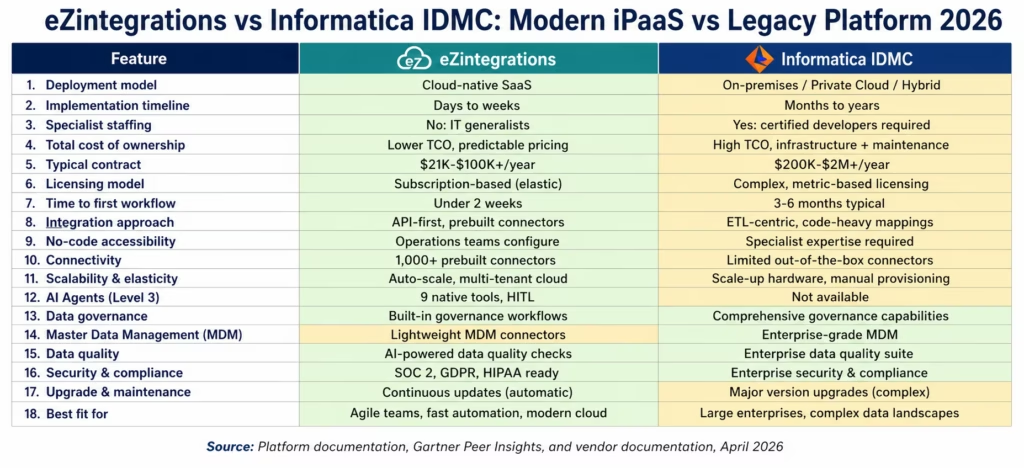
Summary Comparison Table (eZintegrations vs Informatica)
| Feature | eZintegrations | Informatica (IDMC) |
|---|---|---|
| Primary positioning | AI-native enterprise automation | Enterprise data management + integration |
| Pricing model | Per-automation ($90-$150/mo per workflow) | Capacity-based enterprise licensing |
| Typical contract size | $21,600-$100,000+/year | $200,000-$2,000,000+/year |
| Implementation timeline | Days to weeks (Automation Hub templates) | Months to years |
| Specialist staffing required | No: IT generalists and ops teams | Yes: Informatica-certified developers |
| Native AI Workflows (Level 2) | Yes: Document Intelligence, LLM | CLAIRE AI (data quality focus) |
| AI Agents (Level 3) | Yes: 9 native tools, HITL, confidence thresholds | Not available |
| Multi-agent orchestration (Level 4) | Yes: Goldfinch AI, Chat UI, Workflow Node | Not available |
| No-code for business users | Yes: operations teams configure | No: requires specialist expertise |
| Data governance and MDM | Basic: not a core strength | Comprehensive: core strength |
| Data quality management | Basic field validation | Deep: industry-leading |
| API integration (iPaaS) | Full: REST, GraphQL, WebSocket, Webhooks | Full: mature platform |
| Automation Hub templates | 1,000+ production-ready | Template library (partner-dependent) |
| ERP connectors | Native SAP, Oracle, NetSuite | Native: deep ERP support |
| Cloud-native architecture | Cloud-native | Hybrid: legacy origins, cloud evolution |
| HIPAA, SOC 2 Type II | All tiers | Enterprise (additional cost) |
| Time to first production workflow | Under 2 weeks | 3-6 months typical |
| Partner/services dependency | Low | High: typical SI partner required |
Introduction
Informatica has been one of the most recognisable names in enterprise data integration for over three decades. Its platform, now marketed as the Informatica Intelligent Data Management Cloud (IDMC), covers data integration, data quality, master data management, data governance, and API management.
When enterprise organisations think about serious data integration, Informatica is typically on the shortlist, as reflected in Gartner iPaaS Magic Quadrant and enterprise integration research.
The 2026 evaluation question is more nuanced than “is Informatica capable?” It clearly is. The question is: is Informatica the right tool for what your organisation actually needs to accomplish in the next two to three years, given the cost, the implementation complexity, the specialist staffing requirement, and the time to first production value?
In 2026, enterprise automation requirements have expanded to include AI-native workflow steps, autonomous AI agents, and multi-agent orchestration: capabilities that Informatica’s CLAIRE AI framework addresses partially (primarily through data quality and governance intelligence) but does not deliver in the form of autonomous enterprise AI agents.
This comparison is for IT leaders who are evaluating Informatica IDMC against modern alternatives, or who are reviewing an existing Informatica deployment and asking whether the platform is the right fit for a business that increasingly needs AI automation, fast deployment cycles, and accessible tooling alongside comprehensive data management.
Table of Contents
- The Informatica Reality: What It Does Well and What It Costs
- Implementation Complexity: Months vs Days
- AI Automation: CLAIRE vs Native Agents
- Ease of Use: Specialist Platform vs Operations-Accessible
- Total Cost of Ownership
- API Integration Depth
- Enterprise Governance and Compliance
- Who Should Choose Each Platform
- Detailed Feature Comparison
- Bottom Line Verdict
- FAQ
The Informatica Reality: What It Does Well and What It Costs
Before addressing the comparison, it is worth being specific about what Informatica does genuinely well. These are real strengths that explain why Informatica has Fortune 500 deployments:
Data governance at scale: Informatica’s data governance capabilities: lineage tracking, business glossary, data cataloguing, policy enforcement: are comprehensive and mature. For enterprises with regulatory mandates around data provenance (financial services, healthcare, energy), Informatica’s governance depth is a legitimate differentiator.
Master data management (MDM): Informatica MDM is one of the market’s leading solutions for golden record creation, entity resolution, and multi-domain master data management. If your primary challenge is managing a single authoritative record for customers, products, or suppliers across complex enterprise systems, Informatica MDM is a serious option.
Data quality: Informatica’s data quality capabilities: profiling, cleansing, standardisation, matching: are deep and supported by decades of development. CLAIRE AI adds intelligent data quality suggestions and automation.
Enterprise ERP depth: Informatica has mature connectors for SAP, Oracle, and other complex ERP systems developed over years of enterprise deployments.
These strengths are real. The comparison below is about the cost, complexity, and specialist overhead that come with these strengths: and whether those are proportionate to what your organisation needs.
Implementation Complexity: Months vs Days
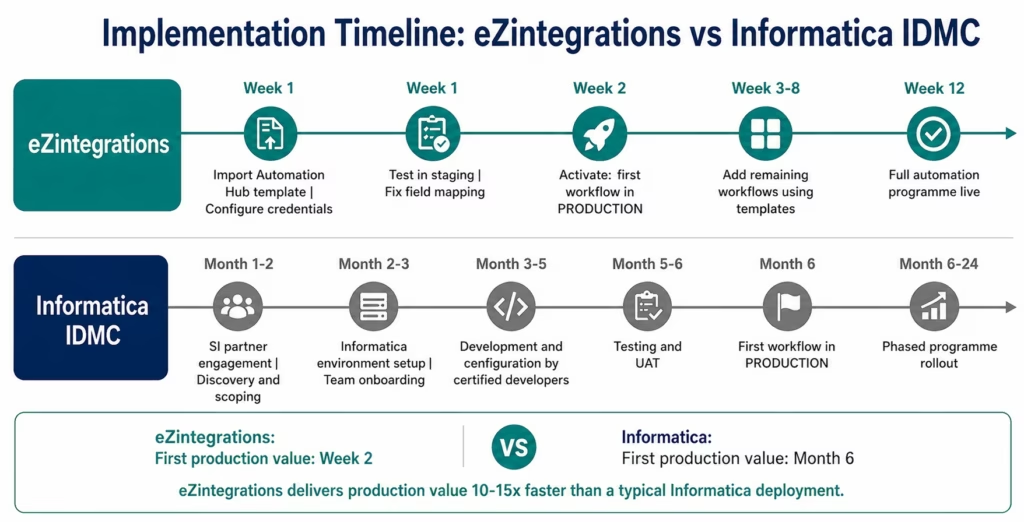
The verdict: Informatica implementations typically take months to years. eZintegrations Automation Hub templates go live in days to weeks.
Informatica is an enterprise platform with enterprise implementation complexity. Deploying Informatica IDMC for a meaningful integration programme typically involves:
- An SI (System Integrator) partner: Deloitte, Accenture, Wipro, Capgemini, or a specialised Informatica partner: required for most enterprise deployments
- A 3-6 month initial deployment phase for a scoped integration programme
- Informatica-certified developer resources, either hired or contracted
- An Informatica Professional Services engagement for complex deployments
- A phased rollout that defers production value for most integrations until Phase 2 or Phase 3
Customer reviews on Gartner Peer Insights consistently identify implementation complexity and time as primary challenges with Informatica. The platform’s power comes with a commensurate implementation cost.
Why implementation complexity matters in 2026:
Enterprise automation priorities move faster than multi-month implementation timelines allow. An AI agent for AP exception handling that could eliminate 60% of manual work in Q3 cannot wait for a 6-month Informatica deployment phase to complete. The business case for automation is time-sensitive; implementation velocity is a competitive factor, not just an operational preference.
eZintegrations’ implementation model:
The Automation Hub contains 1,000+ production-ready templates for enterprise integration pairs. For standard enterprise patterns (Salesforce-to-SAP, Workday-to-Active Directory, Stripe-to-QuickBooks, ServiceNow-to-PagerDuty), the path is: import the template, configure credentials, test, activate. Most standard templates go live in 3-10 days.
For custom integrations without a matching template, the REST API connector, webhook connector, or database connector with visual field mapping can typically go live in 1-3 weeks.
The first production workflow is live in the first week, not the third month. Business value accrues from week one.
Implementation cost comparison:
| Implementation Factor | eZintegrations | Informatica IDMC |
|---|---|---|
| SI partner required | No | Typically yes |
| Internal Informatica-certified staff required | No | Typically yes |
| Time to first production workflow | Under 2 weeks | 3-6 months |
| Full programme deployment | 4-12 weeks | 6-24 months |
| Professional services dependency | Low | High |
| Total implementation cost (estimate) | $15,000-$80,000 | $200,000-$2,000,000+ |
Informatica implementation cost estimates based on Gartner Peer Insights customer reviews and publicly available SI partner project data. Contact Informatica and your preferred SI partner for specific quotes.
AI Automation: CLAIRE vs Native Agents
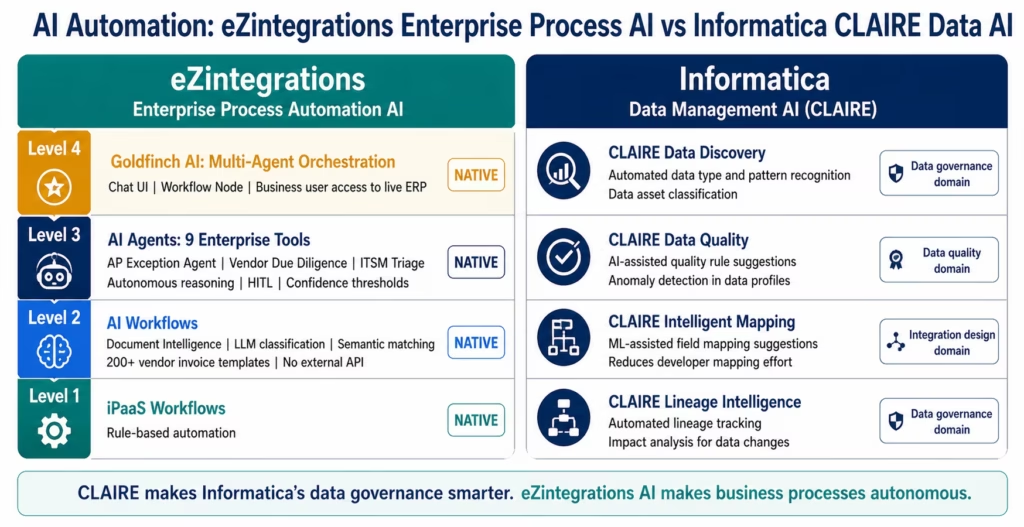
The verdict: Informatica’s CLAIRE AI is focused on data quality and governance intelligence. eZintegrations delivers native Level 2-4 AI for enterprise process automation.
What Informatica offers for AI:
Informatica’s CLAIRE AI engine is embedded throughout the IDMC platform. CLAIRE’s primary applications are:
- Intelligent data discovery: CLAIRE scans data assets and automatically identifies data types, patterns, and relationships
- Data quality recommendations: AI-assisted data quality rule suggestions based on profile analysis
- Intelligent mapping: ML-assisted field mapping suggestions during integration design
- Data lineage intelligence: automated lineage tracking and impact analysis
CLAIRE is a sophisticated AI layer focused on the data management domain: making Informatica’s data governance, quality, and cataloguing capabilities more intelligent and less manual.
What CLAIRE is not: a framework for deploying autonomous enterprise AI agents that process AP exception queues, run vendor due diligence, extract clinical document data, or orchestrate multi-agent workflows for business process automation. These are different use cases that require different AI architectures.
For enterprise process automation with AI: the use cases that are transforming AP, procurement, HR, customer operations, and quality management functions: Informatica’s CLAIRE provides limited assistance.
What eZintegrations provides:
Level 2 (AI Workflows): Document Intelligence runs as a native workflow node. It extracts structured data from invoice PDFs across 200+ vendor templates, validates extracted fields against ERP data, scores confidence, and routes exceptions. No external AI API. No data leaving the HIPAA/SOC 2 compliance boundary.
Level 3 (AI Agents): 9 native enterprise tools in one autonomous agent framework: Knowledge Base Vector Search, Document Intelligence, Data Analysis, Data Analytics with Charts/Graphs/Dashboards, Web Crawling, Watcher Tools, API Tool Call, Integration Workflow as Tool, and Integration Flow as MCP. Confidence thresholds, reflection loops, and human-in-the-loop gates are configurable without code.
Level 4 (Goldfinch AI): coordinator-worker multi-agent orchestration. The Chat UI gives business leaders natural language access to live enterprise data. The Workflow Node embeds multi-agent intelligence inside Level 1 automation processes.
The comparison is domain-specific: Informatica’s CLAIRE is better AI for data management tasks. eZintegrations’ AI is better for enterprise business process automation tasks. If your AI automation goal is improving data quality rules and cataloguing, CLAIRE adds value. If your goal is autonomous AP exception handling, vendor due diligence, contract clause extraction, or ITSM triage, eZintegrations’ Level 3 agents are the appropriate tool.
Ease of Use: Specialist Platform vs Operations-Accessible
The verdict: Informatica requires Informatica-certified specialists. eZintegrations is configurable by IT generalists and operations teams.
This is one of the most consequential differences for the total cost of ownership calculation. Informatica is a specialist platform. Configuring, managing, and maintaining Informatica deployments requires:
- Informatica-certified PowerCenter, IDMC, or MDM developers
- Familiarity with Informatica’s mapping designer, workflow manager, and repository manager
- Understanding of Informatica’s transformation library (Joiner, Aggregator, Lookup, Router, Sorter, Expression, and others)
- SI partner involvement for complex deployments
These skills are specialised and relatively rare in the job market. Informatica developer rates in North America typically run $120-$200/hour for contractors. Informatica-certified employees command significant salary premiums. The Informatica skills dependency creates both a cost and a key-person risk: when the Informatica developer leaves, institutional knowledge about how your integration programme works leaves with them.
Gartner Peer Insights consistently identifies “complexity” and “steep learning curve” as the top Informatica challenges in customer reviews. This is not a criticism of Informatica’s quality: it is an accurate description of the platform’s positioning as a specialist tool.
eZintegrations’ accessibility model:
eZintegrations is designed for IT generalists, operations managers, and business analysts with technical aptitude. The platform does not require:
- Certification or formal training programme completion
- Familiarity with a proprietary transformation library
- SI partner involvement for standard integrations
- Developer involvement for Automation Hub template deployments
An IT manager who can configure a Salesforce integration, manage API credentials, and read a JSON response can configure and maintain eZintegrations workflows. An AP manager can understand the execution log for an AP Exception Agent workflow and identify why a specific invoice failed to process.
This accessibility difference has a compounding operational effect: when the person who configured a workflow leaves the organisation, their replacement can understand what it does, modify it, and maintain it: because the workflow is documented in a readable visual canvas with plain-language execution logs.
Total Cost of Ownership
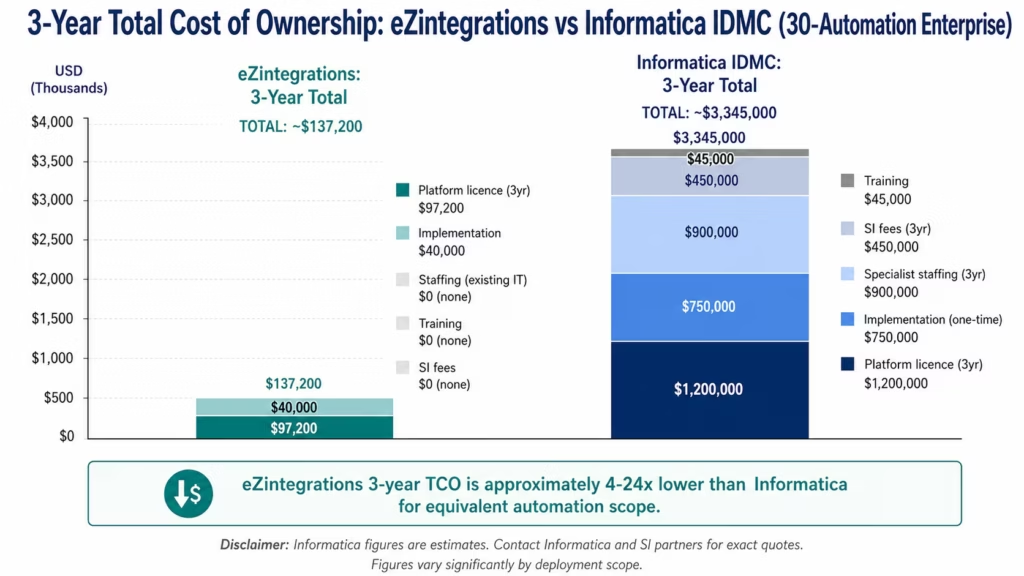
The verdict: eZintegrations TCO is a fraction of Informatica’s at equivalent automation scope. The comparison changes only for organisations with complex MDM and data governance mandates.
Enterprise technology buyers often compare Informatica and alternatives on licence cost alone, which understates the true comparison, as highlighted in Forrester Total Economic Impact of integration platforms.Informatica’s TCO includes:
Licence cost: Informatica IDMC is capacity-based enterprise licensing. Pricing is not publicly listed. Community-reported and analyst-cited figures suggest annual contracts typically start at $200,000-$500,000/year for mid-enterprise deployments and reach $1,000,000-$2,000,000+/year for large enterprise deployments with broad module usage.
Implementation cost: SI partner fees for Informatica deployments typically run $200,000-$1,500,000+ for a full enterprise integration programme. This is a one-time cost but a significant one.
Staffing cost: 1-2 dedicated Informatica developers at $120,000-$180,000/year each (fully loaded), or contractor fees at $120-$200/hour.
Training cost: Informatica certification and training programmes for new team members: $5,000-$20,000 per developer.
Maintenance cost: Ongoing Informatica environment management, version upgrades, and mapping maintenance.
The eZintegrations TCO:
- Platform licence: $90-$150/month per automation workflow. A 30-automation enterprise programme: $32,400/year.
- Implementation: Automation Hub templates reduce implementation cost dramatically. Typical total implementation cost for 30 automations: $20,000-$60,000 (internal IT + configuration time).
- Staffing: No specialist certification required. Existing IT team configures and maintains.
- Training: Platform onboarding (1-2 weeks). No formal certification programme.
- Maintenance: Platform-managed API updates. Minimal ongoing maintenance for standard Automation Hub templates.
3-year TCO comparison (30-automation enterprise programme):
| Cost Component | eZintegrations | Informatica IDMC |
|---|---|---|
| Year-1 platform licence | $32,400 | $300,000-$600,000 |
| Year-3 platform licence | $32,400 | $300,000-$600,000/year |
| Implementation (one-time) | $20,000-$60,000 | $200,000-$1,500,000 |
| Dedicated specialist staffing | $0 (existing IT team) | $240,000-$360,000/year |
| SI partner fees (ongoing) | Minimal | $50,000-$200,000/year |
| Training and certification | $0 | $15,000-$60,000 |
| 3-year total estimate | $170,000-$260,000 | $2,000,000-$6,000,000+ |
All Informatica figures are estimates based on publicly available analyst reports, Gartner Peer Insights reviews, and community-reported data. Contact Informatica and your SI partner for specific quotes. These figures vary significantly by organisation size and deployment scope.
API Integration Depth
The verdict: both platforms support enterprise-grade API integration. eZintegrations adds AI-native automation and is faster to deploy. Informatica adds deeper data governance around integration.
On pure API integration capability, both platforms are enterprise-grade. The comparison is about architecture, accessibility, and what sits around the integration:
| API Integration Feature | eZintegrations | Informatica IDMC |
|---|---|---|
| REST API | Full: 4 pagination types | Full |
| SOAP (legacy) | Via REST adapter | Full native |
| GraphQL | Native connector | Via REST/HTTP adapter |
| WebSocket | Native | Limited |
| Webhooks | Full: HMAC, fan-out, DLQ | Supported |
| SAP connectors | Native OData V4, CSRF managed | Native: mature |
| Oracle connectors | Native REST, OAuth | Native: mature |
| NetSuite connectors | Native SuiteQL + TBA | Connector available |
| Database (SQL/NoSQL) | Native connectors | Full: ETL core strength |
| Cloud DW (Snowflake, BigQuery) | Native | Full: IDMC strength |
| Data lineage | Basic execution logging | Comprehensive |
| Data governance overlay | Minimal | Comprehensive |
| MDM integration | Not a core feature | Core product |
Where Informatica is genuinely stronger: the integration between its iPaaS capability and its data governance, data quality, and MDM modules. When an Informatica integration runs, data lineage is tracked, quality rules are applied, and the data is available in the Informatica data catalogue. This integration of integration and governance is valuable for organisations with strong data governance mandates.
Where eZintegrations is stronger: AI-native workflow steps alongside integration, IPSec Tunnel for on-premises ERP connectivity without agent software, (not just data pipeline), deployment speed using Automation Hub templates, accessibility for non-specialist teams, and the four-level AI automation stack (Level 1-4) as a native platform capability.
Enterprise Governance and Compliance
The verdict: eZintegrations provides enterprise governance at all tiers. Informatica’s compliance certifications are included in enterprise licensing.
Both platforms have strong compliance credentials for enterprise use. The difference is access and cost:
| Compliance Feature | eZintegrations | Informatica IDMC |
|---|---|---|
| SOC 2 Type II | All tiers | Enterprise licensing |
| HIPAA BAA | Available | Enterprise licensing |
| GDPR compliance | All tiers | All tiers |
| ISO 27001 | Available | Yes |
| FedRAMP | Not available | Available (government) |
| Role-based access control | Full RBAC | Full RBAC |
| Audit logs | All tiers | Included |
| Data lineage | Basic | Comprehensive |
| Data masking | Basic | Advanced |
| Encryption at rest and transit | All tiers | All tiers |
For regulated industries, Informatica’s FedRAMP authorisation is relevant for US federal government deployments: a use case where eZintegrations is not an appropriate alternative. For the healthcare, financial services, and life sciences sectors where HIPAA and SOC 2 are the baseline requirements, eZintegrations provides both at all tiers without requiring an enterprise-tier contract.
Who Should Choose Each Platform
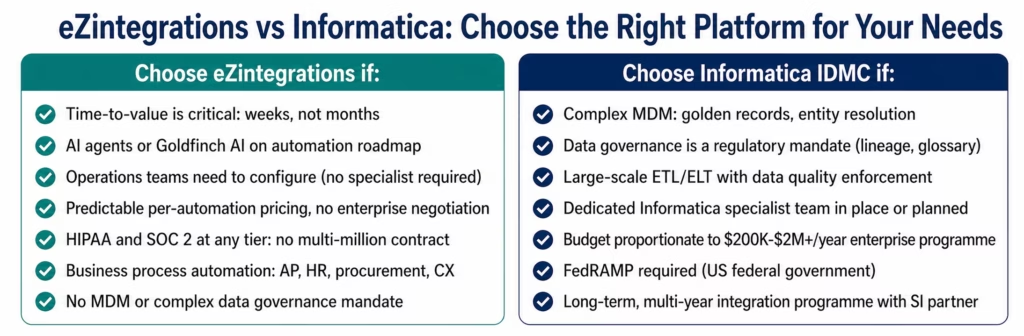
Choose eZintegrations if:
- Your automation programme needs to go live in weeks, not months: time-to-value is a business priority
- AI automation is on your roadmap: Level 2 Document Intelligence, Level 3 autonomous AI agents, or Level 4 Goldfinch AI multi-agent orchestration for business process automation
- You need your operations teams, IT generalists, and business analysts to configure and maintain integrations without Informatica certification
- You need predictable, transparent pricing that scales with your automation count, not with data volume and module licensing
- Your compliance requirements are HIPAA and SOC 2 Type II without a multi-million dollar enterprise contract
- Your primary use case is enterprise process automation (AP, HR, procurement, customer operations) rather than enterprise data governance and MDM
Choose Informatica IDMC if:
- Your organisation has a complex master data management programme that requires golden record creation across multiple enterprise systems
- Data governance: lineage tracking, business glossary, policy enforcement: is a regulatory mandate, not just a preference
- Your integration programme is large-scale ETL/ELT between major enterprise data systems with comprehensive data quality requirements
- You have or are willing to build a dedicated Informatica specialist team
- You are a large enterprise where the $200,000-$2,000,000+/year licence cost is proportionate to the scope of your data management mandate
- FedRAMP compliance is required (US federal government deployments)
Detailed Feature Comparison
| Capability | eZintegrations | Informatica IDMC | Winner |
|---|---|---|---|
| Level 1: iPaaS / Integration | Full: REST, GraphQL, WebSocket, DB | Full: mature platform | Tie |
| Level 2: AI Workflow steps | Native: Document Intelligence, LLM | CLAIRE (data quality domain) | eZintegrations (process automation) |
| Level 3: AI Agents | 9 native tools, autonomous, HITL | Not available | eZintegrations |
| Level 4: Multi-agent (Goldfinch AI) | Chat UI + Workflow Node | Not available | eZintegrations |
| Data governance | Basic | Comprehensive: industry-leading | Informatica |
| Master data management | Not available | Core product: industry-leading | Informatica |
| Data quality | Basic field validation | Deep: CLAIRE-enhanced | Informatica |
| Data lineage | Execution logging | Comprehensive: automated | Informatica |
| ETL/ELT throughput | Good: enterprise scale | Excellent: decades optimised | Informatica |
| ERP connectors | Native (SAP CSRF, NetSuite TBA) | Native: deep and mature | Tie |
| Cloud DW connectors | Native (Snowflake, BigQuery, Redshift) | Full: IDMC strength | Tie |
| Implementation speed | Days to weeks | Months to years | eZintegrations |
| No-code for non-specialists | Yes: operations teams | No: specialist required | eZintegrations |
| Pricing transparency | Public: $90-$150/mo per automation | Not public: negotiated enterprise | eZintegrations |
| Typical contract size | $21K-$100K+/year | $200K-$2M+/year | eZintegrations |
| SI partner required | No | Typically yes | eZintegrations |
| Time to first production | Under 2 weeks | 3-6 months | eZintegrations |
| HIPAA at all tiers | Yes | Enterprise contract | eZintegrations |
| FedRAMP | Not available | Available | Informatica |
| Template library | 1,000+ production-ready | Partner-dependent | eZintegrations |
Bottom Line Verdict
Informatica is a comprehensive enterprise data management platform. For organisations with genuine data governance mandates, MDM requirements, and the budget and staffing to operate it, Informatica remains a credible and capable platform. These are real use cases with real requirements that Informatica addresses better than eZintegrations.
The organisations this comparison addresses are those where the Informatica evaluation has produced an uncomfortable answer: the implementation will take 6-12 months, the licence cost is $400,000+ per year, the platform requires specialist developers, and the business wants to start using AI automation this quarter.
In that situation, eZintegrations is the right answer. Not because Informatica is weak, but because eZintegrations is built for the modern enterprise automation use case:
On AI automation: eZintegrations is native at all four levels. CLAIRE improves data quality and governance intelligence. These are different AI applications for different problems. If you need autonomous enterprise AI agents for process automation, eZintegrations is the appropriate platform.
On implementation speed: eZintegrations’ Automation Hub templates produce first production value in weeks. Informatica’s implementation model produces first production value in months. For organisations where automation ROI is being evaluated quarterly, this difference is material.
On cost: the 3-year TCO comparison is not marginal. For a 30-automation programme, eZintegrations’ estimated 3-year cost is $137,000-$260,000. Informatica’s estimated 3-year cost for the same scope is $2,000,000-$6,000,000+. Even at the lower end of both estimates, the cost difference funds significant business transformation.
On accessibility: eZintegrations workflows are configured by your existing IT team. Informatica requires specialists. The key-person risk, the hiring cost, and the ongoing staffing expense are significant operational differences.
The tiebreaker: if your primary need is data governance, MDM, and large-scale ETL with comprehensive data quality, evaluate Informatica. If your primary need is modern AI-native business process automation at enterprise speed and predictable cost, eZintegrations is built for that.
FAQs
For business process automation with AI workflows, AI agents, and fast deployment: yes. eZintegrations provides native Level 2-4 AI automation, production workflows in days rather than months, no specialist certification requirement, and pricing that is typically 10-20x lower than Informatica's total cost of ownership. Informatica is better for organisations with complex MDM requirements, comprehensive data governance mandates, large-scale ETL with data quality enforcement, and the budget and staffing profile for a multi-year enterprise data management programme.
For most mid-market enterprises (500-5,000 employees), yes. Informatica is designed and priced for large enterprise deployments with dedicated data integration teams, SI partner relationships, and multi-year programme budgets. Gartner Peer Insights consistently identifies implementation complexity and cost as the primary barriers for smaller enterprise buyers. Mid-market enterprises typically get better ROI from modern cloud-native alternatives (eZintegrations, Boomi, Mulesoft Flex) that deploy faster, cost less, and require less specialist expertise.
CLAIRE and eZintegrations' AI agents serve different problems. CLAIRE is an AI layer for data management tasks: automating data discovery, suggesting data quality rules, generating field mapping recommendations, and tracking lineage. eZintegrations Level 3 AI Agents are for enterprise business process automation: autonomously processing AP exceptions, running vendor due diligence, extracting clinical document data, and routing ITSM incidents. If your goal is smarter data governance, CLAIRE is valuable. If your goal is autonomous enterprise process automation, eZintegrations Level 3 agents are the appropriate tool.
Four primary limitations in the context of modern enterprise automation: implementation complexity: Informatica deployments take months and typically require SI partners and specialist staff; cost: licence, implementation, staffing, and SI fees make Informatica's TCO orders of magnitude higher than eZintegrations; AI automation gap: CLAIRE addresses data management intelligence, not autonomous business process agents (Level 3 and Level 4 do not exist in Informatica); no-code accessibility: Informatica requires certified specialists, while eZintegrations is configurable by IT generalists and operations teams.
Migration complexity depends on which Informatica modules you are using. For Informatica iPaaS integration workflows (connecting enterprise systems, syncing data between applications): Automation Hub templates cover most standard patterns and go live in 3-10 days each. A 20-30 workflow migration typically completes in 6-12 weeks. For Informatica MDM and data governance components: eZintegrations does not replicate these capabilities: MDM and governance functions would need to migrate to a dedicated MDM platform or remain in Informatica while iPaaS workflows move to eZintegrations. A mixed approach (eZintegrations for automation workflows, Informatica MDM for master data) is a common migration path.
For enterprise process automation workflows (invoice processing, HR data sync, CRM-to-ERP integration, order management): yes. eZintegrations handles enterprise-scale data volumes without execution caps or throughput limitations for typical business process automation volumes. For Informatica's specialised high-volume ETL use cases (moving hundreds of millions of rows between enterprise data warehouses in nightly batch windows with complex transformation and data quality rules), Informatica's architecture is optimised for this specific workload in ways that eZintegrations is not. If your primary need is high-volume ETL at data warehouse scale, evaluate Informatica, Fivetran, or Airbyte alongside eZintegrations.1. Is eZintegrations better than Informatica for enterprise automation?
2. Is Informatica too complex and expensive for mid-market enterprises?
3. How does Informatica's CLAIRE AI compare to eZintegrations' AI agents?
4. What are Informatica's main limitations compared to eZintegrations?
5. How long does it take to migrate from Informatica to eZintegrations?
6. Can eZintegrations handle the same data volumes as Informatica?
Conclusion
Informatica is a significant platform with significant capabilities. For the organisations it is designed for: large enterprises with complex MDM mandates, regulatory data governance requirements, and dedicated data integration teams: it remains a credible choice.
For the much larger group of enterprises that need modern AI-native business process automation, fast deployment cycles, accessible tooling, and predictable pricing, Informatica is the wrong tool. Not because it is weak, but because it was designed for a different problem and a different operating model.
The specific gap in 2026: Informatica’s CLAIRE AI makes the platform’s data management functions smarter. It does not provide autonomous enterprise AI agents for business process automation. The organisations that need AP Exception Agents, vendor due diligence agents, contract clause extraction, and ITSM triage automation will not find these capabilities in Informatica IDMC.
eZintegrations delivers all four automation levels: from basic iPaaS to Goldfinch AI multi-agent orchestration: with Automation Hub templates that go live in days, pricing that starts at $90/month per automation, and tooling that your existing IT team can configure and maintain without specialist certification.
Book a free eZintegrations demo and bring your current integration requirements. We will map your use cases to Automation Hub templates, demonstrate Level 3 AI Agent capability for your highest-exception process, and produce a cost comparison that accounts for your full TCO: not just platform licence.
Browse the Automation Hub to see the 1,000+ production-ready templates and identify which of your current integration requirements have a same-day deployment path.
If your organisation is evaluating whether Informatica’s complexity is proportionate to your actual needs, the build vs buy integration decision framework provides a structured way to make that assessment.