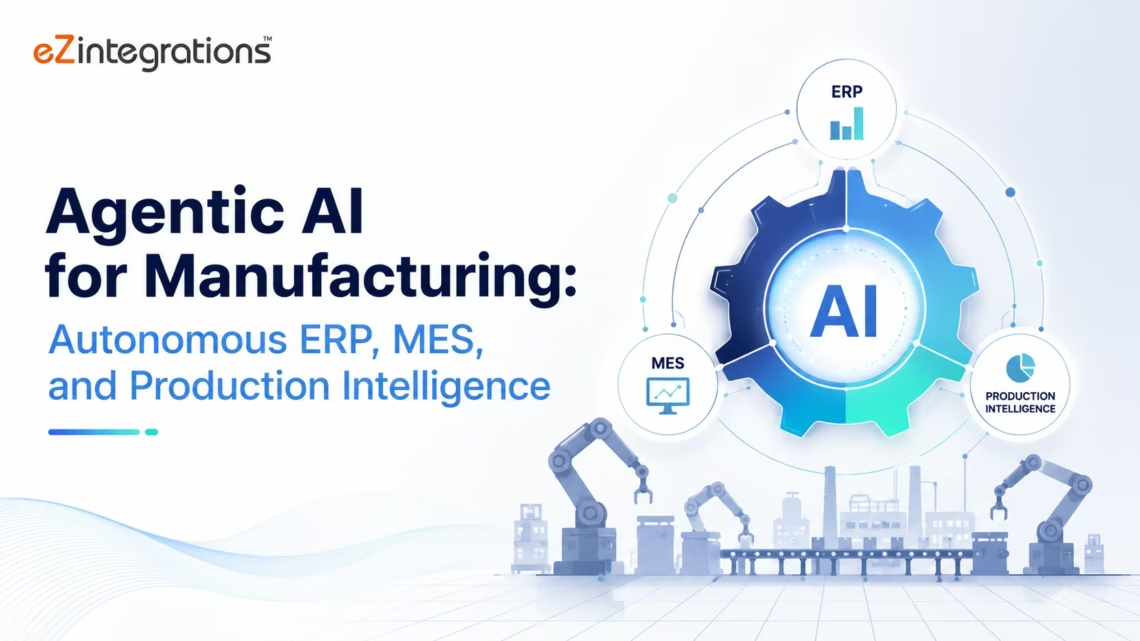
Agentic AI for Manufacturing: Autonomous ERP, MES, and Production Intelligence
June 16, 2026Agentic AI for manufacturing deploys Goldfinch AI coordinator-worker architecture to reason across ERP (SAP S/4HANA, Oracle), MES (Siemens Opcenter, Rockwell Plex), OSIsoft PI historian, and SCADA data simultaneously: delivering production intelligence that no single workflow or agent can produce multi-plant OEE root cause synthesis, cross-system yield loss attribution, predictive maintenance prioritisation across 40+ assets, production schedule risk assessment, and supply chain disruption impact modelling. The coordinator dispatches specialist worker agents to each data source in parallel, synthesises their findings, and delivers intelligence to plant managers, operations VPs, and the CEO, in minutes, not days.
TL;DR
- Manufacturing intelligence is distributed across more systems than any other industry: ERP for production planning and financials, MES for production execution and quality data, PI historian for real-time sensor data, SCADA for equipment control, LIMS for quality testing, and CMMS for maintenance, each generating data that matters, none of them connected enough to answer the questions that actually drive operational decisions.
- The result: a plant manager’s intuition about why OEE dropped last week is built from data assembled by three people over two days, not from intelligence delivered in real time. An operations VP’s view of yield variance across six plants is a PowerPoint assembled from six site reports, not a synthesised brief from connected data.
- Agentic AI changes this model. Goldfinch AI coordinator-worker architecture dispatches specialist worker agents to each manufacturing system simultaneously: MES, ERP, PI historian, LIMS, CMMS synthesises their findings, and delivers production intelligence at the speed the operations team needs, not the speed manual data assembly allows.
- Five agentic AI use cases that deliver manufacturing intelligence no single workflow or agent can produce: multi-plant OEE root cause synthesis, cross-system yield loss attribution, predictive maintenance prioritisation across the asset fleet, production schedule risk assessment, and manufacturing financial performance intelligence.
- eZintegrations’ Goldfinch AI connects SAP S/4HANA, Oracle Manufacturing Cloud, Siemens Opcenter, Rockwell Plex, OSIsoft PI System, OPC-UA, LIMS, and CMMS: with Chat UI for operations and executive queries and Workflow Node for automated production intelligence programmes.
The Problem: Manufacturing Intelligence Lives in Silos
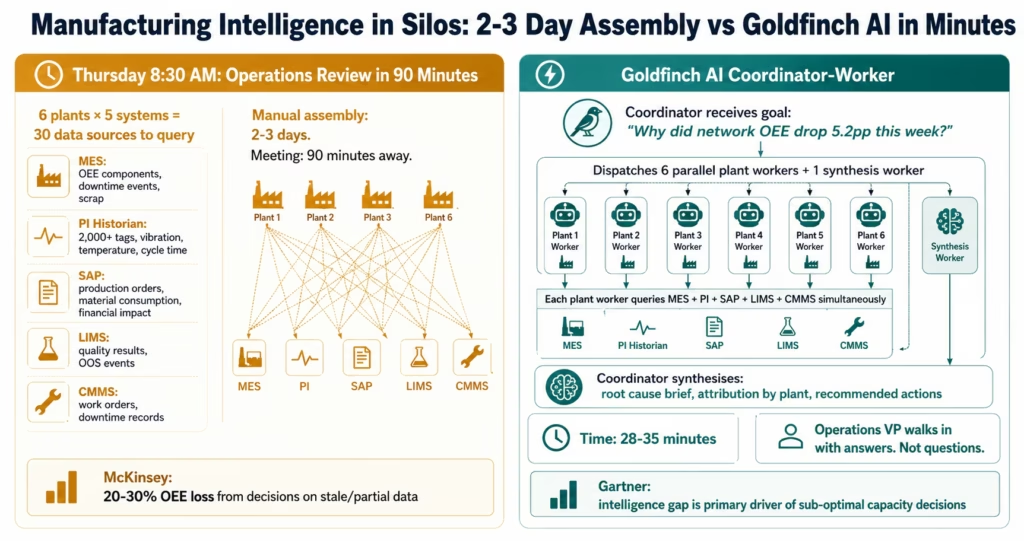
It is Thursday morning at a six-plant discrete manufacturer. The weekly operations review is in 90 minutes.
The operations VP is trying to understand why OEE across the network dropped from 81.4% to 76.2% this week: a 5.2-point decline that represents approximately $340,000 in lost production value at this company’s margin structure. The data to explain this drop exists across six sites, each with its own MES (some Opcenter, some Plex), PI historians with 2,000+ tags of sensor data, SAP for production orders and material consumption, and LIMS for quality results. The maintenance CMMS has downtime logs from every line.
Assembling a root cause explanation for the OEE drop from these sources requires: a data analyst at each site pulling MES data (downtime events, cycle time deviations, scrap rates), a central analyst correlating the site data with the financial impact in SAP, the reliability team reviewing PI historian data for the downtime events that drove the availability loss, and the quality team reviewing LIMS for the quality defect patterns that drove the quality loss.
That assembly process takes 2-3 days. The operations review is in 90 minutes.
The VP walks into the meeting with the MES-based OEE report from last week (not this week: this week’s data is still being assembled), a few Slack messages from site managers, and intuition. Decisions about where to focus corrective action are made on incomplete information assembled too slowly.
Seventy-five percent of manufacturing operations leaders report the same pattern. According to McKinsey, manufacturers lose 20-30% of potential OEE from decisions made on information that is either stale, partial, or incorrectly attributed to root causes. Gartner estimates that the gap between the intelligence manufacturers have the connected data to produce and the intelligence they actually receive routinely is the primary driver of sub-optimal capacity allocation decisions in multi-plant operations.
Agentic AI closes this gap: not by building better dashboards, but by deploying coordinator-worker multi-agent architecture that queries all manufacturing data sources simultaneously, synthesises the findings into coherent operational intelligence, and delivers that intelligence at the speed the operations review requires.
Agentic AI vs AI Agents vs AI Workflows: The Manufacturing Distinction
Each level of the eZintegrations architecture addresses a different manufacturing problem class: and knowing the distinction prevents over-engineering simple problems and under-specifying complex ones.
AI Workflows (Level 2): predefined processing sequences with AI nodes. The MES-to-SAP production actuals sync runs within 2 minutes of every production event. LLM Classification routes quality exceptions. Data Analysis fires an OEE alert when a line drops below 75%. These are high-volume, deterministic, configured in advance. Right tool for the routine majority.
AI Agents (Level 3): single-agent, bounded investigation. The predictive maintenance agent monitors PI historian tags for a specific asset class and creates a CMMS work order when a bearing anomaly is detected. The quality hold agent investigates a specific OOS result across LIMS, SAP QM, and the WMS. One agent, one investigation, bounded scope.
Agentic AI: Goldfinch AI (Level 4): coordinator-worker, multi-system, synthesised intelligence. The multi-plant OEE root cause analysis dispatches six parallel plant workers (one per site), each querying MES + PI + SAP + LIMS + CMMS simultaneously, with the coordinator synthesising the six-plant finding into a coherent attribution which plant, which line, which root cause category, what financial impact. No single agent, no single workflow, no single system can produce this. Coordinator-worker parallelism and synthesis is what makes it possible.
| Manufacturing Problem | Right Level | Why |
|---|---|---|
| MES-to-SAP production actuals sync | Level 2 Workflow | Deterministic, high-volume, predefined |
| OEE alert when line drops below threshold | Level 2 Workflow | Predefined trigger, predefined action |
| Diagnose why this specific line had 2-hr downtime | Level 3 AI Agent | Bounded investigation, one asset, PI + CMMS |
| Root cause for 5.2pp OEE drop across 6 plants | Level 4 Goldfinch AI | 6 parallel investigations + synthesis required |
| LIMS OOS investigation for one batch | Level 3 AI Agent | One batch, bounded, LIMS + SAP QM |
| Yield variance attribution across 6 plants, 3 product lines | Level 4 Goldfinch AI | Multi-plant parallelism + cross-system synthesis |
| Predictive maintenance for one critical asset | Level 3 AI Agent | One asset, PI historian + CMMS |
| Prioritised maintenance schedule for 40-asset fleet | Level 4 Goldfinch AI | 40 parallel asset assessments + prioritisation |
| SAP PP production order confirmation | Level 2 Workflow | Event-driven, predefined, high-volume |
| Production schedule risk for next 2 weeks | Level 4 Goldfinch AI | Multi-system constraint synthesis required |
All three levels are complementary. Level 2 handles the routine data flows. Level 3 handles bounded exception investigations. Level 4 delivers the synthesised intelligence that requires parallel, multi-system, multi-site reasoning, consistent with broader Forrester Research analysis of manufacturing AI architectures and that is currently being produced manually over 2-3 days, or not produced at all.
Before vs After: Agentic AI for Manufacturing Intelligence
| Intelligence Need | Before Agentic AI | After Goldfinch AI | Impact |
|---|---|---|---|
| Multi-plant OEE root cause | 2-3 days manual assembly, available after the operations review | 28-35 min automated brief, available before the operations review | Decisions made on current intelligence, not retrospective data |
| Yield variance attribution | Site-by-site manual reports, synthesised manually (1-2 days) | Coordinator synthesises all sites simultaneously (45-60 min) | Cross-site pattern identification impossible manually |
| 40-asset maintenance prioritisation | Reliability engineer assesses highest-risk assets (4-6 hrs/week) | Coordinator assesses all 40 assets simultaneously, delivers prioritised schedule (35-45 min weekly) | 100% fleet coverage vs sampled |
| Production schedule risk | Planner manually reviews constraints (3-4 hrs), based on current-day data | Goldfinch AI synthesises real-time constraint intelligence across MES, ERP, and PI (25-30 min) | Proactive vs reactive |
| Manufacturing financial intelligence | Finance and ops spend 3-5 days assembling monthly report | Goldfinch AI Workflow Node delivers weekly financial-operations brief automatically | Weekly vs monthly, 3-5 days → automated |
| Shift handover intelligence | Supervisor types narrative from memory (variable quality) | Goldfinch AI assembles shift brief from MES + PI + CMMS + LIMS automatically | Consistent, complete, data-grounded |
| CEO manufacturing dashboard | Assembled by analyst, weekly or monthly, always lagging | Chat UI: CEO queries live manufacturing performance in natural language | On-demand vs weekly lagging |
| Cross-plant capacity reallocation | Operations VP makes call based on partial site data | Goldfinch AI provides complete capacity picture across all plants with constraint analysis | Complete picture for strategic decisions |
| Supplier quality impact on production | Quality and supply chain teams coordinate manually | Coordinator synthesises supplier quality events with production impact across ERP and MES | Same-day attribution vs week-later discovery |
| Energy intensity and waste attribution | Monthly energy report (lagging, high-level) | Data Analysis monitors energy per unit produced continuously, agentic attribution by line | Real-time vs monthly, actionable vs informational |
How Goldfinch AI Connects the Manufacturing Stack
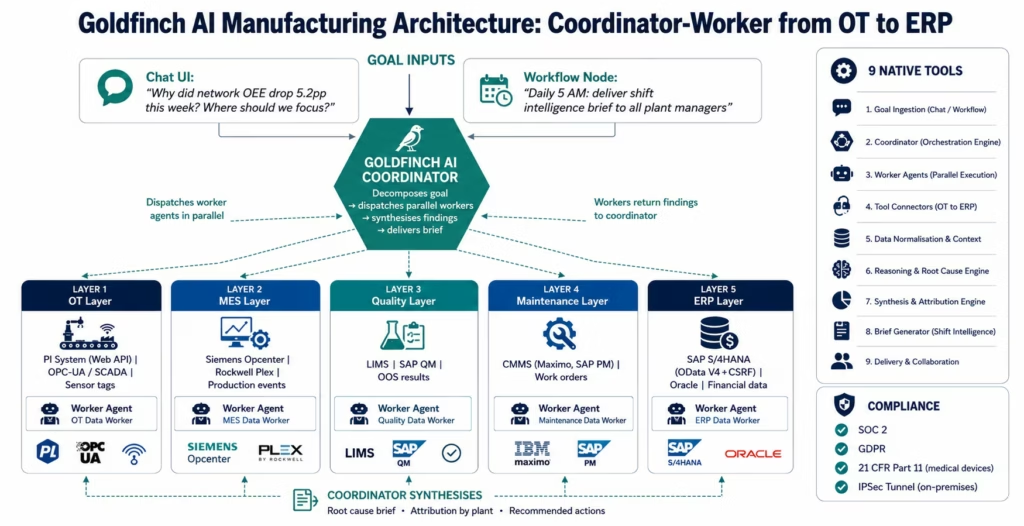
Goldfinch AI of eZintegrations deploys coordinator-worker architecture across the manufacturing technology stack: connecting the OT layer (PI historian, OPC-UA, SCADA) to the IT layer (MES, ERP, LIMS, CMMS) in a way that enables parallelised, synthesised intelligence at plant and portfolio scale.
The coordinator-worker model for manufacturing:
The coordinator receives a manufacturing intelligence goal from the Chat UI (natural language query from the plant manager or operations VP) or the Workflow Node (automated weekly/daily intelligence programme). It decomposes the goal into parallel investigative tasks: one worker per plant for multi-plant queries, one worker per asset class for maintenance prioritisation, one worker per product line for yield attribution: and dispatches all workers simultaneously.
Each worker executes its assigned investigation using the tools it has been given access to (API Tool Call for its designated systems, Data Analysis for the data it retrieves, Knowledge Base for the benchmarks and thresholds relevant to its domain). Workers return structured findings to the coordinator. The coordinator synthesises all worker findings into the coherent intelligence brief.
Manufacturing system connectors:
SAP S/4HANA (OData V4 + CSRF): PP (production planning and orders), QM (quality management, inspection lots, OOS), MM (materials management, goods movements), PM (plant maintenance, work orders), CO (controlling, cost centres, variance analysis). Automatic CSRF token management for write operations.
Oracle Manufacturing Cloud (REST + assertion grant OAuth): discrete and process manufacturing modules: work order management, production dispatching, quality results, supply chain event management.
Siemens Opcenter MES (REST): production order management, operation confirmation, quality data collection, equipment status, downtime events.
Rockwell Plex (REST): production tracking, quality management, inventory, maintenance management across the Plex unified manufacturing platform.
OSIsoft PI System (PI Web API): real-time and historical tag data retrieval, event frame management, PI notification integration. Supports both cloud PI and on-premises PI deployments via IPSec Tunnel.
OPC-UA (OPC-UA client): direct connection to SCADA systems, PLCs, and OPC-UA-enabled manufacturing equipment for real-time tag subscription and data polling.
LIMS (LabVantage, LabWare, STARLIMS): analytical test results, specifications, OOS/OOT flagging, stability data. REST API and database connectors.
CMMS (IBM Maximo, SAP PM, Infor EAM): work order history, equipment failure records, planned maintenance schedules, parts inventory.
9 native Goldfinch AI tools for manufacturing intelligence:
- Knowledge Base Vector Search: plant-specific OEE benchmarks, production standards, maintenance procedures, failure mode libraries, product specifications, and capacity planning parameters
- Document Intelligence: batch manufacturing records, equipment qualification reports, supplier quality documents, maintenance work order histories
- Data Analysis: statistical anomaly detection, OEE component decomposition, yield variance analysis, energy intensity calculation, maintenance pattern recognition
- Data Analytics with Charts/Graphs/Dashboards: OEE trend charts, plant performance matrices, maintenance priority matrices, yield attribution waterfall charts: embedded in intelligence briefs
- Web Crawling: raw material commodity pricing, supplier news and disruption signals, competitor capacity news, regulatory changes affecting production
- Watcher Tools: OEE threshold alerts, CAPA due date monitoring, maintenance window approaching alerts, production schedule milestones
- API Tool Call: all manufacturing system connections above
- Integration Workflow as Tool: trigger existing Level 2 workflows (MES-to-SAP sync, quality hold propagation, maintenance dispatch) as part of agentic resolution actions
- Integration Flow as MCP: expose manufacturing integration capabilities via MCP for external AI tool consumption
Compliance and infrastructure: SOC 2 Type II certified. GDPR compliant for EU operations data. 21 CFR Part 11 and ISO 13485 support for medical device manufacturers. IPSec Tunnel for on-premises PI System, MES, and ERP deployments behind plant firewalls.
Use Case 1: Multi-Plant OEE Root Cause Synthesis
The intelligence gap in one sentence: the operations VP knows OEE dropped across the network this week but does not know where, which root cause category (availability, performance, or quality), what specific events drove it, or where to focus corrective action: because the data to answer these questions takes 2-3 days to assemble manually.
The Goldfinch AI solution: the Multi-Plant OEE Root Cause Synthesis runs via the Workflow Node (automated weekly) or the Chat UI (on-demand query during the operations review). The coordinator dispatches one worker agent per plant, each querying MES, PI historian, LIMS, and CMMS simultaneously for the relevant week.
The Coordinator-Worker Investigation
Coordinator receives goal: “Network OEE dropped from 81.4% to 76.2% this week a 5.2pp decline. Investigate root cause by plant, by OEE component (availability, performance, quality), identify the top contributing events, quantify the production value impact, and recommend corrective focus.”
Six parallel plant workers dispatched simultaneously:
Each plant worker queries (in parallel across all six plants):
MES query (Opcenter or Plex API): OEE by shift and by line, availability losses (planned and unplanned downtime events with durations), performance losses (cycle time deviations, speed losses, micro-stoppages), quality losses (first-pass yield by product and line).
PI historian query (PI Web API): vibration, temperature, and cycle time trends for the lines with the highest downtime contribution correlating sensor anomalies with the downtime events identified in MES.
SAP/Oracle query (production order data): planned production quantity vs actual, material consumption vs planned (yield variance), shift by shift production actuals.
LIMS query: OOS results and first-pass inspection results for the relevant production week. Quality defect categories.
CMMS query: maintenance work orders completed during the week planned PMs, unplanned corrective maintenance, and emergency repairs. Downtime attributed to specific maintenance causes.
Worker findings returned to coordinator (all six in parallel, typically 8-12 minutes):
Each worker returns a structured site OEE brief: OEE by component, top 3 downtime events with duration and root cause category, quality event summary, and the financial impact at standard margin.
Coordinator synthesis:
The coordinator receives all six plant briefs and synthesises:
- Network OEE breakdown: which plants improved, which deteriorated, which are unchanged
- Root cause attribution: availability loss (43% of the 5.2pp decline Plant C Line 2 mechanical failure, Plant E planned maintenance extended), performance loss (31%: Plants A and D running 12-18% below standard cycle time on Product X changeover), quality loss (26%: Plant B elevated scrap rate on new material batch)
- Financial impact: $338,000 lost production value (calculated from plant-specific margin data in SAP)
- Recommended corrective focus: Plant C Line 2 root cause investigation (highest single-event impact), Product X changeover optimisation (systemic performance issue across two plants), Plant B material qualification review (quality issue attributable to incoming material)
- Data Analytics: OEE waterfall chart showing the contribution of each root cause category to the 5.2pp decline
Chat UI delivery time from query submission: 28-35 minutes for the full six-plant analysis. The operations VP walks into the review with the answer, not the question.
Use Case 2: Cross-System Yield Loss Attribution Agent
The intelligence gap: yield variance: the difference between planned and actual output per unit of input material: is the most direct measure of manufacturing efficiency that goes beyond OEE. But attributing yield variance to root causes requires cross-referencing four systems simultaneously the MES production records (actual output), the SAP production order (planned output and planned material consumption), the LIMS quality records (quality-related yield loss), and the PI historian (process parameter correlations with yield).
No single system contains enough information to explain yield variance. Manual attribution requires an analyst with access to all four systems and 4-8 hours of analysis work per product line per plant.
The Goldfinch AI solution: the Yield Loss Attribution Agent dispatches parallel workers to all four systems for each product line under analysis, correlates the findings across the cross-system view, and delivers a structured yield loss brief with root cause attribution and corrective recommendations.
The Cross-System Attribution Logic
Goal: “Product X yield at Plant B dropped from 94.2% to 87.8% this week (6.4pp decline). Attribute the yield loss to root causes and identify corrective actions.”
Parallel worker investigation:
MES worker (Opcenter): retrieves actual yield by shift and by line, scrap reason codes, rework quantities, and operator shift assignments for the relevant period.
SAP PP/QM worker: retrieves the production order targets (planned yield, planned material consumption), the goods issue records (actual material consumption), and the variance calculation between planned and actual.
LIMS worker: retrieves in-process quality results for the affected production period process parameter measurements at each critical control point, specification limits, and the specific measurements that fell outside specification (if any) during the yield-loss period.
PI historian worker: retrieves process parameter trends for the lines with the highest yield loss temperature profiles, pressure readings, reaction time measurements and compares against the historical distribution for this product on this line.
Coordinator synthesis:
The coordinator correlates findings across all four workers:
- 2.1pp of the 6.4pp yield decline: attributed to a process parameter deviation (reactor temperature ran 3°C above the control limit for 6 hours on Shift 2 Wednesday identified by PI worker, correlated with the shift-by-shift MES yield data)
- 2.8pp: attributed to a material quality issue in incoming Batch XYZ-4421: identified by LIMS worker (incoming material test showed moisture content at the upper limit), correlated with SAP goods issue data showing the batch was consumed during the yield-loss period
- 1.5pp: attributed to a changeover efficiency issue on Line 3 (above-normal changeover time, identified by MES worker): likely operator-related, correlated with a shift change in the operator assignment data
Corrective recommendations:
- Immediate: investigate Batch XYZ-4421 material qualification; hold remaining stock pending retest
- Process: review temperature control setpoint on Shift 2, control loop may need recalibration
- Training: review Line 3 changeover procedure with the operator team on the relevant shift
Attribution brief delivery: 18-22 minutes. Manual cross-system analysis, 4-8 hours.
Use Case 3: Asset Fleet Predictive Maintenance Prioritisation
The intelligence gap: a 40-asset critical equipment fleet cannot be monitored with equal attention. Reliability engineers triage manually: assessing the assets they have time to check, based on experience and recent incident history. The 40th asset on the list gets checked when there is time. The asset that has been gradually degrading for 12 days: showing early signs of a bearing failure pattern in the PI historian data does not surface until the scheduled check or until it fails.
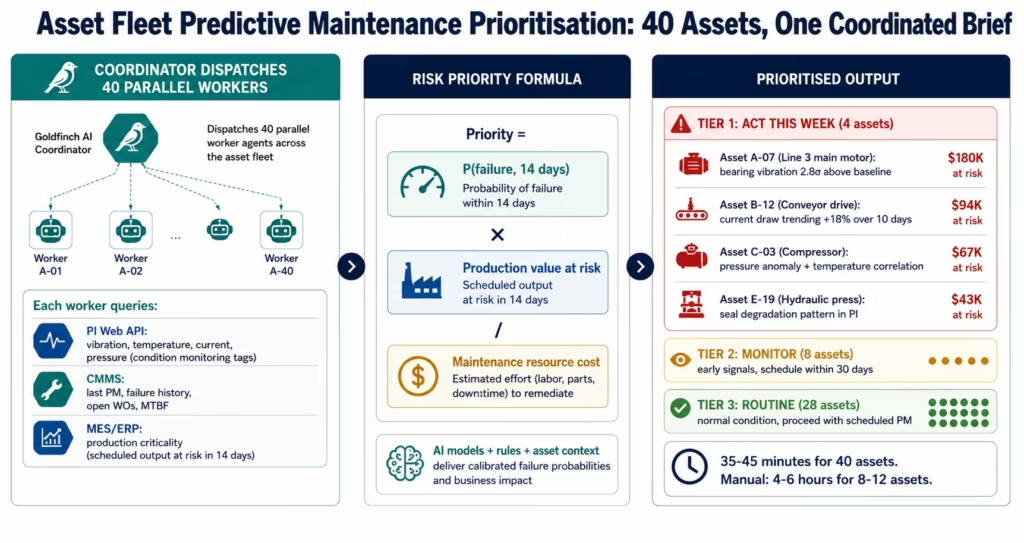
The Goldfinch AI solution: the Asset Fleet Predictive Maintenance Prioritisation agent dispatches 40 parallel asset worker agents simultaneously, each assessing the current condition of one asset from the PI historian data, the maintenance history from the CMMS, and the production criticality context from the MES and ERP. The coordinator synthesises the 40 worker findings into a single prioritised maintenance schedule ordered by risk and production impact.
The 40-Asset Parallel Assessment
Coordinator receives goal (Workflow Node: weekly, Monday morning): “Assess the current maintenance risk for all 40 critical assets in the production fleet. Prioritise by: probability of failure within the next 14 days, production impact if the asset fails, and maintenance resource availability. Deliver a prioritised maintenance schedule for the week.”
40 parallel asset worker agents dispatched:
Each asset worker queries (simultaneously):
PI historian query: current and recent historical values for the configured condition monitoring tags for this asset (vibration X/Y/Z axes, bearing temperature, motor current draw, pressure differential, cycle time deviation). Compares against the historical baseline distribution and the failure-precursor signature library in the Knowledge Base.
CMMS query: the asset’s maintenance history last PM date and outcome, any recent corrective maintenance, open work orders, mean time between failures (MTBF) from the historical record.
MES/ERP production criticality query: is this asset on the critical path for scheduled production in the next 14 days? What is the production volume at risk if it fails?
Coordinator receives 40 worker assessments and synthesises:
Each worker returns: condition assessment (normal, early anomaly, moderate anomaly, critical), days-to-failure estimate (probabilistic, based on degradation rate from PI data and historical MTBF from CMMS), and production impact if failure occurs (production value at risk in the 14-day horizon).
The coordinator calculates a risk-weighted priority score for each asset: Priority = (Probability of failure in 14 days) × (Production value at risk) / (Maintenance resource cost)
Output: a prioritised maintenance schedule with:
- Tier 1 (act this week): 4 assets with critical or moderate anomalies and high production criticality
- Tier 2 (monitor closely): 8 assets with early anomaly signals
- Tier 3 (routine PM on schedule): 28 assets showing normal condition
- Recommended maintenance actions per Tier 1 asset: specific work order recommendation based on the failure mode identified
Time for 40-asset assessment: 35-45 minutes (all 40 workers running in parallel). Manual reliability engineer assessment (highest-risk assets only): 4-6 hours, covering 8-12 assets.
The coordinator’s assessment covers 100% of the fleet. The reliability engineer’s time shifts from data gathering to review and exception management, acting on the Tier 1 recommendations rather than determining which assets to check.
Use Case 4: Production Schedule Risk Assessment Agent
The intelligence gap: the production scheduler builds a two-week schedule in SAP Advanced Planning or in the MES. The schedule assumes machines will run at planned efficiency, materials will arrive as ordered, quality will meet first-pass yield targets, and maintenance will complete within planned windows. Reality rarely matches all four assumptions simultaneously. By the time a constraint becomes visible in the schedule (the material that has not arrived, the machine that is underperforming), it is often too late to recover the week’s production plan without costly expediting.
The Goldfinch AI solution: the Production Schedule Risk Assessment Agent assesses the current production schedule against real-time constraint intelligence from all connected systems identifying the constraints most likely to cause schedule deviations before they occur.
The Multi-System Schedule Risk Assessment
Goal (Chat UI or Workflow Node: daily at 6 AM): “Assess the risk to the two-week production schedule. Identify the top constraints by production value at risk and recommend risk mitigation actions.”
Parallel constraint worker agents:
Material availability worker (SAP MM + Supplier portal):
- Queries open purchase orders against delivery confirmations
- Identifies materials due in the next 14 days that have no confirmed delivery date or that have confirmed delivery dates more than 3 days beyond the production schedule’s material requirement date
- Queries supplier portal (if API accessible) for any communicated lead time changes
Machine condition worker (PI System + CMMS):
- Queries condition monitoring data for all machines on the critical path in the next 14-day schedule
- Identifies machines showing degradation signals that could cause unplanned downtime within the schedule horizon
- Queries CMMS for planned maintenance windows and estimated durations vs production schedule assumptions
Quality risk worker (LIMS + SAP QM):
- Queries first-pass yield trends for the products scheduled in the next 14 days
- Identifies products whose recent first-pass yield is trending below the schedule’s yield assumption
- Queries incoming material quality for materials due in the next 14 days
Capacity utilisation worker (MES + SAP PP):
- Queries current machine utilisation vs the utilisation assumption in the schedule
- Identifies lines running below scheduled efficiency that would create schedule pressure
- Calculates the current capacity buffer before schedule deviation occurs
Coordinator synthesis: risk-ranked constraints:
The coordinator consolidates all four workers’ findings into a risk-ranked constraint brief:
- Material risk (highest value at risk): API supplier for Product X has not confirmed the delivery due next Tuesday. If the material does not arrive, 47 production hours are at risk on Lines 4 and 7 next week $284,000 at standard margin.
- Machine condition risk: Asset A-07 (Line 3 main motor) is showing a bearing anomaly in PI historian. Line 3 has 62 production hours scheduled in the next 14 days, $390,000 at standard margin if the asset fails before the scheduled maintenance window.
- Quality yield risk: Product Z’s first-pass yield has dropped from 93.8% to 89.2% over the past 10 days. At current yield trajectory, the scheduled quantity requires 6.7% more material than the production order allows, creating a material shortage on day 8 of the schedule.
- Capacity buffer: Lines 1-3 are currently running at 91% of scheduled OEE. Current schedule has a 4.2% buffer. If OEE holds at current level, the schedule completes on time. Any further OEE degradation eliminates the buffer.
Recommended actions (pre-staged for scheduler approval):
- Escalate material confirmation request to API supplier immediately
- Advance Line 3 maintenance to this weekend to address bearing anomaly
- Adjust Product Z production order quantity to account for yield trajectory
- Stage a contingency schedule variant assuming Line 3 material arrival delay of 3 days
Daily Workflow Node delivery: the scheduler starts every morning with the current constraint brief: before the production meeting, before the material team calls, before the maintenance team review. Proactive decisions replace reactive firefighting.
Use Case 5: Manufacturing Financial Performance Intelligence
The intelligence gap: the monthly manufacturing financial report: variance analysis, cost per unit, yield losses translated to financial impact, OEE-to-revenue correlation: takes the finance and operations teams 3-5 days to assemble from SAP, the MES, and the LIMS. It is delivered at the end of the month, describing the prior month’s performance. Decisions based on it are made 30+ days after the events that drove the performance.
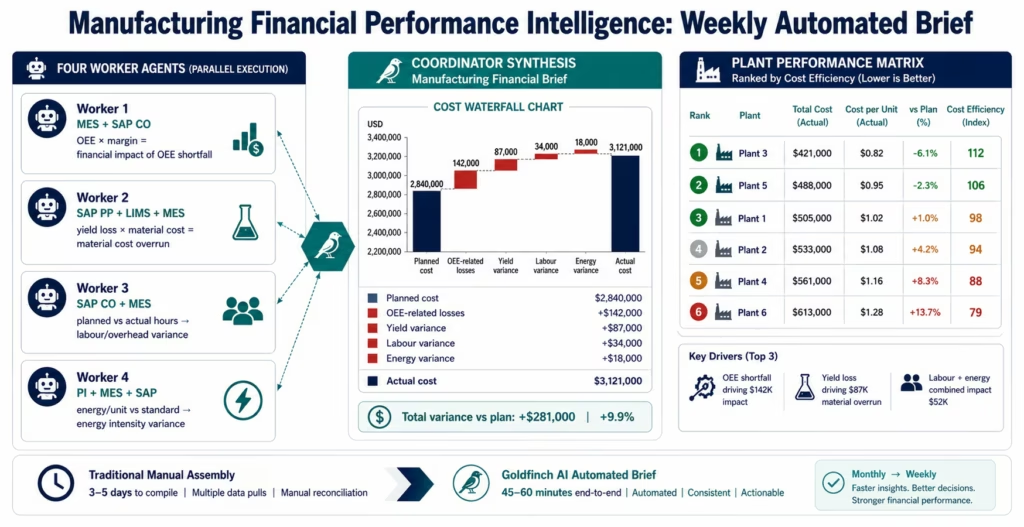
The Goldfinch AI solution: the Manufacturing Financial Performance Intelligence programme runs on the Workflow Node: an automated Goldfinch AI programme that synthesises manufacturing performance data with financial data weekly, delivering a rolling financial performance brief that gives operations and finance leadership a current view of manufacturing economics.
What the Coordinator Synthesises
Weekly Workflow Node (Monday 5:30 AM):
OEE-to-financial translation worker (MES + SAP CO):
- Retrieves the week’s OEE by plant and line
- Queries SAP Controlling for the standard margin per product
- Calculates: OEE losses this week × production hours at risk × standard margin = financial impact of OEE shortfall
- Compares against the OEE-to-financial target for the week
Yield variance financial impact worker (SAP PP + LIMS + MES):
- Retrieves actual yield vs planned yield by product and plant
- Queries SAP for the standard material cost per unit
- Calculates: yield loss percentage × planned output × standard material cost = material cost overrun from yield variance
- Identifies which product lines are contributing most to material cost overrun
Labour and overhead variance worker (SAP CO + MES):
- Retrieves planned vs actual production hours by work centre
- Calculates labour and overhead variance from actual vs standard hours
- Identifies lines and shifts where labour productivity deviated from standard
Energy intensity worker (PI + MES + SAP):
- Retrieves energy consumption data from PI historian (utility meters)
- Calculates energy per unit produced by line and plant
- Compares against the standard energy intensity budget
- Identifies lines with above-standard energy consumption and correlates with production conditions (low OEE, extended changeovers, idle time)
Coordinator synthesis: manufacturing financial brief:
The coordinator synthesises the four workers’ findings into a manufacturing financial performance brief:
- Total manufacturing cost variance this week: actual vs plan (positive or negative)
- Top three cost drivers: OEE-related losses, yield variance material cost, labour variance
- Best-performing and worst-performing plants on a total cost basis
- Week-on-week trend for each cost component
- Projected month-end manufacturing cost variance based on current week trajectory
Data Analytics output: cost waterfall chart (planned cost vs actual cost, decomposed by variance type), plant performance matrix (all plants ranked by manufacturing cost efficiency this week), and week-on-week trend charts for each cost component.
Operations and finance leadership receive this brief automatically every Monday morning. The monthly manufacturing financial report becomes a weekly intelligence programme, with the assembly time reduced from 3-5 days to 45-60 minutes of automated Goldfinch AI processing.
Key Outcomes and Results
Manufacturing organisations deploying Goldfinch AI agentic intelligence with eZintegrations report the following within 90-120 days, reflecting broader smart manufacturing and Industry 4.0 trends tracked by IDC:
OEE and Production Performance:
- OEE root cause assembly time: 2-3 days (manual) → 28-35 minutes (Goldfinch AI Workflow Node weekly)
- Operations leadership visibility: from retrospective monthly to real-time weekly
- Corrective action response time: reduces 3-5 days as root cause intelligence is available before the operations review
- OEE improvement: typically 3-6pp within 12 weeks as decisions are made on current, attributed intelligence
Yield and Quality:
- Yield variance attribution: 4-8 hours (manual cross-system) → 18-22 minutes (coordinator-worker)
- Cross-system attribution accuracy: improves as all four relevant systems are correlated simultaneously
- Material cost overrun identification: same-day (weekly Workflow Node) vs monthly report discovery
Maintenance:
- Fleet assessment coverage: 100% weekly (all 40 assets) vs 20-30% manually (highest-priority assets only)
- Predictive maintenance lead time: 1-2 weeks advance warning on monitored failure modes
- Unplanned downtime on monitored assets: reduces 35-55% as Tier 1 assets are addressed before failure
Production Planning:
- Schedule constraint visibility: daily (Workflow Node) vs weekly or reactive
- Material expediting incidents: reduces 30-40% as material risk is identified before it becomes a production stop
- Schedule recovery cost: reduces as constraints are identified with enough lead time for lower-cost mitigation
Financial Performance:
- Manufacturing financial report: monthly (3-5 day assembly) → weekly (automated, 45-60 min)
- Variance attribution accuracy: improves as cross-system synthesis captures variance sources not visible in single-system reports
- Cost overrun detection lead time: weeks earlier as weekly intelligence replaces monthly lagging report
How to Get Started
Manufacturing agentic AI deployment follows an incremental approach: start with the intelligence programme that delivers the highest immediate operational value, validate the coordinator-worker architecture, and expand to additional programmes as confidence is established.
Step 1: Book a manufacturing agentic AI demo with your operations and IT teams
Goldfinch AI manufacturing intelligence is best evaluated in a live demonstration: showing the coordinator dispatching parallel plant workers, the synthesised OEE root cause brief for a sample week of data, and the Chat UI responding to a natural language production query from your specific MES and ERP systems. Book a free demo and include your plant managers, operations VP, IT/OT integration lead, and reliability engineering team.
Step 2: Connect your manufacturing stack
If eZintegrations is already deployed for Level 2 MES-to-ERP workflow automation at your sites, the Goldfinch AI agents inherit those connections. For new deployments;
- SAP S/4HANA: OData V4 service activation (PP, QM, MM, PM, CO modules), service account with appropriate authorisations (2-4 hours per plant)
- Siemens Opcenter or Plex: REST API credentials and endpoint configuration (2-4 hours per plant)
- OSIsoft PI System: PI Web API credentials and tag configuration (4-8 hours for initial tag list configuration, ongoing self-service) or IPSec Tunnel for on-premises PI deployments
- LIMS: REST API or database connector configuration (2-4 hours)
- CMMS: REST API credentials (IBM Maximo, SAP PM, or Infor EAM: 2-4 hours)
Step 3: Configure the coordinator goal templates and knowledge base
The knowledge base is what gives the coordinator manufacturing intelligence: plant-specific OEE benchmarks, product-specific yield targets, failure mode signature library for condition monitoring, and financial margin data for production value calculations.
Populate with:
- OEE targets per plant and per line (from your internal operating standards)
- Product-specific yield targets and standard material costs
- Failure mode signatures for the 40 critical assets (vibration patterns, temperature profiles, current signatures that precede known failure modes)
- Standard margin per product family (from SAP Controlling or your standard cost structure)
Takes 4-8 hours for initial deployment. Knowledge base content quality directly determines the quality of the coordinator’s attribution and recommendations.
Step 4: Deploy the Workflow Node for automated intelligence programmes
Configure the first automated Goldfinch AI intelligence programme. Recommended starting point: the weekly Multi-Plant OEE Root Cause Synthesis (Monday morning delivery, before the weekly operations review). This provides immediate, visible ROI the operations review changes character from “what happened?” to “here is what happened and here is what we should do.”
Configure the Workflow Node delivery: output format (structured brief + data visualisations), delivery channel (email, Slack, or both), and the delivery time (typically 90-120 minutes before the weekly operations review meeting).
Step 5: Enable Chat UI for operations and executive queries
Once the Workflow Node intelligence programmes are validated through 4-6 delivery cycles, enable the Chat UI for the operations VP and plant managers. Configure the authorised query scope (which plants, which systems, which data a given user role can query). The Chat UI allows on-demand queries outside the Workflow Node schedule the plant manager who wants a current production status at 2 PM Tuesday, the CEO who wants a live manufacturing performance snapshot before a board call.
FAQs
AI workflow automation (Level 2) executes predefined sequences such as MES-to-ERP synchronisation, OEE alerts when production lines fall below thresholds, and quality hold propagation from LIMS to WMS. The same steps execute every time, making workflows highly reliable for high-volume and predictable operations. Agentic AI (Level 4, Goldfinch AI) uses a coordinator-worker architecture that dispatches multiple specialist worker agents simultaneously across different systems, synthesises findings from parallel investigations, and delivers intelligence that no single workflow can produce. For example, a multi-plant OEE root cause analysis may require six simultaneous plant investigations followed by a synthesis stage. The coordinator-worker model enables this process to be completed in approximately 28-35 minutes instead of the 2-3 days typically required through manual investigation.
Goldfinch AI connects to the full manufacturing technology stack through eZintegrations connectors. Supported systems include SAP S/4HANA using OData V4 with CSRF token management across PP, QM, MM, PM, and CO modules; Oracle Manufacturing Cloud through REST APIs and assertion grant OAuth; Siemens Opcenter MES; Rockwell Plex; OSIsoft PI System through PI Web API for both cloud and on-premises environments; OPC-UA for direct SCADA and PLC connectivity; LIMS platforms including LabVantage, LabWare, and STARLIMS through REST APIs and database connections; and CMMS platforms such as IBM Maximo, SAP PM, and Infor EAM. For on-premises manufacturing systems behind plant firewalls, connectivity is established through the eZintegrations IPSec Tunnel.
The Goldfinch AI Chat UI provides a natural language interface that allows plant managers, operations leaders, and executives to query live manufacturing data without needing to know which system contains the required information. For example, an operations vice president can ask, 'What is the current OEE across all six plants, and which plant has the most unplanned downtime this week?' The coordinator agent dispatches worker agents to the MES platforms at each site, retrieves current OEE metrics and downtime events, and delivers a synthesised response from live operational data in less than 60 seconds. Every Chat UI query generates an audit trail entry, and the coordinator accesses only the information the requesting user is authorised to view.
For a single-site deployment using an OEE Root Cause Synthesis use case, manufacturing system connection configuration for platforms such as SAP, MES, and PI System typically requires 1-2 days per site. Knowledge base population, including OEE benchmarks, yield targets, and failure mode signatures, generally takes 4-8 hours. Workflow Node configuration and delivery of the first automated intelligence programme usually requires one additional day. As a result, the first deployment is commonly completed within 1-2 weeks per site. Multi-site deployments scale efficiently because coordinator configurations are reused while worker agent configurations are replicated and customised for each facility. A six-site deployment is typically completed within 6-8 weeks.
Yes, The Goldfinch AI coordinator-worker architecture is system-agnostic and can connect to the MES, ERP, historian, and operational systems used within both discrete and process manufacturing environments. Discrete manufacturing environments using platforms such as Siemens Opcenter or Rockwell Plex often focus on metrics such as OEE and equipment performance, while process manufacturing environments using systems such as Aveva MES or Emerson DeltaV historians emphasise capacity utilisation, batch yield, and continuous process performance. Goldfinch AI accommodates these differences by configuring worker agents with the appropriate tools, data schemas, and benchmark references required for each manufacturing model. Mixed environments, which are common in pharmaceutical API and dosage-form operations as well as food and beverage manufacturing, are supported through plant-specific worker configurations.1. What is agentic AI for manufacturing and how is it different from AI workflow automation?
2. What manufacturing systems does Goldfinch AI connect to?
3. How does the Goldfinch AI Chat UI work for manufacturing operations?
4. How long does it take to deploy Goldfinch AI for manufacturing intelligence?
5. Can Goldfinch AI handle both discrete and process manufacturing environments?
Conclusion: Manufacturing Intelligence Should Not Be a Two-Day Assembly Project
The operations VP who walks into the weekly review meeting knowing why OEE dropped, which plants to focus on, which assets to prioritise, and what the financial impact was: and who received that intelligence 90 minutes before the meeting, assembled automatically from live data makes better decisions than the operations VP who assembles this intelligence from incomplete site reports and intuition over 2-3 days.
The data to produce this intelligence exists in every manufacturing organisation that has deployed MES, ERP, PI historian, LIMS, and CMMS. The gap is not data. The gap is the architecture to synthesise it at the cadence that manufacturing decisions require.
Goldfinch AI coordinator-worker architecture closes this gap. Parallel worker agents query all manufacturing systems simultaneously. The coordinator synthesises the findings into coherent intelligence root cause attributed, financially quantified, action-oriented. The Workflow Node delivers it automatically before every operations review. The Chat UI makes it available on demand for any query the plant manager, operations VP, or CEO needs answered from live data.
This is not a future manufacturing capability. It is the manufacturing intelligence architecture available today: at $150/month for Level 4 Goldfinch AI, on the same platform as the Level 1 MES-to-ERP sync that already runs in production.
Book a free demo and bring your operations VP, plant manager, and IT/OT integration lead. We will show you the multi-plant OEE root cause synthesis and the Chat UI querying your specific manufacturing system stack in real time.