eZintegrations vs SnapLogic 2026: Which iPaaS Handles Real Enterprise Complexity?
April 28, 2026eZintegrations beats SnapLogic on native AI automation (Level 2 AI Workflows, Level 3 AI Agents, and Level 4 Goldfinch AI are built in, not bolted on), implementation speed (Automation Hub templates go live in days versus SnapLogic’s pipeline-build cycle), and maintenance burden (eZintegrations manages API updates; SnapLogic Snap maintenance falls on your team). SnapLogic has strong data pipeline capability and a visual pipeline builder that data engineers favour. For enterprises prioritising AI automation readiness, fast deployment, and lower ongoing maintenance, eZintegrations is the stronger choice in 2026.
TL;DR
- SnapLogic is a data pipeline and integration platform with a visual Snap-based pipeline builder that experienced data engineers use effectively. Its strength is in large-scale data movement and ETL/ELT pipelines.
- eZintegrations delivers native Level 1 iPaaS, Level 2 AI Workflows, Level 3 AI Agents with 9 built-in enterprise tools, and Level 4 Goldfinch AI multi-agent orchestration. SnapLogic’s AI capability (SnapGPT) is primarily a development assistant, not production-grade autonomous AI agents.
- SnapLogic’s Snap maintenance model means your team is responsible for keeping pipelines current when upstream APIs change. eZintegrations manages API version updates at the platform level.
- Pipeline debugging in SnapLogic is a documented pain point in customer reviews: complex pipelines require data engineering expertise to troubleshoot. eZintegrations’ workflow execution logs are designed for operations teams, not only developers.
- Verdict: eZintegrations for AI-native enterprise automation, fast implementation, and operations-team accessibility. SnapLogic for data engineering teams building complex ETL/ELT data movement pipelines.
Summary Comparison Table (eZintegrations vs SnapLogic)
| Feature | eZintegrations | SnapLogic |
|---|---|---|
| Primary use case | Enterprise automation + AI workflows + AI Agents | Data pipelines, ETL/ELT, iPaaS |
| Pricing model | Per-automation ($90-$150/mo per workflow) | Subscription, capacity-based |
| Platform fee | None | Included in subscription |
| Connector fee | None | Snaps included in subscription |
| Native AI Workflows (Level 2) | Yes: Document Intelligence, LLM classification | SnapGPT (development assistant) |
| AI Agents (Level 3) | Yes: 9 native tools, HITL, confidence thresholds | Not available |
| Multi-agent orchestration (Level 4) | Yes: Goldfinch AI, Chat UI, Workflow Node | Not available |
| Target user | IT teams + operations teams + AI teams | Data engineers, integration developers |
| No-code accessibility | Operations teams and IT generalists | Requires data engineering skills |
| Automation Hub templates | 1,000+ production-ready | Snap template library |
| Pipeline debugging | Operations-accessible execution logs | Requires developer expertise |
| API maintenance | Platform-managed (no Snap updates needed) | Customer-managed Snap updates |
| REST, GraphQL, WebSocket, Webhooks | All native | REST primary, limited others |
| Database integration | Native SQL, NoSQL, cloud DW | Strong (ETL core capability) |
| On-premises connectivity | IPSec Tunnel (included) | Groundplex agent |
| HIPAA, GDPR, SOC 2 Type II | All tiers | Enterprise tiers |
| Implementation speed | 3-10 days (Automation Hub templates) | Weeks to months (pipeline build) |
| AI readiness for 2026 | Native: Levels 1-4 | Limited: SnapGPT assists development |
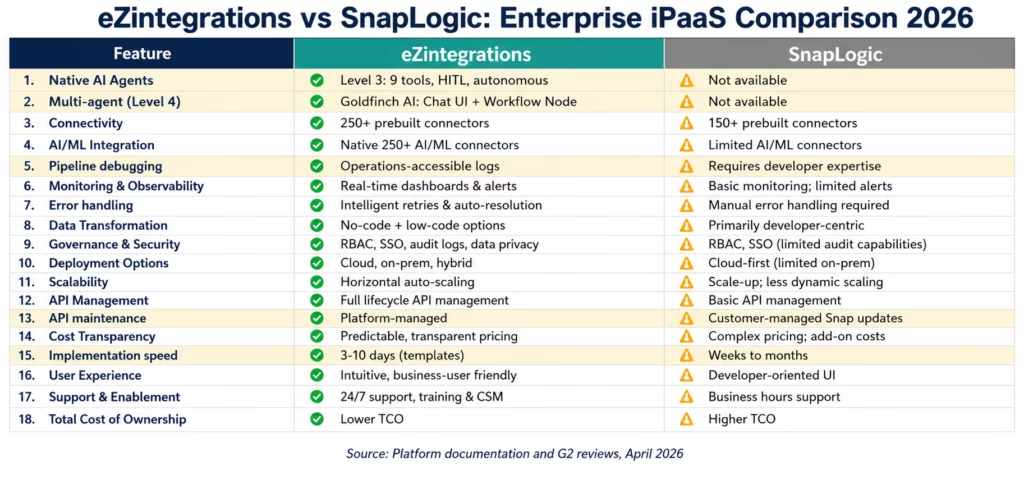
Introduction
SnapLogic has been an established player in the iPaaS and data integration market for over a decade. Its visual pipeline builder, Snap ecosystem, and cloud-native architecture have made it a preferred tool for data engineering teams managing complex ETL and ELT pipelines.
The market has evolved. In 2026, “handling real enterprise complexity”, as reflected in Gartner iPaaS Magic Quadrant and enterprise integration research, means more than data pipeline throughput. It means native AI workflow automation, autonomous AI agents that handle exception queues without developer intervention, multi-agent orchestration for complex enterprise decisions, and maintenance models that do not require your integration team to become experts in upstream API change management.
This comparison examines eZintegrations and SnapLogic across the criteria that determine which platform genuinely handles enterprise complexity in 2026: AI automation depth, implementation and maintenance model, pipeline debugging accessibility, connector depth, governance, and total cost of ownership.
If you are evaluating SnapLogic for a new deployment or reconsidering a current SnapLogic investment, this analysis gives you the specific data points for that decision.
What “Enterprise Complexity” Actually Means in 2026
A decade ago, “enterprise complexity” in integration meant: high data volumes, many source systems, complex transformation logic, and reliable delivery. SnapLogic was designed for exactly this: and it handles it well.
In 2026, enterprise complexity has two additional layers that were not relevant at SnapLogic’s founding:
Layer 1: AI automation complexity. Enterprise processes generate exceptions that cannot be handled by deterministic rules. A 15-20% invoice exception rate, a vendor due diligence process that requires researching multiple data sources, a contract review that requires reading and classifying document content. These require AI reasoning, not pipeline logic.
Layer 2: Operational accessibility. When an integration breaks at 2 AM, the question is: who fixes it? If the answer is “only the data engineer who built the pipeline,” you have a key person risk and a mean-time-to-recovery problem. If the answer is “the operations manager can read the execution log and identify the issue,” you have operational resilience.
eZintegrations was designed for both layers. SnapLogic was designed for the pre-2026 definition of complexity, and its AI additions (SnapGPT) are primarily a developer productivity tool, not a production-grade AI automation layer.
AI Automation: Native Capability vs Development Assistance
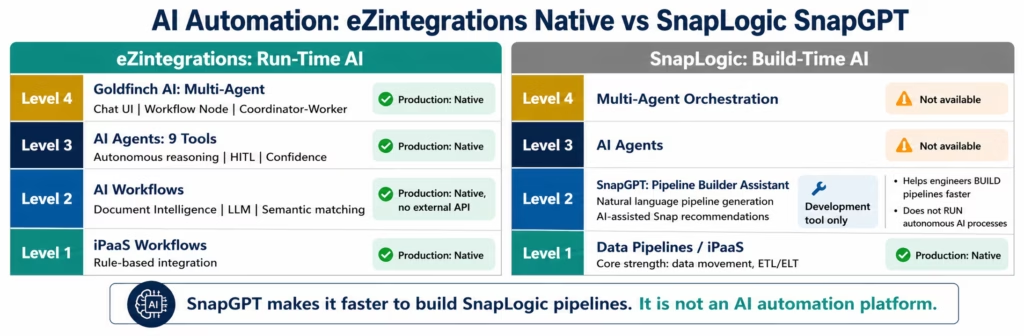
The verdict: eZintegrations delivers production AI automation. SnapLogic’s SnapGPT is a developer assistant that helps build pipelines faster, not a platform for autonomous AI workflows.
What SnapLogic offers for AI:
SnapLogic launched SnapGPT in 2023. SnapGPT is described as an AI-powered integration assistant that helps users build pipelines using natural language. You describe a pipeline in plain English, and SnapGPT generates a starting pipeline structure. SnapGPT also includes AI-assisted Snap recommendations and pipeline documentation.
This is genuinely useful for experienced SnapLogic users who want to build pipelines faster. It is not AI workflow automation. SnapGPT does not:
- Process documents autonomously and extract structured data
- Run as an autonomous agent that retrieves ERP context and makes routing decisions
- Execute multi-step reasoning chains across enterprise systems
- Provide a Chat UI through which business users can query enterprise data in natural language
For production AI workflow automation (processing AP exceptions, running vendor due diligence, extracting clinical document data, routing insurance claims), SnapLogic requires building pipelines that call external AI APIs from within SnapLogic Snaps. This approach sends your data to a third-party AI environment, adds cost and latency, and does not provide the agent architecture (confidence thresholds, reflection loops, human-in-the-loop gates, tool orchestration) that production AI automation requires.
What eZintegrations offers for AI:
All four automation levels are native:
Level 1 (iPaaS Workflows): rule-based integration automation: comparable to SnapLogic’s core pipeline capability.
Level 2 (AI Workflows): Document Intelligence, LLM classification, semantic duplicate detection, and 3-way match with AI tolerance assessment run as native workflow nodes within eZintegrations. No external AI API. Document data stays within the HIPAA/GDPR/SOC 2 compliance boundary.
Level 3 (AI Agents): autonomous multi-step agents with 9 native enterprise tools: Knowledge Base Vector Search, Document Intelligence, Data Analysis, Data Analytics with Charts/Graphs/Dashboards, Web Crawling, Watcher Tools, API Tool Call, Integration Workflow as Tool, and Integration Flow as MCP. Confidence thresholds, reflection loops, and human-in-the-loop gates configured visually. No custom agent code.
Level 4 (Goldfinch AI): coordinator-worker multi-agent orchestration with Chat UI (natural language enterprise queries) and Workflow Node (coordinator intelligence embedded in Level 1 workflows).
SnapLogic has no production equivalent to Level 3 or Level 4. SnapGPT is a build-time tool; eZintegrations’ AI agents are run-time autonomous processes.
The Practical Test
Ask SnapLogic this question: “Can your platform process an invoice exception autonomously: extracting the invoice data, querying SAP for the PO, comparing amounts, classifying the discrepancy, and routing a structured recommendation to an AP manager: without custom code and without the data leaving your compliance boundary?”
The honest answer from SnapLogic: you can build a pipeline that calls external AI APIs to perform some of these steps. The result requires: custom pipeline development, external AI API credentials and cost, data leaving SnapLogic to the AI provider, and no native confidence threshold or HITL architecture.
The eZintegrations answer: yes. Import the AP Exception Agent template from the Automation Hub. Configure SAP credentials. Set your confidence threshold. The agent runs natively. No external AI API. No custom code.
The Snap Maintenance Problem
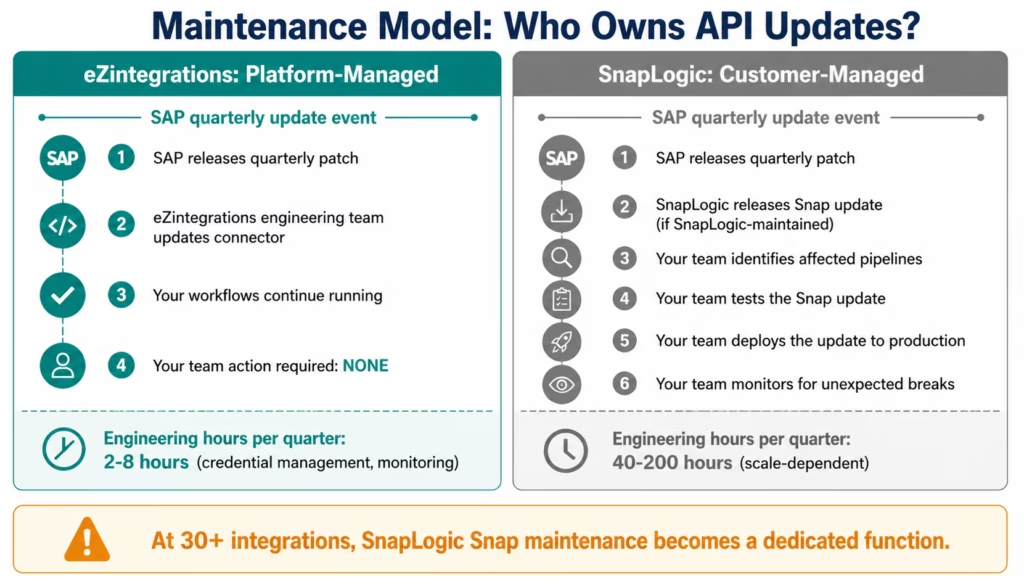
The verdict: SnapLogic’s Snap model transfers API maintenance responsibility to your team. eZintegrations manages API updates at the platform level.
SnapLogic’s Snap ecosystem contains hundreds of pre-built connectors (Snaps) for enterprise systems. When Salesforce releases a new API version, when SAP changes an OData endpoint in a quarterly patch, when NetSuite deprecates an authentication method: the question is: whose responsibility is it to update the affected Snaps?
In SnapLogic’s architecture, Snaps are either:
- SnapLogic-maintained Snaps: the SnapLogic team updates these when upstream APIs change. You apply the update to your pipelines.
- Community Snaps or custom Snaps: your team maintains these when upstream APIs change.
- HTTP Generic Snaps: your team configures and maintains these for any API without a dedicated Snap.
The maintenance burden shows up in three places. First, when a Snap update is released, your team needs to identify which pipelines use the affected Snap, test the update, and deploy it. Second, for ERP systems (SAP, Oracle, NetSuite) where authentication complexity is high (SAP CSRF tokens, NetSuite TBA), maintenance incidents are common when authentication changes. Third, community and custom Snaps have no maintenance guarantee.
Customer reviews on G2 and Gartner Peer Insights consistently identify pipeline maintenance as a SnapLogic pain point: not because the platform is unreliable, but because the maintenance model requires ongoing developer attention that compounds with integration scale.
eZintegrations’ model: the platform team monitors upstream API release schedules and updates connectors before breaking changes take effect. SAP quarterly updates, Salesforce API version releases, NetSuite biannual updates: all handled by the eZintegrations engineering team. Your team configures credentials and business logic. The platform maintains the API connections.
The maintenance math:
| Maintenance Item | eZintegrations | SnapLogic |
|---|---|---|
| SAP quarterly API update | Platform team handles | Your team identifies and deploys Snap update |
| Salesforce API version release (3x/year) | Platform handles | Your team updates affected pipelines |
| NetSuite auth change | Platform handles | Your team debugs and updates |
| Custom HTTP connector break | Platform handles for catalog APIs | Your team fixes |
| New Snap update deployment | Not required | Your team tests and deploys |
| Estimated engineering hours per quarter | 2-8 hours | 40-200 hours (scale-dependent) |
Pipeline Debugging: Who Can Actually Fix It?
The verdict: eZintegrations execution logs are accessible to operations teams. SnapLogic pipeline debugging requires data engineering expertise.
This is one of the most consistent themes in SnapLogic customer feedback: when a complex pipeline fails, diagnosing and fixing the issue requires the data engineer who built it. The visual pipeline builder that makes SnapLogic powerful for builders also makes failed pipeline state difficult to interpret without significant SnapLogic expertise.
SnapLogic’s pipeline execution view shows the pipeline flow with Snap-level status indicators. For data engineers familiar with the platform, this is useful. For operations managers, IT business analysts, or AP managers who need to understand why a specific invoice failed to process, the SnapLogic execution view requires translation.
eZintegrations’ execution log is designed for operations teams, not only developers. Every workflow execution shows:
- Which step failed and the specific error message in plain language
- The input data that triggered the step (the specific record that caused the failure)
- The destination system response (the exact error returned by SAP, Salesforce, or NetSuite)
- The retry status and history
- A one-click reprocess option for failed records
The AP manager who receives a HITL package from an AI agent can trace the agent’s reasoning. The finance team lead can see why a specific invoice failed to post. The IT manager can identify the root cause without escalating to the data engineering team.
This accessibility difference matters at 2 AM when a critical process fails: with eZintegrations, the on-call operations person can diagnose and often resolve the issue. With SnapLogic, the on-call data engineer needs to be available.
Connector and Protocol Depth
The verdict: eZintegrations is stronger on API protocol breadth and native ERP authentication management. SnapLogic is stronger on data pipeline throughput and ETL/ELT volume capability.
API protocol support:
| Protocol | eZintegrations | SnapLogic |
|---|---|---|
| REST API | Full: 4 pagination types, all auth methods | Full |
| GraphQL | Native connector with cursor pagination | Limited: primarily custom Snap |
| WebSocket | Native | Limited |
| Webhooks | Full: HMAC verification, fan-out, dead letter queue | Supported |
| SQL databases (MySQL, PostgreSQL, Oracle, SQL Server) | Native connectors | Strong: ETL core strength |
| NoSQL (MongoDB, DynamoDB, Cassandra) | Native connectors | Connector library |
| Cloud DW (Snowflake, BigQuery, Redshift) | Native connectors | Strong: core strength |
| API Catalog depth | 1,000+ pre-configured with auth + pagination | Snap library, variable depth |
Where SnapLogic is stronger: data volume throughput, ETL/ELT pipeline orchestration for large-scale data movement, and cloud data warehouse connectivity as a core design capability. SnapLogic was built for data engineers moving large datasets between cloud systems.
Where eZintegrations is stronger: native ERP authentication management (SAP OData V4 with automatic CSRF token handling, NetSuite SuiteQL with TBA, Oracle REST with OAuth assertion), GraphQL and WebSocket support, and the API Catalog approach where 1,000+ connectors are pre-configured with the correct authentication method and pagination pattern. The eZintegrations API Catalog means you configure credentials; the platform manages the authentication complexity.
Implementation Speed and Time to Value
The verdict: eZintegrations goes live in days using Automation Hub templates. SnapLogic pipelines are typically built in weeks to months.
SnapLogic’s implementation model: a data engineer (internal or from a SnapLogic partner) builds the pipeline from Snaps, configures connections, writes transformation logic, tests in development, and promotes to production. For a straightforward pipeline (one source, one destination, simple transformation), this takes days. For a complex enterprise integration (SAP to Salesforce with bidirectional sync, error handling, and retry), this takes weeks.
eZintegrations’ implementation model: search the Automation Hub for your integration pair. Import the template. Configure credentials. Test. Activate. For standard enterprise integration pairs (Salesforce-to-SAP, Workday-to-Active Directory, Stripe-to-QuickBooks), Automation Hub templates go live in 3-10 days.
The quality difference between template types:
SnapLogic has a Snap template library that provides starting points for common patterns. These templates require configuration and are a starting point, not a production-ready workflow.
eZintegrations Automation Hub templates are production-ready: they include the correct API endpoint paths, authentication configuration, field mapping for standard data flows, error handling, retry logic, and pagination. Import and configure credentials: the business logic is pre-built.
Implementation cost comparison:
| Implementation Factor | eZintegrations | SnapLogic |
|---|---|---|
| Standard integration (one source, one dest) | 3-5 days (template) | 2-3 weeks (build) |
| Complex ERP integration (SAP to Salesforce) | 5-10 days (template + config) | 4-8 weeks (build) |
| Professional services dependency | Low: templates reduce build work | Moderate-high: partner ecosystem common |
| Internal staffing requirement | IT generalist can configure | Data engineer required |
| Time to first production workflow | Under 2 weeks | 4-8 weeks typical |
[VIDEO PLACEHOLDER: implementation comparison | “eZintegrations vs SnapLogic: Salesforce to SAP Integration Setup Compared” | Embed after implementation section | Show: importing eZintegrations Automation Hub template for Salesforce-to-SAP, configuring credentials, activating: compared to equivalent SnapLogic pipeline build steps. Duration: 10-12 minutes.]
Enterprise Governance and Compliance
The verdict: eZintegrations includes HIPAA and SOC 2 Type II at all tiers. SnapLogic restricts some compliance features to enterprise tiers.
| Security and Governance Feature | eZintegrations | SnapLogic |
|---|---|---|
| SOC 2 Type II | All tiers | Enterprise |
| HIPAA BAA | Available | Enterprise |
| GDPR compliance | All tiers | All tiers |
| Role-based access control | All tiers | All tiers |
| SSO / SAML | All tiers | Enterprise |
| Full audit logs | All tiers | Enterprise |
| Data residency options | Enterprise | Enterprise |
| On-premises connectivity | IPSec Tunnel (included) | Groundplex agent |
| Pipeline/workflow encryption | All tiers | All tiers |
| Credential vault | All tiers | All tiers |
For enterprises in healthcare, financial services, and life sciences where HIPAA and SOC 2 Type II are baseline procurement requirements, eZintegrations includes both at all tiers. SnapLogic restricts these to enterprise tier contracts, which adds to the cost for regulated industries.
The on-premises connectivity difference is also material: eZintegrations connects to on-premises ERP systems (SAP ECC, Oracle EBS, JDE) via IPSec Tunnel without requiring agent software installation and management. SnapLogic uses Groundplex, a containerised agent that your team installs, sizes, patches, and monitors. For enterprises with strict on-premises security policies, the agent approach adds infrastructure overhead that the IPSec Tunnel approach does not.
Pricing and Total Cost of Ownership
The verdict: eZintegrations is more predictable. SnapLogic’s capacity-based pricing escalates with pipeline complexity and data volume.
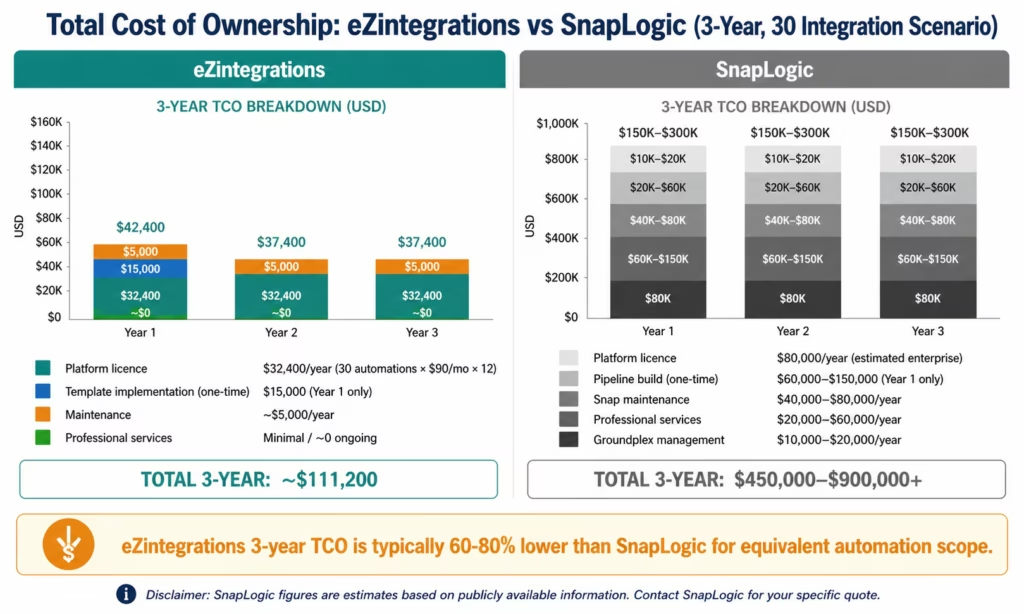
SnapLogic does not publish full pricing publicly (see SnapLogic pricing reference). Based on available community-reported figures and public information, SnapLogic is positioned as an enterprise platform with pricing typically starting in the $30,000-$60,000/year range for mid-market and reaching $150,000-$500,000+/year for large enterprise deployments with high pipeline capacity and data volume requirements.
SnapLogic’s pricing is capacity-based (pipeline nodes, data throughput, and sometimes user counts), which means that as your integration complexity grows and your data volumes increase, your SnapLogic costs increase: often unpredictably between contract renewals.
eZintegrations pricing:
- Level 1 and Level 2 automations: $90/month per automation
- Level 3 AI Agent automations: $120/month per automation
- Level 4 Goldfinch AI automations: $150/month per automation
- Platform fee: $0. Connector fee: $0. Data volume overages: $0.
A 20-automation deployment: $21,600/year. A 50-automation deployment: $54,000/year. Predictable for the life of the contract regardless of data volume growth.
The hidden cost comparison, consistent with findings from Forrester Total Economic Impact of integration platforms:
Beyond licence cost, the total cost of operating SnapLogic includes:
- Engineering time for pipeline builds (versus Automation Hub template imports)
- Engineering time for Snap maintenance (versus platform-managed API updates)
- Groundplex agent management for on-premises connectivity
- Professional services fees for complex pipeline builds (SnapLogic partner ecosystem)
- Data engineer specialisation requirement (versus IT generalist accessibility)
Gartner research consistently shows that implementation and maintenance costs represent 3-5x the licence cost for complex enterprise integration deployments. SnapLogic’s model places more of these costs on the customer side; eZintegrations’ Automation Hub and platform-managed maintenance model reduces them.
Who Should Choose Each Platform
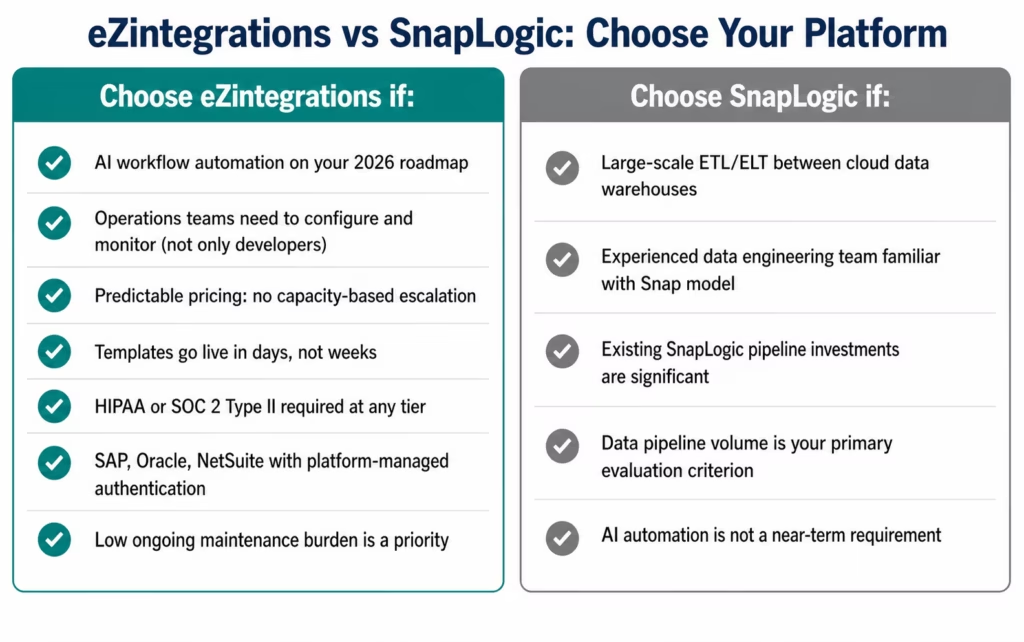
Choose eZintegrations if:
- Your organisation has AI automation on its 2026-2027 roadmap and needs native Level 2, 3, or 4 AI capability without external API calls
- Your integration team includes IT generalists and operations managers who need to configure and monitor workflows without data engineering skills
- You need predictable, flat pricing that does not escalate with data volume or pipeline complexity
- You want production-ready Automation Hub templates that go live in days, not weeks
- Your compliance requirements include HIPAA or full SOC 2 Type II coverage at any tier
- You need native ERP connectivity (SAP, Oracle, NetSuite) with platform-managed authentication
- You want platform-managed API updates rather than a team that monitors and deploys Snap updates
Choose SnapLogic if:
- Your primary use case is large-scale ETL/ELT data movement between cloud data warehouses and cloud sources
- Your integration team consists of experienced data engineers comfortable with the SnapLogic Snap model
- You have existing SnapLogic expertise and pipeline investments that would be costly to migrate
- Data pipeline throughput and volume are your primary evaluation criteria
- AI automation for business process workflows is not a near-term requirement
Detailed Feature Comparison
| Capability | eZintegrations | SnapLogic | Winner |
|---|---|---|---|
| Data pipeline / ETL | Level 1 workflows + database connectors | Core strength: high-volume ETL/ELT | SnapLogic (volume) |
| Level 2: AI Workflow steps | Native: Document Intelligence, LLM | SnapGPT (development assistant only) | eZintegrations |
| Level 3: AI Agents | 9 native tools, autonomous, HITL | Not available | eZintegrations |
| Level 4: Multi-agent | Goldfinch AI (Chat UI + Workflow Node) | Not available | eZintegrations |
| No-code for non-developers | Full: operations teams configure | Partial: data engineer optimised | eZintegrations |
| REST API integration | Full: 4 pagination types | Full | Tie |
| GraphQL support | Native connector | Custom Snap / limited | eZintegrations |
| WebSocket | Native | Limited | eZintegrations |
| ERP connectors (SAP, Oracle, NetSuite) | Native (CSRF, SuiteQL, OAuth) | Connector library | eZintegrations |
| Database throughput | Good: incremental watermark | Excellent: ETL core | SnapLogic |
| Cloud DW (Snowflake, BigQuery) | Native connectors | Strong: core strength | Tie/SnapLogic |
| Template library quality | 1,000+ production-ready | Snap starting points | eZintegrations |
| Implementation speed | 3-10 days (templates) | Weeks to months | eZintegrations |
| API maintenance | Platform-managed | Customer-managed Snaps | eZintegrations |
| Pipeline debugging accessibility | Operations-team accessible | Developer-required | eZintegrations |
| Pricing predictability | Flat per-automation | Capacity-based, escalates | eZintegrations |
| HIPAA at all tiers | Yes | Enterprise tier only | eZintegrations |
| On-premises connectivity | IPSec Tunnel (included, no agent) | Groundplex agent (managed) | eZintegrations |
Bottom Line Verdict
eZintegrations handles real enterprise complexity in 2026 better than SnapLogic on four of the five criteria that define that term today.
On AI automation: eZintegrations wins clearly. SnapGPT helps engineers build pipelines faster. That is useful. But when your AP team has a 200-exception-per-month queue, your vendor due diligence process requires multi-source research, or your quality team needs autonomous CAPA investigation, you need production AI agents, not a pipeline builder assistant.
On maintenance burden: eZintegrations wins. Platform-managed API updates versus customer-managed Snap updates represents a material difference in engineering capacity as your integration estate grows. At 30+ integrations, SnapLogic Snap maintenance becomes a significant ongoing cost.
On debugging accessibility: eZintegrations wins. When a process fails at 2 AM, the operations manager who can read an eZintegrations execution log resolves the issue faster than waking the data engineer who built the SnapLogic pipeline.
On pricing predictability: eZintegrations wins. Flat per-automation pricing versus capacity-based SnapLogic pricing that escalates with data volume and pipeline complexity.
On data pipeline throughput for ETL/ELT: SnapLogic wins. If your primary use case is moving millions of records between cloud data sources, SnapLogic’s ETL architecture is genuinely strong. eZintegrations handles enterprise integration volumes well, but high-throughput ETL is SnapLogic’s core design focus.
The tiebreaker: if AI automation is anywhere on your roadmap, eZintegrations is built for 2026. SnapLogic’s SnapGPT is a development tool, not an AI automation platform.
FAQs
For enterprise automation that includes AI workflows, AI agents, or business-process automation, yes. eZintegrations provides native Level 2 AI Workflows, Level 3 AI Agents with 9 built-in tools, and Level 4 Goldfinch AI multi-agent orchestration. SnapLogic's AI capability (SnapGPT) is a development assistant that helps build pipelines faster, not a production AI automation platform. For large-scale ETL/ELT data movement, SnapLogic's dedicated pipeline architecture gives it an advantage. The decision depends on whether your complexity challenge is business-process automation with AI or high-throughput data pipeline movement.
SnapLogic does not have a native AI agent capability equivalent to eZintegrations' Level 3 AI Agents. SnapGPT assists engineers in building SnapLogic pipelines faster using natural language. To add AI reasoning to a SnapLogic pipeline (document extraction, autonomous exception handling, multi-step research), you build pipelines that call external AI APIs from HTTP Snaps. This approach requires external API credentials and cost, adds latency and failure points, sends data outside SnapLogic's compliance boundary, and provides no native confidence threshold, reflection loop, or HITL gate architecture. eZintegrations Level 3 AI Agents run natively with all these capabilities built in.
Four main weaknesses. First, AI capability: SnapGPT is a build-time development assistant, not production AI automation. Level 3 and Level 4 AI capabilities do not exist in SnapLogic. Second, maintenance burden: SnapLogic Snap updates are customer-managed, meaning your team monitors, tests, and deploys updates when upstream APIs change. Third, debugging accessibility: complex SnapLogic pipelines require data engineer expertise to debug, whereas eZintegrations execution logs are designed for operations team accessibility. Fourth, pricing: SnapLogic's capacity-based model escalates with data volume and pipeline complexity in ways that eZintegrations' flat per-automation pricing does not.
Both platforms have SAP connectors, but the depth of native authentication management is different. eZintegrations' SAP connector uses native OData V4 with automatic CSRF token management for write operations. Your team configures SAP credentials; the platform manages CSRF token fetch, authentication refresh, and SAP-specific error parsing. SnapLogic's SAP connector works but CSRF token handling for SAP write operations is a documented maintenance challenge: authentication incidents are more common and require data engineer intervention to resolve. For enterprises where SAP is a critical system with frequent write operations, eZintegrations' native ERP connector model is more reliable and lower maintenance.
Migration complexity depends on your SnapLogic deployment. For business-process automation pipelines (SaaS-to-SaaS, ERP integration, HR automation), Automation Hub templates cover most common patterns and deploy in 3-10 days each. For complex ETL/ELT data pipelines with significant transformation logic, migration requires mapping SnapLogic Snap logic to eZintegrations workflow steps and database queries, typically 2-4 weeks per complex pipeline. eZintegrations offers a migration assessment during the demo: the team reviews your current SnapLogic pipeline inventory, identifies Automation Hub template coverage, and produces a migration timeline and effort estimate.
Yes, for business-process integration. eZintegrations has native Snowflake, BigQuery, and Redshift connectors with incremental watermark-based pull, batch load, and SQL query support. For use cases where SnapLogic is used to move operational data from Salesforce, SAP, or NetSuite into Snowflake, eZintegrations handles this with native connectors on both sides. Where SnapLogic holds an advantage is in very high-throughput ETL scenarios (hundreds of millions of rows per run) where SnapLogic's distributed pipeline execution architecture is specifically optimised. For most mid-market and large enterprise operational data integration (up to tens of millions of records), eZintegrations' database connector handles the volume adequately.1. Is eZintegrations better than SnapLogic for enterprise automation?
2. How does SnapLogic compare to eZintegrations for AI agent workflows?
3. What are SnapLogic's main weaknesses compared to eZintegrations?
4. How does SnapLogic compare to eZintegrations for SAP integration?
5. How long does it take to migrate from SnapLogic to eZintegrations?
6. Can eZintegrations replace SnapLogic for Snowflake and data warehouse integration?
Conclusion
SnapLogic is a capable platform for data engineering teams who need high-throughput ETL/ELT pipelines and are comfortable with the Snap model. Its data warehouse connectivity and distributed pipeline architecture are genuine strengths for specific data movement use cases.
But “enterprise complexity” in 2026 extends beyond data movement. It includes autonomous AI workflow automation, operations-team-accessible tooling, platform-managed maintenance, and predictable pricing at scale. On these four criteria, eZintegrations holds a clear advantage.
If your organisation’s integration needs are primarily large-scale ETL between cloud data warehouses managed by a dedicated data engineering team, SnapLogic is worth evaluating. If your needs include business-process automation, AI agent workflows, exception handling, and accessible tooling for operations teams alongside IT, eZintegrations is the stronger choice.
Book a free demo and bring your current SnapLogic pipeline inventory. We will show you the Automation Hub template coverage for your integration pairs, demonstrate the Level 3 AI Agent capability for your highest-exception process, and produce a side-by-side cost comparison for your deployment profile.
Browse the Automation Hub to see the 1,000+ production-ready templates available and identify your SnapLogic migration candidates.
If you are experiencing pipeline debugging pain, Snap maintenance overhead, or AI capability gaps today, you may recognise your situation in the 5 signs your integration platform is holding you back.