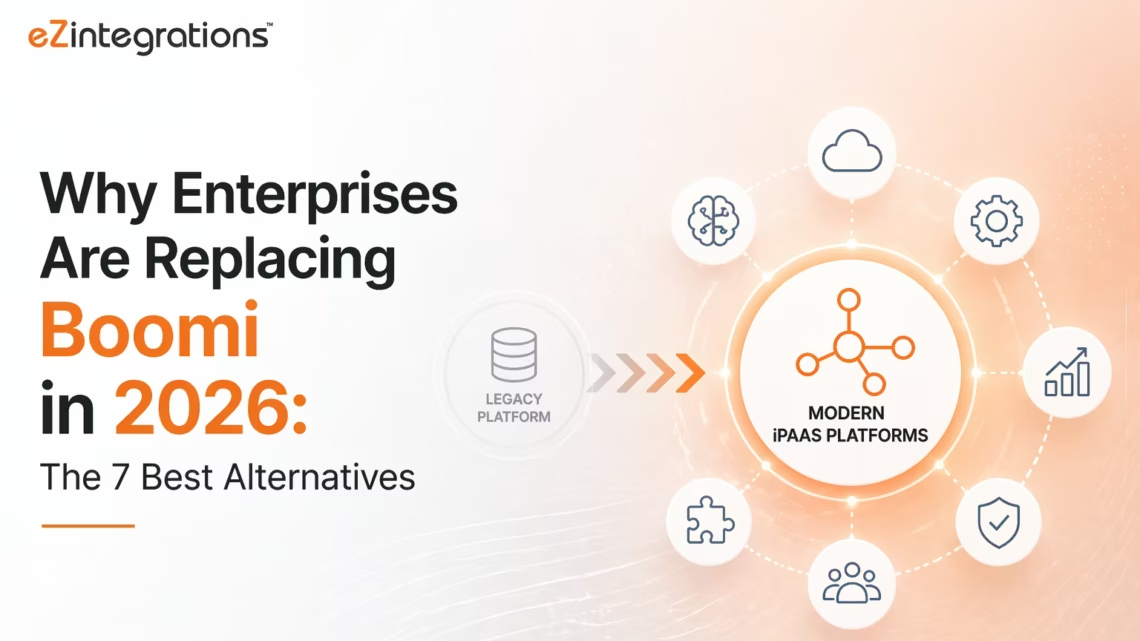
Why Enterprises Are Replacing Boomi in 2026: The 7 Best Alternatives
April 30, 2026The best Boomi alternative in 2026 is eZintegrations, which covers all four automation levels: Level 1 (iPaaS Workflows), Level 2 (AI Workflows), Level 3 (AI Agents), and Level 4 (Goldfinch AI multi-agent) in one platform with transparent per-automation pricing, 1,000+ ready-to-import templates, native ERP connectors for SAP, NetSuite, Oracle, and Dynamics 365, and no connection-counting or atom infrastructure to manage. Teams migrating from Boomi typically go live in 3-10 days per workflow versus the 60-90 day Boomi implementation average.
TL;DR:
- Boomi is a legitimate enterprise iPaaS with 12 consecutive Gartner Magic Quadrant Leader years, 30,000+ customers, and strong B2B/EDI capabilities. This post is not a dismissal of Boomi. It is an honest assessment of the specific situations where teams outgrow it and what they choose instead.
- The most common reasons teams replace Boomi: opaque connection-based pricing that escalates unpredictably at scale, complex transformations requiring scripting workarounds, CI/CD pipelines that need third-party tooling rather than native support, atom infrastructure management overhead, and an AI workflow layer (AgentStudio/Meta Hub) that arrived later than competitors.
- The best Boomi alternative depends on your specific gap: pricing, AI capabilities, ERP connector depth, no-code accessibility, or time-to-value.
- eZintegrations is the top pick for enterprises that need all four automation levels (iPaaS, AI Workflows, AI Agents, Goldfinch AI multi-agent) in one platform with transparent per-automation pricing and 1,000+ pre-built templates.
Why Teams Start Looking for Boomi Alternatives
Boomi has been a Gartner Magic Quadrant Leader for iPaaS for 12 consecutive years, with strong enterprise feedback reflected in Gartner Peer Insights reviews. The platform holds an 88% user satisfaction rating across major review platforms, with a 4.4/5 on G2 and 4.4/5 on Capterra. For many organisations, Boomi works well and continues to work well. This post is about the organisations where it does not, and why.
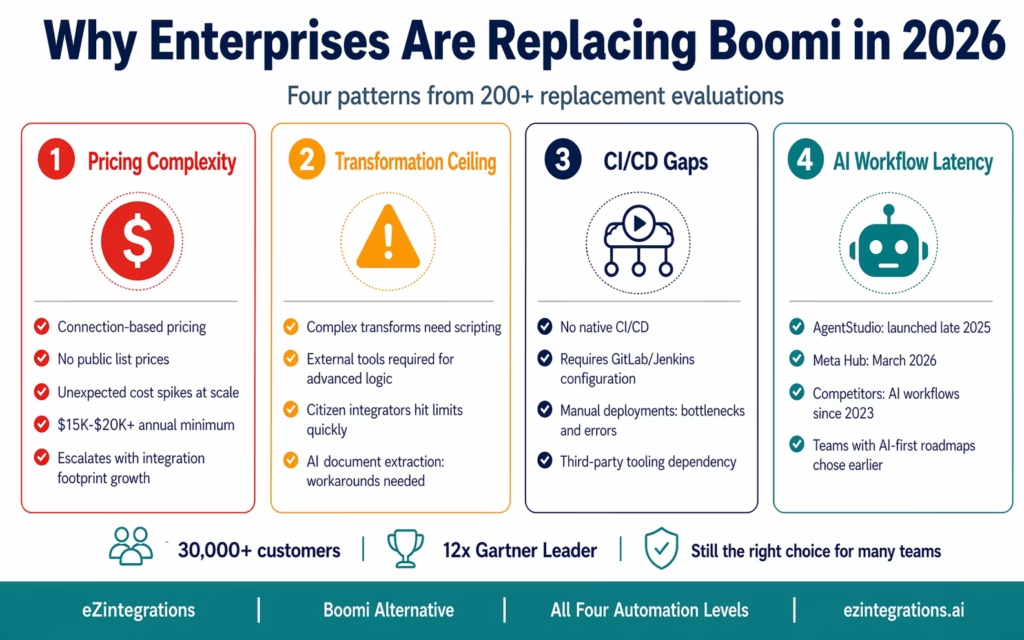
The four patterns that most frequently drive Boomi replacement searches:
Pattern 1: Pricing complexity at scale
Boomi does not publish list Prices for its subscription tiers. Nearly every subscription edition routes to “Talk to sales” rather than showing a dollar amount. The only public numeric price is the pay-as-you-go option starting at approximately $550 per month for 5 connections. Annual contract values range from mid-five figures for smaller deployments to mid-six figures or higher for enterprise-scale implementations. The connection-counting model means growing your integration footprint triggers unpredictable cost escalations. As one PeerSpot reviewer noted: “The pricing is not reasonable at all. It’s very high.” Organizations experiencing rapid growth or seasonal spikes often encounter unexpected cost increases that contrast with fixed-fee alternatives.
Pattern 2: Transformation complexity ceiling
Complex data transformations, a common need in large organisations, can push Boomi’s limits. Users highlight the need for external tools or custom scripting to handle intricate data manipulation. For teams running straightforward ERP-to-CRM syncs, this ceiling never becomes visible. For teams running invoice document extraction, multi-system matching, or AI-assisted exception handling, Boomi’s visual transformation layer runs out of runway before the business requirement does.
Pattern 3: CI/CD and DevOps gaps
Boomi is fast, but without CI/CD automation, releases are not. Traditional development cycles slow teams down. Manual deployments create bottlenecks, introduce errors, and compromise governance. CI/CD integration with Boomi requires third-party tooling (GitLab, Jenkins, or custom API scripting against Boomi’s deployment APIs). This is not insurmountable, but it adds a dependency that teams with mature DevOps practices find frustrating compared to platforms where environment promotion and version management are native.
Pattern 4: The AI workflow gap
Boomi released AgentStudio and Meta Hub in late 2025 and March 2026 respectively. These are genuine innovations, and the claim of 75,000 agents in production is significant. However, teams evaluating platforms for AI Workflow automation (document intelligence, LLM-based classification, agentic exception handling) in 2024 and early 2025 found Boomi’s AI layer still maturing while competitors had production-ready AI workflow steps available. The gap has narrowed in 2026 but remains a consideration for teams with AI-first automation roadmaps.

How We Evaluated These Alternatives
This evaluation is based on seven criteria relevant to enterprises currently running Boomi or evaluating it as a purchase:
Pricing transparency: does the platform publish prices publicly? Is the pricing model predictable as integration volume grows?
ERP connector depth: native connectors for SAP S/4HANA, NetSuite, Oracle, Dynamics 365, JDE. Not HTTP workarounds.
AI automation capabilities: beyond basic workflow automation, does the platform handle document intelligence, LLM-based classification, autonomous agent workflows, and multi-agent orchestration?
Time to value: how long from contract signing to a production workflow? The 60-90 day Boomi implementation average is a known benchmark. Can alternatives compress this?
CI/CD and DevOps: native environment promotion, version management, and deployment pipeline support without requiring third-party tooling.
No-code accessibility: can operations managers, finance analysts, and procurement leads configure and maintain workflows without developer involvement?
Compliance and security: HIPAA, GDPR, SOC 2 Type II certification. On-premises connectivity for regulated industries.
We reviewed G2, Gartner Peer Insights, Capterra, TrustRadius, and PeerSpot data current to April 2026, combined with direct platform evaluation and pricing research.
Summary Comparison Table
| Platform | Pricing Model | ERP Connectors | AI Workflows | AI Agents | Native CI/CD | No-Code | G2 Rating |
|---|---|---|---|---|---|---|---|
| eZintegrations | Per-automation, transparent | SAP, NetSuite, Oracle, D365, JDE native | Level 2 AI Workflows | Level 3 + L4 Goldfinch AI | Yes (native) | Yes | 4.7/5 |
| Boomi | Connection-based, quote only | 1,500+ connectors (some ERP via HTTP) | AgentStudio | Meta Hub | Via API + 3rd party | Yes | 4.4/5 |
| MuleSoft | vCore-based, expensive | Deep ERP connectors | AI Chain + Copilot | Limited | Yes | Partial | 4.4/5 |
| Workato | Recipe-based, quote | Good ERP coverage | AI features available | Limited | Partial | Yes | 4.7/5 |
| Azure Integration Services | Consumption-based | Azure-native + some ERP | Azure AI Services | Limited | Yes (Azure DevOps) | Partial | 4.3/5 |
| Celigo | Connection-based | NetSuite-strong, growing | AI features | Limited | Partial | Yes | 4.6/5 |
| Informatica IICS | Usage-based, complex | Strong data connectors | CLAIRE AI engine | Limited | Partial | Partial | 4.3/5 |
| Jitterbit | Connection-based, quote | ERP connectors available | Basic AI features | No | Partial | Yes | 4.6/5 |
The 7 Best Boomi Alternatives in 2026
1. eZintegrations: Best Overall Boomi Alternative
Overview
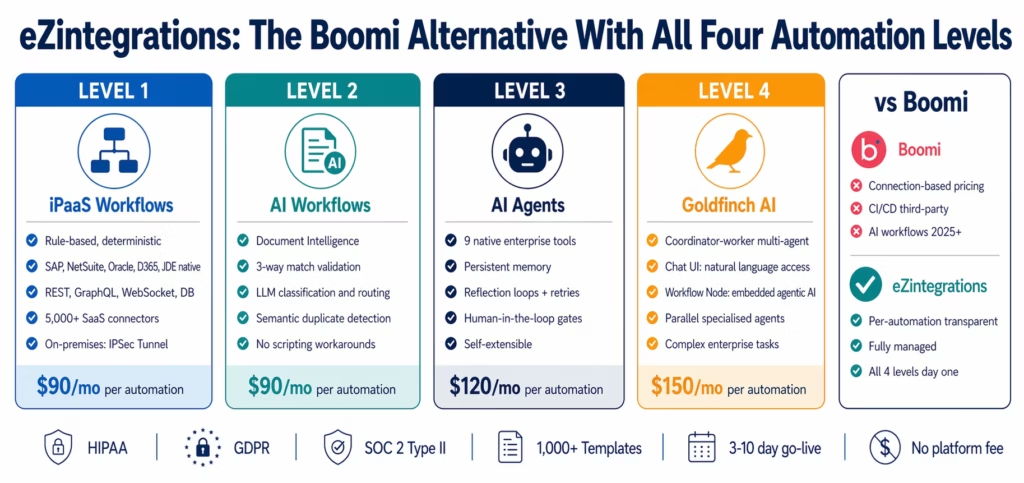
eZintegrations is a fully managed, enterprise no-code automation platform built across four levels: Level 1 (iPaaS Workflows) for deterministic rule-based integration, Level 2 (AI Workflows) for document intelligence and context-sensitive automation, Level 3 (AI Agents) for autonomous tool-using agents, and Level 4 (Goldfinch AI) for multi-agent orchestration with Chat UI and Workflow Node. It is cloud-native and fully managed: no atoms, no infrastructure, no DevOps overhead.
For teams replacing Boomi specifically, eZintegrations addresses each of the four replacement patterns directly: transparent per-automation pricing with no connection counting, AI workflow steps native to the platform from the first release, native ERP connectors (not HTTP workarounds) for SAP S/4HANA, NetSuite, Oracle, Dynamics 365, and JDE, and a 1,000+ template Automation Hub that compresses go-live from Boomi’s 60-90 day average to 3-10 days per workflow.
Best For
- Mid-market enterprises (200-2,000 employees) replacing Boomi due to pricing unpredictability
- Teams with AI-first automation roadmaps that found Boomi’s AI layer still maturing in 2024-2025
- Finance and operations teams that need AP automation, approval workflows, and ERP connectivity without developer involvement
- Organisations that want all four automation levels (iPaaS through agentic AI) in one platform and one pricing structure
Key Features
Level 1 (iPaaS Workflows): REST, GraphQL, WebSocket, webhooks, database integration, queue and pagination support. Native connectors for SAP S/4HANA and ECC (OData V4, automatic CSRF token management), NetSuite (SuiteTalk REST, full SuiteQL), Oracle ERP Cloud (REST, FBDI, OTBI), Dynamics 365 (Finance, SCM, Sales), JD Edwards (Orchestrator API, BSSV), and 5,000+ SaaS applications. On-premises connectivity via IPSec Tunnel.
Level 2 (AI Workflows): Document Intelligence for unstructured PDF extraction across vendor templates, 3-way match validation with AI-assessed tolerance, LLM-based classification and routing, expense policy compliance, duplicate detection via semantic matching. AI steps are native workflow nodes, not external API calls.
Level 3 (AI Agents): 9 native enterprise tools (Knowledge Base Vector Search, Document Intelligence, Data Analysis, Data Analytics with Charts/Graphs/Dashboards, Web Crawling, Watcher Tools, API Tool Call, Integration Workflow as Tool, Integration Flow as MCP). Reflection loops, persistent memory, human-in-the-loop gates. Self-extensible beyond the 9 native tools.
Level 4 (Goldfinch AI): coordinator-worker multi-agent architecture. Chat UI for natural language access to enterprise processes. Workflow Node for embedding agentic intelligence within Level 1 processes.
Automation Hub: 1,000+ ready-to-import templates across all four levels. Most Boomi migration workflows have a matching template. Average go-live per workflow: 3-10 days.
Compliance: HIPAA, GDPR, and SOC 2 Type II certified across the full platform stack.
How eZintegrations Addresses the Boomi Replacement Patterns
| Boomi Pain Point | eZintegrations Resolution |
|---|---|
| Opaque connection-based pricing | Per-automation annual pricing: $5/$90/$120/$150/month per automation. No connection counting. No surprise tier upgrades. No platform fee. No connector fee. |
| Transformation complexity ceiling | Level 2 AI Workflows handle document extraction, semantic matching, and LLM-based classification natively. No scripting workarounds. |
| CI/CD and DevOps third-party dependency | Fully managed platform: no atoms, no containers, no deployment pipelines to maintain. Platform updates are automatic. |
| AI workflow layer immaturity | All four automation levels available from day one. Level 3 AI Agents with 9 native tools and Level 4 Goldfinch AI are production-grade, not beta features. |
| ERP connector HTTP workarounds | Native OData V4 connectors for all major ERPs with automatic CSRF token management, OAuth refresh, and error handling built in. |
| 60-90 day implementation average | Automation Hub templates: 3-10 days per workflow to production. Parallel running protocol included. |
Limitations
eZintegrations does not currently have a B2B/EDI module comparable to Boomi’s Enterprise Plus EDI capabilities. For organisations with significant EDI trading partner management requirements (850/855/856/810 transaction sets at scale), Boomi’s B2B module remains more mature. eZintegrations handles EDI via its API connectors but does not have a native EDI management interface. This is the one use case where staying on Boomi or choosing a Boomi/eZintegrations hybrid may be appropriate.
eZintegrations also does not yet have Boomi’s Master Data Hub (MDH) for cross-system master data management. Teams with active MDM programmes should evaluate this gap.
Pricing
Transparent per-automation annual pricing:
- Free tier: available for basic workflows
- $5/month per automation: simple SaaS-to-SaaS
- $90/month per automation: standard enterprise workflows (Level 1 and Level 2)
- $120/month per automation: AI Agent workflows (Level 3)
- $150/month per automation: Goldfinch AI multi-agent (Level 4)
No platform fee. No connector fee. No connection counting. All compliance certifications included.
G2 Rating: 4.7/5
2. MuleSoft Anypoint Platform: Best for Large Enterprises with Deep Developer Teams
Overview
MuleSoft Anypoint Platform is the integration layer within Salesforce, targeting large enterprises with complex integration landscapes and dedicated integration development teams. It is technically the most powerful iPaaS in the category, with deep API management, runtime fabric deployment options, and the largest connector library. It is also the most expensive and the most developer-dependent.
Best For
Large enterprises (2,000+ employees) with 10+ dedicated integration developers, Salesforce-heavy technology stacks, and requirements for the most technically capable API management platform in the category.
Key Features
vCore-based Mule runtime, Anypoint Exchange for reusable assets, Runtime Fabric for Kubernetes deployment, API Designer and API Manager, DataWeave transformation language (powerful but requiring developer skills), Flow Designer for low-code, and MuleSoft AI Chain for LLM integration.
Limitations
MuleSoft’s vCore-based pricing often results in higher total cost for similar integration workloads, particularly for organisations with high transaction volumes or complex workflows. DataWeave requires developer fluency. Not accessible to citizen integrators. Heavy implementation services dependency. For organisations replacing Boomi because of cost, MuleSoft is typically more expensive, not less.
Pricing
vCore-based, custom quote. Typically the most expensive platform in this comparison. Expect six-figure annual contracts for enterprise deployments. Salesforce integration discounts available for existing Salesforce customers.
G2 Rating: 4.4/5
3. Workato: Best for Business-Led Automation with Strong Recipe Library
Overview
Workato is a strong mid-market iPaaS known for its business-user-accessible recipe-based automation model. The recipe library is extensive, the interface is genuinely accessible to non-developers, and the platform has made serious AI investments with its Copilot features. For organisations replacing Boomi because of complexity and accessibility, Workato is a frequently cited alternative.
Best For
Mid-market teams wanting business-led automation, organisations with strong Salesforce, ServiceNow, or Workday investments, and teams where the primary pain with Boomi is developer dependency rather than pricing.
Key Features
Recipe-based visual automation, Workato Copilot for AI-assisted recipe creation, strong Salesforce and Workday connectors, real-time triggers, and an enterprise-grade connector library. Workbot for Slack and Teams enables conversational automation.
Limitations
Pricing is recipe-based and also quote-driven, not transparently published. Enterprise ERP connectivity (SAP S/4HANA deep OData, NetSuite SuiteQL) is available but not as natively deep as dedicated ERP integration platforms. AI workflow steps are newer additions rather than foundational architecture. The multi-agent and Level 3/Level 4 agentic capabilities are limited compared to platforms built AI-first.
Pricing
Quote-based. Comparable to Boomi Enterprise tier. Recipe and workspace-based model. Contact sales for enterprise pricing.
G2 Rating: 4.7/5
4. Microsoft Azure Integration Services: Best for Microsoft-Centric Enterprises
Overview
Azure Integration Services is not a single product but a family: Azure Logic Apps (workflow automation), Azure API Management (API gateway), Azure Service Bus (messaging), Azure Event Grid (events), and Azure Data Factory (data pipelines). For organisations already deeply invested in the Microsoft stack (Dynamics 365, Azure AD, Power Platform, Teams), the integration between these services is a genuine advantage.
Best For
Enterprises with Azure-first infrastructure strategies, Microsoft Dynamics 365 as primary ERP, and existing Azure DevOps pipelines. Teams that want to avoid per-platform licensing costs by consolidating on existing Azure spend.
Key Features
Logic Apps (low-code workflow builder), built-in connectors for Microsoft ecosystem, pay-per-execution pricing model, native Azure DevOps integration for CI/CD, and access to Azure OpenAI Service for AI-enhanced workflows.
Limitations
The Azure Integration Services family is exactly that: a family of separate services, not a unified platform. Building an enterprise integration architecture on Logic Apps, API Management, Service Bus, and Event Grid together requires meaningful integration architecture expertise. The citizen integrator experience is significantly weaker than dedicated iPaaS platforms. Deep ERP connectivity outside the Microsoft ecosystem (SAP, NetSuite, Oracle) requires additional configuration. Azure Data Factory’s pricing displays “$-” instead of actual costs, requiring organisations to model expected spend from usage calculators.
Pricing
Consumption-based (Logic Apps: per action execution). Generally cost-effective for low-to-medium volumes but can become expensive at high execution volumes. Azure DevOps and existing enterprise agreements provide bundling opportunities.
G2 Rating: 4.3/5
5. Celigo: Best for NetSuite-Centric Mid-Market Companies
Overview
Celigo is an iPaaS that built its reputation on deep NetSuite integration. For NetSuite customers replacing Boomi, Celigo is the most frequently considered alternative because of its native NetSuite connector depth and the SuiteApp marketplace presence. Beyond NetSuite, Celigo has expanded to general mid-market iPaaS with a solid connector library.
Best For
Mid-market companies with NetSuite as primary ERP, organisations that need SuiteQL support and NetSuite SuiteScript integration, and teams evaluating Boomi replacements specifically for NetSuite-to-X workflows.
Key Features
Native NetSuite connector (SuiteQL, SuiteScript, SuiteTalk REST), template library for NetSuite use cases (order-to-cash, procure-to-pay, lead-to-customer), Celigo AI for integration assistance, and Celigo iHub for data orchestration.
Limitations
Celigo is strongest in the NetSuite ecosystem. SAP S/4HANA connectivity is available but less deep than dedicated SAP integration platforms. The AI workflow capabilities are newer and less mature than AI-first platforms. Multi-system enterprise architectures spanning SAP, Salesforce, NetSuite, and custom APIs simultaneously require more configuration than a unified-architecture platform.
Pricing
Connection-based pricing, quote-driven. Starting point typically around $600-$800/month for smaller deployments, scaling with connections. Annual contracts standard.
G2 Rating: 4.6/5
6. Informatica Intelligent Cloud Services (IICS): Best for Data-Heavy Enterprises with MDM Requirements
Overview
Informatica IICS is the cloud version of Informatica’s data integration and management platform, now branded as the Intelligent Data Management Cloud (IDMC). It targets large enterprises with serious data quality, data governance, and MDM requirements alongside their integration needs. If Boomi’s Master Data Hub was a key part of your implementation, Informatica is the natural comparison point.
Best For
Large enterprises with active MDM programmes, data governance requirements, Informatica on-premises deployments considering cloud migration, and organisations where data quality is as important as connectivity.
Key Features
CLAIRE AI engine for intelligent data management, Data Integration (ETL/ELT), Application Integration, API Center, Master Data Management, Data Quality, and Data Catalog. The breadth of data management capabilities is unmatched in this comparison.
Limitations
Informatica IICS is complex to implement and maintain. It is primarily used by large enterprises and requires significant technical expertise. Pricing is usage-based and complex, with IPUs (Informatica Processing Units) as the billing unit. For teams replacing Boomi because of complexity, Informatica is typically more complex, not less. The learning curve is steep and implementation services costs are high.
Pricing
IPU-based consumption pricing, custom quotes. Typically higher than Boomi for comparable workloads. Enterprise contracts with annual minimums. Free trial available for evaluation.
G2 Rating: 4.3/5
7. Jitterbit: Best for ERP-Focused Mid-Market Teams Seeking Faster Go-Live
Overview
Jitterbit is a mid-market iPaaS with a strong focus on ERP integration and a reputation for faster implementation than enterprise platforms like Boomi and MuleSoft. The platform positions itself on time-to-value and has a growing AI Studio feature set. Jitterbit Harmony is the integration platform; Jitterbit APIM handles API management.
Best For
Mid-market companies (200-1,000 employees) that need ERP integration without the complexity of Boomi or MuleSoft, organisations seeking faster go-live than the 60-90 day Boomi average, and teams evaluating Boomi replacements for budget reasons.
Key Features
Visual workflow builder, pre-built integration templates for Salesforce-SAP, Salesforce-NetSuite, and common ERP patterns, AI Studio for low-code AI integration, Jitterbit Harmony Cloud, and API management capabilities.
Limitations
Jitterbit does not have the AI workflow depth of AI-first platforms. Level 3 autonomous agent capabilities and multi-agent orchestration are not available. The connector library, while solid for ERP use cases, is smaller than Boomi’s 1,500+ connector catalogue. For organisations with broad enterprise automation needs beyond ERP integration, Jitterbit may require supplementing with additional tools.
Pricing
Connection-based, quote-driven. Generally positioned below Boomi Enterprise pricing, making it a viable cost-reduction alternative for mid-market teams. Annual contracts standard.
G2 Rating: 4.6/5
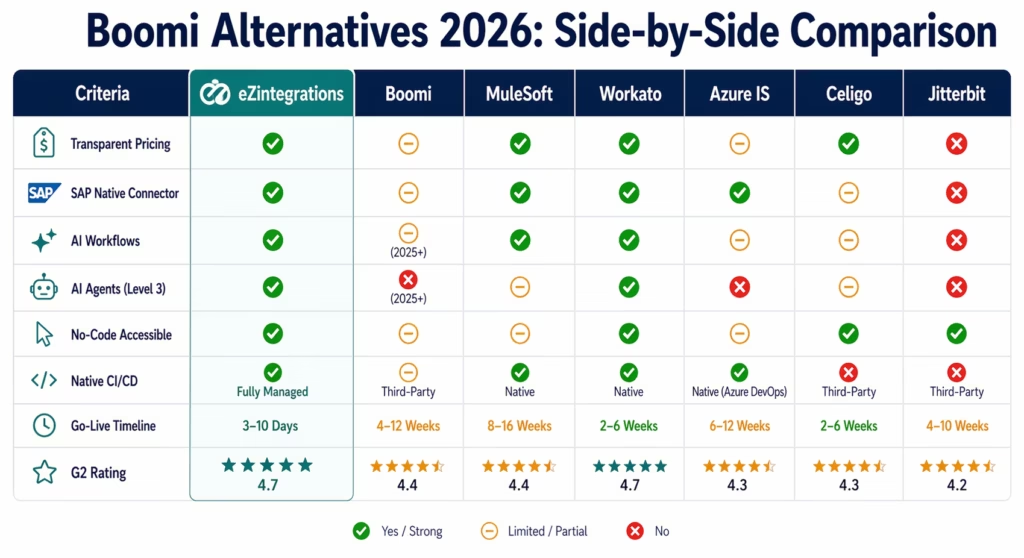
Quick Comparison Table
| Criteria | eZintegrations | Boomi | MuleSoft | Workato | Azure IS | Celigo | Informatica | Jitterbit |
|---|---|---|---|---|---|---|---|---|
| Transparent pricing | Yes | No | No | No | Partial | No | No | No |
| SAP native connector | Yes (OData V4) | Partial | Yes | Partial | Partial | No | Partial | Partial |
| NetSuite native | Yes (SuiteQL) | Partial | Partial | Partial | No | Yes | Partial | Partial |
| AI Workflows (Level 2) | Native | AgentStudio 2025 | AI Chain | Copilot | Azure AI | Celigo AI | CLAIRE | AI Studio |
| AI Agents (Level 3) | 9 native tools | Meta Hub 2026 | Limited | Limited | Limited | No | Limited | No |
| Multi-agent (Level 4) | Goldfinch AI | Partial | No | No | No | No | No | No |
| No-code accessible | Yes | Yes | Partial | Yes | Partial | Yes | Partial | Yes |
| Native CI/CD | Fully managed | 3rd party needed | Yes | Partial | Azure DevOps | Partial | Partial | Partial |
| HIPAA/GDPR/SOC 2 | All three | Yes | Yes | Yes | Yes | Yes | Yes | Partial |
| On-premises ERP | IPSec Tunnel | Atom (on-premise) | Runtime Fabric | Yes | Yes | Yes | Yes | Yes |
| Template library | 1,000+ | Pre-built processes | Exchange | Recipe library | Logic Apps | Templates | Limited | Templates |
| Go-live timeline | 3-10 days | 60-90 days avg | 90-180 days | 30-60 days | 30-60 days | 14-30 days | 90-120 days | 14-30 days |
| G2 rating | 4.7/5 | 4.4/5 | 4.4/5 | 4.7/5 | 4.3/5 | 4.6/5 | 4.3/5 | 4.6/5 |

FAQs
The best Boomi alternative depends on your primary reason for replacing it. For pricing predictability, AI capabilities, and faster time-to-value: eZintegrations offers transparent per-automation pricing (no connection counting), native AI Workflows at Level 2, AI Agents at Level 3, and Goldfinch AI multi-agent at Level 4, all in one platform. For deep Salesforce integration and large enterprise developer teams: MuleSoft remains the most technically capable option. For NetSuite-centric mid-market companies: Celigo has the deepest native NetSuite connector. For Microsoft-stack enterprises: Azure Integration Services provides the best cost consolidation opportunity.
Boomi is worth it for enterprises that need its specific strengths: mature B2B/EDI trading partner management, the Master Data Hub for MDM, proven stability with consistent Gartner Magic Quadrant leadership, and a connector library of 1,500+ with hybrid deployment via the Atom model. For teams focused on AI workflow automation, transparent pricing, and faster time-to-value, alternatives may deliver better value in 2026.
Azure Integration Services has the lowest entry cost with consumption-based Logic Apps pricing. However, at enterprise scale, costs can exceed Boomi. eZintegrations offers the most predictable pricing: flat per-automation cost with no platform or connector fees. Jitterbit and Celigo are typically mid-range, while MuleSoft and Informatica IICS are the most expensive.
For enterprise teams, the choice depends on the capability gap. For AI workflows and agents: eZintegrations. For Salesforce ecosystem depth: MuleSoft. For data quality and MDM: Informatica IICS. For pricing predictability and no-code usability: eZintegrations. Most enterprise evaluations narrow down to MuleSoft vs eZintegrations.
Migration typically takes 4-8 weeks for 15-40 processes. Phase 1: inventory and template mapping (1 week). Phase 2: configuration and parallel validation (2-3 weeks). Phase 3: cutover and decommission (1-2 weeks). ERP-related workflows often simplify due to native connectors replacing HTTP-based integrations.1. What is the best alternative to Boomi in 2026?
2. Is Boomi worth it in 2026?
3. Which Boomi alternative is cheapest?
4. Best Boomi alternative for enterprise teams?
5. How long does it take to migrate from Boomi to eZintegrations?
The Boomi Decision: When to Stay, When to Switch
Boomi is a good platform for the right use case. This post is honest about that. If your team has a mature Boomi deployment that is delivering value, the switching cost of migration is real and should not be underestimated.
Stay on Boomi if: your B2B/EDI trading partner programme depends on Boomi’s Enterprise Plus features, your Master Data Hub implementation is active and working, your team has strong Boomi developer expertise and the transition cost would exceed the pricing savings, or you are mid-contract and the commercial terms do not support migration.
Consider switching if: your integration footprint is growing and the connection-based pricing is escalating unpredictably, your teams are hitting the complex transformation ceiling and using scripting workarounds that are becoming maintenance overhead, your AI-first automation roadmap is being delayed because Boomi’s AI layer arrived later than you needed, or your go-live timelines are running 60-90 days when the business need is 1-2 weeks.
For the teams in that second group: eZintegrations delivers all four automation levels in one platform, with transparent per-automation pricing that does not count connections, native ERP connectors that eliminate HTTP workarounds, and an Automation Hub that compresses go-live to 3-10 days per workflow.
Book a free demo. Bring your current Boomi process list and your primary replacement driver. The eZintegrations team will map your processes to Automation Hub templates, identify which HTTP-based ERP connections become native connectors, and produce a side-by-side cost comparison.
For the complete workflow automation ROI framework, see the ROI business case guide.