AI Agents for Retail: Autonomous Order, Inventory, and Customer Data Workflows
June 16, 2026AI agents for retail connect Shopify, Amazon, Walmart, Magento, NetSuite, SAP, and 3PL systems to autonomously investigate and resolve the exceptions that workflow automation cannot handle: orders that fail standard routing rules, inventory discrepancies across channels, customer escalations that require multi-system investigation, return fraud signals that need pattern analysis, and demand anomalies that require supplier intelligence before a reorder decision can be made. Unlike predefined retail workflows, retail AI agents determine their investigation path based on what each step reveals.
TL;DR
- AI workflows (Level 2) handle routine retail data flows: orders routing to WMS in 30 seconds, inventory broadcasting to all channels within seconds of warehouse movement, standard returns processing on schedule. They handle the 80-85% of operations that follow predictable patterns.
- AI agents (Level 3) handle the 15-20% that doesn’t: the order that fails standard routing because it spans three fulfilment nodes with different inventory positions, the customer who has been escalated after three failed delivery attempts and is threatening churn, the inventory discrepancy that has been accumulating across Shopify and NetSuite for six days and nobody knows why, the demand spike that requires a reorder decision across four suppliers with different lead times and stock positions.
- The distinction is architectural: workflows execute predefined sequences; agents determine investigation paths based on findings at each step. You need both: and the ROI difference between handling the exception class with agents versus with manual queues is 70-85% reduction in time-to-resolution.
- Five retail AI agent use cases with the highest operational ROI: complex order exception investigation agent, multi-channel inventory reconciliation agent, customer escalation intelligence agent, return fraud detection agent, and competitive demand intelligence agent.
- eZintegrations connects Shopify, Amazon, Walmart, Magento, NetSuite, SAP, 3PL systems, and customer service platforms: with 9 native enterprise tools and no custom development required.
The Problem: Retail Exceptions That Workflow Automation Cannot Resolve
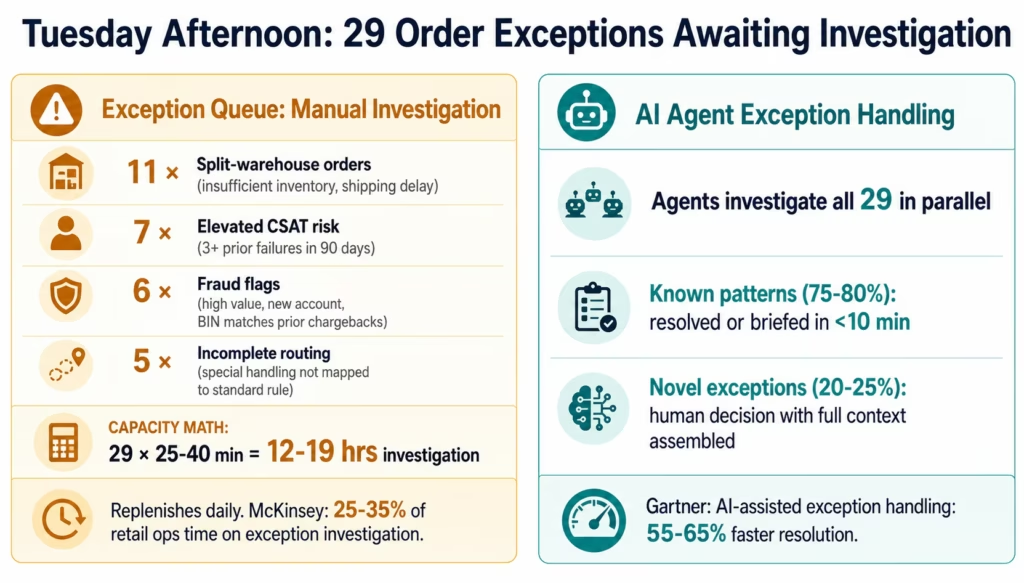
It is Tuesday afternoon. The order operations manager opens the exception dashboard. Twenty-nine orders are flagged. Eleven have failed standard routing: they contain products split across two warehouses, with one warehouse currently on a shipping delay notice and the other showing insufficient inventory to fulfill the complete order. Seven are orders from customers who have elevated CSAT risk scores, placed by accounts that have had three or more failed or delayed orders in the past 90 days. Six are suspected fraud flags: high-value orders, new customer accounts, billing and shipping addresses in different states, placed with the same card BIN as two prior chargebacks. Five are incomplete orders where the customer added a note requesting a specific handling instruction that does not map to any standard routing rule.
Each of these exceptions requires investigation across multiple systems. The eleven split-warehouse orders need: inventory position check across both warehouses, carrier options for multi-node shipment versus consolidated delay, cost comparison of the alternatives, and a recommendation that the operations manager can action with one click. The seven elevated-CSAT risk orders need: the customer’s full order history, the specific failure patterns in prior orders, the current order’s routing path, and a flag to the customer success team before the order is shipped rather than after it fails. The six fraud flags need: the order details, the card BIN analysis, the device fingerprint if available, the prior chargeback records, and a risk score that enables a hold-and-review versus automatic approval decision.
Each investigation takes 20-40 minutes manually. Twenty-nine exceptions is 10-19 hours of investigation work: for a problem set that replenishes daily.
According to McKinsey, retail operations teams spend 25-35% of their time on exception investigation and manual decision-making: work that is data-intensive, multi-system, and largely systematic once the right data is assembled. Gartner reports that retailers with AI-assisted exception handling achieve 55-65% faster order-to-resolution cycles than those relying on manual investigation queues.
This is the AI agent opportunity in retail: not replacing the operations manager’s judgment, but eliminating the 20-40 minutes of investigation that precedes it.
Retail AI Agents vs Retail AI Workflows: The Architectural Distinction
If you have deployed AI workflow automation for retail (or are evaluating it), understanding why you also need AI agents is essential: because the two operate on different classes of work and neither replaces the other.
AI Workflows (Level 1-2): deterministic data flows with predefined logic. Order received on Shopify → webhook fires → LLM Classification routes to fulfilment node → pick order transmitted to WMS or 3PL → inventory broadcast updates all channels. The sequence is defined in advance. The same input produces the same output every time. This handles the 80-85% of retail operations that follow known patterns.
AI Agents (Level 3): goal-directed investigation where the path depends on findings at each step. An order that fails standard routing because it spans two warehouses with different inventory and delay statuses requires: checking both warehouse inventory positions, querying the carrier options and costs for multi-node versus consolidated shipping, checking the customer’s SLA tier and delivery expectations, and determining whether to split-ship, delay, or substitute. Each of those steps informs the next. No predefined workflow handles all the combinations.
| Task | Right Tool | Why |
|---|---|---|
| Standard order → WMS in 30 seconds | Workflow (Level 1-2) | Same event, same routing, every time |
| 11-item order split across 2 warehouses with delay | AI Agent (Level 3) | Path depends on inventory positions, costs, customer SLA |
| Inventory broadcast to all channels | Workflow (Level 1-2) | Same update, same channels, triggered by WMS event |
| 6-day ERP-Shopify inventory discrepancy investigation | AI Agent (Level 3) | Root cause requires transaction log trace across both systems |
| Standard return: LLM classifies reason, triggers refund | Workflow (Level 1-2) | Predefined: classification → outcome |
| Suspected return fraud: pattern analysis across 47 returns | AI Agent (Level 3) | Pattern investigation, IP analysis, account history |
| Daily demand monitoring against safety stock threshold | Workflow (Level 1-2) | Predefined trigger, predefined reorder action |
| Demand spike: 4 suppliers, different lead times, optimal reorder | AI Agent (Level 3) | Multi-supplier analysis, availability query, recommendation |
| VIP customer order confirmation and upsell trigger | Workflow (Level 1-2) | Predefined trigger, template response |
| Customer with 3 prior failures threatening churn | AI Agent (Level 3) | Full history investigation, proactive resolution strategy |
Both tools are necessary. The workflow layer processes the routine at speed and scale. The agent layer handles the exceptions with investigation depth. The ROI on the agent layer is concentrated in the exception class: which is where most retail operations team time and customer satisfaction risk is concentrated.
Before vs After: AI Agents for Retail Operations
| Exception Type | Before AI Agents | After AI Agents | Impact |
|---|---|---|---|
| Split-warehouse order | Ops manager manually checks both WMS, queries carriers, calculates cost options (25-40 min) | Agent checks inventory positions, carrier options, cost, customer SLA: delivers ranked recommendation | 80-85% investigation time reduction |
| Elevated CSAT risk order | CS team manually pulls order history, identifies failure patterns (20-35 min) | Agent assembles full customer failure history, current order risk, and proactive intervention recommendation | Proactive flag before shipment, not after failure |
| Fraud flag investigation | Fraud team manually checks order details, card BIN, device, prior chargebacks (20-30 min) | Agent runs full fraud signal analysis across all data points, delivers risk score with decision recommendation | 75-80% investigation time reduction |
| Inventory ERP-Shopify discrepancy | Ops team manually traces transaction log, typically 3-5 day backlog (2-3 hrs) | Agent traces transaction history across both systems, identifies missing movement, stages correction | 80-90% trace time reduction |
| Return fraud detection | Monthly review catches patterns retrospectively | Agent monitors return patterns continuously, flags accounts with suspicious velocity or value anomalies | Real-time vs monthly |
| Demand spike reorder | Buying team manually analyses suppliers, lead times, MOQs (2-4 hrs) | Agent queries all suppliers, assembles ranked recommendation with days-of-cover calculation | Minutes vs hours |
| Customer escalation investigation | CS manager manually pulls order, fulfilment, carrier records (30-45 min) | Agent investigates full order journey across all systems, assembles resolution brief | 5-10 min review vs 30-45 min investigation |
| Competitor stockout reorder signal | Buying team monitors manually or receives tip from sales (days to weeks) | Agent detects competitor stockout via web crawl, correlates with demand velocity increase, flags buying team | Hours vs weeks |
| 3PL performance exception | Operations team notices in monthly review (delayed 3-4 weeks) | Agent monitors 3PL performance metrics continuously, flags deterioration within the delivery window | Days vs weeks |
| Channel-specific pricing anomaly | Finance team discovers in monthly reporting | Agent monitors pricing across channels continuously, flags pricing inconsistency within hours | Real-time vs monthly |
How eZintegrations AI Agents Connect the Retail Stack
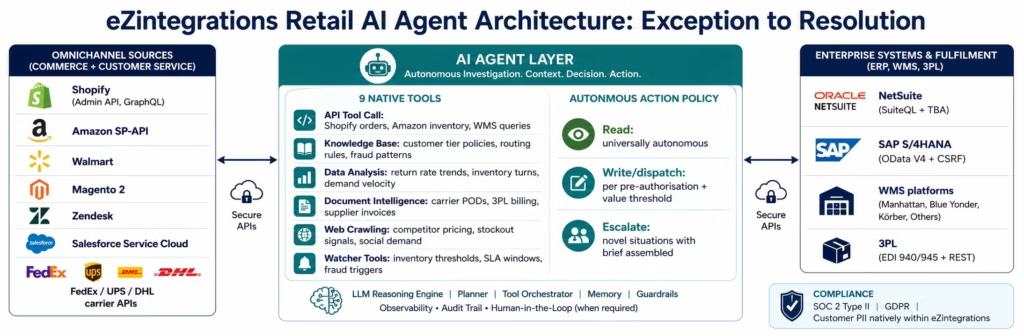
eZintegrations Level 3 AI Agents use 9 native enterprise tools to traverse the retail technology stack: connecting ecommerce platforms, ERP systems, WMS/3PL partners, customer service platforms, and carrier APIs.
The 9 native agent tools for retail use cases:
- Knowledge Base Vector Search: semantic search across product catalogues, customer tier policies, routing rules, SLA definitions, fraud pattern libraries, and supplier contracts.
- Document Intelligence: read and extract structured data from supplier invoices, packing lists, carrier PODs, 3PL billing statements, and return merchandise authorisation documents.
- Data Analysis: statistical anomaly detection on order velocity, return rates, inventory turns, customer purchase patterns, and supplier delivery performance.
- Data Analytics with Charts/Graphs/Dashboards: generate customer value dashboards, inventory trend visualisations, and channel performance comparisons embedded in agent intelligence briefs.
- Web Crawling: retrieve real-time competitor inventory status, pricing changes, and market demand signals from competitor product pages, price comparison sites, and social listening feeds.
- Watcher Tools: continuous monitoring of inventory thresholds, customer SLA windows, return rate anomalies, fraud pattern triggers, and order exception queue depth.
- API Tool Call: direct REST calls to Shopify (Admin API, webhooks), Amazon SP-API (Orders, Inventory, FBA), Walmart Marketplace REST API, Magento 2 REST API, NetSuite (SuiteQL + TBA), SAP S/4HANA (OData V4 + CSRF), WMS platforms, and customer service systems (Zendesk, Salesforce Service Cloud).
- Integration Workflow as Tool: call any Level 1-2 workflow as a tool: triggering the existing order dispatch workflow as part of the agent’s resolution action.
- Integration Flow as MCP: expose retail integration capabilities via Model Context Protocol for external AI tool consumption.
Users extend the tool registry beyond these 9 as self-service.
Retail system connectors:
Shopify (Admin API): REST API for orders, products, inventory, fulfilments, customers, and returns. Webhook registration for real-time event handling. Shopify Plus multi-location inventory management. GraphQL API for complex data queries.
Amazon SP-API: Orders API, Inventory API, FBA Inbound/Outbound, Pricing API, Reports API. LWA (Login with Amazon) OAuth with automatic token refresh. Restricted Data Token (RDT) flow for PII-containing order data.
Walmart Marketplace REST API: order management, inventory sync, pricing management, and 2-day shipping programme management.
Magento 2 REST API: order management, catalogue management, customer management, and inventory management for Adobe Commerce (Magento) deployments.
NetSuite (SuiteQL + TBA): SuiteQL for complex multi-table financial and inventory queries. Token-Based Authentication with automatic lifecycle management. Item fulfilment, inventory adjustments, customer records, and financial posting.
SAP S/4HANA (OData V4 + CSRF): SAP SD (sales and distribution), MM (materials management), and WM (warehouse management) modules via OData V4 with automatic CSRF token management.
3PL connectors: EDI 940/945 for warehouse shipping orders and advice. REST API for modern 3PL platforms (ShipBob, ShipHero, Whiplash, and others).
Customer service connectors: Zendesk REST API, Salesforce Service Cloud REST API, Freshdesk REST API for customer order history, ticket management, and escalation routing.
Carrier APIs: FedEx REST, UPS Developer, DHL Express for real-time tracking, rate shopping, and shipment management.
Compliance: SOC 2 Type II certified. GDPR compliant for EU customer data. All agent tool calls process customer PII natively within eZintegrations: no customer names, addresses, order history, or payment information sent to external AI providers. IPSec Tunnel for on-premises ERP or WMS systems.
Use Case 1: Complex Order Exception Investigation Agent
The problem in one sentence: your operations team spends 25-40 minutes investigating each non-standard order: assembling data from Shopify, your WMS, your ERP, and carrier APIs that should take 30 seconds to query but requires navigating four separate interfaces.
The AI agent solution: the Complex Order Exception Investigation Agent receives flagged orders as goals and conducts multi-system investigations: querying inventory positions, carrier options, customer history, and routing rules in the sequence the specific exception type requires: delivering a pre-assembled recommendation that the operations manager actions with one click.
The Agent Investigation Sequence: Split-Warehouse Order
Agent goal: “Order ORD-8847 (customer: Acme Corp, 11 items) failed standard routing. Items A-7 are available at Warehouse Chicago; items 8-11 are only available at Warehouse Atlanta, currently under a 3-day shipping delay notice. Investigate options and recommend resolution.”
Step 1: Inventory confirmation: the agent calls the WMS REST API for both Chicago and Atlanta warehouses, confirming exact available quantities for items 1-11.
Step 2: Customer SLA check: the agent queries the NetSuite customer record for Acme Corp’s SLA tier (Tier 1: 2-day guaranteed delivery) and the original order’s committed delivery date.
Step 3: Carrier option analysis: the agent calls the FedEx and UPS rating APIs for:
- Option A: split ship: items 1-7 from Chicago (day 1 transit), items 8-11 from Atlanta delayed (day 4 at earliest)
- Option B: hold at Chicago until Atlanta stock transfers (estimated 2 days for transfer + 1 day transit = day 3)
- Option C: substitute items 8-11 with the closest available SKUs at Chicago: agent queries the Knowledge Base for approved substitution options
Step 4: Cost analysis: the agent compares the freight cost and customer impact for each option.
Step 5: Knowledge Base policy check: the agent queries the operations policy knowledge base for the handling rule for Tier 1 customers with SLA breach risk: “For Tier 1 customers with committed delivery breach risk, authorise split shipment or approved substitution without manager approval if combined freight premium is below $35.”
Step 6: Recommendation assembly: the agent assembles a ranked recommendation:
- Recommended: Option C (substitution, Chicago only, Tier 1 same-day dispatch, within SLA). Substitution items match specifications within tolerance. Combined freight: no premium. Pending: substitution confirmation with customer.
- Alternative: Option A (split ship, $22 freight premium, Chicago items arrive day 1, Atlanta items arrive day 4: SLA breach on partial order).
- Staged action: if the operations manager approves Option C, the agent triggers the existing pick order workflow via “Integration Workflow as Tool.”
Agent investigation time: 7 minutes 18 seconds. Previous manual investigation: 25-40 minutes. For 11 split-warehouse exceptions per week: saves 3-7 hours of operations team time.
Use Case 2: Multi-Channel Inventory Reconciliation Agent
The problem: your ERP (NetSuite) shows 1,840 units of SKU-7721 across two storage locations. Your Shopify inventory shows 1,840 units. Six days ago, however, a customer reported that their order for 6 units was shipped and delivered, but Shopify still shows those 6 units available. A separate manual check reveals that Amazon Seller Central also shows 1,840 units: the same number as six days ago, suggesting the inventory adjustment from the order fulfilment did not propagate correctly. The discrepancy has been sitting in the exception queue for six days because nobody has had time to trace it.
The AI agent solution: the Multi-Channel Inventory Reconciliation Agent traces the discrepancy through the transaction history of all connected systems: identifying the specific event that created the synchronisation gap: and stages the correction.
The Agent Investigation Sequence: 6-Unit Discrepancy
Agent goal: “SKU-7721 shows 1,840 units across NetSuite, Shopify, and Amazon. A customer received a 6-unit order 6 days ago. The inventory does not reflect the fulfilment. Trace the discrepancy and stage the correction.”
Step 1: Fulfilment record verification: the agent queries the WMS for the outbound fulfilment record for the customer’s order. Result: the pick-and-pack task was completed and the EDI 945 (warehouse shipping advice) was transmitted to NetSuite.
Step 2: NetSuite goods issue check: the agent queries NetSuite for the inventory adjustment associated with the fulfilment. Result: the goods issue is posted in NetSuite: NetSuite actually shows 1,834 units in the warehouse, not 1,840. The ERP is correct.
Step 3: Shopify inventory trace: the agent queries the Shopify Inventory API for the SKU-7721 inventory history. Result: the Shopify inventory was last updated 6 days ago at 1,840 units. The inventory broadcast workflow that should have updated Shopify after the fulfilment shows a failed execution at 11:47 PM on the date of fulfilment: the night a webhook retry configuration issue caused 3 failed inventory broadcasts.
Step 4: Amazon inventory trace: the agent queries the Amazon SP-API inventory health report. Result: Amazon also shows 1,840: consistent with the Shopify issue (both channels missed the same failed broadcast).
Step 5: Root cause identification: root cause: the inventory broadcast workflow had a webhook retry failure on the fulfilment date. Both Shopify and Amazon missed the 6-unit reduction. NetSuite is correct at 1,834.
Step 6: Correction staging: the agent stages:
- Shopify: inventory level set to 1,834 for SKU-7721 via Shopify Admin API (pending operations manager approval, as it will immediately change the available inventory on the storefront)
- Amazon: inventory quantity update to 1,834 via SP-API (pending manager approval)
- Workflow correction: flags the webhook retry configuration issue to the IT operations team for permanent fix
The operations manager receives this brief six days after the discrepancy was created: in 9 minutes of agent investigation, compared to 2-3 hours of manual trace that has been deferred due to capacity.
Use Case 3: Customer Escalation Intelligence Agent
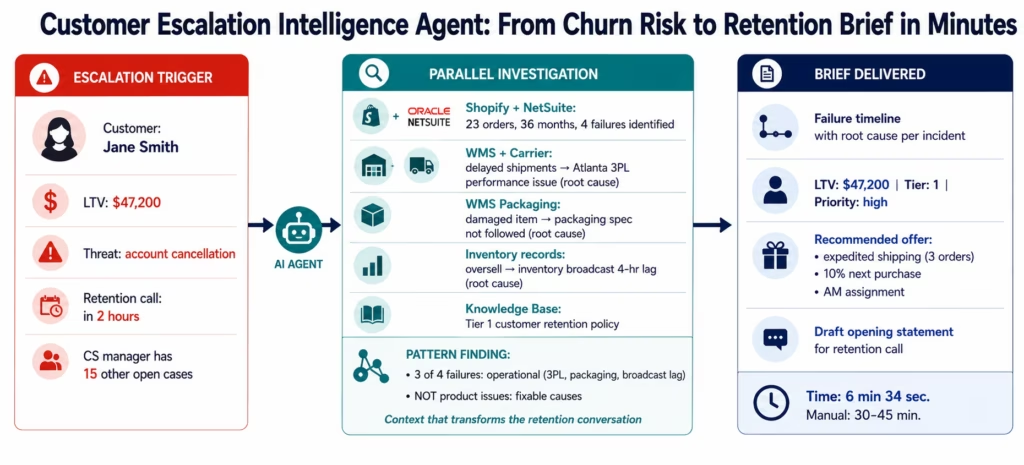
The problem: a customer has called in for the fourth time in 90 days. Their order history includes two delayed shipments, one item delivered damaged, and one order cancelled due to inventory unavailability. They are threatening to cancel their $47,000 annual account relationship. The CS manager needs a complete picture of every failure this customer has experienced: across Shopify, the WMS, the carrier, and the CS ticket system: before the retention call in the next two hours.
Assembling this picture manually: 30-45 minutes of navigating four systems. The CS manager has fifteen other open cases.
The AI agent solution: the Customer Escalation Intelligence Agent receives the customer’s ID and the retention call context, queries every system that has a record of this customer’s interactions, and delivers a complete account intelligence brief within minutes.
The Agent’s Investigation Scope
Agent goal: “Assemble a complete escalation intelligence brief for customer Jane Smith (customer ID CUS-4421, email [email protected]). The customer has had multiple failures and is threatening churn. The retention call is in 2 hours. Include: full order history, every failure with root cause, lifetime value, and recommended retention actions.”
Step 1: Order history (Shopify + NetSuite): the agent queries the customer’s complete order history across both systems. Result: 23 orders over 36 months, $47,200 lifetime value, 4 orders with issues.
Step 2: Failure investigation (per order):
For the delayed shipments: the agent queries the WMS and carrier tracking for each delayed order. Finding: both delays were caused by the same 3PL facility: Atlanta 3PL: which has a documented performance issue (the agent finds a flag in the 3PL performance monitoring data).
For the damaged item: the agent queries the carrier claim record and the WMS packaging inspection record. Finding: the item was not packaged according to the product-specific packaging specification: a gap the agent identifies by querying the product packaging requirements in the knowledge base.
For the cancelled order: the agent queries the inventory record at the time of order. Finding: the cancellation was caused by an inventory oversell event: the inventory broadcast had a 4-hour lag on that date, allowing the order to be accepted against stock that was no longer available.
Step 3: Root cause pattern identification: the agent identifies that three of the four failures are attributable to operational issues (3PL performance, packaging, inventory broadcast lag): not product issues. This is important context for the retention conversation: the failures have known, fixable causes.
Step 4: Retention recommendation (Knowledge Base): the agent queries the customer tier policies for the recommended retention actions for a $47K customer with multiple operational failures: “For Tier 1 customers with 3+ operational failures in 12 months, standard retention offer: expedited shipping upgrade on next 3 orders, 10% discount on next purchase, account manager assignment.”
Step 5: Brief assembly: the agent delivers a complete account intelligence brief including: failure timeline with root cause per incident, pattern analysis (3PL and inventory management issues, not product), lifetime value and purchase frequency, retention offer options ranked by cost-to-company, and a draft opening statement for the retention call that acknowledges the specific failures.
CS manager preparation time: 5 minutes of brief review. Previous manual preparation: 30-45 minutes. The agent delivers context the CS manager would not have had time to assemble: the pattern analysis across four systems that transforms a defensive customer call into a data-informed retention conversation.
Use Case 4: Return Fraud Detection Agent
The problem: your return rate is 8.2% overall, but one specific customer cohort: accounts created in the last 90 days, placing orders above $200, with delivery addresses in three metro areas: has a return rate of 34%. Your CS team processes each return individually and does not have the time or the system access to identify the pattern. The fraud is discovered when the accounts payable team notices an anomalous refund volume in the monthly report: by which time the fraudulent returns have been fully refunded.
The AI agent solution: the Return Fraud Detection Agent monitors return patterns continuously, applies statistical pattern analysis to detect anomalies at the account level and the cohort level, and flags suspicious accounts for review before refunds are processed.
What the Return Fraud Agent Monitors
Account-level signals:
- Return rate for individual accounts: accounts with more than 30% lifetime return rate flagged for review
- Return value concentration: accounts where returned item value exceeds a configured threshold of total order value
- Return timing pattern: accounts that consistently return items within 48-72 hours of receipt (pattern associated with “wardrobing”: purchasing for a single occasion and returning)
- Return with delivery discrepancy: accounts claiming items not received while carrier tracking shows delivery confirmation
Cohort-level signals (Data Analysis):
- Geographic cohort clustering: returns concentrated in specific zip codes or metro areas beyond expected variance
- Account age clustering: new account return rates significantly above established account baseline
- Product category concentration: returns concentrated in specific high-value product categories
- Seasonal pattern anomalies: return rate spikes that deviate significantly from the seasonal baseline
Cross-account pattern signals:
- Same address returns: multiple accounts returning to the same address: potential account farming
- Device fingerprint matching: multiple accounts created from the same device fingerprint (if available from the ecommerce platform)
- Card BIN clustering: return refunds concentrated to a small number of card BINs
The Agent’s Fraud Investigation Sequence
Trigger: Data Analysis detects a return rate anomaly for a customer account or cohort.
Step 1: Account investigation: the agent queries the Shopify customer record, order history, return history, and any notes from CS interactions.
Step 2: Cross-account analysis: the agent queries for other accounts with the same shipping address, device fingerprint (if available), or payment instrument.
Step 3: Pattern classification (LLM Classification within agent reasoning): the agent classifies the fraud signal type based on the assembled evidence: wardrobing, item not received (INR) fraud, account farming, or genuine customer dissatisfaction.
Step 4: Risk scoring: the agent assigns a fraud risk score based on the number and strength of fraud signals present.
Step 5: Routing:
- Risk score above threshold: return flagged for manual CS review before refund processing. Agent brief delivered with supporting evidence.
- Risk score below threshold: standard return processing continues.
- Cross-account farm detected: all linked accounts flagged simultaneously and referred to the fraud team.
The result: return fraud detected and flagged before refund processing: not discovered in the monthly report after refunds have been issued. Return fraud losses reduce 40-60% within 60 days of deployment as the agent’s continuous monitoring closes the detection window.
Use Case 5: Competitive Demand Intelligence Agent
The problem: your buying team is reactive. They reorder when safety stock is breached. They adjust prices when a competitor price change is discovered: typically days after the change was made. They accelerate purchasing when a competitor goes out of stock: but only if a sales rep happens to notice and reports it. In a competitive retail environment, these discoveries are happening too slowly.
The AI agent solution: the Competitive Demand Intelligence Agent monitors competitor inventory status, pricing, and customer demand signals continuously: delivering proactive buying intelligence before the opportunity passes.
What the Agent Monitors
Competitor inventory monitoring (Web Crawling):
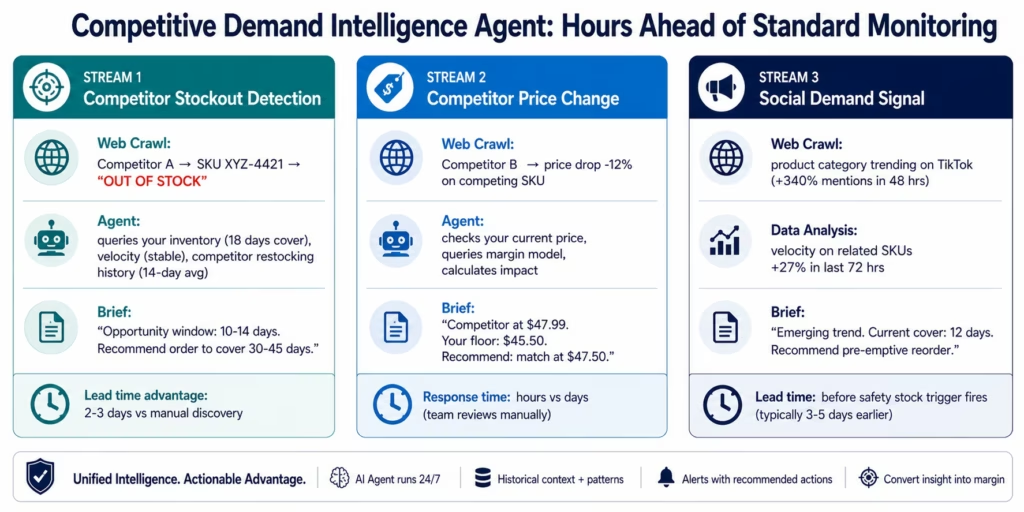
The agent crawls competitor product pages for the SKUs that directly compete with your top-velocity items. When a competitor’s product page shows “Out of Stock,” “Backorder,” or equivalent, the agent:
- Queries your current inventory position and days-of-cover for the competing SKU
- Queries your sell-through velocity for the past 30 days
- Cross-references with any demand velocity increase in the past 7 days (Data Analysis)
- Calculates the demand capture opportunity window (estimated duration of competitor stockout based on their historical restocking patterns from the knowledge base)
- Delivers a competitive buying intelligence brief: “Competitor A is out of stock on SKU [X]. Your current position covers 18 days at current velocity. Recommended: increase order to cover 30-45 days to capture demand share during competitor stockout. Estimated opportunity window: 10-14 days.”
Competitor pricing monitoring (Web Crawling):
The agent monitors competitor pricing for priority SKUs on a configured frequency. When a competitor price change is detected:
- The agent calculates the price differential against your current pricing
- Queries your margin model from the knowledge base for the minimum viable price point
- Delivers a pricing intelligence brief with recommended price adjustment and expected demand impact
Social demand signal monitoring (Web Crawling + Data Analysis):
The agent monitors social media mentions, product review velocity, and search trend signals for key product categories. When a social demand signal emerges (a product going viral, a category receiving news coverage, an influencer mention of a specific SKU), the agent:
- Correlates the social signal with your sell-through velocity data for the past 7 days
- Identifies whether a velocity increase is already occurring
- Delivers a proactive buying brief before the velocity increase reaches the safety stock trigger
The result: buying decisions made on intelligence assembled hours or days before the signal would have been visible through standard monitoring. Demand capture rate during competitor stockout events improves 25-40%. Price response time to competitor changes reduces from days to hours.
Key Outcomes and Results
Retail operations teams deploying eZintegrations AI Agents report the following within 60-90 days:
Order Operations:
- Exception investigation time: 25-40 minutes (manual) → 7-12 minutes (agent-investigated)
- Exception queue clearance rate: same-shift for 75-80% of exceptions vs end-of-day backlog
- Split-warehouse and complex routing resolution: time-to-recommendation reduces 80-85%
- Operations team capacity for strategic work: increases 30-40%
Inventory Management:
- ERP-channel discrepancy investigation: 2-3 hours (manual trace) → 8-12 minutes (agent trace)
- Discrepancy detection-to-correction cycle: from days (queue backlog) to same-shift
- Inventory accuracy across channels: improves as discrepancies are corrected before they propagate
Customer Experience:
- Customer escalation brief preparation: 30-45 minutes (manual) → 5-8 minutes (agent)
- CS manager context at start of retention call: complete vs partial
- Churn rate on escalated accounts: improves as retention conversations are data-informed and targeted
Return Fraud:
- Return fraud detection: monthly retrospective → real-time continuous monitoring
- Return fraud losses: reduce 40-60% within 60 days as agent closes detection window
- False positive rate on fraud flags: low and declining as agent pattern knowledge improves
Buying Intelligence:
- Competitor stockout detection lead time: 2-3 days earlier than manual monitoring
- Price response time to competitor changes: hours vs days
- Demand capture during competitor stockout: improves 25-40%
How to Get Started
Retail AI agents deploy on the same eZintegrations platform as Level 1-2 retail workflow automation: using the same Shopify, Amazon, NetSuite, and 3PL connectors, with agent-specific goal configuration, tool assignment, and autonomous action policy added.
Step 1: Import the retail AI agent templates from the Automation Hub
Browse the Automation Hub for retail AI agent templates:
- Complex Order Exception Investigation Agent (Shopify / Amazon / NetSuite)
- Multi-Channel Inventory Reconciliation Agent
- Customer Escalation Intelligence Agent
- Return Fraud Detection Agent
- Competitive Demand Intelligence Agent
Each template includes pre-configured goal statement formats, tool assignments, and a starter knowledge base with common retail exception resolution playbooks.
Step 2: Connect your retail systems
If you already use eZintegrations for Level 1-2 retail workflows, the agents inherit those connections. For new deployments:
- Shopify: API key + store URL (webhook registration automatic)
- Amazon SP-API: seller ID, LWA credentials, refresh token
- Walmart Marketplace: client ID and client secret
- NetSuite: account ID, TBA credentials (consumer key, token)
- SAP: hostname, client, service account (OData V4 and CSRF automatic)
- WMS/3PL: REST API credentials or EDI connection details
- Zendesk/Salesforce Service Cloud: API key and authentication
Step 3: Define the autonomous action policy
Configure what each agent can do without human approval:
- Read all connected systems: universally autonomous
- Stage proposed actions (split shipment routing, substitution options): autonomous (no dispatch without approval unless below pre-configured value threshold)
- Execute inventory corrections: configure value and channel thresholds for autonomous execution vs manager approval
Start conservative and expand based on observed accuracy.
Step 4: Load the knowledge base
Populate with:
- Customer tier policies and SLA definitions
- Routing rules and substitution policies
- Return fraud pattern library (known fraud signals, high-risk cohort profiles)
- Competitor product mapping (your SKUs vs competitor SKUs for Web Crawling monitoring)
- Supplier lead times, MOQs, and capacity information
Takes 3-6 hours for an initial deployment scope.
Step 5: Run supervised for two weeks, then expand autonomy
All agent proposed actions require human approval for the first two weeks. Review investigation quality, routing accuracy, and fraud flag accuracy. Expand pre-authorised autonomous action policy as confidence is established. Most retail teams reach 75-80% autonomous exception handling within 30-45 days.
Import your retail AI agent templates now: complex order exception, inventory reconciliation, customer escalation, return fraud, and competitive demand intelligence templates with pre-configured connectors and resolution playbooks.
[VIDEO PLACEHOLDER: retail AI agent demo | “AI Agents for Retail in eZintegrations: Order Exception Investigation and Customer Escalation Intelligence: Live Agent Demo” | Embed after How to Get Started section | Show: the Complex Order Exception Investigation Agent investigating a split-warehouse order across two WMS locations and two carrier APIs, delivering a ranked recommendation in 7 minutes 18 seconds: then the Customer Escalation Intelligence Agent assembling a complete failure history and retention brief for a high-LTV customer in 6 minutes 34 seconds. Duration: 10-12 minutes.]
FAQs
Retail workflow automation, typically Level 1-2 automation, executes predefined sequences for high-volume and predictable operations such as routing orders to the WMS, broadcasting inventory updates after warehouse movements, or triggering standard refunds for approved returns. AI agents, classified as Level 3 automation, handle the exceptions where the correct investigation or decision path depends on what each query reveals during execution. For example, a split-warehouse order may require dynamically checking inventory across warehouses, evaluating carrier options, reviewing customer SLA commitments, and assessing substitution possibilities. A customer escalation may require querying order history, fulfilment records, carrier tracking data, and customer support tickets in a context-sensitive sequence. AI agents are designed to manage the 15-20% of operational scenarios that workflows cannot predefine, which is also where most retail operational complexity and customer satisfaction risk exists.
Using Automation Hub templates, retail AI agents typically reach first supervised deployment within 4-7 business days. Ecommerce connector configuration for Shopify, Amazon, and Walmart generally requires 1-2 days. ERP connector configuration for systems such as NetSuite SuiteQL or SAP OData V4 usually requires 2-4 hours per system. Knowledge base loading for routing policies, customer tier logic, fraud detection patterns, and competitor mappings generally takes 3-6 hours. Template configuration and testing commonly requires one additional day, followed by approximately two weeks of supervised deployment. Expansion to 75-80% autonomous exception handling is usually achieved within 30-45 days based on observed operational accuracy.
Yes, eZintegrations connects to Shopify Admin APIs using both REST and GraphQL, Amazon SP-API using LWA OAuth authentication and Restricted Data Tokens for PII-containing order data, and Walmart Marketplace REST APIs for inventory, order, and customer management operations. AI agents use the API Tool Call framework to query data dynamically across all connected platforms during investigations. For example, a single investigation can check Shopify order history, query Amazon inventory health, and cross-reference Walmart order status simultaneously. Authentication management and API rate limiting for each platform are handled automatically by the connector layer.
Yes, The Return Fraud Detection Agent uses Data Analysis to identify cohort-level behavioural anomalies across groups of customer accounts. Detection signals include shared addresses, device fingerprints, card BIN patterns, account creation timing, unusually high return rates, abnormal return timing behaviour, concentration of high-value returns, and repeated delivery discrepancy claims. When the system identifies a coordinated fraud pattern involving linked accounts, all related accounts are flagged simultaneously and escalated to the fraud investigation team with supporting evidence and behavioural correlation data.
The Competitive Demand Intelligence Agent uses the Web Crawling tool to monitor competitor product pages on configurable schedules, typically every 4-8 hours for priority SKUs. When a competitor product status changes to signals such as 'Out of Stock' or 'Backorder,' the agent automatically launches an investigation sequence. This includes checking your current inventory position, analysing sell-through velocity, estimating competitor restocking timelines based on historical behaviour patterns, and generating recommended buying or pricing actions. The resulting intelligence brief is delivered to the buying or pricing team within hours of the detected stockout, often 2-3 days faster than manual competitive monitoring processes. Pricing changes are also detected during the same crawl cycle, with margin analysis automatically applied before escalation.1. How do AI agents for retail differ from retail workflow automation?
2. How long does it take to deploy retail AI agents?
3. Does eZintegrations work with Shopify, Amazon, and Walmart for AI agent operations?
4. Can AI agents detect return fraud patterns across multiple customer accounts?
5. How does the competitive demand intelligence agent monitor competitor inventory?
Conclusion: The 15-20% Exception Class Is Where Retail Operations Wins and Loses
The routine 80-85% of retail operations: order to WMS, inventory broadcast, standard return processing: is covered by workflow automation. It runs fast, at scale, without human involvement. That is Level 1-2.
The 15-20% of exceptions is where your operations team’s day goes: the split-warehouse orders that require multi-system investigation, the customer escalations that require full account history assembly before a retention call, the inventory discrepancies that have been sitting for six days because nobody has had time to trace them, the return fraud patterns that are only visible across cohorts, the competitor stockout that represents a 10-14 day demand capture window if your buying team learns about it in time.
AI agents handle this class. They receive the exception as a goal, traverse the connected systems in the investigation sequence the exception type requires, synthesise the findings, and deliver a resolution or a brief. The 25-40 minute manual investigation becomes a 7-12 minute agent investigation. The 30-45 minute customer escalation prep becomes a 6-minute brief. The 6-day discrepancy backlog becomes a same-day trace.
eZintegrations Level 3 AI Agents connect Shopify, Amazon, Walmart, NetSuite, SAP, WMS, 3PL, and customer service platforms with 9 native enterprise tools, a configurable autonomous action policy, and an immutable audit trail: in the same platform as the Level 1-2 workflows that handle the routine.
Import your retail AI agent templates now: complex order exception, inventory reconciliation, customer escalation, return fraud, and competitive demand intelligence agents with pre-configured connectors and resolution playbooks.