How is Lab Report Extracted and Synced to a LIMS Automatically?
$0.00
| Workflow Name: |
Lab Report Extraction and Sync – PDF Scanned to LIMS System |
|---|---|
| Purpose: |
Extract lab values from PDF/scanned reports and push structured data into LIMS. |
| Benefit: |
Automates lab data entry and ensures clean structured datasets. |
| Who Uses It: |
Data Engineers, Lab Admins, Quality Teams |
| System Type: |
LIMS Integration Workflow |
| On-Premise Supported: |
Yes |
| Supported Protocols: |
HTTPS, REST |
| Industry: |
Healthcare / Life Sciences |
| Outcome: |
real-time lab data in LIMS, Structured |
Table of Contents
Description
| Problem Before: |
LIMS updates required manual entry from scanned reports. |
|---|---|
| Solution Overview: |
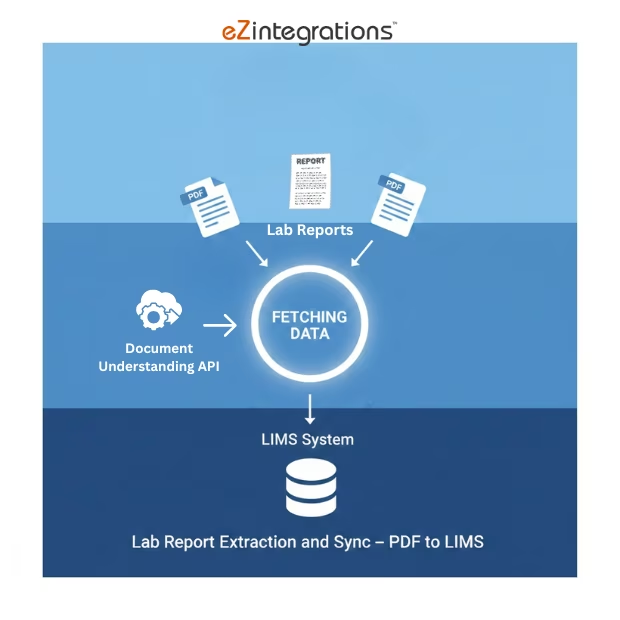
AI extracts structured values from PDFs and sends them to LIMS via API. |
| Key Features: |
API integration, data mapping, OCR extraction, validation |
| Business Impact: |
Improves lab processing speed and reduces human errors |
| Productivity Gain: |
Significant reduction in time spent manually updating LIMS |
| Cost Savings: |
Lowered admin and rework costs |
| Security & Compliance: |
compliant with lab data policies, Encrypted |
Lab Report Extraction and Sync – LIMS Integration
This workflow automates the extraction of lab values from PDF or scanned reports and synchronizes the processed data into LIMS platforms. It captures report data in real time and delivers accurate, structured results to support consistent laboratory operations.
Real-Time Lab Data Processing for Structured Results
The solution securely retrieves information from digital or scanned lab reports, validates critical values, and transforms the data before syncing it to the LIMS. By minimizing manual handling, it enables data engineers, lab administrators, and quality teams to access reliable and well-structured datasets, improving accuracy, efficiency, and overall data quality.
Watch Demo
| Video Title: |
Pharma Industry Document Automation: Use Cases & Data Flow |
|---|---|
| Duration: |
13:18 |
Outcome & Benefits
| Time Savings: |
Eliminates manual LIMS entry |
|---|---|
| Cost Reduction: |
Reduces manual workload |
| Accuracy: |
High with validation |
| Productivity: |
Faster lab operations |
Industry & Function
| Function: |
Document Extraction and LIMS Sync |
|---|---|
| System Type: |
LIMS Integration Workflow |
| Industry: |
Healthcare / Life Sciences |
Functional Details
| Use Case Type: |
Lab Data Processing |
|---|---|
| Source Object: |
Lab Reports |
| Target Object: |
LIMS Lab Result Tables |
| Scheduling: |
On-demand or batch |
| Primary Users: |
Data Teams, Lab, QA |
| KPI Improved: |
Data Accuracy, Processing speed |
| AI/ML Step: |
OCR + value extraction |
| Scalability Tier: |
Enterprise |
Technical Details
| Source Type: |
PDF/Scanned Document |
|---|---|
| Source Name: |
Lab Reports |
| API Endpoint URL: |
LIMS API endpoint |
| HTTP Method: |
POST/PUT |
| Auth Type: |
API Key / Oauth |
| Rate Limit: |
Depends on LIMS vendor |
| Pagination: |
Not applicable |
| Schema/Objects: |
Lab values, ranges, units |
| Transformation Ops: |
normalization, unit validation |
| Error Handling: |
Retry logic, validation logs |
| Orchestration Trigger: |
Real-time or batch |
| Batch Size: |
Single or batch-mode |
| Parallelism: |
Concurrent extraction threads |
| Target Type: |
LIMS System |
| Target Name: |
LIMS |
| Target Method: |
REST API |
| Ack Handling: |
API response stored for audit |
| Throughput: |
High-volume ready |
| Latency: |
<10 seconds/report |
| Logging/Monitoring: |
Extraction + API logs |
Connectivity & Deployment
| On-Premise Supported: |
Yes |
|---|---|
| Supported Protocols: |
HTTPS, REST |
| Security & Compliance: |
compliant with lab data policies, Encrypted |
FAQ
1. What is the Lab Report Extraction and Sync workflow for LIMS?
It is an automated workflow that extracts lab values from PDF or scanned lab reports and pushes the structured data into a LIMS system, eliminating manual data entry.
2. How does the workflow extract and sync lab report data?
The workflow reads lab values from PDFs or scanned documents using automated extraction methods, validates the data, and then pushes clean, structured results into the LIMS system.
3. What types of lab information are captured?
It captures lab test values, units, reference ranges, sample identifiers, and metadata needed for accurate and complete LIMS records.
4. How frequently does the workflow run?
The workflow can run in real-time or on a scheduled basis, depending on lab processes and reporting needs.
5. What happens if a lab report cannot be processed?
If a report is unreadable or missing data, the workflow logs the issue, alerts relevant teams, and continues processing other reports without interruption.
6. Who uses this workflow?
Data Engineers, Lab Administrators, and Quality Teams use this workflow to maintain accurate structured datasets in LIMS.
7. What are the benefits of the Lab Report Extraction and Sync workflow?
It automates lab data entry, ensures clean structured datasets, reduces transcription errors, and supports higher data quality for lab operations.
Resources
Case Study
| Customer Name: |
Lab Organizations |
|---|---|
| Problem: |
Manual LIMS entry was slow and error-prone |
| Solution: |
Automated extraction and LIMS API sync |
| ROI: |
Faster lab cycles and lower admin cost |
| Industry: |
Healthcare / Life Sciences |
| Outcome: |
real-time lab data in LIMS, Structured |