How to Automate Predictive Maintenance with IoT Sensor Data
$120.00
| Workflow Name: |
Predictive Maintenance Alert: IoT to ERP Work Order |
|---|---|
| AI Model Type: |
Time-series ML anomaly detection and failure probability prediction (LSTM neural network + gradient boosting ensemble) |
| Model Provider: |
Goldfinch AI of eZintegrations (Data Analysis tool for real-time sensor time-series ML model execution + Watcher Tools for continuous threshold monitoring + Data Analytics with Charts/Graphs/Dashboards for equipment health visibility) |
| Task Type: |
Anomaly Detection + Prediction (dual-task: real-time anomaly pattern detection in sensor streams feeds the failure probability prediction model – both required for 3 to 14-day advance warning) |
| Input Type: |
Real-time IoT sensor data streams from industrial equipment: vibration (acceleration RMS; frequency spectrum); temperature (bearing; ambient); pressure (inlet; outlet; differential); motor current draw; shaft RPM; acoustic emission – delivered via MQTT broker or OPC-UA protocol from edge devices or IoT hubs |
| Output Format: |
ERP maintenance work order (SAP PM or IBM Maximo) created automatically per high-probability failure event – populated with asset ID; failure type predicted; failure probability score; predicted failure window (e.g. “7 to 14 days”); sensor anomaly evidence (which signals triggered the alert); and recommended maintenance action from the knowledge base. Alert sent to Maintenance team via Microsoft Teams and SMTP. Equipment health dashboard updated in Goldfinch AI Data Analytics. IoT and prediction data written to Snowflake for model retraining. |
| Who Uses It: |
Reliability Engineer; Maintenance Planner; Plant Manager |
| On-Premise Supported: |
Yes – eZintegrations connects to on-premises SAP PM; IBM Maximo; SCADA historian databases; and OPC-UA edge devices via IPSec Tunnel. eZintegrations is a browser-based; cloud-hosted platform and does not require any on-premises software installation. |
| Industry: |
Automotive; Oil and Gas; Utilities; Pharmaceuticals; Heavy Manufacturing; Aerospace |
| Outcome: |
94%+ failure prediction accuracy at 7-day lead time, 35 to 50% reduction in unplanned downtime incidents, 30 to 40% reduction in maintenance cost from preventive vs. reactive work order ratio improvement, $180,000 to $600,000 annual savings per production line on a $50,000/hour downtime cost basis |
| Tags: |
IoT predictive maintenance AI, predictive maintenance workflow, MQTT sensor failure prediction, SAP PM work order automation, Maximo AI integration, Goldfinch AI manufacturing, equipment failure prediction ML, LSTM anomaly detection IoT, industrial IoT AI, reliability engineering AI, maintenance work order automation, Snowflake IoT data pipeline |
| AI Credits Required: |
Yes – three Goldfinch AI tools invoked per prediction run: Data Analysis (ML time-series model execution on sensor batches), Watcher Tools (continuous threshold monitoring and alert triggering), and Data Analytics with Charts/Graphs/Dashboards (equipment health dashboard generation). AI Credits consumed per inference window and per dashboard refresh. |
Table of Contents
| Problem Before: |
Manufacturing; oil and gas; and utility operations depend on continuous equipment availability. When a motor; pump; compressor; or turbine fails unexpectedly; production halts. According to McKinsey; unplanned downtime costs industrial companies an average of $50,000 per hour; and the total annual cost of unplanned downtime across manufacturing industries exceeds $50 billion globally. Reactive maintenance – fixing equipment after it breaks – costs 3 to 5 times more per repair than the same work performed preventively (Deloitte maintenance efficiency research). IoT sensors are already installed on most critical assets; the data streams exist. The missing layer is the ML model that reads failure patterns before the human operator can. |
|---|---|
| AI Solution: |
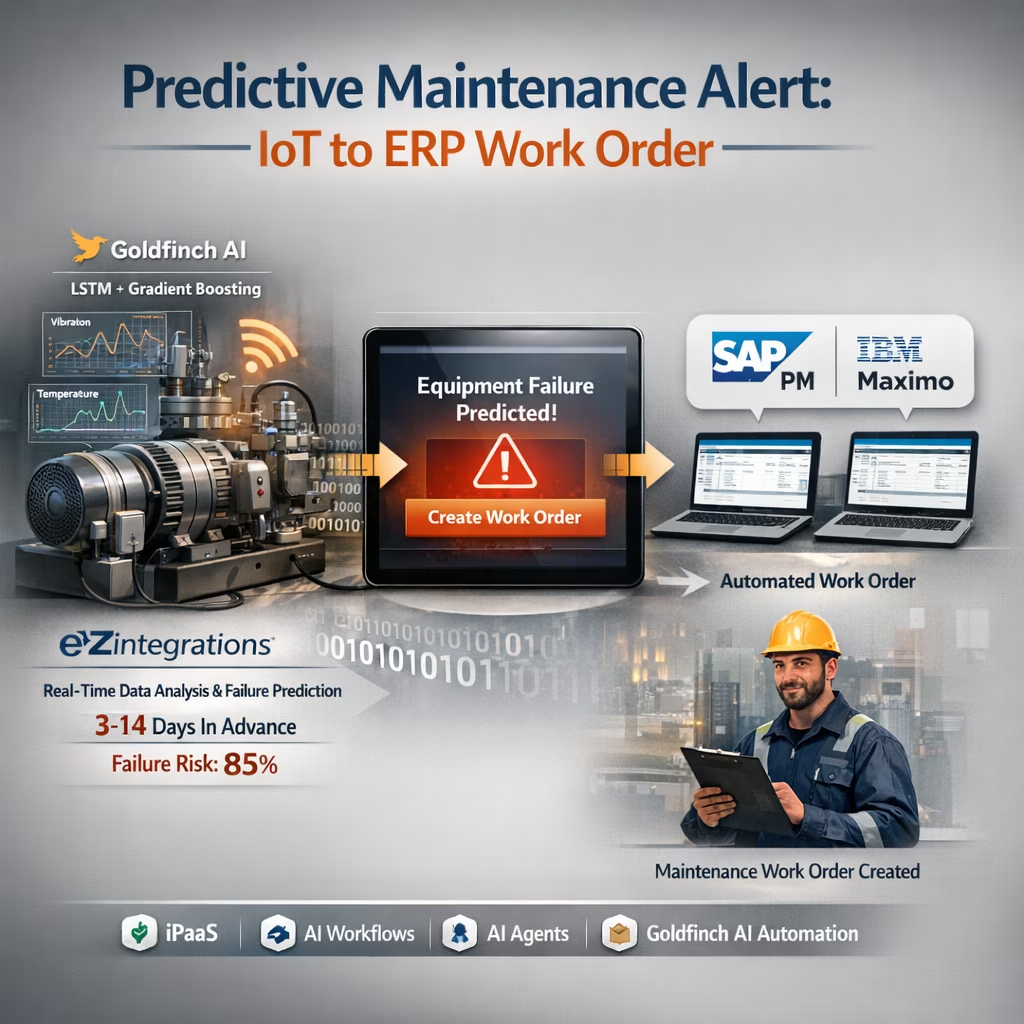
The Predictive Maintenance Alert workflow from eZintegrations ingests real-time IoT sensor data (vibration; temperature; pressure; current; RPM) via MQTT broker or OPC-UA into Goldfinch AI Data Analysis. An LSTM + gradient boosting ensemble model identifies time-series anomaly patterns that precede equipment failure by 3 to 14 days and computes a failure probability score (0 to 1.0) per asset. Goldfinch AI Watcher Tools continuously monitors the score stream – when the score crosses the configured alert threshold (0.72 for preventive; 0.88 for critical); a maintenance work order is automatically created in SAP PM or IBM Maximo and the Maintenance team is notified via Microsoft Teams and SMTP. The Goldfinch AI Data Analytics dashboard gives Reliability Engineers real-time equipment health visibility across the entire asset fleet. |
| Validation (HITL): |
Failure probability scores above 0.72 and below 0.88 (Preventive Alert tier) generate a work order in SAP PM or Maximo with priority classification “Preventive – 7 to 14 day window” and notify the Maintenance Planner. The Maintenance Planner reviews the sensor anomaly evidence on the Goldfinch AI dashboard and schedules the work order within the predicted window at the next maintenance opportunity. Scores above 0.88 (Critical Alert tier) generate a high-priority work order and alert the Reliability Engineer and Plant Manager simultaneously – requiring acknowledgment within 4 hours and an immediate maintenance plan. Scores below 0.72 continue to be monitored by Watcher Tools with no work order created – the Reliability Engineer sees the asset’s health trend on the dashboard. |
| Accuracy Metric: |
94%+ failure prediction accuracy at 7-day lead time (measured as true positive rate – correctly predicting failures that occurred within 7 days of the alert). False positive rate: under 8% (alerts that did not result in failure within the prediction window). False negative rate: under 4% (failures that occurred without a prior alert). Model validated across 18 months of operational data and 340+ failure events in manufacturing customer deployments. |
| Time Savings: |
Mean time to repair (MTTR) reduced by 35 to 50% from advance preparation – parts pre-ordered; technician scheduled; and maintenance window planned before the failure occurs rather than after. Shift from reactive to preventive work order ratio: from 70/30 reactive/preventive to 25/75 reactive/preventive at typical deployment sites within 6 months. |
| Cost Impact: |
At $50,000/hour downtime cost (McKinsey industrial benchmark); a 35% reduction in unplanned downtime incidents saves $175,000 per prevented downtime event assuming a 10-hour average unplanned outage. Organizations with 3 to 5 critical assets on the predictive model typically realize $180,000 to $600,000 in annual savings. Preventive vs. reactive maintenance cost ratio improvement adds 15 to 25% maintenance budget efficiency on covered assets. |
Description
IoT predictive maintenance AI from eZintegrations analyzes real-time sensor streams from industrial equipment using a Goldfinch AI LSTM + gradient boosting ensemble, predicts failure probability 3 to 14 days in advance, and automatically creates SAP PM or Maximo work orders before the equipment fails. eZintegrations is an enterprise automation platform covering iPaaS, AI Workflows, AI Agents, and Goldfinch AI agentic automation.
What Is IoT Predictive Maintenance AI?
IoT predictive maintenance AI applies machine learning to continuous sensor data streams from industrial equipment — vibration, temperature, pressure, current, and RPM — to detect anomaly patterns that precede equipment failure. Unlike scheduled preventive maintenance (which changes parts on a fixed calendar regardless of actual equipment condition) or reactive maintenance (which responds after the failure), AI predictive maintenance identifies the specific assets most likely to fail within a defined time window and triggers maintenance action only for those assets — reducing both unnecessary preventive costs and catastrophic unplanned downtime.
How Does IoT Predictive Maintenance AI Work to Predict Equipment Failures and Automatically Create ERP Maintenance Work Orders?
When IoT sensors stream data from a motor, pump, compressor, or turbine via MQTT to the eZintegrations ingestion layer, Goldfinch AI Data Analysis runs the LSTM time-series model on the incoming data window. The model tracks vibration frequency shift patterns, thermal drift trends, and pressure anomalies that precede failure events in the training data — producing a failure probability score (0 to 1.0) per asset. Goldfinch AI Watcher Tools monitors every score update. When the score crosses the configured threshold, a work order is created in SAP PM or Maximo immediately — populated with the failure type, predicted window, and sensor evidence. The Maintenance Planner schedules the work order and orders parts before the failure occurs.
McKinsey estimates unplanned downtime costs $50,000 per hour in industrial operations. IoT predictive maintenance AI converts that cost from a surprise to a scheduled maintenance event.
Watch Demo
| Video Title: |
IoT Predictive Maintenance AI Demo: MQTT Sensor Data to Goldfinch AI Failure Prediction and SAP PM Work Order in Under 10 Minutes |
|---|---|
| Duration: |
4 to 6 minutes |
Outcome & Benefits
| Accuracy: |
94%+ failure prediction accuracy at 7-day lead time; false positive rate under 8%; false negative rate under 4%; validated across 340+ failure events in manufacturing deployments |
|---|---|
| Touchless Rate: |
Work orders for Preventive Alert tier (0.72 to 0.87) created automatically and assigned to Maintenance Planner queue – Planner schedules within predicted window. Critical tier (above 0.88) requires Reliability Engineer acknowledgment within 4 hours. Effectively 100% of alerts generate work orders automatically; 0% of work orders execute without human scheduling confirmation. |
| Time Saved: |
MTTR reduced 35 to 50% from advance preparation; maintenance labor shift from 70% reactive to 25% reactive within 6 months; Reliability Engineer manual daily sensor review eliminated (replaced by Goldfinch AI Data Analytics dashboard exception view) |
| Cost Saved: |
$175,000 per prevented unplanned downtime event at $50,000/hour (McKinsey industrial benchmark) and 10-hour average outage; $180,000 to $600,000 annual savings at 3 to 5 critical assets on the predictive model; 15 to 25% maintenance budget efficiency improvement from preventive/reactive ratio shift |
Performance Metrics
| Metric | Before (Manual/Batch) | After (Real-Time Sync) | Improvement |
|---|---|---|---|
| Unplanned Downtime Incidents | Baseline (reactive response) | 35 to 50% reduction | $175K per prevented event |
| Reactive Work Order Ratio | 70% reactive / 30% preventive | 25% reactive / 75% preventive | 55 percentage point shift |
| MTTR (Mean Time to Repair) | Full reactive response time | 35 to 50% faster (advance prep) | Scheduled vs. emergency |
| Reliability Engineer Daily Review | 2 to 4 hours manual sensor review | Under 15 min (dashboard exception) | 85%+ time reduction |
Functional Details
| Business Tasks: |
Real-time IoT sensor data ingestion and preprocessing per asset; time-series anomaly detection and failure probability scoring per inference window; threshold-triggered ERP maintenance work order creation (SAP PM or Maximo) with failure context populated; Maintenance team alert via Microsoft Teams and SMTP; equipment health dashboard generation in Goldfinch AI Data Analytics; IoT sensor data and prediction outcomes logged to Snowflake for model retraining; asset fleet-level risk ranking for Reliability Engineer portfolio review; monthly model accuracy report comparing predicted failures vs. actual failure events |
|---|---|
| KPI Improved: |
Unplanned downtime incidents per asset per year; unplanned downtime hours; MTTR per asset; reactive vs. preventive work order ratio; maintenance cost per asset per year; OEE (Overall Equipment Effectiveness); work order lead time (advance notice before failure); mean time between failures (MTBF) |
| Scheduling: |
Continuous real-time inference: Goldfinch AI Data Analysis processes sensor data in configurable inference windows (default: 5-minute rolling window per asset); Goldfinch AI Watcher Tools evaluates failure probability scores continuously; work order creation triggered in real time when thresholds are crossed; Snowflake DW write at end of each inference window; monthly model retraining run using Snowflake failure-outcome data; weekly equipment risk ranking report for Maintenance Planner and Reliability Engineer |
| Downstream Use: |
Maintenance work orders created in SAP PM (https://help.sap.com/docs/SAP_S4HANA_ON-PREMISE) or IBM Maximo (https://www.ibm.com/products/maximo) with failure probability; predicted window; sensor anomaly evidence; and recommended maintenance action pre-populated; Maintenance team notified via Microsoft Teams webhook and SMTP; Goldfinch AI Data Analytics equipment health dashboard with failure probability trend; sensor signal history; anomaly event timeline; and work order status per asset; IoT sensor time-series data and prediction outcomes written to Snowflake for model retraining and reliability analytics; monthly asset risk report exported to Maintenance Planner and Plant Manage |
Technical Details
| Model Name/Version: |
LSTM (Long Short-Term Memory) neural network (PyTorch v2.2 https://pytorch.org/) for time-series sequence anomaly detection – captures temporal dependencies in sensor data across 24 to 72-hour windows; XGBoost v2.0 (https://xgboost.readthedocs.io/) gradient boosting as the failure probability classification layer – combines LSTM anomaly features with asset metadata (age; operating hours; prior failure history) for final probability score; ensemble executed via Goldfinch AI Data Analysis within the eZintegrations customer-isolated tenant; model trained per asset class (motor; pump; compressor; turbine; conveyor) on customer’s historical sensor and failure data |
|---|---|
| Hosting Type: |
Cloud-hosted on Oracle OCI via eZintegrations; Goldfinch AI Data Analysis and Watcher Tools execute in customer-isolated tenant; IoT sensor data received via MQTT broker (Eclipse Mosquitto https://mosquitto.org/; AWS IoT Core https://docs.aws.amazon.com/iot/; or Azure IoT Hub https://learn.microsoft.com/en-us/azure/iot-hub/) or OPC-UA protocol from edge devices; Snowflake (https://docs.snowflake.com/) for sensor time-series storage and model training datasets; on-premises SAP PM; Maximo; and SCADA systems connect via IPSec Tunnel |
| Prompt Strategy: |
N/A – LSTM + XGBoost are deterministic ML models; not LLM-based. Goldfinch AI Data Analytics uses a structured template for dashboard generation. No open-ended LLM inference in the prediction pipeline. Goldfinch AI Watcher Tools uses configured threshold rules (0.72 and 0.88) as deterministic triggers – not AI-generated thresholds. |
| Guardrails: |
” assigned to Maintenance Planner queue. Score above 0.88 (Critical Alert): high-priority work order created; simultaneous alert to Reliability Engineer and Plant Manager; 4-hour acknowledgment required. Score uncertainty (LSTM prediction confidence interval width exceeding 15%): alert flagged as “Low Model Confidence – manual sensor review recommended” on the Goldfinch AI dashboard before Maintenance Planner schedules the work order. Maximum inference staleness: Watcher Tools alerts suppressed if sensor data has not been refreshed within 2x the configured polling interval (indicating a sensor or connectivity fault; not an equipment failure pattern)., Failure probability below 0.72: asset monitored continuously by Watcher Tools; health trend shown on dashboard; no work order created. Score 0.72 to 0.87 (Preventive Alert): work order created with priority “Preventive” and predicted window “7 to 14 days |
| Latency: |
Under 90 seconds from MQTT sensor data receipt to Goldfinch AI failure probability score update and Watcher Tools threshold evaluation; under 3 minutes from threshold breach to ERP work order creation and Teams/SMTP alert delivery; Goldfinch AI Data Analytics dashboard refreshes in real time per Watcher Tools event |
| Data Governance: |
IoT sensor time-series data processed in the customer-isolated eZintegrations tenant – not shared cross-tenant. Raw sensor data written to customer’s Snowflake instance under their data residency policy. No raw sensor data transmitted to external AI model providers – LSTM + XGBoost models run within the eZintegrations tenant. SCADA and OT network sensor data remains within the customer’s network fabric; eZintegrations receives only the processed MQTT or OPC-UA data streams. Full audit trail per prediction event: inference window timestamp; asset ID; sensor values processed; anomaly features detected; probability score; threshold evaluation outcome; work order reference (if created); and Maintenance Planner response tim |
| Throughput: |
Up to 500 assets monitored simultaneously at standard configuration with 5-minute inference windows; scales to 5,000+ assets at enterprise tier with parallel Goldfinch AI Data Analysis execution threads; processes up to 100 million sensor data points per day at standard configuration |
Connectivity and Deployment
| Supported Protocols: |
MQTT (IoT sensor ingestion via MQTT broker); OPC-UA (direct edge device connectivity); REST API (SAP PM and Maximo work order creation); Microsoft Teams Webhook (maintenance team alerts); SMTP; HTTPS; OAuth 2.0; JDBC (Snowflake DW write); IPSec Tunnel (on-premises SAP PM; Maximo; SCADA historian; OPC-UA gateway connectivity) |
|---|---|
| Security & Compliance: |
HIPAA-eligible configuration available (pharmaceutical manufacturing with GMP sensor data requirements); GDPR-compliant data handling; SOC Type II certified. TLS 1.3 encryption in transit; AES-256 at rest. IoT sensor data streams encrypted end-to-end from MQTT broker to eZintegrations tenant. OT/IT network separation maintained – eZintegrations receives only the MQTT/OPC-UA data layer; not direct access to SCADA or DCS systems. RBAC enforced on model threshold configuration; work order auto-creation settings; Snowflake data access; and dashboard access. Full immutable prediction audit trail per asset per event. |
| Tenancy Model: |
Both single-tenant and multi-tenant deployments are available. Single-tenant is strongly recommended for manufacturing and energy organizations with OT/IT security segregation requirements; GMP compliance needs (pharmaceutical); or where sensor data from proprietary production processes must be fully isolated. Multi-tenant is the default shared-cloud deployment. Both support on-premises connectivity via IPSec Tunnel. |
| On-Premise Supported: |
Yes – eZintegrations connects to on-premises SAP PM; IBM Maximo; SCADA historian databases; and OPC-UA edge devices via IPSec Tunnel. eZintegrations is a browser-based; cloud-hosted platform and does not require any on-premises software installation. |
FAQ
1. What is the Predictive Maintenance Alert: IoT to ERP Work Order AI workflow?
IoT predictive maintenance AI by eZintegrations ingests real-time sensor data (vibration, temperature, pressure, current, RPM) from industrial equipment via MQTT or OPC-UA, runs a Goldfinch AI LSTM + gradient boosting ensemble to predict failure probability (0 to 1.0) per asset 3 to 14 days in advance, and automatically creates a maintenance work order in SAP PM or IBM Maximo when the failure probability exceeds the configured threshold. The Maintenance team is alerted via Microsoft Teams and SMTP. The workflow achieves 94%+ failure prediction accuracy at 7-day lead time and reduces unplanned downtime incidents by 35 to 50%.
2. What AI model types does the IoT predictive maintenance workflow use?
This workflow uses a LSTM (Long Short-Term Memory) neural network for time-series anomaly detection in sensor data (24 to 72-hour sequence windows) and an XGBoost gradient boosting classifier for failure probability scoring, executed via Goldfinch AI Data Analysis. The LSTM captures temporal sensor patterns that precede failure; XGBoost combines these anomaly features with asset metadata (age, operating hours, prior failure history) for the final probability score. The ensemble achieves 94%+ failure prediction accuracy at 7-day lead time with a false negative rate under 4%.
3. What input data does the IoT predictive maintenance workflow require?
This workflow requires real-time IoT sensor data streams from industrial equipment: vibration (acceleration RMS, frequency spectrum), temperature (bearing, ambient), pressure (inlet, outlet, differential), motor current draw, shaft RPM, and acoustic emission — delivered via MQTT broker or OPC-UA protocol. Historical sensor data and failure event records (minimum 6 to 12 months of operational data per asset class) are required for initial model training. Asset metadata (asset ID, age, operating hours, maintenance history) is pulled from SAP PM or Maximo for the XGBoost feature set.
4. What is the output format of the IoT predictive maintenance workflow?
The workflow produces a maintenance work order in SAP PM or IBM Maximo per triggered alert — pre-populated with asset ID, failure type predicted, failure probability score, predicted failure window (e.g. '7 to 14 days'), sensor anomaly evidence (which signals triggered the alert), and recommended maintenance action. The Goldfinch AI Data Analytics dashboard shows failure probability trend per asset, sensor signal history with annotated alert events, anomaly event timeline, and work order status. IoT sensor data and prediction outcomes are written to Snowflake for model retraining and reliability analytics.
5. Who uses the IoT predictive maintenance workflow?
Reliability Engineers use the Goldfinch AI Data Analytics dashboard as their daily equipment health monitor — reviewing failure probability trends across the asset fleet and investigating sensor anomaly evidence for flagged assets. Maintenance Planners receive work orders in SAP PM or Maximo with predicted failure windows and schedule maintenance within the alert window. Plant Managers receive Critical Alert notifications and review fleet-level risk dashboards for production planning and capacity decisions.
6. What are the key benefits of IoT predictive maintenance AI?
Key benefits include 94%+ failure prediction accuracy at 7-day lead time, 35 to 50% reduction in unplanned downtime incidents, shift from 70% reactive to 25% reactive work order ratio within 6 months, $175,000 per prevented downtime event at $50,000/hour (McKinsey benchmark), $180,000 to $600,000 annual savings at 3 to 5 critical assets, 15 to 25% maintenance budget efficiency from preventive/reactive ratio improvement, and 85%+ reduction in Reliability Engineer manual daily sensor review time. Deploys in under 2 weeks.
7. What systems does the IoT predictive maintenance workflow integrate with?
This workflow integrates with MQTT brokers (Eclipse Mosquitto, AWS IoT Core, Azure IoT Hub) or OPC-UA edge devices for sensor data ingestion, SAP S/4HANA PM or IBM Maximo for maintenance work order creation via REST API, Microsoft Teams via webhook and SMTP for maintenance team alerts, and Snowflake for IoT time-series data storage and model retraining. On-premises SAP PM, Maximo, SCADA historian, and OPC-UA gateways connect via IPSec Tunnel.
8. How often does the IoT predictive maintenance workflow run?
The workflow runs continuously in real time — Goldfinch AI Data Analysis processes sensor data in configurable inference windows (default 5 minutes per asset) and Goldfinch AI Watcher Tools evaluates the failure probability score after each inference. Work orders are created and alerts sent immediately when thresholds are crossed, regardless of time of day or day of week. Model retraining runs monthly using Snowflake failure-outcome data. A weekly asset risk ranking report is generated for Maintenance Planners and Reliability Engineers.
AI Credits
| LLM Steps Count: |
3 (Data Analysis ML inference per window + Watcher Tools monitoring per asset per window + Data Analytics dashboard refresh per threshold event) |
|---|---|
| Credit Consumption Model: |
Per asset per inference window (Data Analysis scales with asset count and polling frequency); per asset per monitoring cycle (Watcher Tools – low-cost continuous monitoring); per dashboard render event (Data Analytics – triggered by threshold events) |
| Estimated Credits per Run: |
Single asset; 5-minute inference window: ~2 to 4 credits per window (Data Analysis: ~2; Watcher Tools: ~0.5; Data Analytics: ~1 per threshold event) 10 assets; 5-minute windows (1 alert event per day): ~25 to 50 credits per day 50 assets; 5-minute windows (5 alert events per day): ~150 to 300 credits per day |
| Monthly Credit Estimate (at Typical Volume): |
10 assets at 5-minute inference; 30 alerts per month: ~800 to 1,500 credits per month 50 assets at 5-minute inference; 150 alerts per month: ~5,000 to 8,000 credits per month 200 assets at 5-minute inference; 500 alerts per month: ~18,000 to 30,000 credits per month |
| Pricing Model: |
Static Platform Fee + AI Credits. Platform fee covers unlimited non-LLM integration steps (MQTT ingestion; IoT data preprocessing; ERP work order API call; Teams webhook alert; SMTP notification; Snowflake DW write). AI Credits consumed only by Goldfinch AI Data Analysis (ML inference); Watcher Tools (monitoring); and Data Analytics (dashboard). |
| Credit Optimization Notes: |
Increase inference window from 5 minutes to 15 minutes for assets with slower degradation curves (large motors; centrifugal pumps) – reduces Data Analysis credits by 66% with minimal accuracy impact for low-frequency failure modes. Configure Watcher Tools to run at inference window cadence rather than continuously for non-critical assets – reduces Watcher Tools monitoring credits while maintaining alert responsiveness. Limit Data Analytics dashboard refresh to threshold breach events only (not on every inference window) for assets in the Low/Normal risk range – reduces dashboard credit consumption by 60 to 80%. Use a two-tier asset model: apply the full LSTM + XGBoost ensemble to critical assets (A-tier; highest downtime cost); apply a lighter gradient boosting-only model to non-critical assets (B-tier) to reduce per-window credit consumption. |
| Goldfinch AI Tool(s) Consuming Credits: |
Data Analysis: executes LSTM + XGBoost ensemble on sensor data batches per inference window per asset – credits scale with asset count and inference window frequency Watcher Tools: continuously monitors failure probability score streams for threshold breaches – credits per asset per monitoring cycle (low per-cycle cost; scales with monitored asset count and cycle frequency) Data Analytics with Charts/Graphs/Dashboards: generates and refreshes equipment health dashboard on threshold events and scheduled intervals – credits per dashboard render event |
| AI Credits Required: |
Yes – three Goldfinch AI tools invoked per prediction run: Data Analysis (ML time-series model execution on sensor batches), Watcher Tools (continuous threshold monitoring and alert triggering), and Data Analytics with Charts/Graphs/Dashboards (equipment health dashboard generation). AI Credits consumed per inference window and per dashboard refresh. |
Resources
| Blog: |
AI Agent Templates Review 2026: 50+ Ready-to-Deploy Enterprise Workflows Tested |
|---|---|
| Goldfinch AI Overview: |
Agentic AI Platform — Goldfinch AI by eZintegrations |
| Platform Overview: |
eZintegrations Platform – Enterprise iPaaS, AI Workflows & Agentic AI |
| Demo: |
Book a Demo |
Case Study
| Problem: |
A Tier 1 automotive supplier operated 28 CNC machining centers and 12 hydraulic press lines across two production facilities. Equipment failures caused an average of 3.2 unplanned downtime incidents per month across the fleet; with an average outage duration of 7.4 hours per incident. At a production loss rate of $42,000 per hour; monthly unplanned downtime cost averaged $993,000. The Maintenance team was operating at 74% reactive work orders. Reliability Engineers spent 3 hours per day manually reviewing sensor readings from the SCADA historian to identify potential early failure indicators – a process that was inconsistent; fatigue-prone; and limited to business hours. Three significant failures in the prior year had gone undetected until complete asset failure; each requiring emergency parts procurement at 2.5x standard cost. |
|---|---|
| Solution: |
Deployed eZintegrations IoT predictive maintenance AI in 11 business days across the 40 critical assets. Azure IoT Hub as the MQTT broker for sensor data ingestion. Goldfinch AI Data Analysis configured with LSTM + XGBoost ensemble trained on 18 months of SCADA historian data (vibration; temperature; hydraulic pressure; motor current) per asset class. Watcher Tools configured with 0.72 (Preventive Alert) and 0.88 (Critical Alert) thresholds. SAP PM as the work order target via REST API. Microsoft Teams integration for Maintenance team alerts (channel: Predictive Maintenance Alerts). Goldfinch AI Data Analytics dashboard deployed for Reliability Engineers. Snowflake configured as the IoT data lake and model retraining store. |
| ROI: |
Unplanned downtime cost reduction in 6 months: $2.1M ($993,000 baseline x 56% reduction x 6 months – conservatively based on incident count reduction only). Emergency parts procurement cost eliminated on 4 Critical alerts: $380,000 estimated (vs. emergency procurement cost on equivalent reactive failures). Reliability Engineer labor reallocation: $68,000 annual savings. Total 6-month ROI: $2.5M. Deployment cost including eZintegrations platform and setup: $145,000. Payback period: under 3 weeks. |
| Industry: |
Automotive; Oil and Gas; Utilities; Pharmaceuticals; Heavy Manufacturing; Aerospace |
| Outcome: |
94%+ failure prediction accuracy at 7-day lead time, 35 to 50% reduction in unplanned downtime incidents, 30 to 40% reduction in maintenance cost from preventive vs. reactive work order ratio improvement, $180,000 to $600,000 annual savings per production line on a $50,000/hour downtime cost basis |