How to Classify Emails and Create CRM Leads Using AI
$120.00
| Workflow Name: |
Email-to-CRM Lead Classification |
|---|---|
| AI Model Type: |
NLP email classification + ML lead intent scoring (multi-class text classification with feature-based intent scoring) |
| Model Provider: |
Goldfinch AI of eZintegrations (Document Intelligence for email NLP classification and data extraction + Data Analysis for ML lead intent scoring + Knowledge Base Vector Search for SDR routing rules and product interest matching) |
| Goldfinch AI Tool(s) Used: |
Document Intelligence: Classifies each inbound email into one of four categories (Sales Lead, Customer Support, Spam/Unsubscribe, Internal/Other) using NLP text classification; extracts structured lead data from Sales Lead emails – company name, contact name, job title, email address, phone, stated pain points, product/solution interest signals, and urgency language; Data Analysis: Scores lead intent on a 0 to 100 scale using an ML model trained on historical email-to-opportunity conversion data – incorporating signal features including seniority inference, company size indicators, urgency language density, product specificity score, competition mention, and timeline language; assigns a lead quality tier (Hot/Warm/Cold) |
| Task Type: |
Classification + Extraction + Scoring + Recommendation (four-step AI pipeline – classification gates extraction; extraction feeds scoring; scoring and extraction together feed routing recommendation) |
| Input Type: |
Inbound email messages from sales mailbox (Microsoft 365 shared inbox or Gmail/Google Workspace sales alias) – monitored via Microsoft Graph API or IMAP; email subject line; body text; and sender metadata (email domain; name) |
| Output Format: |
CRM lead record in Salesforce or HubSpot – populated with company name; contact name; email; job title; phone (where extracted); lead source (“Inbound Email”); email classification label; intent score (0 to 100); lead quality tier (Hot/Warm/Cold); product interest tags; extracted pain point summary; SDR assignment; and original email body stored as a note. Routing notification sent to assigned SDR via SMTP or Salesforce/HubSpot task. Spam and support emails routed to the appropriate mailbox or ticketing queue without CRM record creation. |
| Who Uses It: |
Sales Development Representative (SDR); Sales Manager; Marketing Operations Manager On-Premises Systems Supported: Yes – eZintegrations connects to on-premises systems (Oracle CRM on-prem; SAP CRM; MSSQL; and others) via IPSec Tunnel. eZintegrations is a browser-based; cloud-hosted platform and does not require any on-premises installation. |
| On-Premise Supported: |
Yes – eZintegrations connects to on-premises CRM systems (Salesforce on-prem; Oracle CRM; SAP CRM); helpdesk systems; and MSSQL data stores via IPSec Tunnel. eZintegrations is a browser-based; cloud-hosted platform and does not require any on-premises software installation. |
| Industry: |
SaaS; Professional Services; Manufacturing; Financial Services |
| Outcome: |
91%+ email classification accuracy (Sales Lead vs. non-lead), 84% of inbound leads correctly scored and routed without SDR manual review, lead response time reduced from 4 to 24 hours (manual routing) to under 15 minutes, pipeline coverage improvement of 20 to 35% from leads that would have been missed or delayed in manual review queues |
| Tags: |
AI email lead classification; email lead scoring AI; NLP email classification; Salesforce lead creation automation; HubSpot AI email capture; Goldfinch AI sales automation; email to CRM automation; inbound lead routing AI; SDR automation AI; lead intent scoring; email NLP classification; B2B lead capture AI |
| AI Credits Required: |
Yes — three Goldfinch AI tools invoked per email processed: Document Intelligence (email NLP classification and lead data extraction), Data Analysis (ML lead intent scoring), and Knowledge Base Vector Search (SDR routing recommendation). AI Credits consumed per email evaluated – non-lead emails (spam, support, internal) consume credits only for the classification step; lead emails consume all three steps. |
Table of Contents
| Problem Before: |
B2B companies receive hundreds to thousands of inbound emails per month to their sales aliases and contact forms. SDRs and Sales Operations teams manually read each email to determine: is this a lead; a support request; spam; or internal communication? If it is a lead; they then manually extract contact details; assess company fit; judge intent level; look up the correct SDR based on territory and product; and create the CRM record. A 2022 Harvard Business Review study found that companies responding to leads within 5 minutes are 100x more likely to qualify the lead than those responding after 30 minutes. Yet TOPO (now Gartner) research shows 73% of B2B companies report lead routing delays as a direct cause of pipeline loss. Manual email classification consumes 2 to 4 SDR hours per day on administrative triage rather than outreach. |
|---|---|
| AI Solution: |
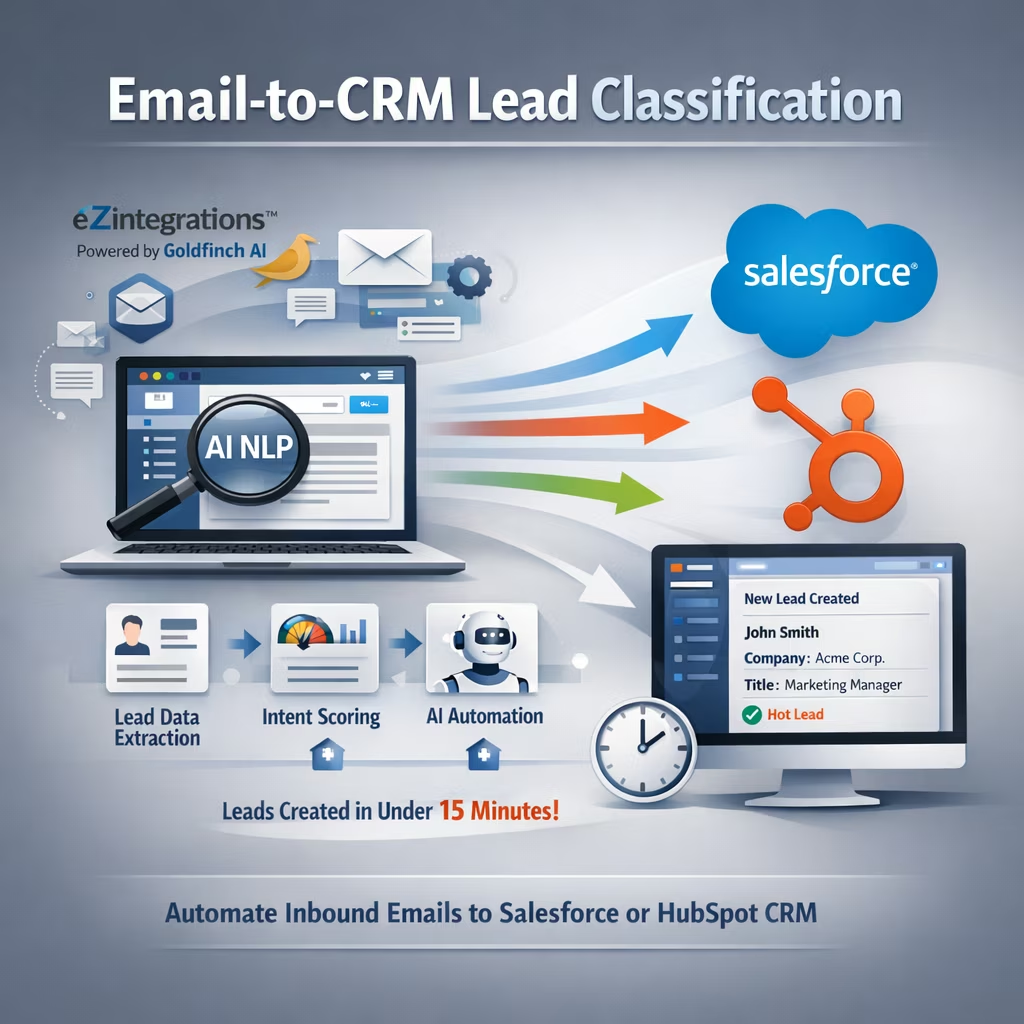
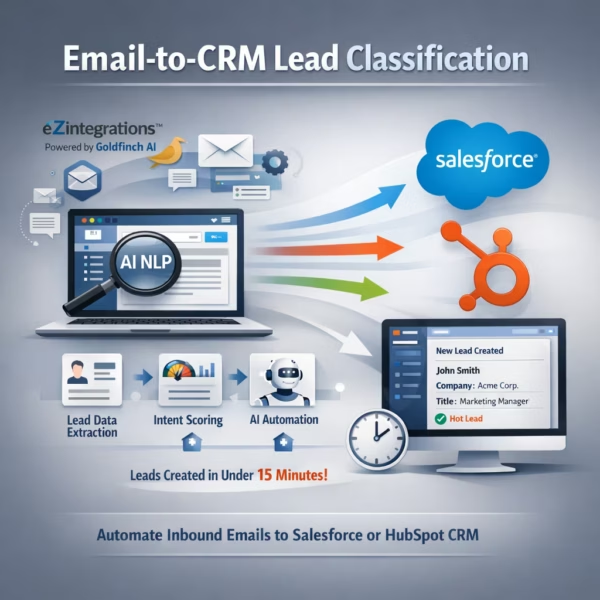
The Email-to-CRM Lead Classification workflow from eZintegrations monitors the sales inbox via Microsoft Graph API or IMAP and processes each inbound email as it arrives. Goldfinch AI Document Intelligence classifies the email type (Sales Lead; Support; Spam; Internal) and extracts structured lead data from Sales Lead emails. Goldfinch AI Data Analysis scores lead intent on a 0 to 100 scale using ML trained on historical email-to-opportunity conversion data. Goldfinch AI Knowledge Base Vector Search routes the lead to the correct SDR based on territory; product line; and intent profile. A CRM lead record is created in Salesforce or HubSpot within 15 minutes of email arrival – fully populated; scored; and assigned. |
| Validation (HITL): |
All CRM lead records created by the AI workflow are visible to the SDR and Sales Manager in their standard CRM view – every record is reviewed by the SDR before outreach is initiated. Emails classified as Sales Lead with intent score above 70 (Hot) trigger an immediate SDR notification via CRM task or SMTP; flagging the record for same-day outreach. Emails classified as Sales Lead with intent score below 40 (Cold) are created as CRM leads but added to a nurture sequence queue for Sales Manager review before SDR assignment. Emails classified as Support or Spam are not creating CRM leads – they are routed to the support queue or discarded. For any email where Document Intelligence classification confidence falls below 0.70; the email is flagged as “Uncertain – manual review required” and sent to a shared Sales Ops review mailbox before any CRM action. |
| Accuracy Metric: |
91%+ email classification accuracy (Sales Lead vs. non-lead; 4-class). Lead-specific extraction accuracy (company name; contact name; job title): 94%+ on standard B2B email formats. ML intent score correlation with SDR-rated lead quality: 82% agreement. False negative rate (genuine leads classified as non-lead): under 4% after model calibration. |
| Time Savings: |
Lead response time reduced from 4 to 24 hours (manual triage queue) to under 15 minutes (AI classification and CRM creation). SDR daily email triage time reduced from 2 to 4 hours to under 20 minutes (reviewing only flagged Uncertain emails and Hot lead notifications). Sales Ops manual CRM entry time eliminated for all inbound email leads. |
| Cost Impact: |
At $73,000 average SDR annual salary and 2.5 hours per day on email triage (TOPO research); the workflow saves 625 SDR hours per year per SDR redeployed to outreach – an estimated $22,000 to $35,000 in annual SDR productivity per seat. Organizations with 5 to 15 SDRs typically realize $110,000 to $525,000 in annual pipeline value improvement from faster lead response; reduced lead abandonment; and SDR time redeployed to qualified outreach. |
Description
AI email lead classification from eZintegrations monitors your sales inbox, classifies each inbound email using Goldfinch AI NLP, extracts lead data, scores intent, and creates a fully populated CRM lead in Salesforce or HubSpot in under 15 minutes — replacing hours of daily SDR email triage. eZintegrations is an enterprise automation platform covering iPaaS, AI Workflows, AI Agents, and Goldfinch AI agentic automation.
What Is AI Email Lead Classification?
AI email lead classification applies natural language processing to inbound sales emails to automatically distinguish sales leads from support requests, spam, and internal communications — and for genuine leads, extracts structured contact and intent data, scores the lead’s purchase readiness, and routes it to the appropriate SDR. The AI replaces the manual read-and-triage process that consumes 2 to 4 SDR hours per day on administrative work rather than selling activity.
How Does AI Email Lead Classification Work to Automatically Score and Route Inbound Sales Emails to the Right CRM and SDR?
When an email arrives in the sales alias inbox monitored by eZintegrations via Microsoft Graph API or IMAP, Goldfinch AI Document Intelligence classifies the email type and extracts structured lead data from confirmed Sales Lead emails. Goldfinch AI Data Analysis scores the lead on a 0 to 100 intent scale using ML trained on historical email-to-opportunity conversion patterns. Goldfinch AI Knowledge Base Vector Search matches the lead’s product interest and company profile to the SDR territory and product assignment rules. A CRM lead record is created in Salesforce or HubSpot within 15 minutes, fully populated and assigned — and the SDR receives a notification to begin outreach.
Harvard Business Review research shows companies responding within 5 minutes are 100x more likely to qualify a lead than those responding after 30 minutes. AI email lead classification makes the 5-minute response the default, not the exception.
Watch Demo
| Video Title: |
AI Email Lead Classification |
|---|---|
| Duration: |
3 to 5 minutes |
Outcome & Benefits
| Accuracy: |
91%+ email classification accuracy (Sales Lead vs. non-lead); 94%+ lead data extraction accuracy on standard B2B email formats; 82% ML intent score agreement with SDR-rated lead quality; false negative rate under 4% |
|---|---|
| Touchless Rate: |
84% of inbound leads correctly scored; CRM-created; and SDR-assigned without manual review; 16% flagged for Uncertain review or Cold lead Sales Manager review before SDR assignment |
| Time Saved: |
Lead response time from 4 to 24 hours to under 15 minutes; SDR daily email triage from 2 to 4 hours to under 20 minutes; Sales Ops CRM entry time eliminated for all inbound email leads |
| Cost Saved: |
$22,000 to $35,000 in annual SDR productivity per seat (2.5 hours/day triage eliminated); $110,000 to $525,000 in annual pipeline value improvement at 5 to 15 SDRs from faster lead response; reduced abandonment; and redeployed SDR time |
Performance Metrics
| Metric | Before (Manual/Batch) | After (Real-Time Sync) | Improvement |
|---|---|---|---|
| Lead Response Time | 4 to 24 hours | Under 15 minutes | 95%+ faster |
| SDR Daily Email Triage | 2 to 4 hours/day | Under 20 min/day (flagged only) | 85%+ reduction |
| Inbound Lead CRM Entry Rate | Variable (missed leads common) | 100% of Sales Lead emails | Full capture |
| Lead-to-SDR Routing Accuracy | Manual, error-prone | 91%+ AI classification | Consistent |
Functional Details
| Business Tasks: |
Continuous inbound email monitoring (Microsoft 365 or Gmail sales alias via Graph API or IMAP); 4-class NLP email classification (Sales Lead / Support / Spam / Internal); structured lead data extraction from Sales Lead emails (company; contact; job title; phone; pain points; product interest; urgency signals); ML lead intent scoring (0 to 100) with Hot/Warm/Cold tier assignment; SDR territory and product routing via Knowledge Base; CRM lead record creation in Salesforce or HubSpot with full data population; Hot lead SDR notification via CRM task or SMTP; support email routing to helpdesk queue; spam filtering and discard; weekly lead classification accuracy report for Sales Ops |
|---|---|
| KPI Improved: |
Lead response time (minutes from email to SDR notification); SDR triage hours per day; inbound lead capture rate (vs. email volume); lead-to-meeting conversion rate; pipeline coverage from inbound channel; CRM data completeness for inbound leads; SDR outreach time vs. triage time ratio |
| Scheduling: |
Continuous real-time monitoring – eZintegrations polls the sales inbox via Microsoft Graph API or IMAP every 2 minutes for new emails; each email is classified and processed within 15 minutes of arrival; batch backfill mode available for processing historical email archives; weekly model accuracy report; quarterly model retraining using Salesforce/HubSpot opportunity outcome data (email leads that converted vs. did not) |
| Downstream Use: |
CRM lead records created in Salesforce (https://developer.salesforce.com/docs/atlas.en-us.api_rest.meta/api_rest/) via REST API (Lead object) or HubSpot (https://developers.hubspot.com/docs/api/crm/contacts) via REST API (Contact + Deal object); Hot lead SDR notification via Salesforce Task or SMTP; support emails forwarded to Zendesk; Freshdesk; or configured helpdesk queue; spam discarded with log entry; all classification decisions and lead records logged to Snowflake or configured data warehouse for CRM sync analytics; lead source attribution; and quarterly intent model retraining |
Technical Details
| Model Name/Version: |
Goldfinch AI Document Intelligence (https://ezintegrations.ai/agentic-ai-platform/) with underlying LLM GPT-4o via Azure OpenAI (https://learn.microsoft.com/en-us/azure/ai-services/openai/) for email NLP classification and structured data extraction; Goldfinch AI Data Analysis using a gradient boosting classifier (XGBoost v2.0 https://xgboost.readthedocs.io/) trained on historical email-to-opportunity conversion data for intent scoring; Goldfinch AI Knowledge Base Vector Search with Weaviate or Pinecone as the vector store for SDR territory and routing rules |
|---|---|
| Hosting Type: |
Cloud-hosted on Oracle OCI via eZintegrations; email inbox monitored via Microsoft Graph API (https://learn.microsoft.com/en-us/graph/api/message-list) or IMAP; Goldfinch AI Document Intelligence and Data Analysis execute in customer-isolated tenant; CRM lead records created via Salesforce or HubSpot REST API; routing knowledge base maintained in customer-isolated Goldfinch AI Knowledge Base environment |
| Prompt Strategy: |
Document Intelligence email classification uses a structured 4-class classification prompt: “Classify the following email as one of: Sales Lead (inbound inquiry from a prospect or potential buyer); Customer Support (request from an existing customer or user); Spam/Unsubscribe (promotional; unsolicited; or unsubscribe request); or Internal (from a colleague; partner; or vendor). Return the classification and confidence score. If Sales Lead; extract the following structured data: company name; contact name; job title; phone number; stated pain points or challenges; product/solution interest signals; urgency language (timeline; deadline; budget mention); and competition mention.” Data Analysis scoring: deterministic XGBoost model – not LLM-based. Knowledge Base routing: structured semantic search – not open-ended generation. |
| Guardrails: |
Document Intelligence classification confidence below 0.70: email flagged as “Uncertain – manual review” and routed to Sales Ops shared mailbox – no CRM record created until reviewed. Intent score below 40 (Cold lead): CRM lead created but assigned to nurture queue; Sales Manager review required before SDR assignment and outreach. Intent score 40 to 69 (Warm): CRM lead created and SDR assigned – SDR outreach within 48-hour window. Intent score above 70 (Hot): CRM lead created; SDR immediately notified via CRM task and SMTP; same-day outreach expected. Emails containing sensitive PII beyond standard contact data (financial details; medical information; legal communication indicators): flagged for Sales Ops review rather than automated processing. |
| Latency: |
Under 15 minutes from email arrival in inbox to CRM lead record created and SDR notification sent for standard B2B emails; under 5 minutes for short-form emails with high classification confidence; under 30 minutes for complex multi-paragraph emails requiring extended extraction |
| Data Governance: |
Email content processed in customer-isolated eZintegrations tenant – not shared cross-tenant. Email body text processed via Azure OpenAI inference – no email content retained by the model provider beyond the inference call. Sender PII (email address; name; company) used only for CRM lead creation and routing – not included in intent scoring model features (scoring is based on content signals only; not sender identity). Full audit trail per email processed: classification label; confidence score; extracted fields; intent score; routing decision; CRM record reference; and processing timestamp. Emails classified as support or spam: email body not stored in eZintegrations after processing; only classification label and routing action logged |
| Throughput: |
Up to 2,000 emails processed per day at standard configuration; scales to 20,000+ per day at enterprise tier with parallel Goldfinch AI inference threads; supports high-volume campaign response processing (post-webinar email surges; trade show follow-up volumes) |
Connectivity and Deployment
| Supported Protocols: |
Microsoft Graph API (Microsoft 365 inbox monitoring); IMAP (Gmail/Google Workspace inbox monitoring); REST API (Salesforce and HubSpot CRM lead creation); Webhooks; HTTPS; OAuth 2.0; SMTP (SDR notification emails); IPSec Tunnel (on-premises CRM connectivity); Weaviate or Pinecone vector database API (SDR routing knowledge base) |
|---|---|
| Security & Compliance: |
HIPAA-eligible configuration available (healthcare sales teams); GDPR-compliant data handling (inbound email sender PII processed under GDPR Article 6 lawful basis for legitimate interest in sales communications; data subject access request support for sender data); SOC Type II certified; CAN-SPAM and CASL compliant routing (unsubscribe/opt-out emails classified as Spam and routed to suppression list management rather than CRM lead creation). TLS 1.3 encryption in transit; AES-256 at rest. Email content processed in isolated tenant via Azure OpenAI – no content retention beyond inference call. RBAC enforced on classification model configuration; routing rules; intent threshold settings; and CRM write access. |
| Tenancy Model: |
Both single-tenant and multi-tenant deployments are available. Single-tenant is recommended for organizations with strict email data segregation requirements (financial services; healthcare; legal) or where inbound email contains commercially sensitive prospect information. Multi-tenant is the default shared-cloud deployment. Both support on-premises CRM connectivity via IPSec Tunnel. |
| On-Premise Supported: |
Yes – eZintegrations connects to on-premises CRM systems (Salesforce on-prem; Oracle CRM; SAP CRM); helpdesk systems; and MSSQL data stores via IPSec Tunnel. eZintegrations is a browser-based; cloud-hosted platform and does not require any on-premises software installation. |
FAQ
1. What is the Email-to-CRM Lead Classification AI workflow?
AI email lead classification by eZintegrations monitors the sales inbox via Microsoft Graph API or IMAP, classifies each inbound email using Goldfinch AI Document Intelligence NLP (Sales Lead/Support/Spam/Internal), extracts structured lead data from Sales Lead emails, scores intent on a 0 to 100 scale using Goldfinch AI Data Analysis ML, and creates a fully populated CRM lead record in Salesforce or HubSpot within 15 minutes — routed to the correct SDR via Goldfinch AI Knowledge Base Vector Search. The workflow achieves 91%+ email classification accuracy and reduces SDR daily email triage from 2 to 4 hours to under 20 minutes.
2. What AI model types does the email lead classification workflow use?
This workflow uses three Goldfinch AI tools: Document Intelligence (GPT-4o via Azure OpenAI) for 4-class email NLP classification and structured lead data extraction, Data Analysis (XGBoost gradient boosting classifier trained on historical email-to-opportunity conversion data) for ML intent scoring, and Knowledge Base Vector Search (Weaviate or Pinecone vector store) for SDR territory and routing recommendation. The combination achieves 91%+ classification accuracy and 82% intent score agreement with SDR-rated lead quality.
3. What input data does the AI email lead classification workflow require?
This workflow requires access to the sales inbox (Microsoft 365 shared mailbox via Graph API or Gmail/Google Workspace sales alias via IMAP), and a configured SDR routing knowledge base (territory assignments, product line ownership, account size rules) loaded into Goldfinch AI Knowledge Base Vector Search. Historical email-to-opportunity data from Salesforce or HubSpot (minimum 6 months, 500+ email examples per lead tier) is required for initial intent scoring model training per customer.
4. What is the output format of the AI email lead classification workflow?
The workflow produces a CRM lead record in Salesforce (Lead object) or HubSpot (Contact + Deal) — populated with company name, contact name, email, job title, phone (where extracted), lead source, email classification label, intent score (0 to 100), lead quality tier (Hot/Warm/Cold), product interest tags, extracted pain point summary, SDR assignment, and original email as a note. Hot leads trigger immediate SDR notification via CRM task or SMTP. Support emails are forwarded to the helpdesk queue. Spam is discarded with a log entry.
5. Who uses the AI email lead classification workflow?
SDRs receive Hot and Warm lead notifications and the pre-populated CRM record — they review the AI-extracted data and initiate outreach without manual email triage. Sales Managers review Cold leads in the nurture queue before SDR assignment and use the intent scoring distribution to assess inbound pipeline quality. Marketing Operations Managers use the weekly classification report to measure inbound email campaign response quality and optimize email subject and offer strategy.
6. What are the key benefits of AI email lead classification?
Key benefits include 91%+ email classification accuracy, lead response time from 4 to 24 hours to under 15 minutes (Harvard Business Review research: 100x higher qualification rate at 5-minute response), 85%+ reduction in SDR daily email triage, 100% inbound email lead capture rate (no missed leads), $22,000 to $35,000 annual SDR productivity per seat, and $110,000 to $525,000 in annual pipeline value improvement at 5 to 15 SDRs from faster response and redeployed SDR capacity.
7. What systems does the AI email lead classification workflow integrate with?
This workflow monitors Microsoft 365 sales mailboxes via Microsoft Graph API or Gmail/Google Workspace via IMAP, creates lead records in Salesforce CRM or HubSpot via REST API, routes support emails to Zendesk or configured helpdesk queue, sends SDR notifications via Salesforce Task or SMTP, and logs all classification decisions to Snowflake or a configured data warehouse. On-premises CRM systems connect via IPSec Tunnel.
8. How often does the AI email lead classification workflow run?
The workflow monitors the inbox continuously in real time — polling every 2 minutes via Microsoft Graph API or IMAP for new emails. Each email is classified and processed within 15 minutes of arrival. A batch backfill mode is available for processing historical email archives. The intent scoring model is retrained quarterly using Salesforce or HubSpot opportunity outcome data. A weekly email classification accuracy report is generated for Sales Ops.
AI Credits
| LLM Steps Count: |
Up to 3 (Document Intelligence classification + extraction for all emails; Data Analysis scoring + Knowledge Base routing for Sales Lead emails only) |
|---|---|
| Credit Consumption Model: |
Per email for Document Intelligence (token-based; scales with email length); per Sales Lead email for Data Analysis and Knowledge Base (flat per-call; triggered only for confirmed Sales Lead classification) |
| Estimated Credits per Run: |
Short email (under 200 words; confirmed Sales Lead): ~8 to 14 credits per email (Document Intelligence: ~4; Data Analysis: ~3; Knowledge Base: ~2) Long email (200 to 800 words; confirmed Sales Lead): ~14 to 22 credits per email Non-lead email (support; spam; internal – classification step only): ~3 to 5 credits per email High-volume inbox (1,000 emails per day; 20% Sales Lead rate): ~5,000 to 8,000 credits per day |
| Monthly Credit Estimate (at Typical Volume): |
1,000 emails per month (small sales team; 20% lead rate): ~5,000 to 8,000 credits per month 5,000 emails per month (mid-market sales team): ~25,000 to 40,000 credits per month 20,000 emails per month (large enterprise sales inbox): ~100,000 to 160,000 credits per month |
| Pricing Model: |
Static Platform Fee + AI Credits. Platform fee covers unlimited non-LLM steps (inbox monitoring; email routing; CRM API write; SMTP SDR notification; helpdesk queue forwarding; Snowflake logging). AI Credits consumed only by Goldfinch AI Document Intelligence (classification); Data Analysis (intent scoring); and Knowledge Base Vector Search (routing). |
| Credit Optimization Notes: |
Configure a pre-filter to skip Document Intelligence processing for emails that pass basic spam/pattern rules (known domains; structural patterns) – reduces credit consumption on high-volume inboxes with significant spam. Apply a two-stage classification: run a lightweight keyword pre-screen on email subject line and sender domain before full Document Intelligence classification – this can reduce full NLP calls by 25 to 40% on inboxes with high spam rates. For Data Analysis and Knowledge Base; only invoke these steps for emails with Document Intelligence Sales Lead classification confidence above 0.75 – this avoids scoring emails that are likely borderline classifications. Run the full intent scoring model daily in batch for lower-priority inboxes rather than real-time per-email; reducing per-email credit cost. |
| Goldfinch AI Tool(s) Consuming Credits: |
Document Intelligence: 4-class email classification and structured lead data extraction using LLM inference – credits per email (scales with email length/token count) Data Analysis: ML intent scoring using XGBoost gradient boosting – credits per Sales Lead email (flat per-email cost; non-lead emails skip this step) Knowledge Base Vector Search: SDR territory and routing recommendation retrieval – credits per Sales Lead email (flat per-routing-call; non-lead emails skip this step) |
| AI Credits Required: |
Yes — three Goldfinch AI tools invoked per email processed: Document Intelligence (email NLP classification and lead data extraction), Data Analysis (ML lead intent scoring), and Knowledge Base Vector Search (SDR routing recommendation). AI Credits consumed per email evaluated – non-lead emails (spam, support, internal) consume credits only for the classification step; lead emails consume all three steps. |
Resources
| Blog: |
AI Email Agent: 7 Powerful Steps to Set Up Goldfinch AI Easily |
|---|---|
| Goldfinch AI Overview: |
Agentic AI Platform — Goldfinch AI by eZintegrations |
| Platform Overview: |
eZintegrations Platform – Enterprise iPaaS, AI Workflows & Agentic AI |
| Demo: |
Book a Demo |
Case Study
| Problem: |
The Sales Development team at a mid-market cloud infrastructure SaaS company managed a shared sales alias (sales@company.com) that received 800 to 1,200 emails per month. Three SDRs rotated inbox monitoring daily – spending an average of 2.8 hours per SDR per day reading emails; determining lead vs. non-lead; extracting contact data; looking up territory ownership; and creating Salesforce lead records. Lead response time averaged 8.4 hours from email arrival. The SDR team estimated that 12 to 18% of inbound leads were either missed (not created in Salesforce); delayed beyond 24 hours; or routed to the wrong SDR due to territory misassignment. The VP of Sales calculated that the lead triage process consumed 35% of SDR available time that should have been spent on outbound calls and follow-up. |
|---|---|
| Solution: |
Deployed eZintegrations AI email lead classification in 5 business days. Microsoft 365 inbox monitored via Microsoft Graph API. Goldfinch AI Document Intelligence configured with the company’s 4-class email taxonomy and 12 product area interest categories. Data Analysis intent scoring model trained on 14 months of Salesforce data (1,840 historical email leads; 340 opportunities created; 520 closed-won). Knowledge Base Vector Search loaded with SDR territory assignments; product line ownership matrix; and company size routing rules (SMB vs. mid-market vs. enterprise by employee count inferred from email domain signals). Salesforce Lead object mapping configured for all extracted fields. Hot lead threshold set at 70 (immediate SDR notification); Cold lead threshold at 40 (Sales Manager review queue). |
| ROI: |
SDR productivity improvement: estimated $186,000 in annual additional pipeline from redeployed SDR time (3 x 2.8-hour daily triage savings x 230 working days x $35 SDR productive hour value). Lead response improvement: 44% increase in lead-to-meeting booking rate (from 12-minute vs. 8.4-hour response time impact; aligned to Harvard Business Review lead response research). Revenue impact: $820,000 in incremental closed pipeline attributable to faster lead response and improved routing accuracy in the first 12 months post-deployment. |
| Industry: |
SaaS; Professional Services; Manufacturing; Financial Services |
| Outcome: |
91%+ email classification accuracy (Sales Lead vs. non-lead), 84% of inbound leads correctly scored and routed without SDR manual review, lead response time reduced from 4 to 24 hours (manual routing) to under 15 minutes, pipeline coverage improvement of 20 to 35% from leads that would have been missed or delayed in manual review queues |