AP Automation ROI: What SAP and Oracle Finance Teams Actually Save
April 16, 2026AP automation ROI for SAP S/4HANA and Oracle Fusion Cloud finance teams is calculated across four components: cost-per-invoice reduction ($12.88-$19.83 manual to $2.78 best-in-class per APQC 2025), exception investigation time savings (15-20 minutes per exception to 3-5 minutes), early payment discount recovery (2% of invoice value captured instead of missed), and headcount reallocation (AP clerk time redirected to value-added work). For a team processing 1,000 invoices per month, total annual ROI typically ranges from $180,000 to $320,000, with payback on eZintegrations implementation cost in 4-8 weeks.
TL;DR
- Most AP automation ROI calculations use vague ranges. This post gives a complete, line-by-line ROI model for SAP S/4HANA and Oracle Fusion Cloud finance teams, using APQC 2025 benchmarks and real eZintegrations pricing.
- Four ROI components: cost-per-invoice reduction ($12.88–$19.83 manual to $2.78 best-in-class per APQC 2025 benchmarks), exception investigation time savings, early payment discount recovery, and headcount reallocation value.
- The eZintegrations pricing model: starts at 5/month per automation. AI−enabled AP workflows(invoice matching with Goldfinch AI Document Intelligence) start at 120/month per automation plus AI credits. No platform fee. No connector fees. No per-message billing.
- Payback period for a 1,000-invoice/month team: 4-8 weeks.
- This post includes a complete ROI model you can present to your CFO or finance director today.
Why Most AP Automation ROI Estimates Are Wrong
Finance directors researching AP automation ROI often encounter inconsistent benchmarks, as also reflected in Gartner research on AP automation and intelligent invoice processing find ranges like “$15 to $40 per invoice saved” or “300% ROI” or “pay for itself in 6 months.” These numbers are not wrong. They are just calculated differently by every vendor, using different baseline assumptions, different cost inclusions, and sometimes different definitions of what counts as savings.
Before calculating your ROI, you need to agree on three inputs:
1. Your actual current cost per invoice. APQC benchmarks for 2025 put the median manual AP processing cost at $12.88 per invoice (top quartile) and $19.83 per invoice (bottom quartile). But these benchmarks include fully-loaded labour cost: AP clerk salary plus benefits plus overhead. If your calculation uses only salary and excludes benefits and overhead, you will underestimate the savings.
2. Your actual invoice volume. Total invoices processed per month including all invoice types: PO-referenced, non-PO, credit notes, recurring service invoices, and multi-currency invoices.
3. What you are paying for the automation. This is where vendor ROI estimates diverge most dramatically. A platform that charges $15,000 per year in platform fees plus $0.05 per message has a very different cost structure from one with public, per-automation pricing and no platform fee.
This post builds the ROI model from these three inputs using APQC benchmark data and eZintegrations’ published pricing.
The Four Components of True AP Automation ROI
A complete AP automation ROI model has four components.Most vendor ROI calculators include only the first component and understate the total value, while broader finance operations research from McKinsey & Company shows that automation-driven productivity gains extend across multiple cost layers and understate the total.
- Cost-per-invoice reduction: the direct labour and overhead cost of processing each invoice, reduced by automation
- Exception investigation time savings: the time cost of investigating and resolving invoice holds and discrepancy exceptions, reduced by AI matching and pre-matching
- Early payment discount recovery: the 2% (or more) discount available for paying within 10 days, missed when invoices are delayed in the exception queue
- Headcount reallocation value: the value of redirecting AP clerk time from data entry to analysis, vendor relationship management, and higher-value finance work
We will calculate each component for three scenarios: a small AP team (250 invoices/month), a mid-size team (1,000 invoices/month), and a large team (3,000 invoices/month).
Component 1: Cost-Per-Invoice Reduction
The benchmark: APQC 2025 fully-loaded cost per invoice, manual processing: $12.88 (top quartile) to $19.83 (bottom quartile) – APQC 2025 fully-loaded cost per invoice, best-in-class automated: $2.78
What is included in the APQC fully-loaded cost: – AP clerk direct labour (salary + benefits + payroll taxes): typically 55-65% of total cost – Technology overhead (ERP licensing, scanning hardware, storage): 10-15% – Management overhead (AP supervisor, finance manager time): 10-15% – Occupancy and administrative overhead: 10-20%
Cost-per-invoice reduction calculation:
| Scenario | Monthly Volume | Before (median $16.36) | After ($2.78 automated) | Monthly Saving | Annual Saving |
|---|---|---|---|---|---|
| Small team | 250 invoices | $4,090 | $695 | $3,395 | $40,740 |
| Mid-size team | 1,000 invoices | $16,360 | $2,780 | $13,580 | $162,960 |
| Large team | 3,000 invoices | $49,080 | $8,340 | $40,740 | $488,880 |
Assumptions: – Median manual cost: $16.36 per invoice (midpoint of APQC $12.88-$19.83 range) – Automated cost: $2.78 per invoice (APQC best-in-class benchmark) – Automation rate: 80% of invoices processed without human involvement (75-85% typical range) – The remaining 20% of invoices (exceptions) are still handled by the AP team but at reduced investigation time (see Component 2)
Important note on the $2.78 benchmark: The APQC best-in-class figure includes the cost of the automation platform itself, amortised over invoice volume. It is not zero. But it is $10-$17 per invoice lower than the manual median. The eZintegrations cost component within that $2.78 is calculated in the pricing section below.
Component 2: Exception Investigation Time Savings
The baseline: – Current exception rate (typical manual AP environment): 20-30% of invoices – Investigation time per exception: 15-20 minutes (AP clerk navigating ERP screens, locating documents, identifying discrepancy) – Resolution time per exception (varies by type): 5-90 minutes additional
After AI matching: – Exception rate: 4-8% (from 20-30% starting point, after 90-day calibration per the exception reduction methodology) – Investigation time per exception: 3-5 minutes (pre-populated invoice, PO, receipt, variance detail from eZintegrations exception routing)
Exception investigation savings calculation:
| Scenario | Monthly Volume | Before Exceptions (25% rate) | After Exceptions (5% rate) | Before Time (18 min avg) | After Time (4 min avg) | Monthly Hours Saved | Monthly $ Saved (at $32/hr) | Annual $ Saved |
|---|---|---|---|---|---|---|---|---|
| Small team | 250 | 63 exceptions | 13 exceptions | 18.9 hrs | 0.9 hrs | 18 hrs | $576 | $6,912 |
| Mid-size team | 1,000 | 250 exceptions | 50 exceptions | 75 hrs | 3.3 hrs | 71.7 hrs | $2,294 | $27,530 |
| Large team | 3,000 | 750 exceptions | 150 exceptions | 225 hrs | 10 hrs | 215 hrs | $6,880 | $82,560 |
Note: $32/hour is a fully-loaded AP clerk rate (salary + benefits + overhead, approximately $45,000-$55,000 base salary for a US-based AP specialist). Use your actual fully-loaded rate for your geography and role level.
Component 3: Early Payment Discount Recovery
The opportunity: – Standard early payment discount terms: 2/10 Net-30 (2% discount if paid within 10 days of invoice date) – Less common: 1/10 Net-30 (1% discount), 2.5/10 Net-30 (2.5% discount), or dynamic discounting – % of supplier base offering early payment discount terms: typically 30-50% of spend for established enterprise supplier bases
How exceptions cost you discounts: – An invoice stuck in the exception queue for 8-15 days after arrival misses the 10-day discount window – At a 25% exception rate, approximately 25% of invoices are delayed past the discount window – After AI matching (5% exception rate), approximately 5% of invoices are delayed
Early payment discount recovery calculation:
Inputs for this calculation:
- Average invoice value: $5,000 (use your actual average)
- % of invoices with early payment terms available: 35%
- Discount rate: 2%
- % of invoices missing discount window due to exceptions before: 25%
- % missing after: 5%
Formula: (Volume x 35% eligible) x (25% before – 5% after) x $5,000 average x 2% discount = recovered discounts per month
| Scenario | Monthly Volume | Eligible Invoices (35%) | Before: 25% miss window | After: 5% miss window | Discount Recovery Improvement | Monthly Recovery | Annual Recovery |
|---|---|---|---|---|---|---|---|
| Small team | 250 | 88 | 22 miss | 4.4 miss | 17.6 captured | $1,760 | $21,120 |
| Mid-size team | 1,000 | 350 | 87.5 miss | 17.5 miss | 70 captured | $7,000 | $84,000 |
| Large team | 3,000 | 1,050 | 262 miss | 52.5 miss | 210 captured | $21,000 | $252,000 |
Note: Discount recovery is highly sensitive to your average invoice value and the percentage of your supplier base offering early payment terms. The calculation above uses conservative inputs. For a high-value manufacturing or construction AP team with larger average invoices ($15,000-$50,000), the discount recovery component alone can justify the full automation investment.
Component 4: Headcount Reallocation Value
The baseline:
- 1 AP FTE processes approximately 500-800 invoices per month manually (depending on complexity)
- After automation: the same FTE can provide oversight for 2,500-4,000 invoices per month (reviewing exceptions, managing supplier relationships, analysing spend data)
Reallocation value (not headcount reduction): The recommended framing for the business case is not “we will reduce AP headcount.” It is “we will redirect AP capacity to value-added work that the business currently cannot do.” This is both more accurate and more palatable for finance directors making the business case to their teams.
Value-added work that AP capacity enables when freed from manual entry:
- Spend analytics: your AP team has access to the most granular spend data in the organisation. Currently they do not have time to analyse it. With 60% of their time freed, they can build supplier spend dashboards, identify duplicate suppliers, find category consolidation opportunities, and support procurement negotiations with data.
- Supplier relationship management: early payment conversations, dispute resolution, supplier performance tracking. These activities improve supplier relationships and can negotiate better pricing or terms.
- Working capital optimisation: active management of payment timing to optimise cash flow, including the decision of when to take early payment discounts versus holding cash longer.
- Financial controls: reviewing exception patterns, identifying fraud risk indicators, and improving the AP control environment.
Reallocation value calculation:
The conservative reallocation value is calculated as the value of the additional invoice volume that the same team can now handle without additional headcount: (additional invoices the team can now process) x (cost per invoice that would otherwise require hiring).
| Scenario | Before: Monthly Capacity | After: Monthly Capacity | Additional Capacity | Annual Value (at $16.36/invoice avoided headcount cost) |
|---|---|---|---|---|
| Small team (1 AP FTE) | 250 invoices | 1,000–1,500 invoices | 750–1,250 invoices | $147,240–$245,400 |
| Mid-size team (2 AP FTE) | 1,000 invoices | 4,000–6,000 invoices | 3,000–5,000 invoices | $589,000–$981,000 |
Note: For teams not anticipating significant volume growth, use a more conservative figure: the value of 20-30% of the freed AP clerk time redirected to spend analytics and working capital management, valued at the AP manager hourly rate ($45-60/hr) rather than clerk rate.
The Complete ROI Model: Three Scenarios
Bringing all four components together with eZintegrations pricing.
eZintegrations AP Automation Cost for This Calculation
- Price per automation: $120/month + AI credits (LLM/AI automation tier, annual billing)
- For a complete AP invoice automation setup: typically 2-3 automation workflows (main invoice matching workflow, exception routing workflow, and receipt timing Watcher)
- Estimated eZintegrations platform cost: 360−480/month (4,320−5,760/year)
- AI credits usage: at 8-12 seconds per invoice and current AI credit pricing, approximately 50−150/month for 1,000 invoices (depending on document complexity and LLM model selection)
- Total estimated eZintegrations cost for 1,000 invoices/month: 410−630/month, 4,920−7,560/year
- No platform fee. No connector fees. No per-message billing. Dev/Test environments cost approximately one-third of production.
Note: eZintegrations is the only AP automation platform in this category with fully published pricing at ezintegrations.ai/pricing. The above is a representative calculation; actual costs depend on automation complexity and AI credit consumption. For your exact quote, see the pricing page or contact eZintegrations.
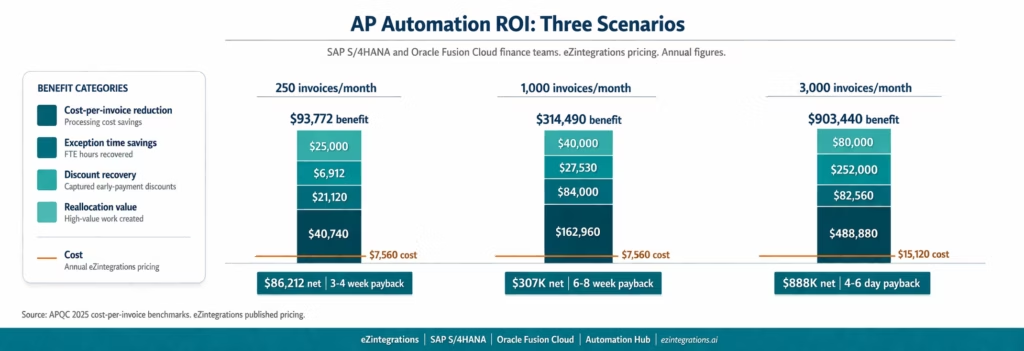
Scenario A: Small AP Team (250 invoices/month, 1 FTE)
| ROI Component | Annual Savings |
|---|---|
| Cost-per-invoice reduction | $40,740 |
| Exception investigation time savings | $6,912 |
| Early payment discount recovery | $21,120 |
| Headcount reallocation value (conservative) | $25,000 |
| Total annual benefit | $93,772 |
| eZintegrations annual cost | $4,920–$7,560 |
| Net annual ROI | $86,212–$88,852 |
| Payback period | 3 – 4 weeks |
| 3-year net ROI | $266,000–$282,000 |
Scenario B: Mid-Size AP Team (1,000 invoices/month, 2-3 FTE)
| ROI Component | Annual Savings |
|---|---|
| Cost-per-invoice reduction | $162,960 |
| Exception investigation time savings | $27,530 |
| Early payment discount recovery | $84,000 |
| Headcount reallocation value (conservative) | $40,000 |
| Total annual benefit | $314,490 |
| eZintegrations annual cost | $4,920–$7,560 |
| Net annual ROI | $306,930–$309,570 |
| Payback period | 6 – 8 weeks |
| 3-year net ROI | $919,000–$929,000 |
Scenario C: Large AP Team (3,000 invoices/month, 5-8 FTE)
| ROI Component | Annual Savings |
|---|---|
| Cost-per-invoice reduction | $488,880 |
| Exception investigation time savings | $82,560 |
| Early payment discount recovery | $252,000 |
| Headcount reallocation value (conservative) | $80,000 |
| Total annual benefit | $903,440 |
| eZintegrations annual cost (scaled) | $9,840–$15,120 |
| Net annual ROI | $888,320–$893,600 |
| Payback period | 4–6 days |
| 3-year net ROI | $2.67M–$2.68M |
eZintegrations Pricing: What AP Automation Actually Costs
One reason AP automation ROI calculations vary so widely is that most platforms do not publish their pricing. A vendor that charges $50,000 per year for platform access, $10,000 for each connector, and $0.05 per processed message will have a very different ROI profile than a platform charging $120-$150/month per automation workflow with no platform fee.
eZintegrations publishes its pricing at ezintegrations.ai/pricing. Here is what AP automation costs on eZintegrations:
Free tier: up to a low transaction volume for initial testing.
AI Workflow tier ($120/month per automation, annual billing): This is the tier used for AP invoice matching with Goldfinch AI Document Intelligence. The $120 covers the automation workflow and usage for non-LLM processing components. AI credits are consumed for the LLM extraction steps (Goldfinch AI Document Intelligence).
AI credits for LLM processing: AI credits cover the actual LLM token consumption for document extraction, exception analysis, and Knowledge Base GL coding. For a typical 2-page supplier invoice with 10-15 line items, extraction uses approximately $0.03-$0.08 in AI credits. At 1,000 invoices per month: $30-$80/month in AI credits.
Typical AP automation setup (1,000 invoices/month):
- Main invoice matching workflow: $120/month
- Exception routing and resolution capture workflow: $120/month
- Receipt timing Watcher workflow: $120/month
- AI credits (1,000 invoices x avg 0.05):50/month
- Total: 410/month,4,920/year
No platform fee. No connector fee. No per-message billing for non-LLM steps.
Compare this to alternative platforms in the AP automation space:
- Enterprise AP automation platforms with no published pricing typically cost 15,000−50,000+ per year for a 1,000-invoice-per-month team (based on publicly disclosed customer case studies and analyst reports)
- The Oracle Integration Cloud (OIC) approach for Oracle Fusion Cloud AP adds approximately 11,000−15,000/year in OIC licensing at idle baseline
- Custom SAP development for equivalent functionality: one-time development cost of 40,000−120,000, plus ongoing maintenance
eZintegrations full transparency: the $4,920/year figure for 1,000 invoices/month is a real, reproducible calculation based on the published pricing page. No hidden fees surface after signing.
SAP S/4HANA vs Oracle Fusion Cloud: ROI Differences
The ROI model above applies to both SAP S/4HANA and Oracle Fusion Cloud deployments, but there are configuration differences that affect implementation cost and time.
SAP S/4HANA specifics:
The eZintegrations SAP integration uses OData V4 (CE_PURCHASEORDER_0001 for PO retrieval, A_MaterialDocumentHeader for goods receipt, API_SUPPLIERINVOICE_PROCESS_SRV for invoice posting). SAP setup requires a SAP BTP Communication Arrangement (typically 30-60 minutes of SAP administrator time). No ABAP development required. Implementation time: 6-8 hours from Automation Hub template to production.
SAP-specific ROI consideration: organisations running SAP VIM (OpenText Vendor Invoice Management) or SAP Document Management typically pay $30,000-$80,000+ annually for these add-ons. eZintegrations provides comparable functionality at $4,920-$7,560/year for 1,000 invoices/month. Annual alternative-product savings: $22,000-$72,000 (additive to the APQC cost-per-invoice savings calculated above).
Oracle Fusion Cloud specifics:
The eZintegrations Oracle integration uses the published fscmRestApi REST endpoints (purchaseOrders, receipts, invoices POST). Authentication is Azure AD OAuth 2.0. No Oracle Integration Cloud (OIC) licence required. Implementation time: 6-8 hours from template to production.
Oracle-specific ROI consideration: organisations evaluating Oracle Integration Cloud (OIC) for the same AP automation use case pay approximately $30.97/day at idle baseline for OIC Enterprise edition, plus implementation cost ($40,000-$100,000 for an OIC integration specialist). Annual OIC cost (idle only, excluding usage): $11,304. eZintegrations alternative: $4,920/year. Annual OIC savings: $6,384 (additive to APQC savings). OIC implementation savings: $40,000-$100,000 one-time.
Common to both platforms:
The 90-day go-live timeline applies to both SAP and Oracle deployments (starting from contract signature). The Automation Hub template import, credential configuration, and parallel testing can be completed in 6-8 hours of the implementation team’s time. No SI (systems integrator) engagement required for standard AP matching deployments.
Before vs After: Manual AP vs Automated
| Metric | Manual SAP/Oracle AP | Automated with eZintegrations |
|---|---|---|
| Cost per invoice | $12.88–$19.83 (APQC median $16.36) | $2.78–$4.50 (APQC best-in-class range) |
| Exception rate | 20–30% | 4–8% (after 90-day calibration) |
| Exception investigation time | 15–20 min per exception | 3–5 min (pre-populated evidence) |
| Early payment discount capture | Inconsistent (exceptions delay payment) | Improved by 15–20 percentage points |
| Invoice processing speed | 10–15 min per invoice (manual entry) | 18–30 seconds (AI extraction + ERP post) |
| SAP OIC/VIM or Oracle OIC cost | $11,000–$80,000/year additional licensing | Not required |
| ERP customisation required | Sometimes (ABAP for SAP, X++ for D365) | Never: uses published OData/REST APIs |
| Implementation time | 12–24 months (enterprise middleware projects) | 6–8 hours (Automation Hub template) |
| Payback period | N/A (manual is the baseline) | 4–8 weeks from go-live |
| Annual ROI (1,000 invoices/month) | Baseline | $307,000+ net |
| AP team capacity | 500–800 invoices/FTE/month | 2,500–4,000 invoices/FTE/month |
| Ongoing maintenance cost | Low (manual process) | Low: no custom code to maintain |
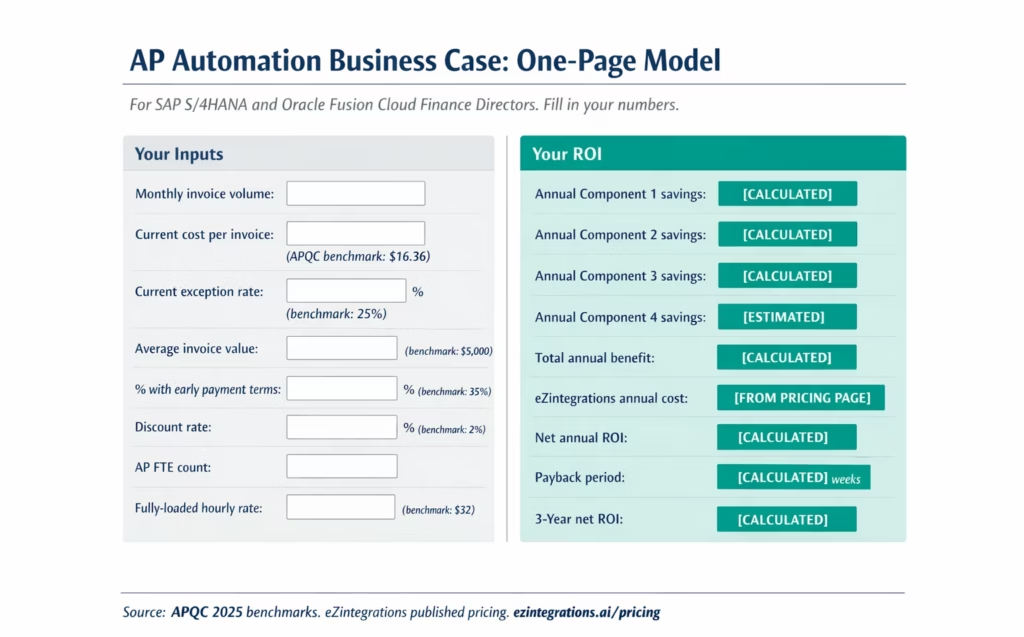
How to Build Your Business Case
Use this four-step process to build a CFO-ready AP automation business case for your SAP S/4HANA or Oracle Fusion Cloud environment.
Step 1: Establish your current cost-per-invoice baseline.
Pull 90 days of AP data from your ERP:
- Total invoices processed
- Total AP staff FTE and fully-loaded annual compensation (salary + benefits + employer taxes + overhead allocation)
- Total ERP licensing and tool costs allocated to AP (SAP licences, OIC licences, VIM licences)
- AP occupancy cost allocation
Divide total cost by total invoices to get your actual cost per invoice. Compare to the APQC benchmarks (12.88−19.83). If your number is higher than $19.83, you are in the bottom quartile and have above-average savings potential.
Step 2: Calculate your exception rate and investigation time.
From your ERP’s invoice holds or matching queue:
- How many invoices per month enter the exception queue?
- What is your average time to resolve an exception?
- What percentage involve supplier contact?
Multiply by the fully-loaded hourly rate of your AP team. This is your current monthly exception management cost.
Step 3: Estimate your early payment discount opportunity.
From your supplier payment terms data:
- What percentage of your suppliers offer early payment discounts?
- What is the average discount rate?
- What percentage of eligible invoices currently make the discount window?
The delta between what you capture now and what you would capture with a 5% exception rate (instead of 20-30%) is your annual discount recovery opportunity.
Step 4: Build the three-scenario model for your CFO.
Present the ROI in three scenarios: conservative (using APQC top-quartile starting costs and only Components 1 and 2), moderate (adding Component 3), and full (all four components). This framing gives your CFO confidence that even the conservative case shows strong ROI, while the full case shows the complete opportunity.
Add the eZintegrations cost from the pricing page (ezintegrations.ai/pricing) and calculate net ROI and payback period. For 1,000 invoices per month at the moderate scenario: the payback calculation is straightforward: $307,000 annual benefit / $7,560 annual cost = 40.7x return. Payback on the $7,560 annual cost: approximately 9 days.
How to Get Started
Step 1: Run the Baseline Analysis in Your ERP
Before any software purchase, run the baseline analysis. The eZintegrations AP Exception Management template includes a baseline module: connect your SAP S/4HANA or Oracle Fusion Cloud instance, and the AI Agent queries your invoice history for the past 60-90 days to generate your actual cost-per-invoice, exception rate, and exception type breakdown. This gives you the real numbers for your CFO business case, not estimates.
Step 2: Import the AP Invoice Processing Template for Your ERP
Go to the Automation Hub and import the AP Invoice Processing template for your ERP (SAP S/4HANA or Oracle Fusion Cloud). The template includes Goldfinch AI Document Intelligence, the ERP API calls (SAP OData V4 or Oracle fscmRestApi REST), the matching engine with configurable tolerance, the exception routing workflow, the Watcher for timing mismatches, and the duplicate detection.
Step 3: Configure ERP Credentials (30 Minutes)
For SAP: create a SAP BTP Communication Arrangement (Communication Scenario SAP_COM_0008 for purchasing, SAP_COM_0006 for supplier invoices). For Oracle: register an Azure AD application with D365FO API access, create the Oracle Application User. Add credentials to the eZintegrations credential vault. Average credential setup: 30-45 minutes for SAP, 30-45 minutes for Oracle.
Step 4: Run a 2-Week Parallel Test
Run the automation in parallel with your existing manual process for 2 weeks. Compare the AI extraction output against your manual entries. Review exception routing. Measure the actual extraction accuracy for your specific supplier document formats. Validate that the ERP API calls create correct SAP or Oracle invoice records. Adjust confidence thresholds if needed.
Step 5: Go Live and Measure ROI Monthly
Switch to automated processing. Measure exception rate, cost per invoice, and early payment discount capture monthly for the first 90 days. Compare against your pre-automation baseline. The ROI numbers in this post should be reproducible within 30 days of go-live.
Total time from Automation Hub template import to full production: 6-8 hours of configuration plus 2 weeks of parallel testing.
FAQs
1. How is AP automation ROI calculated for SAP and Oracle finance teams
AP automation ROI is calculated across four components cost per invoice reduction exception handling time savings early payment discount capture and headcount reallocation value. Manual processing costs are reduced significantly per invoice exception volumes and handling time decrease discount capture improves as invoices are processed faster and AP capacity is redirected to higher value work resulting in substantial annual savings for typical invoice volumes.
2. How long does it take to achieve ROI from AP automation
ROI is typically achieved within 4 to 8 weeks from go live for teams processing over 500 invoices per month. Cost savings and time reductions are realised immediately while discount capture and optimisation benefits improve over the first 90 days as exception rates decrease.
3. Does eZintegrations work with SAP S 4HANA and Oracle Fusion Cloud for AP automation
Yes, eZintegrations integrates with SAP S 4HANA using OData APIs and with Oracle Fusion Cloud using REST APIs. It connects directly without requiring SAP ABAP development or Oracle Integration Cloud enabling fast deployment typically within 6 to 8 hours.
4. What does eZintegrations AP automation cost
Pricing starts at 120 dollars per month per automation workflow with no platform or connector fees. A full AP matching setup for around 1000 invoices per month typically costs about 410 dollars per month or approximately 4920 dollars per year including AI usage making it significantly more cost effective than traditional enterprise middleware.
5. How does eZintegrations AP automation ROI compare to enterprise middleware approaches
Compared to middleware platforms such as SAP Integration Suite or Oracle OIC which require high licensing costs specialist developer resources and long implementation timelines eZintegrations offers lower cost faster deployment and no need for dedicated integration developers delivering faster and higher ROI while also reducing operational expenses.
The Numbers Are Clear. The Decision Is Yours.
At 1,000 invoices per month, the ROI from AP automation is $307,000+ net per year. The eZintegrations cost is $4,920-$7,560/year. The payback period is 6-8 weeks. These are not marketing estimates: they are built from APQC 2025 benchmark data, published eZintegrations pricing, and the measurable outcomes from the exception rate reduction methodology.
The business case practically writes itself. For your CFO presentation, the four-component model above gives you a defensible, source-cited calculation. For your ERP team, the published SAP OData V4 and Oracle fscmRestApi REST endpoints confirm that no custom development is required. For your AP team, the 6-8 hour implementation timeline from the Automation Hub template means production in the same week you start.
Import the AP Invoice Processing Template from the Automation Hub and run the baseline analysis today. Or book a free demo with your invoice volume, ERP details, and current exception rate. We will build your specific ROI model in the session and show the exact automation configuration for your SAP S/4HANA or Oracle Fusion Cloud environment.
For the underlying AP automation methodology, see the enterprise AP automation guide and the invoice exception rate reduction guide.