How to Automate Workforce Planning and Talent Intelligence Using Multi-Agent AI Systems
$150.00
| System Name: |
Enterprise Talent Intelligence Platform |
|---|---|
| Architecture: |
Hierarchical Multi-Agent System – 1 Talent Orchestrator (Coordinator) + 7 specialized Worker Agents (Skills Inventory; Skills Gap; Sourcing; Retention; Learning; Workforce Planning; Compensation; Analytics) operating through continuous people signal processing from Workday HRIS; Greenhouse ATS; LinkedIn; and Snowflake DW; shared talent intelligence vector knowledge base; and human-in-the-loop approval gates at sourcing outreach; retention intervention; and compensation recommendation decisions; 8 total agents |
| Coordinator Agent: |
Talent Orchestrator – continuously receives workforce signal events from all 7 Worker Agents; cross-correlates talent risks (a Skills Gap Agent finding combined with a Retention Agent attrition risk signal at the same critical skill cluster creates a compound talent risk); decomposes the workforce goal (fill critical skill gaps; reduce attrition in target segments; build bench depth for planned headcount growth) into domain-specific sub-tasks per Worker Agent; enforces cross-agent consistency (Sourcing Agent outreach targets candidates with skills the Skills Gap Agent has flagged as critical; Compensation Agent benchmarks inform the Sourcing Agent’s offer parameters); and routes material talent risk alerts and the weekly executive talent dashboard to the CHRO and VP Talent |
| Extensibility Note: |
Beyond the 9 native Goldfinch AI tools; users can add custom tools self-service – including SAP SuccessFactors connectors (for organizations using SAP HCM); Lever ATS connectors; culture and engagement platform APIs (Glint; Culture Amp; Lattice); executive assessment platform connectors (Heidrick and Struggles; Spencer Stuart); and diversity; equity; and inclusion analytics APIs. |
| On-Premise Supported: |
Yes – eZintegrations connects to on-premises systems (on-premises Workday; on-premises HRIS systems; on-premises ATS; on-premises LMS) via IPSec Tunnel. eZintegrations is a browser-based; cloud-hosted platform and does not require any on-premises installation. |
| Tags: |
Goldfinch AI talent intelligence; workforce planning AI; skills gap analysis AI; talent retention AI agent; passive candidate sourcing AI; learning development AI personalized; compensation benchmarking AI; CHRO analytics AI; Workday AI agent; Greenhouse ATS AI; attrition prediction AI; Goldfinch AI HR |
| AI Credits Required: |
Yes – Goldfinch AI agentic systems consume credits across the Talent Orchestrator and all 7 Worker Agents per talent signal processed, per document analyzed, per attrition risk cycle, and per reflection/retry loop. |
| Worker Agents: |
Compensation Agent: Benchmarks employee and candidate compensation against external market data – using publicly available compensation survey data, LinkedIn salary insights, and Radford/Mercer benchmark databases via Web Crawling and API – identifying employees below market compensation (attrition risk flag to Retention Agent) and generating competitive offer parameters for the Sourcing Agent’s candidate outreach; Analytics Agent: Maintains the real-time talent health dashboard – tracking time-to-fill by role and criticality, attrition rate by team and segment, skills coverage score by business unit, bench depth for critical roles, L&D completion rate, offer acceptance rate, and hiring manager satisfaction – delivering the monthly CHRO talent health brief, Learning Agent: Recommends personalized learning and development paths for each employee – aligning the employee’s current skill profile (from Skills Inventory Agent), identified skill gaps (from Skills Gap Agent), career trajectory, and available Cornerstone LMS content – generating a personalized L&D recommendation for the employee and their manager, with completion tracking and skills update triggers when courses are completed; Workforce Planning Agent: Models headcount scenarios against business growth plans, attrition forecasts, and skill requirement projections – generating a 12-month and 3-year workforce plan with headcount recommendations by role, skill, and geography, and identifying the hiring and development actions required to close the projected workforce gap under each scenario, Skills Inventory Agent: Maps the current workforce’s skill profile – extracting structured skill data from Workday HRIS profiles, LinkedIn API data for enriched skill signals, performance review data, and completed learning records from Cornerstone LMS – building a continuously updated skills inventory per employee, team, business unit, and the enterprise, classified against the organization’s approved skills taxonomy; Skills Gap Agent: Identifies skill gaps between the current workforce inventory (from the Skills Inventory Agent) and the future business skill requirements defined by the Workforce Planning Agent – scoring each skill gap by severity (critical path vs. addressable vs. emerging), sourcing strategy (build via L&D, buy via external hiring, borrow via contract/gig), and time-to-close estimate, Sourcing Agent: Identifies and engages passive candidate pipelines for critical skill gaps – sourcing candidates from LinkedIn, GitHub https://github.com/, Stack Overflow Jobs https://stackoverflow.com/jobs, and configured talent pools, scoring each candidate against the target skill profile and culture fit indicators, and routing approved candidate profiles to the Talent Acquisition team for outreach with CHRO or VP Talent approval for executive role searches; Retention Agent: Predicts employee attrition risk using multi-signal analysis – compensation market gap (vs. Compensation Agent benchmark), engagement score trends from HRIS pulse surveys, manager quality signals, internal mobility history, tenure at-risk patterns, and external LinkedIn activity signals – classifying each at-risk employee by severity and recommending the appropriate retention intervention (compensation review, internal mobility opportunity, manager coaching, recognition) for HR Business Partner review |
| Safety Layer: |
Workforce Planning Agent generates a scenario that includes a reduction in force recommendation – CHRO and CEO review required before any communication; Talent Orchestrator cross-agent confidence falls below 0.75 on any attrition risk or workforce gap assessment. Max 3 retries before CHRO escalation with full agent context. All HITL decisions logged with reviewer identity, decision, and employee reference (pseudonymized where required under GDPR) for HR governance and audit documentation., Human-in-the-loop gate triggers when: Sourcing Agent identifies a candidate for outreach above the configured seniority threshold (Director and above) – VP Talent or CHRO review required before any outreach is initiated; Retention Agent classifies an employee as Critical attrition risk – HR Business Partner and the employee’s manager (with relevant manager context withheld from the direct manager where appropriate) required before any retention intervention is executed; Compensation Agent recommends an off-cycle compensation adjustment above the configured threshold (default: 10% above current compensation) – CHRO and Finance sign-off required; |
| Goldfinch AI Native Tools Used: |
API Tool Call: All 7 Worker Agents use API Tool Call – Skills Inventory Agent (Workday HRIS https://developer.workday.com/s/ employee profile and skills API, Cornerstone LMS completion API https://developer.csod.com/), Skills Gap Agent (Workday HRIS skills taxonomy API, Snowflake DW https://docs.snowflake.com/ workforce planning data), Sourcing Agent (LinkedIn Talent Solutions API https://developer.linkedin.com/, Greenhouse ATS https://developers.greenhouse.io/ candidate creation and pipeline management), Retention Agent (Workday HRIS engagement and pulse survey data, Snowflake DW attrition signal query), Learning Agent (Cornerstone LMS https://developer.csod.com/ learning path creation and assignment API), Workforce Planning Agent (Workday HRIS headcount data, Snowflake DW growth plan data), Compensation Agent (Workday HRIS compensation data, Greenhouse ATS offer data), Analytics Agent (Snowflake DW talent KPI aggregation, Workday HRIS reporting API), Data Analysis: Skills Inventory Agent computes skills coverage scores per team and business unit; Skills Gap Agent scores skill gap severity and time-to-close; Sourcing Agent scores candidate fit against target skill profile; Retention Agent computes multi-signal attrition risk scores per employee; Learning Agent scores L&D recommendation relevance and career alignment; Workforce Planning Agent models headcount scenarios under different growth and attrition assumptions; Compensation Agent computes market positioning percentile per employee vs. external benchmark; Talent Orchestrator computes cross-agent talent health score and workforce risk index, Data Analytics with Charts/Graphs/Dashboards: Analytics Agent generates the post-launch KPI dashboard (revenue vs. plan, units sold vs. forecast, return rate, NPS trend, market share); Orchestrator generates the stage-gate status dashboard (milestone completion by function, gate decision timeline, open risk items by agent, launch date probability score); Integration Workflow as Tool: NPD Orchestrator and Worker Agents call pre-built sub-workflows — R&D Coordination Agent (PLM milestone update and engineering change order sub-workflow), Marketing Agent (PIM data population and eCommerce content push sub-workflow), Launch Agent (cross-functional Day-1 readiness coordination sub-workflow), and Analytics Agent (Snowflake DW KPI aggregation and CPO digest delivery sub-workflow), Document Intelligence: Skills Gap Agent analyzes job description documents, role specifications, and business strategy presentations to extract future skill requirements; Retention Agent analyzes exit interview transcripts and turnover analysis reports for attrition pattern context; Compensation Agent analyzes compensation survey report documents (Radford, Mercer, Willis Towers Watson) for structured benchmark data extraction; Workforce Planning Agent analyzes annual business plan and budget documents for headcount growth assumptions, Integration Workflow as Tool: Talent Orchestrator and Worker Agents call pre-built HR sub-workflows – Sourcing Agent (Greenhouse ATS candidate profile creation and job requisition assignment sub-workflow), Retention Agent (HRBP intervention routing sub-workflow with employee risk context), Learning Agent (Cornerstone LMS learning path assignment sub-workflow), Compensation Agent (Workday HRIS compensation review trigger sub-workflow after CHRO approval), Analytics Agent (Snowflake DW talent KPI write and CHRO digest delivery sub-workflow), Knowledge Base Vector Search: All 8 agents share a persistent talent intelligence knowledge base containing: the organization’s approved skills taxonomy and proficiency level definitions, historical attrition patterns and contributing factor analysis, successful retention intervention playbooks per segment and risk type, compensation band structures and market positioning targets per role family and level, Workforce Planning scenario parameters and growth plans per business unit, L&D content catalog metadata and learning path effectiveness data, sourcing channel performance benchmarks, and hiring manager preferences per role family – each agent retrieves context relevant to its current talent domain task and the specific employee, role, or business unit in scope, Watcher Tools: Talent Orchestrator continuously monitors Workday HRIS for new hire events, termination events, performance review completions, and compensation change records; Greenhouse ATS for job requisition status and candidate pipeline changes; Cornerstone LMS for new course completions; and Snowflake DW for attrition risk KPI threshold breaches – triggering the appropriate Worker Agent within 24 hours of each talent signal event, Web Crawling: Compensation Agent monitors external compensation benchmark sources (Glassdoor https://www.glassdoor.com/, LinkedIn Salary Insights https://www.linkedin.com/salary/, Levels.fyi for technology roles https://www.levels.fyi/, US Bureau of Labor Statistics https://www.bls.gov/bls/blswage.htm, and configured industry-specific compensation survey publications) to maintain current external market compensation benchmarks per role family, level, and geography; Sourcing Agent crawls GitHub contribution data and Stack Overflow careers for passive technical candidate identification; Skills Gap Agent crawls industry skills taxonomy publications and job posting data to identify emerging skill requirements before they appear in internal planning data |
Table of Contents
| Planning: |
The Talent Orchestrator uses workforce-goal-driven decomposition – at the start of each planning cycle (quarterly default); the Orchestrator ingests the business growth plan and decomposes the workforce goal into domain-specific sub-tasks per Worker Agent (Skills Inventory Agent first to establish the baseline; then Skills Gap Agent to identify gaps vs. growth plan; then Workforce Planning Agent to model scenarios; then Sourcing and Retention Agents to execute). Continuous monitoring runs in parallel for real-time attrition risk signal processing and compensation market drift detection. Schema-driven rules govern GDPR-compliant employee data handling; compensation decision thresholds; and attrition risk classification tiers; LLM reasoning governs skills gap narrative; retention intervention recommendation personalization; workforce scenario narrative; and CHRO executive brief synthesis. |
|---|---|
| Messaging: |
All 8 agents communicate via structured talent signal messages – the Retention Agent publishes a structured attrition risk event (employee ID pseudonymized; risk score; primary risk drivers; recommended intervention type; urgency) to the Talent Orchestrator; which validates the risk against the cross-agent context (is the employee in a critical skill cluster flagged by the Skills Gap Agent?) before routing for HRBP HITL review; the Sourcing Agent publishes candidate match events (candidate pseudonym; skills match score; pipeline stage; hiring manager preference alignment) to the Orchestrator for approval routing. |
| Reflection: |
The Talent Orchestrator applies a reflection cycle when compound talent risk events emerge – if the Retention Agent flags a critical attrition risk employee in a skill cluster that the Skills Gap Agent has classified as Critical and the Sourcing Agent’s pipeline for that skill shows a 90-day fill time; the Orchestrator computes the compound risk (losing the employee before the replacement is hired creates a critical skill coverage gap) and re-queries the Knowledge Base for retention intervention precedents for this risk profile before routing to the HRBP with a full compound risk narrative. The Retention Agent applies an additional reflection cycle when a new attrition risk signal conflicts with a recent positive engagement signal for the same employee. |
| Knowledge: |
All 8 agents share a persistent talent intelligence vector knowledge base containing: the organization’s approved skills taxonomy and proficiency level definitions; historical attrition patterns and contributing factor analysis per segment and role family; successful retention intervention playbooks per risk type (compensation gap; manager quality; internal mobility; recognition deficit); compensation band structures and market positioning targets per role family; Workforce Planning scenario parameters and growth plans; L&D content catalog metadata and learning path effectiveness; sourcing channel performance benchmarks per role and geography; hiring manager preferences per role family; and GDPR/CCPA employee data classification and retention policies. Indexed by employee pseudonym; role family; business unit; skills cluster; and talent risk type. |
| Execution: |
The Skills Inventory Agent extracts skill signals from Workday HRIS and LinkedIn via API Tool Call continuously. The Skills Gap Agent computes gap severity scores weekly against the Workforce Planning Agent’s requirement model. The Sourcing Agent identifies passive candidates via LinkedIn API and Web Crawling and creates Greenhouse ATS profiles via Integration Workflow as Tool. The Retention Agent computes attrition risk scores for all monitored employees weekly and immediately on material signal change. The Learning Agent creates personalized Cornerstone LMS learning paths via Integration Workflow as Tool after Skills Gap Agent input. The Compensation Agent monitors market benchmarks via Web Crawling weekly and flags below-market employees to the Retention Agent. The Analytics Agent delivers the monthly CHRO talent health dashboard via Data Analytics on Snowflake DW. |
| Business Impact: |
McKinsey Global Institute: the annual cost of employee turnover for a knowledge worker is 150 to 200% of annual salary. Gartner HR research: organizations with AI-powered talent intelligence reduce voluntary turnover by 20% and time-to-fill for critical roles by 40%. LinkedIn Workforce Report: 87% of executives cite skills gaps as a top-3 strategic priority; yet most HR functions discover skills gaps reactively (at departure or during a critical project failure) rather than 12 to 18 months ahead when they can be addressed through L&D or proactive hiring. The Goldfinch AI talent intelligence platform converts reactive; lagging HR metrics into a continuously updated; forward-looking workforce intelligence capability – the first multi-agent talent system that simultaneously maps skills; predicts attrition; sources candidates; personalizes development; models scenarios; and benchmarks compensation without 6 separate HR technology platforms. |
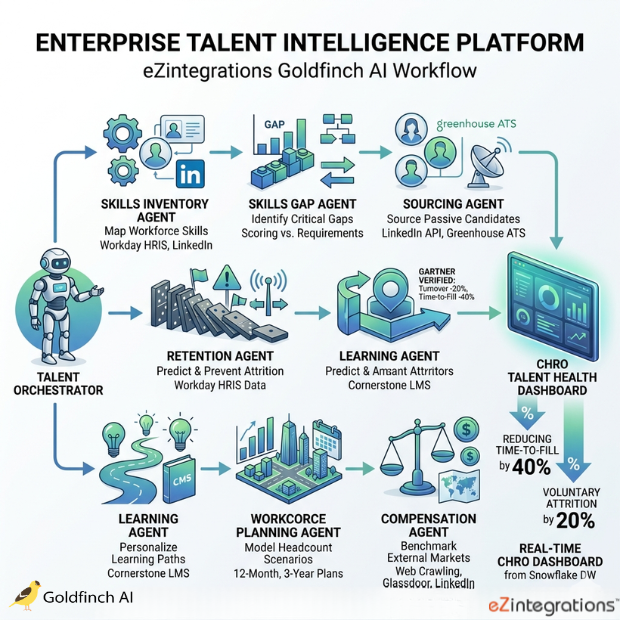
The Goldfinch AI talent intelligence platform from eZintegrations deploys 8 coordinated AI agents – a Talent Orchestrator plus 7 specialized Worker Agents — to continuously map workforce skills from Workday HRIS and LinkedIn, identify critical skill gaps, source passive candidates via LinkedIn and Greenhouse ATS, predict and prevent employee attrition, personalize learning paths in Cornerstone LMS, model headcount scenarios, benchmark compensation against external markets, and deliver a real-time CHRO talent health dashboard – reducing time-to-fill by 40% and voluntary attrition by 20%. eZintegrations is an enterprise automation platform covering iPaaS, AI Workflows, AI Agents, and Goldfinch AI agentic automation.
What Is Goldfinch AI Talent Intelligence Automation?
Goldfinch AI talent intelligence automation is a hierarchical multi-agent system where a Talent Orchestrator coordinates 7 domain-specific Worker Agents simultaneously – mapping skills, detecting gaps, sourcing candidates, predicting attrition, personalizing development, planning headcount, and benchmarking compensation through a shared talent intelligence Knowledge Base. Unlike workforce analytics platforms that surface insights for HR teams to act on manually, the Goldfinch AI talent intelligence platform autonomously executes sourcing profile creation in Greenhouse ATS, learning path assignment in Cornerstone LMS, and compensation market monitoring – escalating only the decisions that require HR Business Partner or CHRO judgment.
How Does Goldfinch AI Talent Intelligence Use 8 Agents Across Workday, Greenhouse ATS, LinkedIn, Cornerstone LMS, and Snowflake to Reduce Time-to-Fill 40% and Attrition 20%?
The Skills Inventory Agent maps workforce skills from Workday HRIS and LinkedIn. The Skills Gap Agent scores gaps vs. business requirements. The Sourcing Agent identifies passive candidates via LinkedIn API. The Retention Agent predicts attrition via multi-signal scoring from Workday HRIS. The Learning Agent creates Cornerstone LMS learning paths. The Workforce Planning Agent models 12-month and 3-year headcount scenarios. The Compensation Agent benchmarks via Web Crawling of Glassdoor, LinkedIn Salary, and Radford. The Analytics Agent delivers the real-time CHRO dashboard from Snowflake DW.
Goldfinch AI ships with 9 native out-of-the-box agent tools. Users can add custom tools self-service beyond the 9 native tools. Gartner: AI-powered talent intelligence reduces voluntary turnover 20% and time-to-fill 40%. This Goldfinch AI talent intelligence platform converts those research outcomes into a continuously executing, cross-domain workforce intelligence system.
Watch Demo
| Video Title: |
Goldfinch AI Talent Intelligence Platform | 8 Agents; Skills Mapping to CHRO Dashboard Across Workday; Greenhouse; and LinkedIn |
|---|---|
| Duration: |
7 to 10 minutes |
Outcome & Benefits
| Autonomy: |
80%+ of talent intelligence tasks executed autonomously (skills inventory updates; attrition risk scoring; candidate profile creation in Greenhouse ATS; L&D path assignment in Cornerstone LMS; compensation market monitoring); Director and above candidate outreach; Critical attrition risk interventions; and off-cycle compensation adjustments above threshold require CHRO or VP Talent HITL approval; all workforce planning scenarios involving headcount reduction require CEO and CHRO review |
|---|---|
| Time Saved: |
Time-to-fill for critical roles from 87 days average (LinkedIn Talent Trends benchmark) to 52 days with proactive pipeline maintenance (40% reduction); skills gap identification from annual workforce planning exercise to continuously updated gap register; attrition detection from post-departure discovery to 90-day advance warning for at-risk employees; CHRO talent report from 2 to 3 days of manual BI compilation to automated monthly generation |
| Cost Reduction: |
20% voluntary attrition reduction: at 150 to 200% of salary replacement cost (McKinsey); a 20% attrition reduction for a 5,000-employee enterprise at $100,000 average salary saves $15M to $20M annually; 40% time-to-fill reduction eliminates estimated $2,000 to $4,000 per day of vacancy cost for critical roles (Gallup productivity loss research); L&D personalization improves training |
| Reliability: |
100% of monitored employees scored for attrition risk weekly; 100% of job requisitions in Greenhouse ATS tracked with time-to-fill vs. benchmark; skills inventory updated within 48 hours of any Workday HRIS or LMS completion event; compensation market benchmarks refreshed weekly via Compensation Agent Web Crawling |
Performance Metrics
| Metric | Before (Manual/Batch) | After (Real-Time Sync) | Improvement |
|---|---|---|---|
| Contract Cycle Time | 3 to 6 months | Under 2 weeks (standard types) | 80 to 90% compression |
| Legal Review Burden | Full contract review per cycle | Deviation-only review of flagged clauses | 60 to 70% reduction |
| Playbook Deviation Coverage | Inconsistent (human reviewer fatigue) | 100% automated coverage | Full coverage |
| CLM Abstraction Time | 2 to 5 days manual post-execution | Minutes post-DocuSign completion | 99%+ faster |
Technical Details
| Evaluation Metrics: |
Time-to-fill per role family and criticality tier (days from requisition open to offer accepted); voluntary attrition rate vs. target (overall and by segment; role family; and manager); attrition prediction accuracy (% of Critical-flagged employees who voluntarily departed within 90 days; validated quarterly); skills coverage score per business unit and critical skill cluster; offer acceptance rate per sourcing channel and role family; L&D completion rate and skills improvement rate per learning path; compensation market positioning (% of workforce below market; at market; above market); bench depth for critical roles (number of internal candidates assessed as ready in 12 months); Talent Orchestrator compound risk identification rate and HITL escalation acceptance rate. |
|---|---|
| Planner Type: |
compensation decision thresholds, and sourcing outreach seniority authority limits; LLM reasoning governs skills gap narrative synthesis, retention intervention recommendation personalization, workforce scenario narrative generation, compensation market positioning assessment, and CHRO executive brief synthesis., Workforce-goal-driven decomposition with continuous event-driven talent signal processing and LLM-hybrid cross-domain synthesis – the Talent Orchestrator uses schema-driven rules for GDPR/CCPA employee data classification (employees are processed with pseudonymized IDs in all agent workflows; direct identifiers accessible only to HRBP and authorized HR roles), attrition risk classification tiers (Critical, High, Medium, Low), |
| Agent Roles: |
Analytics Agent: API Tool Call (Snowflake DW talent KPI aggregation, Workday HRIS reporting API), Data Analytics with Charts/Graphs/Dashboards (real-time talent health dashboard: time-to-fill by role and criticality, attrition rate by team and segment, skills coverage score by BU, bench depth for critical roles, L&D completion rate, offer acceptance rate, hiring manager satisfaction — all vs. target and prior period), Knowledge Base Vector Search (talent KPI benchmarks and prior period targets), Integration Workflow as Tool (Snowflake DW KPI write and CHRO monthly digest delivery sub-workflow), Compensation Agent: API Tool Call (Workday HRIS compensation data, Greenhouse ATS offer data), Web Crawling (Glassdoor https://www.glassdoor.com/, LinkedIn Salary Insights https://www.linkedin.com/salary/, Levels.fyi https://www.levels.fyi/ for technology roles, Bureau of Labor Statistics OES data https://www.bls.gov/oes/, Radford/Mercer benchmark publications), Data Analysis (market positioning percentile computation per employee vs. external benchmark, below-market employee identification, competitive offer range computation), Knowledge Base Vector Search (compensation band structures and market positioning targets per role family and level), Learning Agent: API Tool Call (Cornerstone LMS learning path creation and assignment API https://developer.csod.com/, Workday HRIS employee career profile), Data Analysis (L&D recommendation relevance scoring: career trajectory alignment, skills gap priority alignment, learning format preference), Knowledge Base Vector Search (L&D content catalog metadata and learning path effectiveness data per skill and role), Integration Workflow as Tool (Cornerstone LMS learning path assignment sub-workflow), Retention Agent: API Tool Call (Workday HRIS engagement and pulse survey data https://developer.workday.com/s/, Snowflake DW attrition signal query), Data Analysis (multi-signal attrition risk scoring: compensation market gap, engagement score trend, manager quality signal, internal mobility history, tenure pattern, LinkedIn activity signals), Knowledge Base Vector Search (attrition pattern analysis per segment and role family, retention intervention playbooks per risk type), Integration Workflow as Tool (HRBP intervention routing sub-workflow with employee risk context, pseudonymized), Skills Gap Agent: API Tool Call (Workday HRIS skills taxonomy API, Snowflake DW workforce planning data), Web Crawling (industry skills taxonomy publications and job posting data for emerging skill requirement identification), Document Intelligence (job description documents, role specifications, business strategy presentations for future skill requirement extraction), Data Analysis (skill gap severity scoring: critical path vs. addressable vs. emerging; time-to-close estimate per gap; build/buy/borrow sourcing strategy recommendation), Knowledge Base Vector Search (skills gap resolution playbooks, historical sourcing velocity per skill type), Talent Orchestrator (Coordinator): workforce goal decomposition, cross-agent compound talent risk assessment, CHRO/VP Talent escalation routing, executive talent dashboard assembly, GDPR/CCPA compliant employee data handling governance; Skills Inventory Agent: API Tool Call (Workday HRIS employee profile and skills API https://developer.workday.com/s/, Cornerstone LMS completion API https://developer.csod.com/), Data Analysis (skills coverage score computation per team and business unit, proficiency level distribution analysis), Knowledge Base Vector Search (organization’s approved skills taxonomy and proficiency level definitions), Workforce Planning Agent: API Tool Call (Workday HRIS headcount and org structure data, Snowflake DW business growth plan data), Document Intelligence (annual business plan and budget documents for headcount growth assumption extraction), Data Analysis (headcount scenario modeling: 12-month and 3-year projections under growth/attrition/hiring assumptions; build/buy/borrow recommendation by gap; geography and role distribution), Data Analytics with Charts/Graphs/Dashboards (headcount scenario model dashboard), Knowledge Base Vector Search (Workforce Planning scenario parameters and growth plans per business unit) |
| Scheduling: |
Skills Gap Agent runs weekly gap computation after each Skills Inventory Agent update; Compensation Agent crawls external benchmark sources weekly and immediately on Retention Agent compensation flag; Sourcing Agent runs weekly passive candidate pipeline refresh and immediately on new critical skill vacancy; Workforce Planning Agent runs quarterly scenario update and on-demand for business plan change events; Learning Agent activates on Skills Gap Agent gap classification and on individual employee L&D milestone; Analytics Agent delivers monthly CHRO talent health dashboard and real-time KPI updates (daily refresh)., Talent Orchestrator monitors Workday HRIS, Greenhouse ATS, Cornerstone LMS, and Snowflake DW via Watcher Tools continuously (24-hour event processing for standard talent signals; immediate trigger on Critical attrition risk events and executive role vacancy openings); Skills Inventory Agent updates skill profiles within 48 hours of any Workday HRIS profile change or LMS completion; Retention Agent runs weekly attrition risk scoring for all monitored employees and immediately on material compensation gap signal or engagement score drop; |
| Tool Router: |
compensation market drift below threshold triggers Compensation Agent re-benchmark; quarterly planning cycle triggers Workforce Planning Agent; business plan headcount change triggers all agents simultaneously for compound impact assessment. Each Worker Agent selects its tools: API Tool Call for HRIS/ATS/LMS/DW reads and writes; Data Analysis for scoring and scenario modeling; Knowledge Base for talent context, benchmarks, and playbooks; Document Intelligence for business plan, job description, and survey document analysis; Web Crawling for compensation benchmarks and passive candidate sourcing; Data Analytics for talent dashboards; Watcher Tools for continuous talent event monitoring; Integration Workflow as Tool for HRIS/ATS/LMS execution sub-workflows., The Talent Orchestrator routes each talent signal event to the appropriate Worker Agent based on event type and employee segment – new attrition signal above Critical threshold triggers Retention Agent immediately and notifies HRBP queue; new critical skill vacancy triggers Sourcing Agent and Skills Gap Agent simultaneously; new LMS completion triggers Skills Inventory Agent update; |
| Auditability: |
Every agent action is logged with: agent name, employee pseudonym (GDPR-compliant pseudonymized identifier), talent domain event type (attrition risk score, skills gap identification, sourcing candidate match, compensation flag, L&D assignment), tool invoked, data source accessed (Workday HRIS record ID, Greenhouse ATS job ID, LinkedIn profile ID hash, Cornerstone LMS course ID), Data Analysis methodology applied, recommendation generated, confidence score, HITL status (autonomous execution or HRBP/VP Talent/CHRO-reviewed), system write confirmation (Greenhouse ATS candidate ID, Cornerstone LMS path assignment ID, Workday compensation change reference), and timestamp., The Talent Orchestrator maintains a per-employee and per-role-family talent action log for HR governance review. GDPR Article 22 compliance: all automated decisions that have a legal or significant impact on employees (compensation adjustments, employment decisions) require documented human review and have the automated decision-making rationale documented for employee access requests. CCPA compliance: all employee data processing logged with consent and purpose documentation. External audit teams access the full talent action log via the Goldfinch AI audit dashboard with GDPR-compliant data subject access request support. |
Connectivity and Deployment
| Supported Protocols: |
REST API (Workday HRIS REST API; Greenhouse ATS REST API; Cornerstone LMS REST API; LinkedIn Talent Solutions API; Snowflake DW JDBC); Web Crawling (Glassdoor salary data; LinkedIn Salary Insights; Levels.fyi; Bureau of Labor Statistics OES; Radford/Mercer publications; GitHub contribution profiles; Stack Overflow careers); SMTP (CHRO talent health digest; HRBP attrition risk intervention alerts; VP Talent sourcing pipeline updates; hiring manager time-to-fill alerts); HTTPS; OAuth 2.0; IPSec Tunnel (on-premises HRIS; ATS; and LMS connectivity) |
|---|---|
| Tenancy Model: |
Single-tenant is strongly recommended for all talent intelligence deployments. Employee skills data; attrition risk scores; compensation data; and career trajectory assessments are among the most sensitive employee personal data under GDPR Article 9 (special category data in some jurisdictions) and CCPA. Single-tenant provides dedicated infrastructure with full data isolation; configurable data residency per regulatory jurisdiction (EU: GDPR; US: CCPA; UK: UK GDPR; other applicable employment law jurisdictions); and pseudonymization controls per employee population segment. Multi-tenant is available for organizations outside strict data residency requirements. |
| On-Premise Supported: |
Yes – eZintegrations connects to on-premises systems (on-premises Workday; on-premises HRIS systems; on-premises ATS; on-premises LMS) via IPSec Tunnel. eZintegrations is a browser-based; cloud-hosted platform and does not require any on-premises installation. |
| Security & Compliance: |
CHRO has full talent portfolio view; VP Talent accesses sourcing pipeline and skills analytics; HRBPs access only their assigned employee population (attrition risks and intervention queue); hiring managers access role-specific requisition data and candidate pipeline; compensation data accessible only to CHRO, Finance, and designated compensation reviewers; all employee attrition risk data pseudonymized in agent workflows – direct employee identity visible only to authorized HRBP for the specific employee., GDPR-compliant employee data processing (all employee personal data processed under GDPR Article 6 legitimate interest for employment and HR management; GDPR Article 22 compliance for automated decision-making documentation – all compensation and employment decisions require documented human review; data subject access request support built-in; data minimization applied; employee data retention configured per applicable employment law jurisdiction); CCPA-compliant employee data handling (California employee data processed with consent documentation and purpose limitation per CCPA); SOC Type II certified; HIPAA-eligible for healthcare employee health benefits-adjacent HR data processing. RBAC enforced: |
AI Credits
| Credit Consumption Model: |
Weekly continuous monitoring (Retention; Skills Inventory; Skills Gap; Sourcing; Compensation Agents); quarterly high-credit Workforce Planning scenario update; monthly CHRO dashboard generation; event-triggered immediate cycles for Critical attrition risk events and executive role vacancies Estimated Credits per End-to-End Run: Weekly talent monitoring cycle (1,000-employee population; standard event volume): ~200 to 400 credits per week Per Critical attrition risk event end-to-end (detection through HRBP intervention routing): ~20 to 40 credits per event Per quarterly Workforce Planning scenario update (full scenario modeling with Document Intelligence business plan analysis): ~60 to 120 credits per quarter Per monthly CHRO talent health dashboard: ~25 to 50 credits per report Annual total talent intelligence cycle (1,000 employees; standard talent event volume): ~12,000 to 25,000 credits per year |
|---|---|
| Retry / Reflection Credit Cost: |
Each Talent Orchestrator compound risk reflection cycle: ~5 to 8 additional credits per retry. Retention Agent conflicting signal reflection: ~4 to 6 additional credits. At 10% complex event rate; add approximately 12 to 18% to the annual credit estimate. |
| Monthly Credit Estimate (at Typical Volume): |
Mid-market enterprise (1,000 to 3,000 employees): ~1,500 to 4,000 credits per month Large enterprise (5,000 to 15,000 employees): ~5,000 to 15,000 credits per month Global enterprise (20,000+ employees; multi-region): ~15,000 to 40,000 credits per month |
| Pricing Model: |
Static Platform Fee + AI Credits. Platform fee covers unlimited non-LLM orchestration across all agents (Workday HRIS connection; Greenhouse ATS connection; Cornerstone LMS connection; LinkedIn API integration; Snowflake DW writes; SMTP digest delivery; audit log writes). AI Credits consumed only by Goldfinch AI tool invocations and LLM reasoning cycles. |
| Credit Optimization Notes: |
Configure Retention Agent attrition risk scoring at weekly intervals for standard employee population and immediate trigger only for Critical threshold breaches (reduces Data Analysis credits 40 to 60% vs. daily scoring). Batch Workday HRIS API calls for all monitored employees in a single weekly extraction per agent rather than per-employee sequential queries. Cache Knowledge Base skills taxonomy and compensation band structures for 30 days (these change quarterly at most). Configure Compensation Agent Web Crawling to target role-family-specific pages of benchmark sources rather than full site crawls (reduces Web Crawling credits 40 to 50%). Apply Skills Gap Agent Document Intelligence only to new job descriptions and business plan updates (not recurring unchanged roles – reduces Document Intelligence credits 50 to 60%). |
| AI Credits Required: |
Yes – Goldfinch AI agentic systems consume credits across the Talent Orchestrator and all 7 Worker Agents per talent signal processed, per document analyzed, per attrition risk cycle, and per reflection/retry loop. |
| LLM Steps Count: |
14 to 26 LLM-invoking steps per weekly talent intelligence cycle (Talent Orchestrator compound risk assessment: 2 to 4 steps; Retention Agent attrition risk scoring: 3 to 5 steps; Skills Gap Agent gap narrative: 2 to 4 steps; Sourcing Agent candidate fit scoring: 2 to 4 steps; Compensation Agent market positioning: 2 to 3 steps; Workforce Planning Agent scenario narrative: 2 to 4 steps; reflection/retry: 1 to 2 steps per retry) |
| Per-Agent Credit Breakdown: |
Learning Agent: 3 to 6 credits per L&D recommendation cycle (Cornerstone LMS API + learning path Data Analysis + Knowledge Base content retrieval); Workforce Planning Agent: 6 to 12 credits per quarterly scenario update (Document Intelligence business plan + headcount Data Analysis + scenario Data Analytics dashboard); Compensation Agent: 4 to 8 credits per weekly benchmark refresh (Web Crawling Glassdoor/LinkedIn Salary/Levels.fyi + market positioning Data Analysis); Analytics Agent: 3 to 6 credits per monthly CHRO dashboard generation (Snowflake DW aggregation + Data Analytics dashboard render + digest delivery), Talent Orchestrator: 3 to 6 credits per weekly cycle (compound risk assessment + cross-agent synthesis + CHRO brief assembly); Skills Inventory Agent: 2 to 4 credits per weekly skills update cycle (Workday HRIS + LMS API Tool Call + skills coverage Data Analysis); Skills Gap Agent: 4 to 8 credits per weekly gap computation (skills gap Data Analysis + Web Crawling emerging skills + Knowledge Base playbook retrieval); Sourcing Agent: 5 to 10 credits per weekly candidate pipeline refresh (LinkedIn API + GitHub Web Crawling + candidate fit Data Analysis); Retention Agent: 4 to 8 credits per weekly attrition risk scoring run (multi-signal Workday HRIS + Snowflake DW API + Data Analysis risk scoring per employee – scales with monitored employee population) |
| Goldfinch AI Tool(s) Consuming Credits: |
Document Intelligence (Skills Gap Agent job descriptions and business strategy; Retention Agent exit interview transcripts; Compensation Agent survey reports; Workforce Planning Agent business plan documents – per document analyzed), Data Analytics with Charts/Graphs/Dashboards (Workforce Planning scenario model; Skills heat map; Compensation positioning; Analytics CHRO dashboard – per render), Integration Workflow as Tool (Sourcing Greenhouse ATS profile; Retention HRBP routing; Learning Cornerstone LMS path; Compensation Workday review trigger; Analytics Snowflake write – per sub-workflow), Watcher Tools (Talent Orchestrator continuous HRIS/ATS/LMS/DW event monitoring), API Tool Call (all 7 Worker Agents – per Workday/Greenhouse/Cornerstone/LinkedIn/Snowflake call), Data Analysis (Skills Inventory coverage scoring; Skills Gap severity scoring; Sourcing candidate fit; Retention multi-signal attrition risk; Learning recommendation scoring; Workforce Planning scenario modeling; Compensation market positioning – per computation cycle), Knowledge Base Vector Search (all 8 agents per talent context and benchmark query), Web Crawling (Compensation Agent weekly benchmark crawl; Skills Gap Agent emerging skill identification; Sourcing Agent passive candidate identification – per crawl cycle), |
FAQ
1. What is the Enterprise Talent Intelligence Platform and what does it automate end to end?
The Goldfinch AI talent intelligence platform from eZintegrations deploys 8 coordinated AI agents - a Talent Orchestrator and 7 domain Worker Agents - to continuously map workforce skills from Workday HRIS and LinkedIn (Skills Inventory Agent), identify critical skill gaps vs. business requirements (Skills Gap Agent), source passive candidates via LinkedIn API and Greenhouse ATS (Sourcing Agent), predict and prevent employee attrition (Retention Agent), personalize learning paths in Cornerstone LMS (Learning Agent), model 12-month and 3-year headcount scenarios (Workforce Planning Agent), benchmark compensation against external markets (Compensation Agent), and deliver the real-time CHRO talent health dashboard (Analytics Agent) - reducing time-to-fill 40% and voluntary attrition 20%. Gartner: AI talent intelligence reduces voluntary turnover 20% and time-to-fill 40%.
2. How does the multi-agent architecture work?
The Talent Orchestrator coordinates 7 Worker Agents through a shared talent intelligence Knowledge Base containing skills taxonomy, attrition patterns, retention playbooks, compensation bands, sourcing benchmarks, and L&D effectiveness data. When the Retention Agent flags a Critical attrition risk employee in a skill cluster the Skills Gap Agent has classified as Critical, the Orchestrator computes the compound risk (losing the employee before the replacement pipeline is filled) and routes a structured compound risk narrative to the HRBP and VP Talent for intervention. Cross-agent insights are what a single-domain platform cannot produce - a compensation gap that creates attrition risk in a critical skill cluster requires both the Compensation Agent's market data and the Skills Gap Agent's criticality assessment to be routed as a priority.
3. Which Goldfinch AI tools does this system use?
The system uses 8 of Goldfinch AI's 9 native tools: Watcher Tools (Talent Orchestrator continuous HRIS/ATS/LMS/DW monitoring), API Tool Call (all 7 Worker Agents - Workday HRIS, Greenhouse ATS, Cornerstone LMS, LinkedIn Talent Solutions, Snowflake DW), Data Analysis (skills coverage; gap severity; candidate fit; multi-signal attrition risk; L&D recommendation; headcount scenario; compensation market positioning), Knowledge Base Vector Search (all 8 agents - skills taxonomy, attrition patterns, retention playbooks, compensation bands, sourcing benchmarks), Web Crawling (Compensation Agent Glassdoor/LinkedIn Salary/Levels.fyi; Sourcing Agent GitHub/Stack Overflow; Skills Gap Agent emerging skill publications), Document Intelligence (Skills Gap Agent job descriptions and business strategy; Retention Agent exit interviews; Compensation Agent survey reports; Workforce Planning Agent business plan), Data Analytics (Workforce Planning scenario model; Skills heat map; Compensation positioning; CHRO talent health dashboard), and Integration Workflow as Tool (Greenhouse ATS candidate; Cornerstone LMS learning path; HRBP intervention routing; Snowflake DW KPI write). Users can add SAP SuccessFactors, Culture Amp, Lattice, and DEI analytics APIs self-service.
4. How does the system ensure data accuracy and handle errors?
The Talent Orchestrator applies a reflection cycle when compound talent risk signals conflict - if a Retention Agent Critical attrition risk flag conflicts with a recent positive engagement signal, the Orchestrator re-queries the Knowledge Base for attrition pattern precedents and retries up to 3 times before CHRO escalation. The Retention Agent applies an additional reflection cycle on conflicting signals before committing an attrition risk classification. All Critical attrition interventions, Director-and-above sourcing outreach, and off-cycle compensation adjustments above threshold require HRBP, VP Talent, or CHRO human review before execution. Workforce planning scenarios involving headcount reduction require CEO and CHRO review before any communication.
5. What types of data and documents does this system process?
The system processes: Workday HRIS employee profiles, skills data, engagement survey results, compensation records, and org structure (Skills Inventory, Retention, Compensation Agents via API Tool Call); LinkedIn Talent Solutions API data for passive candidate identification and skills enrichment; Greenhouse ATS job requisition and candidate pipeline data; Cornerstone LMS course completion and learning path data; Snowflake DW talent analytics and business growth plan data; job description documents and business strategy presentations (Skills Gap Agent Document Intelligence); exit interview transcripts and turnover analysis reports (Retention Agent Document Intelligence); compensation survey reports from Radford, Mercer, and Willis Towers Watson (Compensation Agent Document Intelligence); annual business plan documents (Workforce Planning Agent Document Intelligence).
6. Who uses this system and in which departments?
Daily operators include the VP Talent (reviews Sourcing Agent passive candidate pipeline updates and Director-and-above outreach HITL requests), HR Business Partners (receive Retention Agent Critical attrition risk HITL routing with pseudonymized employee context and recommended interventions), Talent Acquisition team (receives Sourcing Agent candidate profiles in Greenhouse ATS), L&D team (reviews Learning Agent personalized development path recommendations), and Compensation team (receives Compensation Agent below-market employee flags for review). Executive stakeholders - the CHRO and Chief People Officer - receive the monthly talent health dashboard, quarterly Workforce Planning scenario updates, and immediate Critical attrition risk escalations for strategic talent segments.
7. How does the safety layer and human oversight work?
HITL triggers when: Sourcing Agent identifies a Director-and-above candidate - VP Talent or CHRO review required before any outreach; Retention Agent classifies a Critical attrition risk - HRBP review required before intervention (with appropriate manager context controls under GDPR); Compensation Agent recommends an off-cycle adjustment above 10% - CHRO and Finance sign-off required; Workforce Planning Agent generates a headcount reduction scenario - CHRO and CEO review required; Orchestrator confidence below 0.75. After 3 retries, CHRO escalation with full context. GDPR Article 22 compliance: all automated decisions with employment significance require documented human review - the system generates the analysis and recommendation; the HR professional makes the decision.
8. What are the key business benefits and executive KPIs improved?
Key benefits: time-to-fill from 87 days to 52 days for critical roles (40% reduction, Gartner), voluntary attrition from baseline to 20% reduction ($15M to $20M annual savings for 5,000-employee enterprise at $100,000 average salary per McKinsey replacement cost methodology), skills gap detection from annual planning to continuously updated with 12 to 18-month advance warning, attrition detection from post-departure to 90-day advance warning for at-risk employees, compensation market monitoring from quarterly surveys to continuous Web Crawling, and the CHRO shifts from assembling lagging HR metrics from 6 disconnected platforms to reviewing a continuously updated, forward-looking workforce intelligence dashboard.
Resources
Case Study
| Industry: |
Technology / Global SaaS Company |
|---|---|
| ROI: |
Attrition cost reduction (22% to 16.8% over 7 months): 924 annual departures x 0.236 reduction x 7/12 x $150,000 replacement cost = $17.2M (7-month). Time-to-fill reduction (112 to 64 days): 340 open requisitions x 48 days saved x average $2,200/day vacancy cost (Gallup) = $35.9M in recovered productivity (7-month). Skills gap analysis cost avoidance: 4 quarterly analyses at $180,000 each = $720,000 annually vs. continuous automated gap register. People Analytics team productivity: 4 FTE team x 50% time freed from manual reporting x $125,000 blended cost = $250,000 annually. Total 7-month |
| Problem: |
Time-to-fill: average time-to-fill for technical roles was 112 days (SaaS industry benchmark: 75 days). The Talent Acquisition team of 16 was spending 60% of their time on reactive sourcing (responding to vacancies) rather than building proactive pipelines. The Greenhouse ATS had 340 open requisitions at any given time; Skills gaps: the CHRO had commissioned a manual skills gap analysis in Q1 2023. By Q4, when the results were presented to the Board, 4 of the 12 identified critical skill gaps had already been partially addressed through ad-hoc hiring, and 3 new gaps had emerged from the business plan update that the Q1 analysis had not captured. The analysis had taken 16 weeks and $180,000 in consulting fees to complete., A global B2B SaaS company with 4,200 employees, $620M ARR, and operations in 18 countries faced three compounding talent crises entering 2024: Attrition: voluntary attrition was running at 22% annually (industry benchmark for B2B SaaS in 2023: 15% per LinkedIn Workforce Report) – the company was losing 924 employees per year and spending an estimated $138M annually in replacement cost (924 x $150,000 average replacement cost at 150% of $100,000 average salary). HR identified post-departure that 68% of departing employees had shown detectable attrition signals at least 90 days before resignation, but the 4-person People Analytics team had no systematic way to score attrition risk proactively across 4,200 employees; |
| Solution: |
3 years of attrition data with exit interview analysis (2,772 departures), successful retention intervention records (312 documented interventions with outcomes), compensation band structures for all 28 role families and 18 geographies, sourcing channel benchmarks per role family, Cornerstone LMS content catalog metadata (4,200 available learning items), hiring manager preference profiles for top 80 requisition types, and the 2024 annual business plan headcount growth assumptions. HITL authority: Director-and-above candidate outreach requires CHRO or VP Talent; Critical attrition risk intervention requires HRBP (with pseudonymized context); off-cycle compensation adjustment above 8% requires CHRO and CFO; workforce planning headcount reduction scenario requires CEO and Board., Deployed the eZintegrations Goldfinch AI talent intelligence platform in 24 business days across all 4,200 employees in 18 countries. Workday HRIS connected via REST API (all employee profiles, compensation records, engagement pulse survey data, org structure). Greenhouse ATS connected via REST API (all 340 open requisitions, candidate pipeline status). Cornerstone LMS connected via REST API (all learning catalog and completion data for 4,200 employees). LinkedIn Talent Solutions API configured for passive candidate identification (technical, product, and go-to-market role families). Snowflake DW connected via JDBC for historical attrition and talent analytics (3 years of workforce data). Knowledge Base Vector Search loaded with: the organization’s skills taxonomy (840 skills across 28 role families), |
| Outcome: |
After 7 months across 4,200 employees: Voluntary attrition from 22% to 16.8% (5.2 percentage point reduction, 23.6% relative reduction). 312 Critical attrition risk events identified by the Retention Agent in 7 months – HR Business Partners intervened on 287 (25 were past the point of no return per HRBP judgment): 198 employees retained (69% retention rate for intervened Critical cases vs. industry norm of 20% for unaddressed at-risk cases). At $150,000 replacement cost per employee: 198 retentions x $150,000 = $29.7M in replacement cost avoidance (7-month period). Time-to-fill for technical roles: from 112 days to 64 days (43% reduction)., Greenhouse ATS active requisitions with pre-qualified passive candidate pipelines: from 12% (40 of 340 requisitions) to 78% (265 of 340). Skills gap analysis: continuously updated gap register delivered within 5 weeks of deployment – 23 critical skill gaps identified (vs. 12 in the prior annual analysis); 4 gaps classified as requiring immediate external hiring, 11 as addressable via L&D, 8 as emerging (monitor only). Quarterly business plan update in Q3 2024 required a full skills gap refresh – completed in 3 days by the Skills Gap Agent (vs. 16 weeks and $180,000 for the prior annual analysis). CHRO talent health dashboard: from 2 days of monthly manual compilation to automated daily refresh. |