How to Automate Revenue Operations Using Multi-Agent AI Sales Orchestration Systems
$150.00
| System Name: |
Agentic Sales Orchestration System |
|---|---|
| Architecture: |
Hierarchical Multi-Agent System – 1 Revenue Orchestrator (Coordinator) + 8 specialized Worker Agents (Demand; Outreach; Qualification; Proposal; Deal Intelligence; Forecasting; Expansion; Churn) operating through continuous revenue signal processing from Salesforce CRM; Marketo; CPQ; and Snowflake DW; shared revenue intelligence vector knowledge base; and human-in-the-loop approval gates for outbound sequences; proposal delivery; forecast sign-off; and expansion outreach; 9 total agents |
| Coordinator Agent: |
Revenue Orchestrator – continuously receives revenue signal events from all 8 Worker Agents; cross-correlates funnel intelligence (a Deal Intelligence Agent risk signal on an at-risk deal combined with a Churn Agent renewal threat at the same account creates a compound revenue risk requiring immediate CRO escalation); decomposes the revenue goal (pipeline generation; conversion acceleration; forecast accuracy; net revenue retention) into domain-specific sub-tasks per Worker Agent; enforces cross-agent consistency (Outreach Agent sequences are informed by Demand Agent MQL qualification; Expansion Agent outreach is blocked when Churn Agent has an active retention risk at the same account); and routes the weekly revenue health dashboard to the CRO and VP Sales |
| Worker Agents: |
Churn Agent: Monitors renewal risk and protects net revenue retention – scoring customer health on usage trend, support ticket sentiment, executive engagement, competitive mentions, and NPS trajectory, and routing Critical renewal risks to the Customer Success Manager and VP Sales for immediate retention action with a structured account context brief, Demand Agent: Generates and qualifies Marketing Qualified Leads (MQLs) – aggregating intent signals from web behavior (Marketo), content engagement, job change signals, technographic changes, and Web Crawling of prospect company news – scoring each prospect against the Ideal Customer Profile (ICP) from the Knowledge Base, and routing qualified MQLs above the threshold to the Outreach Agent pipeline, Forecasting Agent: Builds the real-time pipeline forecast – scoring each opportunity’s close probability using AI-weighted signals (deal stage, engagement score, time in stage vs. benchmark, competitive risk, economic buyer identified), aggregating to a committed, best case, and pipeline forecast per sales segment, and publishing the weekly forecast to the Revenue Operations Director and CRO for sign-off; Expansion Agent: Identifies upsell and cross-sell opportunities in the existing customer base – analyzing product usage data, contract expansion triggers, account growth signals (new departments, headcount increase, new executive hire), and customer health scores to generate expansion recommendations for the Customer Success and Account Management teams, Outreach Agent: Runs personalized outbound sequences for qualified prospects – generating personalized multi-step email and LinkedIn sequences using prospect context (role, company, recent news, pain point signals) from the Knowledge Base and Web Crawling, managing sequence timing and channel optimization via Salesforce CRM and Marketo, and routing engaged prospects (reply, meeting booked) to the Qualification Agent Qualification Agent: Scores and routes Sales Qualified Leads (SQLs) to the appropriate Account Executive – applying MEDDIC/BANT qualification criteria from the Knowledge Base, scoring each lead on budget, authority, need, timeline, and fit, and routing SQLs above the threshold to Salesforce CRM opportunity creation with a structured discovery brief for the assigned AE, Proposal Agent: Generates customized proposals and commercial documents for active opportunities – retrieving the prospect’s requirements, competitive context, and commercial terms from Salesforce CRM and the Knowledge Base, assembling a tailored proposal from approved templates, and routing the draft to the AE and Revenue Operations for review before delivery; Deal Intelligence Agent: Monitors deal health for all active pipeline opportunities – tracking engagement signals (email responsiveness, stakeholder mapping completeness, champion strength, competitive risk, deal velocity vs. benchmark), scoring each deal’s win probability, and publishing next-action recommendations to the assigned AE with HITL confirmation for high-value deal strategy changes |
| Extensibility Note: |
Beyond the 9 native Goldfinch AI tools; users can add custom tools self-service – including conversation intelligence platforms (Chorus; Salesloft); sales engagement platform connectors (Outreach.io; Apollo); ABM platform APIs (Demandbase; 6sense); contract management connectors (DocuSign; Ironclad); and revenue intelligence platforms (Clari; Boostup). |
| On-Premise Supported: |
Yes – eZintegrations connects to on-premises systems (on-premises Salesforce; on-premises CRM; on-premises CPQ; and others) via IPSec Tunnel. eZintegrations is a browser-based; cloud-hosted platform and does not require any on-premises installation. |
| Tags: |
Goldfinch AI revenue orchestration; sales AI orchestration; pipeline forecasting AI; deal intelligence AI agent; proposal generation AI; outbound sales AI; churn prevention AI; expansion revenue AI; Salesforce AI agent; CRO revenue dashboard AI; MQL qualification AI; Goldfinch AI sales |
| AI Credits Required: |
Yes – Goldfinch AI agentic systems consume credits across all 9 agents per revenue signal processed, per document analyzed, per proposal generated, and per reflection/retry loop. |
| Safety Layer: |
Expansion Agent identifies an expansion opportunity above the configured upsell threshold at an account with an active Churn Agent risk flag – cross-functional review required to ensure expansion outreach does not conflict with retention action; Revenue Orchestrator cross-agent confidence falls below 0.75 on any deal health or forecast assessment. Max 3 retries before CRO escalation. All HITL decisions logged with reviewer identity, opportunity reference, and timestamp for revenue governance documentation., Human-in-the-loop gate triggers when: Outreach Agent initiates a new outbound sequence to a target above the configured ACV threshold (default: $50,000 ACV) or a named account – VP Sales or CRO review required before sequence launch; Proposal Agent completes a commercial proposal above the configured deal size threshold (default: $100,000 ACV) – AE and Revenue Operations sign-off required before delivery; Forecasting Agent computes a forecast that deviates from the prior week’s committed forecast by more than the configured variance threshold (default: 15%) – Revenue Operations Director and CRO review required before the forecast is published to the Board; |
| Goldfinch AI Native Tools Used: |
API Tool Call: All 8 Worker Agents use API Tool Call – Demand Agent (Marketo https://developers.marketo.com/ lead scoring and MQL API, Salesforce CRM https://developer.salesforce.com/docs lead creation), Outreach Agent (Salesforce CRM sequence management, Marketo email campaign API, LinkedIn Sales Navigator API https://developer.linkedin.com/), Qualification Agent (Salesforce CRM opportunity creation and AE assignment), Proposal Agent (Salesforce CRM opportunity data retrieval, CPQ https://help.salesforce.com/s/articleView?id=sf.cpq_product.htm pricing and configuration API),, Data Analysis: Demand Agent computes ICP fit scores and intent signal weights; Outreach Agent scores sequence engagement metrics and channel optimization recommendations; Qualification Agent scores SQL qualification criteria per MEDDIC/BANT framework; Deal Intelligence Agent computes deal health score and win probability; Forecasting Agent computes forecast confidence by stage and segment using AI-weighted close probability; Expansion Agent scores upsell/cross-sell opportunity fit and urgency; Churn Agent computes multi-signal renewal risk score; Revenue Orchestrator computes cross-agent revenue health index, Data Analytics with Charts/Graphs/Dashboards: Forecasting Agent generates the pipeline forecast dashboard (committed/best case/pipeline by segment and rep, close probability distribution, forecast vs. prior period); Deal Intelligence Agent generates the deal health heat map (win probability by deal, risk flags per opportunity, next action by AE); Expansion Agent generates the expansion opportunity map (upsell/cross-sell pipeline value by account and product); Revenue Orchestrator generates the CRO revenue health dashboard (full funnel conversion metrics, forecast accuracy trend, pipeline coverage ratio, NRR trend), Deal Intelligence Agent (Salesforce CRM opportunity engagement data, Gong https://app.gong.io/settings/api-access call intelligence API for conversation signal extraction), Forecasting Agent (Salesforce CRM pipeline data, Snowflake DW https://docs.snowflake.com/ historical win rate query), Expansion Agent (Salesforce CRM customer account data, product usage DW data), Churn Agent (Salesforce CRM health score, NPS platform API, customer support ticketing system API), Document Intelligence: Proposal Agent analyzes prior winning proposals, RFP/RFI documents, and prospect requirements documents to extract proposal structure, pricing rationale, and winning language patterns; Deal Intelligence Agent analyzes call transcripts from Gong and email thread content for buying signal and risk extraction; Qualification Agent analyzes inbound inquiry emails and demo request content for qualification signal extraction; Churn Agent analyzes customer support ticket threads for escalation pattern and churn language detection, Integration Workflow as Tool: Revenue Orchestrator and Worker Agents call pre-built revenue sub-workflows – Demand Agent (Salesforce CRM lead creation and Marketo nurture enrollment sub-workflow), Outreach Agent (Salesforce CRM sequence creation and LinkedIn outreach sub-workflow), Qualification Agent (Salesforce CRM opportunity creation and AE assignment sub-workflow), Proposal Agent (CPQ pricing configuration and proposal document assembly sub-workflow), Forecasting Agent (Snowflake DW forecast write and CRO digest delivery sub-workflow), Expansion Agent (Salesforce CRM expansion opportunity creation sub-workflow), Churn Agent (CSM intervention routing sub-workflow with account context), Knowledge Base Vector Search: All 9 agents share a persistent revenue intelligence knowledge base containing: ICP definitions and scoring criteria per segment and product, MEDDIC/BANT qualification rubrics, approved proposal templates and winning language libraries per use case and vertical, competitive battle cards and differentiation positioning, deal velocity benchmarks per stage and ACV band, historical win/loss analysis by competitor and vertical, customer expansion playbooks per product and customer segment, churn risk intervention playbooks per risk type, compensation and pricing guidelines per deal type, and prior CRO and Board forecast narrative context – each agent retrieves context relevant to its current prospect, opportunity, or account domain task, Watcher Tools: Revenue Orchestrator monitors Salesforce CRM continuously for new lead events, opportunity stage changes, deal engagement signal changes, contract renewal dates approaching, and customer health score threshold breaches – triggering the appropriate Worker Agent within 60 minutes of each revenue signal event, Web Crawling: Demand Agent monitors prospect company websites, LinkedIn company pages, Crunchbase https://www.crunchbase.com/ for funding and growth signals, G2 and Capterra product review platforms for competitive intelligence, and industry news sources for buying intent signals and trigger events (new executive hire, funding round, competitive product displacement); Outreach Agent crawls prospect LinkedIn profiles and company news for personalization signals; Churn Agent monitors review platforms and LinkedIn for competitive threat signals at existing accounts |
Table of Contents
| Planning: |
The Revenue Orchestrator uses revenue lifecycle goal decomposition – when a new quarter begins or a pipeline gap is identified; the Orchestrator decomposes the revenue goal (pipeline generation target; conversion rate target; forecast accuracy target; NRR target) into domain-specific sub-tasks per Worker Agent. Continuous monitoring runs in parallel for real-time deal health; churn risk; and MQL pipeline signals. Schema-driven rules govern cross-agent blocking logic (Expansion Agent blocked when Churn Agent has active retention risk at the same account; Outreach Agent sequence hold for named accounts above ACV threshold pending VP Sales approval); LLM reasoning governs proposal personalization; deal health narrative; forecast commentary generation; and expansion opportunity ranking. |
|---|---|
| Messaging: |
All 9 agents communicate via structured revenue signal messages – the Deal Intelligence Agent publishes a structured deal risk event (opportunity ID; health score; risk factors; recommended next action; AE assignment) to the Revenue Orchestrator; which validates against the current pipeline stage and cross-references with the Forecasting Agent’s close probability for that deal before routing the action recommendation to the AE with HITL confirmation for high-value strategy changes; the Churn Agent publishes structured renewal risk events (account ID; health score; risk drivers; recommended intervention; ARR at risk) that the Orchestrator cross-references with Expansion Agent’s pending outreach queue before routing to the CSM. |
| Reflection: |
The Revenue Orchestrator applies a reflection cycle when cross-agent revenue signals conflict – if the Forecasting Agent’s AI model scores a deal as 85% likely to close while the Deal Intelligence Agent’s engagement score has deteriorated 30% in the last 14 days; the Orchestrator re-queries the Knowledge Base for comparable deal profiles where late-stage engagement deterioration preceded deal loss; retries the conflict resolution up to 3 times; and escalates to the VP Sales with the full conflicting signal narrative before the deal is included in the committed forecast. The Proposal Agent applies a reflection cycle when a generated proposal’s commercial terms deviate from the Knowledge Base approved pricing guidelines before routing to the AE. |
| Knowledge: |
All 9 agents share a persistent revenue intelligence vector knowledge base containing: ICP definitions and scoring criteria per segment; MEDDIC/BANT qualification rubrics; approved proposal templates and winning language per use case and vertical; competitive battle cards and differentiation positioning; deal velocity benchmarks per stage and ACV band; historical win/loss analysis by competitor; customer expansion playbooks per product and segment; churn risk intervention playbooks per risk type; approved pricing guidelines and CPQ configuration rules; and prior CRO forecast narrative and Board commentary context. Indexed by deal stage; ACV band; vertical; product; and competitive context. |
| Execution: |
The Demand Agent monitors intent signals and publishes qualified MQLs to the Outreach Agent pipeline via API Tool Call to Marketo and Salesforce CRM. The Outreach Agent generates and manages personalized sequences via Integration Workflow as Tool. The Qualification Agent scores SQLs and creates Salesforce CRM opportunities via Integration Workflow as Tool. The Proposal Agent assembles custom proposals via Document Intelligence and CPQ API Tool Call. The Deal Intelligence Agent monitors deal engagement and publishes next-action recommendations. The Forecasting Agent computes AI-weighted close probabilities and publishes the pipeline forecast via Data Analytics. The Expansion Agent identifies upsell pipeline and creates Salesforce expansion opportunities. The Churn Agent monitors renewal risk and routes interventions to the CSM team. |
| Business Impact: |
Gartner: organizations with AI-powered revenue orchestration improve pipeline conversion rates by 25 to 40% and forecast accuracy by 25 to 35 percentage points. McKinsey Sales Effectiveness research: the average B2B sales organization loses 20 to 30% of potential revenue to poor qualification; delayed proposals; and unmanaged deal risk – representing $10M to $100M in lost revenue annually for mid-market and enterprise companies. Forrester Research: companies with unified revenue intelligence (connecting marketing; sales; and customer success signals) achieve 19% faster revenue growth and 15% lower customer acquisition cost than companies using siloed point solutions. The Goldfinch AI revenue orchestration system converts the fragmented; reactive revenue function into a continuously coordinated; intelligence-driven revenue engine. |
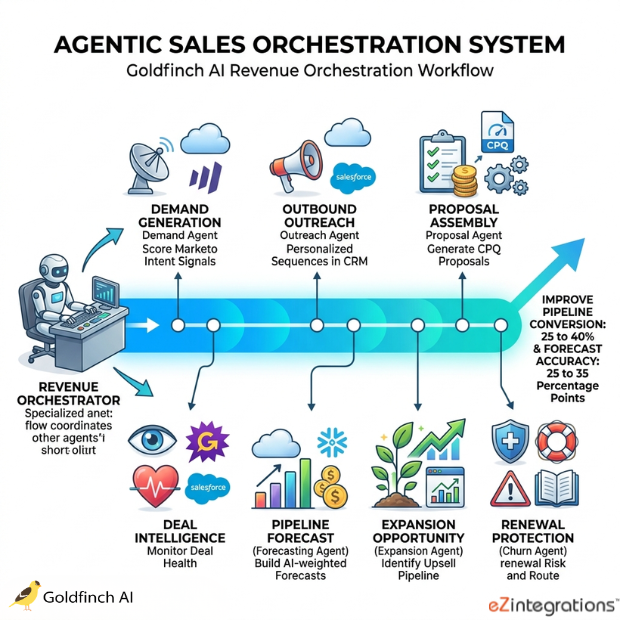
The Goldfinch AI revenue orchestration system from eZintegrations deploys 9 coordinated AI agents – a Revenue Orchestrator plus 8 specialized Worker Agents – to continuously qualify and route MQLs from Marketo, run personalized outbound sequences, score SQLs via MEDDIC/BANT qualification, generate customized proposals via CPQ, monitor deal health in Salesforce, build AI-weighted pipeline forecasts, identify expansion opportunities, and protect renewals from churn risk – improving pipeline conversion by 25 to 40% and forecast accuracy by 25 to 35 percentage points. eZintegrations is an enterprise automation platform covering iPaaS, AI Workflows, AI Agents, and Goldfinch AI agentic automation.
What Is Goldfinch AI Revenue Orchestration Automation?
Goldfinch AI revenue orchestration automation is a hierarchical multi-agent system where a Revenue Orchestrator coordinates 8 domain-specific Worker Agents simultaneously – from demand generation through renewal protection – through a shared revenue intelligence Knowledge Base containing ICP criteria, deal velocity benchmarks, competitive battle cards, and churn intervention playbooks. Unlike CRM or sales engagement platforms that surface revenue data for sales teams to act on manually, the Goldfinch AI revenue orchestration system autonomously advances the revenue lifecycle within configured authority limits, surfacing only the decisions that require VP Sales or CRO judgment.
How Does Goldfinch AI Revenue Orchestration Use 9 Agents Across Salesforce CRM, Marketo, CPQ, and Snowflake to Improve Pipeline Conversion 25 to 40% and Deliver Real-Time Revenue Intelligence from Demand Generation Through Expansion?
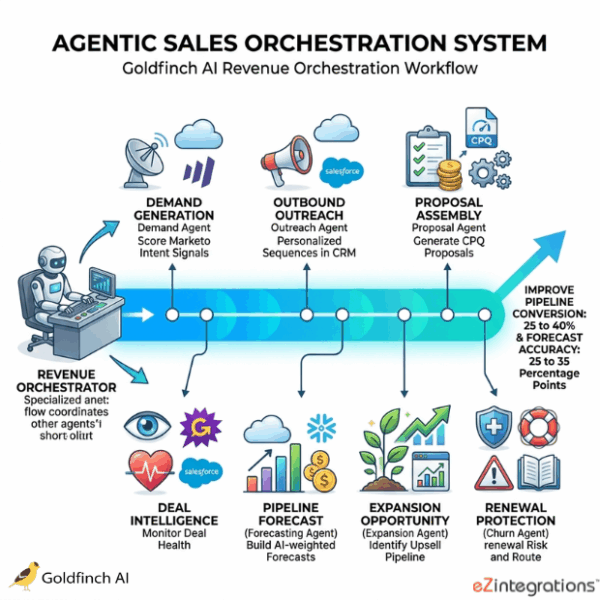
The Demand Agent scores intent signals from Marketo and Web Crawling. The Outreach Agent runs personalized sequences via Salesforce CRM and LinkedIn API. The Qualification Agent scores SQLs via MEDDIC/BANT and creates Salesforce opportunities. The Proposal Agent assembles CPQ proposals via Document Intelligence. The Deal Intelligence Agent monitors deal health via Gong and Salesforce. The Forecasting Agent builds AI-weighted forecasts via Snowflake DW. The Expansion Agent identifies upsell pipeline from usage data. The Churn Agent monitors renewal risk and routes CSM interventions. The Revenue Orchestrator coordinates all 9 agents through the shared revenue Knowledge Base.
Goldfinch AI ships with 9 native out-of-the-box agent tools. Users can add custom tools self-service beyond the 9 native tools. Gartner: AI revenue orchestration improves pipeline conversion 25 to 40%. This Goldfinch AI revenue orchestration system converts that benchmark into a continuously executing, cross-funnel revenue intelligence system.
Watch Demo
| Video Title: |
Goldfinch AI Revenue Orchestration | 9 Agents; Demand Generation to Renewal Protection Across Salesforce; Marketo; and CPQ |
|---|---|
| Duration: |
8 to 12 minutes |
Outcome & Benefits
| Autonomy: |
80%+ of revenue operations tasks executed autonomously within configured authority limits (MQL qualification and routing; standard outbound sequences below ACV threshold; SQL scoring and opportunity creation; deal health monitoring and next-action generation; pipeline forecast computation; expansion opportunity identification; churn risk scoring); proposals above $100,000 ACV; named account outreach; and forecast deviations above 15% require HITL approval; Churn Agent interventions at Critical-risk accounts require CSM and VP Sales review |
|---|---|
| Time Saved: |
MQL-to-SQL conversion cycle from 5 to 14 days (manual qualification lag) to same-day automated scoring and routing; proposal generation from 3 to 7 days AE manual effort to 4 to 8 hours with AE review; weekly forecast compilation from 4 to 8 hours of RevOps manual CRM analysis to automated real-time generation; deal health review from weekly rep-reported pipeline updates to continuous AI-monitored engagement scoring |
| Cost Reduction: |
25 to 40% pipeline conversion improvement (Gartner): at $50M annual pipeline; a 30% conversion improvement = $15M additional closed revenue; 20 to 30% reduction in revenue leakage from unqualified pipeline (McKinsey): eliminates $10M to $30M in annual lost revenue from poor qualification and delayed proposals; forecast accuracy improvement of 25 to 35 percentage points reduces over-hiring and over-provisioning cost from inaccurate revenue planning |
| Reliability: |
100% of Salesforce CRM pipeline monitored continuously for deal health signals; zero renewal dates approaching without Churn Agent risk assessment; 100% of MQLs scored against ICP criteria within 24 hours of Marketo lead creation; pipeline forecast updated in real time (not weekly snapshot) with AI-weighted close probabilities per opportunity |
Performance Metrics
| KPI | Before | After | Impact |
|---|---|---|---|
| Pipeline Conversion Rate | Baseline | 25 to 40% improvement (Gartner) | $10M to $30M+ additional revenue |
| MQL-to-SQL Cycle Time | 5 to 14 days | Same day | 95%+ faster routing |
| Proposal Generation Time | 3 to 7 days AE effort | 4 to 8 hours with review | 85%+ faster |
| Forecast Accuracy | 60 to 70% typical | 85 to 90%+ (Gartner AI benchmark) | 25 to 35pp improvement |
| Deal Health Visibility | Weekly rep-reported | Continuous AI monitoring | Real-time risk detection |
| Renewal Protection Coverage | Manual CSM observation | 100% account risk scoring | Full coverage |
Technical Details
| Tool Router: |
The Revenue Orchestrator routes each revenue signal event to the appropriate Worker Agent based on event type and revenue lifecycle stage – new Marketo MQL above ICP threshold triggers Demand Agent confirmation and Outreach Agent pipeline enrollment; demo completion triggers Qualification Agent SQL scoring; SQL above MEDDIC threshold triggers Qualification Agent AE routing and Proposal Agent activation; deal health deterioration triggers Deal Intelligence Agent next-action generation; weekly forecast cycle triggers Forecasting Agent; product usage ceiling approach triggers Expansion Agent; renewal within 180 days + health score below threshold triggers Churn Agent. Cross-agent blocking rules enforced by Orchestrator: Expansion Agent blocked when Churn Agent active at the same account; Outreach Agent named account sequence held pending VP Sales approval. |
|---|---|
| Evaluation Metrics: |
Pipeline conversion rate (MQL-to-SQL; SQL-to-opportunity; opportunity-to-closed won – per segment and ACV band); forecast accuracy (committed forecast vs. actual closed at end of period; by segment and rep); MQL-to-SQL cycle time (hours from Marketo MQL creation to Salesforce opportunity creation); proposal response rate (% of proposals delivered receiving a customer response within 5 business days); deal health score accuracy (% of deals flagged as High Risk that closed lost within 30 days; validated monthly); expansion pipeline identified by Expansion Agent vs. CSM-identified; churn prediction accuracy (% of Critical-flagged accounts that churned within 90 days); Revenue Orchestrator compound risk identification rate and HITL escalation acceptance rate. |
| Planner Type: |
Revenue lifecycle goal decomposition with continuous event-driven signal processing and LLM-hybrid cross-domain conflict resolution – the Revenue Orchestrator uses schema-driven routing rules for funnel stage transitions (MQL above ICP threshold routes to Outreach; SQL above MEDDIC score routes to AE assignment), cross-agent blocking logic (Expansion Agent blocked on Churn Agent active account), and authority limits per action type (autonomous vs. HITL); LLM reasoning governs proposal personalization, deal health narrative and next-action recommendation, forecast commentary generation, competitive response strategy, expansion opportunity ranking narrative, and CRO executive revenue brief synthesis. |
| Agent Roles: |
Churn Agent: API Tool Call (Salesforce CRM customer health score, NPS platform API, customer support ticketing system API), Web Crawling (G2/Capterra/TrustRadius for competitive threat signals and negative reviews at existing accounts, LinkedIn for executive departure signals), Document Intelligence (customer support ticket threads for churn language and escalation pattern detection), Data Analysis (multi-signal renewal risk score: usage trend, support ticket sentiment, executive engagement, competitive mentions, NPS trajectory), Knowledge Base Vector Search (churn risk intervention playbooks per risk type), Integration Workflow as Tool (CSM intervention routing sub-workflow with account context), Deal Intelligence Agent: API Tool Call (Salesforce CRM opportunity engagement data, Gong call intelligence API https://app.gong.io/settings/api-access for conversation signal extraction), Document Intelligence (call transcripts and email threads for buying signal and risk factor extraction), Data Analysis (deal health score computation: engagement trend, stakeholder map completeness, champion strength, competitive risk, deal velocity vs. benchmark; win probability computation), Knowledge Base Vector Search (deal velocity benchmarks per stage and ACV band, historical win/loss analysis by competitor and vertical), Expansion Agent: API Tool Call (Salesforce CRM customer account and contract data, product usage DW data via Snowflake), Data Analysis (upsell/cross-sell opportunity scoring: product usage ceiling approach, contract expansion trigger, account growth signal, customer health score), Data Analytics with Charts/Graphs/Dashboards (expansion opportunity pipeline map by account and product), Knowledge Base Vector Search (customer expansion playbooks per product and customer segment), Integration Workflow as Tool (Salesforce CRM expansion opportunity creation sub-workflow), Forecasting Agent: API Tool Call (Salesforce CRM pipeline data by stage and rep, Snowflake DW https://docs.snowflake.com/ historical win rate and seasonality query), Data Analysis (AI-weighted close probability per opportunity: deal stage weight, engagement score weight, time-in-stage vs. benchmark, competitive risk adjustment, economic buyer identified flag; forecast aggregation to committed/best case/pipeline by segment), Data Analytics with Charts/Graphs/Dashboards (pipeline forecast dashboard: committed/best case/pipeline by segment and rep, forecast vs. prior period, close probability distribution), Knowledge Base Vector Search (historical forecast accuracy benchmarks, seasonality patterns per vertical), Integration Workflow as Tool (Snowflake DW forecast write and CRO digest delivery sub-workflow), Outreach Agent: API Tool Call (Salesforce CRM sequence management, Marketo email campaign API, LinkedIn Sales Navigator API https://developer.linkedin.com/), Web Crawling (prospect LinkedIn profile and company news for personalization signals), Document Intelligence (inbound inquiry emails for personalization context extraction), Data Analysis (sequence engagement metric scoring, channel optimization recommendation, A/B test performance), Knowledge Base Vector Search (approved outbound sequence templates and winning messaging per vertical and persona), Integration Workflow as Tool (Salesforce CRM sequence creation and LinkedIn outreach sub-workflow), Proposal Agent: API Tool Call (Salesforce CRM opportunity data and requirements retrieval, CPQ pricing and configuration API https://help.salesforce.com/s/articleView?id=sf.cpq_product.htm), Document Intelligence (prior winning proposals, RFP/RFI documents, prospect requirements documents for proposal structure and winning language extraction), Data Analysis (competitive positioning scoring, commercial terms validation vs. Knowledge Base pricing guidelines), Knowledge Base Vector Search (approved proposal templates and winning language per use case and vertical, competitive battle cards), Integration Workflow as Tool (CPQ pricing configuration and proposal document assembly sub-workflow), Qualification Agent: API Tool Call (Salesforce CRM opportunity creation and AE assignment), Document Intelligence (inbound inquiry emails and demo request content for qualification signal extraction), Data Analysis (MEDDIC/BANT qualification scoring per dimension: Budget, Authority, Need, Timeline, MEDDIC champion and economic buyer identification), Knowledge Base Vector Search (MEDDIC/BANT qualification rubrics, AE assignment routing rules per segment and territory), Integration Workflow as Tool (Salesforce CRM opportunity creation and AE assignment sub-workflow with structured discovery brief), Revenue Orchestrator (Coordinator): revenue lifecycle management, cross-agent conflict resolution, CRO/VP Sales escalation routing, revenue health dashboard assembly; Demand Agent: Web Crawling (prospect company websites, LinkedIn company pages, Crunchbase funding signals, G2/Capterra for competitive displacement signals), API Tool Call (Marketo lead scoring API https://developers.marketo.com/, Salesforce CRM lead creation https://developer.salesforce.com/docs), Data Analysis (ICP fit scoring per segment, intent signal weighting, MQL threshold computation), Knowledge Base Vector Search (ICP definitions and scoring criteria per segment and product) |
| Scheduling: |
Qualification Agent processes each new lead within 4 hours of Marketo MQL creation; Proposal Agent activates on demo completion and opportunity qualification confirmation from the AE; Deal Intelligence Agent runs continuous engagement monitoring (24-hour deal health score update) and immediately on negative call transcript signal from Gong; Forecasting Agent updates the pipeline forecast in real time on each Salesforce CRM opportunity stage change and delivers the weekly CRO forecast report; Expansion Agent runs weekly product usage scan and immediately on contract expansion trigger event; Churn Agent runs weekly renewal risk scoring for all accounts within 180 days of renewal and immediately on NPS Detractor response or support escalation event., Revenue Orchestrator monitors Salesforce CRM, Marketo, and Snowflake DW via Watcher Tools continuously (60-minute standard cycle for pipeline and deal health signals; immediate trigger for Critical events – deal lost signal, renewal lapse within 30 days, forecast variance breach, named account response to outreach); Demand Agent runs daily intent signal aggregation and immediately on Marketo MQL threshold trigger; Outreach Agent manages sequence timing per prospect engagement event; |
| Auditability: |
Every agent action is logged with: agent name, opportunity or account reference (Salesforce CRM opportunity ID or account ID), signal source (Marketo lead ID, Gong call ID, Salesforce CRM record), tool invoked, Data Analysis methodology applied, recommendation generated, confidence score, HITL status (autonomous execution or VP Sales/CRO-reviewed), system write confirmation (Salesforce CRM record ID, CPQ quote ID, Marketo campaign ID), and timestamp., The Revenue Orchestrator maintains a per-opportunity and per-account audit trail from lead creation through closed won or lost — including all agent actions, recommendations, HITL decisions, and revenue outcomes. Revenue Operations Director and CRO access the full revenue intelligence audit log via the Goldfinch AI revenue dashboard. Forecast audit trail: every Forecasting Agent AI-weighted close probability computation is logged with the input signals and weights applied — providing the Revenue Operations Director with full forecast explainability for each opportunity for Board and investor reporting. |
Connectivity and Deployment
| Supported Protocols: |
REST API (Salesforce CRM REST API; Marketo REST API; Salesforce CPQ REST API; Gong API; LinkedIn Sales Navigator API; NPS platform API; customer support ticketing REST API; Snowflake DW JDBC); Web Crawling (Crunchbase; LinkedIn company pages; G2; Capterra; TrustRadius; prospect company news sources; industry press); SMTP (AE deal health alert notifications; VP Sales forecast variance alerts; CRO revenue health digest; CSM churn risk intervention routing); HTTPS; OAuth 2.0; IPSec Tunnel (on-premises CRM; CPQ; and marketing automation connectivity) |
|---|---|
| Tenancy Model: |
Single-tenant is strongly recommended for all revenue intelligence deployments. Pipeline data; deal terms; competitive intelligence; pricing guidelines; and forecast data constitute the most commercially sensitive operational data in the enterprise – equivalent to the M&A competitive intelligence sensitivity category. Single-tenant provides dedicated infrastructure with full data segregation and no cross-customer intelligence exposure. Multi-tenant is available for organizations without strict competitive intelligence data isolation requirements. |
| On-Premise Supported: |
Yes – eZintegrations connects to on-premises systems (on-premises Salesforce; on-premises CRM; on-premises CPQ; and others) via IPSec Tunnel. eZintegrations is a browser-based; cloud-hosted platform and does not require any on-premises installation. |
| Security & Compliance: |
SOC Type II certified; GDPR-compliant prospect and customer data handling (prospect contact data processed under GDPR Article 6 legitimate interest for commercial sales outreach with unsubscribe and contact preference management built-in for all Outreach Agent sequences; customer data processed under GDPR Article 6 for commercial relationship management; data minimization applied per agent); CCPA-compliant prospect outreach (California prospects handled with opt-out and consent documentation per CCPA);, SOX-compliant revenue forecast documentation (Forecasting Agent AI-weighted close probability computation logged with full input signal documentation for SOX revenue recognition internal controls). RBAC enforced: CRO has full revenue portfolio view; VP Sales accesses their team’s pipeline and forecast data; individual AEs access only their assigned opportunities; Revenue Operations Director accesses full pipeline and forecast data; CSM team accesses only their assigned customer accounts; competitive intelligence (battle cards, pricing guidelines) accessible only to sales leadership and Revenue Operations. |
AI Credits
| Credit Consumption Model: |
Continuous daily monitoring (Demand; Deal Intelligence; Churn Agents); weekly batch for Qualification scoring run; Forecasting pipeline update; Expansion scan; Outreach sequence management; event-triggered for Proposal Agent (per demo completion); Outreach Agent (per sequence launch); Qualification Agent (per new MQL) Estimated Credits per End-to-End Run: Per MQL-to-opportunity end-to-end (Demand → Outreach → Qualification → Salesforce CRM opportunity): ~25 to 45 credits per converted MQL Per proposal generated: ~15 to 35 credits per proposal Per weekly full revenue cycle (all 9 agents; 100-opportunity pipeline): ~500 to 1,000 credits per week Per deal health weekly monitoring (100 active opportunities): ~200 to 400 credits per week |
|---|---|
| Retry / Reflection Credit Cost: |
Each Revenue Orchestrator conflict resolution retry: ~5 to 8 additional credits per retry. Proposal Agent commercial terms reflection: ~4 to 6 additional credits. At 10% complex event rate; add approximately 12 to 18% to the weekly estimate. |
| Monthly Credit Estimate (at Typical Volume): |
SMB to mid-market (50-person sales team; 500-opportunity pipeline; standard event volume): ~8,000 to 18,000 credits per month Enterprise (200-person sales team; 2,000-opportunity pipeline): ~30,000 to 60,000 credits per month Large enterprise SaaS (500+ reps; global pipeline): ~80,000 to 150,000 credits per month |
| Pricing Model: |
Static Platform Fee + AI Credits. Platform fee covers unlimited non-LLM orchestration across all agents (Salesforce CRM connection management; Marketo connection; CPQ connection; Gong API integration; LinkedIn API connection; Snowflake DW writes; SMTP notification dispatch; audit log writes). AI Credits consumed only by Goldfinch AI tool invocations and LLM reasoning cycles. |
| Credit Optimization Notes: |
Configure Demand Agent Web Crawling to prospect company pages at 48-hour intervals (not daily) for companies not showing active Marketo intent signals – reduces Web Crawling credits 40 to 60% by focusing crawl on active intent prospects. Batch Deal Intelligence Agent Gong API call transcript retrieval in a single daily API call per rep rather than per-call sequential queries. Cache Knowledge Base competitive battle cards and ICP criteria for 30 days (these change at most monthly). For Proposal Agent; apply Document Intelligence to prior winning proposals only in the same vertical and deal size band as the current opportunity – reduces Document Intelligence credits 40 to 50% by avoiding irrelevant proposal analysis. Configure Churn Agent to run weekly for accounts 90+ days from renewal and daily only for accounts within 30 days of renewal. |
| AI Credits Required: |
Yes – Goldfinch AI agentic systems consume credits across all 9 agents per revenue signal processed, per document analyzed, per proposal generated, and per reflection/retry loop. |
| LLM Steps Count: |
14 to 28 LLM-invoking steps per active revenue cycle (Revenue Orchestrator cross-agent signal correlation: 2 to 4 steps; Demand Agent ICP scoring: 2 to 3 steps; Outreach Agent sequence personalization: 3 to 5 steps; Proposal Agent proposal assembly: 4 to 8 steps; Deal Intelligence Agent health narrative: 2 to 4 steps; Forecasting Agent commentary generation: 2 to 3 steps; reflection/retry: 1 to 2 steps per retry) |
| Per-Agent Credit Breakdown: |
Proposal Agent: 8 to 16 credits per proposal generated (Document Intelligence prior proposals + CPQ API configuration + proposal personalization LLM generation) – highest per-event credit consumer; Deal Intelligence Agent: 4 to 8 credits per weekly deal health cycle (Gong API + email thread Document Intelligence + deal health Data Analysis); Forecasting Agent: 4 to 8 credits per weekly forecast (Salesforce CRM pipeline API + Snowflake DW win rate query + AI-weighted close probability Data Analysis + Data Analytics forecast dashboard); Expansion Agent: 3 to 6 credits per weekly expansion scan (Salesforce CRM + Snowflake DW product usage + expansion Data Analysis); Churn Agent: 4 to 8 credits per weekly renewal risk cycle (multi-signal API + Web Crawling competitive signals + churn risk Data Analysis), Revenue Orchestrator: 3 to 6 credits per weekly cycle (cross-agent correlation + revenue health score + CRO brief assembly); Demand Agent: 3 to 6 credits per daily intent signal cycle (Web Crawling prospect signals + ICP Data Analysis + Marketo/Salesforce API write); Outreach Agent: 5 to 10 credits per sequence launch (Web Crawling prospect personalization + sequence personalization LLM + Salesforce CRM and LinkedIn API execution); Qualification Agent: 3 to 6 credits per SQL scoring event (MEDDIC/BANT Data Analysis + Document Intelligence inquiry content + Salesforce CRM opportunity creation) |
| Goldfinch AI Tool(s) Consuming Credits: |
Churn Agent support tickets – per document), Data Analysis (Demand ICP scoring; Outreach engagement; Qualification MEDDIC scoring; Deal Intelligence health; Forecasting close probability; Expansion upsell scoring; Churn risk – per computation), Knowledge Base Vector Search (all 9 agents per revenue context and benchmark query), Data Analytics (Forecasting pipeline dashboard; Expansion opportunity map; Revenue Orchestrator CRO dashboard – per render), Integration Workflow as Tool (all 8 Worker Agents for Salesforce CRM/Marketo/CPQ/Snowflake sub-workflows – per invocation), Watcher Tools (Revenue Orchestrator continuous CRM/marketing automation/DW event monitoring), Web Crawling (Demand Agent prospect intent signals; Outreach Agent personalization; Churn Agent competitive threat monitoring – per crawl cycle), API Tool Call (all 8 Worker Agents per Salesforce/Marketo/CPQ/Gong/LinkedIn/Snowflake call), Document Intelligence (Proposal Agent prior proposals and RFPs; Deal Intelligence Agent call transcripts; Qualification Agent inquiry emails; |
FAQ
1. What is the Agentic Sales Orchestration System and what does it automate end to end?
The Goldfinch AI revenue orchestration system from eZintegrations deploys 9 coordinated AI agents - a Revenue Orchestrator and 8 domain Worker Agents - to continuously qualify MQLs from Marketo (Demand Agent), run personalized outbound sequences in Salesforce CRM and LinkedIn (Outreach Agent), score SQLs via MEDDIC/BANT (Qualification Agent), generate custom proposals via CPQ (Proposal Agent), monitor deal health via Gong and Salesforce (Deal Intelligence Agent), build AI-weighted pipeline forecasts from Snowflake DW (Forecasting Agent), identify expansion opportunities from product usage data (Expansion Agent), and protect renewals from churn risk (Churn Agent) - improving pipeline conversion 25 to 40% and forecast accuracy by 25 to 35 percentage points. Gartner: AI revenue orchestration improves pipeline conversion 25 to 40%.
2. How does the multi-agent architecture work?
The Revenue Orchestrator coordinates 8 Worker Agents through a shared revenue intelligence Knowledge Base containing ICP criteria, deal velocity benchmarks, competitive battle cards, and churn intervention playbooks. Cross-agent intelligence is the key capability: when the Deal Intelligence Agent flags a deal as High Risk at the same time the Forecasting Agent has it in the committed forecast, the Orchestrator detects the conflict, re-evaluates the deal against comparable loss profiles in the Knowledge Base, and escalates to the VP Sales before the deal is included in the Board forecast. Simultaneously, the Expansion Agent is blocked from outreach to any account where the Churn Agent has an active retention risk - preventing the cross-purposes interaction that destroys customer relationships.
3. Which Goldfinch AI tools does this system use?
The system uses 8 of Goldfinch AI's 9 native tools: Watcher Tools (Revenue Orchestrator continuous Salesforce/Marketo/DW monitoring), Web Crawling (Demand Agent prospect intent signals, Crunchbase, G2/Capterra; Outreach Agent prospect personalization; Churn Agent competitive threat monitoring), API Tool Call (all 8 Worker Agents - Salesforce CRM, Marketo, CPQ, Gong, LinkedIn Sales Navigator, NPS platform, Snowflake DW), Document Intelligence (Proposal Agent prior proposals and RFPs; Deal Intelligence Agent call transcripts; Qualification Agent inquiry emails; Churn Agent support tickets), Data Analysis (ICP scoring; MEDDIC/BANT; deal health; AI-weighted close probability; expansion scoring; churn risk), Knowledge Base Vector Search (all 9 agents - ICP, deal velocity benchmarks, competitive battle cards, pricing guidelines, expansion playbooks), Data Analytics (pipeline forecast dashboard; expansion opportunity map; CRO revenue health dashboard), and Integration Workflow as Tool (Salesforce CRM lead/opportunity/expansion creation; Marketo sequence; CPQ proposal; Snowflake forecast write; CSM churn routing). Users can add Outreach.io, 6sense, Demandbase, DocuSign, and Clari self-service beyond the 9 native tools.
4. How does the system ensure data accuracy and handle errors?
The Revenue Orchestrator applies a reflection cycle when cross-agent revenue signals conflict - if the Forecasting Agent's AI model shows 85% close probability while Deal Intelligence Agent's engagement score has dropped 30%, the Orchestrator re-queries the Knowledge Base for comparable deal loss profiles, retries up to 3 times, and escalates to VP Sales before the deal is committed. The Proposal Agent applies a reflection cycle when generated commercial terms deviate from Knowledge Base pricing guidelines. All proposals above $100,000 ACV, named account outbound sequences, and forecast deviations above 15% require HITL approval before execution.
5. What types of data and documents does this system process?
The system processes: Marketo lead scoring and behavioral data (Demand Agent); prospect company websites, LinkedIn profiles, and Crunchbase funding data (Demand and Outreach Agent Web Crawling); Salesforce CRM opportunity and account data across all stages; Gong call intelligence transcripts (Deal Intelligence Agent Document Intelligence); inbound inquiry emails and demo request forms (Qualification Agent Document Intelligence); prior winning proposals, RFPs, and prospect requirements documents (Proposal Agent Document Intelligence); product usage data from Snowflake DW (Expansion Agent); customer support ticket threads and NPS data (Churn Agent Document Intelligence); CPQ pricing configuration data (Proposal Agent).
6. Who uses this system and in which departments?
Daily operators include Account Executives (receive Deal Intelligence Agent next-action recommendations and Proposal Agent draft proposals for review), Sales Development Representatives (receive Demand Agent qualified MQL pipeline and Outreach Agent sequence recommendations), Revenue Operations Director (reviews Forecasting Agent pipeline forecast and variance alerts, full pipeline audit trail), Customer Success Managers (receive Churn Agent renewal risk alerts with structured account context and Expansion Agent upsell recommendations). Executive stakeholders - the CRO and VP Sales - receive the weekly revenue health dashboard, forecast variance HITL requests, and compound revenue risk escalations.
7. How does the safety layer and human oversight work?
HITL triggers when: Outreach Agent targets a named account or ACV above $50,000 - VP Sales or CRO review required before sequence launch; Proposal Agent generates a proposal above $100,000 ACV - AE and Revenue Operations sign-off required before delivery; Forecasting Agent computes a forecast deviation above 15% from prior week's committed - Revenue Operations Director and CRO review required; Expansion Agent identifies upsell above threshold at an account with active Churn Agent risk - cross-functional review required; Revenue Orchestrator confidence below 0.75. After 3 retries, CRO escalation with full context. All HITL decisions logged for revenue governance and SOX revenue recognition documentation.
8. What are the key business benefits and executive KPIs improved?
Key benefits: pipeline conversion from baseline to 25 to 40% improvement (Gartner), MQL-to-SQL cycle from 5 to 14 days to same day, proposal generation from 3 to 7 days to 4 to 8 hours, forecast accuracy from 60 to 70% to 85 to 90%+ (Gartner AI benchmark), 100% pipeline covered for deal health vs. weekly rep-reported updates, renewal protection across 100% of accounts within 180 days of renewal, and the CRO shifts from assembling lagging revenue metrics from 5 disconnected tools to reviewing a continuously updated, cross-funnel revenue intelligence dashboard. McKinsey: B2B sales organizations lose 20 to 30% of potential revenue to poor qualification and unmanaged deal risk.
Resources
| Blog: |
Enterprise Retail Integration Platform: Connect ERP WMS Shopify & More |
|---|---|
| Platform Overview: |
eZintegrations Platform – Enterprise iPaaS, AI Workflows & Agentic AI |
| Demo: |
Book a Demo |
| Goldfinch AI Platform: |
Agentic AI Platform — Goldfinch AI by eZintegrations |
Case Study
| Industry: |
SaaS / B2B Enterprise Software Company |
|---|---|
| ROI: |
Forecast accuracy improvement (28% to 7.2% MAE): value of avoided over-hiring and over-provisioning from inaccurate revenue planning – estimated $4.2M in avoided cost (2 headcount that would have been hired on prior forecast; not hired on corrected forecast). Deals saved from Risk flag intervention: 62 x $84,000 average ACV = $5.2M recovered pipeline. Faster proposal delivery: 12 additional converts x $84,000 = $1.0M. SDR productivity (SDR research time savings: 220 SDRs x (4.5 hours – 0.37 hours saved per week) x 47 working weeks x $45/hour blended cost = $1.8M). Reply rate improvement |
| Problem: |
34% of deals that closed lost in the prior year had shown detectable risk signals (engagement deterioration, competitive mention, no economic buyer identified) at least 30 days before the loss event, with no intervention triggered; Proposal generation: the average proposal generation time was 4.6 days (AE research + Revenue Operations pricing review + legal commercial terms). 18% of opportunities that requested a proposal did not receive one within 7 days – with an estimated 35% of those converting to a lost deal due to proposal delay; Pipeline generation: the SDR team was running manual outbound sequences with average personalization of 1 to 2 data points per prospect (name and company). Reply rate: 2.1%. Industry benchmark for AI-personalized sequences: 5 to 8%. The team was spending 4 to 5 hours per SDR per week on prospect research before sequence launch., A B2B enterprise software company with $185M ARR, 220-person sales organization across 3 segments (SMB, Mid-Market, Enterprise), and a Salesforce CRM instance with 4,200 active opportunities operated with the following revenue performance gaps: Forecast accuracy: the Revenue Operations team’s weekly committed forecast had a mean absolute error of 28% vs. actual quarter-end closed (industry benchmark for AI-powered forecasting: below 8%). The CRO’s credibility with the Board was impacted twice in the prior fiscal year by forecast misses above 20%; Deal health: of 4,200 active Salesforce CRM opportunities, the Deal Intelligence review was performed manually by 4 Revenue Operations analysts – covering approximately 15% of the pipeline per week. |
| Solution: |
Deployed the eZintegrations Goldfinch AI revenue orchestration system across all 3 sales segments in 19 business days. Salesforce CRM connected via REST API (all 4,200 active opportunities, 12,400 active accounts, full pipeline and activity data). Marketo connected via REST API (lead scoring, email engagement, behavioral data for all active prospects). Salesforce CPQ connected via REST API (product catalog, pricing tiers, discount authorization rules). Gong connected via API (call recording transcripts for all 220 reps – 8,400 calls per month). LinkedIn Sales Navigator API configured for the Outreach Agent (passive prospect outreach and personalization for SDR team). Snowflake DW connected via JDBC (3 years of historical win rate, deal velocity, and seasonality data by segment). Knowledge Base Vector Search loaded with:, ICP definitions for all 3 segments (SMB, Mid-Market, Enterprise) with 47 scoring criteria, MEDDIC qualification rubrics calibrated against 2 years of closed-won and closed-lost data, 340 prior winning proposal documents categorized by use case and vertical (6 verticals), competitive battle cards for 14 competitors, deal velocity benchmarks per stage and ACV band (SMB: 14 days average, Mid-Market: 42 days, Enterprise: 124 days), expansion playbooks for 8 product expansion paths, churn risk intervention playbooks for 6 risk categories, approved pricing guidelines for 3 tier structures and 4 deal size bands, and 3 years of forecast accuracy data by rep and segment. HITL authority: VP Sales review for named account outreach and ACV above $75,000 sequence initiation; Revenue Operations Director sign-off for forecast deviations above 12%; AE and RevOps sign-off for proposals above $150,000 ACV; CSM and VP Sales for Critical churn risk interventions. |
| Outcome: |
After 7 months: Forecast accuracy: mean absolute error from 28% to 7.2% (74% improvement, below industry AI benchmark of 8%). CRO had zero forecast misses above 10% in the 7-month period. Deal health coverage: from 15% of pipeline reviewed per week (manual) to 100% of 4,200 opportunities monitored continuously by Deal Intelligence Agent; 312 High Risk deal flags issued in 7 months, 248 actioned by AEs (79% HITL acceptance rate); estimated 62 deals saved from loss based on interventions where pipeline closed won after Risk flag + AE intervention (at average ACV $84,000 = $5.2M in saved pipeline)., Proposal generation: from 4.6 days to 9.4 hours average including AE review; proposal within 7-day threshold from 82% to 97% of requested proposals; estimated 12 additional deal converts from faster proposal delivery at average ACV $84,000 = $1.0M. Outbound sequences: SDR reply rate from 2.1% to 5.8% from AI-personalized sequences; SDR prospect research time from 4 to 5 hours/week to 22 minutes/week. MQL-to-SQL cycle from 9.2 days average to same-day (95% within 4 hours). Churn: 180 accounts flagged as Critical renewal risk; 152 CSM interventions; 114 accounts retained (estimated $9.6M ARR protected) |