How to Automate Manufacturing Operations Using Multi-Agent AI Systems
$150.00
| System Name: |
Agentic Manufacturing Intelligence Platform |
|---|---|
| Architecture: |
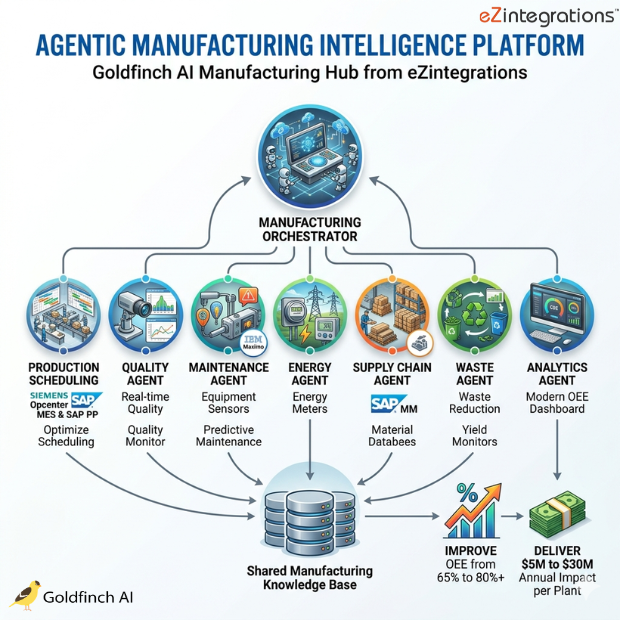
Hierarchical Multi-Agent System – 1 Manufacturing Orchestrator (Coordinator) + 7 specialized Worker Agents (Production Scheduling; Quality; Maintenance; Energy; Supply Chain; Waste; Analytics) operating through continuous real-time signal processing from IoT/SCADA and MES; shared manufacturing vector knowledge base; and human-in-the-loop approval gates for production plan changes; maintenance work orders above configured thresholds; and quality hold decisions; 8 total agents |
| Coordinator Agent: |
Manufacturing Orchestrator – continuously receives signal events from all 7 Worker Agents; cross-correlates competing manufacturing objectives (maximize OEE; minimize energy cost; maintain quality; prevent unplanned downtime; manage material availability); decomposes the current shift production goal into domain-specific sub-tasks per Worker Agent; enforces priority sequencing when objectives conflict (a quality hold from the Quality Agent overrides a Production Scheduling Agent throughput optimization for the affected line); and routes material alerts; unplanned downtime events; and quality excursions to the Plant Manager or VP Manufacturing for human approval |
| On-Premise Supported: |
Yes – eZintegrations connects to on-premises systems (Siemens Opcenter MES on-prem; SAP ERP on-prem; IBM Maximo CMMS on-prem; on-premises SCADA systems; on-premises IoT data platforms; and others) via IPSec Tunnel. eZintegrations is a browser-based; cloud-hosted platform and does not require any on-premises software installation. |
| Tags: |
Goldfinch AI manufacturing; manufacturing AI orchestration; OEE improvement AI; predictive maintenance AI agent; production scheduling AI; quality control AI agent; MES AI integration; SAP PP AI agent; IBM Maximo AI; manufacturing analytics AI; plant operations AI; Goldfinch AI Industry 4.0 |
| AI Credits Required: |
Yes – Goldfinch AI agentic systems consume credits across the Manufacturing Orchestrator and all 7 Worker Agents per monitoring cycle, per anomaly analyzed, per production optimization computed, and per reflection/retry loop. |
| Safety Layer: |
Maintenance Agent generates a work order for a safety-critical or production-critical asset (e.g. primary press, furnace, autoclave) – Maintenance Manager approval required before the work order is scheduled; Supply Chain Agent detects a material shortage that will halt production within 24 hours – VP Manufacturing escalation required; Manufacturing Orchestrator cross-agent confidence falls below 0.75 on any production optimization decision. Max 3 retries before Plant Manager escalation with full agent context. All HITL decisions logged with reviewer identity, decision, asset or batch reference, and timestamp for ISO 9001 and regulatory audit documentation., Human-in-the-loop gate triggers when: Production Scheduling Agent proposes a production plan change that deviates from the MES master schedule by more than the configured threshold (default: 15% capacity reallocation) – Plant Manager approval required before MES write; Quality Agent initiates a quality hold on a production run above the configured batch value threshold – Quality Director review required before hold is confirmed and customer notification is triggered; |
| Worker Agents: |
Analytics Agent: Maintains the real-time OEE (Overall Equipment Effectiveness) dashboard – tracking Availability, Performance, and Quality components continuously per machine, line, and plant – delivering the shift OEE report to the Plant Manager and the weekly OEE trend brief to the VP Manufacturing, Maintenance Agent: Generates predictive maintenance work orders in IBM Maximo CMMS based on IoT sensor data (vibration, temperature, pressure, run-time hours) and historical failure pattern analysis – scheduling maintenance during planned windows identified by the Production Scheduling Agent to minimize production impact; Energy Agent: Monitors energy consumption across the plant in real time, identifies energy optimization opportunities (load shifting to off-peak tariff windows, compressed air pressure optimization, HVAC scheduling), and adjusts energy-consuming equipment parameters within configured limits to reduce energy cost per unit produced, Production Scheduling Agent: Optimizes work order sequencing across machines and production lines – balancing machine capacity, material availability from the Supply Chain Agent, maintenance windows from the Maintenance Agent, and energy cost windows from the Energy Agent – generating the optimized production schedule in Siemens Opcenter MES and SAP PP; Quality Agent: Monitors real-time product quality signals from IoT sensors, SCADA systems, and in-line inspection equipment – detecting statistical process control (SPC) violations, out-of-specification trends, and defect pattern signals before they result in scrap or customer non-conformance, and triggering quality holds or process adjustments within configured autonomous authority, Supply Chain Agent: Monitors raw material and component inventory levels, supplier delivery status, and production consumption rates – alerting the Manufacturing Orchestrator and Production Scheduling Agent when a material shortage will constrain the production schedule within the configured planning horizon; Waste Agent: Identifies and analyzes production waste signals (scrap rate by machine, process, and material; rework volumes; yield loss patterns) – computing root cause candidates and recommending process parameter adjustments to reduce waste generation, with adjustments within configured authority executed autonomously |
Table of Contents
| Planning: |
The Manufacturing Orchestrator uses shift-level goal decomposition with continuous event-driven re-planning – at the start of each shift; the Orchestrator decomposes the shift production goal (target units; quality specification; energy budget) into sub-tasks per Worker Agent; when a signal event fires mid-shift (quality excursion; machine fault; material alert); the Orchestrator immediately re-plans the affected agent’s sub-tasks while maintaining the other agents’ current objectives. Schema-driven rules govern production priority sequencing; quality hold authority limits; and maintenance work order approval tiers; LLM reasoning governs cross-agent conflict resolution (throughput vs. quality vs. energy); root cause candidate narrative for quality and maintenance events; and OEE improvement recommendation synthesis. |
|---|---|
| Messaging: |
All 8 agents communicate via structured manufacturing event messages – the Quality Agent publishes a structured quality event (affected process; SPC violation type; severity score; recommended action) that the Manufacturing Orchestrator evaluates against the current production plan; the Maintenance Agent publishes a structured maintenance urgency event (asset ID; failure mode; remaining useful life estimate; recommended maintenance window) that the Orchestrator cross-references with the Production Scheduling Agent’s planned run schedule before routing for HITL approval or autonomous scheduling. |
| Reflection: |
The Manufacturing Orchestrator applies a reflection loop when cross-agent recommendations conflict – if the Production Scheduling Agent’s optimal schedule requires a machine that the Maintenance Agent has flagged as approaching failure; the Orchestrator re-evaluates the asset’s RUL estimate against the Knowledge Base failure pattern library; retries the conflict resolution up to 3 times with expanded context; and escalates to the Plant Manager with the full conflict context if confidence remains below 0.75. The Quality Agent applies an additional reflection cycle when an SPC violation has borderline severity before initiating a quality hold. |
| Knowledge: |
All 8 agents share a persistent manufacturing vector knowledge base containing: machine capacity profiles and production constraints per asset; historical failure patterns and maintenance records per equipment family; SPC control limits and quality specifications per product and process; energy tariff schedules and equipment energy consumption profiles (updated daily); supplier lead times and material reliability scores; material specifications and approved substitutions; waste reduction playbooks per process type; shift handover notes and production incident records; and OEE improvement playbooks from prior shifts and comparable plants. Indexed by asset ID; product; process; shift; and failure mode. |
| Execution: |
The Production Scheduling Agent optimizes and writes the production schedule to Siemens Opcenter MES via Integration Workflow as Tool. The Quality Agent reads real-time sensor data via API Tool Call and creates SAP QM quality notifications for confirmed excursions. The Maintenance Agent creates IBM Maximo CMMS work orders via Integration Workflow as Tool within configured authority limits. The Energy Agent adjusts energy-consuming equipment parameters via API Tool Call to the energy management system. The Supply Chain Agent queries SAP MM inventory and supplier delivery data. The Waste Agent computes yield loss Pareto analysis. The Analytics Agent writes OEE KPIs to Snowflake DW and delivers shift reports via Integration Workflow as Tool. |
| Business Impact: |
McKinsey Industry 4.0 research: manufacturers that deploy connected AI operations improve OEE by 10 to 25 percentage points. The average manufacturing plant operating at 65% OEE loses $5M to $30M annually in unrealized production capacity vs. a plant operating at 80%+ OEE (McKinsey Global Manufacturing benchmark). Unplanned downtime costs the average manufacturer $260,000 per hour (Aberdeen Group). The Goldfinch AI manufacturing hub shifts the plant from reactive; siloed operations to proactive; continuously coordinated intelligence – the first manufacturing agentic system that simultaneously optimizes production; quality; maintenance; energy; supply chain; and waste without requiring separate specialist platforms for each domain. |
The Goldfinch AI manufacturing hub from eZintegrations deploys 8 coordinated AI agents – a Manufacturing Orchestrator plus 7 specialized Worker Agents – to continuously optimize production scheduling in Siemens Opcenter MES, monitor real-time quality via SPC, generate predictive maintenance work orders in IBM Maximo, optimize energy consumption, monitor material availability in SAP MM, reduce production waste, and deliver a live OEE dashboard – improving OEE from the industry average of 65% to 80%+ and delivering $5M to $30M annual impact per plant. eZintegrations is an enterprise automation platform covering iPaaS, AI Workflows, AI Agents, and Goldfinch AI agentic automation.
What Is Goldfinch AI Manufacturing Intelligence Automation?
Goldfinch AI manufacturing intelligence automation is a hierarchical multi-agent system where a Manufacturing Orchestrator coordinates 7 domain-specific Worker Agents simultaneously – balancing competing plant objectives (throughput, quality, maintenance, energy, material availability) in real time from a single shared manufacturing Knowledge Base. Unlike MES or CMMS platforms that present data for engineers to act on manually, the Goldfinch AI manufacturing hub autonomously executes production schedule optimizations, quality holds, and maintenance work order creation within configured authority limits, surfacing only the decisions that require Plant Manager or Quality Director judgment.
How Does Goldfinch AI Manufacturing Hub Use 8 Agents Across MES, SAP PP, Maximo, IoT/SCADA, and Snowflake to Improve OEE from 65% to 80%+ and Deliver $5 to $30M Annual Impact Per Plant?
The Production Scheduling Agent optimizes work orders in Siemens Opcenter MES and SAP PP. The Quality Agent monitors SPC signals from IoT/SCADA via Data Analysis. The Maintenance Agent generates predictive work orders in IBM Maximo via Integration Workflow as Tool. The Energy Agent adjusts equipment parameters via API Tool Call. The Supply Chain Agent monitors SAP MM inventory. The Waste Agent analyzes yield loss patterns. The Analytics Agent delivers the real-time OEE dashboard from Snowflake DW via Data Analytics. The Manufacturing Orchestrator coordinates all 8 agents through the shared manufacturing Knowledge Base.
Goldfinch AI ships with 9 native out-of-the-box agent tools. Users can add custom tools self-service beyond the 9 native tools. McKinsey: connected AI operations improve OEE by 10 to 25 percentage points. This Goldfinch AI manufacturing hub converts that research benchmark into a continuously executing, multi-domain plant intelligence system.
Watch Demo
| Video Title: |
Goldfinch AI Manufacturing Hub | 8 Agents; IoT to OEE Dashboard Across MES; Maximo; and SAP PP |
|---|---|
| Duration: |
8 to 12 minutes |
Outcome & Benefits
| Autonomy: |
80%+ of production scheduling optimizations; quality SPC monitoring and alerting; maintenance urgency scoring; and energy adjustments executed autonomously within configured authority limits; quality holds above configured batch value and maintenance work orders for safety-critical assets require HITL approval; OEE dashboard updated continuously without manual shift data compilation |
|---|---|
| Time Saved: |
Unplanned downtime detection from 45 to 90 minutes (manual fault triage) to under 5 minutes (continuous IoT/SCADA monitoring with immediate Maintenance Agent escalation); shift production schedule optimization from 2 to 4 hours of manual planning to automated generation at shift start; quality excursion detection from end-of-shift review to real-time SPC monitoring with sub-minute alert; OEE shift report from 30 to 60 minutes of manual compilation to automated generation |
| Cost Reduction: |
OEE improvement from 65% to 80%+ = $5M to $30M annual recovered production capacity per plant (McKinsey); unplanned downtime reduction: Aberdeen Group average $260,000 per hour avoided; energy cost per unit reduction of 8 to 15% from load shifting and equipment optimization (US Department of Energy manufacturing energy efficiency benchmark); scrap and rework cost reduction of 20 to 35% from real-time SPC monitoring vs. end-of-shift defect detection |
| Reliability: |
100% of configured IoT/SCADA sensors monitored continuously; zero quality excursions processed without SPC analysis and structured disposition; 40% reduction in unplanned downtime frequency from predictive maintenance vs. reactive maintenance (Aberdeen Group Maintenance benchmark); 100% of OEE KPIs computed per shift with documented calculation methodology |
Performance Metrics
| Metric | Before (Manual/Batch) | After (Real-Time Sync) | Improvement |
|---|---|---|---|
| Spend Analysis Cycle | 3 to 6 months | Under 2 weeks | 85%+ faster |
| Transaction Coverage | 20 to 30% sample | 100% of AP volume | Full coverage |
| Category Strategy Prep | 4 to 8 weeks per category | Under 3 days (AI findings) | 90%+ faster |
| Savings Identified | Incomplete (partial data) | 5 to 15% of addressable spend | $2.5M to $7.5M at $50M spend |
Technical Details
| Planner Type: |
Shift-level goal decomposition with continuous event-driven re-planning and LLM-hybrid cross-domain conflict resolution – the Manufacturing Orchestrator uses schema-driven rules for production priority sequencing (quality hold overrides throughput optimization; safety-critical maintenance overrides production scheduling), IoT/SCADA alarm threshold classification (SPC violation severity tiers, maintenance urgency tiers), and authority limits per action type (autonomous vs. HITL); LLM reasoning governs cross-agent conflict resolution (throughput vs. quality vs. energy trade-off), root cause narrative generation for quality and maintenance events, production optimization recommendation justification, and shift handover summary synthesis. |
|---|---|
| Scheduling: |
Maintenance Agent runs continuous RUL scoring on all monitored assets and immediately on any IoT sensor anomaly above the configured threshold; Energy Agent runs continuous monitoring with load-shifting recommendations at tariff change boundaries; Supply Chain Agent monitors inventory coverage continuously with immediate alert when coverage falls below the configured safety stock level; Waste Agent runs shift-end yield loss analysis and immediately on any scrap rate spike above the configured threshold; Analytics Agent generates real-time OEE dashboard (5-minute refresh) and shift-end OEE report., Manufacturing Orchestrator monitors all IoT/SCADA sensor feeds, MES event queue, CMMS work order queue, and ERP production order status via Watcher Tools continuously (30-second polling for real-time quality and process signals; 60-second for production scheduling and energy signals; immediate trigger for Critical alarms – SPC out-of-control condition, machine fault above severity threshold, material shortage within 4-hour production horizon); Production Scheduling Agent runs shift-start optimization (configurable: 30 minutes before shift start) and mid-shift re-optimization on material or constraint change events; |
| Tool Router: |
The Manufacturing Orchestrator routes each plant signal event to the appropriate Worker Agent based on event type and asset classification – IoT/SCADA SPC violation triggers Quality Agent; machine fault signal above maintenance urgency threshold triggers Maintenance Agent; production order material shortage triggers Supply Chain Agent simultaneously with Production Scheduling Agent constraint update; energy tariff boundary triggers Energy Agent load-shifting assessment; scrap rate spike triggers Waste Agent root cause analysis. Each Worker Agent selects its tools: API Tool Call for MES; CMMS; ERP; SCADA; and IoT data reads and writes; Data Analysis for optimization and scoring; Knowledge Base for plant context and operational specifications; Document Intelligence for failure mode and quality precedent analysis; Data Analytics for OEE and quality dashboards; Integration Workflow as Tool for MES; CMMS; ERP; and DW sub-workflows. |
| Evaluation Metrics: |
OEE per asset per shift (Availability; Performance; and Quality components); unplanned downtime frequency and average MTTR per asset family; quality defect rate and first-pass yield per product and process; predictive maintenance work order accuracy (% of agent-initiated work orders that prevented a confirmed failure within 30 days; validated at next scheduled inspection); energy cost per unit produced (actual vs. target); material shortage incidents that impacted production (% avoidance rate from Supply Chain Agent vs. prior baseline); scrap and rework cost as % of production cost; Manufacturing Orchestrator cross-agent conflict resolution count and HITL escalation rate. |
| Auditability: |
Every agent action is logged with: agent name, asset ID or production order reference, signal source (IoT device ID, MES event ID, or SAP document number), tool invoked, Data Analysis methodology applied, recommendation generated, confidence score, HITL status (autonomous execution or Plant Manager/Quality Director/Maintenance Manager-reviewed), system write confirmation (Opcenter work order ID, Maximo work order number, SAP QM notification ID), and timestamp. The Manufacturing Orchestrator maintains a per-shift and per-asset audit trail from signal detection through recommendation, approval, and system write., ISO 9001 quality audit: all quality excursion events, SPC violations, quality hold decisions, and customer non-conformance notifications are logged with full agent action chronology for quality management system documentation. ISO 55000 asset management: all Maintenance Agent predictive work orders are logged with RUL estimate, sensor data basis, and work order outcome for asset management audit. Plant Managers and Quality Directors access the full audit trail via the Goldfinch AI audit dashboard; the VP Manufacturing receives the weekly plant health digest. |
Connectivity and Deployment
| Supported Protocols: |
OPC-UA (IoT/SCADA real-time sensor data from all configured PLCs; HMIs; and SCADA systems – the manufacturing standard for plant-floor data connectivity); REST API (Siemens Opcenter MES; SAP PP/QM/MM/PM OData v2/v4; IBM Maximo CMMS REST API; energy management system API; Snowflake DW JDBC); MQTT (IoT sensor data streaming from edge devices to the manufacturing data platform); SMTP (Plant Manager and Quality Director production event notifications; shift OEE report delivery); HTTPS; OAuth 2.0; IPSec Tunnel (on-premises Siemens Opcenter MES; SAP ERP; IBM Maximo CMMS; SCADA; and IoT platform connectivity) |
|---|---|
| Tenancy Model: |
Both single-tenant and multi-tenant deployments are supported. Single-tenant is recommended for manufacturing organizations where production data; machine performance data; quality specifications; and process parameters are commercially sensitive and represent proprietary manufacturing intelligence. For multi-plant deployments; each plant can be configured as a separate single-tenant environment or as a shared multi-tenant with plant-level data segregation. Both support on-premises MES; CMMS; ERP; and SCADA connectivity via IPSec Tunnel. |
| On-Premise Supported: |
Yes – eZintegrations connects to on-premises systems (Siemens Opcenter MES on-prem; SAP ERP on-prem; IBM Maximo CMMS on-prem; on-premises SCADA systems; on-premises IoT data platforms; and others) via IPSec Tunnel. eZintegrations is a browser-based; cloud-hosted platform and does not require any on-premises software installation. |
| Security & Compliance: |
employee shift and performance data processed under GDPR Article 6 legitimate interest for manufacturing operations management); HIPAA-eligible configuration for pharmaceutical manufacturing (FDA 21 CFR Part 11-compatible audit trail for electronic records in regulated pharmaceutical manufacturing environments). RBAC enforced: VP Manufacturing has full plant portfolio view; Plant Managers access their assigned plant’s data; Quality Directors access quality excursion and SPC data; Maintenance Managers access CMMS work order data; energy managers access energy optimization recommendations; all production schedule changes above the configured threshold require Plant Manager explicit approval., SOC Type II certified; ISO 9001-compatible quality audit trail (all quality excursion events, SPC violations, and quality hold decisions logged with full agent action chronology, supporting clause 8.5.2 control of nonconforming outputs and clause 8.7 nonconforming process outputs); ISO 55000-compatible asset management audit trail (Maintenance Agent predictive work orders with RUL estimate, sensor data basis, and outcome for asset lifecycle documentation); GDPR-compliant plant floor data handling (manufacturing operational data is not personal data under GDPR; |
AI Credits
| Credit Consumption Model: |
Continuous low-credit monitoring (Watcher Tools; API Tool Call for IoT polling; Analytics Agent OEE refresh) with event-triggered higher-credit cycles for Quality Agent SPC events; Maintenance Agent RUL assessments; and Production Scheduling Agent shift optimizations; shift-end Waste Agent Pareto analysis Estimated Credits per End-to-End Run: Per shift (8-hour production shift; standard event volume): ~300 to 600 credits per shift per plant Per quality excursion event end-to-end (detection through SAP QM notification): ~15 to 25 credits per event Per predictive maintenance work order (RUL assessment through Maximo creation): ~15 to 30 credits per work order Per shift-end OEE report generation: ~20 to 40 credits per report Daily plant monitoring (3 shifts; standard event volume): ~900 to 1,800 credits per day per plant |
|---|---|
| Retry / Reflection Credit Cost: |
Each Manufacturing Orchestrator cross-agent conflict resolution retry: ~4 to 7 additional credits per retry. Quality Agent SPC violation severity reflection: ~3 to 5 additional credits per reflection cycle. At 12% complex event rate; add approximately 12 to 18% to the daily credit estimate. |
| Monthly Credit Estimate (at Typical Volume): |
Single plant; 3 shifts/day; 22 operating days: ~20,000 to 40,000 credits per month Multi-plant deployment (5 plants; standard event volume): ~100,000 to 200,000 credits per month High-complexity plant (pharmaceutical; aerospace – high quality event frequency; complex scheduling constraints): ~40,000 to 80,000 credits per month per plant |
| Pricing Model: |
Static Platform Fee + AI Credits. Platform fee covers unlimited non-LLM orchestration across all agents (OPC-UA IoT/SCADA data polling; MES API connection management; CMMS connection; ERP OData polling; SMTP shift report delivery; Snowflake DW writes; audit log writes). AI Credits consumed only by Goldfinch AI tool invocations and LLM reasoning cycles. |
| AI Credits Required: |
Yes – Goldfinch AI agentic systems consume credits across the Manufacturing Orchestrator and all 7 Worker Agents per monitoring cycle, per anomaly analyzed, per production optimization computed, and per reflection/retry loop. |
| LLM Steps Count: |
12 to 22 LLM-invoking steps per active plant event cycle (Manufacturing Orchestrator event correlation and routing: 2 to 3 steps; Quality Agent SPC analysis and scoring: 2 to 4 steps; Maintenance Agent RUL computation and work order narrative: 2 to 4 steps; Production Scheduling Agent optimization: 3 to 5 steps; Analytics Agent OEE computation: 1 to 2 steps; Waste Agent Pareto analysis: 2 to 3 steps; reflection/retry: 1 to 2 steps per retry) |
| Per-Agent Credit Breakdown: |
Maintenance Agent: 4 to 8 credits per RUL assessment (IoT sensor API Tool Call + RUL Data Analysis + Knowledge Base failure pattern retrieval + Maximo work order via Integration Workflow as Tool); Energy Agent: 2 to 4 credits per optimization cycle (energy API Tool Call + load-shifting Data Analysis); Supply; Chain Agent: 2 to 4 credits per inventory monitoring cycle (SAP MM API Tool Call + coverage Data Analysis); Waste Agent: 3 to 6 credits per shift-end analysis (MES scrap data API + Pareto Data Analysis + Waste Data Analytics render); Analytics Agent: 2 to 4 credits per OEE dashboard update (Snowflake DW API + OEE Data Analysis + Data Analytics render), Manufacturing Orchestrator: 2 to 4 credits per event cycle (cross-agent correlation + priority resolution + HITL routing); Production Scheduling Agent: 4 to 8 credits per shift optimization (constraint data API queries + sequencing Data Analysis + Opcenter/SAP PP write via Integration Workflow as Tool); Quality Agent: 3 to 6 credits per SPC event (IoT data API Tool Call + SPC Data Analysis + SAP QM notification via Integration Workflow as Tool) |
| Goldfinch AI Tool(s) Consuming Credits: |
Quality Agent NCR and FMEA documents – per document analyzed), Data Analytics with Charts/Graphs/Dashboards (Analytics Agent OEE dashboard; Waste Agent Pareto; Quality Agent SPC control charts – per render), Integration Workflow as Tool (Production Scheduling MES write; Quality SAP QM notification; Maintenance Maximo work order; Supply Chain emergency replenishment; Analytics shift report – per sub-workflow), Watcher Tools (Manufacturing Orchestrator continuous plant signal monitoring), API Tool Call (all 7 Worker Agents – per IoT/SCADA/MES/CMMS/ERP/DW call), Data Analysis (Production Scheduling optimization; Quality SPC analysis; Maintenance RUL computation; Energy cost scoring; Supply Chain shortage risk; Waste Pareto; Analytics OEE computation – per analysis cycle), Knowledge Base Vector Search (all 8 agents – per plant context and specification query), Document Intelligence (Maintenance Agent OEM manuals and failure reports; |
FAQ
1. What is the Enterprise ESG Reporting and Strategy system and what does it automate end to end?
The Goldfinch AI ESG intelligence system from eZintegrations deploys 8 coordinated AI agents to continuously collect Scope 1/2/3 emissions data from SAP and IoT (Data Collection Agent), manage supplier ESG questionnaires (Supplier ESG Agent), conduct TCFD double materiality assessments (Materiality Agent), map disclosures against CSRD/ISSB/GRI/SASB/SEC requirements (Regulatory Agent), benchmark ESG strategy against peers (Strategy Agent), generate the audit-ready ESG report (Reporting Agent), prepare external assurance evidence packages (Assurance Agent), and maintain the real-time ESG performance dashboard (Analytics Agent). CSRD applies to 50,000 EU companies with independent assurance requirements from 2024 to 2028 — this system was designed to meet that auditability standard.
2. How does the multi-agent architecture work?
The ESG Orchestrator manages the annual ESG reporting calendar and enforces data quality gates before each reporting stage. The Data Collection and Analytics Agents run continuously throughout the year for real-time monitoring. The Supplier ESG, Materiality, Strategy, Reporting, and Assurance Agents activate at their respective annual reporting calendar milestones. All 8 agents share a persistent ESG Knowledge Base containing GHG Protocol methodology, disclosure requirement matrices, the organization's approved ESG targets, and prior-year disclosures — ensuring every agent's output is consistent with the organization's reporting methodology and regulatory obligations.
3. Which Goldfinch AI tools does this system use?
The system uses all 8 of Goldfinch AI's 9 native tools (missing only one): Watcher Tools (ESG Orchestrator continuous pipeline and regulatory calendar monitoring), API Tool Call (Data Collection SAP/IoT/utility/logistics APIs; Supplier ESG supplier portal; Analytics Snowflake DW), Document Intelligence (Materiality TCFD/CSRD guidance; Regulatory standards and prior reports; Strategy peer reports; Assurance engagement letters), Web Crawling (Regulatory Agent EFRAG/ISSB/SEC/GRI; Strategy Agent CDP disclosures and SBTi registry), Data Analysis (GHG computation; supplier validation; materiality scoring; regulatory gap scoring; peer benchmarking; assurance lineage assessment), Knowledge Base Vector Search (all 8 agents — GHG methodology, disclosure matrices, ESG targets, assurance standards), Data Analytics (real-time ESG dashboard; peer benchmarking; regulatory gap heat map), and Integration Workflow as Tool (GHG calculation; questionnaire distribution; report assembly; assurance package; KPI write sub-workflows). Users can add CDP direct submission, EcoVadis supplier scoring, XBRL taxonomy, and building management system APIs self-service.
4. How does the system ensure data accuracy and handle errors?
The ESG Orchestrator applies a reflection cycle when cross-agent data quality falls below 0.75 — if the Data Collection Agent's computed Scope 3 emissions differ materially from prior year without a documented business change, it re-queries the Knowledge Base for prior methodology, re-evaluates calculation inputs, and retries up to 3 times before CSO escalation with a data quality flag. The Supplier ESG Agent applies additional reflection when supplier questionnaire data deviates from ESG DW benchmark ranges. The Assurance Agent scores data lineage completeness before the report proceeds to external assurance — data quality issues are surfaced to the CSO before the external assurance provider sees them.
5. What types of data and documents does this system process?
The system processes: SAP ERP energy, procurement, and fleet data (Data Collection Agent); IoT sensor real-time emissions data; utility bill and logistics provider emissions data; supplier ESG questionnaire responses (Supplier ESG Agent); TCFD framework and CSRD/ISSB/SASB materiality guidance documents (Materiality Agent); regulatory standard disclosure requirement documents, EFRAG/ISSB/SEC/GRI publications (Regulatory Agent); peer company CDP disclosures and published sustainability reports (Strategy Agent); and external assurance engagement letters and prior-year assurance management letters (Assurance Agent).
6. Who uses this system and in which departments?
Daily operators include the Chief Sustainability Officer (full ESG portfolio view, HITL for materiality matrix, report sign-off), ESG/Sustainability Analysts (data collection validation, supplier follow-up oversight), and IR/Finance team (CSRD and SEC regulatory compliance monitoring). The CFO and Board ESG Committee receive the quarterly ESG performance brief and annual report for sign-off. Legal Counsel accesses the Regulatory Agent's disclosure gap register. External assurance providers access the Assurance Agent's evidence package (read-only, scoped to the reporting period) for their ISAE 3000 engagement.
7. How does the safety layer and human oversight work?
HITL gates trigger when: Materiality Agent completes double materiality assessment — Board ESG Committee review required before finalization; Regulatory Agent identifies a disclosure gap where the organization lacks data to meet the standard — CSO and Legal Counsel review required; Reporting Agent completes draft ESG report — CSO and CFO sign-off required before external assurance; Assurance Agent flags a data quality issue likely to receive a qualified assurance opinion — CSO and data owner review required; ESG Orchestrator confidence below 0.75. After 3 retries, CSO escalation with full context. The published ESG report always requires Board ESG Committee human approval — no autonomous public disclosure.
8. What are the key business benefits and executive KPIs improved?
Key benefits: annual reporting cycle from 6 to 9 months to 8 to 12 weeks (75%+ faster), supplier ESG response rate from 35 to 45% to 65 to 80%, regulatory gap detection from annual manual review to continuous real-time monitoring, 100% data lineage traceability for CSRD and ISSB assurance (vs. partial lineage in manual processes), internal ESG cost reduction of 60 to 75% ($900K to $3M annually), CSRD penalty avoidance (up to 5% of annual turnover per EU member state for non-compliance), and the CSO shifts from managing a 9-month annual reporting project to reviewing a continuously updated ESG intelligence hub year-round.
Resources
| Blog: |
How an Industrial Manufacturer Replaced Boomi and Saved 60% on Integration Costs |
|---|---|
| Platform Overview: |
eZintegrations Platform – Enterprise iPaaS, AI Workflows & Agentic AI |
| Demo: |
Book a Demo |
| Goldfinch AI Platform: |
Agentic AI Platform — Goldfinch AI by eZintegrations |
Case Study
| Industry: |
Automotive / Tier-1 Automotive Components Manufacturer |
|---|---|
| ROI: |
Unplanned downtime reduction: 156.8 hours to 29.1 hours per month x $240,000/hour x 12 months = $36.7M annual cost reduction (9-month: $27.5M). Quality improvement (customer non-conformance reduction): 3 containment events/year x $380,000 = $1.14M avoided; scrap and rework cost reduction estimated at $4.8M annually from 5.6 percentage point yield improvement. Energy cost reduction: 11.4% x estimated $8.2M annual energy cost across 4 plants = $935,000 annually. Production planning FTE savings: 8 planners x (3.5 hours/shift – 18 minutes)/shift x 3 shifts x 260 days x $52/hour = $2.1M annually. Total year-1 |
| Problem: |
Quality: the average first-pass yield across the 4 plants was 91.2%. Customer non-conformance rate: 847 PPM (parts per million), which was above the OEM customer’s 500 PPM target – 3 customer containment events in the prior year, each costing $380,000 in sorting, expedited freight, and customer penalty; Production scheduling: shift schedules were manually planned by 8 production planners (2 per plant) consuming 3 to 4 hours per shift; last-minute material shortages caused 12% of planned production orders to be replanned mid-shift; Maintenance: the maintenance function operated reactively – 68% of work orders were initiated after a failure event vs. the industry benchmark of 35 to 40% reactive for plants with mature predictive maintenance programs., A Tier-1 automotive components manufacturer with 4 plants, $1.8B revenue, and 3,200 production employees operated its manufacturing operations with a current average OEE of 63% across the 4 plants. The VP Manufacturing had identified 4 systemic problems contributing to the OEE gap: Unplanned downtime: the 4 plants experienced an average of 14 unplanned downtime events per plant per month, averaging 2.8 hours per event (total: 156.8 FTE-hours of unplanned downtime per month across 4 plants). At $240,000 per hour of downtime cost (lost contribution margin + customer penalty clauses), the annual unplanned downtime cost was estimated at $45M across the 4-plant network; |
| Solution: |
Deployed the eZintegrations Goldfinch AI manufacturing hub across all 4 plants in 28 business days (phased: Plant 1 in Week 1, Plants 2 to 4 in Weeks 2 to 4). Siemens Opcenter MES connected via REST API for all 4 plants (production orders, work orders, scrap and rework records). SAP PP/QM/MM/PM connected via OData (production orders, quality notifications, inventory levels, plant maintenance work orders). IBM Maximo CMMS connected via REST API for all 4 plants (1,240 monitored assets total). OPC-UA configured for 3,840 IoT/SCADA sensors across all 4 plants (vibration, temperature, pressure, run-time hours per monitored asset; in-line quality measurement sensors per production line). Snowflake DW connected via JDBC for historical OEE and production data (3 years of historical data). Knowledge Base Vector Search loaded with:, machine capacity profiles and production constraints for all 1,240 assets, SPC control limits and quality specifications for 340 active part numbers, historical failure patterns from 5 years of Maximo CMMS work order data (4,200 prior work orders analyzed), energy tariff schedules for all 4 plant locations, supplier lead times and reliability scores for 180 material types, and OEE improvement playbooks from 12 comparable automotive plant deployments. Maintenance Agent Tier-1 classification: 340 safety-critical and production-critical assets (hourly RUL scoring); Tier-2: 900 non-critical assets (4-hour RUL scoring). HITL authority matrix: production plan change above 15% capacity reallocation requires Plant Manager; quality hold above $50,000 batch value requires Quality Director; maintenance work order for Tier-1 asset requires Maintenance Manager; material shortage with production halt within 4 hours requires VP Manufacturing. |
| Outcome: |
After 9 months across all 4 plants: Average OEE from 63% to 79.4% (16.4 percentage point improvement). Unplanned downtime: 14 events per plant per month to 5.2 events per plant per month (63% reduction); average downtime event duration from 2.8 hours to 1.4 hours (Maintenance Agent pre-staging parts and resources) – total monthly unplanned downtime from 156.8 hours to 29.1 hours across 4 plants. Customer non-conformance rate from 847 PPM to 312 PPM (63% reduction, below OEM customer’s 500 PPM target)., First-pass yield from 91.2% to 96.8% (5.6 percentage point improvement). Customer containment events: 3 in prior year to 0 in 9-month period. Production planning: shift schedule planning from 3 to 4 hours manual to 18 minutes automated; mid-shift production order rescheduling from 12% of orders to 3.2% of orders. Reactive maintenance work order rate from 68% to 38% (below industry benchmark for plants with mature predictive programs). Energy cost per unit: 11.4% reduction from load-shifting and equipment parameter optimization across all 4 plants. |
Related products
-
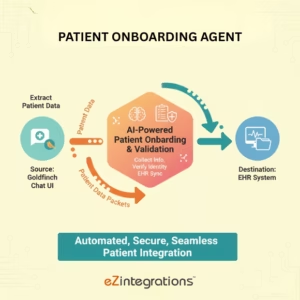
Patient Onboarding Agent
 $0.00
Download
$0.00
Download
-
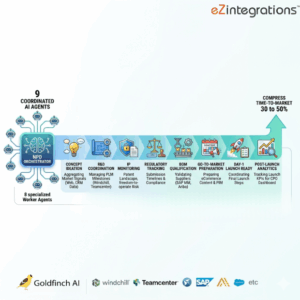
How to Automate New Product Development Using Multi-Agent AI Stage-Gate Orchestration
 $150.00
Download
$150.00
Download
-
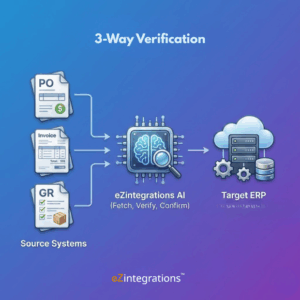
How to Automate 3-Way Invoice Verification Using AI
 $0.00
Download
$0.00
Download
-
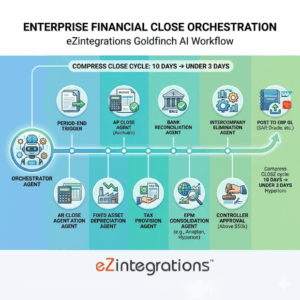
How to Automate Enterprise Financial Close Using Multi-Agent AI Orchestration
 $150.00
Download
$150.00
Download