How to Automate Enterprise M&A Due Diligence Using Multi-Agent AI Systems
$150.00
| System Name: |
Enterprise M&A Due Diligence System |
|---|---|
| Architecture: |
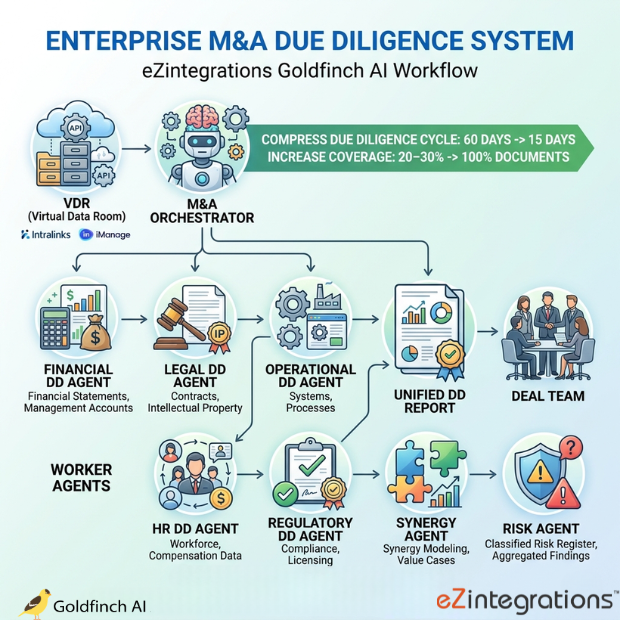
Hierarchical Multi-Agent System – 1 M&A Orchestrator (Coordinator) + 7 specialized Worker Agents (Financial DD; Legal DD; Operational DD; HR DD; Regulatory DD; Synergy; Risk) operating through parallel workstream execution; shared M&A vector knowledge base memory; and human-in-the-loop review gates for material findings and deal recommendation; 8 total agents |
| Coordinator Agent: |
M&A Orchestrator – maintains the master due diligence work plan and document review pipeline across all 7 Worker Agents; decomposes the deal’s due diligence scope into domain-specific sub-tasks; routes documents from the VDR (Intralinks or iManage) to the appropriate domain agent; manages parallel workstream execution (Financial; Legal; Operational; HR; and Regulatory agents run simultaneously on their assigned document domains); aggregates all domain findings into the unified DD report; and routes material risk flags and deal-breaker candidates to the Deal Team and General Counsel for human review |
| Extensibility Note: |
Beyond the 9 native Goldfinch AI tools; users can add custom tools self-service – including specialized financial model APIs (Refinitiv; Capital IQ for comparable company data); ESG and sustainability scoring APIs for target assessment; real estate and property valuation APIs for asset-heavy targets; sanctions and denied party screening APIs (OFAC); and deal management platform connectors (DealRoom; Ansarada). |
| On-Premise Supported: |
Yes – eZintegrations connects to on-premises systems (iManage on-prem; on-premises document management systems; on-premises ERP financial data; and others) via IPSec Tunnel. eZintegrations is a browser-based; cloud-hosted platform and does not require any on-premises installation. |
| Tags: |
Goldfinch AI M&A diligence; M&A due diligence AI; multi-agent DD system; VDR AI analysis; financial due diligence AI; legal due diligence AI; M&A deal intelligence; synergy modeling AI agent; deal risk register AI; Intralinks AI agent; M&A document analysis AI; Goldfinch AI corporate development |
| AI Credits Required: |
Yes – Document Intelligence is the primary credit consumer in M&A DD, scaling with VDR document volume and page count. Large M&A deals with 50,000 to 100,000 VDR document pages will have substantially higher Document Intelligence credit consumption than smaller deals. Credit estimates below are based on typical mid-market M&A deal document volumes. |
| Safety Layer: |
Synergy Agent’s synergy case assumptions deviate materially from the Knowledge Base benchmark range – CFO review required before synergy figures are included in the deal model; Orchestrator cross-agent confidence falls below 0.75 on any aggregated finding. Max 3 retries before Deal Team escalation with full agent context. All HITL decisions logged with reviewer identity, finding classification, and timestamp for deal governance and regulatory documentation., Human-in-the-loop gate triggers when: any domain agent identifies a potential deal-breaker finding (change-of-control clause that voids a material customer contract, unquantified environmental liability, IP ownership dispute, regulatory approval uncertainty that could block the deal) – M&A Director and General Counsel review required before the finding is escalated to the Deal Committee; Risk Agent computes an aggregate deal risk score above the configured threshold – Deal Team principal review required before the deal recommendation report is finalized; |
| Worker Agents: |
Financial DD Agent: Extracts and analyzes the target company’s financial statements, management accounts, adjustments, and quality of earnings – identifying revenue recognition issues, working capital adjustments, off-balance-sheet liabilities, debt-like items, unusual accruals, and EBITDA bridge adjustments for the deal model; Legal DD Agent: Reviews contracts, agreements, IP assignments, litigation history, regulatory filings, and corporate structure documents from the VDR – identifying change-of-control provisions, material adverse change clauses, IP ownership ambiguities, pending litigation exposure, and contractual liabilities that affect deal valuation or completion, Operational DD Agent: Analyzes the target’s processes, technology systems, IT infrastructure, and operational complexity – identifying integration risk, technology debt, key person dependencies, customer concentration, and post-close operational synergy barriers; HR DD Agent: Reviews workforce data, compensation structures, employment agreements, benefit plan obligations, non-compete and retention arrangements, and organizational culture signals – identifying compensation normalization adjustments, workforce restructuring cost estimates, and people-related integration complexity; Regulatory DD Agent: Screens the target’s regulatory compliance history, licenses, permits, environmental obligations, sector-specific regulatory approvals (FDA, FCA, FCC, GDPR data protection status, antitrust notifications required), and any regulatory red flags that could block or delay deal completion, Synergy Agent: Models integration synergies across revenue and cost dimensions – retrieving the acquirer’s comparable transaction synergy benchmarks from the Knowledge Base, analyzing the target’s cost structure and revenue base for synergy potential, and computing the synergy case (conservative, base, and upside) for the Deal Team’s valuation model; Risk Agent: Aggregates and cross-references all domain findings from the other 6 Worker Agents – classifying each finding by risk severity (Deal Breaker, Material Risk, Manageable Risk, Information Request), computing the overall deal risk score, and generating the consolidated risk register for the M&A Director and General Counsel review |
| Goldfinch AI Native Tools Used: |
API Tool Call: Orchestrator retrieves documents from the VDR (Intralinks API or iManage API) and routes them to the appropriate domain agents; Financial DD Agent queries the target’s ERP financial data via API if data room access includes live system access; Synergy Agent queries the acquirer’s financial DW for comparable transaction synergy benchmarks; Risk Agent writes the consolidated risk register to the deal management system; Orchestrator delivers the unified DD report to the configured deal team distribution, Data Analysis: Financial DD Agent computes normalized EBITDA, quality of earnings adjustments, working capital peg, and debt-like item identification; Synergy Agent models synergy cases (conservative, base, upside) with confidence ranges; HR DD Agent computes workforce restructuring cost estimates and compensation normalization; Risk Agent computes the aggregate deal risk score and finding severity distribution; Regulatory DD Agent scores regulatory approval complexity and timeline risk; Operational DD Agent scores integration complexity and technology debt severity, Data Analytics with Charts/Graphs/Dashboards: Risk Agent generates the deal risk heat map (findings by domain and severity, deal-breaker flags, material risk items); Financial DD Agent generates the EBITDA bridge waterfall and quality of earnings adjustment summary; Synergy Agent generates the synergy bridge and integration timeline chart; M&A Orchestrator generates the executive DD summary dashboard for Deal Committee presentation Watcher Tools: M&A Orchestrator monitors the VDR document upload queue for new document additions – triggering the appropriate domain agent review within 4 hours of each new document batch upload; also monitors domain agent workstream completion status against the DD timeline milestones and flags approaching deadline workstreams that require additional document review resources, Document Intelligence: The primary tool across all 7 Worker Agents – extracting structured data from the thousands of unstructured documents in the VDR (Intralinks https://www.intralinks.com/ or iManage https://imanage.com/): financial statements, audit reports, management accounts, contracts, IP assignments, employment agreements, regulatory filings, environmental reports, IT system documentation, and organizational charts; each domain agent receives only the document set relevant to its workstream, extracted and structured for its analytical task, Integration Workflow as Tool: M&A Orchestrator calls pre-built sub-workflows – the deal-breaker escalation sub-workflow (routes findings to M&A Director and General Counsel with full document context and agent analysis), the DD report assembly sub-workflow (compiles all domain agent findings into the structured unified DD report), and the risk register write sub-workflow (writes the consolidated findings to the deal management system for tracking through to deal close), Knowledge Base Vector Search: All 9 agents share a persistent accounting knowledge base containing: chart of accounts with GL account definitions and materiality thresholds, reconciliation procedures per account type, prior period close notes and recurring adjusting entries, intercompany elimination matrices, tax provision methodology, and the organization’s accounting policies – each agent retrieves relevant context for its current close sub-process Data Analytics with Charts/Graphs/Dashboards: Consolidation Agent generates the consolidated trial balance dashboard; Variance Agent generates the variance explanation report with charts; Orchestrator generates the close progress dashboard (task completion percentage, open items by agent, approaching SLA alerts) for the Controller and CFO, Web Crawling: Regulatory DD Agent crawls public regulatory databases, enforcement action databases, court filing search systems (PACER https://pacer.uscourts.gov/ for US litigation, Companies House https://www.gov.uk/government/organisations/companies-house for UK filings), patent databases (USPTO https://www.uspto.gov/ for IP status verification), and sector-specific regulatory body databases (FDA warning letter database, FCA regulated entity register, GDPR supervisory authority enforcement records) to supplement the VDR document set with public record intelligence |
Table of Contents
| Planning: |
The M&A Orchestrator uses deal-scope decomposition – when a new deal is initiated; the Orchestrator ingests the deal scope document (target company name; deal type; sector; key DD focus areas; known risks; and timeline) and decomposes the DD workplan into domain-specific document review assignments and analytical tasks per Worker Agent. All 7 Worker Agents run in parallel from Day 1 – the Financial DD Agent; Legal DD Agent; Operational DD Agent; HR DD Agent; and Regulatory DD Agent simultaneously review their assigned document categories from the VDR. Schema-driven rules govern document routing per domain; LLM reasoning governs financial adjustment classification; legal risk assessment; synergy case modeling; and consolidated risk register narrative generation. |
|---|---|
| Messaging: |
All 8 agents communicate via structured DD finding messages – each Worker Agent publishes its findings as structured events (finding description; document reference; finding classification; recommended management inquiry; confidence score) to the M&A Orchestrator; which aggregates findings by severity across all domains. Deal-breaker findings from any agent trigger immediate HITL escalation to the M&A Director and General Counsel. All other findings accumulate in the M&A Knowledge Base for the Risk Agent’s cross-domain aggregation and the unified DD report. |
| Reflection: |
The M&A Orchestrator applies a reflection cycle when a finding from one domain has implications for another domain’s assessment – e.g. a Legal DD Agent finding of a change-of-control clause in a major customer contract is cross-referenced with the Financial DD Agent’s revenue analysis to compute the financial exposure of that legal risk. If the cross-domain confidence falls below 0.75; the Orchestrator re-queries the Knowledge Base for comparable precedent classifications before committing the finding severity. The Financial DD Agent applies an additional reflection cycle when quality of earnings adjustments are identified – retrieving the benchmark adjustment classification standards from the Knowledge Base before committing the normalized EBITDA figure. |
| Knowledge: |
All 8 agents share a persistent M&A deal knowledge base containing: deal scope and investment thesis parameters (populated at deal initiation); sector-specific valuation and DD benchmarks; comparable transaction terms and synergy achievement data (anonymized precedent library); regulatory approval timeline benchmarks per jurisdiction and sector; quality of earnings adjustment classification standards; DD finding severity classification rubrics; the acquirer’s integration playbook and synergy model assumptions; and prior DD findings from similar sector deals for precedent comparison. The KB is scoped per deal (each deal has its own isolated KB partition) and indexed by document type; DD domain; and finding classification. |
| Execution: |
All 7 Worker Agents run in parallel from Day 1 against their assigned VDR document domain – Document Intelligence extracts structured content from every document; Data Analysis classifies findings against the benchmark standards in the Knowledge Base; the Risk Agent aggregates findings from all 6 domain agents daily; the M&A Orchestrator delivers daily deal status updates and the final unified DD report on the timeline milestone dates. The DD report includes the executive summary for the Deal Committee; the detailed findings by domain; the consolidated risk register classified by severity; and the Synergy Agent’s integration case model – all generated from the document review outputs without deal team manual compilation. |
| Business Impact: |
PwC Deals research: M&A due diligence errors and missed risks contribute to 70% of deals failing to achieve their expected value. The average large corporate DD engagement deploys 50 to 200 analysts for 60 days at blended rates of $400 to $800 per analyst per day – a cost of $3M to $10M per deal in analyst fees alone before the acquirer’s internal deal team time is counted. The Goldfinch AI M&A diligence system compresses the DD timeline from 60 days to 15 days; reduces the analyst team requirement by 60 to 80%; and increases document coverage from the typical 20 to 30% of VDR documents reviewed by human analysts (due to time constraints) to 100% of uploaded documents reviewed by the AI agents. |
The Goldfinch AI M&A diligence system from eZintegrations deploys 8 coordinated AI agents – an M&A Orchestrator plus 7 specialized Worker Agents — to simultaneously analyze every document in the VDR (Intralinks or iManage) across financial, legal, operational, HR, regulatory, and synergy domains, producing a unified due diligence report with a classified risk register and synergy model in 15 days rather than 60, at 100% document coverage rather than the 20 to 30% achieved by time-constrained human analyst teams. eZintegrations is an enterprise automation platform covering iPaaS, AI Workflows, AI Agents, and Goldfinch AI agentic automation.
What Is Goldfinch AI M&A Diligence Automation?
Goldfinch AI M&A diligence automation is a hierarchical multi-agent system where an M&A Orchestrator routes VDR documents to 7 domain-specific Worker Agents running in parallel – the Financial DD Agent, Legal DD Agent, Operational DD Agent, HR DD Agent, Regulatory DD Agent, Synergy Agent, and Risk Agent – each analyzing its assigned document domain using Goldfinch AI Document Intelligence and classifying findings against the deal’s Knowledge Base benchmark standards. Unlike traditional DD where time-constrained analysts review 20 to 30% of VDR documents across sequential workstreams, the Goldfinch AI M&A diligence system reviews 100% of uploaded documents simultaneously across all domains, cross-references findings across workstreams, and delivers a deal-ready report in 15 days.
How Does Goldfinch AI M&A Diligence Automation Use 8 Agents to Analyze VDR Documents Across Financial, Legal, Operational, HR, and Regulatory Domains and Compress Due Diligence from 60 to 15 Days?
The M&A Orchestrator retrieves documents from the VDR via API Tool Call and routes them to domain agents via Goldfinch AI Document Intelligence. All 7 Worker Agents run in parallel – Financial DD Agent analyzes financial statements and management accounts; Legal DD Agent reviews contracts and IP documents; Operational DD Agent assesses systems and processes; HR DD Agent reviews workforce and compensation data; Regulatory DD Agent screens compliance and licensing; Synergy Agent models synergy cases; Risk Agent aggregates all domain findings. The M&A Orchestrator compiles the unified DD report via Data Analytics.
Goldfinch AI ships with 9 native out-of-the-box agent tools. Users can add custom tools self-service beyond the 9 native tools. PwC Deals: 70% of deals fail to achieve expected value – due diligence errors are a primary contributor. This Goldfinch AI M&A diligence system compresses the review window, increases coverage to 100%, and surfaces cross-domain risk that sequential workstream-based DD teams consistently miss.
Watch Demo
| Video Title: |
Goldfinch AI M&A Due Diligence System | 8 Agents; 100% VDR Coverage; Financial to Risk Register in 15 Days |
|---|---|
| Duration: |
8 to 12 minutes |
Outcome & Benefits
| Autonomy: |
100% of VDR documents processed through Document Intelligence across all 7 domain agents (vs. 20 to 30% human analyst coverage under time pressure); financial statement analysis; contract review; and regulatory screening execute autonomously within configured scope; all deal-breaker finding candidates and the final deal recommendation require Deal Team and General Counsel HITL review before escalation |
|---|---|
| Time Saved: |
DD timeline from 60 days (traditional) to 15 days (Goldfinch AI parallel agent architecture); analyst team onboarding from 2 to 4 weeks (traditional DD team assembly) to 5 business days (Goldfinch AI deal configuration); DD report compilation from 5 to 10 analyst-days of manual aggregation to automated generation from agent findings; management inquiry list from 3 to 5 days to draft within hours of document batch review completion |
| Cost Reduction: |
60 to 80% reduction in external DD analyst cost (blended rate $400 to $800/analyst/day x 60 days x 50 to 200 analysts = $1.2M to $10M per deal); 100% VDR document coverage vs. 20 to 30% human coverage – each additional 10% of document coverage in M&A DD corresponds to approximately $500K to $2M in additional risk identified (PwC DD value research); deal execution velocity improvement: faster DD enables faster signing; reducing deal uncertainty window and competitive bid risk |
| Reliability: |
100% of uploaded VDR documents processed – zero documents reviewed on a sampling basis; all findings classified against consistent benchmark standards from the Knowledge Base (vs. analyst-by-analyst interpretation variance in traditional DD); deal-breaker screening applied to 100% of reviewed documents (change-of-control provisions; material adverse change clauses; IP ownership issues) rather than the subset reviewed by time-constrained human teams |
Performance Metrics
| KPI | Before (Traditional DD) | After (Goldfinch AI M&A Diligence) | Impact |
|---|---|---|---|
| DD Timeline | 60 business days | 15 business days | 75% faster |
| VDR Document Coverage | 20 to 30% (time-constrained) | 100% of uploaded documents | 3 to 5x coverage increase |
| External Analyst Cost | $1.2M to $10M per deal | 60 to 80% cost reduction | $720K to $8M saved per deal |
| Deal-Breaker Detection | Sampling-dependent | 100% document screening | Full coverage |
| DD Report Compilation | 5 to 10 analyst-days | Automated from agent findings | Full automation |
| Cross-Domain Risk Identification | Sequential (workstream silos) | Continuous cross-domain correlation | New capability |
Technical Details
| Planner Type: |
Deal-scope decomposition with parallel domain workstream execution and LLM-hybrid analysis – the M&A Orchestrator uses schema-driven document routing rules (financial statements route to Financial DD Agent; contracts route to Legal DD Agent; HR documents route to HR DD Agent) and LLM reasoning for financial adjustment classification, legal risk narrative, synergy case modeling, cross-domain risk correlation, and unified DD report narrative generation. |
|---|---|
| Scheduling: |
M&A Orchestrator activates immediately on deal initiation (deal scope document loaded and VDR access configured); all 7 Worker Agents activate simultaneously and run in parallel from Day 1 through DD timeline completion; Watcher Tools monitors the VDR document queue continuously (4-hour trigger for new document batches – new documents uploaded by the target’s management team are processed within 4 hours of upload); Risk Agent runs a daily consolidated findings aggregation and deal risk score computation; M&A Orchestrator delivers daily deal status updates to the M&A Director and weekly milestone reports to the Deal Committee; final unified DD report delivered on the configured DD completion milestone date. |
| Tool Router: |
The M&A Orchestrator routes each VDR document to the appropriate Worker Agent based on document type classification (financial statements, management accounts, audit reports → Financial DD Agent; contracts, IP documents, corporate filings → Legal DD Agent; IT system docs, process maps, customer contracts → Operational DD Agent; organizational charts, employment agreements, compensation data → HR DD Agent; regulatory filings, permits, environmental reports → Regulatory DD Agent). The Risk Agent receives structured findings from all 6 domain agents rather than raw documents. The Synergy Agent receives structured data from the Financial DD Agent and Operational DD Agent rather than processing VDR documents directly. Each Worker Agent uses Document Intelligence as its primary tool for all document processing; Data Analysis for analytical scoring; Knowledge Base for benchmark context; Web Crawling for supplementary public record verification (Legal DD and Regulatory DD Agents only). |
| Evaluation Metrics: |
VDR document coverage rate (% of uploaded documents processed across all domain agents); finding completeness rate (% of management inquiry items identified vs. resolved at deal close); deal-breaker detection recall (% of deal-breaker conditions identified before signing; validated post-close); DD timeline completion vs. target (days from deal initiation to unified DD report delivery); quality of earnings adjustment accuracy (QoE-identified adjustments confirmed by the target’s management or external auditor); synergy case accuracy (synergy achievement at 12/24 months post-close vs. pre-deal forecast); cross-domain finding correlation rate (% of findings that were strengthened by cross-domain evidence from another agent). |
| Auditability: |
Every agent action is logged with: agent name, document reference (VDR document ID and name), document type, finding generated, document excerpt reference, Data Analysis confidence score, Knowledge Base benchmark applied, finding classification (Deal Breaker/Material/Manageable/Information Request), HITL status (autonomous classification or Deal Team-reviewed), and timestamp. The M&A Orchestrator maintains a per-deal audit trail of all document reviews and findings from initiation through deal close or termination., The unified DD report includes full source references (document name, page, and paragraph) for every finding — enabling the Deal Team and external auditors to trace each finding to its source document. Attorney-client privilege: all agent findings and the unified DD report are scoped within the deal’s legal privilege framework (deal-specific single-tenant deployment; no cross-deal data sharing). Post-close, the deal audit trail supports integration planning and potential warranty and indemnity claim documentation. |
Connectivity and Deployment
| Supported Protocols: |
REST API (Intralinks VDR API; iManage API; DocuSign for signing workflows; deal management system APIs – DealRoom; Ansarada; Datasite); Web Crawling (PACER court filings; Companies House; USPTO patent database; FDA warning letters; FCA register; GDPR enforcement records; EPA enforcement database); SMTP (Deal Team finding notifications; daily deal status updates; Deal Committee milestone reports); HTTPS; OAuth 2.0; IPSec Tunnel (on-premises iManage; document management systems; and ERP financial data) |
|---|---|
| Security & Compliance: |
Attorney-client privilege protection (all deal content; agent findings; and DD reports are scoped within the deal’s legal privilege framework in a single-tenant isolated deployment – no cross-deal data sharing; no use for model training); SOC Type II certified; GDPR-compliant data handling for target company employee and customer data included in the DD document set (data minimization applied; DD data retained only for the deal period plus the configured post-close retention period); SOX-compliant financial data handling for public company targets (financial statement data processed under configured data access protocols). RBAC enforced per deal: Deal Team principals have full deal view; external legal counsel has Legal DD domain access only; financial advisors have Financial DD domain access only; deal access terminates on deal close or termination. Deal audit trail sealed post-close for warranty and indemnity claim documentation. |
| Tenancy Model: |
Single-tenant per deal is the mandatory deployment model for all M&A due diligence engagements. Each deal receives a fully isolated; dedicated infrastructure deployment with: deal-specific Knowledge Base partition isolated from all other deals; no cross-deal document sharing or model training on deal content; attorney-client privilege protection for all agent findings and communications within the deal scope; configurable data residency per deal jurisdiction. Multi-tenant is not available for M&A DD engagements due to strict legal confidentiality; privilege; and competitive sensitivity requirements. |
| On-Premise Supported: |
Yes – eZintegrations connects to on-premises systems (iManage on-prem; on-premises document management systems; on-premises ERP financial data; and others) via IPSec Tunnel. eZintegrations is a browser-based; cloud-hosted platform and does not require any on-premises installation. |
AI Credits
| Credit Consumption Model: |
Deal-scoped credit model – credits are consumed throughout the DD timeline as documents are uploaded to the VDR and processed by domain agents; daily Risk Agent aggregation; weekly Synergy Agent case updates; final unified DD report generation. Total deal credit cost scales with VDR document volume. Estimated Credits per Deal: Small M&A deal (1,000 to 5,000 VDR documents; mid-market target; 15-day DD timeline): ~8,000 to 25,000 credits per deal Mid-market deal (5,000 to 20,000 VDR documents; standard 6-domain DD scope): ~25,000 to 80,000 credits per deal Large deal (20,000 to 100,000 VDR documents; complex multi-jurisdiction; full DD scope): ~80,000 to 300,000 credits per deal |
|---|---|
| Retry / Reflection Credit Cost: |
Each M&A Orchestrator cross-domain reflection cycle: ~6 to 10 additional credits per retry. Financial DD Agent QoE adjustment reflection: ~5 to 8 additional credits per reflection cycle. At the typical M&A DD exception rate (15 to 20% of findings requiring additional reflection); add approximately 18 to 25% to the per-deal credit estimate. |
| Monthly Credit Estimate (at Typical Volume): |
1 mid-market deal active per month: ~25,000 to 80,000 credits per deal (total monthly credit consumption equals deal credit consumption) 3 to 5 concurrent deals (PE fund active deal portfolio): ~75,000 to 400,000 credits per month 10+ concurrent deals (large investment bank or active corporate development team): ~250,000 to 1,000,000+ credits per month (volume pricing recommended) |
| Pricing Model: |
Static Platform Fee + AI Credits. Platform fee covers unlimited non-LLM orchestration across all agents (VDR API connection management; document queue polling; SMTP notification dispatch; deal management system writes; audit log writes). AI Credits consumed only by Goldfinch AI tool invocations and LLM reasoning cycles. Note: due to the document-intensive nature of M&A DD; volume pricing for high-document-count deals is recommended – contact for deal-specific credit estimation. |
| AI Credits Required: |
Yes – Document Intelligence is the primary credit consumer in M&A DD, scaling with VDR document volume and page count. Large M&A deals with 50,000 to 100,000 VDR document pages will have substantially higher Document Intelligence credit consumption than smaller deals. Credit estimates below are based on typical mid-market M&A deal document volumes. |
| LLM Steps Count: |
20 to 40 LLM-invoking steps per daily DD cycle (M&A Orchestrator document routing and cross-domain aggregation: 3 to 5 steps; Financial DD Agent financial statement analysis: 4 to 8 steps; Legal DD Agent contract analysis: 4 to 8 steps; Risk Agent daily findings aggregation: 3 to 5 steps; Synergy Agent case modeling: 3 to 5 steps; reflection/retry cycles: 1 to 3 steps per retry) |
| Goldfinch AI Tool(s) Consuming Credits: |
Document Intelligence (all 7 domain Worker Agents – by far the highest credit consumer per deal; scales with VDR document page count), Data Analysis (Financial DD, Legal DD, Operational DD, HR DD, Regulatory DD, Synergy, Risk Agents – per analysis cycle), Knowledge Base Vector Search (all 8 agents – per document type and finding context query), API Tool Call (Orchestrator VDR document retrieval + deal management system write; Synergy Agent DW query), Data Analytics with Charts/Graphs/Dashboards (Risk Agent deal risk heat map; Financial DD EBITDA bridge; Synergy Agent synergy bridge;, Orchestrator executive DD summary dashboard), Web Crawling (Legal DD Agent public record verification; Regulatory DD Agent regulatory database screening), Watcher Tools (Orchestrator VDR document queue monitoring), Integration Workflow as Tool (Orchestrator deal-breaker escalation, DD report assembly, risk register write sub-workflows) |
| Per-Agent Credit Breakdown: |
HR DD Agent: 8 to 20 credits per document batch (Document Intelligence employment and compensation document extraction + workforce cost Data Analysis; Regulatory DD Agent: 10 to 25 credits per document batch (Document Intelligence regulatory filing extraction + Web Crawling regulatory database verification + compliance gap Data Analysis); Synergy Agent: 8 to 15 credits per synergy modeling cycle (Data Analysis synergy case computation – runs 3 times during DD timeline at key financial data milestones); Risk Agent: 5 to 12 credits per daily aggregation (cross-domain findings Data Analysis + deal risk score computation + Data Analytics risk heat map update), M&A Orchestrator: 4 to 8 credits per daily cycle (document routing + cross-domain aggregation + deal status update); Financial DD Agent: 15 to 40 credits per document batch (Document Intelligence financial statement extraction + QoE Data Analysis – scales with document count and financial statement complexity) Legal DD Agent: 20 to 50 credits per document batch (Document Intelligence contract extraction – contracts are high page-count documents – + legal risk Data Analysis + Web Crawling public record verification); Operational DD Agent: 10 to 25 credits per document batch (Document Intelligence IT and process document extraction + integration complexity Data Analysis) |
FAQ
1. What is the Enterprise M&A Due Diligence System and what does it automate end to end?
The Goldfinch AI M&A diligence system from eZintegrations deploys 8 coordinated AI agents - an M&A Orchestrator and 7 domain Worker Agents - to simultaneously analyze every document in the VDR (Intralinks or iManage) across financial (Financial DD Agent: QoE, EBITDA normalization, working capital), legal (Legal DD Agent: contracts, IP, litigation), operational (Operational DD Agent: IT systems, integration complexity), HR (HR DD Agent: workforce, compensation), regulatory (Regulatory DD Agent: compliance, licensing), synergy (Synergy Agent: integration case modeling), and risk (Risk Agent: cross-domain risk register and deal risk score) domains — producing a unified DD report with full source references in 15 days at 100% document coverage. PwC Deals: 70% of deals fail to achieve expected value, with DD errors as a primary contributor.
2. How does the multi-agent architecture work?
The M&A Orchestrator retrieves documents from the VDR via API Tool Call and routes each document to the appropriate domain agent based on document type classification. All 7 Worker Agents run in parallel from Day 1 - eliminating the sequential workstream approach of traditional DD that forces financial, legal, and operational teams to work in series rather than simultaneously. Each Worker Agent publishes its findings as structured events to the Orchestrator and the shared M&A Knowledge Base. The Risk Agent aggregates all domain findings daily, computing the cross-domain deal risk score and identifying findings that are strengthened or amplified by evidence from multiple domains.
3. Which Goldfinch AI tools does this system use?
The system uses 7 of Goldfinch AI's 9 native tools: Document Intelligence (all 7 Worker Agents - the primary tool for processing all VDR documents; scales with document volume), Knowledge Base Vector Search (all 8 agents — deal scope, benchmark standards, comparable transaction data, and precedent findings per domain), Data Analysis (all 7 Worker Agents - QoE adjustments, contract risk scoring, integration complexity, workforce cost estimation, regulatory exposure, synergy modeling, deal risk score computation), API Tool Call (Orchestrator VDR retrieval and deal management system write; Synergy Agent DW query), Data Analytics (Risk Agent deal risk heat map; Financial DD EBITDA bridge; Synergy Agent synergy bridge; Orchestrator DD summary dashboard), Watcher Tools (Orchestrator VDR document queue monitoring), Web Crawling (Legal DD Agent court and patent filings; Regulatory DD Agent regulatory database screening), and Integration Workflow as Tool (deal-breaker escalation, DD report assembly, risk register write sub-workflows). Users can add Capital IQ comparable company data, ESG scoring APIs, and OFAC screening self-service beyond the 9 native tools.
4. How does the system ensure data accuracy and handle errors?
The M&A Orchestrator applies a reflection cycle when a cross-domain finding creates analytical implications for another domain's assessment - if confidence falls below 0.75, it re-queries the Knowledge Base for comparable precedent classifications and retries up to 3 times before Deal Team escalation with an uncertain flag. The Financial DD Agent applies an additional reflection cycle on quality of earnings adjustments before committing the normalized EBITDA figure. All deal-breaker findings and the final deal recommendation require M&A Director and General Counsel HITL review before escalation. Every finding includes the source document reference (VDR document ID, page, and paragraph) for Deal Team verification.
5. What types of data and documents does this system process?
The system processes all document types typically found in an M&A VDR: financial statements, management accounts, audit reports, and quality of earnings workpapers (Financial DD Agent); customer contracts, supplier agreements, IP assignment records, employment agreements, corporate structure filings, and litigation documents (Legal DD Agent); IT system documentation, process maps, and operational KPI reports (Operational DD Agent); organizational charts, compensation data, benefit plan documents, and non-compete arrangements (HR DD Agent); regulatory filings, licenses, permits, environmental reports, and data protection records (Regulatory DD Agent); and public record supplements from PACER, USPTO, Companies House, FDA, and sector-specific regulatory databases (Legal DD and Regulatory DD Agents via Web Crawling).
6. Who uses this system and in which departments?
The primary users are the Corporate Development team (M&A Director, Deal Team principals - who configure the deal scope, monitor daily status updates, and review HITL escalations), the CFO and financial advisors (who review Financial DD Agent QoE findings and Synergy Agent modeling), the General Counsel and external legal counsel (who review Legal DD Agent contract and IP findings), and the CEO and Deal Committee (who receive the unified DD report and deal recommendation). Investment banks, private equity firms, and corporate development functions in manufacturing, healthcare, government, and retail are the primary deployment contexts.
7. How does the safety layer and human oversight work?
HITL gates trigger when: any domain agent identifies a potential deal-breaker finding - M&A Director and General Counsel review required before Deal Committee escalation; Risk Agent computes an aggregate deal risk score above the configured threshold - Deal Team principal review required before the deal recommendation report is finalized; Synergy Agent's case assumptions deviate materially from the Knowledge Base benchmark range - CFO review required before synergy figures are included in the deal model; Orchestrator confidence falls below 0.75. After 3 retries, the Deal Team is escalated with the full agent context and an uncertain flag. All HITL decisions are logged for deal governance documentation. The final deal recommendation always requires Deal Committee human approval.
8. What are the key business benefits and executive KPIs improved?
Key benefits include: DD timeline from 60 days to 15 days (75% faster), VDR document coverage from 20 to 30% (time-constrained human teams) to 100% of uploaded documents, external analyst cost reduction of 60 to 80% ($720K to $8M saved per deal), deal-breaker detection applied to 100% of documents (vs. sampling-dependent human review), cross-domain risk identification as a new capability (Legal DD finding cross-referenced with Financial DD revenue analysis for compound risk quantification), automated DD report compilation eliminating 5 to 10 analyst-days of manual aggregation, and PwC Deals: 70% of deals fail to achieve expected value from DD errors -q` comprehensive 100% document coverage materially reduces this risk.
Resources
| Blog: |
Agentic AI for Humanoid Robots: The Integration Layer Powering Next-Gen Autonomous Systems |
|---|---|
| Platform Overview: |
eZintegrations Platform – Enterprise iPaaS, AI Workflows & Agentic AI |
| Demo: |
Book a Demo |
| Goldfinch AI Platform: |
Agentic AI Platform — Goldfinch AI by eZintegrations |
Case Study
| Industry: |
Private Equity / Mid-Market PE Fund |
|---|---|
| ROI: |
External advisor fee savings: 3 deals x ($2.4M – $680K = $1.72M savings per deal) = $5.16M. Deal-breaker termination value: 1 deal terminated before closing based on agent-identified deal-breaker = estimated $8.4M loss avoided. Environmental indemnity protection: $1.6M protected. QoE improvement value: $2.0M in additional EBITDA adjustments identified ($6.8M vs. $4.8M prior-year baseline) at the fund’s standard 8x purchase price multiple = $16M in purchase price protection (adjustments negotiated into deal price reduction or representations). Total 8-month value: $31.16M. Deployment cost (3 deals): $385,000. Payback period: under 3 days per deal. |
| Outcome: |
$8.4M based on post-discovery valuation adjustment). Environmental liability detection: 1 environmental issue identified in Deal 3 (identified 18 days before signing – negotiated into indemnity holdback, estimated $1.6M protected). QoE adjustments identified: $6.8M in aggregate trailing EBITDA adjustments across 3 deals (vs. $4.8M in 3 prior-year deals from manual QoE process – 42% improvement in adjustment identification)., Average DD timeline from 52 business days (prior year average) to 14.2 business days (Deal 1: 15 days, Deal 2: 13 days, Deal 3: 14.6 days). VDR document coverage from 28% to 100% across all 3 deals. External advisor fees: average per-deal reduction from $2.4M to $680,000 (external legal counsel retained for HITL Legal DD review and negotiation; Big 4 QoE team reduced from full engagement to review-and-sign-off model; operational DD consultants eliminated for 2 of 3 deals). Change-of-control provision detection: agent identified 7 change-of-control provisions across the 3 deals (4 in Deal 1, 2 in Deal 2, 1 in Deal 3) – 6 were successfully negotiated in purchase agreement representations, 1 was a deal-breaker condition that resulted in deal termination (estimated loss from proceeding: |
| Solution: |
Deployed the eZintegrations Goldfinch AI M&A diligence system for 3 consecutive deal processes over 8 months. Each deal configured in 4 business days (deal scope document upload, VDR access configuration, Knowledge Base population with deal-specific parameters, agent domain assignment). Intralinks VDR API connected for each deal for document retrieval. Document Intelligence configured for 9 document type categories: financial statements, management accounts, audit reports, customer and supplier contracts, IP and technology agreements, employment agreements, regulatory filings, environmental records, and IT system documentation. Knowledge Base Vector Search populated with:, the fund’s sector-specific QoE adjustment standards (manufacturing sector benchmarks for 3 deals), comparable transaction terms from 14 prior fund investments, synergy achievement data from 12 prior integrations, regulatory approval timeline benchmarks for the target jurisdictions, and the fund’s integration playbook. Legal DD Agent Web Crawling configured for PACER (US litigation), USPTO (patent status), and relevant state regulatory databases. HITL: deal-breaker findings require Managing Partner and General Counsel review; Risk Agent aggregate risk score above 75th percentile threshold requires Investment Committee notification; Synergy Agent assumptions above 1.5 standard deviation from benchmark require CFO review. |
| Problem: |
2 instances of undisclosed change-of-control provisions in material customer contracts (discovered post-close after customer churn – combined impact estimated at $18M in lost revenue); 1 instance of an unquantified environmental liability (discovered during integration – $3.1M remediation cost); Multiple instances of management account normalization adjustments that were missed in the QoE process (aggregate overstatement of trailing EBITDA: $4.8M across 3 deals). The fund’s Managing Partners had identified that improving DD coverage was a higher-value investment than any single operational improvement post-close., A mid-market consumer goods distributor managed 42,000 active SKUs across 6 distribution centers. Replenishment was managed using fixed reorder points set quarterly by a team of 4 Inventory Planners – each managing approximately 10,500 SKUs. Fixed reorder points were based on 90-day average demand with a static 2-week safety stock multiplier; regardless of actual demand variability or supplier lead time performance. Inventory audit results: 24.8% of inventory value in excess stock (over-replenished slow-movers and seasonal items after peak). Stockout rate: 11.3% on high-velocity promotional SKUs. Each Inventory Planner spent an average of 16 hours per week on manual replenishment review; ERP reorder point adjustment; and purchase requisition creation. |