How to Automate Employee Lifecycle Management Using Multi-Agent AI Systems
$150.00
| System Name: |
Agentic HR Lifecycle Management System |
|---|---|
| Architecture: |
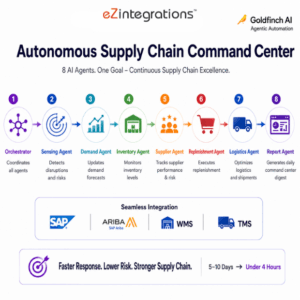
Hierarchical Multi-Agent System – 1 HR Lifecycle Orchestrator (Coordinator) + 8 specialized Worker Agents (Recruiter; Onboarding; Development; Retention; Payroll; Compliance; Offboarding; Analytics) operating through event-driven lifecycle stage transitions; shared HR vector knowledge base; and GDPR/SOX-compliant human-in-the-loop approval gates; 9 total agents |
| Coordinator Agent: |
HR Lifecycle Orchestrator – monitors every employee’s lifecycle stage (candidate through alumni); decomposes the appropriate HR goal per stage transition (hire event; day-1; development cycle; risk signal; payroll change; compliance deadline; departure event); routes the task to the correct Worker Agent; manages cross-agent dependencies (Onboarding Agent cannot provision access until Recruiter Agent confirms offer acceptance in Workday); and assembles the workforce health dashboard across all 8 Worker Agent outputs |
| Safety Layer: |
Human-in-the-loop gate triggers when: Recruiter Agent shortlists a candidate for final-round interview – Hiring Manager must confirm shortlist before SMTP engagement is sent; Retention Agent classifies an employee as Critical churn risk – HR Business Partner review required before intervention message is sent; Payroll Agent detects a salary change above the configured autonomous authority threshold (default $10,000 annual); Offboarding Agent receives a termination event – HR Director confirmation required before Okta access is revoked; Orchestrator confidence falls below 0.75 on any cross-agent lifecycle decision. Max 3 retries before escalation to CHRO with full agent context. All HITL decisions logged with reviewer identity and timestamp for GDPR compliance audit. |
| Extensibility Note: |
Beyond the 9 native Goldfinch AI tools; users can add custom tools self-service – including equity plan management connectors (Carta; Morgan Stanley); relocation management APIs; employee survey platforms (Qualtrics; Culture Amp); background check providers (Sterling; HireRight); and pension/benefits administration systems. |
| On-Premise Supported: |
Yes – eZintegrations connects to on-premises systems (SAP HCM on-prem; Oracle HCM Cloud; PeopleSoft HCM on-prem; ADP Workforce Now on-prem; and others) via IPSec Tunnel. eZintegrations is a browser-based; cloud-hosted platform and does not require any on-premises software installation. |
| Tags: |
Goldfinch AI HR lifecycle; HR lifecycle automation AI; multi-agent HR system; Workday AI agent; employee lifecycle AI; onboarding automation AI; HR churn risk AI; payroll automation agent; compliance monitoring AI; offboarding automation AI; Goldfinch AI CHRO; people analytics AI dashboard |
| AI Credits Required: |
Yes – Goldfinch AI agentic systems consume credits across all 9 agents per lifecycle event, per tool invocation, per employee profile analysis, and per reflection/retry loop. |
| Worker Agents: |
Offboarding Agent: Coordinates the full departure sequence – revoking Okta access, processing the Workday termination, transferring ADP payroll to final pay processing, archiving the employee’s documents, routing the exit interview, and managing the structured knowledge transfer to the team; Analytics Agent: Compiles the workforce health dashboard from all 8 Worker Agent outputs – headcount, time-to-fill, onboarding completion rate, development plan adherence, churn risk distribution, payroll exception rate, compliance violation rate, and turnover – delivering the CHRO’s weekly People Analytics brief, Recruiter Agent: Sources candidates from configured job boards and ATS (Greenhouse), screens applications against the role requirements in the HR Knowledge Base, engages shortlisted candidates via SMTP sequences, and logs disposition decisions in Greenhouse and Workday; Onboarding Agent: Coordinates Day-1 readiness across HR, IT, and Payroll – triggering Okta identity provisioning, ADP payroll enrollment, Workday HRIS record creation, equipment ordering, and the Day-1 task checklist delivery to the new employee and their manager; Development Agent: Retrieves the employee’s role, tenure, performance history, and career path aspirations from Workday – matching against the LMS course library and career progression framework in the HR Knowledge Base to deliver a personalized development plan and training recommendations, Retention Agent: Monitors employee churn risk signals (engagement survey scores, voluntary overtime trends, manager feedback, peer comparison, compensation gap vs. market) from the HR DW – classifying churn risk severity and triggering HR Business Partner intervention when the risk threshold is crossed; Payroll Agent: Monitors Workday for payroll change events (salary adjustments, role changes, benefit enrollments, terminations) and coordinates the corresponding ADP Payroll update, validating that the payroll change is accurately reflected in the next pay cycle before the processing deadline; Compliance Agent: Monitors employee certification expiry dates, mandatory training completion deadlines, regulatory requirement changes (GDPR, OSHA, SOX separation of duties), and labor law compliance triggers – alerting employees and managers before deadlines are missed and escalating unresolved items to the HR Director |
| Goldfinch AI Native Tools Used: |
API Tool Call: All 8 Worker Agents use API Tool Call across their system targets – Recruiter Agent (Greenhouse ATS API, Workday candidate record), Onboarding Agent (Workday HRIS employee record creation, Okta user provisioning API, ADP Payroll new hire enrollment), Development Agent (Workday performance and career data, LMS API course enrollment), Retention Agent (HR DW churn signal query, Workday engagement data), Payroll Agent (Workday payroll change event, ADP Payroll update API), Compliance Agent (Workday certification data, regulatory requirement database), Offboarding Agent (Okta access revocation, Workday termination processing, ADP final pay trigger), Analytics Agent (Snowflake DW KPI aggregation), Document Intelligence: Recruiter Agent analyzes candidate CVs and application documents – extracting structured profile data (skills, experience, qualifications, tenure) for knowledge base comparison; Offboarding Agent analyzes employment contracts and confidentiality agreements to identify knowledge transfer obligations before the departure date; Data Analytics with Charts/Graphs/Dashboards: Analytics Agent generates the weekly CHRO workforce health dashboard – headcount trend, time-to-fill by department, onboarding NPS, development plan completion, churn risk heatmap by function, payroll exception rate, compliance posture, and turnover vs. industry benchmark, Integration Workflow as Tool: Orchestrator and Worker Agents call pre-built sub-workflows – Onboarding Agent (Day-1 provisioning sub-workflow coordinating Okta + ADP + Workday + IT equipment request), Payroll Agent (ADP payroll change submission sub-workflow), Offboarding Agent (full departure sequence sub-workflow), and Analytics Agent (Snowflake DW aggregation and CHRO digest delivery sub-workflow); Web Crawling: Compliance Agent crawls regulatory body websites (OSHA, EEOC, GDPR supervisory authority publications, local labor law databases) for new regulatory requirements and deadline changes – ensuring the compliance monitoring framework reflects current obligations without manual HR Operations research, Knowledge Base Vector Search: All 9 agents share a persistent HR vector knowledge base containing: job role requirements and competency frameworks, onboarding checklists per role type, career progression paths, training course library metadata, compensation band benchmarks, churn risk intervention playbooks, compliance requirement matrices per jurisdiction, exit interview frameworks, and prior lifecycle event outcomes – each agent retrieves context relevant to the current employee’s stage and profile; Data Analysis: Retention Agent computes churn risk scores from multi-signal HR data; Analytics Agent runs workforce health KPI calculations; Payroll Agent validates payroll change amounts against compensation band policy; Compliance Agent scores regulatory exposure by jurisdiction and employee population; Recruiter Agent scores candidate fit against role requirements, Watcher Tools: HR Lifecycle Orchestrator monitors Workday for all lifecycle trigger events (new hire confirmed, offer accepted, performance review submitted, voluntary resignation submitted, termination approved, certification expiry approaching, payroll change event) – triggering the appropriate Worker Agent within 60 minutes of each event |
Table of Contents
| Planning: |
The HR Lifecycle Orchestrator uses event-driven goal decomposition – when a lifecycle event fires in Workday (new hire confirmed; resignation submitted; certification expiring); the Orchestrator decomposes the appropriate goal for that lifecycle stage (Day-1 readiness; departure sequence; compliance remediation) into sub-tasks and routes to the relevant Worker Agents. Schema-driven rules govern the execution sequence for operational tasks (Okta provisioning before LMS enrollment; payroll confirmed before equipment ordered); LLM reasoning governs churn risk intervention content; development plan personalization; and cross-agent lifecycle conflict resolution. |
|---|---|
| Messaging: |
All 9 agents communicate via structured lifecycle event messages – each Worker Agent publishes its outcome as a structured event (e.g. “Onboarding Agent: Day-1 provisioning complete; Okta account active; ADP enrollment confirmed; equipment order placed; Day-1 checklist delivered to manager”) that the Orchestrator validates before marking the lifecycle stage complete and triggering the next downstream agent. The Orchestrator blocks downstream agents when upstream dependencies are unresolved. |
| Reflection: |
Before any cross-system write action (Okta provisioning; ADP payroll change; Workday termination); the Orchestrator applies a reflection check – if confidence falls below 0.75; the agent re-queries the Knowledge Base for the relevant policy or procedural requirement; confirms the upstream event data; and retries up to 3 times before escalating to the HR Director. The Retention Agent applies an additional reflection cycle when a churn risk score is at the boundary between Medium and Critical thresholds – retrieving additional data signals before committing the severity classification. |
| Knowledge: |
All 9 agents share a persistent HR vector knowledge base containing: job role requirements and competency frameworks; onboarding checklists per role type and seniority level; career progression paths; training course library metadata; compensation band benchmarks; churn risk intervention playbooks per risk type (compensation; engagement; career; manager relationship); compliance requirement matrices per jurisdiction; exit interview frameworks; and prior lifecycle event outcomes. The KB is indexed by employee role; seniority; department; location; and lifecycle stage – each agent retrieves only the context relevant to the current employee’s situation. |
| Execution: |
Recruiter Agent posts and monitors job listings; screens CVs via Document Intelligence; and engages shortlisted candidates after Hiring Manager HITL confirmation. Onboarding Agent executes the full Day-1 provisioning sequence via Integration Workflow as Tool (Workday record; Okta identity; ADP enrollment; equipment request; manager checklist). Development Agent enrolls the employee in LMS courses via API Tool Call. Retention Agent sends the HR Business Partner a structured intervention brief when churn risk is Critical. Payroll Agent submits ADP change requests via Integration Workflow as Tool. Offboarding Agent executes the departure sequence (Okta revocation; Workday termination; ADP final pay) after HR Director HITL confirmation. |
| Business Impact: |
Deloitte Global HR Trends research: organizations automating end-to-end employee lifecycle management reduce HR cost per employee by 30% and improve time-to-productivity for new hires by 40%. The Goldfinch AI HR lifecycle system compresses onboarding from an average 3-week completion timeline to Day-1 readiness; detects churn risk 60 to 90 days earlier than manual manager observation; ensures 100% compliance monitoring coverage vs. the typical 60 to 70% achieved through manual HR Operations review; and delivers the CHRO a real-time workforce health dashboard vs. lagging monthly headcount reports. |
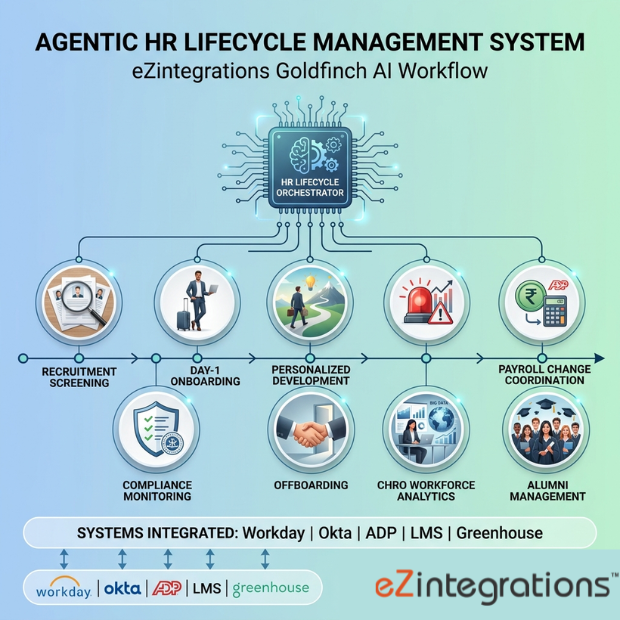
The Goldfinch AI HR lifecycle system from eZintegrations deploys 9 coordinated AI agents – an HR Lifecycle Orchestrator plus 8 Worker Agents – to autonomously manage every stage of the employee journey from candidate sourcing through alumni management: recruitment screening, Day-1 onboarding across Workday, Okta, and ADP, personalized development planning, churn risk detection and intervention, payroll change coordination, compliance monitoring, offboarding, and CHRO workforce analytics. eZintegrations is an enterprise automation platform covering iPaaS, AI Workflows, AI Agents, and Goldfinch AI agentic automation.
What Is Goldfinch AI HR Lifecycle Automation?
Goldfinch AI HR lifecycle automation is a hierarchical multi-agent system where an HR Lifecycle Orchestrator monitors every employee’s lifecycle stage and decomposes each stage transition into coordinated sub-tasks – routing recruitment events to the Recruiter Agent, hire confirmations to the Onboarding Agent, risk signals to the Retention Agent, payroll changes to the Payroll Agent, and departure events to the Offboarding Agent. Unlike HRIS platforms that record HR events for HR staff to act on, the Goldfinch AI HR lifecycle system autonomously executes the cross-system actions each lifecycle event requires – provisioning identities in Okta, enrolling employees in ADP, assigning LMS courses, and revoking access at offboarding – within configured authority limits and with full audit trail generation.
How Does Goldfinch AI HR Lifecycle Automation Orchestrate 9 Agents Across Workday, ADP, Okta, and Greenhouse from Recruitment to Alumni Management?
The Orchestrator monitors Workday via Goldfinch AI Watcher Tools for lifecycle events. The Recruiter Agent screens candidates via Document Intelligence. The Onboarding Agent coordinates Day-1 readiness via Integration Workflow as Tool across Workday, Okta, and ADP. The Development Agent retrieves LMS recommendations via Knowledge Base Vector Search. The Retention Agent scores churn risk via Data Analysis. The Payroll Agent submits ADP changes. The Compliance Agent monitors regulatory deadlines via Web Crawling. The Offboarding Agent executes the departure sequence. The Analytics Agent delivers the CHRO dashboard via Data Analytics.
Goldfinch AI ships with 9 native out-of-the-box agent tools. Users can add custom tools self-service beyond the 9 native tools. Deloitte: end-to-end HR lifecycle automation reduces HR cost per employee by 30%. This Goldfinch AI HR lifecycle system delivers that outcome across Workday, Greenhouse, Okta, ADP, and LMS without custom integration development.
Watch Demo
| Video Title: |
Goldfinch AI HR Lifecycle System | 9 Agents; Recruitment to Offboarding Across Workday; Okta; ADP; and Greenhouse |
|---|---|
| Duration: |
7 to 10 minutes |
Outcome & Benefits
| Autonomy: |
80%+ of employee lifecycle events handled autonomously within configured authority limits; Critical churn risk interventions; salary changes above $10,000; and all offboarding access revocations require HR Director or HR Business Partner confirmation; Day-1 provisioning STP rate: 88%+ for standard role types |
|---|---|
| Time Saved: |
Onboarding from average 3-week task completion to Day-1 readiness; churn risk detection from manager observation (typically 60 to 90 days after signals emerge) to automated scoring within 48 hours of signal; compliance deadline monitoring from manual HR Operations calendar review to continuous automated tracking; offboarding from 5 to 10-day manual deprovisioning checklist to same-day automated sequence |
| Cost Reduction: |
30% HR cost per employee reduction from lifecycle automation (Deloitte Global HR Trends); 40% improvement in new hire time-to-productivity from Day-1 readiness; cost avoidance from prevented employee churn (average cost to replace an employee: 50 to 200% of annual salary; depending on role – SHRM); compliance penalty avoidance from 100% monitored certification and regulatory deadlines |
| Reliability: |
100% of Workday lifecycle events monitored and routed; zero onboarding steps missed through automated Day-1 checklist execution; zero uncaught certification expiries through continuous Compliance Agent monitoring; 100% offboarding access revocation confirmed via Okta API response before Orchestrator marks the departure complete |
Performance Metrics
| KPI | Before | After | Impact |
|---|---|---|---|
| Onboarding Completion | 3-week average task window | Day-1 readiness (88%+ STP) | 40% faster time-to-productivity |
| Churn Risk Detection | 60 to 90 days (manager observation) | 48 hours (automated scoring) | 60 to 90 days earlier intervention |
| HR Cost per Employee | Baseline | 30% reduction (Deloitte) | Significant FTE reallocation |
| Compliance Coverage | 60 to 70% (manual review) | 100% (continuous monitoring) | Full regulatory coverage |
| Offboarding Duration | 5 to 10 business days | Same-day automated sequence | 95%+ faster, zero missed steps |
Technical Details
| Scheduling: |
HR Lifecycle Orchestrator monitors Workday continuously via Watcher Tools (60-minute polling for standard events; immediate trigger for Critical events – resignation; termination; Critical churn risk flag); Recruiter Agent runs on ATS event trigger (new application) and weekly talent pipeline review; Onboarding Agent triggers within 24 hours of offer acceptance confirmation; Development Agent runs quarterly on performance review submission; Retention Agent runs weekly on updated HR DW churn signals; Payroll Agent triggers on Workday payroll change event (prior to next payroll processing cutoff); Compliance Agent runs daily for certification expiry monitoring; Offboarding Agent triggers within 2 hours of Workday termination event; Analytics Agent runs weekly for CHRO dashboard and daily for HITL escalation summary. |
|---|---|
| Tool Router: |
The Orchestrator routes each lifecycle event to the appropriate Worker Agent(s) based on event type – hire confirmation triggers Onboarding Agent; resignation event triggers Retention Agent (intervention attempt if not past the point of no return) and Offboarding Agent in sequence; payroll change event triggers Payroll Agent; certification expiry warning triggers Compliance Agent; performance review submission triggers Development Agent. Each Worker Agent selects its tools based on task type: API Tool Call for HRIS/ATS/IAM/payroll reads and writes; Document Intelligence for document analysis; Data Analysis for scoring; Web Crawling for regulatory research; Integration Workflow as Tool for multi-system coordinated sub-workflows; Knowledge Base Vector Search for HR policy and procedure context. |
| Evaluation Metrics: |
Day-1 provisioning completion rate (all required systems active before employee’s first day); onboarding task completion rate and time; churn risk prediction accuracy (validated against subsequent 90-day voluntary departure data); payroll change processing accuracy (zero payroll errors per pay cycle); compliance coverage rate (certified employees with current certifications as % of required); offboarding completion rate (all access revoked; all systems updated; exit interview completed); CHRO dashboard freshness (hours since last full data refresh). |
| Auditability: |
Every agent action is logged with: agent name; trigger event (Workday event ID and timestamp); employee record ID (anonymized in GDPR-compliant jurisdictions per data minimization principle); tool invoked; data retrieved; decision made; confidence score; HITL status (autonomous or human-approved); system write confirmation (API response code or Workday document number); and completion timestamp. The HR Lifecycle Orchestrator assembles a per-employee lifecycle audit log covering all agent interactions throughout the employee’s tenure. GDPR-compliant data subject access requests are supported – the audit log exports the employee’s complete interaction record on request. Compliance and HR Operations access the audit dashboard via role-based access; CHRO has full portfolio view; HR Business Partners access only their assigned employees. |
| Planner Type: |
Event-driven goal decomposition with LLM-hybrid execution – the HR Lifecycle Orchestrator uses schema-driven rules for operational task sequencing (Okta must provision before LMS enrollment; Workday termination before ADP final pay trigger; Hiring Manager confirmation before candidate SMTP engagement) and LLM reasoning for personalization decisions (development plan content, churn intervention message personalization, candidate engagement sequences). |
| Agent Roles: |
Development Agent: API Tool Call (Workday performance and career data, LMS API), Knowledge Base Vector Search (career paths, training library); Retention Agent: API Tool Call (HR DW churn signal query, Workday engagement data), Data Analysis (churn risk scoring), Knowledge Base Vector Search (intervention playbooks); Payroll Agent: API Tool Call (Workday payroll change event), Integration Workflow as Tool (ADP payroll update sub-workflow), Knowledge Base Vector Search (compensation band policy); Compliance Agent: API Tool Call (Workday certification data), Web Crawling (OSHA, EEOC, GDPR supervisory authority sites), Data Analysis (regulatory exposure scoring), Knowledge Base Vector Search (compliance requirement matrices), HR Lifecycle Orchestrator (Coordinator): Workday lifecycle event monitoring, goal decomposition, cross-agent dependency enforcement, HITL escalation packaging, workforce dashboard assembly; Recruiter Agent: Document Intelligence (CV parsing), API Tool Call (Greenhouse ATS https://developers.greenhouse.io/harvest.html, Workday https://community.workday.com/sites/default/files/file-hosting/productionapi/index.html), Knowledge Base Vector Search (role requirements), Data Analysis (candidate fit scoring); Onboarding Agent: Integration Workflow as Tool (Day-1 sub-workflow), API Tool Call (Workday HRIS, Okta https://developer.okta.com/docs/reference/, ADP https://developers.adp.com/), Knowledge Base Vector Search (onboarding checklist per role type), Offboarding Agent: Integration Workflow as Tool (departure sequence sub-workflow), API Tool Call (Okta access revocation, Workday termination, ADP final pay trigger), Document Intelligence (contract and NDA obligation extraction), Knowledge Base Vector Search (exit interview framework); Analytics Agent: API Tool Call (Snowflake DW https://docs.snowflake.com/ KPI aggregation), Data Analytics with Charts/Graphs/Dashboards (CHRO workforce health dashboard), Knowledge Base Vector Search (benchmark comparison data) |
Connectivity and Deployment
| Supported Protocols: |
REST API (Workday HRIS; Greenhouse ATS; Okta IAM; ADP Payroll; LMS platforms – Cornerstone; SAP SuccessFactors Learning; Degreed); SMTP (candidate engagement; employee notifications; manager task assignments; CHRO digest delivery); JDBC (Snowflake DW HR analytics data); Web Crawling (OSHA; EEOC; GDPR supervisory authority sites; labor law databases); Microsoft Graph API (Microsoft Teams HR notifications and task assignments); HTTPS; OAuth 2.0; IPSec Tunnel (on-premises SAP HCM; Oracle HCM; PeopleSoft; ADP on-prem connectivity) |
|---|---|
| Security & Compliance: |
GDPR-compliant employee data handling (all personal data processed under GDPR Article 6 employment contract necessity and legitimate interest; data minimization applied per agent; data subject access request support built-in; data retention limits configurable per jurisdiction); SOC Type II certified; HIPAA-eligible configuration for healthcare HR operations; SOX separation of duties enforced – Payroll Agent cannot modify compensation without HR Director approval chain; Offboarding Agent cannot revoke access without confirmed Workday termination event and HR Director HITL confirmation. RBAC enforced at agent level: Recruiter Agent accesses only candidate data; Payroll Agent accesses only compensation and payroll data; all agents are scoped to the minimum data required for their task. Full immutable per-employee lifecycle audit log for employment law compliance and labor dispute documentation. |
| Tenancy Model: |
Both single-tenant and multi-tenant deployments are supported. Single-tenant is strongly recommended for all HR deployments – employee data (salary; performance; health status; resignation details; churn risk scores) is among the most sensitive personal data in the enterprise and is subject to GDPR; CCPA; and local labor law privacy obligations. Single-tenant provides dedicated infrastructure per customer with full data segregation. |
| On-Premise Supported: |
Yes – eZintegrations connects to on-premises systems (SAP HCM on-prem; Oracle HCM Cloud; PeopleSoft HCM on-prem; ADP Workforce Now on-prem; and others) via IPSec Tunnel. eZintegrations is a browser-based; cloud-hosted platform and does not require any on-premises software installation. |
AI Credits
| Credit Consumption Model: |
Event-driven per-employee lifecycle stage – credits consumed when a lifecycle event triggers a Worker Agent; weekly recurring credits for Retention Agent population scan and Analytics Agent dashboard; daily recurring credits for Compliance Agent monitoring; per-candidate credits for Recruiter Agent screening Estimated Credits per End-to-End Run: Per new hire lifecycle (recruitment through first 90-day development cycle): ~30 to 55 credits per hire Weekly operational cycle (Retention scan for 500 employees; Compliance monitoring; Analytics dashboard): ~80 to 160 credits per week Per offboarding event: ~15 to 25 credits per departure Per payroll change event: ~5 to 10 credits per event |
|---|---|
| Retry / Reflection Credit Cost: |
Each Orchestrator reflection/retry cycle: ~3 to 5 additional credits per retry per agent. At 10% exception rate across all lifecycle events; add approximately 12 to 18% to the monthly credit estimate. |
| Monthly Credit Estimate (at Typical Volume): |
500-employee organization (20 hires/month; 5 departures/month; weekly operations): ~3,500 to 6,500 credits per month 2,000-employee organization (80 hires/month; 20 departures/month; weekly operations): ~10,000 to 20,000 credits per month 10,000-employee organization (400 hires/month; 100 departures/month): ~45,000 to 85,000 credits per month |
| Pricing Model: |
Static Platform Fee + AI Credits. Platform fee covers unlimited non-LLM orchestration across all agents (Workday event monitoring; HRIS connection management; Okta webhook handling; ADP connection; SMTP delivery; audit log writes). AI Credits consumed only by Goldfinch AI tool invocations and LLM reasoning cycles. |
| Credit Optimization Notes: |
Configure Retention Agent population scan to run weekly (not daily) for Standard-risk employees; escalate to daily only for employees already classified as Medium or Critical risk – reduces Retention Agent weekly credits by 60 to 70% for large employee populations. Cache Knowledge Base role requirements and onboarding checklists per role type for 30 days (they change infrequently). Batch Compliance Agent Workday certification data queries across the entire employee population in a single API Tool Call rather than per-employee sequential queries. Configure Recruiter Agent Document Intelligence to process CV documents at the application screening stage only (not before the Hiring Manager confirms the role is actively open) – avoids credit spend on CVs for roles that are on hold. |
| AI Credits Required: |
Yes – Goldfinch AI agentic systems consume credits across all 9 agents per lifecycle event, per tool invocation, per employee profile analysis, and per reflection/retry loop. |
| LLM Steps Count: |
10 to 20 LLM-invoking steps per lifecycle event cycle (Orchestrator event classification and goal decomposition: 2 to 3 steps; each activated Worker Agent: 1 to 3 LLM steps; Retention Agent churn scoring: 3 to 5 steps; Analytics Agent dashboard generation: 2 to 3 steps; reflection/retry: 1 to 2 steps per retry) |
| Goldfinch AI Tool(s) Consuming Credits: |
Watcher Tools (Orchestrator – continuous Workday lifecycle event monitoring), API Tool Call (all 8 Worker Agents – per HRIS/ATS/IAM/payroll/LMS/DW call), Document Intelligence (Recruiter Agent CV analysis; Offboarding Agent contract extraction), Data Analysis (Retention Agent churn scoring; Analytics Agent KPI computation; Compliance Agent regulatory exposure; Recruiter Agent candidate fit), Knowledge Base Vector Search (all 9 agents – per query), Data Analytics with Charts/Graphs/Dashboards (Analytics Agent – weekly CHRO dashboard render), Integration Workflow as Tool (Onboarding, Payroll, Offboarding Agents – per coordinated sub-workflow), Web Crawling (Compliance Agent – per regulatory source crawled) |
| Per-Agent Credit Breakdown: |
HR Lifecycle Orchestrator: 3 to 5 credits per lifecycle event (event classification + goal decomposition + HITL packaging); Recruiter Agent: 6 to 12 credits per candidate (Document Intelligence CV parsing + candidate fit scoring + engagement sequence personalization); Onboarding Agent: 4 to 8 credits per new hire (Integration Workflow as Tool Day-1 sub-workflow + Knowledge Base onboarding checklist retrieval); Development Agent: 3 to 6 credits per development cycle (Workday performance data + Knowledge Base career path and LMS matching), Retention Agent: 5 to 10 credits per weekly scan (Data Analysis churn risk scoring across employee population + Knowledge Base intervention playbook retrieval for flagged employees); Payroll Agent: 2 to 4 credits per payroll change event (Workday change event + ADP submission validation) Compliance Agent: 3 to 6 credits per daily monitoring cycle (Workday certification data query + Web Crawling regulatory update check + Data Analysis exposure scoring); Offboarding Agent: 5 to 10 credits per departure (Integration Workflow as Tool departure sub-workflow + Document Intelligence contract obligation extraction + Knowledge Base exit framework); Analytics Agent: 4 to 8 credits per weekly report (Snowflake DW aggregation + Data Analytics dashboard render + CHRO digest delivery) |
FAQ
1. What is the Agentic HR Lifecycle Management System and what does it automate end to end?
The Goldfinch AI HR lifecycle system from eZintegrations deploys 9 coordinated AI agents — an HR Lifecycle Orchestrator and 8 Worker Agents — to autonomously manage the complete employee journey from candidate sourcing through alumni management. The system covers: CV screening and candidate engagement (Recruiter Agent), Day-1 provisioning across Workday, Okta, and ADP (Onboarding Agent), personalized development planning (Development Agent), churn risk scoring and intervention (Retention Agent), payroll change coordination (Payroll Agent), certification and regulatory compliance monitoring (Compliance Agent), departure sequence execution (Offboarding Agent), and CHRO workforce analytics (Analytics Agent). Deloitte: end-to-end HR lifecycle automation reduces HR cost per employee by 30%.
2. How does the multi-agent architecture work?
The HR Lifecycle Orchestrator monitors Workday via Goldfinch AI Watcher Tools for all lifecycle trigger events — hire confirmations, resignations, payroll changes, certification expiry warnings, termination approvals. When an event fires, the Orchestrator decomposes the appropriate goal for that lifecycle stage, enforces cross-agent dependencies (Hiring Manager confirmation before candidate engagement; Workday termination before Okta revocation), and routes the task to the relevant Worker Agent(s). All 9 agents share a persistent HR vector knowledge base for policy-consistent execution. Each Worker Agent publishes a structured completion event that the Orchestrator validates before marking the lifecycle stage complete.
3. Which Goldfinch AI tools does this system use?
The system uses all 8 applicable Goldfinch AI native tools: Watcher Tools (Orchestrator — Workday lifecycle event monitoring), API Tool Call (all 8 Worker Agents — Greenhouse, Workday, Okta, ADP, LMS, Snowflake DW reads and writes), Knowledge Base Vector Search (all 9 agents — HR policy, checklists, competency frameworks, compliance matrices), Document Intelligence (Recruiter Agent CV parsing; Offboarding Agent contract obligation extraction), Data Analysis (Retention Agent churn scoring; Compliance Agent exposure scoring; Recruiter Agent candidate fit; Analytics Agent KPI computation), Data Analytics with Charts/Graphs/Dashboards (Analytics Agent CHRO workforce dashboard), Integration Workflow as Tool (Onboarding Day-1 sub-workflow; Payroll ADP submission; Offboarding departure sequence), and Web Crawling (Compliance Agent regulatory source monitoring). Beyond these 9 native tools, users can add custom tools self-service — equity plan systems, survey platforms, background check providers, and pension administration connectors.
4. How does the system ensure data accuracy and handle errors?
The Orchestrator applies a reflection check before any cross-system write action — if confidence falls below 0.75, the agent re-queries the Knowledge Base for the relevant HR policy, confirms upstream event data, and retries up to 3 times before escalating to the HR Director. Cross-system writes are confirmed via API response codes before the Orchestrator marks the task complete. The Retention Agent applies an additional reflection cycle at the Medium-to-Critical churn risk boundary before committing the severity classification. All HITL decisions (Hiring Manager shortlist confirmation, HR Director offboarding authorization, HR Business Partner churn intervention) are logged with reviewer identity and timestamp for GDPR compliance audit.
5. What types of data and documents does this system process?
The system processes: Greenhouse ATS application and candidate data (Recruiter Agent), Workday HRIS employee records across all lifecycle stages, Okta identity and access provisioning data (Onboarding and Offboarding Agents), ADP Payroll compensation and enrollment data, LMS course completion and enrollment data (Development Agent), Snowflake DW HR analytics data (Analytics Agent), employee CVs and application documents (Recruiter Agent Document Intelligence), employment contracts and NDAs (Offboarding Agent Document Intelligence), certification expiry records (Compliance Agent), and regulatory publication updates from OSHA, EEOC, and GDPR supervisory authority websites (Compliance Agent Web Crawling).
6. Who uses this system and in which departments?
Daily operators include HR Business Partners (receive Retention Agent churn risk briefs and intervention guidance), Recruiters (review Recruiter Agent candidate shortlists and engagement sequences), Payroll Managers (receive Payroll Agent change confirmations), and IT Administrators (receive Onboarding and Offboarding Agent provisioning and revocation confirmations). Executive stakeholders — the CHRO, HR Director, and VP of People Analytics — receive the Analytics Agent weekly workforce health dashboard and HITL escalation requests. The CFO monitors HR cost per employee trends and FTE productivity metrics from the CHRO dashboard.
7. How does the safety layer and human oversight work?
HITL gates trigger when: Recruiter Agent shortlists a candidate for final-round interview — Hiring Manager must confirm before SMTP engagement is sent; Retention Agent classifies an employee as Critical churn risk — HR Business Partner review required before intervention message is sent; Payroll Agent detects a salary change above $10,000; Offboarding Agent receives a termination event — HR Director confirmation required before Okta access is revoked; Orchestrator confidence falls below 0.75. After 3 retries without resolution, the Orchestrator escalates to the CHRO with the full agent context briefing. Every HITL decision is logged with reviewer identity and timestamp for GDPR compliance audit.
8. What are the key business benefits and executive KPIs improved?
Key executive KPIs improved include: onboarding from 3-week average completion to Day-1 readiness (88%+ STP rate), churn risk detection 60 to 90 days earlier than manager observation (enabling intervention before the resignation conversation), 30% HR cost per employee reduction (Deloitte benchmark), 100% compliance monitoring coverage (vs. 60 to 70% manual), offboarding from 5 to 10 days to same-day automated sequence with zero missed access revocations, and the CHRO shifts from lagging monthly headcount reports to a real-time weekly workforce health dashboard across all 8 HR lifecycle domains.
Resources
| Blog: |
How to Automate Employee Onboarding: From Offer Letter to Day-One System Access |
|---|---|
| Platform Overview: |
eZintegrations Platform – Enterprise iPaaS, AI Workflows & Agentic AI |
| Demo: |
Book a Demo |
| Goldfinch AI Platform: |
Agentic AI Platform — Goldfinch AI by eZintegrations |
Case Study
| Industry: |
Financial Services / Global Asset Management Firm |
|---|---|
| ROI: |
High-performer churn avoidance: $3.92M (14 retained x $280,000 average replacement cost). Compliance lapse avoidance: 12 avoided lapses x estimated $45,000 average cost per regulatory lapse (remediation; reporting; legal review) = $540,000. HR staff productivity reallocation: 28 FTE-equivalent hours per week x $65/hour blended HR staff cost x 35 weeks (8-month period) = $637,000 in redeployed HR capacity value. Onboarding productivity improvement: 6 to 8 provisioning failures per month avoided x 4.5 days average lost productivity per failure x $210/day average employee cost = $326,000 annually (8-month: $217,000). Total 8-month |
| Problem: |
6 to 8 critical provisioning failures per month (employee started work with no system access or incorrect payroll enrollment). Churn – the firm lost 23 high-performing employees in the prior year who had shown detectable behavioral signals 60 to 90 days before resignation but had not been flagged to HR Business Partners until the resignation conversation. Average replacement cost per high-performer: $280,000. Total churn cost: $6.44M. Compliance – the firm operated across 14 regulatory jurisdictions with 4,200 mandatory certification requirements; HR Compliance Officers were manually tracking expiry dates in Excel, and 12 certification lapses had occurred in the prior year (2 with regulatory reporting consequences). Offboarding – average time to complete full system deprovisioning: 7.3 business days; 3 instances in the prior year where a departed employee’s Okta access had not been revoked within the required 24-hour window., A global asset management firm with 6,800 employees across 14 countries and $180B AUM operated its HR function with a team of 82 HR professionals (28 HR Business Partners, 18 Recruiters, 14 Payroll Analysts, 12 Compliance Officers, 10 HR Operations staff). The firm averaged 420 new hires per year, 180 voluntary departures, and 340 internal transfers. Key HR pain points: Onboarding – average time for all systems to be provisioned and new hire to be fully productive: 18 business days; |
| Solution: |
Deployed the eZintegrations Goldfinch AI HR lifecycle system in 19 business days across all 14 countries and all 8 HR lifecycle domains. Workday HRIS connected via REST API (all 6,800 employee records, all lifecycle event types). Greenhouse ATS connected via Harvest API for Recruiter Agent. Okta connected via Okta API for Onboarding and Offboarding Agents. ADP GlobalView connected via ADP API for Payroll Agent (14 country payroll configurations). Cornerstone LMS connected via REST API for Development Agent. Snowflake DW connected via JDBC for Retention Agent signal data and Analytics Agent. Knowledge Base Vector, Search loaded with: 14-country compliance requirement matrix (4,200 individual certification requirements, expiry rules, regulatory reporting obligations), job competency frameworks for 68 role families, onboarding checklists for 14 country configurations, career progression paths for all 68 role families, churn risk intervention playbooks per risk type (compensation gap, engagement decline, manager relationship, career stagnation, peer departure), exit interview frameworks, and compensation band benchmarks per country and role family. HITL authority matrix: salary changes above $15,000 annual require CHRO approval; Critical churn risk interventions require HR BP confirmation; all offboarding access revocations require HR Director confirmation and Workday termination event confirmation. |
| Outcome: |
After 8 months: Onboarding provisioning from 18 days to Day-1 for 91% of new hires (provisioning failure rate from 6 to 8 per month to 0.4 per month). Churn risk detection: Retention Agent flagged 31 employees as Critical risk across the 8-month period; HR Business Partners intervened in 28 cases; 19 of 28 were retained (68% retention rate on Critical-flagged employees vs. 0% retention for unflagged departures)., High-performer churn cost reduction estimated: 14 retained high-performers x $280,000 average replacement cost = $3.92M avoided. Compliance monitoring: 4,200 certification requirements monitored continuously; 0 certification lapses in 8 months (vs. 12 in prior year). Offboarding access revocation: average time from termination event to Okta revocation from 7.3 days to 1.8 hours; 0 instances of access not revoked within 24-hour window. HR staff reallocation: 82 HR staff reduced manual administrative task load by an estimated 35%, freeing approximately 28 FTE-equivalent hours per week across the HR function for strategic HRBP work. |