How to Automate Enterprise Financial Close Using Multi-Agent AI Orchestration
$150.00
| System Name: |
Enterprise Financial Close Orchestration |
|---|---|
| Architecture: |
Hierarchical Multi-Agent System – 1 Financial Close Orchestrator (Coordinator) + 8 specialized Worker Agents (AR Close; AP Close; Bank Reconciliation; Intercompany; Fixed Asset; Tax; Consolidation; Variance) operating through dependency-aware goal decomposition; event-based inter-agent sequencing; shared accounting vector knowledge base; and SOX-compliant human-in-the-loop review gates; 9 total agents |
| Coordinator Agent: |
Financial Close Orchestrator – maintains the master close calendar and task dependency graph; decomposes the period-end close goal into sequenced sub-tasks per Worker Agent; enforces upstream-downstream dependencies (e.g. AR Agent must complete before Intercompany Agent can run); monitors each agent’s completion status and SLA adherence; escalates anomalies and low-confidence adjustments to the Controller for human review; and assembles the automated audit trail across all 9 agents |
| Safety Layer: |
Human-in-the-loop gate triggers when: any journal entry exceeds the configured autonomous posting authority (default $50,000; configurable per entry type); Orchestrator confidence score falls below 0.75 on any cross-agent reconciliation decision; Variance Agent identifies a material unexplained variance above the configured threshold; Intercompany Agent detects an out-of-balance pair above the materiality limit; Tax Agent’s provision deviates more than 5% from the prior period estimate. At max retry (3 attempts); unresolved exceptions escalate to the Controller with the full agent context and recommended resolution. |
| Extensibility Note: |
Beyond the 9 native Goldfinch AI tools; users can add custom tools self-service – including payroll sub-ledger connectors; lease accounting engines (ASC 842/IFRS 16); revenue recognition automation (ASC 606); pension actuarial data feeds; and FX revaluation APIs. |
| On-Premise Supported: |
Yes – eZintegrations connects to on-premises systems (SAP FI/CO on-prem; Oracle EBS; Oracle Hyperion on-prem; Oracle EPM Cloud; MSSQL general ledger databases; and others) via IPSec Tunnel. eZintegrations is a browser-based; cloud-hosted platform and does not require any on-premises software installation. |
| Tags: |
Goldfinch AI financial close; financial close automation AI; multi-agent financial close; SAP FI close AI agent; financial close orchestration; month-end close AI; intercompany reconciliation AI; bank reconciliation AI agent; tax provision AI; EPM consolidation AI; variance analysis AI agent; close cycle compression AI |
| AI Credits Required: |
Yes – Goldfinch AI agentic systems consume credits across all 9 agents (Coordinator + 8 Worker Agents) per close cycle, per tool invocation, per journal entry approval routing, and per reflection/retry loop. |
| Worker Agents: |
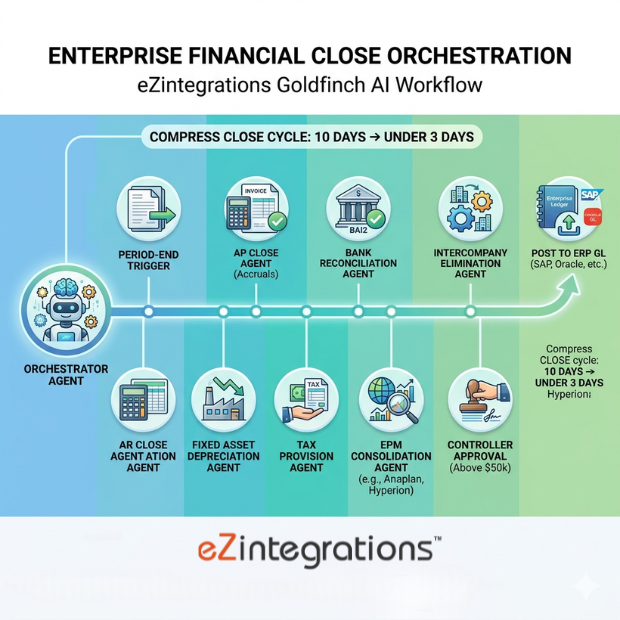
AR Close Agent: Clears open AR items, posts period-end reserves and provisions, and validates the AR subledger balance against the GL control account in SAP FI or Oracle GL – flagging unreconciled items for Controller review; AP Close Agent: Processes period-end accruals for received-but-not-invoiced items, clears GR/IR accounts, posts AP provisions, and validates the AP subledger against the GL – flagging items above the materiality threshold for Controller approval; Bank Reconciliation Agent: Matches BAI2 bank statement transactions against GL bank account entries, classifies matched and unmatched items, posts standard reconciling entries within authority, and presents the reconciliation exception list to the Controller, Consolidation Agent: Aggregates validated subledger data in the EPM system (Anaplan or Oracle Hyperion), applies elimination entries, and produces the consolidated trial balance – publishing it to the Variance Agent and the CFO reporting layer Variance Agent: Investigates and explains material account balance movements vs. prior period and budget – retrieving business context from the shared vector KB and flagging unexplained variances above the materiality threshold for Controller investigation, Intercompany Agent: Identifies and eliminates inter-entity transactions across all legal entities, reconciles intercompany receivables and payables, and flags out-of-balance intercompany pairs for resolution – with cross-entity context from the shared accounting KB; Fixed Asset Agent: Posts period-end depreciation entries for all asset classes, validates asset additions and disposals from the period, and confirms the fixed asset subledger balance against the GL; Tax Agent: Computes the tax provision using the configured tax engine (Thomson Reuters OneSource or Vertex), posts current and deferred tax journal entries, and delivers the tax provision summary to the Tax Director for review |
| Goldfinch AI Native Tools Used: |
API Tool Call: Used by all 8 Worker Agents – AR Close Agent (SAP FI AR subledger query and journal posting), AP Close Agent (SAP FI AP subledger query, GR/IR clearing, and accrual posting), Bank Reconciliation Agent (BAI2 bank API retrieval and GL bank account query), Intercompany Agent (multi-entity GL query and elimination entry posting), Fixed Asset Agent (asset register query and depreciation posting), Tax Agent (OneSource/Vertex API and tax journal posting), Consolidation Agent (EPM Anaplan/Hyperion API push and trial balance retrieval), Variance Agent (prior period and budget GL query via Snowflake DW) Document Intelligence: Bank Reconciliation Agent analyzes BAI2 bank statement files – parsing the structured transaction records into GL-comparable fields and interpreting bank narrative descriptions for matching; Tax Agent analyzes tax provision calculation documents and prior period tax workpapers for variance context, Data Analysis: AR Close Agent runs aged receivables analysis and reserve adequacy scoring; AP Close Agent computes accrual amounts from GR/IR aging data; Intercompany Agent identifies and quantifies intercompany imbalances; Variance Agent runs period-over-period and budget-vs-actual variance scoring; Orchestrator runs cross-agent dependency satisfaction scoring, Integration Workflow as Tool: Orchestrator and Worker Agents call pre-built close sub-workflows – including the Controller journal entry approval routing workflow (journals above $50K require Controller sign-off before posting), the EPM consolidation push sub-workflow (structured financial data submitted to Anaplan or Hyperion), the audit trail assembly sub-workflow (compiling per-agent action logs into the period-end audit package), and the CFO close status communication sub-workflow, Knowledge Base Vector Search: All 9 agents share a persistent accounting knowledge base containing: chart of accounts with GL account definitions and materiality thresholds, reconciliation procedures per account type, prior period close notes and recurring adjusting entries, intercompany elimination matrices, tax provision methodology, and the organization’s accounting policies – each agent retrieves relevant context for its current close sub-process Data Analytics with Charts/Graphs/Dashboards: Consolidation Agent generates the consolidated trial balance dashboard; Variance Agent generates the variance explanation report with charts; Orchestrator generates the close progress dashboard (task completion percentage, open items by agent, approaching SLA alerts) for the Controller and CFO, Watcher Tools: Orchestrator monitors the close calendar trigger (period-end date or manual initiation), tracks each Worker Agent’s task completion against SLA, and monitors the Controller journal entry approval queue – triggering escalation when SLAs approach without completion. Also monitors the BAI2 bank statement file arrival for the Bank Reconciliation Agent; Document Intelligence (dual use): Also used by the Variance Agent to analyze supporting documentation for unusual account movements – including vendor contract amendments, one-time settlement notices, board resolutions for special charges, and acquisition/divestiture accounting memos that explain period-specific variances |
Table of Contents
| Planning: |
The Financial Close Orchestrator uses dependency-aware goal decomposition – the Orchestrator maintains a master close task dependency graph (AR close must complete before intercompany elimination can run; all subledger closes must complete before Consolidation Agent can aggregate; Variance Agent runs after Consolidation to explain the consolidated results). Schema-driven rules govern the execution sequence; LLM reasoning governs cross-agent conflict resolution and variance investigation context retrieval. |
|---|---|
| Messaging: |
All 9 agents communicate via structured event messages – each Worker Agent publishes a completion event (e.g. “AR Close Agent: subledger closed; $4.2M in reserves posted; 3 items above materiality threshold flagged for Controller review”) that the Orchestrator validates against the dependency graph before routing the next downstream agent. Out-of-sequence attempts are blocked by the dependency gate. |
| Reflection: |
Before any journal entry posting; the Orchestrator applies a reflection check: if the Goldfinch AI Data Analysis confidence score is below 0.75; the agent re-queries the Knowledge Base Vector Search for relevant accounting policy or prior period precedent; recalculates the proposed entry; and retries up to 3 times. After 3 failed attempts; the entry is held in the Controller review queue. The Variance Agent triggers an additional reflection cycle when a material variance cannot be explained by business context from the KB – escalating to the Controller with the unresolved variance amount and all available evidence. |
| Knowledge: |
All 9 agents share a persistent accounting vector knowledge base containing: chart of accounts with GL account definitions and materiality thresholds; reconciliation procedures per account type; prior period close notes and recurring adjusting entries (from Document Intelligence extraction of prior period close workpapers); intercompany elimination matrices; tax provision methodology documentation; and the organization’s accounting policies. The KB is indexed by GL account; entity; period; and close sub-process – each agent retrieves the specific accounting context relevant to its current task. |
| Execution: |
Worker Agents execute their close sub-processes autonomously within configured authority limits – the AR Close Agent posts reserves; the AP Close Agent clears GR/IR; the Bank Reconciliation Agent posts standard reconciling entries; the Fixed Asset Agent posts depreciation; the Tax Agent posts the tax provision (after Tax Director review); and the Consolidation Agent pushes the validated trial balance to Anaplan or Hyperion. All journal postings above the $50,000 autonomous posting authority threshold are held for Controller approval via the Integration Workflow as Tool approval routing sub-workflow. |
| Business Impact: |
PwC research: 15 to 25% reduction in Finance close labor cost from AI-assisted close automation. Hackett Group: top-quartile close at 3 business days; average organization takes 10 days – the 7-day gap represents $1M+ in annual Finance labor cost and 7 fewer days of board reporting analysis time per period. The Goldfinch AI financial close system compresses the close cycle to under 3 days; eliminates manual reconciliation error risk; and generates the complete SOX-compliant audit trail automatically. |
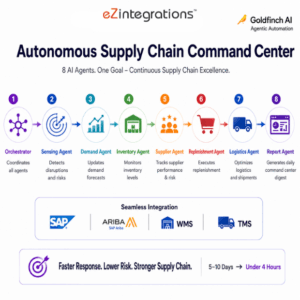
The Goldfinch AI financial close system from eZintegrations deploys 9 coordinated AI agents — a Financial Close Orchestrator plus 8 specialized Worker Agents — to autonomously execute every period-end close sub-process: AR and AP close, BAI2 bank reconciliation, intercompany elimination, fixed asset depreciation, tax provision, EPM consolidation, and variance analysis, all within a dependency-aware agentic architecture that compresses the close cycle from 10 days to under 3. eZintegrations is an enterprise automation platform covering iPaaS, AI Workflows, AI Agents, and Goldfinch AI agentic automation.
What Is Goldfinch AI Financial Close Automation?
Goldfinch AI financial close automation is a hierarchical multi-agent system where a Financial Close Orchestrator decomposes the period-end close goal into sequenced sub-tasks — enforcing upstream-downstream dependencies (AR subledger closes before intercompany elimination runs; all subledger agents complete before Consolidation aggregates) and routing each task to a specialized Worker Agent. Unlike close management platforms that create checklists for accountants to execute, the Goldfinch AI financial close system autonomously executes each sub-process within configured authority limits and posts journal entries directly to SAP FI or Oracle GL with Controller approval for entries above the $50,000 posting threshold.
How Does Goldfinch AI Financial Close Automation Orchestrate 9 Agents Across SAP FI, Oracle, EPM, and BAI2 to Compress the Close Cycle from 10 Days to Under 3 Days?
The Financial Close Orchestrator triggers at period-end, activates each Worker Agent in dependency order, and monitors completion against the close calendar. The AR Close Agent clears open items and posts reserves. The AP Close Agent processes accruals and clears GR/IR. The Bank Reconciliation Agent matches BAI2 statements against GL via Document Intelligence. The Intercompany Agent eliminates cross-entity transactions. The Fixed Asset Agent posts depreciation. The Tax Agent computes the provision via OneSource. The Consolidation Agent pushes to Anaplan or Hyperion. The Variance Agent investigates and explains material movements.
Goldfinch AI ships with 9 native out-of-the-box agent tools. Users can add custom tools self-service beyond the 9 native tools. Hackett Group: top-quartile close is 3 days; the average is 10 days. This Goldfinch AI financial close system closes that gap while generating the SOX-compliant audit trail automatically across all 9 agents.
Watch Demo
| Video Title: |
Goldfinch AI Financial Close System | 9 Agents; Period-End to Consolidated Trial Balance in Under 3 Days |
|---|---|
| Duration: |
7 to 10 minutes |
Outcome & Benefits
| Autonomy: |
85%+ of close tasks executed autonomously within configured authority limits; journal entries below $50,000 posted without Controller intervention; Tax Agent provision requires Tax Director review before posting; Variance Agent material unexplained variances route to Controller for investigation |
|---|---|
| Time Saved: |
Close cycle from 10 business days (average) to under 3 days (Hackett Group top-quartile benchmark); bank reconciliation from 3 to 5 days (manual; 22 bank accounts) to 1.8 hours (automated BAI2 matching); intercompany reconciliation from 4 to 5 days (manual; 28 entity pairs) to 1.4 hours |
| Cost Reduction: |
15 to 25% Finance close labor cost reduction (PwC research); 30% Finance FTE cost savings from cycle compression; $1M+ annual Finance labor cost at the 10-day-to-3-day close compression value (Hackett Group); audit fee reduction from eliminated manual reconciliation errors and auto-generated audit trail |
| Reliability: |
100% of close tasks tracked against SLA with escalation before breach; zero manual reconciliation steps unaccounted for in the audit trail; journal entry error rate reduced 95%+ from autonomous policy-compliant posting; 97%+ key term extraction accuracy from BAI2 and subledger documents |
Performance Metrics
| KPI | Before | After | Impact |
|---|---|---|---|
| Close Cycle | 10 business days (average) | Under 3 days | 70% compression |
| Bank Reconciliation | 3 to 5 days (manual) | 1.8 hours (automated) | 95%+ faster |
| Intercompany Reconciliation | 4 to 5 days (28 entity pairs) | 1.4 hours | 95%+ faster |
| Finance Close Labor Cost | Baseline | 15 to 25% reduction (PwC) | $1M+ annually |
| Post-Close Audit Adjustments | 2 to 3 per year average | Near-zero (automated accuracy) | Restatement risk eliminated |
| Board Analysis Window | 2 to 3 days post-close | 5 to 7 days post-close | 4 to 5 additional analysis days |
Technical Details
| Scheduling: |
Orchestrator triggers on period-end calendar event (configurable: calendar month-end; fiscal period-end; or manual Controller initiation); AR Close Agent activates first (no upstream dependencies); AP; Bank Reconciliation; Intercompany; Fixed Asset agents activate after AR close completes (parallel where possible); Tax Agent activates after AP close; Consolidation Agent activates after all subledger agents complete; Variance Agent activates after Consolidation Agent completes; Report/Audit trail assembly is the final Orchestrator step. |
|---|---|
| Tool Router: |
The Financial Close Orchestrator routes each task to the appropriate Worker Agent based on close task type and dependency readiness. Each Worker Agent selects its Goldfinch AI tools based on its task: API Tool Call for all ERP reads and journal writes; Document Intelligence for BAI2 files; prior period workpapers; and supporting documentation; Data Analysis for scoring; classification; and calculation; Knowledge Base Vector Search for accounting policy and procedure context; Data Analytics for dashboard and report generation; Integration Workflow as Tool for approval routing and EPM sub-workflows. |
| Evaluation Metrics: |
Close cycle time (trigger to consolidated trial balance); per-agent SLA adherence (task completion vs. target time); journal entry error rate (adjustments required post-posting); bank reconciliation match rate; intercompany reconciliation balance rate (% of entity pairs in balance on first run); variance explanation coverage (% of material variances explained by Variance Agent without Controller escalation); audit trail completeness (% of close actions with full agent log). |
| Auditability: |
Every agent action is logged with: agent name; task received; GL account(s) affected; journal entry amount and type; confidence score; approval status (autonomous or Controller-approved); ERP posting confirmation (journal document number); and timestamp. The Financial Close Orchestrator assembles the period-end audit trail package from all 9 agent logs – formatted per SOX 302/906 close process documentation requirements and exportable to Snowflake or the configured audit repository. External auditors access the audit trail package via the Goldfinch AI audit dashboard without requiring ERP access. Controller escalation events log the Controller’s identity; review decision; and the original agent recommendation for every HITL instance. |
| Planner Type: |
Dependency-aware schema-driven planning with LLM reasoning for exception handling – the Financial Close Orchestrator enforces a deterministic close task dependency graph (topology-sorted per close sub-process requirements) for execution sequencing; LLM reasoning is applied for cross-agent conflict resolution, variance investigation context retrieval, and journal entry policy interpretation when the schema alone does not resolve an ambiguous close situation. |
| Agent Roles: |
Consolidation Agent: API Tool Call (Anaplan https://help.anaplan.com/ or Oracle Hyperion https://docs.oracle.com/en/applications/enterprise-performance-management/ EPM API push), Data Analytics with Charts/Graphs/Dashboards (consolidated trial balance dashboard), Knowledge Base Vector Search (elimination entries and consolidation rules); Variance Agent: API Tool Call (Snowflake DW https://docs.snowflake.com/ prior period and budget GL data), Document Intelligence (supporting documentation analysis for unusual movements), Data Analysis (variance scoring and materiality classification), Data Analytics with Charts/Graphs/Dashboards (variance explanation report), Knowledge Base Vector Search (business context for account movements), Financial Close Orchestrator (Coordinator): close calendar management, dependency graph enforcement, cross-agent event routing, HITL escalation packaging, audit trail assembly; AR Close Agent: API Tool Call (SAP FI AR subledger), Data Analysis (reserve adequacy scoring), Knowledge Base Vector Search (AR aging and reserve policy); AP Close Agent: API Tool Call (SAP FI AP subledger, GR/IR clearing), Data Analysis (accrual amount computation), Knowledge Base Vector Search (AP close procedures); Bank Reconciliation Agent: Document Intelligence (BAI2 file parsing), API Tool Call (GL bank account query), Data Analysis (matched/unmatched item classification), Knowledge Base Vector Search (reconciliation exception policy), Intercompany Agent: API Tool Call (multi-entity GL query, Snowflake DW intercompany data), Data Analysis (imbalance identification and quantification), Knowledge Base Vector Search (elimination matrix); Fixed Asset Agent: API Tool Call (asset register query and depreciation posting via SAP FI https://help.sap.com/docs/SAP_S4HANA_ON-PREMISE), Knowledge Base Vector Search (asset class depreciation policy); Tax Agent: API Tool Call (Thomson Reuters OneSource https://tax.thomsonreuters.com/en/solutions/onesource or Vertex https://www.vertexinc.com/), Document Intelligence (prior period tax workpaper analysis), Knowledge Base Vector Search (tax provision methodology) |
Connectivity and Deployment
| Supported Protocols: |
OData v2/v4 (SAP FI and SAP CO journal posting and subledger query); Oracle REST API (Oracle GL and Oracle Financials); BAI2 (bank statement file parsing via Document Intelligence); REST API (Anaplan EPM; Oracle Hyperion/EPM Cloud; Thomson Reuters OneSource; Vertex tax; Snowflake DW); SMTP (Controller approval routing; CFO close status communications); HTTPS; OAuth 2.0; IPSec Tunnel (on-premises SAP FI; Oracle EBS; Oracle Hyperion; and MSSQL GL database connectivity) |
|---|---|
| Security & Compliance: |
SOX-compliant audit trail generated automatically across all 9 agents per close cycle (supporting SOX 302/906 close process certification); GDPR-compliant financial data handling (employee and customer financial data in subledger documents processed under GDPR Article 6 employment contract and legitimate interest; data minimization applied); SOC Type II certified; HIPAA-eligible configuration for healthcare financial close with patient-revenue-adjacent accounting. Journal entry segregation of duties enforced architecturally: Worker Agents prepare journal entries; the Controller approves entries above the $50,000 threshold; the Orchestrator posts only after confirmation – the system cannot post above-threshold entries without the documented approval chain. RBAC enforced on ERP posting scope; EPM data push authority; tax provision access (Tax Director and CFO only); and audit trail access. |
| Tenancy Model: |
Both single-tenant and multi-tenant deployments are supported. Single-tenant is strongly recommended for all financial close deployments – period-end financial data; journal entries; tax provision calculations; and audit trail records are subject to strict SOX; GDPR; and financial confidentiality requirements. Single-tenant provides dedicated infrastructure per customer with full data segregation. |
| On-Premise Supported: |
Yes – eZintegrations connects to on-premises systems (SAP FI/CO on-prem; Oracle EBS; Oracle Hyperion on-prem; Oracle EPM Cloud; MSSQL general ledger databases; and others) via IPSec Tunnel. eZintegrations is a browser-based; cloud-hosted platform and does not require any on-premises software installation. |
AI Credits
| Credit Consumption Model: |
Per close cycle (monthly cadence) – all 9 agents execute per period-end close; reflection/retry loops add credits at 10 to 15% overhead; bank account count; entity count; and transaction volume affect total credits per cycle Estimated Credits per End-to-End Run: Small enterprise close (single entity; 2 to 4 bank accounts; under 10,000 journal lines): ~200 to 350 credits per monthly close cycle Mid-market close (3 to 5 entities; 5 to 15 bank accounts; 10,000 to 100,000 journal lines): ~350 to 700 credits per close cycle Large enterprise close (10 to 20 entities; 15 to 50 bank accounts; 100,000+ journal lines): ~700 to 1,500 credits per close cycle |
|---|---|
| Retry / Reflection Credit Cost: |
Each Orchestrator reflection/retry cycle: ~6 to 8 additional credits per retry per agent. At 10% exception rate across all agents; add approximately 15 to 20% to the per-cycle credit estimate. |
| Monthly Credit Estimate (at Typical Volume): |
Small enterprise (monthly close): ~200 to 350 credits per month (one close cycle) Mid-market (monthly close + quarterly full consolidation): ~400 to 800 credits per month amortized Large enterprise (monthly close + quarterly + annual): ~800 to 2,000 credits per month amortized Note: the Goldfinch AI financial close system is the highest-value-per-credit use case in the catalog – credits are consumed once per close period rather than per transaction; making it one of the most credit-efficient agentic deployments relative to business impact |
| Pricing Model: |
Static Platform Fee + AI Credits. Platform fee covers unlimited non-LLM orchestration across all agents (ERP connection management; close calendar monitoring; SLA tracking; SMTP dispatch; audit log writes). AI Credits consumed by LLM reasoning; Goldfinch AI tool invocations; and Knowledge Base retrieval across all 9 agents. |
| Credit Optimization Notes: |
Run AR; AP; Bank Reconciliation; Intercompany; and Fixed Asset agents in parallel where dependencies allow (Orchestrator manages sequencing – after AR completes; AP + Bank + Fixed Asset can run simultaneously) – reduces total elapsed close time without increasing per-cycle credit cost. Cache Knowledge Base accounting policy retrievals for the full close cycle duration per agent (accounting policies do not change mid-close). Configure Bank Reconciliation Agent Document Intelligence to process BAI2 transaction records in batch (all bank accounts in a single processing call; not per-account) – reduces Document Intelligence credits 30 to 50% on multi-bank-account close environments. Pre-generate the Variance Agent’s prior period and budget comparison dataset in Snowflake DW before the close triggers – reduces API Tool Call credits for the Variance Agent’s data retrieval step. |
| AI Credits Required: |
Yes – Goldfinch AI agentic systems consume credits across all 9 agents (Coordinator + 8 Worker Agents) per close cycle, per tool invocation, per journal entry approval routing, and per reflection/retry loop. |
| LLM Steps Count: |
18 to 28 LLM-invoking steps per full close cycle (Orchestrator dependency planning: 3 to 4 LLM steps; each Worker Agent tool invocation: 1 to 2 steps per agent; cross-agent conflict resolution: 1 to 2 steps; Variance Agent investigation: 3 to 5 LLM steps; reflection/retry: 1 to 2 steps per retry; audit trail assembly: 2 to 3 steps) |
| Per-Agent Credit Breakdown: |
Financial Close Orchestrator: 6 to 10 credits per close cycle (dependency planning + cross-agent routing + audit trail assembly + HITL packaging); AR Close Agent: 4 to 8 credits per close cycle (API Tool Call subledger query + Data Analysis reserve scoring + Knowledge Base policy retrieval + journal posting); AP Close Agent: 4 to 8 credits per close cycle (API Tool Call GR/IR query + Data Analysis accrual computation + journal posting); Bank Reconciliation Agent: 6 to 12 credits per close cycle (Document Intelligence BAI2 parsing + API Tool Call GL query + Data Analysis matching + exception classification), Intercompany Agent: 4 to 8 credits per close cycle (API Tool Call multi-entity query + Data Analysis imbalance scoring + Knowledge Base elimination matrix retrieval); Fixed Asset Agent: 3 to 5 credits per close cycle (API Tool Call asset register query + depreciation posting); Tax Agent: 5 to 10 credits per close cycle (API Tool Call OneSource/Vertex + Document Intelligence prior period workpaper + Knowledge Base methodology retrieval); Consolidation Agent: 4 to 8 credits per close cycle (API Tool Call EPM push + Data Analytics trial balance dashboard), Variance Agent: 8 to 16 credits per close cycle (API Tool Call Snowflake DW + Document Intelligence supporting docs + Data Analysis variance scoring + Data Analytics variance report + Knowledge Base business context retrieval) |
| Goldfinch AI Tool(s) Consuming Credits: |
API Tool Call (all 8 Worker Agents – per ERP/EPM/tax/DW call), Document Intelligence (Bank Reconciliation Agent BAI2 parsing; Tax Agent workpaper analysis; Variance Agent supporting documentation), Data Analysis (AR, AP, Bank Reconciliation, Intercompany, Variance Agents and Orchestrator – per scoring cycle), Data Analytics with Charts/Graphs/Dashboards (Consolidation Agent trial balance dashboard; Variance Agent variance report – per render), Knowledge Base Vector Search (all 9 agents – per query), Integration Workflow as Tool (Orchestrator and Worker Agents – Controller approval routing, EPM push, audit trail assembly sub-workflows), Watcher Tools (Orchestrator – close calendar and SLA monitoring) |
FAQ
1. What is the Enterprise Financial Close Orchestration system and what does it automate end to end?
The Goldfinch AI financial close system from eZintegrations deploys 9 coordinated AI agents — a Financial Close Orchestrator and 8 Worker Agents — to autonomously execute every period-end close sub-process: AR close and reserve posting, AP accruals and GR/IR clearing, BAI2 bank reconciliation, intercompany elimination, fixed asset depreciation, tax provision computation (via OneSource or Vertex), EPM consolidation (Anaplan or Hyperion), and variance investigation and explanation. The system enforces close task dependencies, posts journal entries within configured authority limits, routes above-threshold entries to the Controller for approval, and generates the complete SOX-compliant audit trail automatically. Hackett Group benchmarks top-quartile close at 3 business days; the average organization takes 10 days.
2. How does the multi-agent architecture work?
The Financial Close Orchestrator maintains a master close task dependency graph — enforcing that AR Close completes before Intercompany elimination runs, and that all subledger agents complete before the Consolidation Agent aggregates. Each Worker Agent receives its task from the Orchestrator, executes its close sub-process using Goldfinch AI native tools, and publishes a structured completion event (including any flagged exceptions) back to the Orchestrator. The Orchestrator validates the completion event, activates the next downstream agent per the dependency graph, and monitors all agent SLAs — escalating before SLA breach rather than after. All 9 agents share a persistent accounting vector knowledge base for policy-consistent execution across the full close.
3. Which Goldfinch AI tools does this system use?
The system uses 7 of Goldfinch AI's 9 native tools: API Tool Call (all 8 Worker Agents for ERP/EPM/tax/DW reads and journal postings), Document Intelligence (Bank Reconciliation Agent for BAI2 file parsing; Tax Agent for prior period workpaper analysis; Variance Agent for supporting documentation analysis), Data Analysis (AR, AP, Bank Reconciliation, Intercompany, and Variance Agents for scoring, classification, and calculation), Knowledge Base Vector Search (all 9 agents for accounting policy and procedure context), Data Analytics with Charts/Graphs/Dashboards (Consolidation Agent for trial balance dashboard; Variance Agent for variance explanation report), Integration Workflow as Tool (Controller approval routing, EPM push, and audit trail assembly sub-workflows), and Watcher Tools (Orchestrator for close calendar trigger and SLA monitoring). Beyond these 9 native tools, users can add custom tools self-service — payroll connectors, lease accounting engines, revenue recognition automation, and FX revaluation APIs.
4. How does the system ensure data accuracy and handle errors?
The Orchestrator applies a reflection loop before any journal entry posting — if the Goldfinch AI Data Analysis confidence score is below 0.75, the agent re-queries the Knowledge Base for relevant accounting policy or prior period precedent, recalculates the proposed entry, and retries up to 3 times before escalating to the Controller. Journal entry segregation of duties is enforced architecturally: Worker Agents prepare entries, the Controller approves entries above $50,000, the Orchestrator posts only after approval confirmation — the system cannot post above-threshold entries without the documented approval chain. All ERP postings are confirmed via journal document number before the Orchestrator marks the task complete.
5. What types of data and documents does this system process?
The system processes: SAP FI and Oracle GL subledger data (AR aging, AP open items, GR/IR balances, asset register, intercompany account balances), BAI2 bank statement files (Document Intelligence parsing), EPM consolidation data (Anaplan or Hyperion API), tax provision inputs (OneSource or Vertex API), Snowflake DW prior period and budget GL data (Variance Agent), supporting documentation for unusual account movements (Document Intelligence — vendor contracts, board resolutions, settlement notices), and prior period close workpapers (Document Intelligence — Tax Agent and Variance Agent).
6. Who uses this system and in which departments?
Daily operators include the Controller, Accounting Manager, and Senior Accountant in Finance/Accounting. The Tax Director reviews and approves the Tax Agent's provision before posting. The CFO reviews the Consolidation Agent's trial balance and the Variance Agent's explanation report. The external audit team accesses the automatically generated audit trail package via the Goldfinch AI audit dashboard. The Board receives the financial results 4 to 5 days earlier per period from close cycle compression — a direct governance benefit.
7. How does the safety layer and human oversight work?
The HITL gate triggers when: any journal entry exceeds $50,000; Orchestrator confidence falls below 0.75; Variance Agent identifies a material unexplained variance; Intercompany Agent detects an out-of-balance pair above the materiality limit; or Tax Agent's provision deviates more than 5% from the prior period estimate. The Orchestrator packages the full agent briefing (proposed entry, supporting data, confidence score, and recommended action) and routes to the Controller via Teams and SMTP. All Controller decisions are logged with identity, timestamp, and rationale for the SOX audit trail. After 3 retries, all unresolved exceptions remain in the human review queue — the system never posts above-threshold entries without the documented approval chain.
8. What are the key business benefits and executive KPIs improved?
Key executive KPIs improved include: close cycle from 10 days to under 3 (70% compression), bank reconciliation from 3 to 5 days to 1.8 hours, intercompany reconciliation from 4 to 5 days to 1.4 hours, Finance close labor cost reduction of 15 to 25% (PwC research), Board analysis window extended 4 to 5 days per period, near-zero post-close audit adjustments from autonomous policy-compliant posting, and SOX-compliant audit trail generated automatically across all 9 agents — eliminating the 2 to 3-week manual audit package preparation that consumes senior Finance staff time each quarter.
Resources
| Blog: |
Agentic AI for Enterprise Integration: How Autonomous Systems Replace Manual Workflows |
|---|---|
| Platform Overview: |
eZintegrations Platform – Enterprise iPaaS, AI Workflows & Agentic AI |
| Demo: |
Book a Demo |
| Goldfinch AI Platform: |
Agentic AI Platform — Goldfinch AI by eZintegrations |
Case Study
| Industry: |
Healthcare / Regional Health System (Multi-Entity) |
|---|---|
| Outcome: |
After 4 close cycles: Average close cycle from 9.8 business days to 2.9 days. Bank reconciliation (22 accounts) from 4.1 days to 2.2 hours. Intercompany reconciliation (24 entity pairs) from 4.8 days to 1.6 hours with 97.1% straight-through balance rate. Tax provision posting from 2 days (manual calculation and journal creation) to 3.4 hours (OneSource API + agent journal preparation + Tax Director review and approval). CFO board materials available 5.4 days after period-end (from 1.8 days previously). Post-close audit adjustments: 0 in 4 close cycles (vs. 2 per year previously). External audit team accessed the Goldfinch AI auto-generated audit trail package – audit Senior Manager rated it as “more complete than any close package we have received from this client.” |
| ROI: |
Close cycle compression Finance labor savings: 18 Finance staff x (9.8 – 2.9 days) x 8 hours x $68/hour blended cost x 12 close cycles = $723,000 annually. Post-close audit adjustment avoidance: 2 avoided adjustments x $2.4M average impact per prior year event x external counsel and restatement cost: $380,000 annually. Board analysis window extension value: estimated $120,000 annually in avoided board revision cycles (5.4 days vs. 1.8 days available for analysis). Audit fee reduction from cleaner close package: estimated $95,000 annually. Total year-1 |
| Problem: |
The close process involved: manual AR reserve calculations reviewed in Excel, GR/IR clearing by AP Accountants across 3 legacy AP portals, 22 bank accounts reconciled manually from BAI2 files, 24 intercompany entity pair reconciliations conducted in Google Sheets, fixed asset depreciation run via SAP FI batch program (managed by IT), tax provision calculated in OneSource with manual journal entry creation, and Hyperion consolidation driven by Accounting Manager manual data uploads. In the prior fiscal year, 2 post-close audit adjustments were required (total restatement impact: $4.8M across two periods). The CFO’s board materials were prepared with only 1.8 days of analysis time after the close completed., The Finance function of a regional health system with 12 legal entities, $2.8B annual revenue, and $340M in annual non-patient AP spend operated its financial close across SAP FI with a close team of 18 Finance staff (4 Controllers, 8 Accountants, 4 FP&A analysts, 2 Tax Analysts). Monthly close cycle averaged 9.8 business days. |
| Solution: |
22 bank accounts connected via BAI2 file ingestion from the bank API. Snowflake DW connected for Variance Agent historical and budget data. Goldfinch AI Knowledge Base loaded with: chart of accounts (12-entity consolidated COA, 4,200 GL accounts), materiality thresholds per account category, reconciliation procedures for all 8 close sub-processes, intercompany elimination matrices for 24 entity pairs, tax provision methodology documentation, and 3 years of prior close notes and recurring adjusting entries (extracted via Document Intelligence from historical close workpapers). HITL authority threshold: $50,000 for journal entries. Controller review gate for: all intercompany entries above $200,000, all tax provision entries, all material variance exceptions above $500,000. SOX-compliant audit trail assembly configured for quarterly external audit package delivery., Deployed the eZintegrations Goldfinch AI financial close system in 16 business days for all 12 entities and all 8 close sub-processes. SAP FI connected via OData API (AR, AP, GR/IR, GL, Fixed Assets – all 12 entities). Oracle Hyperion connected via REST API for Consolidation Agent EPM push. Thomson Reuters OneSource connected via REST API for Tax Agent provision computation. |