How to Automate Customer Experience Management Using Multi-Agent AI Orchestration
$150.00
| System Name: |
Agentic Customer Experience Orchestration |
|---|---|
| Architecture: |
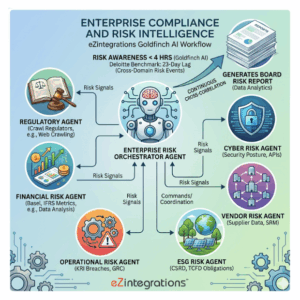
Hierarchical Multi-Agent System – 1 CX Orchestrator (Coordinator) + 7 specialized Worker Agents (Listening; Churn; Upsell; Service; Billing; NPS; CX Analytics) operating through unified customer 360 knowledge base memory; event-driven inter-agent touchpoint coordination; and human-in-the-loop review gates for high-value intervention actions; 8 total agents |
| Coordinator Agent: |
CX Orchestrator – maintains a unified view of each customer’s current experience state across all touchpoints; decomposes the customer success goal per customer segment and account tier; routes incoming signals to the appropriate Worker Agent; prevents cross-agent conflicts (Churn Agent intervention and Upsell Agent expansion outreach cannot be sent to the same customer simultaneously); and ensures consistent CX narrative across all 7 Worker Agents; assembles the customer health KPI dashboard from all agent outputs |
| Extensibility Note: |
Beyond the 9 native Goldfinch AI tools; users can add custom tools self-service – including customer data platform (CDP) connectors (Segment; Amplitude); voice of customer platforms (Medallia; Qualtrics); conversation intelligence tools (Gong; Chorus); loyalty program APIs; and e-commerce behavioral data feeds. |
| On-Premise Supported: |
Yes – eZintegrations connects to on-premises systems (Salesforce on-prem; SAP CRM on-prem; Oracle CX Cloud on-prem; on-premises helpdesk systems; and others) via IPSec Tunnel. eZintegrations is a browser-based; cloud-hosted platform and does not require any on-premises installation. |
| Tags: |
Goldfinch AI CX intelligence; customer experience AI orchestration; multi-agent CX platform; churn prevention AI agent; upsell automation AI; NPS analysis AI agent; Zendesk AI agent; Salesforce CX AI; billing dispute AI agent; customer sentiment AI; CSAT improvement AI; Goldfinch AI customer success |
| AI Credits Required: |
Yes – Goldfinch AI agentic systems consume credits across the CX Orchestrator and all 7 Worker Agents per customer signal processed, per document analyzed, per churn risk computation, and per reflection/retry loop. |
| Worker Agents: |
Billing Agent: Resolves billing disputes and exceptions – retrieving the customer’s contract terms and billing history, comparing the disputed charge against the entitlement, identifying billing errors, generating correction recommendations, and routing material billing disputes above the configured authority threshold to the Finance team for approval before any credit or adjustment is issued; NPS Agent: Analyzes incoming NPS survey responses – extracting the verbatim theme, classifying the feedback category (product, support, billing, onboarding, value perception), scoring the sentiment and urgency, routing Detractor responses to the CSM or Account team within 24 hours of survey completion, and aggregating Promoter and Passive themes for the Product team’s Voice of Customer feed, CX Analytics Agent: Compiles the customer health KPI dashboard from all 7 Worker Agent outputs – tracking CSAT, NPS trend, churn risk distribution by segment, upsell pipeline value identified by the Upsell Agent, support ticket resolution rate and time, billing exception rate, and customer lifetime value trend – delivering the weekly Chief Customer Officer (CCO) brief, Listening Agent: Monitors customer sentiment continuously across all configured channels – email (support and account team), live chat (Zendesk), social media (Twitter/X, LinkedIn, review platforms), and call recording transcripts – classifying sentiment by customer, account tier, product area, and urgency, and publishing sentiment signals to the Orchestrator for cross-agent routing; Churn Agent: Scores at-risk accounts using multi-signal churn risk analysis (usage trend, support ticket frequency and sentiment, NPS delta, billing status, engagement recency, competitive mention detection) – classifying risk severity and triggering the appropriate retention intervention per the Knowledge Base playbook, with HR Business Partner review for Critical-risk accounts (same architecture as HR; here: CSM or VP CS review gate), Upsell Agent: Identifies expansion and cross-sell opportunities from product usage patterns, account growth signals (headcount increase, new department mentions in CRM notes), and the customer’s contractual expansion terms – generating a personalized expansion recommendation for the Account Executive to act on, with an urgency score based on competitive pressure and contract renewal proximity; Service Agent: Resolves Tier-1 and Tier-2 support issues autonomously by retrieving relevant troubleshooting procedures from the Knowledge Base Vector Search – providing the customer with a specific resolution in Zendesk rather than a ticket acknowledgment, and escalating to the support team only when the Knowledge Base confidence is below the configured threshold or when the issue requires system access beyond the agent’s scope |
| Goldfinch AI Native Tools Used: |
API Tool Call: All 7 Worker Agents use API Tool Call – Listening Agent (Zendesk chat and email API, Salesforce CRM account data), Churn Agent (DW churn signal query, Salesforce health score update), Upsell Agent (Salesforce CRM opportunity creation, product usage data from DW), Service Agent (Zendesk ticket update and resolution, Knowledge Base retrieval confirmation), Billing Agent (ERP billing system contract terms and invoice history query, Zendesk billing ticket update), NPS Agent (NPS platform response retrieval, Salesforce CRM NPS score update), CX Analytics Agent (Snowflake DW KPI aggregation, Salesforce CRM customer health dashboard update), Document Intelligence: Listening Agent analyzes call recording transcripts and long-form customer email threads – extracting sentiment signals, product complaints, competitive mentions, and escalation language that are not captured in the structured ticket metadata; Billing Agent analyzes contract documents to verify entitlements, pricing terms, and credit provisions when the billing dispute references contract language; Data Analysis: Churn Agent computes multi-signal churn risk scores; Upsell Agent scores expansion opportunity urgency and ACV potential; NPS Agent scores verbatim theme sentiment and urgency; CX Analytics Agent computes CSAT, NPS trend, churn risk distribution, and CLV trend; Listening Agent classifies sentiment by channel, account tier, and urgency; Orchestrator computes cross-agent customer experience health score per account, Integration Workflow as Tool: CX Orchestrator and Worker Agents call pre-built sub-workflows – Churn Agent (CSM intervention routing sub-workflow with full account context), Upsell Agent (Salesforce opportunity creation sub-workflow), Service Agent (Zendesk ticket resolution and CSAT survey trigger sub-workflow), Billing Agent (ERP credit memo creation sub-workflow after Finance approval), and CX Analytics Agent (Snowflake DW KPI write and CCO digest delivery sub-workflow), Knowledge Base Vector Search: All 8 agents share a persistent customer 360 knowledge base containing: customer contract terms and entitlements by account, prior support ticket history and resolution outcomes, churn risk intervention playbooks per risk type and customer segment, upsell playbooks by product expansion path, product troubleshooting procedures for Service Agent resolution, billing policy and credit authorization rules, NPS Detractor response playbooks, and customer sentiment history – each agent retrieves context relevant to the current customer signal and account profile; Data Analytics with Charts/Graphs/Dashboards: CX Analytics Agent generates the weekly CCO customer health dashboard – CSAT trend, NPS trend by segment, churn risk heat map by account tier, upsell pipeline value by product, support resolution rate and MTTR, billing exception rate, and CLV trend; Orchestrator generates a per-account CX score card for the CSM’s weekly account review, Watcher Tools: CX Orchestrator monitors all customer touchpoint channels – Zendesk support ticket queue for new ticket events, Salesforce CRM for account signal changes (health score update, opportunity stage change, contract renewal date approach), NPS platform for new survey completions, and social media API for brand mention and sentiment change – triggering the appropriate Worker Agent within 60 minutes of each customer signal Web Crawling: Listening Agent monitors social media platforms (Twitter/X, LinkedIn, Reddit, G2, Trustpilot, and configured review platforms) for brand mentions, product sentiment signals, and competitive comparison mentions – supplementing structured channel data with unstructured public sentiment that does not appear in the support ticket or NPS data |
| Safety Layer: |
Service Agent Knowledge Base confidence falls below 0.75 for the current issue – escalation to support engineer required before customer response is sent; Orchestrator detects a cross-agent conflict (Churn Agent intervention and Upsell Agent outreach simultaneously queued for the same customer). Max 3 retries for Service Agent resolution before escalation. All HITL decisions logged with reviewer identity, timestamp, and customer account reference for CX audit trail., Human-in-the-loop gate triggers when: Churn Agent classifies a Critical-risk account – CSM or VP of Customer Success review required before any retention intervention communication is sent to the customer; Upsell Agent identifies an expansion opportunity above the configured ACV threshold (default $50,000) – Account Executive review and approval required before outreach; Billing Agent computes a credit or adjustment above the configured authority limit (default $5,000) – Finance team approval required before issuance; |
Table of Contents
| Planning: |
The CX Orchestrator uses event-driven goal decomposition – when a customer signal fires (NPS Detractor response; support ticket above priority threshold; social mention with negative sentiment; churn risk spike; billing dispute submission); the Orchestrator decomposes the appropriate CX goal for that account into sub-tasks; routes to the relevant Worker Agent(s); and enforces the cross-agent conflict gate (no simultaneous Churn intervention and Upsell outreach for the same customer account). Schema-driven rules govern routing logic per signal type and account tier; LLM reasoning governs churn intervention content personalization; upsell opportunity narrative; service resolution synthesis; and NPS Detractor response messaging. |
|---|---|
| Messaging: |
All 8 agents communicate via structured customer experience event messages – each Worker Agent publishes its action (e.g. “Churn Agent: Account classified Critical churn risk; primary driver: usage decline + pricing complaint in last support ticket; recommended intervention: CSM call with pricing review offer; CSM HITL required”) to the Orchestrator; which validates the action against cross-agent conflict rules and the customer’s current experience state before routing for HITL confirmation or autonomous execution. |
| Reflection: |
The Service Agent applies a reflection loop when the Knowledge Base retrieval confidence for a support issue falls below 0.75 – re-querying the Knowledge Base with alternative search terms; retrieving additional troubleshooting context; and retrying up to 3 times before escalating to a support engineer with the full resolution attempt context. The Orchestrator applies a reflection cycle when cross-agent signals for the same customer conflict (e.g. NPS Promoter score and simultaneous high churn risk signal) – retrieving additional account context from the Customer 360 KB before routing to the CSM with the conflicting signals noted. |
| Knowledge: |
All 8 agents share a persistent customer 360 vector knowledge base containing: customer contract terms and entitlements by account; prior support ticket history and resolution outcomes by product area; churn risk intervention playbooks per risk type (usage decline; pricing pressure; competitive threat; support dissatisfaction; executive disengagement); upsell playbooks by product expansion path and customer profile; product troubleshooting procedures for Service Agent autonomous resolution; billing policy and credit authorization rules; NPS Detractor and Promoter response frameworks; and full customer interaction history across all touchpoints. Indexed by customer account ID; segment; product; and interaction type. |
| Execution: |
The Listening Agent publishes continuous sentiment signals to the Orchestrator from all monitored channels. The Churn Agent computes weekly churn risk scores and immediate scores when triggered by a material negative signal. The Upsell Agent scans for expansion signals on the Upsell Agent’s configured schedule and on CRM trigger events. The Service Agent resolves Tier-1 and Tier-2 issues autonomously within Zendesk using Knowledge Base Vector Search – closing tickets without CSM involvement for 65 to 75% of standard issue types. The Billing Agent retrieves contract terms and billing history via API Tool Call and issues corrections within authority limits. The NPS Agent routes Detractor responses within 24 hours. The CX Analytics Agent delivers the weekly CCO dashboard via Data Analytics. |
| Business Impact: |
Forrester Research: companies that lead on customer experience grow revenue 5 to 8% faster and have 3.2x higher customer lifetime value than CX laggards. Gartner: AI-assisted customer service resolves 60 to 70% of Tier-1 support issues without human intervention; reducing support cost per resolution by 30 to 40%. NICE/Satmetrix NPS research: Detractor responses closed within 24 hours recover 30% of at-risk customers vs. 5% recovery rate for responses after 72 hours. The Goldfinch AI CX intelligence platform delivers the 24-hour Detractor response; the continuous churn risk monitoring; and the autonomous service resolution simultaneously across a unified customer 360 layer. |
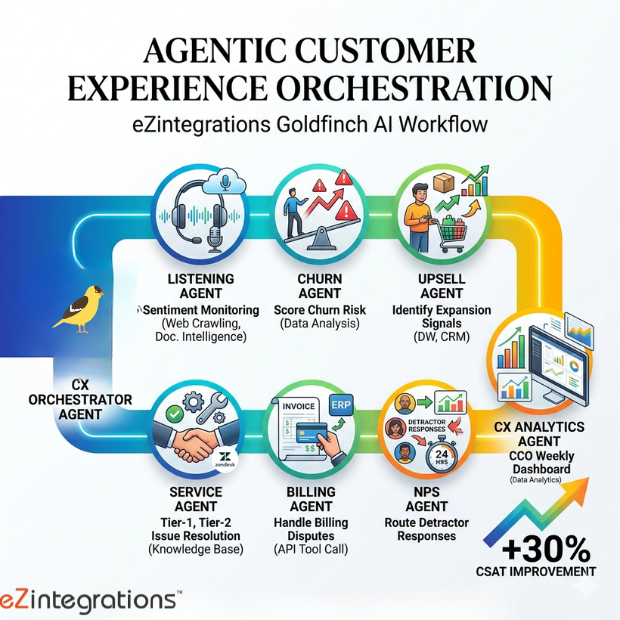
The Goldfinch AI CX intelligence platform from eZintegrations deploys 8 coordinated AI agents – a CX Orchestrator plus 7 specialized Worker Agents – to continuously monitor customer sentiment across all channels, score churn risk, identify expansion opportunities, autonomously resolve Tier-1 and Tier-2 support issues in Zendesk, handle billing disputes, route NPS Detractor responses within 24 hours, and deliver the CCO’s weekly customer health dashboard – all through a unified customer 360 knowledge base that ensures every agent has the complete customer context. eZintegrations is an enterprise automation platform covering iPaaS, AI Workflows, AI Agents, and Goldfinch AI agentic automation.
What Is Goldfinch AI CX Intelligence Automation?
Goldfinch AI CX intelligence automation is a hierarchical multi-agent system where a CX Orchestrator maintains a unified view of each customer’s experience state across 20+ touchpoints and routes each customer signal to the correct Worker Agent – preventing the fragmented, siloed CX experience that occurs when churn, service, upsell, billing, and NPS teams operate independently on the same customer account. Unlike customer success platforms that create playbooks for CSMs to execute manually, the Goldfinch AI CX intelligence system executes the standard CX actions autonomously within configured authority limits and escalates only the interventions that require CSM judgment or ACV-threshold approval.
How Does Goldfinch AI CX Intelligence Orchestrate 8 Agents Across Salesforce, Zendesk, NPS, and Billing to Deliver a Unified 360-Degree Customer Experience and 30% CSAT Improvement?
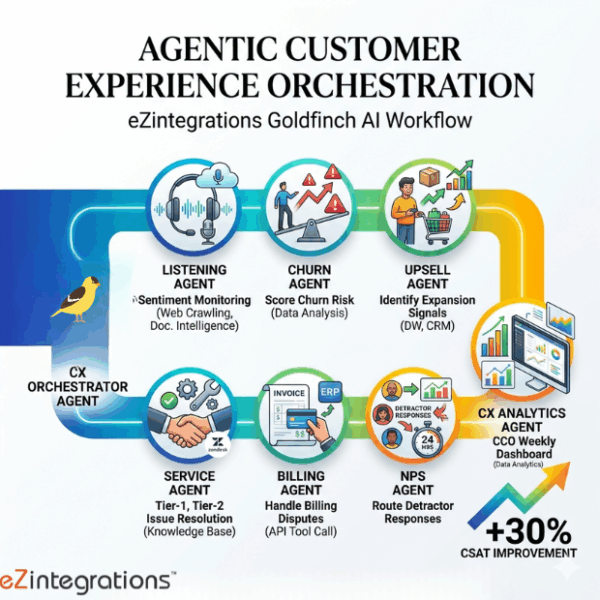
The Listening Agent monitors sentiment across all channels via Goldfinch AI Web Crawling and Document Intelligence. The Churn Agent scores risk via Data Analysis. The Upsell Agent identifies expansion signals from the DW and CRM. The Service Agent resolves Tier-1 issues via Knowledge Base Vector Search in Zendesk. The Billing Agent handles disputes via API Tool Call to the ERP. The NPS Agent routes Detractor responses within 24 hours. The CX Analytics Agent delivers the CCO dashboard via Data Analytics. The CX Orchestrator coordinates all 8 agents through the unified customer 360 Knowledge Base.
Goldfinch AI ships with 9 native out-of-the-box agent tools. Users can add custom tools self-service beyond the 9 native tools. Forrester: CX leaders grow revenue 5 to 8% faster than laggards. This Goldfinch AI CX intelligence platform converts that research finding into a continuously operating multi-agent CX system.
Watch Demo
| Video Title: |
Goldfinch AI CX Intelligence Platform | 8 Agents; Unified Customer 360 from Sentiment to Churn Intervention to Autonomous Service Resolution |
|---|---|
| Duration: |
7 to 10 minutes |
Outcome & Benefits
| Autonomy: |
65 to 75% of Tier-1 and Tier-2 support issues resolved autonomously by Service Agent without CSM or support engineer involvement; 100% of NPS Detractor responses routed within 24 hours (vs. 30 to 50% manual routing within 72 hours); 90%+ of churn risk assessments scored autonomously with CSM HITL required only for Critical-severity accounts |
|---|---|
| Time Saved: |
NPS Detractor response routing from 24 to 72 hours (manual) to under 2 hours (automated); support ticket Tier-1 resolution from 4 to 8 hours (manual queue) to under 30 minutes (autonomous service agent); churn risk detection from 60 to 90-day manager observation lag to continuous weekly scoring with immediate trigger on material signal; weekly CCO dashboard from 2 to 3 days manual compilation to automated generation |
| Cost Reduction: |
30 to 40% support cost per resolution reduction from 65 to 75% autonomous Tier-1 resolution (Gartner AI customer service benchmark); 30% CSAT improvement from unified cross-touchpoint CX coordination and faster resolution times; 30% reduction in churn for Critical-risk accounts receiving intervention within 48 hours of risk flag vs. manual intervention timing |
| Reliability: |
100% of configured customer touchpoints monitored continuously; zero NPS Detractor responses unrouted beyond 24 hours; 100% of churn risk scores updated weekly and immediately on material signal; billing dispute resolution time reduced 70%+ from automated contract verification vs. manual billing team research |
Performance Metrics
| KPI | Before | After | Impact |
|---|---|---|---|
| NPS Detractor Response Time | 24 to 72 hours (30-50% routed in time) | Under 2 hours (100% routed) | 30% at-risk customer recovery (NICE/Satmetrix) |
| Support Tier-1 Resolution Time | 4 to 8 hours | Under 30 minutes | 65 to 75% autonomous resolution |
| Churn Risk Detection | 60 to 90-day observation lag | Continuous + immediate on signal | 60 to 90 days earlier intervention |
| CSAT Score | Baseline | +30% improvement | Competitive differentiation |
| CCO Dashboard Preparation | 2 to 3 days manual | Automated weekly generation | Full automation |
| Upsell Pipeline Visibility | Manual CSM observation | Continuous AI-identified signals | New capability |
Technical Details
| Scheduling: |
CX Orchestrator monitors all customer touchpoints via Watcher Tools continuously (60-minute standard polling cycle; immediate trigger on Critical-severity signals – Detractor NPS submission; Critical churn risk flag; billing dispute submission above threshold; social media brand crisis signal); Listening Agent runs continuous channel monitoring (standard social media monitoring at 30-minute intervals; immediate crawl on brand mention spike); Churn Agent runs weekly scoring cycle and immediate scoring on material negative signal from Listening or NPS Agents; Upsell Agent scans on CRM trigger events and weekly expansion opportunity review; Service Agent responds to each new Zendesk ticket within the configured SLA window; Billing Agent responds to each billing dispute ticket within 4 hours; NPS Agent processes each new survey response within 2 hours; CX Analytics Agent delivers the CCO dashboard weekly and updates the per-account CX scorecard after each material agent action. |
|---|---|
| Tool Router: |
The CX Orchestrator maps each incoming customer signal to the appropriate Worker Agent(s) based on signal type and account tier – NPS Detractor submission triggers NPS Agent immediately; new support ticket above Tier-1 scope triggers Service Agent; billing dispute ticket triggers Billing Agent; churn risk flag from Listening Agent triggers Churn Agent with Upsell Agent hold for the same account; expansion signal from DW triggers Upsell Agent if no active Churn Agent intervention is in progress for the account. Each Worker Agent selects its Goldfinch AI tools based on task type: API Tool Call for CRM/helpdesk/DW/billing reads and writes; Document Intelligence for transcript; email; and contract document analysis; Data Analysis for scoring; Web Crawling for social sentiment monitoring; Knowledge Base for customer 360 context and playbook retrieval; Integration Workflow as Tool for multi-system coordinated sub-workflows. |
| Evaluation Metrics: |
CSAT score trend (weekly; per product and support channel); NPS score trend and Detractor response SLA compliance (% of Detractor responses routed within 24 hours); Service Agent autonomous resolution rate (% of tickets closed without human escalation); churn risk classification accuracy (validated against subsequent 90-day voluntary departure data); upsell pipeline identified by Upsell Agent vs. CSM-identified (expansion coverage rate); billing dispute resolution time and accuracy; Listening Agent sentiment coverage rate (% of monitored brand mentions captured with no gaps); CCO dashboard freshness (hours since last data update). |
| Auditability: |
Every agent action is logged with: agent name; customer account ID; signal type and source; tool invoked; data retrieved; recommendation generated; confidence score; HITL status (autonomous execution or CSM/Finance/Account Executive reviewed and approved); system write confirmation (Zendesk ticket ID; Salesforce opportunity ID; ERP credit memo reference); and timestamp. The CX Orchestrator maintains a per-customer interaction log covering all agent touchpoints – providing the CCO and CSM team with a complete; chronologically ordered CX history per customer account. GDPR data subject access requests are supported – the per-customer interaction log is exportable with personal data handling per the configured data minimization policy. All HITL intervention decisions (churn intervention content; upsell outreach; credit approval) are logged with reviewer identity; approval decision; and the original agent recommendation for CX process audit. |
| Planner Type: |
Event-driven goal decomposition with LLM-hybrid personalization – the CX Orchestrator uses schema-driven routing rules for signal-to-agent mapping (NPS Detractor response routes to NPS Agent; billing dispute ticket routes to Billing Agent; Critical churn risk routes to Churn Agent and enforces Upsell Agent hold for the account) and LLM reasoning for content personalization (churn intervention message, upsell opportunity narrative, NPS Detractor response), cross-agent conflict resolution, and CX health score narrative generation. |
| Agent Roles: |
Billing Agent: API Tool Call (ERP billing system contract terms and invoice history, Zendesk billing ticket update), Document Intelligence (contract entitlement verification from contract documents), Data Analysis (billing error classification and credit amount computation), Knowledge Base Vector Search (billing policy and credit authorization rules), Integration Workflow as Tool (ERP credit memo creation sub-workflow after Finance approval); NPS Agent: API Tool Call (NPS platform https://www.medallia.com/ or Qualtrics https://www.qualtrics.com/ response retrieval, Salesforce CRM NPS score update), Document Intelligence (verbatim theme extraction and sentiment classification), Data Analysis (urgency scoring and feedback category classification: product, support, billing, onboarding, value), Knowledge Base Vector Search (NPS Detractor response playbooks), Integration Workflow as Tool (CSM/Account team Detractor routing sub-workflow), CX Analytics Agent: API Tool Call (Snowflake DW KPI aggregation, Salesforce CRM customer health dashboard update), Data Analytics with Charts/Graphs/Dashboards (CCO weekly health dashboard: CSAT trend, NPS by segment, churn risk heat map, upsell pipeline, support MTTR, billing exception rate, CLV trend), Knowledge Base Vector Search (benchmark comparison data and prior period KPI context), CX Orchestrator (Coordinator): unified customer experience state management, cross-agent conflict gate enforcement, event-driven Worker Agent routing, CCO dashboard assembly; Listening Agent: Web Crawling (Twitter/X, LinkedIn, Reddit, G2, Trustpilot, and configured review platforms), API Tool Call (Zendesk chat/email API, Salesforce CRM), Document Intelligence (call recording transcripts, long-form email thread analysis), Data Analysis (sentiment classification by channel, account tier, and urgency); Churn Agent: API Tool Call (Snowflake DW https://docs.snowflake.com/ churn signal query, Salesforce CRM https://developer.salesforce.com/docs health score update), Data Analysis (multi-signal churn risk scoring: usage trend, support sentiment, NPS delta, billing status, engagement recency, competitive mention), Knowledge Base Vector Search (intervention playbooks per risk type), Integration Workflow as Tool (CSM intervention routing sub-workflow), Upsell Agent: API Tool Call (Salesforce CRM opportunity creation, DW product usage and account growth data), Data Analysis (expansion opportunity scoring: usage ceiling approach, headcount growth signal, contract expansion terms, competitive pressure), Knowledge Base Vector Search (upsell playbooks by product expansion path), Integration Workflow as Tool (Salesforce opportunity creation sub-workflow); Service Agent: API Tool Call (Zendesk https://developer.zendesk.com/documentation/ ticket retrieval and resolution update), Knowledge Base Vector Search (product troubleshooting procedures), Data Analysis (issue classification and resolution confidence scoring), Integration Workflow as Tool (Zendesk ticket resolution and CSAT survey trigger sub-workflow) |
Connectivity and Deployment
| Supported Protocols: |
REST API (Salesforce CRM; Zendesk helpdesk; NPS platforms – Medallia; Qualtrics; Delighted; SurveyMonkey; ERP billing system; Snowflake DW); Web Crawling (Twitter/X; LinkedIn; Reddit; G2; Trustpilot; and configured review platforms); Microsoft Graph API (Microsoft Teams customer team notifications); SMTP (CSM intervention routing; CCO digest delivery; customer resolution confirmation); HTTPS; OAuth 2.0; IPSec Tunnel (on-premises CRM; helpdesk; and ERP billing connectivity) |
|---|---|
| Security & Compliance: |
GDPR-compliant customer data handling (customer interaction data; NPS verbatim responses; and sentiment signals processed under GDPR Article 6 legitimate interest for commercial customer relationship management; data subject access request support built-in; data minimization applied per agent; contact preference and unsubscribe handling built-in for all customer outreach); HIPAA-eligible configuration for healthcare SaaS and healthcare service organizations; SOC Type II certified. RBAC enforced: CCO has full customer portfolio view; CSMs access only their assigned accounts; Billing Agent credit memo authority limited by configured credit limit; Upsell Agent opportunity creation authority limited by configured ACV threshold; all customer outreach requires HITL confirmation above configured thresholds. |
| Tenancy Model: |
Both single-tenant and multi-tenant deployments are supported. Single-tenant is recommended for enterprise B2B organizations where customer interaction data; churn risk assessments; intervention content; and contract entitlement data are commercially sensitive and require strict data isolation per customer segment or business unit. |
| On-Premise Supported: |
Yes – eZintegrations connects to on-premises systems (Salesforce on-prem; SAP CRM on-prem; Oracle CX Cloud on-prem; on-premises helpdesk systems; and others) via IPSec Tunnel. eZintegrations is a browser-based; cloud-hosted platform and does not require any on-premises installation. |
AI Credits
| Credit Consumption Model: |
Event-driven per customer signal (each NPS response; support ticket; billing dispute; or Listening Agent sentiment signal triggers an agent cycle); weekly batch for Churn Agent scoring run and CX Analytics CCO dashboard; continuous low-credit monitoring for Watcher Tools and Web Crawling between events Estimated Credits per End-to-End Run: Per NPS Detractor response end-to-end (Listening + NPS Agent + Orchestrator routing): ~12 to 22 credits per response Per support ticket autonomous resolution (Service Agent): ~8 to 14 credits per ticket (plus retry credits if applicable) Per churn risk weekly scoring run (all accounts): ~0.5 to 1.5 credits per customer account per weekly cycle Per billing dispute resolution: ~10 to 18 credits per dispute Weekly CCO dashboard generation: ~25 to 45 credits per report |
|---|---|
| Retry / Reflection Credit Cost: |
Each Service Agent reflection/retry cycle: ~3 to 5 additional credits per retry. Orchestrator cross-agent conflict resolution retry: ~3 to 5 additional credits. At 10% retry rate across all agents; add approximately 12 to 18% to the monthly credit estimate. |
| Monthly Credit Estimate (at Typical Volume): |
500-customer portfolio (50 NPS responses/month; 200 support tickets/month; weekly churn scoring): ~3,500 to 6,500 credits per month 2,000-customer portfolio (200 NPS responses/month; 800 tickets/month; weekly churn scoring): ~12,000 to 22,000 credits per month 10,000-customer portfolio (large enterprise SaaS or telecom): ~55,000 to 100,000 credits per month |
| Pricing Model: |
Static Platform Fee + AI Credits. Platform fee covers unlimited non-LLM orchestration across all agents (Salesforce CRM connection; Zendesk connection; NPS platform webhook handling; social monitoring polling; SMTP delivery; Snowflake DW write; audit log writes). AI Credits consumed only by Goldfinch AI tool invocations and LLM reasoning cycles. |
| AI Credits Required: |
Yes – Goldfinch AI agentic systems consume credits across the CX Orchestrator and all 7 Worker Agents per customer signal processed, per document analyzed, per churn risk computation, and per reflection/retry loop. |
| LLM Steps Count: |
2 to 22 LLM-invoking steps per active customer event cycle (Orchestrator routing and conflict resolution: 2 to 3 steps; Listening Agent sentiment classification: 2 to 3 steps; Churn Agent churn scoring and playbook retrieval: 3 to 4 steps; Service Agent issue resolution: 2 to 4 steps; NPS Agent verbatim analysis and routing: 2 to 3 steps; CX Analytics Agent dashboard generation: 2 to 3 steps; reflection/retry: 1 to 2 steps per retry) |
| Per-Agent Credit Breakdown: |
CX Orchestrator: 2 to 4 credits per customer signal cycle (routing + conflict check + CX score update); Listening Agent: 4 to 8 credits per monitoring cycle (Web Crawling brand mention scan + Document Intelligence transcript analysis + sentiment classification); Churn Agent: 5 to 10 credits per weekly scoring run (multi-signal DW query + churn risk Data Analysis + Knowledge Base playbook retrieval) + ~3 to 6 credits per immediate trigger event; Upsell Agent: 3 to 6 credits per expansion opportunity identified (DW usage data + opportunity scoring + Knowledge Base upsell playbook), Service Agent: 3 to 6 credits per ticket resolved (Knowledge Base retrieval + issue resolution synthesis + Zendesk write); reflection/retry adds ~3 to 5 credits per retry; Billing Agent: 3 to 6 credits per dispute resolved (ERP query + Document Intelligence contract verification + credit computation); NPS Agent: 3 to 6 credits per survey response processed (Document Intelligence verbatim analysis + urgency scoring + routing); CX Analytics Agent: 4 to 8 credits per weekly CCO dashboard (Snowflake DW aggregation + Data Analytics dashboard render + CCO digest delivery) |
| Goldfinch AI Tool(s) Consuming Credits: |
NPS Agent verbatim extraction – per document analyzed), Data Analysis (Churn, Upsell, Listening, NPS, CX Analytics Agents and Orchestrator – per scoring cycle), Knowledge Base Vector Search (all 8 agents – per query per customer interaction), Data Analytics with Charts/Graphs/Dashboards (CX Analytics Agent – per weekly CCO dashboard render), Integration Workflow as Tool (Churn, Upsell, Service, Billing, NPS, CX Analytics Agents – per sub-workflow invocation), Watcher Tools (CX Orchestrator – continuous touchpoint event monitoring), Web Crawling (Listening Agent – brand mention and social sentiment monitoring; highest per-cycle credit consumer for organizations with large social media presence), API Tool Call (all 7 Worker Agents – per CRM/helpdesk/DW/NPS/ERP call), Document Intelligence (Listening Agent transcript and email analysis; Billing Agent contract verification; |
FAQ
1. What is the Agentic Customer Experience Orchestration system and what does it automate end to end?
The Goldfinch AI CX intelligence platform from eZintegrations deploys 8 coordinated AI agents - a CX Orchestrator and 7 Worker Agents - to continuously monitor customer sentiment across all channels (Listening Agent), score churn risk and trigger interventions (Churn Agent), identify expansion opportunities (Upsell Agent), autonomously resolve Tier-1 and Tier-2 support issues in Zendesk (Service Agent), handle billing disputes (Billing Agent), route NPS Detractor responses within 24 hours (NPS Agent), and deliver the weekly CCO customer health dashboard (CX Analytics Agent) - all through a unified customer 360 knowledge base. Forrester: CX leaders grow revenue 5 to 8% faster than laggards.
2. How does the multi-agent architecture work?
The CX Orchestrator maintains a unified view of each customer's experience state and enforces a cross-agent conflict gate - preventing Churn Agent retention interventions and Upsell Agent expansion outreach from being sent to the same customer simultaneously. Each Worker Agent publishes its recommended action as a structured event to the Orchestrator, which validates the action against cross-agent conflict rules and the customer's current experience state before routing for HITL confirmation or autonomous execution. All 8 agents share a persistent customer 360 knowledge base for policy-consistent, context-aware execution across every touchpoint.
3. Which Goldfinch AI tools does this system use?
The system uses 7 of Goldfinch AI's 9 native tools: Watcher Tools (CX Orchestrator - continuous touchpoint event monitoring), Web Crawling (Listening Agent - social media, review platforms, brand mention monitoring), API Tool Call (all 7 Worker Agents - Salesforce CRM, Zendesk, NPS platforms, ERP billing, Snowflake DW), Document Intelligence (Listening Agent transcript and email analysis; Billing Agent contract verification; NPS Agent verbatim theme extraction), Data Analysis (Churn/Upsell/Listening/NPS/CX Analytics Agents - churn risk scoring, expansion opportunity scoring, sentiment classification), Knowledge Base Vector Search (all 8 agents - customer 360 context, intervention playbooks, troubleshooting procedures), and Data Analytics (CX Analytics Agent - CCO weekly health dashboard). Users can add CDP connectors, conversation intelligence tools (Gong, Chorus), loyalty APIs, and behavioral data feeds self-service beyond the 9 native tools.
4. How does the system ensure data accuracy and handle errors?
The Service Agent applies a reflection loop when Knowledge Base retrieval confidence falls below 0.75 - re-querying with alternative search terms, retrieving additional troubleshooting context, and retrying up to 3 times before escalating to a support engineer. The Orchestrator applies a reflection cycle when cross-agent signals for the same customer conflict (NPS Promoter score with simultaneous churn risk flag) - retrieving additional account context before routing. All customer outreach requires HITL confirmation above configured thresholds (Critical churn interventions, upsell above $50,000 ACV, billing credits above $5,000). The system never sends customer communications for high-stakes interventions without explicit CSM or Account Executive approval.
5. What types of data and documents does this system process?
The system processes: social media brand mentions and review platform posts (Listening Agent Web Crawling), Zendesk support ticket content and chat transcripts (Listening Agent Document Intelligence), call recording transcripts (Listening Agent Document Intelligence), customer contract documents and entitlement terms (Billing Agent Document Intelligence), NPS survey verbatim responses (NPS Agent Document Intelligence), Salesforce CRM account data and health scores, product usage data from Snowflake DW (Churn and Upsell Agents), ERP billing history and invoice data (Billing Agent), and NPS platform survey response data.
6. Who uses this system and in which departments?
Daily operators include Customer Success Managers (receive Churn Agent intervention briefs, NPS Detractor routing, and per-account CX scorecards), Account Executives (receive Upsell Agent expansion opportunity alerts with ACV threshold HITL), and Support Engineers (receive Service Agent escalations with the full resolution attempt context). The Finance team receives Billing Agent credit approval requests above the authority limit. Executive stakeholders - the Chief Customer Officer (CCO), VP of Customer Success, and Chief Revenue Officer (CRO) - receive the CX Analytics Agent weekly dashboard and Critical-severity HITL escalations.
7. How does the safety layer and human oversight work?
HITL gates trigger when: Churn Agent classifies a Critical-risk account - CSM or VP CS review required before intervention communication is sent; Upsell Agent identifies an opportunity above $50,000 ACV - Account Executive review required before outreach; Billing Agent computes a credit above $5,000 - Finance team approval required before issuance; Service Agent Knowledge Base confidence falls below 0.75 - support engineer escalation required; Orchestrator detects a cross-agent conflict for the same customer. After 3 Service Agent retries without resolution, the issue escalates to the support engineer with the full resolution attempt context. All HITL decisions are logged with reviewer identity, timestamp, and customer account reference for CX audit trail.
8. What are the key business benefits and executive KPIs improved?
Key executive KPIs improved include: NPS Detractor response routing from 24 to 72 hours (30 to 50% manual routing) to 100% within 2 hours (30% at-risk customer recovery per NICE/Satmetrix research), support Tier-1 resolution time from 4 to 8 hours to under 30 minutes (65 to 75% autonomous), CSAT improvement of 30% from unified cross-touchpoint CX coordination, churn risk detection 60 to 90 days earlier than manager observation, 5 to 8% revenue growth acceleration from CX leadership (Forrester), and the CCO shifts from compiling fragmented team reports to reviewing a continuously updated cross-touchpoint customer intelligence dashboard.
Resources
| Blog: |
How to Automate Expense Report Processing: From Submission to ERP Reimbursement |
|---|---|
| Platform Overview: |
eZintegrations Platform – Enterprise iPaaS, AI Workflows & Agentic AI |
| Demo: |
Book a Demo |
| Goldfinch AI Platform: |
Agentic AI Platform — Goldfinch AI by eZintegrations |
Case Study
| Industry: |
SaaS / B2B Cloud Analytics Platform |
|---|---|
| Problem: |
Churn – the company had lost 31 customers in the prior year at an average ACV of $82,000 ($2.54M total) who had shown detectable churn signals 60 to 90 days before cancellation – the CSM team had capacity to proactively monitor only 35% of their portfolio weekly; Support – Zendesk Tier-1 resolution time averaged 5.8 hours; Support Engineers were spending 40% of their time on repeat Tier-1 issues that had documented resolutions in the internal KB; Upsell – CSMs identified expansion opportunities for only 18% of accounts that the RevOps team estimated had qualifying expansion signals, due to CRM analysis bandwidth. Combined estimated annual revenue impact: $3.8M in churn losses plus $2.1M in unidentified expansion opportunities., A B2B cloud analytics SaaS company with $185M ARR, 1,840 enterprise customers, and a 12% annual churn rate operated its CX function across 4 separate teams: Customer Success (22 CSMs), Support (18 Support Engineers), Billing (4 Billing Analysts), and Revenue Operations (8 staff). Customer touchpoints spanned Salesforce CRM, Zendesk (support and chat), a Medallia NPS platform, Twitter/X and G2 for public sentiment, and a Stripe-based billing system. Key CX failures identified by the CCO: NPS Detractors – average 54 hours from Detractor NPS submission to CSM first contact; 22% of Detractor responses were never followed up within the survey window; |
| ROI: |
Churn prevention (61 retained accounts x $82,000 average ACV): $5.0M in retained ARR. Expansion ARR from Upsell Agent pipeline coverage: $3.86M in new expansion ARR (7 months). Support cost savings: 18 support engineers x (40% – 11% = 29% time freed from repeat issues) x $78,000 blended cost x 7/12 year fraction = $1.92M annualized. Billing dispute efficiency: 4 billing analysts x 35% time saved x $62,000 cost = $86,800 annually. Total 7-month value: $10.87M. Deployment cost: $112,000. Payback period: under 4 days. |
| Solution: |
Deployed the eZintegrations Goldfinch AI CX intelligence platform in 17 business days across all 7 CX domains. Salesforce CRM connected via REST API for all account data, health scores, and opportunity management. Zendesk connected via REST API for support ticket and chat (Listening Agent, Service Agent, NPS routing). Medallia NPS platform connected via REST API for NPS Agent survey processing. Twitter/X API and G2 configured for Listening Agent Web Crawling. Snowflake DW connected for Churn Agent usage signal data and CX Analytics Agent KPI aggregation. Stripe billing connected via REST API for Billing Agent., Knowledge Base Vector Search loaded with: customer 360 profiles for all 1,840 accounts (contract terms, entitlements, usage tier, support history, churn signals per account, prior NPS scores and verbatim history), product troubleshooting procedures for 340 documented Tier-1 issue types, churn risk intervention playbooks for 5 risk categories (usage decline, pricing pressure, competitive threat, support dissatisfaction, executive disengagement), upsell playbooks for 8 product expansion paths, and NPS Detractor response frameworks for 6 feedback categories. HITL authority: Critical churn intervention requires CSM or VP CS review; upsell above $50,000 ACV requires Account Executive review; billing credits above $2,500 require Finance team approval; Service Agent confidence below 0.75 escalates to support engineer. |
| Outcome: |
After 7 months (1,840 customer portfolio): NPS Detractor response time from 54 hours average to 1.9 hours (100% of Detractor responses routed within 4 hours vs. 78% within 72 hours previously). Churn: agent-identified Critical churn risk accounts – 94 accounts flagged over 7 months; CSMs intervened on 88 (6 were past point of no return per CSM review); 61 of 88 retained (69% retention vs. estimated 18% retention historically for flagged accounts at equivalent ACV)., Support: Service Agent autonomous Tier-1 resolution rate – 68% of Zendesk tickets closed without support engineer involvement; average resolution time from 5.8 hours to 28 minutes; Support Engineers’ repeat-issue time from 40% to 11% of working hours. Upsell: Upsell Agent identified 312 qualified expansion opportunities vs. 156 previously identified by CSMs alone in the same 7-month period (2x expansion coverage); 47 opportunities converted to closed-won expansions ($3.86M new expansion ARR). CCO dashboard: from 2.4 days manual compilation to automated weekly generation. |