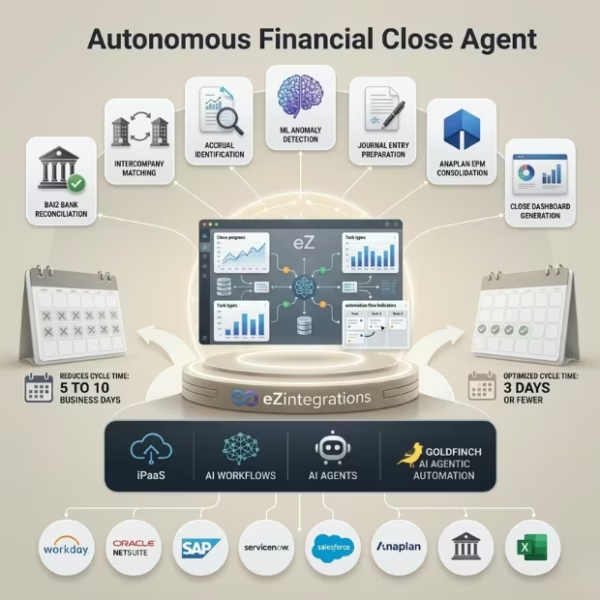
How to Automate Month-End Financial Close for Reconciliation and Close Orchestration
$150.00
Autonomous Financial Close Agent Autonomously orchestrate the month-end financial close process – triggering AR aging cleanup; reconciling bank statements via BAI2 matching; running intercompany reconciliation; identifying accrual requirements; preparing journal entries for Controller approval; validating trial balance integrity; detecting anomalous GL movements via ML; consolidating results in EPM (Anaplan); generating the close status dashboard; and escalating open items – compressing close from 5 to 10 business days to 3 days or fewer Close cycle compressed from 5 to 10 business days to 3 days or fewer (Hackett Group top-quartile benchmark); Controller and Accountant manual reconciliation effort reduced 70%+; board reporting readiness accelerated by 4 to 6 days per period; anomalous GL movements identified in minutes vs. end-of-close audit review; zero reconciliation items missed through automated completeness checks Financial Controller; CFO; FP&A Manager; Accounting Manager AI Agent (autonomous; goal-oriented; multi-step orchestrator – the agent manages the full close sequence; adapts when reconciliation exceptions are found; escalates only items requiring human judgment; and tracks progress against the close calendar without step-by-step Controller instruction) Yes – eZintegrations connects to on-premises systems (SAP FI on-prem; Oracle EBS; Oracle Financials Cloud; MSSQL; and others) via IPSec Tunnel. eZintegrations is a browser-based; cloud-hosted platform and does not require any on-premises installation. OData v2/v4 (SAP FI GL; AP; and AR modules); Oracle REST API (Oracle Financials); BAI2 (bank statement file parsing); REST API (Anaplan EPM; bank APIs; Snowflake DW); HTTPS; OAuth 2.0; SMTP (Controller escalation and close status notifications); JDBC (Snowflake DW); IPSec Tunnel (on-premises SAP; Oracle EBS; and ERP connectivity) Both single-tenant and multi-tenant deployments are available. Single-tenant is strongly recommended for organizations with strict financial data confidentiality requirements; public company reporting obligations (SOX compliance); or multi-entity consolidation environments requiring infrastructure segregation. Multi-tenant is the default shared-cloud deployment. Both support on-premises ERP connectivity via IPSec Tunnel. All Industries – Mid to Large Enterprise (highest cycle compression benefit in Manufacturing; Distribution; Financial Services; Technology; and Healthcare with multi-entity structures) Close cycle from 5 to 10 business days to 3 days or fewer; Controller manual reconciliation effort reduced 70%+; board reporting readiness accelerated 4 to 6 days; 100% reconciliation completeness vs. manual risk of missed items financial close agent; autonomous financial close AI; month-end close automation; close cycle compression AI; SAP FI close automation; Oracle AR close agent; Goldfinch AI finance close; intercompany reconciliation AI; BAI2 bank reconciliation AI; GL anomaly detection AI; Anaplan EPM automation; financial controller AI agent Yes – the financial close agent invokes multiple Goldfinch AI tools per close cycle: API Tool Call (ERP data extractions and GL posting); Data Analysis (BAI2 matching; intercompany reconciliation; accrual identification; ML anomaly detection); Document Intelligence (BAI2 file and document parsing); Knowledge Base Vector Search (close policy retrieval); Data Analytics with Charts/Graphs/Dashboards (close status dashboard); Integration Workflow as Tool (Anaplan push; journal entry routing; close communication sub-workflows); and Watcher Tools (close calendar and approval monitoring). Credits consumed per close cycle (monthly cadence). API Tool Call: Triggers each close sub-process via ERP API – extracting the AR aging report from SAP FI or Oracle AR for cleanup initiation, pulling bank statement BAI2 files from the bank API or configured file location, extracting intercompany balances from the GL, retrieving open AP invoices for accrual identification, reading the trial balance from the ERP GL, posting approved accrual journal entries to the ERP GL, and pushing consolidated results to Anaplan EPM via REST API; also creates Controller escalation tasks in the configured task management system, Data Analysis: Executes the BAI2 bank statement matching model – comparing bank statement transactions against GL entries to identify matched pairs, unmatched bank transactions, and unmatched GL entries; runs the intercompany reconciliation model to identify out-of-balance intercompany positions across entities; identifies open AP invoices that require period-end accrual based on receipt date, invoice date, and accrual policy rules; and runs the ML anomaly detection model on GL movements – scoring each account balance change against historical period-end patterns to flag statistically anomalous movements requiring audit explanation, Document Intelligence: Analyzes BAI2 bank statement files and any supplementary bank documents – parsing the structured BAI2 transaction records into GL-comparable fields and identifying transaction descriptions that require interpretation for matching (e.g. bank charges, wire transfer references, ACH batch identifications); also reads intercompany confirmation emails or documents when automated intercompany reconciliation requires cross-entity confirmation, Integration Workflow as Tool: Calls pre-built eZintegrations integration sub-workflows for close-specific operations including the Anaplan EPM consolidation push (structured financial data submitted to Anaplan for consolidation and planning model update), the journal entry approval routing workflow (prepared accrual journal entries routed to Controller for review and approval before ERP posting), and the close status communication workflow (close progress notifications to CFO and Controller at configured milestones); Watcher Tools: Monitors the close calendar trigger (month-end date or manual close initiation) to start the close sequence; monitors the status of in-flight close sub-processes to detect stalls or failures; monitors Controller approval queue for journal entry approvals to unblock the close sequence when entries are approved; and monitors the Anaplan EPM consolidation status to confirm successful data receipt before the close is marked complete, Knowledge Base Vector Search: Retrieves the close checklist and procedural rules for each close sub-process – including accrual policy thresholds (which open invoices require accrual vs. which can be deferred), intercompany elimination rules per entity pair, materiality thresholds for anomaly escalation, and prior period close notes that are relevant to the current period’s close (e.g. recurring adjusting entries, known timing differences, standing journal entries); Data Analytics with Charts/Graphs/Dashboards: Generates the close status dashboard – showing completion percentage per close sub-process, open items requiring Controller attention with aging, bank reconciliation status by bank account, intercompany balance positions, trial balance comparison vs. prior period, and the overall close progress timeline against the close calendar targetWorkflow Name: Purpose: Benefit: Who Uses It: System Type: On-Premise Supported: Supported Protocols: Tenancy Model: Industry: Outcome: Tags: AI Credits Required: Goldfinch AI Tool(s) Used:
The month-end financial close is the highest-stakes; most labor-intensive process in Finance. Financial Controllers and their teams manually execute 50 to 100 close tasks across GL; AP; AR; bank reconciliation; intercompany; and consolidation – coordinating across departments; systems; and entities over 5 to 10 business days. According to the Hackett Group; top-quartile organizations close in 3 business days; the average organization takes 7 to 10 days. The gap represents 4 to 7 days of senior Finance staff time consumed by reconciliation mechanics rather than analysis. Controllers identify trial balance anomalies at the end of the close cycle – after 8 days of accumulation – when restatement risk is highest. Board reporting cannot begin until the close completes; compressing the analysis and commentary window to 2 to 3 days before board materials are due. PwC’s Closing the Gap survey found that 75% of CFOs cite close cycle compression as a top Finance transformation priority. The Autonomous Financial Close Agent from eZintegrations triggers at period-end and orchestrates the full close sequence without step-by-step Controller instruction. Goldfinch AI API Tool Call extracts data from SAP FI or Oracle across GL; AP; AR; and bank modules. Goldfinch AI Data Analysis runs BAI2 bank reconciliation matching; intercompany balance reconciliation; accrual identification; and ML anomaly detection on GL movements. Goldfinch AI Document Intelligence parses BAI2 bank statement files. Goldfinch AI Knowledge Base Vector Search retrieves close policy rules and accrual thresholds. Goldfinch AI Data Analytics generates the close status dashboard. Goldfinch AI Integration Workflow as Tool routes journal entries to the Controller for approval and pushes results to Anaplan EPM. Goldfinch AI Watcher Tools monitors the close calendar and approval queue. Close cycle compressed from 5 to 10 business days to 3 days or fewer (Hackett Group top-quartile benchmark); board reporting analysis window extended 4 to 6 days; Controller and Accountant manual reconciliation effort reduced 70%+; GL anomalies identified during the close (not post-close in audit); materially reducing restatement and audit adjustment risk Controller and Accountant reconciliation work from 70%+ of close cycle time to under 20%; CFO board preparation window from 2 to 3 days (after 8 to 10-day close) to 5 to 7 days (after 3-day close); Accounting Manager close status compilation from daily manual status updates to real-time dashboard Close cycle compression value: PwC research links close cycle compression to 15 to 25% reduction in Finance close labor cost per period (Controller; Accountant; and FP&A staff time). At $850,000 average Finance close labor cost per year for a mid-enterprise Finance team; 15 to 25% reduction = $127,000 to $212,000 annually. Board readiness acceleration: each additional day of analysis and commentary time before the board meeting is quantified by CFOs as material to presentation quality and board member preparation – typically valued at $50,000 to $150,000 in avoided board rework and re-presentation cycles. Audit preparation cost reduction: ML anomaly detection during close reduces post-close audit adjustment requests – estimated $40,000 to $80,000 per audit cycle in avoided adjustment restatement effort. SOX-compliant close automation controls (journal entry approval workflow enforces segregation of duties – the agent prepares journal entries; the Controller approves; the agent posts; the agent cannot post journal entries without Controller approval); HIPAA-eligible configuration for healthcare Financial Controllers; GDPR-compliant financial data handling (employee and customer financial data in close documents processed under Article 6 employment contract and legitimate interest); SOC Type II certified. All ERP write operations (journal entry posting; AR aging updates) require authenticated API credentials within the agent’s configured authorization scope – the agent cannot post to the GL without Controller approval for all non-automated reconciliation entries. Full immutable audit trail per close cycle: every reconciliation performed; anomaly detected; journal entry prepared and approved; and Anaplan push completed – supporting SOX 302/906 close process documentation requirements. Accrual identification and journal entry preparation: The agent identifies open AP invoices that require period-end accrual (received goods not yet invoiced, services received but invoice not yet processed) based on receipt date, invoice date, and the accrual policy thresholds from the Knowledge Base – and prepares the accrual journal entries for Controller approval rather than requiring the Controller to manually review AP aging for accruals; Intercompany reconciliation automation: Data Analysis reconciles intercompany balance positions across all entities in the configured entity structure – identifying out-of-balance intercompany pairs, quantifying the variance, and routing the discrepancy to the responsible entity’s Finance team for resolution rather than requiring the Controller to manually chase intercompany counterparts, Automated BAI2 bank reconciliation: Data Analysis matches BAI2 bank statement transactions against GL entries – identifying matched, unmatched bank, and unmatched GL items per bank account, producing a reconciliation exception list for Controller review rather than a raw transaction list requiring manual matching; ML-powered GL anomaly detection: Data Analysis runs an ML anomaly model on period-end GL movements – scoring each account balance change against 24 months of historical period-end patterns to flag statistically anomalous movements that require audit explanation before the close is certified, enabling Controllers to address issues during the close rather than in the audit, Real-time close status dashboard: Data Analytics generates a close progress dashboard showing completion percentage per sub-process, open item aging, GL anomaly flags, bank reconciliation status, and the overall close timeline against the close calendar target – giving the CFO and Controller a live close status view instead of a morning email from the Accounting ManagerProblem Before: Solution Overview: Business Impact: Productivity Gain: Cost Savings: Security & Compliance: Key Features:
Description
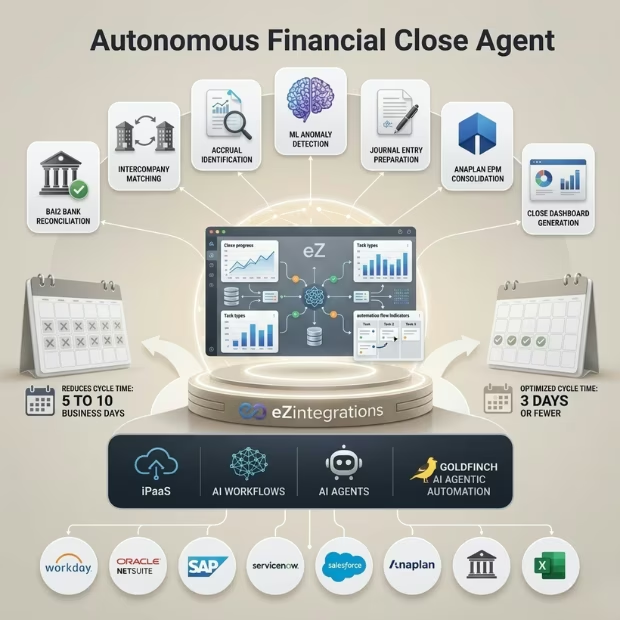
The financial close agent from eZintegrations triggers at period-end and orchestrates the full month-end close sequence – running BAI2 bank reconciliation, intercompany matching, accrual identification, ML anomaly detection, journal entry preparation, Anaplan EPM consolidation, and close dashboard generation – compressing the close cycle from 5 to 10 business days to 3 days or fewer without step-by-step Controller instruction. eZintegrations is an enterprise automation platform covering iPaaS, AI Workflows, AI Agents, and Goldfinch AI agentic automation.
What Is a Financial Close Agent?
A financial close agent is an AI Agent that takes the period-end close trigger as its goal and autonomously orchestrates the full close process – extracting data from ERP across GL, AP, AR, and bank modules, executing reconciliation and matching tasks, detecting anomalies in GL movements, preparing journal entries for Controller approval, consolidating results in EPM, and generating close status reporting. Where manual close requires Controllers to direct and monitor each step across 5 to 10 days, the agent executes the mechanical close tasks autonomously and surfaces only the exceptions and judgment calls that require human decision-making.
How Does a Financial Close Agent Autonomously Orchestrate Month-End Close Reconciliations, Detect GL Anomalies, and Compress the Close Cycle to Under 3 Days?
When the period-end trigger fires, the financial close agent begins its orchestrated close sequence. Goldfinch AI API Tool Call extracts AR aging, bank statements, intercompany balances, and open AP data from SAP FI or Oracle. Goldfinch AI Document Intelligence parses BAI2 bank statement files. Goldfinch AI Data Analysis runs bank reconciliation matching, intercompany reconciliation, accrual identification, and the ML anomaly detection model on GL movements. Knowledge Base Vector Search retrieves accrual policy thresholds and close procedure rules. Goldfinch AI Integration Workflow as Tool routes prepared journal entries to the Controller and pushes results to Anaplan. Data Analytics generates the close status dashboard. Watcher Tools monitors approvals and close calendar milestones.
Hackett Group benchmarks top-quartile close at 3 business days. This financial close agent makes that benchmark achievable within your existing SAP or Oracle environment.
Watch Demo
| Video Title: | Financial Close Agent |
|---|---|
| Duration: | 6 to 8 minutes |
Outcome & Benefits
| Throughput: | Full month-end close orchestrated per period; agent processes all reconciliation sub-processes simultaneously where parallel execution is supported; scales to multi-entity consolidation environments with 5 to 20+ legal entities |
|---|---|
| Cost Reduction: | 15 to 25% reduction in Finance close labor cost per period (PwC Closing the Gap benchmark); $127,000 to $212,000 annually at $850,000 average Finance close labor cost; $40,000 to $80,000 audit adjustment cost reduction from ML anomaly detection during close |
| Accuracy: | BAI2 bank reconciliation matching accuracy: 98%+ on structured transaction matching; ML anomaly detection precision (correctly identifying anomalous GL movements vs. legitimate period-end entries): 86%+; accrual identification completeness: 97%+ of open invoices requiring accrual correctly identified per configured policy |
| Time Saved: | Close cycle from 5 to 10 business days to 3 days or fewer (Hackett Group top-quartile); Controller and Accountant reconciliation work from 70%+ of close cycle time to under 20%; board reporting analysis window extended 4 to 6 days per period |
Performance Metrics
| Metric | Before (Manual/Batch) | After (Real-Time Sync) | Improvement |
|---|---|---|---|
| Close Cycle | 5 to 10 business days | 3 business days or fewer | 50 to 70% compression |
| Reconciliation Effort | 70%+ of close cycle time | Under 20% of close cycle time | 70%+ reduction |
| GL Anomaly Detection | End-of-close audit review | During close via ML model | Real-time detection |
| Board Analysis Window | 2 to 3 days post-close | 5 to 7 days post-close | 4 to 6-day extension |
Technical Details
| Data Validation: | Four-stage validation per close cycle: data completeness check – the agent verifies all required data extracts (AR aging; bank statements; intercompany balances; AP open items; trial balance) are received and within expected volume ranges before close processing begins; reconciliation completeness – after each reconciliation sub-process; the agent verifies that all items are classified (matched; exception; or posted) before marking the sub-process complete; trial balance integrity check – the agent validates that the trial balance debits equal credits and that the net change from prior period is within the expected range before triggering the Anaplan push; journal entry segregation of duties – the agent never posts journal entries without Controller approval; prepared entries are held in the approval queue until explicit Controller confirmation is received. |
|---|---|
| Real-Time Support: | Yes – the financial close agent supports both calendar-triggered execution (fires automatically on the configured month-end date) and manual trigger (Controller initiates the close sequence on demand). During the close; all sub-process execution; exception detection; and status updates occur in real time – the Controller and CFO can view live close progress in the Data Analytics dashboard at any point during the 3-day close window. Watcher Tools detects Controller journal entry approvals within 5 minutes of submission; immediately unblocking dependent close steps. The agent operates 24/7 during the close window – close work does not pause overnight. |
| Customization: | Configurable per deployment via eZintegrations no-code Agent Builder: close sub-process sequence and data dependencies; BAI2 matching rules (exact match; fuzzy match tolerance; transaction type categorization); accrual policy thresholds (minimum accrual amount; eligible invoice aging; expense category inclusions); ML anomaly detection sensitivity (standard deviation threshold for anomaly flag; account-level sensitivity override for volatile accounts); intercompany entity matrix and elimination rules; Anaplan EPM connection and module mapping; journal entry approval routing (Controller; Accounting Manager; or CFO per materiality threshold); close calendar configuration (close start trigger; target close date; sub-process SLA windows); and escalation communication templates. Finance team manages close procedure rules and accrual policy thresholds in the Goldfinch AI knowledge base editor without IT involvement. |
| Knowledge Retrieval: | Goldfinch AI Knowledge Base Vector Search (https://ezintegrations.ai/agentic-ai-platform/) retrieves close procedure rules; accrual policy thresholds; intercompany elimination rules; anomaly explanation templates; and prior period close notes (Weaviate https://weaviate.io/developers/weaviate or Pinecone https://docs.pinecone.io/ as vector store) – matching the current period’s close context against the configured close playbook to return the relevant rules and thresholds for each close sub-process. Finance team maintains the close playbook and accrual policies in the Goldfinch AI knowledge base editor – policy changes for the current period (e.g. materiality threshold update; new intercompany entity added) take effect immediately without a development cycle. |
| Agent Architecture: | Single autonomous agent with sequential close process orchestration (close sub-processes execute in the sequence defined by the close checklist; with parallel execution where data dependencies allow – e.g. bank reconciliation and intercompany reconciliation run simultaneously since they are independent data sources). For multi-entity consolidation environments; hierarchical multi-agent mode is available – one orchestrator agent manages the close timeline and sub-process dependencies; with entity-specific sub-agents executing the close at each legal entity in parallel; then reporting status to the orchestrator for consolidation sequencing. The agent uses a close calendar as its execution framework – each close task has a configured sequence position; data dependency; estimated duration; and escalation trigger (if task not completed within estimated duration plus buffer; the agent escalates to the Controller with the specific blocker context). |
| Task Orchestration: | Goldfinch AI orchestrates the 11-step close sequence using a dependency-aware execution model – tasks that have upstream data dependencies (journal entry posting depends on Controller approval; Anaplan consolidation depends on trial balance validation; close status dashboard depends on all sub-process completions) wait for their upstream gate before executing. Tasks without upstream dependencies execute in parallel. The agent maintains a close process state (each sub-process in Not Started; In Progress; Completed; Blocked; or Escalated state) and updates the close status dashboard in real time. Watcher Tools monitors Controller approval events to unblock dependent tasks when approvals arrive. |
AI Credits
| AI Credits Required: | Yes – the financial close agent invokes multiple Goldfinch AI tools per close cycle: API Tool Call (ERP data extractions and GL posting); Data Analysis (BAI2 matching; intercompany reconciliation; accrual identification; ML anomaly detection); Document Intelligence (BAI2 file and document parsing); Knowledge Base Vector Search (close policy retrieval); Data Analytics with Charts/Graphs/Dashboards (close status dashboard); Integration Workflow as Tool (Anaplan push; journal entry routing; close communication sub-workflows); and Watcher Tools (close calendar and approval monitoring). Credits consumed per close cycle (monthly cadence). |
|---|---|
| LLM Steps Count: | 7 to 9 Goldfinch AI tool invocations per close cycle (API Tool Call x multiple ERP extracts + Document Intelligence BAI2 parsing + Data Analysis x4 models + Knowledge Base retrieval + Data Analytics dashboard + Integration Workflow as Tool x3 sub-workflows + Watcher Tools monitoring) |
| Credit Consumption Model: | Per close cycle (monthly) – bundle of 7 to 9 tool invocations per close cycle; entity count; bank account count; and transaction volume affect total credits per cycle; multi-entity consolidation environments consume proportionally more credits Estimated Credits per Close Cycle: Small enterprise close (single entity; 2 to 4 bank accounts; under 10,000 GL transactions): ~400 to 700 credits per monthly close Mid-market close (3 to 5 entities; 5 to 15 bank accounts; 10,000 to 100,000 GL transactions): ~700 to 1,500 credits per monthly close Large enterprise close (10 to 20 entities; 15 to 50 bank accounts; 100,000+ GL transactions): ~1,500 to 4,000 credits per monthly close |
| Monthly Credit Estimate (at Typical Volume): | Monthly close cycle (one close per month): credits equal to per-close-cycle estimate above; quarterly closes consume credits in Q1/Q2/Q3/Q4 months only Note: the financial close agent is a low-frequency; high-value use case – credits consumed once per close period rather than per day; making it one of the highest business-value-per-credit investments in the AI Agent catalog |
| Pricing Model: | Static Platform Fee + AI Credits. Platform fee covers unlimited non-LLM orchestration (close calendar trigger; ERP connection management; approval routing; Anaplan connection; audit log writes). AI Credits consumed only by Goldfinch AI tool invocations and LLM reasoning cycles. |
| Credit Optimization Notes: | Run Data Analysis reconciliation models in batch (all bank accounts reconciled in a single batch Data Analysis call rather than per-account individual calls) – reduces Data Analysis credits 30 to 50% on multi-bank-account close environments. Cache Knowledge Base close policy retrievals for the full close cycle duration (accrual thresholds and intercompany rules do not change mid-close). Configure Watcher Tools at 30-minute approval polling intervals during the close window (Controller approval typically takes minutes to hours; not seconds – continuous polling wastes credits). For the ML anomaly detection model; pre-filter to accounts with material period-end movement before running the full model (reduces the transaction set fed to Data Analysis by 60 to 80% with minimal loss of anomaly detection coverage). |
FAQ
1. What is the Autonomous Financial Close Agent?
The financial close agent by eZintegrations triggers at period-end and autonomously orchestrates the full month-end close — extracting data from SAP FI or Oracle across GL, AP, AR, and bank modules via Goldfinch AI API Tool Call; parsing BAI2 bank statements via Document Intelligence; running bank reconciliation, intercompany reconciliation, accrual identification, and ML anomaly detection via Data Analysis; routing prepared journal entries to the Controller via Integration Workflow as Tool; generating the close status dashboard via Data Analytics; and pushing results to Anaplan EPM. Hackett Group benchmarks top-quartile close at 3 business days; the average organization takes 7 to 10 days.
2. How does the agent handle task orchestration?
The financial close agent uses a dependency-aware execution model — close sub-processes with upstream data dependencies wait for their gate (journal entry posting waits for Controller approval; Anaplan push waits for trial balance validation), while independent sub-processes execute in parallel (bank reconciliation and intercompany reconciliation run simultaneously). Watcher Tools monitors Controller approvals to unblock dependent tasks within 5 minutes of submission. The agent maintains real-time close process state and escalates to the Controller with specific blocker context when any sub-process stalls beyond its configured SLA window.
3. What Goldfinch AI tools does the financial close agent use?
Seven native Goldfinch AI tools: API Tool Call (ERP data extractions across GL/AP/AR/bank + journal entry posting + Anaplan API), Data Analysis (BAI2 bank matching, intercompany reconciliation, accrual identification, ML anomaly detection — 4 distinct models), Document Intelligence (BAI2 bank statement file parsing), Knowledge Base Vector Search (close policy, accrual thresholds, intercompany rules), Data Analytics with Charts/Graphs/Dashboards (live close status dashboard), Integration Workflow as Tool (Anaplan EPM push, journal entry approval routing, close communication sub-workflows), and Watcher Tools (close calendar trigger and Controller approval monitoring). Goldfinch AI is self-service extensible for additional close systems (tax provision tools, consolidation platforms, FX revaluation APIs).
4. Can the financial close agent be customized for my close process?
Yes — all parameters configurable via eZintegrations no-code Agent Builder: close sub-process sequence and data dependencies; BAI2 matching rules; accrual policy thresholds; ML anomaly sensitivity per account; intercompany entity matrix; Anaplan EPM module mapping; journal entry approval routing per materiality threshold; close calendar configuration; and escalation templates. Finance team manages close procedure rules and accrual policies in the Goldfinch AI knowledge base editor without IT involvement.
5. How is data validated before the agent posts journal entries or pushes to Anaplan?
Four-stage validation: data completeness check — all required ERP extracts verified before close processing begins; reconciliation completeness — all items classified before sub-process is marked complete; trial balance integrity — debits equal credits and net change is within expected range before Anaplan push; journal entry segregation of duties — the agent never posts without Controller approval; entries are held in the approval queue until explicit Controller confirmation. The agent cannot post to the GL outside its configured authorization scope.
6. Does the financial close agent support real-time execution?
Yes — the agent supports both calendar-triggered execution (fires on configured month-end date) and manual trigger (Controller initiates on demand). During the 3-day close, all sub-processes, exception detection, and status updates occur in real time. The Controller and CFO can view live close progress in the Data Analytics dashboard at any point. Watcher Tools detects Controller journal entry approvals within 5 minutes, immediately unblocking dependent steps. The agent works 24/7 during the close window — close does not pause overnight.
7. What are the key benefits of the financial close agent?
Key benefits include close cycle from 5 to 10 days to 3 days or fewer (Hackett Group top-quartile), Controller reconciliation effort reduced 70%+, board analysis window extended 4 to 6 days per period, ML anomaly detection during close (not post-close in audit), 15 to 25% Finance close labor cost reduction (PwC benchmark), $127,000 to $212,000 annual savings on close labor, SOX-compliant journal entry segregation of duties, and 97%+ accrual identification completeness.
8. How does the financial close agent compare to BlackLine or LangChain?
BlackLine and Trintech require full suite implementation, data migration, and multi-month deployment, and do not natively integrate SAP FI and Oracle simultaneously without additional connectors. FloQast focuses on close checklist management rather than autonomous reconciliation execution and ML anomaly detection. LangChain requires 4 to 8 months to build ERP, BAI2, EPM, and reconciliation model connectors. The financial close agent ships 7 Goldfinch AI tools pre-connected to SAP FI, Oracle, BAI2, and Anaplan, deploys in under 3 weeks, adds ML anomaly detection natively, and enforces SOX-compliant journal entry approval segregation of duties. Goldfinch AI is self-service extensible for additional close systems.
Resources
Case Study
| Industry: | All Industries – Mid to Large Enterprise (highest cycle compression benefit in Manufacturing; Distribution; Financial Services; Technology; and Healthcare with multi-entity structures) |
|---|---|
| Outcome: | Close cycle from 5 to 10 business days to 3 days or fewer; Controller manual reconciliation effort reduced 70%+; board reporting readiness accelerated 4 to 6 days; 100% reconciliation completeness vs. manual risk of missed items |
| ROI: | Close cycle compression value: 6.1-day reduction x 14 Finance staff x $62/hour blended cost x 12 close cycles = $318,000 annually. Audit adjustment avoidance: 2 adjustments per year x 80 hours per adjustment x $72/hour blended cost = $115,200 annually. CFO board preparation quality improvement: 4.8 days vs. 1.5 days = 3.3 additional analysis days per board cycle; valued at $60,000 annually in avoided board revision cycles. Total year-1 |
| Solution: | Deployed eZintegrations financial close agent in 14 days across 8 entities, integrating SAP FI, bank data, and Anaplan. Automated reconciliations, accruals, and anomaly detection using historical data and predefined rules. Enabled workflow for journal approvals, consolidation, and CFO updates, with a real-time dashboard tracking close status. Ensured SOX-compliant controls with structured approval processes. |
| Problem: | A regional health system with 8 entities managed financial close in SAP with a 14-member team, averaging a 9.2-day close cycle. Most time (75%) was spent on manual reconciliations like bank matching, intercompany checks, and accruals. This delayed reporting, leaving limited time before board reviews, and led to occasional audit adjustments due to errors. |
Related products
-
How to Resolve Invoice Exceptions Using an Autonomous AI Agent with Root Cause Analysis
 $150.00
Download
$150.00
Download
-
How to Automate Technical SEO Audits Using an AI Agent
$0.00
Download
-
AI Agent Workflow Automation with eZintegrations & Weaviate
$0.00
Download
-
How to Optimize Procurement Spend Using an Autonomous AI Agent
$150.00
Download