AI Quality Defect Detection from MES Images
$120.00
| Workflow Name: | AI Quality Defect Detection from MES Images |
|---|---|
| AI Model Type: | Computer vision deep learning (CNN-based defect detection and classification – ResNet/EfficientNet backbone with defect classification head) |
| Model Provider: | Goldfinch AI of eZintegrations (Data Analysis tool for computer vision model execution + Watcher Tools for real-time defect threshold monitoring and MES/ERP alert triggering + Data Analytics with Charts/Graphs/Dashboards for quality trend reporting and weekly root cause dashboard) |
| Task Type: | Anomaly Detection + Classification (dual-task: defect presence detection is anomaly detection against defect-free baseline; defect type and severity classification labels the detected anomaly for root cause and ERP routing purposes) |
| Input Type: | Product images captured at inspection station cameras (RGB or grayscale; configurable resolution – minimum 1MP recommended for surface defect detection; 5MP+ for dimensional inspection); camera image delivered via REST API call from MES inspection station to eZintegrations image processing pipeline; product ID and batch/lot number passed as metadata with each image |
| Output Format: | Per-image inspection result: pass/fail classification; defect type label (from configured defect taxonomy); severity classification (Minor/Major/Critical); confidence score (0 to 1.0); bounding box coordinates of detected defect region; and inspection timestamp. MES hold flag created in Siemens Opcenter for defective items. QC hold record created in SAP QM with defect type; severity; and inspection image reference. Defect data written to Snowflake quality data warehouse. Weekly quality trend dashboard and root cause report generated by Goldfinch AI Data Analytics. Process alert triggered when shift defect rate exceeds SPC threshold. |
| Who Uses It: | Quality Engineer; Production Supervisor; Quality Manager |
| On-Premise Supported: | Yes – eZintegrations connects to on-premises Siemens Opcenter MES; SAP QM; SCADA historian databases; and MSSQL quality databases via IPSec Tunnel. eZintegrations is a browser-based; cloud-hosted platform and does not require any on-premises software installation. |
| Industry: | Automotive; Electronics; Medical Devices; Aerospace; Pharmaceuticals |
| Outcome: | Under 1% defect escape rate (vs. 15 to 20% with manual inspection), 98%+ defect detection accuracy on trained defect types, 100% inspection coverage (no sampling — every unit inspected), inspection cycle time under 500 milliseconds per image, 60 to 80% reduction in quality-related rework and warranty claims |
| Tags: | AI visual quality inspection; defect detection AI; computer vision quality control; MES AI inspection; SAP QM defect automation; Siemens Opcenter AI; Goldfinch AI manufacturing quality; CNN defect classification; machine vision inspection AI; automated defect detection; quality control automation; manufacturing AI inspection |
| AI Credits Required: | Yes – three Goldfinch AI tools invoked per inspection cycle: Data Analysis (computer vision model inference per image), Watcher Tools (continuous defect rate and threshold monitoring), and Data Analytics with Charts/Graphs/Dashboards (weekly root cause report generation). AI Credits consumed per image inspected and per report generated. |
Table of Contents
| Problem Before: | Manual visual inspection of manufactured components – checking for surface scratches; dimensional deviations; coating defects; weld quality; and assembly errors – misses 15 to 20% of surface defects even with trained inspectors (NIST Manufacturing Quality research). Inspector fatigue; lighting variability; and the physical limitations of human visual resolution on complex parts create a structural defect escape rate that no training program can fully eliminate. According to the Automotive Industry Action Group (AIAG); the average automotive recall costs $8 million in direct remediation costs; before factoring in brand damage and warranty claim volumes. In medical devices and aerospace; defect escapes can result in regulatory action; product withdrawal; and liability exposure. The inspection station cameras and MES systems already exist at most production facilities – the missing layer is the AI model that processes every image without fatigue. |
|---|---|
| AI Solution: | The AI Quality Defect Detection workflow from eZintegrations receives product images from inspection station cameras via REST API at each MES station trigger point. Goldfinch AI Data Analysis executes a trained CNN-based computer vision model (ResNet/EfficientNet backbone) on each image – detecting defect presence; classifying defect type (from the configured taxonomy per product line); and rating severity (Minor/Major/Critical). For defective items; Goldfinch AI Watcher Tools triggers a hold flag in Siemens Opcenter MES and creates a QC hold record in SAP QM automatically. Defect data is written to Snowflake. When the shift defect rate exceeds the SPC threshold; a process alert is sent to the Production Supervisor. The weekly root cause report and quality trend dashboard are generated by Goldfinch AI Data Analytics. |
| Validation (HITL): | AI defect classifications with confidence score above 0.85 (High confidence) are actioned automatically – hold flag in MES and QC hold in ERP created without Quality Engineer review. Classifications with confidence 0.70 to 0.84 (Medium confidence) trigger a “Review Flag” in the MES inspection queue – the Quality Engineer reviews the inspection image and AI classification on the Goldfinch AI dashboard before the hold is confirmed or released. Classifications below 0.70 are sent to the Quality Engineer for full manual review with the AI preliminary assessment as context. All Critical severity detections (regardless of confidence score) are escalated to the Quality Manager for review and acknowledgment before the production line is flagged for process adjustment. |
| Accuracy Metric: | 98%+ defect detection accuracy on trained defect types (true positive rate – correctly identifying defective units). False negative rate (defective units classified as pass): under 0.8% after model training on customer’s production data (minimum 2,000 labeled defect images per defect type for training). False positive rate (good units classified as defective): under 3% at the 0.85 confidence threshold – configurable via threshold adjustment to optimize precision-recall tradeoff per product line and regulatory requirement. |
| Time Savings: | Inspection cycle time per unit reduced from 8 to 20 seconds (manual visual inspection) to under 500 milliseconds per image (AI inference). 100% of units inspected at line speed vs. statistical sampling (typically 10 to 20% of production volume with manual inspection). Quality Engineer time on repetitive visual inspection eliminated – redirected to defect pattern analysis; root cause investigation; and process improvement. |
| Cost Impact: | Average automotive recall cost: $8 million per recall event (AIAG). Medical device product withdrawal: $50 million to $500 million in direct and indirect costs (FDA and industry benchmarks). Reducing defect escape rate from 15 to 20% to under 1% from a 10,000-unit-per-day production line eliminates 140 to 190 escaped defects per day. At $50 per escaped defect in downstream rework; warranty; and field repair cost; this represents $2.5 million to $3.5 million in annual avoided quality cost on a single production line. |
Description
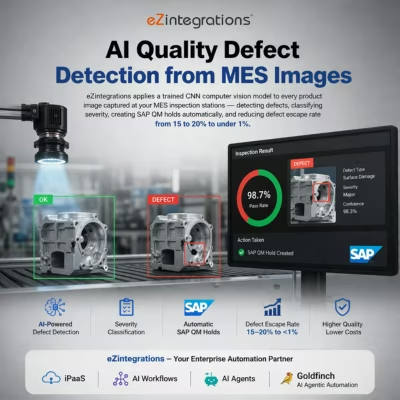
AI visual quality inspection from eZintegrations applies a trained CNN computer vision model to every product image captured at your MES inspection stations — detecting defects, classifying severity, creating SAP QM holds automatically, and reducing defect escape rate from 15 to 20% to under 1%. eZintegrations is an enterprise automation platform covering iPaaS, AI Workflows, AI Agents, and Goldfinch AI agentic automation.
What Is AI Visual Quality Inspection?
AI visual quality inspection applies deep learning computer vision — specifically convolutional neural network (CNN) models trained on labeled images of defective and defect-free product — to detect and classify manufacturing defects automatically at inspection station speed. Unlike manual visual inspection (which is rate-limited by inspector speed and degraded by fatigue) or traditional machine vision (which uses rule-based thresholds for specific defect types), AI visual inspection models learn complex defect patterns from thousands of training examples and generalize to novel defect presentations without manual rule reprogramming.
How Does AI Visual Quality Inspection Work to Automatically Detect Defects from MES Inspection Images and Create ERP Quality Holds?
When a product reaches the inspection station on the production line, the inspection camera captures an image and sends it via REST API to the eZintegrations AI visual quality inspection pipeline. Goldfinch AI Data Analysis runs the CNN model and classifies the image — pass, or fail with defect type and severity. For defective items above the 0.85 confidence threshold, Goldfinch AI Watcher Tools immediately creates a hold flag in Siemens Opcenter MES and a QC hold record in SAP QM. The unit is removed from the production flow before it can escape downstream. The defect data — image, defect type, severity, confidence, station, lot — is logged to Snowflake. The weekly quality dashboard and root cause report are built by Goldfinch AI Data Analytics from the accumulated defect data.
AIAG benchmarks the average automotive recall at $8 million. AI visual quality inspection makes the defect detection problem a solved problem rather than a statistical risk.
Watch Demo
| Video Title: | AI Visual Quality Inspection |
|---|---|
| Duration: | 3 to 5 minutes |
Outcome & Benefits
| Accuracy: | 98%+ defect detection accuracy on trained defect types; false negative rate under 0.8%; false positive rate under 3% at 0.85 confidence threshold; validated on minimum 2,000 labeled defect images per defect type per customer production line |
|---|---|
| Touchless Rate: | High-confidence detections (above 0.85) – MES hold and SAP QM hold created automatically without Quality Engineer review. Medium-confidence (0.70 to 0.84) – Quality Engineer review required. 100% inspection coverage vs. 10 to 20% sampling with manual inspection. Approximately 90 to 95% of inspection decisions made without human review at typical production confidence distributions. |
| Time Saved: | Inspection cycle time from 8 to 20 seconds (manual) to under 500 milliseconds per image; 100% coverage vs. statistical sampling; Quality Engineer visual inspection time eliminated; weekly quality report from 2 to 4 hours of manual data compilation to automated Goldfinch AI dashboard |
| Cost Saved: | $2.5M to $3.5M annual avoided quality cost per production line from defect escape reduction (10,000 units/day x 15 to 20% escape rate reduction x $50 downstream rework/warranty cost per escaped defect); recall risk reduction value depends on product and industry but is quantified at $8M per automotive recall event (AIAG) and $50M to $500M per medical device withdrawal |
Performance Metrics
| Metric | Before (Manual/Batch) | After (Real-Time Sync) | Improvement |
|---|---|---|---|
| Defect Escape Rate | 15 to 20% | Under 1% | 90%+ reduction |
| Inspection Coverage | 10 to 20% (statistical sample) | 100% of units | Full coverage |
| Inspection Cycle Time | 8 to 20 sec per unit | Under 500 ms per image | 97%+ faster |
| Quality Engineer Visual Inspection Hours | 4 to 8 hours/shift | Under 30 min (review flags only) | 90%+ reduction |
Functional Details
| Business Tasks: | Real-time product image capture and API submission from MES inspection stations; CNN-based defect detection and classification per image; defect severity classification (Minor/Major/Critical); MES hold flag creation in Siemens Opcenter for defective units; QC hold record creation in SAP QM with defect type; severity; and image reference; SPC defect rate monitoring and process alert trigger when threshold exceeded; defect data logging to Snowflake quality data warehouse (image metadata; defect type; severity; station; lot; product; timestamp); weekly quality trend dashboard and root cause report generation in Goldfinch AI Data Analytics; monthly model accuracy report and retraining notification when accuracy falls below 96% |
|---|---|
| KPI Improved: | Defect escape rate; defect detection rate; false negative rate; inspection coverage (%); quality hold cycle time (time from defect to MES hold); rework cost per unit; warranty claim rate; cost of poor quality (COPQ); customer complaint rate; process sigma level (DPMO) |
| Scheduling: | Continuous real-time inspection – each image processed within 500 milliseconds of API submission from the MES inspection station trigger; Watcher Tools evaluates each defect classification in real time for MES/ERP hold triggering; SPC monitoring evaluates defect rate per shift against the configured threshold; weekly root cause report and quality trend dashboard generated every Monday at 6:00 AM; monthly model accuracy audit comparing AI classifications vs. Quality Engineer overrides; model retraining triggered when false negative rate exceeds 1.5% in the monthly audit |
| Downstream Use: | MES hold flags created in Siemens Opcenter (https://www.sw.siemens.com/en-US/technology/mes/) for defective units – units automatically removed from production flow; QC hold records created in SAP QM (https://help.sap.com/docs/SAP_S4HANA_ON-PREMISE) with defect type; severity classification; and inspection image reference; defect data written to Snowflake quality data warehouse for SPC analysis; root cause correlation; and model retraining; weekly quality trend dashboard and root cause report delivered to Quality Engineer and Quality Manager via Goldfinch AI Data Analytics; defect data available to Siemens Teamcenter or PLM system for engineering change requests; Quality Manager CAPA (Corrective and Preventive Action) system fed by weekly root cause report findings |
Technical Details
| Model Name/Version: | ResNet-50 (https://arxiv.org/abs/1512.03385) or EfficientNet-B4 (https://arxiv.org/abs/1905.11946) CNN backbone with a custom defect classification head – specific architecture selected per product line based on defect complexity and image resolution requirements; trained on customer’s labeled production images using transfer learning from ImageNet pre-trained weights; executed via Goldfinch AI Data Analysis within eZintegrations; model trained per product family with minimum 2,000 labeled defect images per defect type per class (pass; and each defect type variant); defect taxonomy configured per product line (6 to 20 defect types typical) |
|---|---|
| Hosting Type: | Cloud-hosted on Oracle OCI via eZintegrations; Goldfinch AI Data Analysis executes CNN inference in customer-isolated tenant; images transmitted to eZintegrations via REST API from MES inspection station edge controller or camera API; images processed in memory and inspection results returned to MES within 500 milliseconds; images stored in customer’s Snowflake instance (https://docs.snowflake.com/) or configured object storage per data retention policy (not retained in eZintegrations beyond the inference call); on-premises MES; ERP; and SCADA systems connect via IPSec Tunnel |
| Prompt Strategy: | N/A – ResNet/EfficientNet CNN models are deterministic computer vision models; not LLM-based. No text prompting involved in the defect classification pipeline. Goldfinch AI Data Analytics uses a structured template for root cause report generation – this step may use LLM-based summarization for the root cause narrative; configurable. Goldfinch AI Watcher Tools uses configured SPC threshold rules (3% defect rate per shift default) as deterministic monitoring triggers. |
| Guardrails: | CNN confidence score below 0.70: Quality Engineer full manual review with AI preliminary assessment as context – no automatic MES or ERP action. Confidence 0.70 to 0.84 (Medium): Review Flag in MES inspection queue – Quality Engineer confirms or overrides before hold is created. Confidence above 0.85 (High): automatic MES hold and SAP QM hold created. All Critical severity classifications (regardless of confidence): Quality Manager escalation required with acknowledgment before production line process adjustment. False negative audit: if monthly Quality Engineer override rate on AI pass classifications exceeds 1.5%; automatic model retraining notification sent to Quality Manager. Production volume guardrail: if inspection API latency exceeds 800ms (risk to line speed); alert sent to IT Operations for capacity review. |
| Latency: | Under 500 milliseconds per image from REST API submission to inspection result returned to MES and Watcher Tools threshold evaluation; under 2 seconds from defect detection to MES hold flag creation and SAP QM QC hold creation; under 10 seconds from defect detection to Production Supervisor alert delivery via SMTP or Teams |
| Data Governance: | Product inspection images processed in customer-isolated eZintegrations tenant – not shared cross-tenant. Images transmitted via TLS-encrypted API and processed in memory – not stored in eZintegrations after inference; image metadata (defect type; confidence; station; lot; product ID) written to Snowflake per customer data retention policy. CNN model trained on customer’s production data – model weights stored in customer-isolated Goldfinch AI environment; no cross-tenant model sharing. Product IP in inspection images protected by in-tenant processing without external AI provider transmission (CNN model runs within eZintegrations tenant; not sent to Azure OpenAI or external LLM). Full audit trail per inspection event: timestamp; product ID; lot number; station ID; classification result; confidence score; defect type; severity; human review outcome (if triggered); and ERP/MES action taken. |
| Throughput: | Up to 200 inspections per minute per production line at standard configuration (12,000 units per hour at sub-500ms inference); scales to 1,200 inspections per minute across 6 simultaneous production lines at enterprise tier; supports burst inspection rates for high-speed lines (electronics surface mount inspection up to 10,000 boards per hour) |
Connectivity and Deployment
| Supported Protocols: | REST API (MES inspection station image submission + MES hold flag creation + SAP QM QC hold creation); HTTPS; OAuth 2.0; Microsoft Teams Webhook (quality process alerts); SMTP (Production Supervisor and Quality Manager notifications); JDBC (Snowflake quality DW write); IPSec Tunnel (on-premises MES; ERP; SCADA connectivity); OPC-UA (inspection station trigger signal integration for on-premises edge deployments) |
|---|---|
| Security & Compliance: | HIPAA-eligible configuration available (medical device manufacturing with patient-adjacent production data); GDPR-compliant data handling (no personal data in product inspection images – product images only); SOC Type II certified; FDA 21 CFR Part 11 compliant audit trail capability (for pharmaceutical and medical device customers); ISO 9001 and IATF 16949 compatible inspection record format. TLS 1.3 encryption in transit; AES-256 at rest. Product inspection images processed in isolated tenant – no external AI provider transmission of production images. RBAC enforced on defect taxonomy configuration; confidence threshold settings; SPC alarm parameters; and Snowflake quality data access. |
| Tenancy Model: | Both single-tenant and multi-tenant deployments are available. Single-tenant is strongly recommended for automotive; aerospace; medical device; and pharmaceutical manufacturers with IP protection requirements; regulatory audit obligations (FDA; IATF 16949; AS9100); or contractual product image confidentiality requirements with OEM customers. Multi-tenant is the default shared-cloud deployment. Both support on-premises connectivity via IPSec Tunnel. |
| On-Premise Supported: | Yes – eZintegrations connects to on-premises Siemens Opcenter MES; SAP QM; SCADA historian databases; and MSSQL quality databases via IPSec Tunnel. eZintegrations is a browser-based; cloud-hosted platform and does not require any on-premises software installation. |
FAQ
1. What is the AI Quality Defect Detection from MES Images workflow?
AI visual quality inspection by eZintegrations receives product images from inspection station cameras at each MES trigger point, runs a trained CNN computer vision model via Goldfinch AI Data Analysis to detect and classify defects (type and severity), automatically creates hold flags in Siemens Opcenter MES and QC holds in SAP QM for defective units, and generates weekly quality trend dashboards and root cause reports via Goldfinch AI Data Analytics. The workflow achieves 98%+ defect detection accuracy with under 0.8% false negative rate, reducing defect escape rate from 15 to 20% to under 1%.
2. What AI model types does the AI visual quality inspection workflow use?
This workflow uses a CNN-based computer vision model (ResNet-50 or EfficientNet-B4 backbone, selected per product line based on defect complexity and image resolution) trained on the customer's labeled production images using transfer learning from ImageNet pre-trained weights — executed via Goldfinch AI Data Analysis. The model detects defect presence and classifies defect type (from the configured taxonomy per product line) and severity (Minor/Major/Critical) from each inspection image. Minimum 2,000 labeled defect images per defect type are required for training per product family.
3. What input data does the AI visual quality inspection workflow require?
This workflow requires product images captured at inspection station cameras (RGB or grayscale, minimum 1MP resolution for surface defect detection, 5MP+ for dimensional inspection) submitted via REST API from the MES inspection station trigger point; product ID and batch/lot number as image metadata; and a labeled training image dataset (minimum 2,000 images per defect type per product family) for initial model training. The defect taxonomy (defect type names and severity classification rules) is configured per product line by the Quality Engineer.
4. What is the output format of the AI visual quality inspection workflow?
The workflow produces a per-image inspection result: pass/fail classification, defect type label, severity (Minor/Major/Critical), confidence score (0 to 1.0), bounding box coordinates of the defect region, and inspection timestamp. Defective units trigger a MES hold flag in Siemens Opcenter and a QC hold record in SAP QM with defect details. Defect data is written to Snowflake. The weekly Goldfinch AI Data Analytics dashboard shows defect type distribution, severity heatmap by shift, SPC control charts, and root cause candidates ranked by process parameter correlation.
5. Who uses the AI visual quality inspection workflow?
Quality Engineers configure the defect taxonomy, confidence thresholds, and SPC parameters, and review medium-confidence classification flags in the MES inspection queue using the Goldfinch AI dashboard. Production Supervisors receive SPC process alerts when the shift defect rate exceeds the configured threshold and use the real-time defect rate dashboard to identify production line issues. Quality Managers receive Critical severity escalations and use the weekly root cause report for CAPA (Corrective and Preventive Action) planning.
6. What are the key benefits of AI visual quality inspection?
Key benefits include 98%+ defect detection accuracy (vs. 80 to 85% with manual inspection), defect escape rate reduced from 15 to 20% to under 1%, 100% inspection coverage (vs. 10 to 20% statistical sampling), inspection cycle time under 500 milliseconds per image (vs. 8 to 20 seconds manual), $2.5M to $3.5M annual avoided quality cost per production line, and elimination of recall risk from defect escapes valued at $8M per automotive recall event (AIAG). Quality Engineers spend time on root cause analysis and process improvement rather than manual inspection.
7. What systems does the AI visual quality inspection workflow integrate with?
This workflow integrates with inspection station cameras via REST API for image submission, Siemens Opcenter MES for hold flag creation, SAP S/4HANA Quality Management (QM module) for QC hold record creation, Snowflake for quality data warehouse logging, and Microsoft Teams and SMTP for process alerts and Quality Manager notifications. On-premises MES, ERP, SCADA, and OPC-UA edge devices connect via IPSec Tunnel.
8. How often does the AI visual quality inspection workflow run?
The workflow runs continuously in real time — each image is processed within 500 milliseconds of API submission from the MES inspection station trigger, at the production line's natural throughput rate. Watcher Tools evaluates the defect classification and SPC defect rate after each inspection event. The weekly root cause report and quality trend dashboard are generated every Monday at 6:00 AM. Model retraining is triggered monthly or when the false negative rate exceeds 1.5% in the monthly accuracy audit.
AI Credits
| LLM Steps Count: | Up to 3 per inspection event (Data Analysis CNN inference per image + Watcher Tools monitoring per inspection + Data Analytics dashboard generation per weekly report cycle); Data Analytics root cause narrative may optionally use LLM summarization (configurable; additional credits if enabled) |
|---|---|
| Credit Consumption Model: | Per image inspected for Data Analysis (flat per-inference); per inspection event for Watcher Tools (low per-event monitoring cost); per weekly report generation for Data Analytics (fixed per report) |
| Estimated Credits per Run: | Single image inspection (standard resolution 1MP to 5MP): ~3 to 6 credits per image (Data Analysis: ~3-5; Watcher Tools: ~0.5) Weekly root cause report (covering 50,000 to 100,000 inspections per week): ~20 to 40 credits per report Production line at 1,000 images per hour; 8-hour shift: ~25,000 to 50,000 credits per shift |
| Monthly Credit Estimate (at Typical Volume): | Small production line (500 inspections/hour; 8-hour shift; 20 shifts/month): ~240,000 to 480,000 credits per month Mid-volume electronics line (2,000 inspections/hour; 16-hour shift; 22 shifts/month): ~2,100,000 to 4,200,000 credits per month Note: High-volume AI visual inspection is credit-intensive at scale. Enterprise customers benefit from volume pricing tiers. Discuss credit volume pricing with eZintegrations for production-volume inspection deployments. |
| Pricing Model: | Static Platform Fee + AI Credits. Platform fee covers unlimited non-LLM steps (MES API trigger; image preprocessing; ERP hold creation; Teams/SMTP alert; Snowflake DW write). AI Credits consumed only by Goldfinch AI Data Analysis (CNN inference); Watcher Tools (monitoring); and Data Analytics (reporting). |
| Credit Optimization Notes: | Implement a pre-screening step using a lightweight binary anomaly detection model (lower credit cost) before running the full defect classification model – skip the full CNN inference for images that pass the lightweight pre-screen with high confidence (typical quality parts). This reduces full CNN inference credit consumption by 30 to 60% on production lines with low overall defect rates (under 5%). Configure inspection intervals for non-critical stations at 2 of every 3 units rather than every unit (statistical sampling for lower-risk stations); reserving 100% inspection for critical dimensions and safety-relevant features. Use dedicated inference batching for high-speed lines (batch 5 to 10 images per API call) to reduce per-image API overhead credit cost. |
| Goldfinch AI Tool(s) Consuming Credits: | Data Analysis: executes CNN computer vision model inference on each inspection image – credits per image (flat per-inference cost; scales with image resolution and model complexity) Watcher Tools: monitors defect classification outputs and SPC defect rate in real time – credits per inspection cycle (very low per-image monitoring cost) Data Analytics with Charts/Graphs/Dashboards: generates weekly quality trend dashboard and root cause report – credits per report generation (weekly; fixed cost per report regardless of defect volume) |
| AI Credits Required: | Yes – three Goldfinch AI tools invoked per inspection cycle: Data Analysis (computer vision model inference per image), Watcher Tools (continuous defect rate and threshold monitoring), and Data Analytics with Charts/Graphs/Dashboards (weekly root cause report generation). AI Credits consumed per image inspected and per report generated. |
Resources
| Blog: | AI Workflow Automation for Enterprise: The Definitive Platform Guide |
|---|---|
| Goldfinch AI Overview: | Agentic AI Platform — Goldfinch AI by eZintegrations |
| Platform Overview: | eZintegrations Platform – Enterprise iPaaS, AI Workflows & Agentic AI |
| Demo: | Book a Demo |
Case Study
| Problem: | A Tier 2 automotive electronics supplier manufactured printed circuit board assemblies (PCBAs) for ADAS (Advanced Driver Assistance Systems) modules. The production line ran 2,400 boards per 8-hour shift across 4 inspection stations. Manual visual inspection was performed on a 15% statistical sample (360 boards per shift) by 3 Quality Inspectors – one per inspection area. Internal audit revealed a 16.4% surface defect escape rate on the non-sampled population; discovered during AOI (Automated Optical Inspection) at the customer’s assembly facility. Customer-level escapes had triggered two formal 8D reports in the prior 12 months and were flagged as a supplier qualification risk. Each Quality Inspector spent 7.2 hours per shift on visual inspection – leaving 45 minutes per shift for documentation and root cause activities. |
|---|---|
| Solution: | Deployed eZintegrations AI visual quality inspection in 12 business days across 4 inspection stations. Existing inspection station cameras (5MP; 2 cameras per station) connected via REST API to the eZintegrations image pipeline. Goldfinch AI Data Analysis configured with EfficientNet-B4 backbone trained on 8,400 labeled PCBA images (6 defect types: solder bridge; missing component; misaligned component; solder ball; board scratch; flux residue). Confidence thresholds: 0.85 High (auto-hold); 0.70 Medium (Quality Engineer review flag). Siemens Opcenter MES hold flag creation configured. SAP QM QC hold record creation configured. SPC alert threshold: 3% defect rate per shift triggers Production Supervisor notification. Goldfinch AI Data Analytics weekly dashboard and root cause report configured. Snowflake quality data warehouse configured for defect data logging. |
| ROI: | Customer escape claim costs eliminated: $380,000 (estimated 8D report remediation + component replacement + inspection audit costs for prior-year incidents). Quality Inspector time reallocation: 3 inspectors x 6.4 hours per shift recovered x 220 shifts per year x $26/hour = $109,000 annual labor reallocation value. Supplier qualification risk eliminated: estimated $2.4M contract retention value (customer had indicated qualification review risk). Total year-1 |
| Industry: | Automotive; Electronics; Medical Devices; Aerospace; Pharmaceuticals |
| Outcome: | Under 1% defect escape rate (vs. 15 to 20% with manual inspection), 98%+ defect detection accuracy on trained defect types, 100% inspection coverage (no sampling — every unit inspected), inspection cycle time under 500 milliseconds per image, 60 to 80% reduction in quality-related rework and warranty claims |