How to Optimize Procurement Spend Using an Autonomous AI Agent
$150.00
Autonomous Spend Optimization Agent Autonomously monitor enterprise spend data in Snowflake DW weekly; identify tail spend consolidation opportunities; detect contract leakage (spending with non-contracted suppliers or above contracted rates); compare contracted pricing against current market rates; prepare Ariba sourcing events and RFPs; score supplier responses; recommend award decisions; route for CPO approval; update ERP with approved pricing; and track savings realization vs. target – turning spend analysis insights into executed procurement actions rather than unimplemented recommendations in reports Spend optimization cycle from identifying an opportunity to executing the sourcing action compressed from weeks to days; 3 to 12% savings on addressable spend (McKinsey procurement analytics benchmark); 100% of identified spend optimization opportunities actioned vs. the 20 to 30% that are typically acted on from static spend analysis reports; contract leakage eliminated through continuous detection and sourcing response Chief Procurement Officer (CPO); Category Manager; Sourcing Manager; VP of Procurement AI Agent (autonomous; goal-oriented; action-oriented – the agent does not produce reports for humans to act on; it identifies opportunities; prepares the sourcing actions; and executes the approved ones; tracking realized savings vs. target without requiring the Procurement team to maintain a separate savings tracker) Yes – eZintegrations connects to on-premises systems (SAP MM on-prem; SAP FI on-prem; Oracle EBS; Ariba on-prem; Coupa on-prem; and others) via IPSec Tunnel. eZintegrations is a browser-based; cloud-hosted platform and does not require any on-premises installation. JDBC (Snowflake DW spend data); REST API (SAP Ariba sourcing and SRM; Coupa; Salesforce); OData v2/v4 (SAP FI and SAP MM); SMTP (Sourcing Manager notifications; CPO approval routing; supplier RFP distribution); HTTPS; OAuth 2.0; Web Crawling (market price benchmarks; supplier financial health); IPSec Tunnel (on-premises SAP FI; SAP MM; Oracle EBS; and Ariba connectivity) Both single-tenant and multi-tenant deployments are available. Single-tenant is strongly recommended for organizations where spend data; pricing contracts; and RFP responses are commercially sensitive. Multi-tenant is the default shared-cloud deployment. Both support on-premises ERP and SRM connectivity via IPSec Tunnel. Manufacturing; Healthcare; Government; Financial Services; Retail 3 to 12% savings on addressable spend; 100% of identified opportunities actioned within the configured cycle; contract leakage eliminated through continuous detection; savings realization tracked automatically vs. target in Snowflake DW AI spend optimization agent; procurement savings AI agent; spend optimization automation; Goldfinch AI procurement; CPO savings AI; contract leakage detection AI; Ariba sourcing AI agent; tail spend consolidation AI; category management AI agent; RFP automation AI; SAP spend optimization agent; procurement ROI AI Yes – the AI spend optimization agent invokes multiple Goldfinch AI tools per weekly cycle and per sourcing event: Data Analysis (weekly spend opportunity identification and supplier response scoring); API Tool Call (DW and ERP data queries + Ariba sourcing event creation + ERP pricing update); Knowledge Base Vector Search (category strategy and benchmark retrieval); Document Intelligence (supplier quote analysis and contract document verification); Web Crawling (market benchmark price gathering); Data Analytics with Charts/Graphs/Dashboards (opportunity dashboard and savings tracking); and Integration Workflow as Tool (CPO approval routing; ERP pricing update; and Ariba supplier notification sub-workflows). Credits consumed per weekly spend analysis cycle and per sourcing event progressed through the lifecycle. API Tool Call: Queries Snowflake DW for weekly AP transaction spend data and ERP contract pricing records; creates sourcing events and RFPs in SAP Ariba sourcing module with the correct commodity, spend data, and requirements; retrieves supplier quote responses from Ariba when the RFP response period closes; updates SAP FI and SAP MM with approved new pricing and preferred supplier configurations when the CPO approves the award decision; and creates the savings realization tracking record in Snowflake DW per sourcing event, Data Analysis: Executes the weekly spend optimization analysis on the Snowflake DW spend data – identifying tail spend suppliers with consolidation potential (multiple suppliers for the same commodity with total spend below the rationalization threshold), detecting contract leakage (spend with non-contracted suppliers in categories with existing contracts, or spend above contracted pricing tiers), comparing contracted unit pricing against current market benchmarks, computing the savings opportunity per identified optimization category, and scoring sourcing event prioritization by estimated savings potential vs. effort required, Data Analytics with Charts/Graphs/Dashboards: Generates the spend optimization opportunity dashboard – showing identified opportunities ranked by savings potential, sourcing event status per opportunity (identified, RFP prepared, responses received, award recommended, approved, savings realized), contract leakage rate by category, and cumulative savings realization vs. the Procurement team’s annual savings target; also generates the supplier response comparison scorecard for the CPO award review, Document Intelligence: Analyzes incoming supplier RFP quote responses – extracting structured bid data (quoted unit prices, volume tier pricing, lead times, payment terms, quality certifications, delivery scope) and any qualitative differentiation claims from supplier narrative sections; also analyzes existing supplier contracts when the contract leakage detection identifies a pricing deviation – confirming the contracted rate from the contract document vs. the invoiced rate from the spend data, Integration Workflow as Tool: Calls the CPO approval routing sub-workflow (routes the recommended award decision and supporting analysis to the CPO or authorized approver based on the deal value and category authorization matrix); calls the ERP pricing update sub-workflow (updates SAP FI vendor pricing conditions and SAP MM purchasing info records with approved new pricing); and calls the Ariba supplier notification sub-workflow (notifies winning and non-winning suppliers of the award decision per the Ariba sourcing event closure workflow), Knowledge Base Vector Search: Retrieves the category sourcing strategy, should-cost models, market benchmark pricing, and prior sourcing event outcomes for the commodity being optimized – ensuring the RFP requirements and evaluation criteria reflect the category’s documented sourcing strategy rather than generic requirements; also retrieves the CPO’s approved savings threshold and sourcing event initiation authorization rules (which spend levels and category types require CPO approval vs. Category Manager authority), Web Crawling: Crawls commodity and category market price sources – industry pricing indices (Platts, LME, Bloomberg commodity, or category-specific indices), trade association pricing surveys, competitor supplier pricing announcements, and category-specific market intelligence publications – to provide an independent market benchmark for the should-cost comparison against contracted pricingWorkflow Name: Purpose: Benefit: Who Uses It: System Type: On-Premise Supported: Supported Protocols: Tenancy Model: Industry: Outcome: Tags: AI Credits Required: Goldfinch AI Tool(s) Used:
Enterprise Procurement teams receive spend analysis reports showing 3 to 12% savings opportunities – and act on fewer than 25% of them. McKinsey procurement research documents this implementation gap: organizations consistently identify more savings opportunities than they have Category Manager bandwidth to execute. Tail spend consolidation recommendations sit unactioned because no single Category Manager owns the tail. Contract leakage (spending above contracted rates or with non-contracted suppliers) is identified in quarterly spend reviews and noted in presentations – but corrective sourcing actions are deferred because sourcing events take weeks to prepare and there are higher-priority strategic categories requiring attention. The result: Procurement organizations that spend significant budget on spend analytics platforms receive insights that do not translate to realized savings because the action execution capacity is the bottleneck; not the identification capacity. The Autonomous Spend Optimization Agent from eZintegrations closes the gap between spend analysis insight and executed procurement action. Goldfinch AI Data Analysis runs the weekly spend optimization analysis on Snowflake DW data – identifying tail spend consolidation opportunities and contract leakage. Goldfinch AI Web Crawling gathers market price benchmarks. For each identified opportunity above the configured threshold; the agent automatically prepares a sourcing event or RFP in SAP Ariba via API Tool Call. Goldfinch AI Document Intelligence scores supplier quote responses. Data Analysis recommends the award. Integration Workflow as Tool routes the recommendation to the CPO for approval. On approval; API Tool Call updates SAP FI and SAP MM with new pricing. Data Analytics tracks savings realization. Automated savings realization tracking: Every approved award is tracked in Snowflake DW – comparing pre-award contracted pricing against post-award pricing for all subsequent purchase orders – so the CPO’s annual savings target is tracked against realized savings in real time, not estimated savings from award announcements, Continuous spend opportunity identification: Data Analysis executes weekly against the Snowflake DW AP transaction data – identifying tail spend consolidation opportunities, contract leakage, and contracted-vs-market pricing gaps on a continuous basis rather than requiring a quarterly consulting engagement or manual spend review cycle: Automatic sourcing event preparation: For each opportunity above the configured savings threshold, the agent automatically prepares and launches the Ariba sourcing event – including the commodity requirements, evaluation criteria from the category strategy knowledge base, and supplier invite list – converting an identified opportunity into an active sourcing event without Category Manager manual preparation, Supplier response scoring with market benchmark: Goldfinch AI Document Intelligence extracts structured bid data from supplier RFP responses and Data Analysis scores each response against the market benchmark (from Web Crawling), the category evaluation criteria, and the prior supplier performance record – producing a ranked award recommendation rather than a spreadsheet of raw responses for the Sourcing Manager to manually compare; CPO approval routing with full context: The award recommendation is routed to the CPO or authorized approver via Integration Workflow as Tool with the full supporting analysis – spend data, market benchmark comparison, supplier scorecard, savings impact, and the recommended award rationale – enabling a data-complete approval decision in minutes rather than requiring the approver to request additional context from the Sourcing Manage 3 to 12% savings on addressable spend (McKinsey procurement analytics); 100% of identified spend optimization opportunities converted to sourcing actions (vs. 20 to 25% with manual Procurement bandwidth as the constraint); contract leakage eliminated through continuous weekly detection and automated corrective sourcing; CPO annual savings target tracked in real time against realized savings per award Category Manager sourcing event preparation from 2 to 4 weeks per event to hours (AI-prepared RFP with category-strategy-aligned requirements); Sourcing Manager supplier response evaluation from days of spreadsheet comparison to structured AI-scored supplier scorecard; CPO savings reporting from manual monthly compilation to automated real-time Snowflake DW dashboard 3 to 12% savings on addressable spend. At $50M addressable spend: 3% = $1.5M; 12% = $6M annually. McKinsey research: organizations that automate the spend-analysis-to-sourcing-action loop realize 2x the savings of organizations that rely on manual execution of spend analysis recommendations. Contract leakage correction: organizations with ERP-enforced preferred supplier pricing and contracted rates eliminate 1 to 3% of total spend lost to non-contracted purchases – $500,000 to $1.5M at $50M AP spend. Spend analytics platform consolidation: the agent replaces standalone spend analytics subscription fees (typically $80,000 to $250,000 annually for mid-enterprise) with integrated analysis and action capability. SOC Type II certified; GDPR-compliant procurement data handling (supplier pricing; AP spend data; and RFP content processed under GDPR Article 6 legitimate interest for commercial procurement purposes); HIPAA-eligible configuration for healthcare procurement (clinical supply and GPO pricing data handling). Spend data and supplier pricing processed in customer-isolated eZintegrations tenant. RFP content and supplier bid data stored per the organization’s procurement confidentiality policy. RBAC enforced on spend data access (Sourcing Manager and CPO level); Ariba sourcing event creation authority; ERP pricing update scope (agent cannot update ERP pricing without CPO approval for all awards above the configured autonomous authority threshold); and savings tracking dashboard access.Problem Before: Solution Overview: Key Features: Business Impact: Productivity Gain: Cost Savings: Security & Compliance:
Description
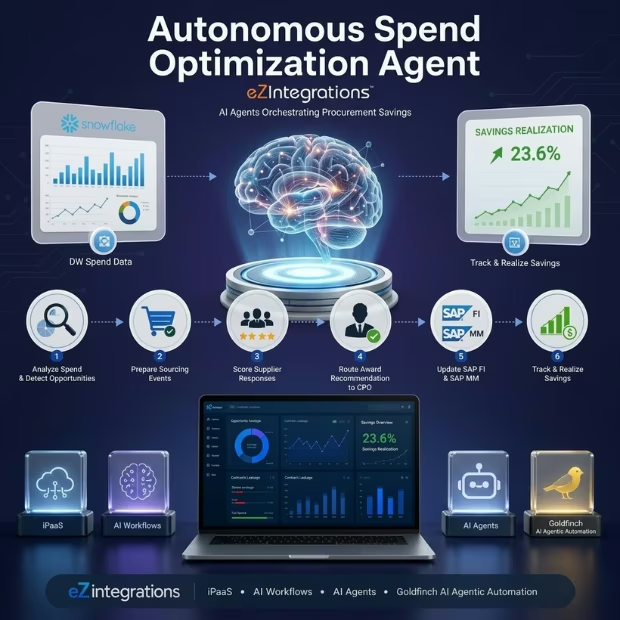
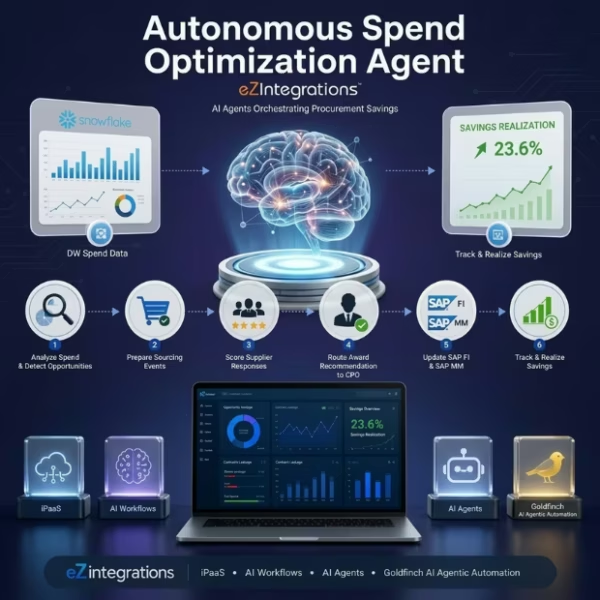
The AI spend optimization agent from eZintegrations analyzes Snowflake DW spend data weekly, identifies tail spend consolidation opportunities and contract leakage, automatically prepares Ariba sourcing events, scores supplier responses, routes award recommendations to the CPO, updates SAP FI and SAP MM with approved pricing, and tracks savings realization – turning spend analysis insights into executed procurement savings without Category Manager manual intervention. eZintegrations is an enterprise automation platform covering iPaaS, AI Workflows, AI Agents, and Goldfinch AI agentic automation.
What Is an AI Spend Optimization Agent?
An AI spend optimization agent is an AI Agent that takes continuous spend data analysis as its goal and autonomously executes the full opportunity-identification-to-savings-realized cycle – identifying tail spend consolidation opportunities and contract leakage in the spend DW, gathering market benchmarks, preparing Ariba sourcing events, scoring supplier responses, routing award recommendations to the CPO, updating ERP pricing on approval, and tracking realized savings. Where spend analytics platforms produce reports for humans to act on, the AI spend optimization agent converts identified opportunities into executed procurement actions – closing the implementation gap that leaves most identified savings unrealized.
How Does an AI Spend Optimization Agent Identify Savings Opportunities, Prepare Sourcing Events, and Track Realized Savings Without Manual Procurement Team Intervention?
The AI spend optimization agent runs the weekly spend analysis via Goldfinch AI Data Analysis on Snowflake DW data. For each identified opportunity, Web Crawling gathers market price benchmarks and Knowledge Base Vector Search retrieves the category sourcing strategy. The agent prepares and launches the Ariba sourcing event via API Tool Call. Goldfinch AI Document Intelligence scores supplier responses. Data Analysis generates the award recommendation. Integration Workflow as Tool routes to the CPO for approval. On approval, API Tool Call updates SAP FI and SAP MM pricing. Data Analytics generates the savings realization dashboard.
McKinsey documents that organizations automating the analysis-to-action loop realize 2x the savings of those relying on manual execution. This AI spend optimization agent closes that execution gap.
Watch Demo
| Video Title: | AI Spend Optimization Agent |
|---|---|
| Duration: | 6 to 8 minutes |
Outcome & Benefits
| Throughput: | Weekly spend optimization analysis across full AP transaction spend in Snowflake DW; up to 20 concurrent sourcing events managed simultaneously at standard; scales to 200+ concurrent events at enterprise tier for large category portfolios |
|---|---|
| Cost Reduction: | 3 to 12% savings on addressable spend (McKinsey); $1.5M to $6M at $50M addressable spend; 1 to 3% contract leakage elimination = $500K to $1.5M at $50M AP spend; $80K to $250K spend analytics platform consolidation |
| Accuracy: | Spend opportunity identification completeness: 100% of AP transactions analyzed weekly vs. quarterly manual spot-check coverage; supplier response scoring agreement with Sourcing Manager manual evaluation: 89%+; contract leakage detection precision: 94%+ (correctly identifying spend with non-contracted suppliers or above contracted pricing) |
| Time Saved: | Spend opportunity identification from quarterly (manual analysis) to weekly (continuous automated); Category Manager sourcing event preparation from 2 to 4 weeks to hours; Sourcing Manager supplier response evaluation from days to hours; CPO savings reporting from manual monthly compilation to real-time dashboard |
Performance Metrics
| Metric | Before (Manual/Batch) | After (Real-Time Sync) | Improvement |
|---|---|---|---|
| Opportunities Actioned | 20 to 25% of identified opportunities | 100% of identified opportunities | 4x action rate |
| Sourcing Event Preparation | 2 to 4 weeks per event | Hours (AI-prepared) | 95%+ faster |
| Contract Leakage Detection | Quarterly manual review | Weekly automated detection | Continuous coverage |
| Savings Tracking | Manual monthly CPO report | Real-time Snowflake DW dashboard | Always current |
FAQ
1. What is the Autonomous Spend Optimization Agent?
The AI spend optimization agent by eZintegrations analyzes Snowflake DW spend data weekly via Goldfinch AI Data Analysis — identifying tail spend consolidation opportunities, contract leakage, and contracted-vs-market pricing gaps. For each opportunity above the configured threshold, the agent automatically prepares and launches an Ariba sourcing event via API Tool Call, scores supplier responses via Document Intelligence and Data Analysis, routes the award recommendation to the CPO via Integration Workflow as Tool, updates SAP FI and SAP MM pricing on approval, and tracks savings realization in Snowflake DW via Data Analytics. McKinsey: organizations automating the analysis-to-action loop realize 2x the savings of those relying on manual execution.
2. How does the agent handle task orchestration?
The AI spend optimization agent uses a threshold-gated action model — identified opportunities are scored by savings potential and implementation effort; opportunities above the configured minimum savings threshold are automatically progressed to sourcing event preparation. Multiple concurrent sourcing events progress through the lifecycle independently (one in RFP preparation, one in response scoring, one in CPO approval routing). Watcher Tools monitors Ariba for supplier response submissions continuously, triggering scoring when the response period closes. The agent maintains savings realization tracking per approved award by comparing pre- and post-award AP invoice pricing.
3. What Goldfinch AI tools does the AI spend optimization agent use?
Seven native Goldfinch AI tools: Data Analysis (weekly spend opportunity identification + supplier response scoring and award recommendation), API Tool Call (Snowflake DW and ERP data queries + Ariba sourcing event creation + ERP pricing update), Knowledge Base Vector Search (category sourcing strategy and benchmark retrieval per opportunity), Document Intelligence (supplier RFP quote response analysis + contract leakage document verification), Web Crawling (commodity market benchmark price gathering), Data Analytics with Charts/Graphs/Dashboards (spend opportunity dashboard + savings realization tracking), and Integration Workflow as Tool (CPO approval routing, ERP pricing update, Ariba supplier notification sub-workflows). Goldfinch AI is self-service extensible — your Procurement team adds GPO pricing databases, ESG scoring APIs, or customs data without coding.
4. Can the AI spend optimization agent be customized for my procurement process?
Yes — all parameters configurable via eZintegrations no-code Agent Builder: spend analysis frequency (weekly default), minimum savings threshold for automatic sourcing event initiation, tail spend rationalization criteria, contract leakage detection parameters, market benchmark data sources, sourcing event template library per category type (Category Managers manage in Goldfinch AI Knowledge Base editor), CPO authorization matrix (deal value and category thresholds), ERP pricing update scope, and savings realization tracking methodology. Procurement Operations manages category strategies and approval thresholds without IT involvement.
5. How is data validated before the agent creates sourcing events or updates ERP pricing?
Three-stage validation: opportunity confirmation — validates each opportunity against spend data before initiating sourcing event; verifies minimum historical spend volume per category justifies an RFP; market benchmark availability — confirms independent benchmark available before concluding a pricing deviation (no benchmark = flagged for Category Manager review rather than auto-actioned); award authorization — all award recommendations above the configured CPO approval threshold require explicit sign-off before ERP pricing update. The agent cannot update ERP vendor pricing without the documented approval chain.
6. Does the AI spend optimization agent support real-time execution?
The spend analysis cycle runs on a configured weekly schedule (default Monday morning). Sourcing event response monitoring via Watcher Tools is continuous — supplier responses received overnight or on weekends are scored as they arrive, so the response scorecard is ready before the Monday team meeting. CPO approval routing is immediate upon award recommendation completion. ERP pricing updates execute within hours of CPO approval. Savings realization tracking updates continuously as post-award AP invoices are processed.
7. What are the key benefits of the AI spend optimization agent?
Key benefits include 3 to 12% savings on addressable spend (McKinsey), $1.5M to $6M at $50M addressable spend, 100% of identified opportunities actioned (vs. 20 to 25% with manual bandwidth as constraint), Category Manager sourcing event preparation from 2 to 4 weeks to hours, 1 to 3% contract leakage elimination, $80K to $250K spend analytics platform consolidation, real-time CPO savings realization tracking vs. annual target, and McKinsey-documented 2x savings realization for organizations automating the analysis-to-action loop vs. manual execution.
8. How does the AI spend optimization agent compare to SpendHQ or LangChain?
SpendHQ, Sievo, and Coupa Spend Intelligence produce spend analytics dashboards with savings recommendations — but Procurement teams must manually act on those recommendations. SAP Ariba Sourcing and Coupa require Category Managers to manually identify opportunities and initiate sourcing events. Ivalua and Jaggaer require full S2P suite migration. LangChain requires 4 to 8 months to build Snowflake, Ariba, SAP FI, and market data connectors. The AI spend optimization agent closes the gap between analysis and action autonomously and deploys in under 3 weeks. Goldfinch AI is self-service extensible for additional procurement data sources.
Technical Details
| Data Validation: | Three-stage validation per sourcing action: opportunity confirmation – the agent validates each identified opportunity against the spend data before preparing a sourcing event; verifying that the tail spend consolidation target has sufficient historical spend volume to justify an RFP (minimum spend threshold per category configurable); market benchmark availability – for pricing gap opportunities; the agent confirms a market benchmark is available from Web Crawling or the Knowledge Base before concluding a contracted-vs-market pricing deviation (opportunities where no independent benchmark can be sourced are flagged for Category Manager review rather than auto-actioned); award authorization – all award recommendations above the configured CPO approval threshold require explicit CPO or authorized approver sign-off before the ERP pricing update is executed. The agent cannot update ERP vendor pricing without the documented approval chain. |
|---|---|
| Real-Time Support: | The spend analysis cycle runs weekly on the configured schedule (typically Monday morning before the Category Manager team’s weekly planning meeting; so identified opportunities are on the table for the week’s planning). Sourcing event response monitoring via Watcher Tools is continuous – supplier responses submitted during weekends or after business hours are processed and scored as they arrive; so the response scorecard is ready for the Sourcing Manager when they arrive Monday morning rather than waiting for a manual Friday afternoon RFP close review. CPO approval routing is immediate on award recommendation completion – the CPO receives the approval request with full analysis at the time the recommendation is ready; not batched into the weekly reporting cycle. |
| Customization: | Configurable per deployment via eZintegrations no-code Agent Builder: spend analysis cycle frequency (default weekly; configurable to daily or monthly for different category types); minimum savings threshold for automatic sourcing event initiation; tail spend rationalization criteria (supplier count threshold per category; minimum consolidated spend value); contract leakage detection parameters (tolerable price variance above contracted rate before flagging); market benchmark sources (commodity-specific price indices; trade association surveys; or custom data feeds); sourcing event template library (RFP requirements and evaluation criteria per category type – managed by Category Managers in the Goldfinch AI Knowledge Base editor); CPO approval authorization matrix (deal value and category thresholds); ERP pricing update scope; and savings realization tracking methodology. Procurement Operations team manages category strategies and approval thresholds without IT involvement. |
| Knowledge Retrieval: | Goldfinch AI Knowledge Base Vector Search (https://ezintegrations.ai/agentic-ai-platform/) retrieves category sourcing strategies; should-cost models; market benchmark references; RFP evaluation criteria libraries; and prior sourcing event outcomes (Weaviate https://weaviate.io/developers/weaviate or Pinecone https://docs.pinecone.io/ as vector store) – matching the identified spend opportunity’s commodity category; spend volume tier; supply market characteristics; and geographic scope against the configured category strategy library. Category Managers and Sourcing Managers maintain the category strategy knowledge base in the Goldfinch AI knowledge base editor – updates to sourcing strategies; preferred supplier lists; and evaluation criteria take effect immediately for subsequent sourcing events in the affected category. |
| Agent Architecture: | Single autonomous agent with weekly batch spend analysis (Data Analysis on full Snowflake DW AP transaction data) feeding a continuous sourcing event pipeline (each identified opportunity above the configured threshold progresses through the sourcing cycle independently). The agent manages multiple concurrent sourcing events in different lifecycle stages simultaneously – one opportunity in RFP preparation while another is in supplier response scoring and a third is in CPO approval routing. For large enterprise Procurement organizations managing category portfolios across multiple business units or regions; hierarchical multi-agent mode is available – one orchestrator agent manages the spend analysis pipeline and assigns each identified category opportunity to a category-specific sub-agent configured with the relevant sourcing strategy; market benchmark sources; and authorization matrix. |
| Task Orchestration: | Goldfinch AI orchestrates the spend optimization cycle using a threshold-gated action model – identified opportunities are scored by estimated savings potential and implementation effort; and only opportunities above the configured minimum savings threshold are automatically progressed to sourcing event preparation. Opportunities below the threshold are queued in the spend opportunity backlog for Category Manager review. Active sourcing events are managed through the Ariba sourcing event lifecycle – RFP launched; response period monitored by Watcher Tools; responses scored on closure; award recommendation prepared; CPO routing triggered. The agent maintains savings realization tracking per approved award: comparing pre-award AP invoice pricing against post-award invoice pricing for all subsequent purchases in the category. |
AI Credits
| AI Credits Required: | Yes – the AI spend optimization agent invokes multiple Goldfinch AI tools per weekly cycle and per sourcing event: Data Analysis (weekly spend opportunity identification and supplier response scoring); API Tool Call (DW and ERP data queries + Ariba sourcing event creation + ERP pricing update); Knowledge Base Vector Search (category strategy and benchmark retrieval); Document Intelligence (supplier quote analysis and contract document verification); Web Crawling (market benchmark price gathering); Data Analytics with Charts/Graphs/Dashboards (opportunity dashboard and savings tracking); and Integration Workflow as Tool (CPO approval routing; ERP pricing update; and Ariba supplier notification sub-workflows). Credits consumed per weekly spend analysis cycle and per sourcing event progressed through the lifecycle. |
|---|---|
| LLM Steps Count: | 5 to 8 Goldfinch AI tool invocations per sourcing event cycle (Data Analysis spend analysis + API Tool Call DW/Ariba queries + Knowledge Base category strategy + Web Crawling market benchmark + API Tool Call sourcing event creation + Document Intelligence RFP response analysis + Data Analysis award scoring + Integration Workflow as Tool CPO routing + API Tool Call ERP pricing update + Data Analytics dashboard update) |
| Credit Consumption Model: | Per weekly spend analysis cycle (fixed weekly Data Analysis run + dashboard update) plus per sourcing event progressed through the lifecycle (sourcing event creation; supplier response scoring; award recommendation; CPO routing; ERP update) |
| Estimated Credits per Task: | Weekly spend analysis cycle (full DW analysis; opportunity identification; dashboard update): ~300 to 600 credits per weekly cycle (scales with AP transaction volume) Per sourcing event lifecycle (RFP preparation through ERP pricing update): ~150 to 350 credits per sourcing event (scales with supplier response count and document length) Contract leakage detection and correction (per category): ~80 to 150 credits per category reviewed |
| Monthly Credit Estimate (at Typical Volume): | 4 weekly analysis cycles + 5 sourcing events per month (small Procurement team; focused categories): ~2,950 to 4,150 credits per month 4 weekly cycles + 20 sourcing events per month (mid-market Procurement): ~5,200 to 9,400 credits per month 4 weekly cycles + 50 sourcing events per month (large enterprise Procurement): ~10,100 to 20,000 credits per month |
| Pricing Model: | Static Platform Fee + AI Credits. Platform fee covers unlimited non-LLM orchestration (Snowflake DW connection; Ariba connection management; ERP connection; SMTP sourcing notifications; audit log writes; savings realization tracking data writes). AI Credits consumed only by Goldfinch AI tool invocations and LLM reasoning cycles. |
| Credit Optimization Notes: | Run the weekly Data Analysis spend opportunity identification in batch across all category spend simultaneously rather than per-category sequential runs – reduces Data Analysis setup credits by 40 to 60% through single-batch processing vs. multiple runs. Cache Knowledge Base category strategy retrievals per category for 30 days – category sourcing strategies change infrequently and the same strategy applies to all sourcing events in the same category within the month. Configure Web Crawling for market benchmark gathering at bi-weekly intervals for commodity categories with stable pricing (vs. weekly for volatile commodity categories) – reduces Web Crawling credits 50% for stable-price categories. Apply Document Intelligence supplier response analysis only to the structured pricing and technical specification sections of RFP responses (not covering pages or boilerplate legal language) – reduces Document Intelligence credits 25 to 40% per response document. |
| Goldfinch AI Tool(s) Consuming Credits: | Data Analysis: weekly spend opportunity identification (full AP transaction analysis – credits scale with spend data volume) + supplier response scoring (credits per sourcing event scored) API Tool Call: Snowflake DW spend data queries + Ariba sourcing event creation + ERP pricing update – credits per tool execution Knowledge Base Vector Search: category strategy and benchmark retrieval – credits per search query per sourcing event Document Intelligence: supplier RFP quote response analysis – credits per response document per sourcing event Web Crawling: market benchmark price gathering – credits scale with pages crawled per category Data Analytics with Charts/Graphs/Dashboards: opportunity dashboard generation and savings tracking update – credits per dashboard render Integration Workflow as Tool: CPO routing + ERP pricing update + Ariba notification sub-workflows – credits per sub-task invocation |
Resources
Case Study
| Industry: | Manufacturing; Healthcare; Government; Financial Services; Retail |
|---|---|
| Outcome: | 3 to 12% savings on addressable spend; 100% of identified opportunities actioned within the configured cycle; contract leakage eliminated through continuous detection; savings realization tracked automatically vs. target in Snowflake DW |
| Problem: | A hospital network with $420M in supply spend used SpendHQ to identify $18.4M in savings but executed only 23% due to limited sourcing capacity and focus on strategic categories. Tail spend opportunities were often deprioritized due to effort vs. value. The CPO, targeting $22M in savings, was at $8M mid-year with concerns about closing the gap without additional resources |
| Solution: | Deployed eZintegrations AI spend optimization agent in 14 days alongside SpendHQ, integrating Snowflake, SAP, and Ariba. Automated identification of tail spend, contract leakage, and pricing gaps using defined thresholds and benchmarks. Enabled sourcing event creation, market data analysis, and approval workflows, with a dashboard tracking savings progress against CPO targets. |
| ROI: | Savings realized from completed sourcing events: $11.2M. Contract leakage elimination: $1.8M annually. Sourcing Manager capacity reallocation (14 Sourcing Managers freed from tail spend sourcing event preparation for strategic category work – estimated 2.1 additional strategic category sourcing events per Sourcing Manager per year): $3.4M in additional strategic sourcing savings from capacity reallocation (6-month estimate). Total 8-month |
Related products
-
How to Prepare Supplier Negotiations Using an AI Agent with Spend, Contract and Market Intelligence
 $150.00
Download
$150.00
Download
-
How to Automate Accounts Receivable Collections Using an Autonomous AI Agent to Reduce DSO
$150.00
Download
-
How to Create a Multimodal AI Chat Assistant
$0.00
Download
-
How to Automate Employee Onboarding Using an Autonomous AI Agent
$150.00
Download