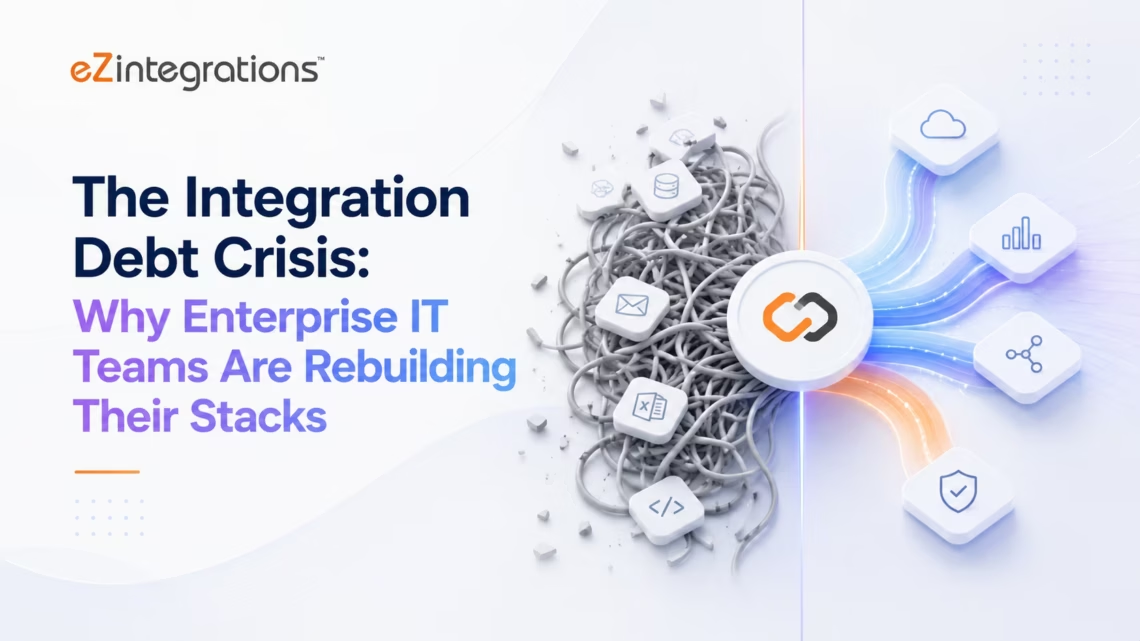
The Integration Debt Crisis: Why Enterprise IT Teams Are Rebuilding Their Stacks
June 11, 2026Integration debt is the accumulated cost of deferred integration architecture decisions: custom point-to-point connections, outdated iPaaS configurations, undocumented data flows, and retired APIs that still have active consumers. It manifests as maintenance overhead (40-50% of engineering capacity), brittle pipelines that break on API updates, growing backlogs, and inability to adopt AI workflow capabilities without rebuilding the foundation first.
TL;DR:
- Integration debt is technical debt applied to the enterprise integration layer: the accumulated cost of architectural shortcuts, deferred decisions, and systems that were never properly connected but somehow became load-bearing.
- The crisis is structural: Gartner estimates the average enterprise has 900+ applications deployed, most of which were integrated through a combination of point-to-point connections, departmental iPaaS tools, and manual workarounds. The maintenance cost of this estate consumes 40-50% of integration engineering capacity before any new work begins.
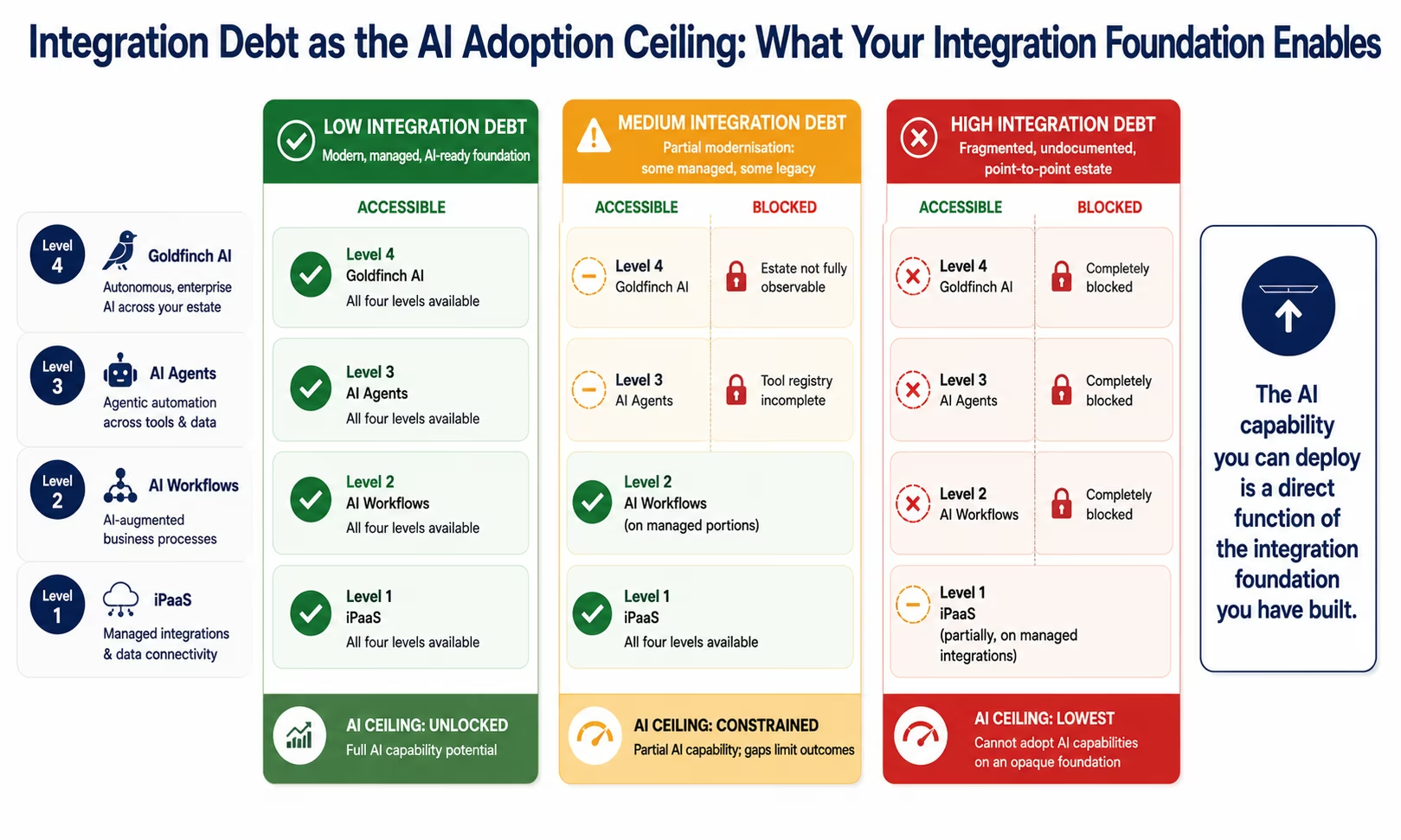
- The crisis is also a ceiling: organisations that want to adopt AI workflow automation, AI agents, and agentic AI capabilities cannot do so effectively on a foundation of fragile, undocumented, point-to-point integrations. The AI ceiling is a function of the integration floor.
- Integration debt is not resolved by a full rebuild. It is resolved incrementally, by category: starting with the highest-risk, highest-cost integrations first.
- eZintegrations is designed for this migration scenario: a four-level platform (Level 1 iPaaS through Level 4 Goldfinch AI agentic) that allows organisations to migrate from legacy integration debt toward modern AI-capable architecture without disrupting what is already working.
What is Integration Debt and How Did We Get Here?
Integration debt is the accumulated cost of deferred, improvised, and undocumented integration architecture decisions: the enterprise equivalent of technical debt, applied specifically to the layer that connects systems to each other.
Wikipedia defines technical debt as the implied cost of additional rework caused by choosing an easy solution now instead of using a better approach that would take longer. Integration debt is this dynamic, applied at the enterprise connectivity layer: every point-to-point connection built instead of a proper hub-and-spoke integration, every credential hard-coded in a workflow file instead of managed through a secrets manager, every undocumented data flow that only one person knows exists, every API that was retired but still has three integrations consuming it.
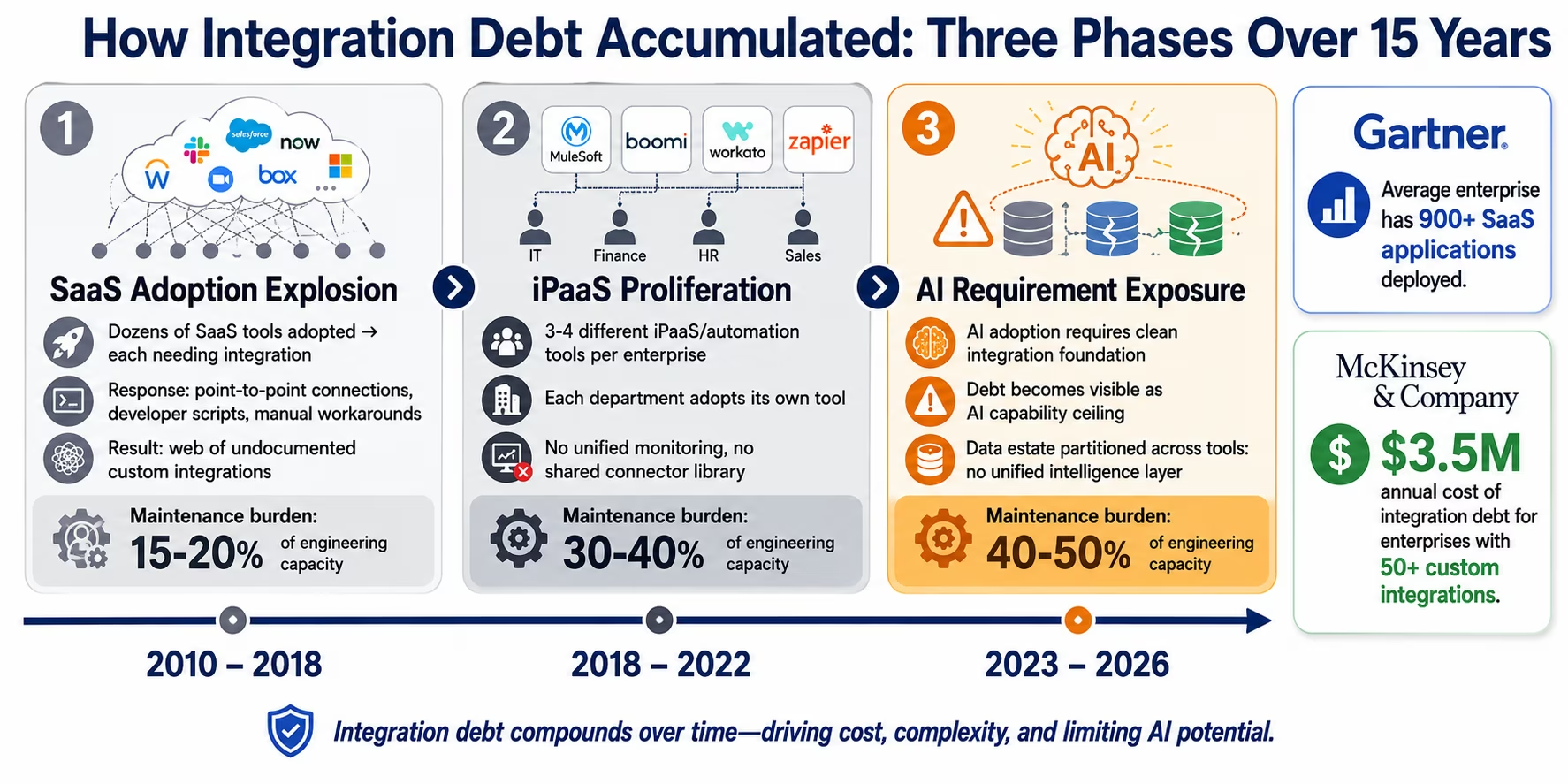
Integration debt did not arrive all at once. It accumulated over years, often in three distinct phases.
Phase 1: The SaaS adoption explosion (2010-2018)
Enterprise software transformed from on-premises ERP and CRM monoliths to a sprawling SaaS estate: Salesforce for CRM, HubSpot for marketing, NetSuite or SAP for ERP, Workday for HR, Stripe for billing, Zendesk for support, Snowflake for analytics, plus dozens of departmental tools adopted without central IT involvement. Each new system created integration requirements. Those requirements were addressed quickly, with whatever was available: a developer built a direct API connection, a business analyst configured an early iPaaS tool (Zapier, or the first generation of MuleSoft), or the integration simply was not built and a manual workaround filled the gap.
Phase 2: The iPaaS proliferation (2018-2022)
iPaaS became the standard approach for enterprise integration: but not one iPaaS. Multiple iPaaS tools. The marketing team adopted HubSpot Operations Hub. The operations team adopted Zapier Enterprise. The IT team adopted MuleSoft or Boomi. The finance team adopted a separate data pipeline tool. By 2022, the average large enterprise had 3-4 different iPaaS or automation tools in production, each with its own connector library, its own monitoring approach, and its own administrator who may or may not still be with the company. None of these tools talked to each other. The integration estate became fragmented across tools as well as fragmented across point-to-point connections.
Phase 3: The AI requirement exposure (2023-2026)
When enterprise IT teams began evaluating AI workflow automation, AI agents, and agentic AI capabilities in 2023-2026, the integration debt became visible in a new way: the AI capabilities they wanted to adopt required a clean, managed, observable integration foundation. You cannot build AI-powered exception handling on top of workflows that nobody fully understands. You cannot build natural language enterprise intelligence on a data estate that is partitioned across four iPaaS tools with no unified monitoring. The AI requirement exposed the integration debt that had been accumulating for a decade.
According to Gartner, the average enterprise now has 900+ SaaS applications deployed. IDC estimates that 70% of enterprise integration implementations involve some degree of technical debt: meaning undocumented flows, deprecated API usage, or configurations that require manual intervention when connected systems change. McKinsey estimates the annual cost of this accumulated debt, measured in engineering time and incident response, at $3.5 million for enterprises with 50+ custom integrations.
The Five Signatures of a Debt-Laden Integration Estate
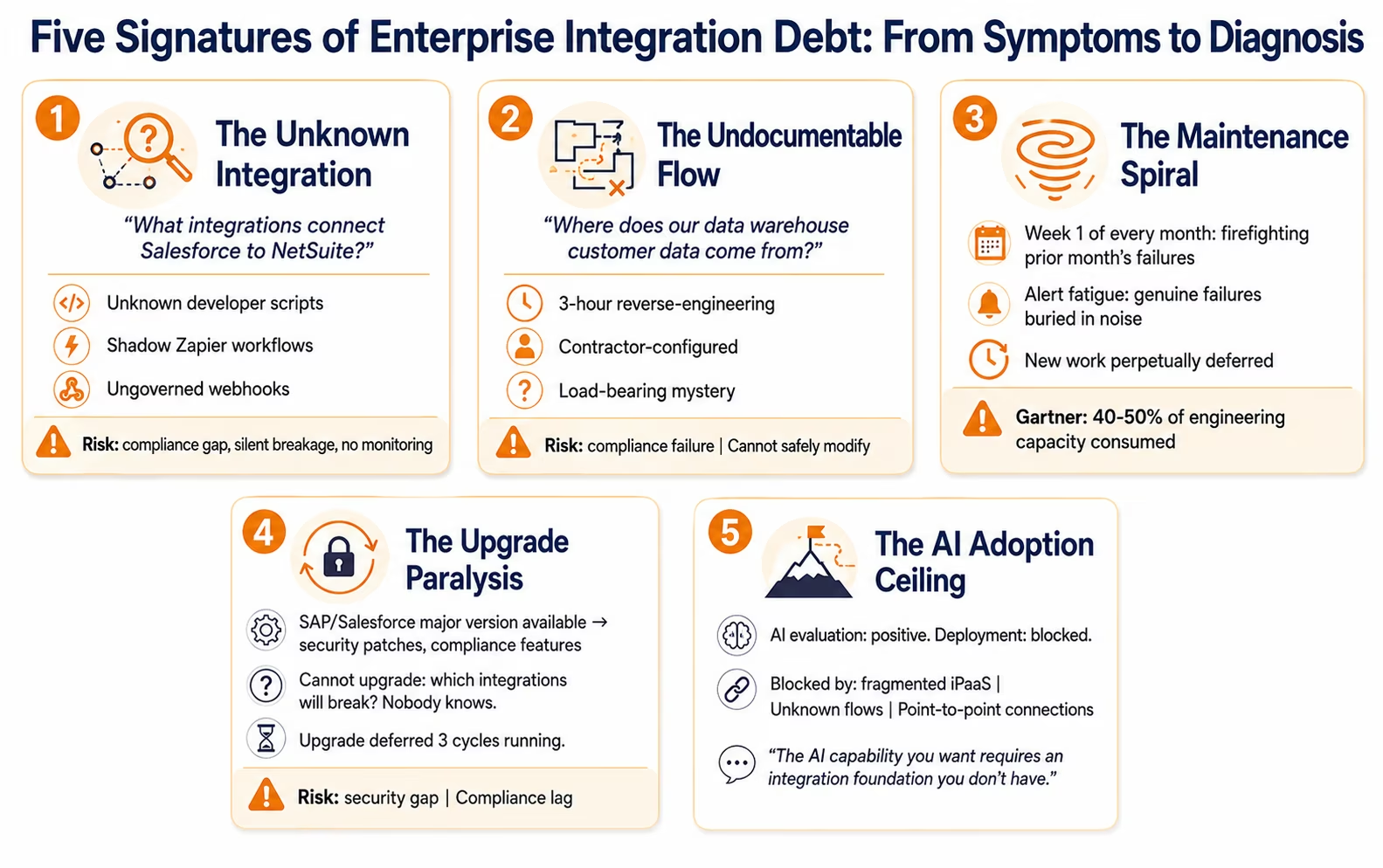
Integration debt is not always visible from the outside: it is felt in symptoms before it is diagnosed as a cause. Five signatures indicate that an enterprise integration estate has accumulated significant debt.
Signature 1: The Unknown Integration
Someone asks “what integrations do we have between Salesforce and NetSuite?” and nobody can give a complete answer. There are the official integrations: the ones in the iPaaS platform. And then there are the other ones: the script a developer wrote in 2019 that runs on a server nobody monitors, the Zapier workflow a sales ops manager set up in 2021 that the IT team does not know about, the webhook that Salesforce sends directly to NetSuite that was configured before the iPaaS was even in place.
Unknown integrations are the most dangerous form of integration debt: they carry data between systems without governance, monitoring, or documentation. When they break, nobody knows to fix them. When the connected systems change their APIs, nobody knows to update them. When a compliance audit asks “show us all data flows between System A and System B,” the unknown integrations are the ones that cannot be shown.
Signature 2: The Undocumentable Flow
Someone asks “where does the customer data in our data warehouse come from?” and the honest answer requires three hours of reverse-engineering. The data warehouse receives customer records. Those records come from a pipeline. That pipeline comes from a tool. That tool was configured by a contractor who left in 2022. The configuration file is in a GitHub repository that is private to the contractor’s account. The pipeline has been running for three years and nobody is sure what it does exactly, but it works, so nobody has touched it.
Undocumentable flows are load-bearing technical debt: they carry data that the business depends on, but in a way that cannot be audited, reproduced, or safely modified. They are the integrations most likely to cause a compliance failure, most likely to break unpredictably, and most likely to require a complete rebuild when the systems they connect are updated.
Signature 3: The Maintenance Spiral
The engineering team spends the first week of every month firefighting integration failures from the prior month. The alerts from the monitoring system are so numerous that the team has alert fatigue: the genuine failures are buried in the noise. New integration work is consistently postponed because maintenance of existing integrations consumes the available capacity. The backlog grows faster than it can be cleared.
The maintenance spiral is the most economically visible signature of integration debt: it is the direct translation of accumulated technical shortcuts into ongoing engineering cost. Gartner quantifies this at 40-50% of integration engineering capacity consumed by maintenance in estates with 50+ integrations.
Signature 4: The Upgrade Paralysis
A major connected system (SAP, Salesforce, NetSuite) is available for a major version upgrade that includes important security patches, compliance features, and capability improvements. The upgrade cannot be executed because nobody is confident about which integrations will break and how. The assessment of “which integrations connect to this system and how might they be affected by the version change?” is a weeks-long manual exercise. The upgrade is deferred to the next cycle. Then the next.
Upgrade paralysis is integration debt manifesting as organisational inability to adopt better technology. The enterprise cannot move its systems forward because its integration layer is too brittle and too opaque to safely migrate.
Signature 5: The AI Adoption Ceiling
The enterprise has evaluated AI workflow automation, AI agents, or agentic AI capabilities. The evaluation is positive: the capabilities are clearly valuable.
The deployment is blocked. Not by the AI platform itself, but by the integration estate it would need to operate on: undocumented flows that cannot be enriched because nobody knows what they contain, fragmented iPaaS tools that cannot be unified into a single AI-observable layer, and point-to-point connections that cannot support the API call patterns that AI agents require.
This is integration debt’s most strategically significant manifestation in 2026: it is not just a maintenance cost. It is a barrier to every AI capability the organisation wants to adopt.
The Three Compounding Costs of Integration Debt
Integration debt does not stay the same size: it compounds. Three cost categories grow over time, creating a debt burden that accelerates faster than the engineering capacity available to address it.
Cost 1: The Direct Maintenance Tax
Every integration in the estate represents an ongoing maintenance obligation. Every connected system that updates its API is a potential breakage event. Every credential that expires is a potential midnight page. Every new business logic change requires a review of every integration that implements that logic.
McKinsey estimates the direct maintenance cost at $3.5 million per year for enterprises with 50+ custom integrations. This is not a one-time cost: it is an annual recurring cost that grows with every new integration added and every year that existing integrations age without modernisation.
The compounding mechanism: integration debt that costs $3.5M in maintenance per year and grows 15-20% annually (as the SaaS estate grows and new integrations are added without retiring old ones) becomes a $5M problem in three years and a $7M problem in five years without intervention.
Cost 2: The Opportunity Cost of Deferred Work
When 40-50% of integration engineering capacity is consumed by maintenance, only 50-60% is available for new work. The backlog of new integration requests: the CRM-to-ERP sync that the finance team has been waiting 6 months for, the analytics pipeline that would enable the CDO’s real-time reporting programme, the customer data integration that would unlock personalisation at scale, continues to grow.
The opportunity cost of this deferred work is harder to quantify than the maintenance cost, but it is often larger. The CRM-to-ERP sync that would have reduced the month-end close cycle from 12 days to 5 days represents 7 days of finance team capacity per month: at the fully loaded cost of the finance team members involved in the close process. The analytics pipeline that would have enabled data-driven personalisation represents the revenue delta between the current conversion rate and the personalised conversion rate.
Gartner estimates that the aggregate opportunity cost of integration backlog: the business value of integrations not yet delivered, averages $8-12 million per year for mid-sized enterprises, dwarfing the direct maintenance cost.
Cost 3: The Risk Premium of Debt-Laden Architecture
Integration debt creates systemic risk: the probability that an uncontrolled event (an API deprecation, a security breach through an ungoverned integration, a compliance failure caused by an undocumented data flow) causes a business-significant incident.
The unknown integration between a marketing automation tool and a customer database that nobody knew existed: until a GDPR audit surfaced it as an undocumented data flow of EU customer PII: is a real scenario that plays out in regulated industries. The cost of a GDPR enforcement action, a SOX audit finding, or a HIPAA breach notification resulting from integration debt is categorically different from the maintenance and opportunity costs above.
The risk premium compounds with the age and opacity of the integration estate: older integrations are more likely to use deprecated authentication patterns, retired API versions, and connection configurations that predate current security standards.
Why Integration Debt Became a Crisis in 2026
The integration debt that has been accumulating for a decade became a crisis in 2026 for two specific reasons: one external (the AI requirement) and one internal (the engineering capacity constraint).
The AI Requirement
Every significant enterprise AI initiative: AI workflow automation, AI agents, agentic enterprise intelligence: requires a clean, observable, AI-capable integration foundation. AI workflow nodes (Document Intelligence, LLM Classification, Data Analysis) must be embedded in integration pipelines that are managed, monitored, and documented. AI agents must be able to call system APIs that are properly authenticated, rate-limit-managed, and schema-documented. Agentic AI coordination requires a connected system estate where each system’s API is accessible and the data it holds is correctly characterised.
A fragmented, undocumented, point-to-point integration estate cannot support any of these requirements. The AI capabilities that CIOs and CTOs are under pressure to deploy cannot be built on the integration foundation that most enterprises have. This is the AI ceiling: and it is the most urgent reason integration debt became a strategic priority in 2026 rather than a persistent operational inconvenience.
The Engineering Capacity Constraint
At the same time, the cost of resolving integration debt has increased. Integration engineers are among the most in-demand technology professionals in 2026, with competition from cloud-native organisations, SaaS vendors, and consulting firms. The fully loaded cost of a senior integration engineer is $200,000-250,000 in major markets. A team large enough to both maintain the existing integration estate and meaningfully reduce the debt backlog is expensive to build and hard to retain.
The result: most enterprises cannot resolve their integration debt by hiring their way out of it. The economics require a different approach: AI-assisted integration operations that reduce the maintenance burden per engineer, enabling the same team to address the debt backlog while still running the existing estate.
The AI Ceiling: Why AI Adoption Depends on Integration Modernisation
The connection between integration debt and AI adoption is not intuitive until you map what AI capabilities require architecturally. Then it becomes unavoidable.
AI workflow automation requires integration pipelines that are: managed in a single platform (so AI nodes can be added to workflows consistently), monitored with per-step execution data (so AI anomaly detection has a data signal to work with), and documented with field-level metadata (so Document Intelligence knows what fields to extract and LLM Classification knows what categories to apply). Workflows that live in three different iPaaS tools, with monitoring in a fourth tool, with field mappings undocumented in any accessible system, cannot support AI workflow enrichment consistently.
AI agents require a tool registry: a catalogue of system APIs the agent can call. Each tool requires: a working API connection with managed authentication (the OAuth token that nobody rotated, the API key that was hard-coded in 2019, cannot be a tool in an agent registry), schema documentation (the agent needs to know what data is available in each system and what format it takes), and rate limit management (agent investigations make multiple API calls per system per query: an API key that is already near its daily limit cannot support agent tool calls). Point-to-point custom connections that bypassed the integration platform cannot be registered as agent tools without being rebuilt first.
Agentic AI coordination (Goldfinch AI) requires all of the above, plus a connected system estate where data flows are observable and the relationships between systems are understood. A coordinator agent that needs to synthesise revenue data from the ERP, usage data from the product analytics platform, and support data from the CS tool requires that all three systems have clean, authenticated, documented API connections. If one of these exists only as an undocumented point-to-point connection, the coordinator cannot query it.
The integration debt audit is therefore not just an IT exercise: it is a prerequisite for AI strategy. The question “which AI capabilities can we deploy?” is answered in large part by the question “which parts of our integration estate are AI-ready?”
The Integration Debt Audit: How to Quantify What You Have
Before resolving integration debt, you must quantify it. The integration debt audit is a structured assessment across four dimensions that produces a debt inventory and a prioritised resolution plan.
Dimension 1: Integration Estate Inventory
Map every integration currently in production: the source system, the destination system, the data it carries, the tool or mechanism used, the person who owns it (if knowable), the last known modification date, and its current health status. This inventory is almost always larger than the engineering team’s estimate: shadow integrations, undocumented flows, and legacy connections consistently add 20-40% to the count.
Tools for inventory: API discovery tools (Postman API catalogue, Kong Konnect), integration platform audit exports (export all workflows from each iPaaS tool), network traffic analysis (identify API calls that bypass the integration platform), and direct stakeholder interviews (ask each department what tools they use for data transfer).
Dimension 2: Health Classification
For each integration in the inventory, classify its current health:
- Green: running, monitored, documented, owner known, connected systems not scheduled for change
- Yellow: running, but with one or more risk factors: monitoring gap, documentation gap, owner unknown, or connected system scheduled for API update
- Red: failing intermittently, undocumented, owner unknown, using deprecated API, or presenting compliance concerns
The health classification produces the triage priority: Red integrations require immediate attention (they are already causing incidents or compliance risk), Yellow integrations require scheduled attention (they will become Red without intervention), and Green integrations can be deferred.
Dimension 3: Business Criticality
For each integration, assess: what happens to the business if this integration fails for 24 hours? This assessment produces a criticality score that determines the priority within each health classification bucket.
A Red integration that moves marketing email campaign data between two SaaS tools is lower priority than a Yellow integration that carries financial transaction data between the ERP and the revenue recognition system. Both need attention, but in the correct order.
Dimension 4: Modernisation Complexity
For each integration, estimate the effort to modernise it to the target architecture: the managed, monitored, AI-capable integration standard. This produces the ROI calculation: (cost of ongoing debt: maintenance burden + incident risk + AI adoption blockage) divided by (effort to modernise: engineering hours + platform cost) = the modernisation ROI.
High-criticality, high-health-risk, low-modernisation-complexity integrations have the highest ROI and should lead the resolution roadmap.
The Four-Phase Resolution Framework
Integration debt is resolved in four phases: prioritised by risk and value rather than attempted as a single comprehensive rebuild.
Phase 1: Stabilise the Red Integrations (Weeks 1-8)
The Red integrations are causing incidents today. They must be stabilised before any broader modernisation work begins. Stabilisation does not mean full modernisation: it means making the failing integrations reliable enough that they stop consuming incident response capacity.
For each Red integration: document it (even at a basic level: source, destination, data, mechanism), move monitoring to the central platform, and implement basic error alerting. If the integration is on deprecated API endpoints, update the endpoint. If it uses hard-coded credentials, move to managed credential storage.
This phase does not eliminate integration debt. It stops the bleeding.
Phase 2: Inventory and Classify (Weeks 6-16)
Execute the integration debt audit described above. The goal is a complete inventory, a health classification, a business criticality score, and a modernisation complexity estimate for every integration in the estate. This is the document that makes all subsequent decisions defensible: it provides the evidence for prioritisation rather than relying on the loudest stakeholder or the most recent incident.
Phase 3: Migrate by Priority (Months 4-24)
Work through the backlog of Yellow integrations in order of (criticality × health risk / modernisation complexity), migrating each to the target architecture, managed platform (single iPaaS, no shadow tools), standardised connectors (vendor-maintained, not custom code), monitored execution (per-step logging, DLQ configuration, alerting), and documented configuration (field mappings, business logic, owner, change log).
At each migration, retire the legacy mechanism. The shadow Zapier workflow, the developer script, the webhook configured outside the platform: retired when the managed replacement is validated in parallel.
Phase 4: Enable AI Capabilities (Rolling, from Month 6)
As integrations migrate to the managed, monitored, documented target architecture, they become eligible for AI capability enablement: AI Workflow nodes added to managed pipelines, API connections registered in the agent tool registry, and integration patterns incorporated into the agentic AI coordination layer.
This phase does not wait for Phase 3 to complete. AI capabilities are enabled on modernised integrations as soon as each integration reaches the target architecture: creating a rolling expansion of AI capability that rewards progress rather than waiting for the full estate to be modernised.
![Four-phase resolution roadmap showing Phase 1 Stabilise Red (weeks 1-8), Phase 2 Inventory and Classify (weeks 6-16), Phase 3 Migrate by Priority (months 4-24), and Phase 4 Enable AI (rolling from month 6): with the AI capability horizon expanding as Phase 3 progresses | Integration debt resolution: the four-phase framework from stabilisation to AI enablement]](https://ezintegrations.ai/wp-content/uploads/2026/05/download-11.avif "The Integration Debt Crisis: Why Enterprise IT Teams Are Rebuilding Their Stacks")
Common Mistakes When Resolving Integration Debt
The resolution framework above is straightforward to describe and genuinely difficult to execute. Three mistakes consistently derail enterprise integration debt resolution programmes.
Mistake 1: The Full Rebuild Fallacy
The temptation: “we should just tear it all down and rebuild from scratch on the new platform.”
The reality: a full integration estate rebuild is a 2-4 year programme that the business cannot sustain. New integrations continue to be needed during the rebuild. The systems being rebuilt change during the rebuild. The team members who understand the current estate leave during the rebuild. Full rebuilds almost always produce a new integration estate with new debt accumulating before the rebuild is complete.
The correct approach: incremental migration, prioritised by risk and value, with parallel-run validation before legacy retirement. The estate is never 100% modernised: but it is continuously becoming less indebted.
Mistake 2: Migrating to a Tool Without a Strategy
The most common form of integration debt replacement produces new integration debt: a team migrates its legacy Mule integrations to a new iPaaS tool without a clear architecture standard, monitoring requirement, documentation template, or AI enablement roadmap. Three years later, the new tool’s integrations are as undocumented, unmonitored, and fragile as the ones it replaced.
The correct approach: define the target architecture before migrating anything. What is the managed integration standard? What monitoring is required? What documentation must each integration have before going live? What is the AI enablement checklist: the criteria an integration must meet before AI nodes can be added to it? These standards must exist before the first migration, not after.
Mistake 3: Ignoring the Shadow Integration Estate
The official integration estate: the one in the iPaaS platform: is not the full integration estate. The shadow estate (Zapier workflows set up by business users, developer scripts running on servers nobody monitors, webhooks configured directly between systems without going through the platform) can represent 20-40% of the actual data flows in the enterprise.
Migrating the official estate without addressing the shadow estate leaves the compliance risk intact (unknown data flows through ungoverned mechanisms) and leaves the business users who depend on shadow integrations without a path to supported, reliable integration. The shadow estate must be surfaced during Phase 2 and either retired, migrated, or explicitly documented as out-of-scope with clear ownership assigned.
How eZintegrations Enables Integration Modernisation
eZintegrations is designed for the integration debt resolution scenario: not as a greenfield platform for enterprises starting fresh, but as the four-level destination architecture for enterprises migrating from legacy debt.This modernisation direction aligns with the Forrester Integration Platform As A Service Landscape, Q2 2025, which gives enterprise technology leaders a broader view of the iPaaS market and how integration platforms are evolving to support modern application, data, automation, and AI-ready integration requirements.
Starting at Level 1: eZintegrations’ iPaaS capabilities (REST, GraphQL, WebSocket, Database, Message Queue, File connectors with 1,000+ Automation Hub templates) provide the managed integration foundation that resolves the primary integration debt pattern, the undocumented, unmonitored, custom-code integration. An integration migrated to eZintegrations is visible in the platform dashboard, monitored with per-execution logging, equipped with DLQ and alerting, and configured through a documented no-code workflow rather than a custom script.
IPSec Tunnel for legacy on-premises connectivity: for enterprises with SAP ECC, Oracle on-premises, or other legacy systems that cannot be immediately modernised, eZintegrations connects via IPSec Tunnel without requiring the legacy system to expose public internet ports. Legacy systems can be integrated cleanly while their modernisation is planned separately.
AI Workflow nodes when integrations are ready: once an integration is managed, monitored, and documented on eZintegrations, AI Workflow nodes can be added to it immediately: Document Intelligence for unstructured data in the pipeline, LLM Classification for routing intelligence, Data Analysis for anomaly detection on data flows, Semantic Matching for entity resolution. The AI capability follows the modernisation: it becomes available integration by integration, not all at once.
AI Agent tool registry as the estate matures: as the managed integration estate grows, each clean API connection can be registered in the Goldfinch AI tool registry, making the system queryable by AI agents. The agent investigation capability expands with the modernised estate. An estate that is 30% modernised supports AI agents querying 30% of its systems. An estate that is 90% modernised supports AI agents querying 90% of its systems.
Goldfinch AI for the modernised estate: when sufficient coverage of the critical system estate is modernised and registered in the tool registry, Goldfinch AI coordinator-worker architecture is available: Chat UI for natural language enterprise intelligence, Workflow Node for automated intelligence programmes. The agentic AI capability that was blocked by integration debt becomes accessible as the debt is resolved.
The migration posture: eZintegrations does not require a rip-and-replace migration. During Phase 3, integrations run in parallel on both the legacy mechanism and eZintegrations before the legacy is retired. This parallel-run validation is standard iPaaS migration practice and is supported natively in eZintegrations’ workflow execution model.
SOC 2 Type II, HIPAA BAA, GDPR, 21 CFR Part 11: for regulated industry enterprises where integration debt includes compliance risk (undocumented PHI flows, ungoverned PII data transfers, unaudited financial data pipelines), eZintegrations provides the compliance infrastructure that legacy custom integrations cannot: immutable execution logs, field-level audit trails, HIPAA-compliant processing for healthcare data, GDPR-compliant processing for EU customer data, and SOX-compliant audit trails for financial data pipelines.
Book a free demo integration modernisation and bring your integration estate inventory. We will show you the target architecture for your specific mix of legacy mechanisms, the migration path from your current state to AI-capable foundation, and the Automation Hub templates that cover your highest-volume integration patterns.
Frequently Asked Questions
Integration debt is the accumulated cost of deferred, improvised, and undocumented integration architecture decisions: including point-to-point connections, unmonitored developer scripts, shadow iPaaS tools, and ungoverned data flows that compound over time. It became a crisis in 2026 for two reasons. First, the maintenance burden consumes 40–50% of engineering capacity, preventing delivery of new capabilities. Second, the fragmented foundation blocks AI workflows, AI agents, and agentic AI adoption: the capabilities enterprise leadership is under pressure to deploy.
Integration debt cost has three components. Direct maintenance cost: engineering hours spent on monitoring, debugging, patching, and updating existing integrations, typically 40–50% of engineering capacity. Opportunity cost: the business value of backlogged integrations not yet delivered, often estimated at $8–12M per year for mid-sized enterprises. Risk premium: the probability-weighted cost of compliance failures, security incidents, and data quality issues caused by unreliable integrations. The direct maintenance component alone can reach several million dollars annually in large estates.
No, Full rebuilds consistently fail or recreate new debt. Integration requirements continue evolving during the rebuild, institutional knowledge is lost as team members leave, and dependent systems change over time. The correct approach is incremental migration, prioritised by (business criticality × health risk ÷ modernisation complexity), with parallel-run validation before retiring legacy integrations. The goal is not a perfect end state, but a continuously improving, less indebted integration estate.
Integration debt directly determines the ceiling for AI adoption. AI workflow nodes require managed, monitored, and documented pipelines. AI agents require clean API connections with managed authentication and schema definitions. Agentic AI coordination requires a fully observable, connected system estate. Point-to-point integrations, undocumented flows, and shadow tools cannot support these requirements without modernisation. Therefore, the integration roadmap is a prerequisite to the AI adoption roadmap.
Shadow IT integrations are data flows built outside the official integration platform: such as Zapier workflows created by business users, developer scripts running on unmonitored servers, and direct system-to-system webhooks. These often represent 20–40% of enterprise data flows and are the highest-risk component of integration debt because they are ungoverned, unmonitored, and undocumented, frequently handling sensitive data. Resolving integration debt without addressing the shadow estate leaves significant compliance and reliability risks unresolved.
Integration debt resolution follows a phased timeline. Phase 1: stabilise high-risk integrations within approximately 8 weeks. Phase 2: inventory and classify the full estate over 6–16 weeks, overlapping with Phase 1. Phase 3: migrate integrations by priority over 4–24 months depending on estate size and resources. Phase 4: enable AI capabilities on modernised integrations as early as month 6. Overall, enterprises typically reach a substantially AI-ready integration foundation within 12–24 months, with incremental value delivered throughout the process.1. What is integration debt and why is it a crisis in 2026?
2. How do you calculate the cost of integration debt?
3. Should enterprises rebuild their integration stack from scratch?
4. What is the connection between integration debt and AI adoption?
5. What is shadow IT integration and why does it matter for debt resolution?
6. How long does integration debt resolution take?
Conclusion: Integration Debt Is Not a Technical Problem. It Is a Strategic Problem.
The engineering team that built the point-to-point connections in 2015 made the right decision for 2015. The developer who configured the Zapier workflow in 2020 solved a real business problem with the tools available. The contractor who set up the webhook in 2022 was trying to be helpful. None of these were mistakes in the context of their time.
They became integration debt when the enterprise’s requirements changed: when the scale of the SaaS estate grew beyond what point-to-point could support, when AI workflow automation required a managed foundation, when AI agents required clean API registries, when compliance audits required documented data flows, when upgrade decisions required confident impact assessment.
The crisis is not that these decisions were made. The crisis is the gap between what the current integration estate can support and what the enterprise’s strategic requirements now demand of it.
Resolving that gap is a strategic initiative: not an IT housekeeping exercise. It requires executive sponsorship, explicit prioritisation against other engineering work, a clear target architecture, and a realistic timeline. The enterprises that treat integration modernisation as a strategic priority in 2026 will have AI-ready foundations by 2027-2028. The enterprises that treat it as a persistent operational inconvenience will be trying to build AI capabilities on a foundation that cannot support them.
eZintegrations provides the destination architecture: four levels from managed iPaaS (Level 1) through AI Workflow enrichment (Level 2), AI Agent investigation (Level 3), and Goldfinch AI agentic coordination (Level 4). The migration from legacy integration debt to this architecture is incremental, parallel-run, and AI-capability-enabling from month 6. The full stack rebuild is not required. The discipline to prioritise, sequence, and execute the migration is.
Book a free demo integration modernisation and bring your integration estate: its size, its known debt, and its AI adoption requirements. We will show you the target architecture for your specific situation and the migration sequence that creates AI capability earliest.