eZintegrations vs Workato 2026: Enterprise Automation Platform Compared
April 27, 2026eZintegrations vs Workato. eZintegrations beats Workato on AI-native agentic automation (Level 3 AI Agents and Level 4 Goldfinch AI multi-agent with Chat UI are built-in, not bolted on), predictable per-automation pricing that does not escalate with recipe count, and implementation speed using 1,000+ Automation Hub templates. Workato has a large recipe ecosystem and strong no-code workflow builder, but its pricing model escalates significantly at scale and its AI capabilities require external API calls rather than native inference. For enterprises prioritising AI automation readiness and cost predictability, eZintegrations is the stronger choice in 2026.
TL;DR
- Workato is a strong no-code workflow platform with a large recipe library and solid business-user experience, as reflected in G2 Workato vs eZintegrations user reviews. It is a legitimate choice for organisations that primarily need SaaS-to-SaaS automation without advanced AI requirements.
- eZintegrations offers native Level 1 iPaaS, Level 2 AI Workflows, Level 3 AI Agents (with 9 built-in enterprise tools), and Level 4 Goldfinch AI multi-agent orchestration in a single platform. Workato requires external AI APIs or add-on modules for comparable AI capability.
- Workato’s pricing model scales by recipe count and workspace tier, which creates cost escalation as automation coverage grows. eZintegrations charges per automation at a fixed rate with no platform fee and no connector fee.
- For enterprises evaluating platforms in 2026, the AI automation readiness gap between the two platforms is the most material difference.
- Verdict: eZintegrations for AI-native enterprise automation at predictable cost. Workato for broad no-code SaaS automation with an established recipe community.
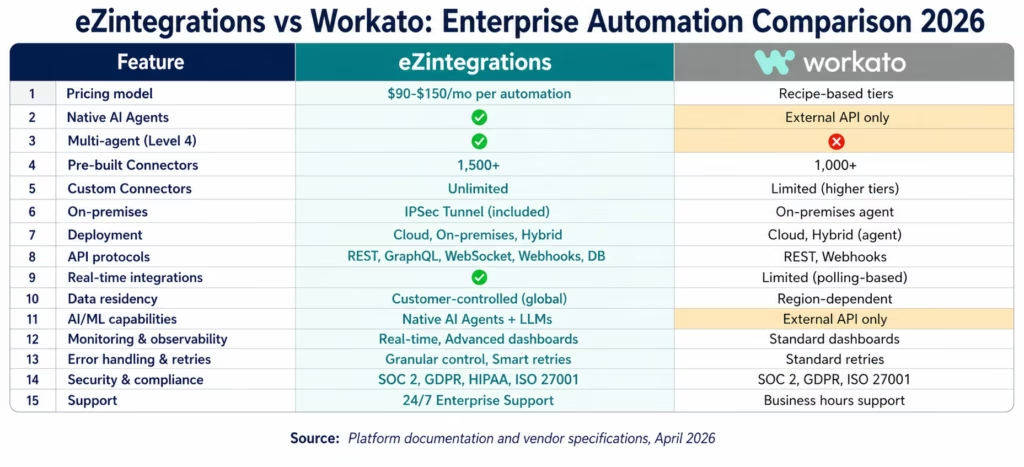
Summary Comparison Table (eZintegrations vs Workato)
| Feature | eZintegrations | Workato |
|---|---|---|
| Pricing model | Per-automation ($90-$150/mo per workflow) | Recipe-based tiers, workspace pricing |
| Platform fee | None | Included in workspace tier |
| Connector fee | None | None (connectors included) |
| Native AI Workflows (Level 2) | Yes: Document Intelligence, LLM classification, semantic matching | Limited: requires external AI API calls |
| AI Agents (Level 3) | Yes: 9 native tools, confidence thresholds, HITL | Workbot for Slack (conversational only, not enterprise agents) |
| Multi-agent orchestration (Level 4) | Yes: Goldfinch AI, Chat UI, Workflow Node | No native multi-agent coordination |
| Automation Hub templates | 1,000+ ready-to-import | 600,000+ community recipes |
| API protocols | REST, GraphQL, WebSocket, Webhooks, Databases | REST, Webhooks, limited GraphQL |
| On-premises connectivity | IPSec Tunnel (included) | On-premises agent (requires setup) |
| ERP connectors | Native SAP OData V4, NetSuite SuiteQL, Oracle REST | Connector library, some native |
| Pagination support | 4 types: numeric, cursor, time-window, Link header | Basic pagination |
| HIPAA, GDPR, SOC 2 Type II | Included at all tiers | Available on enterprise tiers |
| Implementation speed | 3-10 days per workflow (template) | Variable: days to weeks |
| Recipe/workflow maintenance | Platform-managed API updates | Customer-managed recipe updates |
| Coding required | No | No |
Introduction
Workato has built a strong reputation as one of the most accessible enterprise automation platforms. Its recipe-based model, large connector library, and business-user-friendly interface made it a category leader when the primary use case was connecting SaaS applications without code.
The market has shifted. In 2026, the evaluation criteria for enterprise automation platforms aligned with Gartner iPaaS Magic Quadrant and enterprise automation research include AI-native workflow steps, autonomous AI agent capability, multi-agent orchestration, and predictable pricing at scale. These criteria change the comparison significantly. (Gartner)
This analysis compares eZintegrations and Workato across the factors that matter most for enterprises evaluating integration platforms in 2026: AI automation readiness, total cost of ownership, implementation speed, protocol depth, and the maintenance burden your team inherits after deployment.
If you are currently using Workato and evaluating alternatives, or shortlisting platforms for a new deployment, this comparison gives you the specific data points to make that decision.
Pricing and Total Cost of Ownership
The verdict: eZintegrations is more predictable at scale. Workato’s pricing escalates with automation coverage.
Workato uses a workspace-based pricing model with tiers that include recipe limits, connection limits, and task volume (see Workato pricing reference). As your automation coverage grows, you move up tiers. Adding recipes, adding connections, and increasing task volume all trigger pricing escalation. Many enterprises that started on Workato at a manageable cost find their renewal significantly higher after 18-24 months of automation expansion.
The specific challenge with Workato’s pricing is the recipe maintenance overhead it creates: when a recipe breaks (upstream API change, authentication expiry, schema update), your team fixes it. That maintenance time represents an indirect cost that does not appear on the Workato invoice but shows up in your engineering team’s capacity, an effect widely documented in Forrester Total Economic Impact studies of integration platforms.
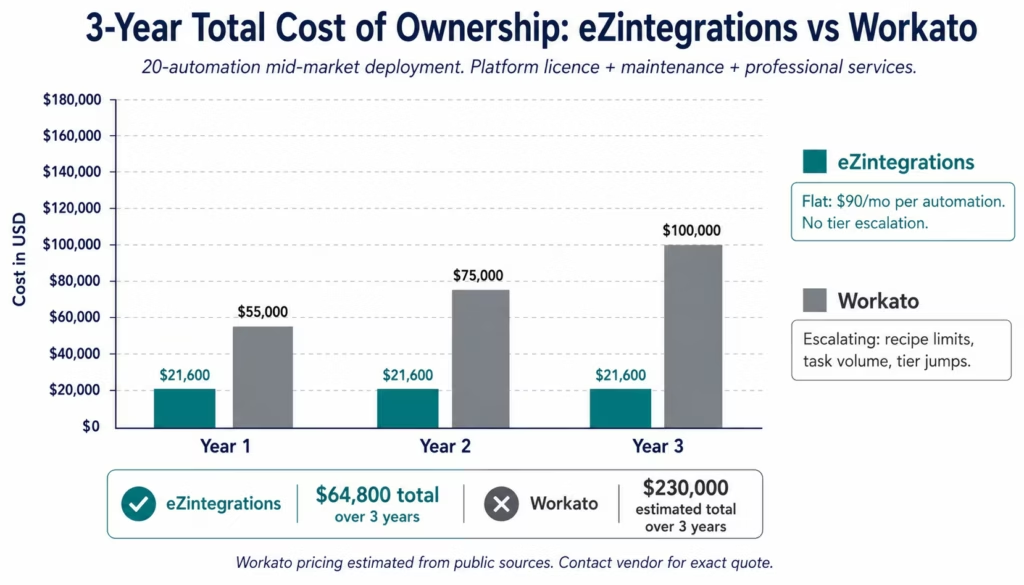
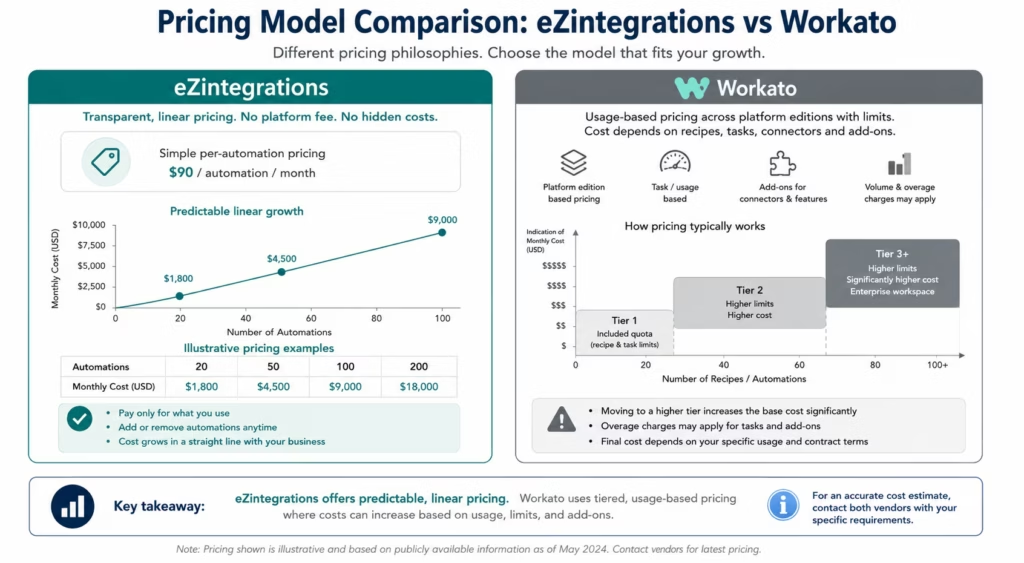
eZintegrations charges $90/month per standard enterprise automation (Level 1 and Level 2), $120/month per Level 3 AI Agent automation, and $150/month per Level 4 Goldfinch AI automation. No platform fee. No connector fee. No task volume overages. Adding 10 new automations increases your bill by exactly $900/month. There are no tier boundaries that create pricing jumps.
3-year cost comparison (illustrative, 20-automation mid-market deployment):
| Cost Component | eZintegrations | Workato (estimated) |
|---|---|---|
| Year-1 platform cost | $21,600 | $35,000-$65,000 (workspace tier) |
| Year-3 cost (20 automations, same scale) | $21,600 | $60,000-$100,000 (tier escalation) |
| Connector fee | $0 | $0 |
| Task volume overages | $0 | Variable |
| Recipe maintenance (engineering time) | Minimal (platform-managed API updates) | $20,000-$60,000/year (estimated) |
| Professional services dependency | Low (1,000+ templates) | Moderate (partner ecosystem) |
Note: Workato pricing is not publicly listed in full; estimates are based on publicly available information and community-reported figures. Contact Workato directly for your specific quote.
AI Automation Capability: The Critical 2026 Difference
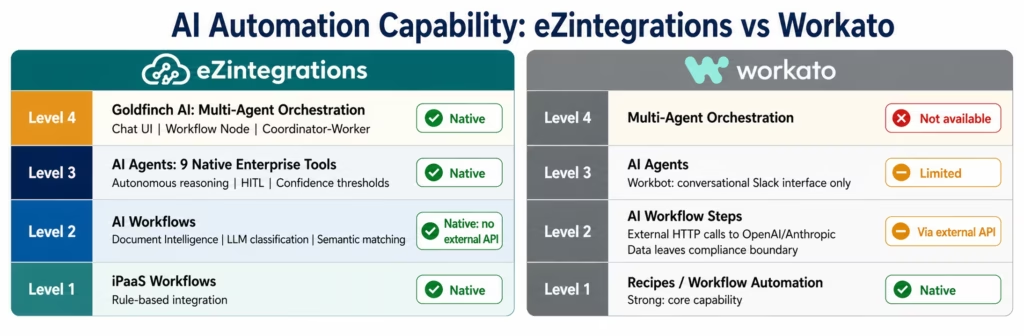
The verdict: eZintegrations is AI-native at all four levels. Workato’s AI requires external API calls or third-party add-ons.
This is the most significant difference between the two platforms in 2026, and it is widening rather than , narrowing, especially as highlighted in McKinsey & Company research on enterprise automation adoption and ROI.
What Workato offers for AI:
Workato has added AI features to its platform, primarily through Workato AI by Workato (launched 2023-2024). The capabilities include AI-generated recipe suggestions, AI-assisted field mapping, and integration with external AI models via HTTP connectors. Workato also offers Workbot, a conversational AI interface for Slack and Teams.
The limitation: Workato’s AI workflow steps are primarily external API calls to OpenAI, Anthropic, or other providers. Your document data leaves the Workato environment and travels to the external AI provider. The workflow step is an HTTP request. This means separate API cost, additional latency (200-800ms per AI call), a separate failure point, and your data leaving the compliance-certified Workato environment into a third-party AI environment.
What eZintegrations offers for AI:
All four automation levels are native to the eZintegrations platform:
Level 1 (iPaaS Workflows): rule-based automation, identical to Workato’s core capability.
Level 2 (AI Workflows): Document Intelligence, LLM classification, semantic duplicate detection, and 3-way match with AI tolerance run as native workflow nodes. No external API calls. Document data stays within eZintegrations’ HIPAA/GDPR/SOC 2 boundary.
Level 3 (AI Agents): autonomous multi-step agents with 9 native enterprise tools: Knowledge Base Vector Search, Document Intelligence, Data Analysis, Data Analytics with Charts/Graphs/Dashboards, Web Crawling, Watcher Tools, API Tool Call, Integration Workflow as Tool, and Integration Flow as MCP. Confidence thresholds, reflection loops, and human-in-the-loop gates are configurable without code. No custom agent framework required.
Level 4 (Goldfinch AI): coordinator-worker multi-agent orchestration. The Chat UI gives business users natural language access to enterprise processes and live ERP data. The Workflow Node embeds coordinator intelligence inside Level 1 automation processes.
Workato has no native equivalent to Level 3 AI Agents or Level 4 multi-agent orchestration. Workbot is a conversational interface for simple task routing, not an autonomous enterprise agent with ERP connectivity, document analysis capability, and multi-tool reasoning.
The Practical Implication
Your AP invoice exception queue today: 15-20% exception rate, 38 minutes of analyst time per exception, 200+ exceptions per month. On Workato, eliminating this queue requires: building a custom HTTP integration to an AI provider, maintaining that integration when the AI provider updates its API, paying separately for the AI API calls, and accepting that your invoice data travels through the external AI provider’s infrastructure.
On eZintegrations, the AP Exception Agent handles this natively. Document Intelligence extracts invoice fields. The API Tool Call tool queries SAP for PO and GR data. Data Analysis identifies the discrepancy. The agent routes a structured recommendation to the AP manager. Document data stays within eZintegrations’ compliance boundary. No external AI API. No additional API cost.
Implementation Speed and Maintenance Burden
The verdict: eZintegrations goes live faster and requires less ongoing maintenance. Workato’s recipe ecosystem is large but maintenance burden falls on your team.
Workato’s community recipe library contains hundreds of thousands of user-contributed recipes. This is a genuine advantage for finding starting points and patterns. The limitation: community recipes are not production-ready without review and testing, and their maintenance is not guaranteed.
eZintegrations’ Automation Hub contains 1,000+ enterprise-ready templates that are production-validated and platform-maintained. The difference between a community recipe and an Automation Hub template:
Community recipe (Workato):
- User-contributed, variable quality
- May use deprecated API versions
- Maintenance is the recipe author’s responsibility (or yours after import)
- No guarantee of continued support
Automation Hub template (eZintegrations):
- Platform-validated, production-ready
- Uses current API versions for each connected system
- Maintained by the eZintegrations platform team
- API version updates applied when upstream systems change
On implementation speed: most Automation Hub templates for standard enterprise integration pairs (Salesforce-to-SAP, Workday-to-Active Directory, Stripe-to-QuickBooks) go live in 3-10 days from import to production. Workato implementations for equivalent integrations typically run 2-6 weeks depending on recipe availability, API configuration, and testing cycles.
Maintenance overhead comparison:
| Maintenance Item | eZintegrations | Workato |
|---|---|---|
| API version updates (SAP quarterly, Salesforce 3x/year) | Platform team responsibility | Your team’s responsibility |
| Authentication token refresh | Automatic (connector-managed) | Varies by connector |
| Recipe/workflow breaks on API change | Rare (native connectors) | Common (especially for non-native) |
| New template deployment | Import in minutes | Build or adapt |
| Engineering hours per quarter for maintenance | 2-8 hours | 40-150 hours (varies significantly) |
Protocol and Connector Depth
The verdict: eZintegrations supports more API protocols natively. Workato is strong on REST and webhooks but has gaps in GraphQL and database connectivity.
Protocol support comparison:
| Protocol | eZintegrations | Workato |
|---|---|---|
| REST API | Full: 4 pagination types, all auth methods | Full |
| GraphQL | Native connector with cursor pagination | Limited: primarily via HTTP action |
| WebSocket | Native | Limited |
| Webhooks | Full: HMAC verification, fan-out, dead letter queue | Full |
| SQL databases (MySQL, PostgreSQL, Oracle DB, SQL Server) | Native connectors | Via connectors: variable depth |
| NoSQL (MongoDB, DynamoDB, Cassandra) | Native connectors | Via connectors |
| Cloud DW (Snowflake, BigQuery, Redshift) | Native connectors | Native connectors |
ERP connector depth:
This is where the difference is most significant for enterprises running SAP, Oracle, or NetSuite.
eZintegrations’ SAP connector uses native OData V4 with automatic CSRF token management. The NetSuite connector uses SuiteQL with Token-Based Authentication handled internally. The Oracle connector uses Oracle REST APIs with OAuth assertion flow. Your team configures credentials; the platform manages the authentication complexity.
Workato has SAP and NetSuite connectors, but the depth of native ERP API support (particularly CSRF token management for SAP write operations and SuiteQL pagination for large NetSuite datasets) has historically required more configuration effort and has a higher rate of authentication-related incidents.
For the API Catalog context: eZintegrations provides pre-configured connectors for SAP S/4HANA, SAP ECC, Oracle ERP Cloud, NetSuite, Infor CloudSuite, EPICOR, Microsoft Dynamics 365, and 1,000+ SaaS, database, and data warehouse APIs: all with the correct authentication method and pagination pattern pre-configured.
Enterprise Security and Compliance
The verdict: both platforms support enterprise security requirements, but eZintegrations includes compliance at all tiers while Workato reserves some compliance features for enterprise tiers.
| Security Feature | eZintegrations | Workato |
|---|---|---|
| SOC 2 Type II | All tiers | Enterprise tier |
| HIPAA BAA | Available | Enterprise tier |
| GDPR compliance | All tiers | All tiers |
| Data residency options | Available for enterprise | Available |
| Role-based access control | All tiers | All tiers |
| SSO / SAML | All tiers | Enterprise tier |
| Audit logs | All tiers | Enterprise tier |
| On-premises connectivity | IPSec Tunnel (included) | On-premises agent (requires setup) |
For life sciences, healthcare, and financial services organisations where HIPAA and SOC 2 Type II are baseline requirements, eZintegrations includes both at all tiers. Workato requires enterprise tier for HIPAA BAA, which adds to the total cost for regulated industries.
Who Should Choose Each Platform
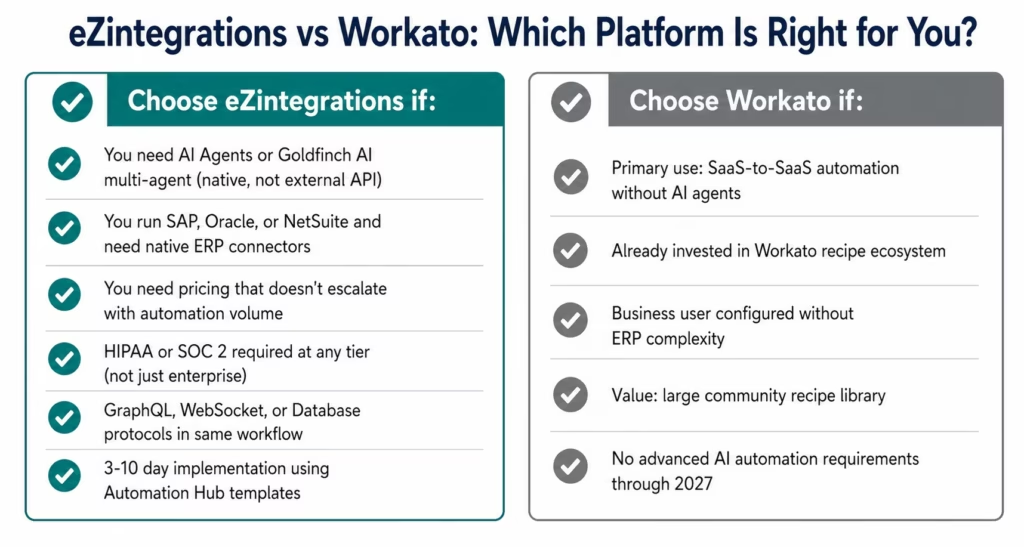
Choose eZintegrations if:
- You are deploying or planning to deploy AI Workflow automation, AI Agents, or Goldfinch AI multi-agent orchestration and need a platform where these capabilities are native rather than bolted on
- You run SAP, Oracle, NetSuite, or other complex ERP systems and need native connectors with automatic authentication management
- You need predictable, flat pricing that does not escalate as you add automations
- Your compliance requirements include HIPAA or full-stack SOC 2 Type II coverage at any tier
- You want to use REST, GraphQL, WebSocket, Webhooks, and database connectors in the same workflow
- You need a 3-10 day implementation time for standard enterprise integration pairs using Automation Hub templates
Choose Workato if:
- Your primary use case is SaaS-to-SaaS automation without advanced AI agent requirements
- Your team is heavily invested in the Workato recipe ecosystem and has built significant institutional knowledge on the platform
- You value the breadth of Workato’s community recipe library and the Workato community for finding patterns
- Your automations are primarily business-user configured with minimal ERP complexity
- You do not have strong AI automation requirements for 2026-2027
Detailed Feature Comparison
| Capability | eZintegrations | Workato | Winner |
|---|---|---|---|
| Level 1: Rule-based automation | Full iPaaS | Full recipe automation | Tie |
| Level 2: AI Workflow steps | Native (Document Intelligence, LLM, semantic matching) | External API calls only | eZintegrations |
| Level 3: AI Agents | 9 native tools, autonomous, HITL, confidence thresholds | Workbot (Slack conversational only) | eZintegrations |
| Level 4: Multi-agent | Goldfinch AI (Chat UI + Workflow Node) | Not available | eZintegrations |
| ERP connectors (SAP, Oracle, NetSuite) | Native (OData V4, SuiteQL, OAuth) | Connector library, variable depth | eZintegrations |
| GraphQL support | Native connector with cursor pagination | HTTP action only | eZintegrations |
| Database connectors | Native (SQL + NoSQL + cloud DW) | Connector library | eZintegrations |
| Pagination depth | 4 types, all enterprise patterns | Basic | eZintegrations |
| Webhook handling | HMAC verification, fan-out, dead letter queue | Standard | eZintegrations |
| Template library | 1,000+ production-ready templates | 600,000+ community recipes | Workato (volume) / eZintegrations (quality) |
| Pricing predictability | Flat per-automation rate | Tier-based, escalates | eZintegrations |
| Maintenance burden | Platform-managed API updates | Customer-managed | eZintegrations |
| HIPAA at all tiers | Yes | Enterprise tier only | eZintegrations |
| SOC 2 Type II at all tiers | Yes | Enterprise tier only | eZintegrations |
| On-premises connectivity | IPSec Tunnel (included) | On-premises agent | eZintegrations |
| No-code interface | Yes | Yes | Tie |
| Business user accessibility | Yes | Yes (strength) | Tie |
| Community / ecosystem | Growing | Established (strength) | Workato |
Pricing Comparison
eZintegrations pricing:
- Level 1 and Level 2 automations: $90/month per automation
- Level 3 AI Agent automations: $120/month per automation
- Level 4 Goldfinch AI automations: $150/month per automation
- Platform fee: $0
- Connector fee: $0
- Task volume overages: $0
20 automations (standard): $1,800/month ($21,600/year). Predictable for the life of the contract.
Workato pricing: Workato does not publish full pricing publicly. Based on available community-reported data and public information, Workato workspace pricing starts at approximately $10,000-$15,000/year for small deployments and escalates significantly for enterprise deployments with high recipe counts and task volumes. Enterprise contracts are typically $50,000-$200,000+/year depending on scope.
The recipe-based model means that as your organisation automates more processes, you move up tiers or add workspaces, each with its own cost implication.
For a direct Workato price quote for your specific scenario, visit the Workato pricing page.
Bottom Line Verdict
eZintegrations is the stronger choice for enterprises prioritising AI automation readiness, predictable pricing at scale, and native ERP connectivity.
Here is the specific breakdown:
On AI automation: eZintegrations wins clearly. If your organisation has any AI automation initiative on its 2026-2027 roadmap, Workato’s external API call approach to AI creates a technical debt you will need to resolve. eZintegrations’ native Level 2, Level 3, and Level 4 AI is production-ready today.
On pricing: eZintegrations wins at scale. The flat per-automation model is significantly more predictable than Workato’s tier-based model, particularly for organisations that expect their automation coverage to grow. The absence of platform fees and task volume overages removes the two biggest sources of billing surprise.
On ERP connectivity: eZintegrations wins for complex ERP environments. The native SAP, Oracle, and NetSuite connectors with automatic authentication management reduce the engineering burden on your team significantly compared to building and maintaining equivalent Workato recipe configurations.
On no-code accessibility and recipe community: Workato’s business user experience and community ecosystem remain genuine strengths. If your use case is primarily business-user-configured SaaS automation and you are not planning AI agent deployments, Workato is a legitimate choice.
On compliance: eZintegrations provides HIPAA, GDPR, and SOC 2 Type II at all tiers. Workato restricts these to enterprise tier, which matters for regulated industries.
The tiebreaker question: Does your organisation have AI automation on its roadmap for 2026-2027? If yes, eZintegrations is built for that future. If no, and your primary need is SaaS-to-SaaS automation with a large recipe community, Workato is adequate.
FAQs
For AI-native enterprise automation, yes. eZintegrations provides native Level 2 AI Workflows, Level 3 AI Agents with 9 built-in tools, and Level 4 Goldfinch AI multi-agent orchestration that Workato cannot match without external API integrations. For pricing predictability at scale, eZintegrations' flat per-automation model is significantly more predictable than Workato's tier-based pricing. For organisations whose primary need is SaaS-to-SaaS automation without AI agents, and who value Workato's recipe community, Workato is a legitimate alternative.
Workato's AI capability is primarily delivered through external API calls to OpenAI or Anthropic from within workflow steps. This approach sends your data to a third-party AI environment, adds latency (200-800ms per call), incurs separate API costs, and creates an additional failure point. eZintegrations delivers AI agent capability natively: Level 3 AI Agents with 9 built-in enterprise tools operate within eZintegrations' compliance boundary (HIPAA, GDPR, SOC 2 Type II), with no external API calls and no additional AI API cost. Workato has no native equivalent to eZintegrations' Level 4 Goldfinch AI multi-agent orchestration or Chat UI.
Workato uses workspace tier pricing with recipe limits and task volume caps. As you add automations or exceed volume limits, you move to higher tiers with higher costs. Enterprise customers typically pay $50,000-$200,000+/year depending on scope and volume. eZintegrations charges $90-$150/month per automation with no platform fee, no connector fee, and no task volume overages. A 20-automation deployment costs $21,600/year on eZintegrations and stays at that level regardless of transaction volume growth.
Workato has SAP, NetSuite, and Oracle connectors, but the depth of native authentication management (SAP CSRF token handling, NetSuite TBA, Oracle OAuth assertion) has historically required more configuration effort and produces a higher rate of authentication-related incidents than eZintegrations' native ERP connectors. For enterprises where SAP, Oracle, or NetSuite is the core system, eZintegrations' native OData V4, SuiteQL, and Oracle REST connectors with automatic authentication management represent a meaningful operational advantage.
Three primary weaknesses. First, AI capability: Workato's AI is delivered through external API calls, not native inference. This adds cost, latency, compliance exposure, and limits the depth of agentic AI capability. Second, pricing escalation: Workato's tier-based model creates cost surprises as automation coverage grows. Third, protocol depth: eZintegrations supports REST, GraphQL, WebSocket, Webhooks, SQL, NoSQL, and cloud data warehouses with native connectors and enterprise pagination. Workato's GraphQL support is limited and database connectivity is less consistent across different database types.
Migration complexity depends on your current Workato deployment. For standard SaaS-to-SaaS automation pairs (Salesforce-to-HubSpot, Stripe-to-QuickBooks, Workday-to-Active Directory), Automation Hub templates cover most common patterns and can be deployed in 3-10 days each. For complex custom Workato recipes with significant business logic, migration requires mapping the recipe logic to eZintegrations workflow steps, which typically takes 1-3 weeks per complex workflow. eZintegrations offers a migration assessment during the demo process: the team reviews your current Workato recipe inventory and produces a template coverage map and migration timeline.
Yes, eZintegrations has native Salesforce REST and HubSpot REST connectors with full bidirectional sync support, including custom object handling and field-level transformation. The Automation Hub contains templates for the most common Salesforce and HubSpot integration patterns. The additional capability eZintegrations provides beyond Workato for these systems: Level 2 AI Workflow steps for lead scoring and data enrichment, and Level 3 AI Agents for autonomous CRM exception handling. If your current Workato use case is primarily Salesforce and HubSpot automation, eZintegrations handles the same workflows with lower maintenance overhead and a clearer path to AI automation.1. Is eZintegrations better than Workato?
2. How does Workato compare to eZintegrations for AI agent workflows?
3. How does Workato's recipe pricing compare to eZintegrations?
4. Is Workato a good Workato alternative for enterprise ERP integration?
5. What are the main weaknesses of Workato compared to eZintegrations?
6. How long does it take to migrate from Workato to eZintegrations?
7. Can eZintegrations replace Workato for Salesforce and HubSpot automation?
Conclusion
If you are evaluating Workato against eZintegrations in 2026, the decision comes down to one primary question: how important is native AI automation capability to your organisation’s automation roadmap?
If AI automation is a priority (even if it is 12-18 months away), eZintegrations is built for it. The platform delivers native Level 2 AI Workflows, Level 3 AI Agents with 9 built-in tools, and Level 4 Goldfinch AI multi-agent orchestration today. Workato’s AI capability depends on external API calls, which creates cost, compliance, and capability limitations that are structurally difficult to resolve.
If AI automation is not a near-term priority and your primary use case is SaaS-to-SaaS automation with business-user-configured recipes, Workato is adequate. Its recipe community and business-user experience are genuine strengths.
On pricing, ERP connectivity, protocol depth, and compliance coverage at all tiers, eZintegrations holds the advantage.
Book a free demo and we will walk through your specific Workato use cases, show you the Automation Hub template coverage for your integration pairs, and produce a side-by-side cost comparison for your deployment profile.
You can also browse the Automation Hub to see the 1,000+ templates available and identify which of your current Workato recipes have a production-ready eZintegrations equivalent.