The Future of Enterprise Integration: Agentic AI, Autonomous Workflows, and What’s Next
June 12, 2026The future of enterprise integration is a four-stage progression: from deterministic pipelines (rule-based data movement) through AI-enriched workflows (intelligence added to pipelines) and autonomous AI agents (goal-directed multi-system investigation) to self-configuring integration ecosystems (agents that propose, build, test, and deploy new integrations with human approval). The defining shift: integration moves from IT infrastructure that connects systems to enterprise intelligence infrastructure that operates on them.
TL;DR:
- Enterprise integration has evolved through three distinct eras: manual ETL (1990s-2000s), cloud iPaaS (2010s-early 2020s), and AI-enriched integration (2023-present). The fourth era: agentic integration is beginning now.
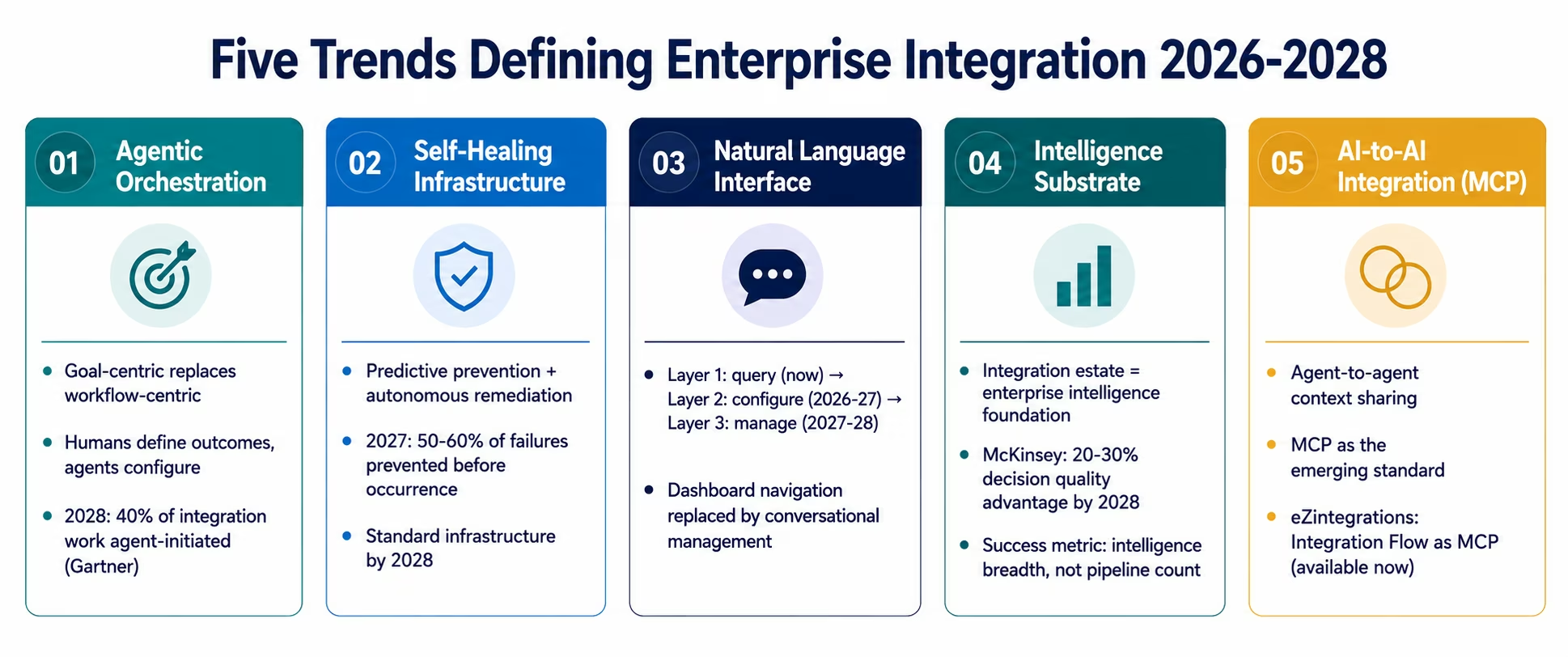
- Five trends define the 2026-2028 integration future: agentic orchestration becoming the default operating model, self-healing integration as standard infrastructure, natural language as the primary integration interface, the integration estate becoming the enterprise intelligence substrate, and AI-to-AI integration as a new connectivity paradigm.
- Gartner predicts that by 2028, 40% of enterprise integration work will be initiated and managed by AI agents rather than human developers, up from less than 2% today.
- The enterprises best positioned for this future are those building the integration foundation now: a managed, observable, AI-native estate (Levels 1-2) that is ready to extend into agentic operation (Levels 3-4) without architectural disruption.
- eZintegrations is designed for the full progression: from deterministic pipelines through Goldfinch AI agentic coordination, on a single platform that grows with the enterprise’s AI maturity.
How We Got Here: Three Eras of Enterprise Integration
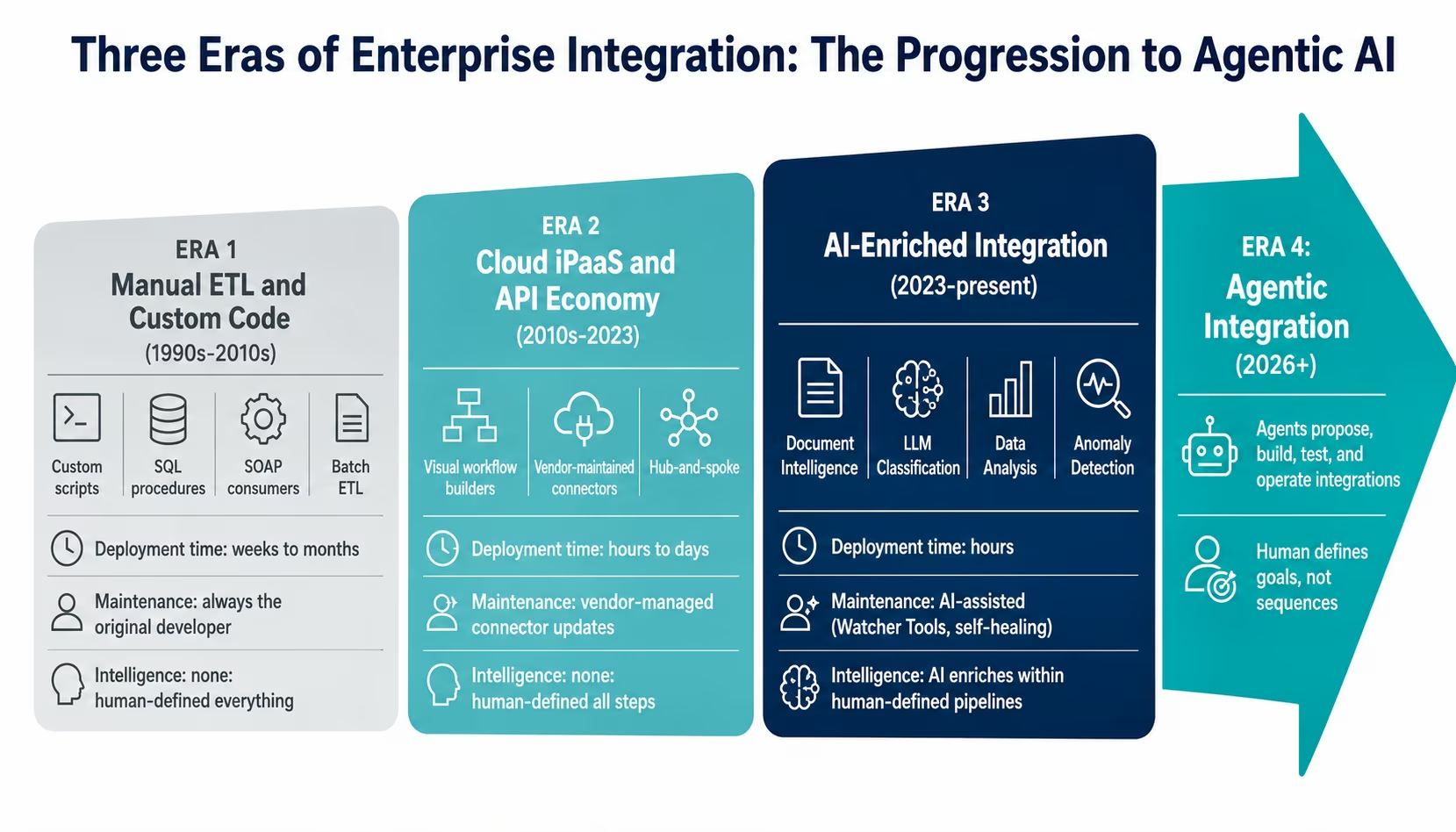
Enterprise integration has evolved through three distinct eras, each defined by the primary mechanism for moving data between systems and the human effort required to maintain it.
Era 1: Manual ETL and Custom Code (1990s-2010s)
The first era of enterprise integration was entirely human-driven: developers wrote custom scripts, SQL stored procedures, and SOAP web service consumers that extracted data from source systems, transformed it, and loaded it into destinations. Every integration was bespoke, every maintenance event required the developer who built it (or a reverse-engineering effort to understand it), and every connected system update created a manual update obligation.
The data warehouse was the centralising force of this era: not a real-time integration mechanism but a periodic accumulator that batch-processed data from operational systems into analytical form. The ETL pipeline was the dominant integration pattern, measured in hours and days rather than seconds and minutes.
Era 2: Cloud iPaaS and the API Economy (2010s-2023)
The SaaS explosion created a connected API estate that could be abstracted through integration platforms. Connectors replaced custom code for common systems. Visual workflow builders enabled operations teams to configure integrations without developer involvement. The iPaaS category standardised the hub-and-spoke architecture at the platform level, replacing the point-to-point custom code of Era 1 with vendor-maintained connectors and no-code workflow configuration.
This era produced significant productivity gains: integration time-to-deploy fell from weeks to hours for common patterns, and platform-managed connectors eliminated the API-update maintenance burden for managed integrations. But Era 2 still required humans to define every integration step in advance, humans to diagnose every failure, and humans to determine every routing decision. The integration was faster and more reliable; the human involvement model was unchanged.
Era 3: AI-Enriched Integration (2023-Present)
The current era added AI capabilities within the integration pipeline: Document Intelligence to read unstructured inputs, LLM Classification to make routing decisions based on semantic meaning, Data Analysis to detect anomalies and patterns, and Semantic Matching to resolve entity identity across inconsistent naming. AI became a processing layer within integration workflows: enriching, classifying, and routing data that rules-based logic could not handle.
This era reduced the manual exception handling that had always been the gap in Era 2 automation. AI-enriched pipelines handle the cases that rules cannot define. The integration estate becomes both more automated and more intelligent.
But Era 3 still has human-defined integration sequences. The AI enriches steps; the human still defines the steps. The next era changes this.
Where We Are Now: The Transition to Agentic Integration
Enterprise integration in 2026 is at an inflection point: most enterprises are operating in Era 3 (AI-enriched integration), a significant minority (34% according to McKinsey’s State of AI 2025) are beginning Era 4 deployment with AI agents and agentic coordination, and almost all enterprise technology leaders are planning for the capabilities that Era 4 will require.
The inflection is structural, not cyclical. It is not that AI-enriched integration (Era 3) has run its course: it continues to deliver value and will continue to be deployed. It is that the class of integration use cases that Era 3 cannot address: autonomous investigation, goal-directed multi-system orchestration, natural language enterprise intelligence, and self-configuring integration pipelines: is growing faster than Era 3’s capability set can accommodate.
The fundamental driver: the volume of enterprise data, the number of connected systems, and the speed at which business decisions require data inputs are all growing faster than human bandwidth to design, configure, and operate integration sequences. The integration estate is becoming too large and too complex to be fully human-operated.
Agentic integration: where agents take over the goal-directed portion of integration work, is the structural response to this scaling challenge.
According to Gartner’s Future of Digital Infrastructure research, by 2028:
- 40% of enterprise integration work will be initiated and managed by AI agents rather than human developers
- 60% of enterprise integration failures will be diagnosed and resolved without human investigation
- 25% of new enterprise integrations will be proposed by AI agents based on detected data flow patterns in the existing estate
These are not aspirational forecasts: they are projections based on the current trajectory of agentic AI capability development and enterprise adoption patterns.
The Five Trends Defining 2026-2028 Enterprise Integration
Five specific trends are shaping the integration technology landscape over the next 24 months. Each represents a shift in how integration work is conceived, executed, or governed, and each is already visible in the early deployments of leading enterprises.
Trend 1: Agentic Orchestration Becomes the Default Operating Model
The shift from workflow-centric to goal-centric integration is the most fundamental change in enterprise integration architecture since the move from custom code to iPaaS.
In the workflow-centric model (Era 2 and most of Era 3), integration work begins with a human defining a workflow: “when trigger A fires, do B, then C, then D.” The workflow is the integration. Every integration is a workflow. Every new integration requirement produces a new workflow design and configuration cycle.
In the goal-centric model (Era 4), integration work begins with a human defining an outcome: “ensure that customer churn signals are detected and routed to the right team within 5 minutes of occurrence.” The agentic system determines how to achieve this outcome: which systems to monitor, which signals to classify, what routing logic to apply, and how to handle exceptions and configures or operates the necessary integration patterns.
Why this shift is happening in 2026 specifically:
The two technical prerequisites for goal-centric integration are now met. First, tool-calling reliability has crossed the production threshold (90-95% on complex multi-tool tasks in 2026, up from 60-70% in 2023): agents can reliably execute the investigation and execution sequences that goal-centric integration requires. Second, enterprise API estates are sufficiently standardised (78% of enterprise SaaS exposes REST/OAuth 2.0 APIs, per Forrester) that agents have reliable access to the connected system estate without custom integration code for each system.
What this looks like in practice:
A head of operations asks the enterprise integration platform: “I need real-time alerts when any enterprise customer’s product usage drops by more than 30% in a 7-day window.” In the workflow-centric model, this initiates a development cycle: architect designs the monitoring workflow, developer configures it, QA tests it, DevOps deploys it: two to four weeks. In the goal-centric model, the agentic orchestration layer interprets the goal, identifies the relevant data sources (product analytics platform, customer database), configures the monitoring parameters, establishes the classification logic, and sets up the alert routing proposing the configuration for human review within hours.
This is not fully autonomous integration configuration: the human reviews and approves the proposed configuration before it goes live. But the human reviews a pre-configured proposal rather than designing from scratch. The integration design effort drops by 70-80%.
Trend 2: Self-Healing Integration as Standard Infrastructure
By 2028, integration platforms that require human intervention for routine failure recovery will be considered as outdated as email systems that require manual spam filtering: functional, but unacceptably labour-intensive.
The transition to self-healing integration as standard infrastructure is driven by the same forces as the agentic orchestration trend: the integration estate is becoming too large and too complex to be maintained through human-first failure response. An enterprise with 200 integrations in production, a realistic 3-5% daily failure rate, and a 2-4 hour manual investigation time per failure is consuming 12-40 hours of engineering time per day on investigation alone. This is not a model that scales.
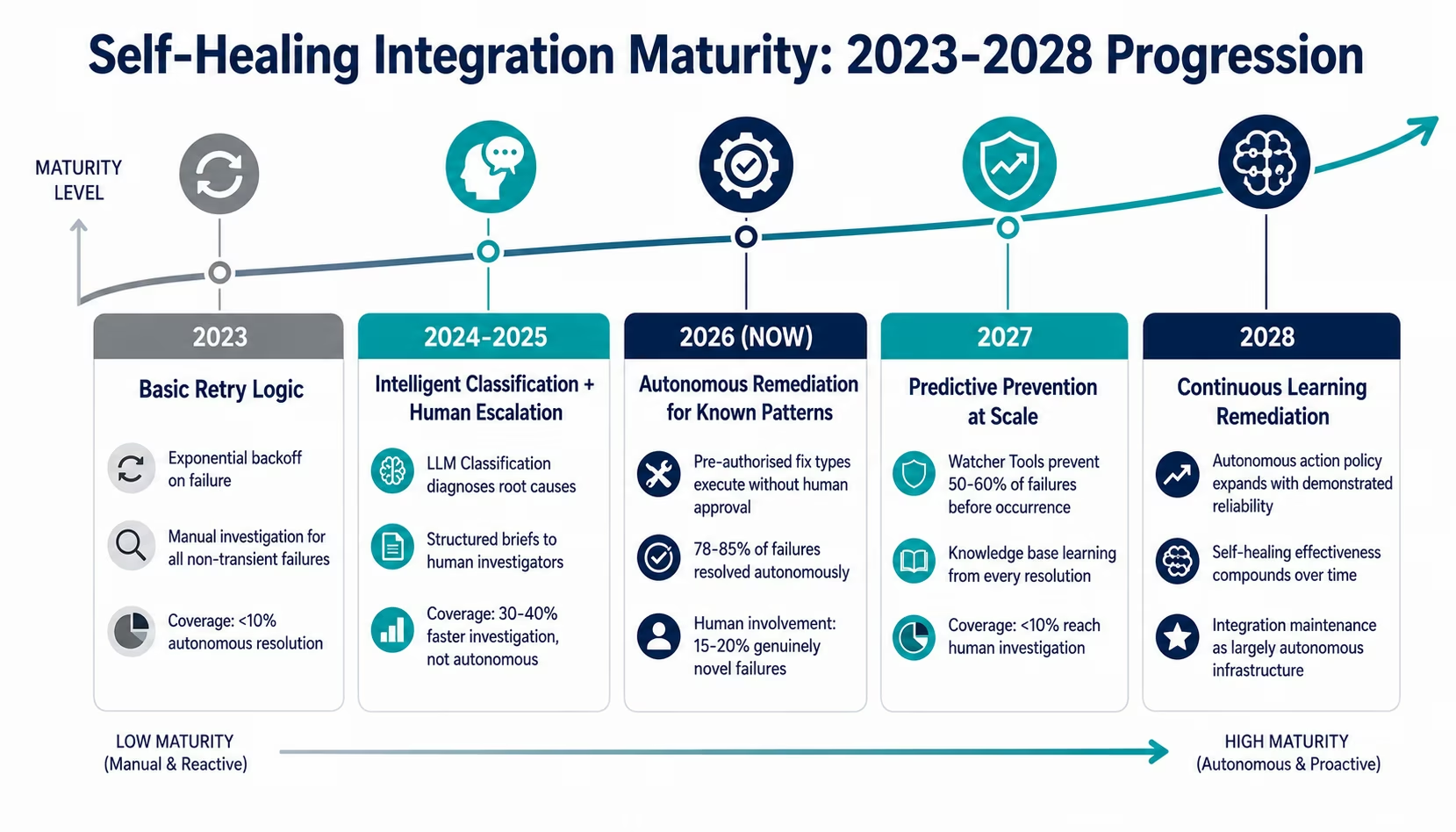
Self-healing integration in the 2026-2028 timeframe has four capabilities working together:
Predictive failure prevention: Watcher Tools monitoring credential expiry, API rate limit trajectories, response latency trends, and data volume anomalies: intervening before failures occur rather than responding after them. Gartner projects that by 2027, predictive monitoring will prevent 50-60% of integration failures that would otherwise generate incidents in mature deployments.
Autonomous root cause classification: LLM Classification with continuously expanding error pattern knowledge bases: not just classifying known errors faster, but learning from new error types and expanding the knowledge base as the estate encounters novel failures. The classification accuracy on known failure types approaches 97% in mature deployments; the novel failure detection rate (flagging genuinely new error types for human investigation) improves as the knowledge base grows.
Context-aware recovery: multi-path recovery strategies that apply the optimal recovery for each specific failure type: rate limit waits calibrated to the Retry-After header, authentication failures that refresh credentials before retry, schema failures that route to adaptation workflows rather than retrying, downstream outage detection that queues rather than retries. The recovery success rate for known failure types in mature deployments exceeds 90%.
Continuous learning remediation: remediation patterns that improve over time: new successful resolutions added to the knowledge base, failure types that repeatedly reach human investigation escalated for knowledge base enrichment, and the autonomous action policy refined based on the outcomes of past autonomous decisions. Self-healing integration becomes more effective the longer it operates.
The governance evolution this requires:
Self-healing infrastructure at this maturity level requires governance frameworks that are currently still being designed in most enterprises.
The autonomous action policy: what the system can remediate without human approval: must expand beyond trivially safe actions (token refresh, rate limit backoff) to include more complex remediations (schema adaptation for backward-compatible changes, data correction and requeue for known quality patterns). This expansion requires both technical capability (the remediation actions must be reliably executable) and organisational confidence (the operations team must trust the remediation logic enough to pre-authorise it).
The enterprises that will have mature self-healing integration by 2027-2028 are the ones expanding their autonomous action policies deliberately and incrementally in 2026.
Trend 3: Natural Language as the Primary Integration Interface
The command-line interface gave way to the graphical interface. The graphical interface is giving way to the natural language interface. In enterprise integration, this transition will be largely complete by 2028.
The natural language integration interface has three layers, each maturing at different rates:
Layer 1: Natural language queries (now)
Already deployed at the leading edge of enterprise integration: executives and operations leaders using Chat UI interfaces to query live business data across connected systems in natural language. “What is the current health of our top 20 accounts?”: answered in under 60 seconds by the agentic intelligence layer without a data team request or a dashboard navigation exercise.
This layer is operational today in early adopter enterprises running platforms like Goldfinch AI. The capability is real, the latency is acceptable, and the adoption curve is accelerating as executives experience the alternative to the 3-5 day BI report cycle.
Layer 2: Natural language configuration (2026-2027)
The next layer: using natural language to configure integration workflows rather than building them step by step in a visual workflow editor. “Create a monitoring workflow that alerts the CS team when any enterprise account’s product usage drops more than 30% in 7 days, and route the alert through Slack with the account’s health history pre-populated.”
The agentic system interprets this intent, proposes a workflow configuration, and presents it to the integration architect for review. The architect reviews, adjusts if needed, and approves. The workflow goes live. Total configuration time: 30-60 minutes versus 2-4 hours of visual workflow building.
This layer is beginning to appear in leading platforms in 2026 and will be standard capability by 2027.
Layer 3: Conversational integration management (2027-2028)
The third layer: ongoing integration management through conversational interfaces. “Show me all integrations that haven’t been updated in 12 months and are connected to systems with upcoming API versions.” “Flag all data flows that carry PII but are not running through our data classification layer.” “Suggest which backlog items could be addressed by existing Automation Hub templates.”
These are investigative queries about the integration estate itself: not queries about the data the estate carries, but queries about the estate’s configuration, health, and compliance posture. The agentic intelligence layer queries its own knowledge base about the managed integration estate and returns structured answers.
This layer represents integration operations becoming conversational: a CTO or integration architect managing a 200-integration estate through natural language dialogue rather than dashboard navigation.
Trend 4: The Integration Estate as Enterprise Intelligence Substrate
The most strategically significant trend in enterprise integration’s future is the reframing of what an integration estate is for.
For 30 years, the integration estate’s purpose was connectivity: move data from System A to System B reliably, at volume, and with acceptable latency. The integration platform was infrastructure: valuable but invisible, like electricity or plumbing. Its success was measured by the absence of failures and the growth of the connected system count.
The future integration estate is intelligence infrastructure: not just a mechanism for moving data, but the substrate on which enterprise intelligence is built. The estate is the collection of live, authenticated, queryable connections to every system the enterprise operates. Agents that need Salesforce data use the estate’s Salesforce connection. Agents that need to correlate product usage with billing status use the estate’s product analytics and billing connections. The agentic intelligence layer: natural language queries, automated intelligence programmes, multi-system investigation: runs on top of the connected estate.
This reframing has profound implications for how integration estates are designed, what success looks like, and who cares about them at the executive level.
Design implication: estates designed for connectivity (data movement between specific systems) are optimised for throughput and reliability. Estates designed as intelligence substrates must also be optimised for observability (agents must be able to query what data is available in each system), schema documentation (agents must understand what each field means), and real-time accessibility (agents query live data, not scheduled exports).
Success metric implication: connectivity estates are measured by pipeline uptime and data delivery SLAs. Intelligence substrates are measured by the quality and breadth of intelligence that can be delivered from them; how many systems can agents query? How quickly can executive intelligence queries be answered? What percentage of business questions asked of the natural language interface can be answered from the connected estate?
Executive relevance implication: in the connectivity era, the integration estate was an IT concern. In the intelligence substrate era, the integration estate determines the quality of executive decision-making: which makes it a CEO and board concern.
McKinsey’s research on data-driven enterprises projects that organisations that have built AI-queryable integration estates by 2028 will have a 20-30% decision quality advantage over those still operating on periodic BI reporting: measurable in faster response to market signals, more accurate forecasting, and better resource allocation.
Trend 5: AI-to-AI Integration: A New Connectivity Paradigm
The fifth trend is the least visible today and the most significant for integration architects planning 2026-2028 infrastructure.
Enterprise AI is becoming multi-agent: not a single AI model that handles everything, but specialist AI systems: a customer success intelligence agent, an integration health monitoring agent, a procurement intelligence agent, a clinical decision support agent, that each operate in their domain and occasionally need to exchange context.
When the customer success AI agent detects a churn signal, it may need to pass context to the procurement AI agent (to pause a renewal conversation) and to the billing AI agent (to flag the account for billing team review). This is AI-to-AI communication: not a human-defined data flow, but an agent-to-agent context handoff.
The Model Context Protocol (MCP), first proposed by Anthropic and gaining rapid enterprise adoption in 2025-2026, is the emerging standard for this AI-to-AI connectivity layer. MCP defines how an AI agent exposes its capabilities and data to other AI agents, creating a standardised interface for the multi-agent enterprise.
What this means for integration architecture:
The integration estate of the future will have two connectivity layers: the traditional data movement layer (APIs, databases, message queues: the foundation) and an MCP layer (AI-to-AI context and capability sharing: the emerging addition). eZintegrations’ Integration Flow as MCP capability: exposing integration workflows as MCP endpoints for consumption by external AI agents is the current implementation of this architecture.
The practical implication for enterprise architects in 2026:
The integration platform decisions made in 2026 will determine whether an enterprise’s AI agents can participate in the emerging multi-agent ecosystem. Platforms that support MCP exposure of integration capabilities will enable cross-agent collaboration; platforms that do not will require agent-specific custom integration for each AI-to-AI interaction, creating a new form of integration debt in the agent layer before the agent layer has matured.
The Four-Stage Integration Maturity Model
Understanding where an enterprise sits on the integration maturity curve determines what it should be building now to position for the capabilities it will need in 2027-2028.
Stage 1: Connected but Fragmented (Majority of enterprises today)
Characteristics: integrations exist across multiple tools (3-4 iPaaS platforms, shadow integrations, developer scripts), monitoring is inconsistent, documentation is incomplete, and the integration estate is not sufficiently observable for AI agent use. The maintenance burden is 40-50% of engineering capacity.
What to do now: execute the integration debt resolution programme: inventory the full estate, stabilise Red integrations, migrate to a single managed platform in priority order. The goal of Stage 1 → Stage 2 transition is not AI adoption; it is creating the managed foundation that makes AI adoption possible.
Stage 2: Managed and Observable (Target for 2026-2027)
Characteristics: integrations are managed on a single platform, monitored with per-execution logging, documented with field-level metadata, and health-classified in real time. The integration estate is fully observable, agents can query what is in each system, what each system’s API can return, and what the current health status of each integration is.
What Stage 2 enables: AI Workflow enrichment (Document Intelligence, LLM Classification, Data Analysis nodes within managed pipelines), initial AI Agent tool registry population (clean API connections can be registered), and the beginning of self-healing integration (Watcher Tools, LLM Classification for failure diagnosis, pre-authorised autonomous remediation).
Stage 3: AI-Native and Agent-Ready (Target for 2027)
Characteristics: AI Workflow nodes are embedded in pipelines across the estate, the agent tool registry covers the critical system estate, self-healing integration handles 70-80% of failures autonomously, and natural language query capability is deployed for operations and executive intelligence needs.
What Stage 3 enables: full Level 3 AI Agent deployment, Goldfinch AI multi-agent coordination for complex cross-system intelligence, automated intelligence programmes running on the Workflow Node, and the beginning of conversational integration management.
Stage 4: Agentic Integration Ecosystem (Target for 2028)
Characteristics: agentic orchestration proposes and configures new integrations from goal statements, self-healing covers 85-90% of failure events without human involvement, natural language is the primary interface for integration management and enterprise intelligence, and MCP-layer AI-to-AI integration enables cross-agent collaboration across the enterprise’s specialist AI systems.
This is the integration estate of 2028 for enterprises that begin the progression in 2026. It is not a speculative vision, it is the logical trajectory of technologies that are already in production at the leading edge of enterprise deployment.
What CIOs Should Do Now to Prepare
The enterprises that will have Stage 4 agentic integration capability by 2028 are the ones that begin Stage 1 → Stage 2 transition in 2026. The progression is incremental and sequential: Stage 3 is not accessible without Stage 2, and Stage 4 is not accessible without Stage 3. Starting in 2027 means arriving at Stage 4 in 2029-2030. Starting in 2026 means arriving in 2028.This planning discipline also connects with the Harvard Business School AI-first strategy guide, which explains that becoming AI-first requires more than adopting AI tools: organisations need the right strategy, operating model, data foundation, governance, and leadership alignment before AI can create scalable business value.
Five actions for CIOs preparing for the integration future:
1. Execute the integration debt audit. Before any AI capability investment, understand the current state of the integration estate: full inventory (including shadow integrations), health classification, business criticality assessment, and AI-readiness assessment (which integrations are managed, monitored, and API-accessible for agent use). The audit is the prerequisite for intelligent prioritisation.
2. Choose a four-level platform now, not later. The platform decision made in 2026 determines the migration cost to reach Stage 3-4. An AI-enabled iPaaS (Level 1-2) requires a platform migration to reach Level 3-4. An AI-native four-level platform (Level 1-4) requires only additional configuration. Platform migrations at Stage 3-4 scale: when the agentic layer is actively operating: are significantly more complex and risky than platform migrations at Stage 1-2 scale. Choose the four-level destination architecture in 2026.
3. Build the agent tool registry incrementally. As integrations migrate to the managed platform, register each clean API connection in the agent tool registry. The tool registry is the agent’s access to the enterprise: each registered system is a system agents can query. Building the registry incrementally, as the estate is modernised, means the agentic capability expands continuously rather than waiting for a big-bang tool registry build.
4. Define the autonomous action policy before you need it. The autonomous action policy: what agents can do without human approval: should be designed before agents are deployed, not after the first autonomous action with unintended consequences. Start conservative (read-only autonomy, human approval for all write operations) and expand incrementally based on demonstrated reliability and operational confidence.
5. Plan the intelligence substrate architecture. As the integration estate is modernised, design it explicitly for intelligence use: real-time API access (not scheduled exports), schema documentation at the field level, and system-specific context that agents need to interpret data correctly (what does “status: 4″ mean in this specific ERP’s API?). This metadata layer: the intelligence substrate documentation: is what makes the difference between an agent that can retrieve data and an agent that can interpret and act on it.
How eZintegrations Is Built for This Future
eZintegrations is designed as the four-level progression architecture: not a point solution for today’s integration requirements, but a platform that grows with the enterprise’s AI maturity from Stage 1 through Stage 4.
Stage 1-2 foundation (available today): Level 1 iPaaS with 1,000+ Automation Hub templates across REST, GraphQL, WebSocket, Database, Message Queue, and File protocols. Enterprise-grade connector depth for SAP (OData V4, CSRF), NetSuite (SuiteQL, TBA), Oracle ERP (assertion grant OAuth), Salesforce (REST, SOQL, Bulk API), and all major healthcare standards (FHIR R4, HL7 v2, X12 EDI). IPSec Tunnel for on-premises systems. SOC 2 Type II, HIPAA BAA, GDPR compliant.
Level 2 AI Workflows (available today): Document Intelligence, LLM Classification, Data Analysis, Semantic Matching, and Data Analytics with Charts/Graphs/Dashboards as native workflow nodes.
All AI inference runs within eZintegrations’ infrastructure: no enterprise data sent to external AI providers. Structured JSON output with built-in confidence threshold routing. Native audit logging for all AI node executions.
Level 3 AI Agents (available today): autonomous investigation agents with 9 native enterprise tools, Knowledge Base Vector Search, Document Intelligence, Data Analysis, Data Analytics with Charts/Graphs/Dashboards, Web Crawling, Watcher Tools, API Tool Call, Integration Workflow as Tool, and Integration Flow as MCP. User-extensible tool registry. Configurable autonomous action policy with human approval gates.
Level 4 Goldfinch AI (available today): coordinator-worker multi-agent architecture : a coordinator agent dispatches specialist worker agents in parallel across connected systems. Chat UI for natural language enterprise intelligence queries, answered in under 60 seconds from live system data. Workflow Node for automated intelligence programmes delivered on schedule or trigger. 47-second account health investigation response. 52-second executive strategic intelligence brief. No data team request required.
MCP-layer AI-to-AI connectivity (available today): Integration Flow as MCP exposes eZintegrations integration capabilities as MCP endpoints, enabling external AI agents and models to call eZintegrations integrations as tools. This is the current implementation of Trend 5 (AI-to-AI integration) in eZintegrations’ architecture.
The progression guarantee: a customer who starts at Level 1 with a CRM-to-ERP sync today has a migration-free path to Level 4 Goldfinch AI agentic coordination, the same platform, additional configuration and licensing, no architectural disruption. The progression does not require a platform change at any stage.
Book a free demo future integration architecture and bring your 2027-2028 integration roadmap. We will show you the progression path from your current state to Stage 3-4 agentic capability, and what enabling the Chat UI and Workflow Node looks like for your specific connected system estate.
Frequently Asked Questions
Enterprise integration is progressing through four stages: from connected-but-fragmented estates (manual maintenance, rule-based pipelines), to managed-and-observable (single platform, AI workflow enrichment), to AI-native-and-agent-ready (autonomous investigation, natural language intelligence), to agentic integration ecosystem (agent-configured integrations, self-healing infrastructure, conversational management). Gartner projects that by 2028, 40% of enterprise integration work will be initiated and managed by AI agents, and 60% of integration failures will resolve without human investigation.
Agentic integration is the goal-centric operating model where AI agents propose, configure, operate, and repair integrations based on outcome specifications rather than predefined sequences. Elements are already mainstream in 2026, autonomous failure investigation (Level 3 AI Agents), multi-agent intelligence delivery (Level 4 Goldfinch AI), and natural language enterprise queries. Full agentic integration: where agents propose and configure new integration pipelines from natural language goal statements with human approval, will be mainstream for leading enterprises by 2027 and broadly adopted by 2028.
MCP (Model Context Protocol) is an emerging standard for AI-to-AI connectivity: defining how AI agents expose their capabilities and data to other AI agents. As enterprise AI becomes multi-agent (specialist agents for customer success, procurement, clinical operations, and integration health all operating simultaneously), these agents need to share context and trigger each others capabilities. MCP is the standard interface for this AI-to-AI layer. eZintegrations Integration Flow as MCP capability exposes integration workflows as MCP endpoints, enabling external AI agents to call eZintegrations integrations as tools.
Four-stage preparation: execute the integration debt audit to understand the current estates AI-readiness, choose a four-level AI-native platform now before the migration cost of reaching Level 3-4 on an AI-enabled platform becomes the bottleneck, build the agent tool registry incrementally as integrations are modernised, define the autonomous action policy before agents are deployed. The enterprises arriving at Stage 3-4 capability in 2028 are the ones beginning the Stage 1-2 foundation work in 2026.
The integration estate as intelligence substrate is the reframing of what integration is for: from connectivity (moving data between systems) to intelligence infrastructure (the foundation on which enterprise intelligence runs). An AI-queryable integration estate where agents can access live data from all connected systems is the foundation for natural language enterprise intelligence, automated strategic briefings, and the decision quality advantage that McKinsey projects at 20-30% for enterprises with AI-queryable estates by 2028.
eZintegrations delivers all four levels on a single platform: Level 1 (managed iPaaS, 1,000+ Automation Hub templates, enterprise-depth connectors, IPSec Tunnel), Level 2 (native AI Workflow nodes with structured output and compliance-safe inference), Level 3 (AI Agents with 9 native tools, configurable autonomous action policy), Level 4 (Goldfinch AI coordinator-worker multi-agent coordination, Chat UI, Workflow Node). The progression from Level 1 to Level 4 requires no platform migration, additional configuration and licensing only. MCP-layer AI-to-AI connectivity available now through Integration Flow as MCP.1. What is the future of enterprise integration in 2026 and beyond?
2. What is agentic integration and when will it be mainstream?
3. What is the Model Context Protocol (MCP) and why does it matter for enterprise integration?
4. How should enterprises prepare their integration estate for an agentic AI future?
5. What is the integration estate as intelligence substrate and why does it matter?
6. How does eZintegrations support the four-stage integration maturity progression?
Conclusion: The Integration Estate of 2028 Is Decided by the Investments of 2026
The enterprise integration landscape of 2028: agentic orchestration as the default, self-healing infrastructure as standard, natural language as the primary interface, the estate as intelligence substrate, is not a speculative vision. It is the destination toward which current investments and current technology trajectories are pointing.
But it is not a destination that is equally accessible to all enterprises. The organisations that arrive at Stage 4 agentic integration capability in 2028 are the ones that begin Stage 1-2 managed foundation work in 2026. The organisations that defer that foundation work to 2027 arrive at Stage 4 in 2029-2030: a gap that compounds, because the intelligence quality advantage of AI-queryable integration estates grows with the time those estates have been operating.
The five trends: agentic orchestration, self-healing infrastructure, natural language interfaces, intelligence substrate architecture, and AI-to-AI MCP connectivity: are already visible in the leading edge of enterprise deployment. They are not evenly distributed. The competitive advantage they create is not evenly distributed.
Enterprise integration is becoming the most strategically significant technology infrastructure decision of the decade. Not because integration is glamorous: it never has been. But because the intelligence layer that determines executive decision quality, operational efficiency, and AI programme ROI is built on the integration estate. The integration estate of 2028 is decided by the investments of 2026.
eZintegrations is the four-level progression platform designed for this journey: Level 1 managed foundation today, Goldfinch AI Level 4 agentic coordination when the estate is ready, and a migration-free path between them.
Book a free demo future integration architecture and bring your 2027-2028 integration and AI roadmap. We will show you the progression path from your current state to Stage 3-4 capability, and the Chat UI answering a live intelligence query from your connected systems.