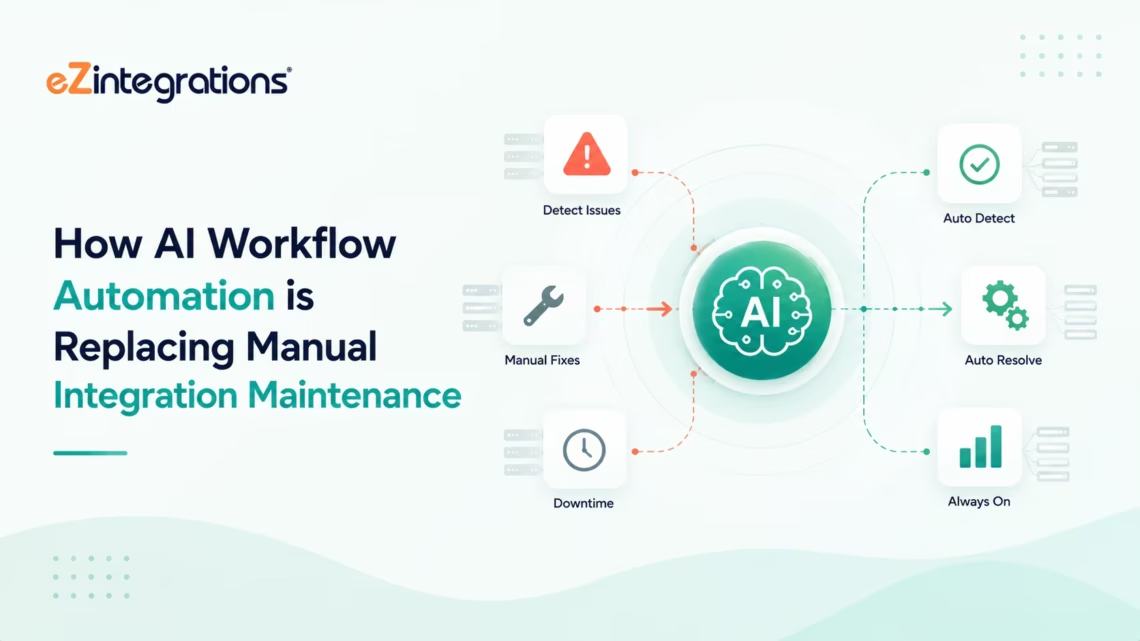
How AI Workflow Automation is Replacing Manual Integration Maintenance
June 6, 2026AI workflow automation replacing manual integration maintenance by handling the four tasks that consume most of engineering’s maintenance time: detecting failures before they cause outages (predictive monitoring), diagnosing root causes without human investigation (intelligent classification), recovering from known error types autonomously (self-healing remediation), and adapting to API and schema changes without manual rework (automated schema evolution), representing the next operational evolution beyond Robotic process automation. The result is that engineering teams spend time building, not maintaining.
TL;DR
- Manual integration maintenance is the largest hidden cost in enterprise IT operations. Gartner estimates enterprises with 50+ integrations spend 40-50% of their integration engineering capacity on maintenance: not on new capabilities.
- This maintenance burden is not caused by bad engineering. It is caused by the structural characteristics of integration work: APIs change, credentials expire, schemas evolve, data volumes spike, and none of these changes announce themselves in advance.
- AI workflow automation is changing this by handling the four core maintenance tasks autonomously: failure prediction, root cause classification, self-healing recovery, and schema adaptation: without requiring engineer involvement for the 80-85% of cases that are known patterns with known resolutions.
- The practical outcome is not that engineers are replaced. It is that engineers spend their time on the 15-20% of problems that genuinely require judgment: while AI handles the rest, consistent with broader Forrester Research analysis of intelligent automation in integration operations.
- eZintegrations delivers this through four native AI capabilities: Watcher Tools (predictive monitoring), LLM Classification (root cause diagnosis), Data Analysis (anomaly detection), and automated remediation workflows: all within the same platform used for integration configuration.
The Hidden Tax of Manual Integration Maintenance
Manual integration maintenance is a hidden enterprise tax that most organisations have never explicitly calculated. It does not appear as a line item in the IT budget. It appears as engineering hours that never go toward new capabilities, backlogs that grow faster than they can be cleared, and data quality problems that accumulate in the gaps between maintenance cycles.
Here is what the tax looks like at a typical Series B or enterprise organisation with 50-100 integrations in production:
An engineer gets paged at 3:47 AM because a Salesforce sync failed. They spend 2.5 hours investigating: reading error logs, querying the Salesforce API, correlating with the credential rotation that happened last week. The fix: 4 minutes. The integration team’s Monday standup has four items on the “integration issues” agenda: each one representing hours of investigation time from the previous week. The quarterly planning meeting allocates 30% of engineering capacity to “integration maintenance and reliability” before any new work is scoped. The integration backlog has 18 months of requested work in it, and it is not shrinking.
None of this is unusual. It is the standard operating condition of enterprise IT organisations with significant integration estates.
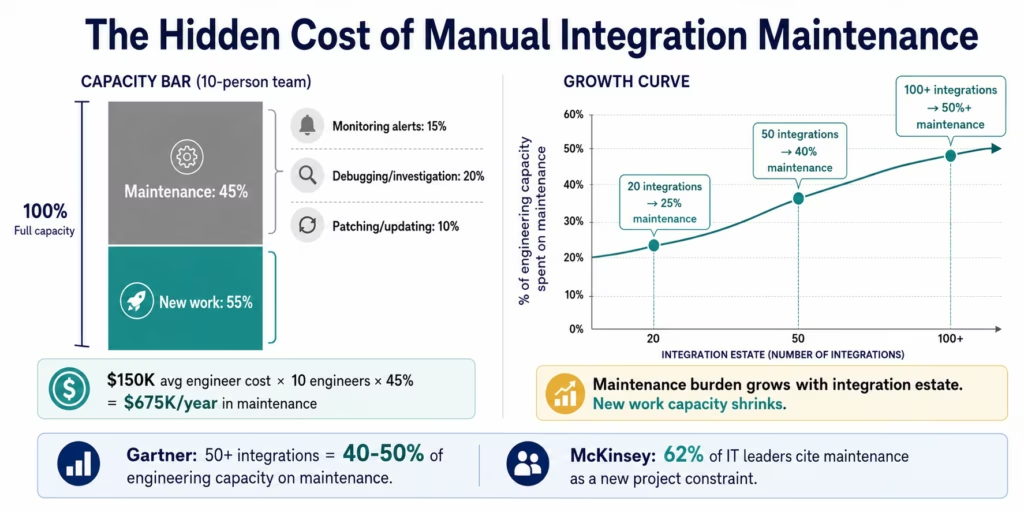
Gartner’s 2025 research on enterprise integration operations found that organisations with 50+ integrations in production spend an average of 40-50% of their integration engineering capacity on maintenance: monitoring, debugging, patching, and updating existing pipelines. At a fully loaded engineering cost of $150,000-200,000 per engineer per year, a 10-person integration team spending 45% of its capacity on maintenance represents $675,000-900,000 per year in maintenance cost. Before counting the business cost of the outages and data quality failures the maintenance misses.
McKinsey’s research on enterprise automation shows that this maintenance burden is one of the top three factors preventing enterprises from delivering new integration capabilities: with 62% of IT leaders citing integration maintenance as a significant constraint on their team’s ability to take on new projects.
Why Integration Maintenance Never Gets Smaller
The integration maintenance burden does not plateau as the estate matures: it grows, because every new integration is a new ongoing maintenance obligation that compounds on all prior obligations.
This compounding is the structural feature that makes manual maintenance unsustainable. A team that manages 20 integrations reliably will not manage 100 integrations with the same reliability unless the maintenance model changes.
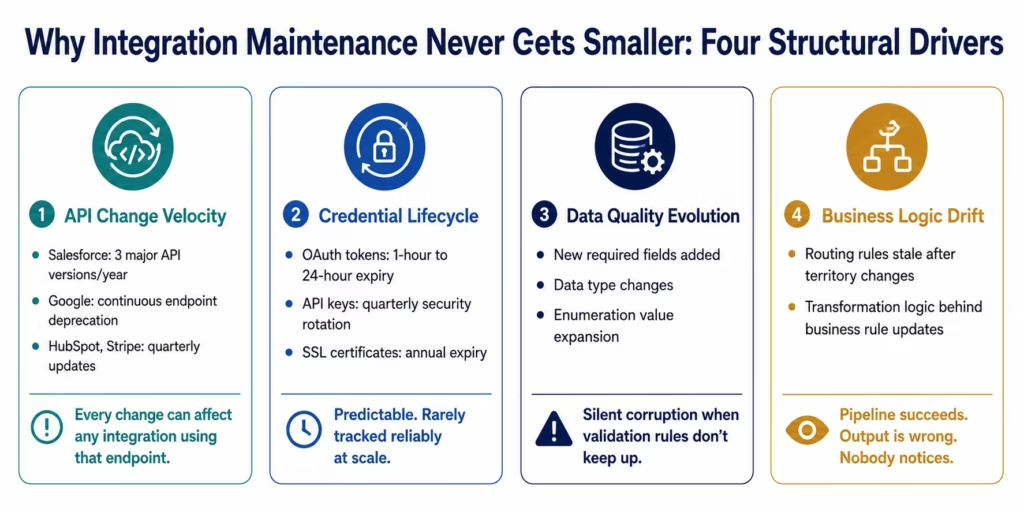
Four structural drivers keep the maintenance burden growing:
Driver 1: API change velocity is accelerating. The major SaaS platforms that most enterprises integrate with: Salesforce, HubSpot, Stripe, Google Workspace, AWS: update their APIs multiple times per year. Salesforce releases three major API versions annually. The Google API ecosystem deprecates and replaces endpoints continuously. Each API change can affect any integration that uses the changed endpoint: and there is typically no advance warning that arrives in a form your monitoring system can act on automatically.
Driver 2: Credential and certificate lifecycles create recurring failures. OAuth tokens expire. API keys are rotated for security compliance. SSL certificates reach their expiry dates. Each of these events is entirely predictable: the expiry date is known: but the manual process of tracking and rotating credentials across dozens of integrations is time-consuming and error-prone. The credential that was rotated in the staging environment but not in production is a classic source of midnight pages.
Driver 3: Data quality is a moving target. The data arriving from source systems changes over time: new required fields are added, data types change, enumeration values expand, field naming conventions shift. Each change that the integration’s validation rules do not accommodate produces either failed records (which route to the error queue) or invalid data (which passes validation and corrupts the destination system silently). Keeping validation rules current with the source system’s data evolution is ongoing maintenance work.
Driver 4: Business logic evolves faster than integrations do. Routing rules change when territory structures change. Transformation logic changes when business rules change. The integration that correctly maps customer segments to the right Salesforce queue in January may be silently mis-routing new customer types in July because the segment definitions changed and nobody updated the integration. This type of drift is the hardest maintenance category to detect: the pipeline runs successfully, producing plausible outputs that are systemically wrong.
The Four Maintenance Tasks AI Is Replacing
AI workflow automation addresses maintenance work by category: each category has a specific AI capability that handles it more reliably and at lower cost than manual processes.
The four maintenance task categories that consume the most engineering time, and the AI capability that replaces each:
| Maintenance Task | Manual Process | AI Replacement | Time Recovered |
|---|---|---|---|
| Failure detection | Alert monitoring, manual dashboard review | Predictive Watcher Tools detecting conditions before failure | Eliminates reactive monitoring shifts |
| Root cause investigation | Engineer reviews logs, queries APIs, hypothesises (2-4 hrs) | LLM Classification with error knowledge base (30 seconds) | 2-4 hrs per incident for known patterns |
| Recovery and remediation | Engineer executes fix, verifies, documents | Autonomous remediation for pre-authorised fix types | 15-60 min per incident for routine fixes |
| API and schema adaptation | Engineer reviews API changelog, updates integration code | Automated schema monitoring and adaptation for backward-compatible changes | 1-4 hrs per API version change |
Together, these four replacements address the tasks that consume the 40-50% of engineering capacity that Gartner identifies as maintenance overhead. They do not address the 15-20% of genuinely novel problems: new failure types, complex architectural decisions, business logic redesigns: that require engineering judgment. That 15-20% remains human work, and appropriately so.
AI Replacing Task 1: Failure Detection and Prediction
The shift from reactive failure detection to predictive failure prevention is the highest-leverage maintenance automation available: because it eliminates the failure entirely rather than just handling it faster after it occurs.
Traditional integration monitoring is reactive by design: an alert fires when something breaks, an engineer investigates the broken thing. The assumption embedded in this model is that failures are unpredictable. For the majority of integration failures, this assumption is wrong.
The predictability of common failures:
OAuth tokens carry an explicit expires_at timestamp in the token response. A token that will expire at 3:47 AM tomorrow is knowable today. A monitoring system that checks expiry timestamps hourly and initiates proactive refresh when expiry is within 60 minutes will never experience a midnight OAuth expiry failure: because the failure condition is detected and resolved before it manifests.
API rate limit consumption is visible in response headers. X-RateLimit-Remaining: 127 in an API response at 2:30 PM tells you that at the current consumption rate, the rate limit will be exhausted in the next 45 minutes. A monitoring system that tracks rate limit trajectory fires a slowdown directive 20 minutes before the limit is hit: before the first 429 error occurs.
API changelog monitoring via Web Crawling can detect announced deprecations before they cause failures. If a Salesforce API endpoint is scheduled for deprecation in 90 days, that is 90 days to update the affected integrations before the deprecation causes a production failure.
The Watcher Tool in eZintegrations:
The Watcher Tool continuously monitors configured metrics: credential expiry windows, rate limit consumption rates, API response latency trends, queue depth trajectories, and upstream data volume anomalies. When a monitored metric crosses a configured threshold, it fires the pre-configured response:
- Credential within 60 minutes of expiry → initiate proactive token refresh
- Rate limit trajectory projecting exhaustion within 30 minutes → activate request throttling
- API latency 2x above baseline for 5 consecutive minutes → route traffic to fallback endpoint and alert
- Queue depth exceeding 10,000 messages → scale consumer instances and alert operations team
The Watcher Tool turns known-predictable failures from inevitable incidents into prevented conditions. According to organisations deploying predictive integration monitoring, 60-70% of authentication failures and 30-40% of rate limit errors are eliminated by moving from reactive to predictive detection.
AI Replacing Task 2: Root Cause Investigation
Root cause investigation is the maintenance task with the highest per-incident time cost: and the one where the gap between what the AI can determine and what the human determines through manual investigation is smallest.
When an integration fails, the engineer’s investigation follows a predictable sequence: read the error log, identify the error code, query the source API for the specific error response, check whether the error is specific to one record or the entire pipeline, correlate with recent changes (credential rotations, deployments, upstream data changes), form a root cause hypothesis, test the hypothesis. For known error types: the majority of integration failures: this sequence reaches the same conclusion every time.
The LLM Classification node, applied to integration error handling, executes this sequence in 30-45 seconds:
- Retrieves the error code, HTTP status, error message text, and endpoint from the failure record
- Searches the pre-populated error pattern knowledge base for the specific error type from the specific API
- Cross-references the failure timestamp against recent changes (credential rotation log, deployment log, upstream change events)
- Classifies the failure: error category, specific type, confidence score, and recommended remediation action
- Delivers a structured diagnostic brief to the monitoring dashboard or Slack channel
The structured output: “Salesforce QUERY_TIMEOUT on the Opportunity sync workflow. This error type has occurred 4 times in the last 30 days, all during peak API load hours (2-4 PM PST). Root cause: API timeout during peak load. Resolution: schedule the sync workflow outside peak hours or reduce batch size to 200 records. Confidence: 91%.”
An engineer receiving this brief reviews it in 3 minutes rather than building it from scratch in 2-3 hours. For the 80-85% of failures that are known patterns, the AI’s diagnostic brief is as accurate as the engineer’s manual investigation: reached 200-300 times faster.
AI Replacing Task 3: Recovery and Remediation
Self-healing remediation is AI automation of the fix itself: not just the diagnosis, but the corrective action: for failure types that are known, deterministic, and within the configured autonomous action policy.
The distinction between what should be automated and what should not is the governance design decision. The practical framework:
Automate when all four conditions are met:
- The fix is deterministic: the same failure type always has the same correct fix
- The fix is reversible: if the automated action produces an unexpected result, it can be undone
- The fix is bounded: the automated action affects only the failing component, not shared infrastructure
- The fix is pre-authorised: the operations team has explicitly configured this fix type as autonomous
Do not automate:
- Fixes that require judgment about whether the fix is appropriate given current business context
- Fixes that affect shared infrastructure (a credential used by 20 integrations)
- Fixes whose reversal is operationally complex
- Fixes for failure types the system has not seen before (low classification confidence)
Applied to integration maintenance, the pre-authorised autonomous remediations typically include:
Credential refresh: when an OAuth token expires or a proactive refresh is triggered, the remediation fetches a new token from the auth server and updates the integration configuration. The pipeline resumes without human involvement. An audit log entry records the action.
Rate limit backoff: when the rate limit trajectory projector triggers, the remediation reduces the API call rate to a configured sustainable level and resumes at full rate after the rate limit window resets.
Fallback routing: when the primary API endpoint is unavailable and a configured fallback endpoint exists, the remediation routes traffic to the fallback until the primary recovers.
DLQ record reprocessing: when a known data quality correction is applicable to a batch of dead letter queue records (a format conversion, a missing field populated from enrichment), the remediation applies the correction and requeues the corrected records.
Organisations deploying autonomous remediation within a well-configured policy report that 60-75% of integration failures are resolved without human involvement, and 25-30% are partially pre-processed (the AI has diagnosed the issue and staged the fix) such that the engineer’s remaining work is review and approval, not investigation.
AI Replacing Task 4: API and Schema Adaptation
The most time-consuming category of integration maintenance is API and schema adaptation: updating integrations whenever the APIs they connect to change their field names, data structures, required fields, or endpoint paths.
This maintenance category is structural: every SaaS API is a living thing that evolves. The API your integration calls today will not be identical to the API it calls in 12 months. The field that was optional is now required. The endpoint that was v3 is now v4. The enumeration value that represented “Enterprise” is now represented as “enterprise” (lowercase: and yes, this breaks case-sensitive matching rules).
Where AI adds value in schema adaptation:
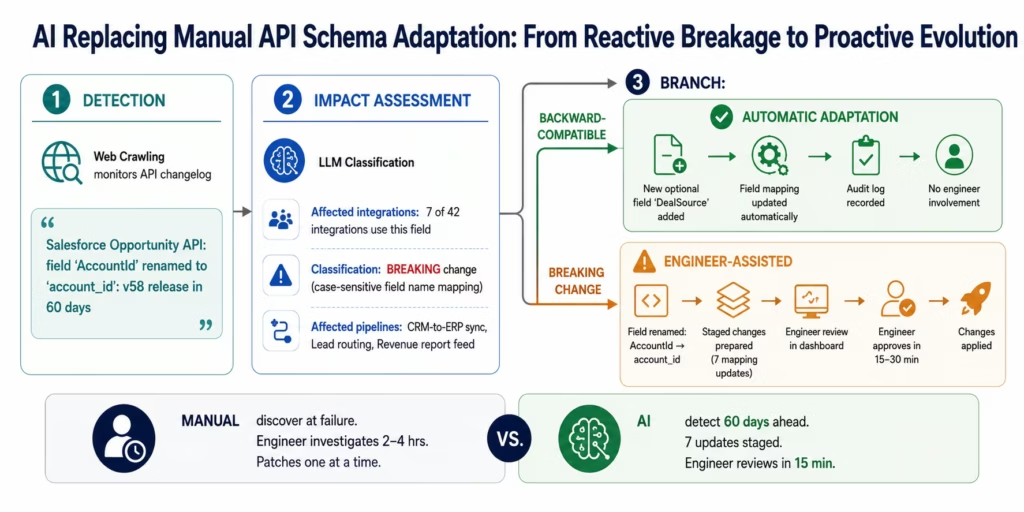
Proactive changelog monitoring: the Web Crawling capability monitors API documentation pages, developer changelogs, and deprecation notices for connected APIs. When a breaking change is announced (a deprecation date published, a field type change documented), the monitoring fires an alert 30-90 days before the change takes effect: when there is still time to update the affected integrations without a midnight incident.
Impact assessment: when a schema change is detected, LLM Classification determines which integrations in the estate are affected and classifies the impact: breaking (the integration will fail after the change), degraded (the integration will continue running but produce incorrect output), or backward-compatible (the integration is unaffected). This impact assessment replaces the manual process of reviewing every integration that touches the changed API.
Automatic adaptation for backward-compatible changes: when a schema change is backward-compatible: a new optional field is added, a field is renamed but the old name is still supported, a new enumeration value is added: the integration platform can update the field mapping automatically without human intervention. The integration continues running with the new field schema; no maintenance window required.
Engineer-assisted adaptation for breaking changes: when a schema change is breaking: a required field is added, an endpoint is deprecated, a data type changes: the AI does the impact assessment and stages the required mapping changes, presenting them to the engineer for review and approval. The engineer verifies the proposed changes, approves, and the update is applied. The engineer’s time: 15-30 minutes of review versus 2-4 hours of manual investigation and implementation.
What AI Cannot Replace (And Should Not Try To)
An honest guide to AI workflow automation must be explicit about where human judgment remains essential: not just as a legal disclaimer, but as an architectural principle that determines where to invest AI automation effort and where not to, reflecting broader operational debates explored by MIT Sloan Management Review.
Integration architecture design: Deciding how systems should be connected, what the canonical data model should be, how to handle data governance across systems, and what the right pattern is for a new integration use case: these are design decisions that require understanding of business context, organisational priorities, and technical constraints that AI cannot evaluate reliably. AI can retrieve API documentation, map field types, and identify potential technical obstacles. The architectural decision is the engineer’s.
Novel failure diagnosis: When an integration fails in a way the error pattern knowledge base has not seen before: a new API behaviour, an unusual interaction between two systems, a failure that appears as one error type but is actually caused by a different underlying condition: the AI classification will produce a low-confidence result. These novel failures are appropriately escalated to engineers with the full diagnostic context pre-assembled by the AI. The diagnostic work is human.
Business logic decisions: When an integration’s routing or transformation rules need to change because the business has changed, the decision about what the new rules should be requires understanding of the business change and its implications. AI can detect that the current rules are producing outputs that differ from historical patterns (a signal that something may have changed), but determining whether the difference reflects an intentional business change or a data quality problem requires human context.
Judgement on consequential autonomous actions: Any automated action that affects shared infrastructure, has complex reversal implications, or whose outcome cannot be easily verified should require human approval. The autonomous action policy exists precisely to enforce this: not everything the AI could do autonomously should be done autonomously.
The correct mental model: AI handles the investigation and the routine fixes. Engineers handle the judgment calls, the novel problems, and the architectural decisions. Both are better at their respective work as a result.
The Organisational Impact: What Changes for Your Team
The replacement of manual maintenance tasks by AI workflow automation does not reduce headcount: it changes what engineers spend their time on. This distinction matters both for how you present the initiative internally and for what you actually get from deploying it.
What changes for on-call engineers:
Before AI automation: the on-call rotation is interrupted by alerts for known failure types (credential expiry, rate limit errors, transient network failures) at unpredictable hours. A meaningful fraction of these alerts resolve before the engineer finishes the investigation.
After AI automation: the on-call rotation receives alerts only for failures that require human judgment: novel errors, failures that exceed the autonomous action policy, failures where the AI’s classification confidence is below threshold. The alert volume drops 60-70%. The alerts that do arrive are higher quality: pre-diagnosed, with remediation options outlined, and with escalation context assembled. On-call becomes less reactive and less fatiguing.
What changes for the integration engineering team:
Before: the team’s planning cycle allocates 40-50% of capacity to maintenance. The backlog grows faster than it can be cleared because maintenance leaves insufficient capacity for new work.
After: the maintenance fraction of capacity drops to 15-25% for the maintenance tasks that AI handles. The remaining maintenance: genuine novel problems and architectural decisions: is still human work. The freed capacity goes to backlog clearance and new integration capabilities. For a 10-person team, recovering 20-25 percentage points of maintenance capacity is equivalent to adding 2-2.5 engineers’ worth of new-work capacity.
What changes for the business:
Before: integration reliability incidents cause periodic data quality failures, missed SLAs, and operational disruptions. Each incident requires post-incident review, stakeholder communication, and documented remediation.
After: the 80-85% of incidents that AI resolves autonomously never become business-visible events. They are log entries, not incidents. Data quality improves because fewer records fall through maintenance gaps. SLA adherence improves because the MTTR for known failure types drops from hours to minutes.
What does not change:
Integration engineering is still a skilled technical function. The judgment-intensive work: designing new integrations, diagnosing novel failures, making architectural decisions, defining autonomous action policies: still requires experienced engineers. AI automation does not change this. It changes the ratio of judgment work to routine work in the engineer’s day.
How eZintegrations Implements AI Workflow Automation
eZintegrations delivers the four AI maintenance automation capabilities natively: as part of the same platform used for integration configuration, not as a separate monitoring or AIOps tool.
Watcher Tools (predictive detection): continuously monitor credential expiry windows, API response latency trends, rate limit consumption trajectories, and queue depth. Threshold breaches trigger pre-configured responses (proactive credential refresh, request throttling, fallback routing, consumer scaling). Operates 24/7 without engineer involvement for the conditions it monitors.
LLM Classification (root cause diagnosis): applied to every integration failure, with a pre-populated error pattern knowledge base covering all APIs in the Automation Hub connector library. Returns a structured diagnostic brief: error category, specific type, confidence score, historical context, and remediation recommendation: in under 60 seconds. Low-confidence results escalate to human investigation with the diagnostic context assembled.
Data Analysis (anomaly and drift detection): monitors data quality metrics (field completeness rates, value distribution, referential integrity) on a continuous basis and flags statistical deviations that indicate upstream data quality issues, business logic drift, or schema evolution before these manifest as visible failures.
Automated remediation workflows: pre-configured remediation actions (token refresh, rate limit backoff, fallback routing, DLQ reprocessing) execute autonomously within the defined autonomous action policy. Each action generates an immutable audit log entry.
Schema monitoring via Web Crawling: the Web Crawling capability monitors connected API documentation pages and changelogs, detecting announced deprecations and schema changes ahead of their effective dates and routing impact assessments to the integration team.
Compliance: all AI processing within eZintegrations runs natively: no integration data sent to external AI providers. SOC 2 Type II certified. HIPAA BAA available for healthcare organisations. GDPR compliant for EU data. IPSec Tunnel for on-premises integration sources.
Book a free AI demo and bring your current maintenance challenge. We will show you the Watcher Tool configuration for your credential and rate limit monitoring, the LLM Classification setup for your specific error patterns, and the autonomous action policy for your integration environment.
FAQs
AI workflow automation applies predictive monitoring intelligent error classification self-healing remediation and automated schema adaptation to integration pipelines replacing the manual investigation credential management and API update work that currently consumes 40-50% of integration engineering capacity. The automation handles the 80-85% of maintenance events that are known patterns with known resolutions leaving engineers to focus on the 15-20% that require genuine judgment.
Gartner research indicates 80-85% of enterprise integration failures are known patterns with documented resolutions. AI automation can address the detection diagnosis and remediation for this majority fraction. The remaining 15-20% including genuinely novel failures architectural decisions and business logic changes remain human work. The practical capacity recovered means a 10-person integration team can recover 20-25 percentage points of capacity currently consumed by routine maintenance equivalent to 2-2.5 engineers worth of new-work capacity.
No. AI automation changes what engineers spend their time on not how many engineers you need. The capacity recovered from routine maintenance goes to backlog clearance new integration capabilities and the higher-judgment work that AI cannot handle including designing new integrations diagnosing novel failures defining autonomous action policies and making architectural decisions. Most organisations that deploy AI integration automation report the same team delivering significantly more new capability rather than the same capability with fewer people.
The autonomous action policy defines which remediation types execute without human approval. It specifies per integration and per remediation type whether the AI can act autonomously whether it requires human approval or whether it always escalates. The criteria for autonomous execution are that the fix is deterministic reversible bounded in impact and explicitly pre-authorised. Token refresh rate limit backoff and fallback routing are typically pre-authorised while changes to routing logic shared credentials and integration architecture require human approval.
AI-powered schema management operates in three phases: proactive detection where Web Crawling monitors API changelogs and fires alerts 30-90 days before the effective date impact assessment where LLM Classification identifies which integrations are affected and whether the change is breaking or backward-compatible and adaptation where backward-compatible changes are applied automatically while breaking changes are staged for engineer review and approval. Engineers typically spend 15-30 minutes reviewing staged changes instead of 2-4 hours performing manual investigation for each API version update.
Watcher Tool configuration for predictive credential and rate limit monitoring activates in 2-4 hours per integration cluster using pre-configured thresholds for common credential types including OAuth 2.0 API keys and SSL certificates. The LLM Classification layer with the pre-populated error knowledge base for common APIs such as Salesforce NetSuite SAP HubSpot and Stripe deploys from an Automation Hub template in 3-5 hours. Full autonomous action policy configuration and validation against historical failure data typically takes 2-4 weeks for an enterprise integration estate of 20-50 integrations. 1. What is AI workflow automation in the context of integration maintenance?
2. How much of integration maintenance can AI actually automate?
3. Does AI replacing integration maintenance mean reducing engineering headcount?
4. What is the autonomous action policy in AI integration automation?
5. How does AI handle API schema changes without breaking integrations?
6. How long does it take to implement AI workflow automation for integration maintenance?
Conclusion: The Maintenance Tax Is Voluntary. Most Organisations Just Don’t Know It Yet.
The 40-50% of integration engineering capacity consumed by maintenance is not a fixed cost of operating an integration estate. It is a cost of operating an integration estate without AI automation.
Every organisation that has deployed predictive monitoring, intelligent classification, self-healing remediation, and automated schema adaptation reports the same outcome: fewer midnight pages, faster resolution of the failures that do occur, and meaningfully more engineering capacity available for new work. None of them have reduced their engineering teams as a result. Every one of them has used the recovered capacity to clear backlog and deliver capabilities that were previously stuck in the queue.
The maintenance tax is real. It is calculable: your team size, times their fully loaded cost, times the fraction of their time spent on maintenance. For most organisations with 50+ integrations, that number is uncomfortable when it is written down explicitly.
AI workflow automation does not eliminate that tax overnight. It addresses it category by category: predictive monitoring for failure prevention, LLM Classification for root cause diagnosis, autonomous remediation for known-pattern recovery, schema monitoring for API evolution. Each category recovered is engineering capacity returned to building rather than maintaining.
Book a free demo and bring your current integration estate. We will calculate the maintenance fraction for your team’s size and integration count, and show you which of the four automation categories would recover the most capacity for your specific environment.