Agentic AI for Healthcare: Autonomous Intelligence Across Clinical & Operational Data
June 3, 2026Agentic AI for healthcare deploys multiple coordinated AI agents, aligned with Multi-agent system architecture, that monitor clinical and operational data continuously, detect anomalies and exceptions, and orchestrate autonomous responses across your EHR, billing, HRIS, and operational systems. eZintegrations’ Goldfinch AI coordinates specialist worker agents through a Chat UI and Workflow Node: giving healthcare executives natural language access to live operational intelligence while autonomous agent teams manage exception queues, flag quality issues, and coordinate care events compliantly within HIPAA boundaries.
TL;DR
- Agentic AI is the next architectural step beyond individual AI agents, reflecting Gartner perspectives on agentic AI enterprise adoption in healthcare. Where a single AI agent handles one exception (one prior auth, one denied claim, one safety event), agentic AI coordinates teams of specialist agents working in parallel across your full clinical and operational estate: monitored by a coordinator that synthesises their findings and routes to the right human for each decision.
- In healthcare, agentic AI means: your revenue cycle is continuously monitored by parallel denial detection, payer policy, and underpayment agents, consistent with McKinsey & Company insights on agentic AI in healthcare operations. Your clinical quality programme is managed by care gap, protocol compliance, and readmission risk agents working simultaneously across your patient population. Your operational stack is orchestrated by scheduling, credentialing, supply chain, and staffing agents that flag issues before they become problems.
- Goldfinch AI is eZintegrations’ Level 4 multi-agent coordination platform. The Chat UI gives healthcare executives natural language access to live answers from across the clinical and operational stack. The Workflow Node embeds coordinator intelligence inside Level 1 automation workflows.
- All of this operates within eZintegrations’ HIPAA-compliant native AI infrastructure. No PHI leaves the platform. Signed BAA. Immutable audit logs for every agent action. Human-in-the-loop gates at every decision point that requires clinical oversight.
- Deployment path: builds on existing Level 1-3 eZintegrations healthcare integration and AI agent deployments, adding Goldfinch AI coordination and Chat UI on top of an already-connected healthcare stack.
What Agentic AI Means for Healthcare (and Why It Is Different from AI Agents)
Understanding this distinction matters because the deployment approach, the use cases, and the governance requirements are different.
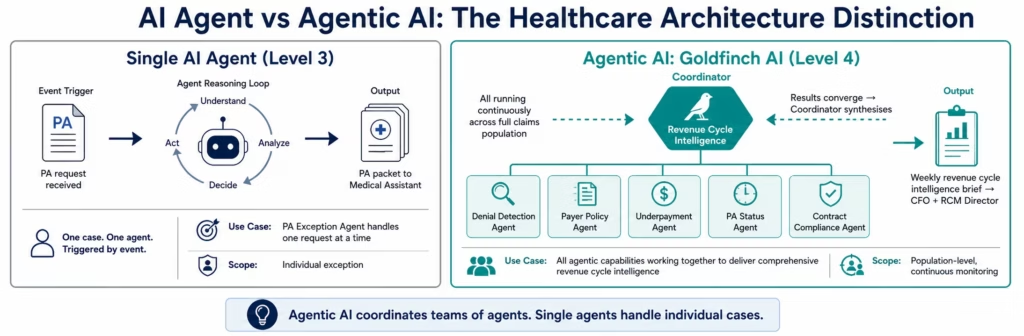
A single AI agent handles a single exception type within a defined scope. The Claims Denial Investigation Agent investigates one denied claim at a time. The Prior Authorisation Exception Agent handles one PA request at a time. Each agent is narrow, deep, and excellent at its specific task. This is Level 3 in the eZintegrations automation hierarchy: powerful for individual exception handling.
Agentic AI operates at a different architectural level. A coordinator agent receives a complex goal: not “investigate this claim” but “monitor our revenue cycle and identify everything that requires attention this week.” The coordinator decomposes this goal into parallel workstreams, dispatches specialist worker agents for each, receives their findings, synthesises across all workstreams, and routes a unified intelligence brief to the appropriate human decision-makers.
The difference in practical terms:
Single AI agent: one billing specialist submits a prior auth request; the PA Exception Agent prepares the packet. One at a time, triggered by individual events.
Agentic AI: the Revenue Cycle Intelligence coordinator continuously dispatches a denial detection agent, a payer policy monitoring agent, an underpayment identification agent, a PA status agent, and a contract compliance agent: all running in parallel across your full claims population: and synthesises their findings into a weekly revenue cycle intelligence brief for the CFO and Revenue Cycle Director.
Agentic AI does not replace individual AI agents. It coordinates them. The Prior Auth Exception Agent still handles individual PA requests. The Goldfinch AI coordinator monitors the aggregate PA pipeline: which payers are denying at unusual rates, which service lines have the longest PA delays, which agents are routing to human review most frequently and why.
The population level versus the individual case level. That is the distinction.
Before vs After: The Agentic AI Transformation
| Domain | Before Agentic AI | After Agentic AI |
|---|---|---|
| Revenue cycle oversight | Monthly revenue cycle reviews from static reports, issues discovered after the fact | Continuous multi-agent monitoring, issues flagged in real time, weekly intelligence brief |
| Denial pattern detection | Billing team discovers denial spike when monthly reports run | Denial Detection Agent identifies emerging payer denial pattern within 48 hours, alerts team |
| Payer policy monitoring | Policy changes discovered from unexpected denials | Policy Monitoring Agent detects payer policy updates, identifies impacted claim types before submission |
| Clinical quality oversight | Quarterly quality report for HEDIS/value-based measures | Continuous Care Gap Agent monitoring across patient population, real-time closure opportunity alerts |
| Readmission risk | Readmissions tracked retrospectively; no proactive intervention | Readmission Risk Agent flags high-risk patients at discharge, triggers care management outreach |
| Staffing and scheduling gaps | Nurse manager manually reviews schedule gaps each morning | Staffing Intelligence Agent identifies gaps 72 hours in advance, initiates fill workflow |
| Supply chain anomalies | Procurement team reviews supply shortages when stock runs low | Supply Monitoring Agent detects consumption anomaly 7 days before projected stockout |
| Executive operational view | Executive team requests reports, waits for analysts to run them | CFO asks Chat UI: “What is our cash collections performance this week?”: answer in 30 seconds |
| Cross-domain exception correlation | Revenue cycle, clinical quality, and operations managed in silos | Coordinator agent detects that a denial spike correlates with a payer policy change and a coding issue |
| Compliance monitoring | Compliance team manually reviews HIPAA access logs quarterly | Compliance Monitoring Agent flags anomalous PHI access patterns in real time |
The Goldfinch AI Architecture for Healthcare
Goldfinch AI is eZintegrations’ Level 4 multi-agent coordination platform. In healthcare, it operates through two interfaces:
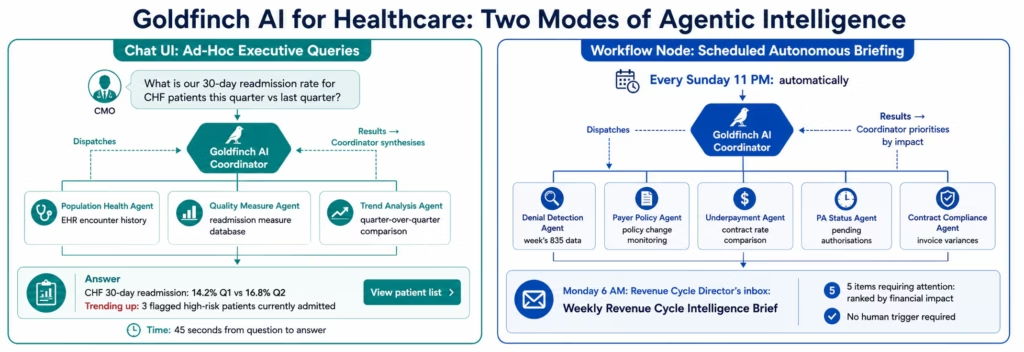
The Chat UI: a natural language interface for healthcare executives and clinical leaders. The CFO types a question. Goldfinch AI interprets the intent, identifies which data sources and agent capabilities are required, dispatches the appropriate worker agents, waits for their results, synthesises the findings, and returns a formatted answer: with supporting data, trend analysis, and exception flags: typically within 30-60 seconds.
The Chat UI does not guess. It queries live systems. When the CMO asks “what is our 30-day readmission rate for CHF patients this quarter compared to last quarter,” Goldfinch AI queries the population health data, the EHR encounter history, and the quality measure database via worker agents, runs the comparative analysis, and returns the answer from current data: not from a cached report.
The Workflow Node: Goldfinch AI’s coordinator intelligence embedded inside Level 1 automation workflows. The Workflow Node is how agentic reasoning is woven into operational processes that run continuously, not just when an executive asks a question.
A Workflow Node deployed in the revenue cycle integrity workflow runs every Sunday night: it dispatches worker agents across the week’s claims data: the denial detection agent, the payer policy agent, the underpayment agent: receives their findings, prioritises the exceptions by financial impact and actionability, and places a structured weekly brief in the Revenue Cycle Director’s queue every Monday morning. No human triggers this. The coordinator coordinates, the workers investigate, the brief arrives.
Together, the Chat UI and the Workflow Node represent two modes of accessing the same agentic intelligence: ad-hoc natural language queries and scheduled autonomous briefings.
Agentic Programme 1: Revenue Cycle Intelligence Network
Healthcare revenue cycles are not failing at the individual claim level. They are failing at the pattern level. A single denied claim is an exception. Forty denied claims from the same payer for the same procedure in a single week is a pattern: one that signals a payer policy change, a coding issue, a credentialing problem, or a documentation gap. Identifying that pattern from individual claim exceptions, without continuous monitoring, takes weeks.
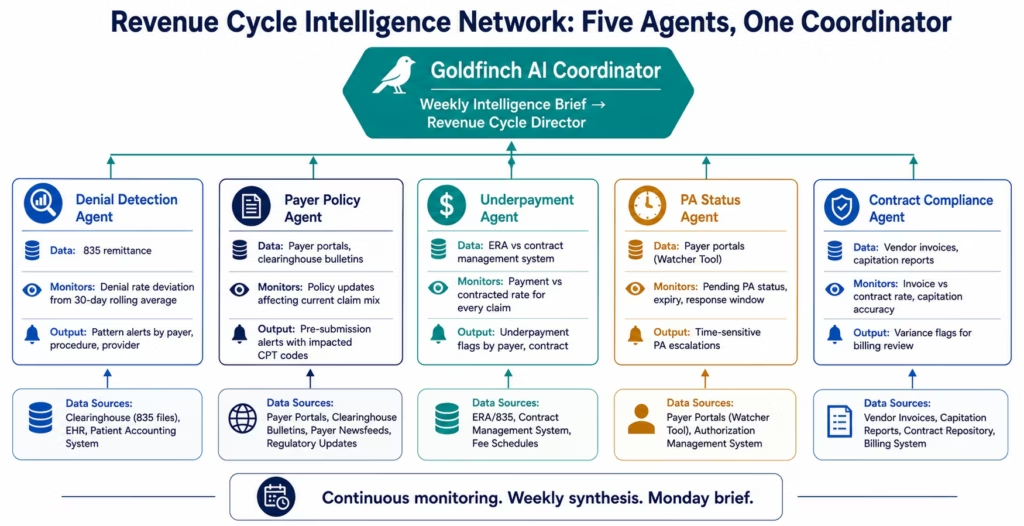
The Revenue Cycle Intelligence Network is an agentic programme that runs five worker agents continuously, coordinated by a Goldfinch AI revenue cycle coordinator.
Worker Agent 1: Denial Detection Agent Continuously monitors incoming 835 remittance data. Runs Data Analysis to identify: denial rate changes by payer (deviation from 30-day rolling average), new denial reason codes appearing for previously-approved procedure types, denial clusters by service line, date of service, or rendering provider. Flags any pattern that deviates from baseline by more than one standard deviation. Routes high-confidence pattern alerts to the Revenue Cycle Director immediately; accumulates lower-confidence observations for the weekly brief.
Worker Agent 2: Payer Policy Monitoring Agent Uses the Web Crawling tool to monitor payer portals, policy update pages, and clearinghouse bulletins for coverage policy changes relevant to your claim mix. When a policy update is detected, uses Document Intelligence to read the update, Knowledge Base Vector Search to identify which CPT codes, diagnosis codes, or service lines are affected, and Data Analysis to estimate the volume of claims that would be impacted if submitted under the old policy. Routes a pre-submission alert to the coding and billing teams before the first affected claim is submitted.
Worker Agent 3: Underpayment Identification Agent Compares every ERA (Electronic Remittance Advice) payment against the contracted fee schedule using API Tool Call to retrieve the current contract terms from the contract management system and Data Analysis to compare the allowed amount against the contracted rate. Flags underpayments above the threshold (typically 1-2% variance, accounting for rounding) for billing team review and follow-up. Tracks underpayment patterns by payer and contract to identify systemic issues requiring contract renegotiation.
Worker Agent 4: Prior Authorisation Status Agent Uses the Watcher Tool to monitor pending prior authorisations across all active payer portals. Flags: PAs approaching expiry without scheduled service, PAs that have been pending beyond the payer’s standard response window, and PAs that have been denied requiring immediate appeal initiation. Routes time-sensitive PA situations to the appropriate medical assistant or billing team member.
Worker Agent 5: Contract Compliance Agent Monitors vendor invoices against contracted rates, compares capitation payments against enrolled membership, and flags coordination of benefits situations where secondary payer billing is either overdue or potentially duplicative. Uses Document Intelligence to read invoices and contract terms, Data Analysis to identify variances.
Coordinator synthesis: The Goldfinch AI revenue cycle coordinator receives findings from all five agents continuously. It correlates findings across agents (does the denial spike from Agent 1 align with the payer policy change detected by Agent 2?) and builds the weekly intelligence brief: a ranked list of revenue cycle issues by estimated financial impact, with the evidence trail from each agent and the recommended action for each item.
Agentic Programme 2: Clinical Quality and Population Health Monitoring
Value-based care contracts reward health systems for population health outcomes: HEDIS measure performance, readmission rates, preventive care closure rates, chronic disease management effectiveness. Monitoring these outcomes across a patient population of tens or hundreds of thousands requires continuous surveillance: a task that overwhelms quality teams relying on monthly reports and manual chart review.
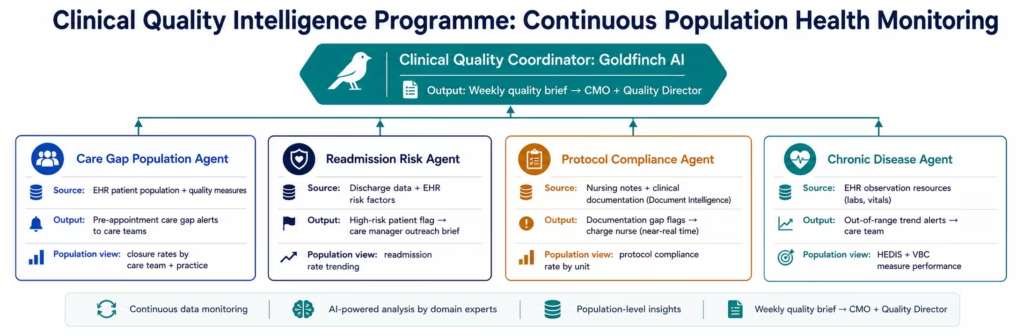
The Clinical Quality Intelligence Programme deploys a coordinated network of quality monitoring agents.
Care Gap Population Agent: Continuously queries the patient population against applicable quality measures (HEDIS, CMS Quality Payment Program, ACO measures). For every patient with an upcoming appointment in the next 14 days, identifies open care gaps relevant to their age, sex, and diagnosis profile. Routes personalised care gap alerts to the care team’s queue before each appointment, with the clinical context and the measure closure action. At the population level, the coordinator tracks closure rates by care gap type, care team, and practice site: identifying where outreach programmes are needed.
Readmission Risk Agent: At discharge, retrieves the patient’s readmission risk factors via API Tool Call: primary discharge diagnosis, comorbidities, social determinants of health flags, previous readmission history, medication complexity, and post-discharge follow-up appointment status. Applies a validated readmission risk model via Data Analysis to score each patient. High-risk patients (score above the configured threshold) trigger the care management outreach workflow: the transition care nurse receives a structured risk brief and the patient receives an automated post-discharge check-in via the patient portal. The coordinator tracks which high-risk patients received outreach and which were readmitted within 30 days, continuously refining the risk threshold calibration.
Protocol Compliance Monitoring Agent: Monitors clinical documentation for protocol adherence across targeted conditions (sepsis screening, fall risk assessment, VTE prophylaxis, pressure injury prevention). Uses Document Intelligence to read nursing notes and clinical documentation, identifies whether required screening and intervention documentation is present for each patient on the applicable protocol, and flags documentation gaps to the charge nurse in near-real time: before the patient is discharged and before a quality deficiency becomes a compliance finding.
Chronic Disease Management Agent: For patients with chronic disease diagnoses (diabetes, heart failure, COPD, hypertension), monitors lab results and vital sign trends via API Tool Call to the EHR observation resources, identifies out-of-range values or trend deterioration, and routes alerts to the responsible care team with the clinical context. Tracks disease management measure performance at the population level for value-based care reporting.
Agentic Programme 3: Operational Continuity and Workforce Management
Healthcare operations fail in predictable ways, reflecting challenges highlighted by American Medical Association around administrative burden and operational inefficiency: shifts go unfilled because the nurse manager didn’t see the call-out until 6 AM, supply shortages surface when the stockroom is already empty, equipment maintenance falls behind because no one is tracking maintenance schedules, and credentialing gaps create billing eligibility problems that only surface on claim denial.
The Operational Continuity Programme deploys agents that monitor these failure modes continuously.
Staffing Intelligence Agent: Integrates with the scheduling system and HRIS via API Tool Call, monitoring for open shifts, call-out patterns, and staffing ratio requirements by unit. When a shift call-out occurs, the agent immediately identifies the open shift, searches the available pool via the scheduling system, identifies qualified available staff (matching credentials, float pool eligibility, overtime limits), and initiates the fill workflow: contacting available staff in the configured priority order. The nurse manager receives a summary of the fill status rather than making individual phone calls.
At the population level, the Staffing Intelligence Agent tracks: call-out patterns by unit and day of week (identifying systemic scheduling problems), overtime utilisation by staff member (identifying burnout risk), and credential-to-scheduling alignment (ensuring staff are only scheduled for assignments their credentials permit).
Supply Chain Monitoring Agent: Monitors inventory levels for clinical supplies and pharmaceuticals via integration with the materials management and pharmacy systems. Uses Data Analysis to calculate projected stockout dates based on current consumption rates and reorder quantities. Flags items where projected stockout falls within the reorder lead time. Initiates the purchase order workflow for standard items; routes urgent stockout risks to the Supply Chain Director with alternative sourcing recommendations retrieved via Knowledge Base Vector Search.
Equipment Maintenance Agent: Monitors preventive maintenance schedules for clinical equipment across the health system. Uses the Watcher Tool to track maintenance due dates, work order completion status, and equipment downtime events. Flags equipment approaching maintenance windows for which no work order has been initiated. Routes biomedical engineering teams the structured maintenance brief. When equipment goes down unexpectedly, correlates the event with maintenance history and flags for root cause review.
Credentialing Continuity Agent: Monitors practitioner credential status across all active practitioners, identifying: credentials approaching expiry (90/60/30-day pipeline), practitioners scheduled for procedures requiring specific credentials that are not current, and new practitioners with incomplete credentialing whose initial privileges need to be established before their first clinical shift. Coordinates with the credentialing system and the scheduling system to prevent scheduling conflicts with credential gaps.
Agentic Programme 4: Healthcare Executive Intelligence via Chat UI
The most visible element of Goldfinch AI for healthcare executives is the Chat UI: the natural language interface that gives clinical and operational leaders direct access to live intelligence across the healthcare stack without submitting report requests or waiting for analyst turnaround.
Here is what a typical executive interaction looks like:
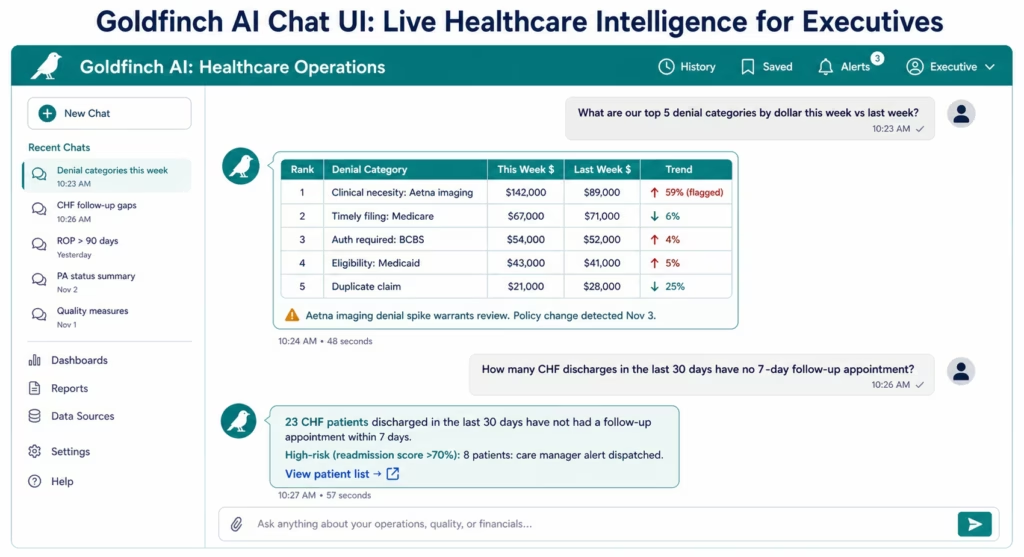
CFO, Monday morning: “What are our top five denial categories by volume and dollar this week, and which of those are trending worse than last week?”
Goldfinch AI’s coordinator dispatches the Denial Detection Agent and the Trend Analysis Agent simultaneously, operating across systems that require HealthIT.gov interoperability and AI-ready infrastructure. The Denial Detection Agent pulls the week’s 835 data via API Tool Call, runs Data Analysis across denial categories, and returns the top five by volume and dollar. The Trend Analysis Agent runs the week-over-week comparison. The coordinator synthesises: a ranked table of denial categories, the week-over-week trend for each, and a flag on any category where the trend is statistically significant.
Time from question to structured answer: 45 seconds.
CMO, Tuesday afternoon: “How many of our CHF patients discharged in the last 30 days have not had a follow-up appointment within 7 days, and who are they?”
Goldfinch AI dispatches a patient population agent that queries the EHR via FHIR API for CHF discharge encounters in the past 30 days, cross-references against the scheduling system for follow-up appointments within 7 days, and identifies the gap population. The coordinator returns: the count, the patient list (names, MRNs, discharge date, attending physician), and the care manager assignment for each patient.
Time: 60 seconds. Previously: a quality analyst would have taken 2-3 hours to pull this from the EHR and scheduling system and format it.
COO, Wednesday: “What is our operating room utilisation rate this quarter by service line, and where are we most over or under block time allocations?”
Goldfinch AI queries the OR scheduling system and the block time management data, runs utilisation analysis by service line, compares to allocated block time, and returns a formatted table with over/under utilisation by service line and a recommendation for block time reallocation based on the trend data.
Chief Quality Officer, Friday: “Are we on track for our HEDIS measure targets for the year? Show me which measures are at risk.”
Goldfinch AI queries the quality measure performance data, runs a trajectory analysis for each measure against the annual target, identifies measures where current performance would result in missing the target at current rates, and returns a ranked risk list with current performance, target, gap, and projected year-end performance if the current trend continues.
HIPAA and Governance for Agentic AI in Healthcare
Agentic AI introduces governance considerations beyond those of single AI agents. When multiple agents are operating in parallel, accessing PHI across multiple systems, and synthesising findings into population-level intelligence, the governance architecture must be proportionate.
PHI access boundaries for each worker agent:
Each Goldfinch AI worker agent is configured with the minimum necessary data access for its specific task. The Denial Detection Agent accesses claims data (claim numbers, procedure codes, denial codes) but not clinical notes. The Readmission Risk Agent accesses discharge diagnosis data and readmission risk factors but not financial data. The scope of PHI access for each agent is defined at configuration and enforced at the API Tool Call level: the agent cannot access FHIR resources beyond its configured scope.
Audit trail at agent and coordinator level:
Every agent action in the network generates an immutable audit log entry: the agent identity, the data accessed, the tool used, the timestamp, and the output produced. The coordinator’s synthesis actions are also logged: which worker agents were dispatched, what findings each returned, and how findings were ranked and prioritised. This creates a complete audit trail from executive question to data source, defensible for any HIPAA access audit.
Human-in-the-loop gates in agentic workflows:
Goldfinch AI coordinator workflows include human-in-the-loop checkpoints for actions that affect individual patients, practitioners, or financial obligations:
- Readmission Risk Agent identifies a high-risk patient: the care manager receives the brief, and the outreach to the patient requires care manager initiation: not autonomous agent action.
- Underpayment Agent identifies a systematic underpayment: the billing director receives the finding, and the payer contact or dispute initiation requires billing team action.
- Staffing Agent initiates a fill workflow for an open shift: the nurse manager receives the fill recommendation and the notification goes out under the manager’s oversight, not autonomously.
Data minimisation in population-level queries:
When the Chat UI handles executive queries about patient populations, Goldfinch AI applies data minimisation. An executive query about CHF readmission rates returns aggregate statistics and flagged patient counts. The patient list (with names and MRNs) is accessible as a secondary action, with the executive’s access governed by the RBAC configuration. Population intelligence is available at the aggregate level by default; individual patient data requires an additional access step.
Key Outcomes and Results
Healthcare organisations deploying agentic AI programmes across revenue cycle, clinical quality, and operations report measurable improvements within 90-120 days:
Revenue Cycle Intelligence Network:
- Denial pattern identification: 30-45 day detection lag → 24-72 hours
- Payer policy change response: reactive (discovered from denials) → proactive (7-14 day advance notice)
- Underpayment recovery rate: 40-60% improvement from systematic monitoring
- PA status monitoring: daily manual portal checks eliminated
- Executive time for weekly revenue cycle briefing: 2-4 hours analyst preparation → automated Monday brief
Clinical Quality and Population Health:
- Care gap identification: monthly batch → real-time at point of care
- High-risk patient readmission outreach rate: 60-85% (automated identification and workflow) vs 20-40% (manual identification)
- Protocol compliance documentation gaps: identified within hours of admission, not at discharge or retrospectively
- Value-based care measure performance: 10-25% improvement in HEDIS closure rates from continuous monitoring
Operational Continuity:
- Open shift fill time: average reduced from 4-6 hours to under 60 minutes
- Supply chain stockouts: reduced by 60-80% with 7-day advance monitoring
- Credential gap scheduling conflicts: near-zero with continuous credentialing agent monitoring
Executive Intelligence:
- Executive report request-to-answer time: 2-4 hours (analyst) → 30-60 seconds (Chat UI)
- Operational blind spots: reduced as continuous agent monitoring surfaces issues before they reach crisis level
- Cross-domain correlation: patterns visible at the coordinator level that were invisible in siloed reports
How to Get Started
Step 1: Confirm your Level 1-3 foundation
Agentic AI builds on existing eZintegrations healthcare integration. The Revenue Cycle Intelligence Network assumes your EHR is connected (FHIR R4), your billing system feeds 835 remittance data to the platform, and your contract management system is accessible via API. If these connections are not in place, start with the healthcare integration platform and the AI agent templates. Goldfinch AI coordination builds on an already-connected stack.
Step 2: Choose your first agentic programme
Revenue cycle, clinical quality, and operations each have strong ROI cases. Revenue cycle is typically the easiest first deployment because the data flows (835 remittance, FHIR encounters, contract management) are already established in Level 1 deployments. Clinical quality has the highest value-based care contract impact. Choose based on your organisation’s strategic priority.
Step 3: Configure the coordinator and worker agents
Import the Goldfinch AI programme template from the Automation Hub. Configure each worker agent with its data source connections and its HIPAA-compliant minimum necessary access scope. Configure the coordinator’s synthesis rules: how to rank findings, how to correlate across agents, and what format the intelligence brief should take.
Step 4: Set up the Chat UI for your executive team
Configure the Goldfinch AI Chat UI access for each executive role (CFO, CMO, COO, CQO). Set the RBAC permissions for each role: population-level aggregate data by default, individual patient data with secondary access. Brief the executive team on query patterns: what kinds of questions the Chat UI answers, how to interpret the structured responses, and how to access supporting patient lists or detail data.
Step 5: Activate Workflow Nodes for scheduled intelligence briefs
Configure the Workflow Node for each scheduled intelligence brief (weekly revenue cycle brief, monthly quality performance summary, daily operational flags). Set the coordinator’s weekly schedule, the worker agent dispatch configuration, and the output routing (who receives the brief, in what format, through what channel). Activate. The first automated intelligence brief runs on the configured schedule.
Book a free agentic AI healthcare demo and bring your current reporting and monitoring pain points. We will map your revenue cycle, clinical quality, and operational data sources to a Goldfinch AI programme and demonstrate the Chat UI with your actual use cases.
FAQs
Agentic AI coordinates multiple AI agents working in parallel toward a complex goal. A single AI agent (Level 3) handles one exception at a time, such as a prior authorisation request or a denied claim. Agentic AI (Level 4, Goldfinch AI) deploys a coordinator agent that dispatches multiple specialist worker agents across the full healthcare population simultaneously, monitoring denial patterns across all claims, tracking care gaps across all patients, and managing staffing across all units, then synthesising their findings into unified intelligence for executive decision-makers. The distinction is individual case handling versus population-level continuous monitoring.
Goldfinch AI operates through two interfaces. The Chat UI gives healthcare executives natural language access to live operational intelligence, such as denial rates by payer, with responses generated from live data in under 60 seconds. The Workflow Node runs scheduled coordinator programmes autonomously, dispatching multiple worker agents across claims, patient, and operational data to generate structured intelligence briefs. Both interfaces use the same coordinator-worker architecture with full HIPAA audit trails and role-based access control.
If EHR, billing, and operational system integrations are already in place through eZintegrations, the Goldfinch AI programme can be configured in 3-4 weeks. For greenfield deployments starting from integration, the full stack including integration, AI agents, and agentic AI orchestration typically takes 10-14 weeks. Automation Hub provides programme-level templates for common healthcare agentic AI use cases.
Yes. Goldfinch AI processes all healthcare data within eZintegrations' HIPAA-compliant infrastructure. Every agent action generates an immutable audit log. PHI access is governed by role-based access control at both the agent configuration and Chat UI levels. Population-level intelligence is available by default, while individual patient data requires additional authorised access. A signed HIPAA BAA covers all processing, and SOC 2 Type II certification validates security controls. No data is sent to external AI providers.
The network uses five worker agents: a Denial Detection Agent analysing 835 remittance data, a Payer Policy Agent monitoring payer portals and bulletins, an Underpayment Agent comparing payments against contract rates, a Prior Authorisation Status Agent tracking payer portal updates, and a Contract Compliance Agent analysing vendor invoices and capitation reports. All processing occurs within eZintegrations' HIPAA-compliant infrastructure.
Both, with appropriate role-based governance. By default, responses provide population-level insights such as rates, trends, and ranked exceptions. Access to individual patient data requires an additional authorised step based on the user's role permissions. This ensures data minimisation while allowing authorised drill-down when required. 1. What is agentic AI in healthcare and how is it different from AI agents?
2. How does Goldfinch AI work in a healthcare setting?
3. How long does it take to set up agentic AI for healthcare?
4. Is Goldfinch AI HIPAA compliant for healthcare population data?
5. What data sources does the Revenue Cycle Intelligence Network monitor?
6. Can Goldfinch AI answer questions about individual patients or only population aggregates?
Conclusion: From Monitoring to Intelligence
Healthcare operations generate enormous amounts of data every day: claims events, lab results, nursing notes, scheduling changes, inventory movements, quality measures. In most health systems, this data is reviewed retrospectively, in batches, by analysts who produce reports that executives receive days or weeks after the underlying events occurred.
Agentic AI changes the information architecture. Instead of data accumulating until someone runs a report, coordinated agent networks monitor continuously, detect patterns in hours rather than weeks, surface exceptions before they become crises, and deliver intelligence to executives in the moment they need it: in natural language, from live systems, in under 60 seconds.
The Revenue Cycle Director does not wait for the denial spike to become visible in the monthly report. The CMO does not find out about readmission rate deterioration at the quarterly board meeting. The COO does not discover the supply shortage when the stockroom is already empty.
This is the operational transformation that agentic AI delivers for healthcare: not faster reports, but continuous intelligence from systems that never stop monitoring.
eZintegrations’ Goldfinch AI provides this capability within the HIPAA architecture that healthcare requires: native AI inference, minimum necessary PHI access per agent, immutable audit trails, human-in-the-loop gates, and RBAC-governed Chat UI access for executive intelligence.
Book a free demo and bring your current reporting and monitoring blind spots. We will map your revenue cycle, clinical quality, and operational data to a Goldfinch AI programme and demonstrate the Chat UI with your actual executive queries.
Browse agentic AI healthcare templates in the Automation Hub to see the programme templates for Revenue Cycle Intelligence, Clinical Quality Monitoring, and Operational Continuity.