AI Workflow Automation for Pharma: Compliance-Ready Intelligent Pipelines
June 6, 2026AI workflow automation for pharma connects Veeva Vault, SAP S/4HANA, LIMS, and regulatory submission systems under a 21 CFR Part 11-compliant architecture: with native AI nodes for adverse event document processing (Document Intelligence), safety signal classification (LLM Classification), and data integrity anomaly detection (Data Analysis). Every AI action generates an immutable, timestamped audit trail. No clinical, regulatory, or quality data is sent to external AI providers during processing.
TL;DR
- Pharmaceutical data workflows are among the most tightly regulated in any industry: 21 CFR Part 11 (electronic records and signatures), GxP (Good Laboratory, Clinical, and Manufacturing Practice), HIPAA (clinical trial participant data), and EU Annex 11 (for European operations) all impose specific requirements on automated systems.
- The compliance requirement is not a reason to avoid AI workflow automation: it is a reason to choose AI-native platforms that design compliance in rather than bolt it on. The requirements are specific: immutable audit trails for every automated action, electronic signature workflows for regulated approvals, validated system processes, and native AI inference that keeps regulated data within the compliance boundary.
- Five pharma use cases with the highest AI workflow ROI: adverse event document processing (Document Intelligence), safety signal classification (LLM Classification), clinical data reconciliation (Data Analysis for integrity monitoring), regulatory submission data assembly (multi-system intelligent aggregation), and LIMS-to-ERP quality data sync with AI anomaly detection.
- eZintegrations connects Veeva Vault, SAP S/4HANA, LabVantage LIMS, Medidata Rave, and regulatory submission systems: with 21 CFR Part 11-compliant audit trails, GxP validation support, and all AI inference running natively within the platform.
- CTA: Book a demo with your validation team to see the compliance architecture in detail.
The Problem: Why Pharma Data Workflows Still Break at the Edges
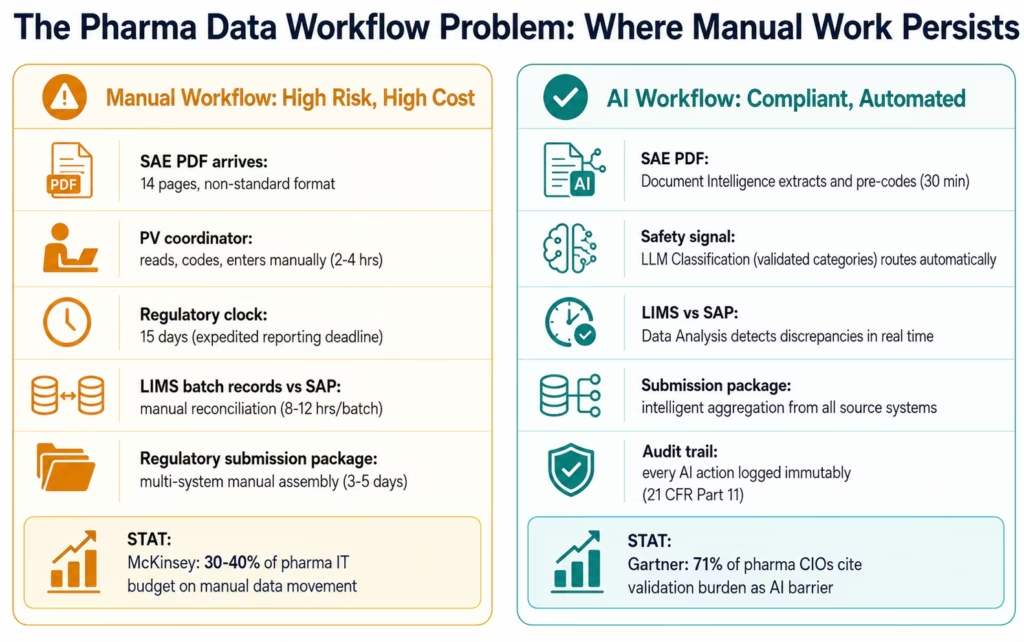
It is 6 PM on a Thursday. A serious adverse event (SAE) report arrives from a clinical investigator site: a 14-page PDF, in the site’s own format, not the structured MedDRA-coded format your safety database expects. Your pharmacovigilance team has a 15-day regulatory clock ticking for expedited reporting to the FDA and EMA. The report has to be read, the adverse event terms coded to MedDRA vocabulary, the patient narrative extracted, the causality assessment noted, and the data entered into the safety database.
There is one pharmacovigilance coordinator available. The PDF sits in the queue.
This is not an unusual scenario in pharmaceutical operations. It is Thursday evening’s version of the same problem that occurs with LIMS batch records that need to be reconciled against SAP manufacturing orders, clinical data listings that need to be compared across Medidata Rave and the internal data warehouse, regulatory submission packages that require assembling data from Veeva Vault, clinical operations systems, and biostatistics outputs, and quality event reports that must be cross-referenced against batch release records before a product ships.
According to McKinsey, life sciences companies spend 30-40% of their data and IT operations budget on manual data movement and reconciliation between systems: despite heavy investment in validated enterprise systems. The systems are sophisticated. The integrations between them are fragile, manual, and under-automated relative to what the regulatory environment actually permits, consistent with broader Forrester Research life sciences technology analysis.
The regulatory environment does not prohibit AI workflow automation in pharma. It requires that automated systems be designed to be auditable: with specific requirements for electronic records, access controls, and audit trails. AI workflows that meet these requirements are not only permitted; they are specifically encouraged by FDA’s digital modernisation agenda and the ICH Q12 guidance on pharmaceutical product lifecycle management.
Gartner’s 2025 life sciences technology survey found that 71% of pharmaceutical CIOs cite “regulatory validation burden” as the primary barrier to AI adoption: not AI capability gaps, not data quality, but the compliance architecture required to validate and deploy AI systems. The barrier is architectural, not technical. The right platform removes it.
The Compliance Foundation: What 21 CFR Part 11 and GxP Require
Before evaluating any AI workflow platform for pharma, it is essential to understand what the regulations actually require of automated systems: because the requirements are specific, and many AI platforms that claim “compliance” do not satisfy them.
21 CFR Part 11 (Electronic Records; Electronic Signatures) applies to any electronic record that is created, modified, maintained, archived, retrieved, or transmitted in the context of an FDA-regulated activity. Key requirements for automated systems:
- Audit trails: every create, modify, or delete action on a regulated electronic record must generate an audit trail entry that captures who took the action, what was changed, and when: with timestamps accurate to the second, in a format that cannot be modified without detection.
- System access controls: access to regulated records must be controlled through unique user accounts, and the system must prevent unauthorised creation, modification, or deletion of records.
- Electronic signatures: when electronic signatures are required (batch release, protocol deviations, regulatory submissions), the signature must be linked to the record, cannot be transferred to another record, and must include the signatory’s printed name, date, and the meaning of the signature.
- Validated systems: automated systems that create or process regulated electronic records must be validated: documented evidence that the system performs as intended under all intended conditions of use.
Good laboratory practice and broader GxP (Good Laboratory, Clinical, and Manufacturing Practice) standards impose data integrity requirements that align with the ALCOA+ framework: Attributable, Legible, Contemporaneous, Original, and Accurate, plus Complete, Consistent, Enduring, and Available. Any automated system processing GxP data must be able to demonstrate compliance with ALCOA+ through its audit trail.
What this means for AI workflow platforms:
An AI workflow platform in a pharma environment must: generate immutable audit trails for every automated action (including AI inference actions: what input was processed, what output was produced, what routing decision was made), execute AI inference within the platform’s own infrastructure (data does not leave the validated environment), produce structured, reproducible outputs (AI classification results must be consistent and auditable, not probabilistic black boxes without documentation), and support system validation documentation (IQ, OQ, PQ protocols for the validated use cases).
Platforms that process AI inference via external API calls (sending regulated data to OpenAI or Anthropic) cannot satisfy the data residency requirements of 21 CFR Part 11 without additional data processing agreements and privacy impact assessments: which add compliance burden rather than reducing it.
Before vs After: AI Workflows for Pharma Compliance
| Process | Before AI Workflows | After AI Workflows | Compliance Impact |
|---|---|---|---|
| Adverse event intake (SAE PDF) | PV coordinator reads, codes, enters manually (2-4 hrs/case) | Document Intelligence extracts fields, pre-codes to MedDRA, routes for coordinator review | 21 CFR Part 11 audit trail on every extraction action |
| Safety signal classification | Medical reviewer reads all ICSRs for signal classification (manual, 1-2 hrs/case) | LLM Classification applies validated categories, flags high-signal cases for expedited review | Confidence score and classification rationale logged immutably |
| LIMS-to-ERP batch reconciliation | Quality team manually compares LIMS batch records against SAP manufacturing orders | Data Analysis detects discrepancies automatically; only exceptions reach the quality team | Continuous GxP data integrity monitoring |
| Regulatory submission assembly | Submission team manually pulls data from Veeva, CTMS, biostatistics, clinical operations (3-5 days) | Intelligent aggregation from all systems with completeness check | Full traceability from source record to submission document |
| Clinical data reconciliation | EDC vs DWH: monthly manual listing comparison (2-3 days) | Data Analysis monitors EDC vs data warehouse in real time; discrepancies surfaced as they occur | ALCOA+ compliance: discrepancies detected contemporaneously |
| Batch release data aggregation | QA team pulls test results from LIMS, specifications from SAP, COAs from document management | Automated aggregation with AI completeness check; release decision presented to QA reviewer | Every source record linked to release decision in audit trail |
| Deviation routing | Quality event reporter selects category manually from dropdown (frequent miscategorisation) | LLM Classification reads narrative and suggests category; reporter confirms or overrides | Human confirmation creates electronic signature equivalent |
| Supplier audit data collection | Supplier qualification team collects documents from multiple supplier portals manually | Document Intelligence reads and indexes supplier qualification documents | Supplier document audit trail maintained automatically |
How eZintegrations Meets Pharma Compliance Requirements
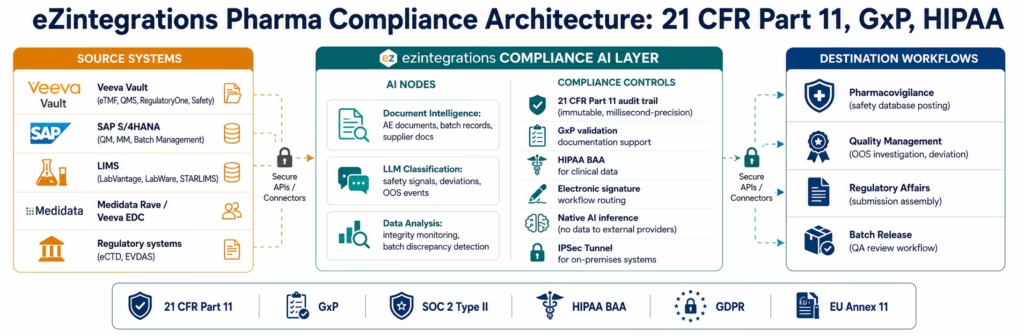
eZintegrations is architected for regulated industry deployment: not as a general-purpose automation platform that happens to have a HIPAA checkbox, but as an enterprise integration platform with 21 CFR Part 11, GxP, and HIPAA architecture built into the infrastructure.
Native AI inference within the compliance boundary. Every Document Intelligence, LLM Classification, and Data Analysis action in eZintegrations runs within the platform’s own processing infrastructure. Adverse event narratives, clinical trial data, batch manufacturing records, and regulatory documents are processed natively: they are not sent to OpenAI, Anthropic, Google, or any external AI provider during AI processing. This satisfies the data residency requirement without requiring a separate Business Associate Agreement or Data Processing Agreement with an AI provider.
Immutable audit trails for every AI action. Every AI node execution generates an audit trail entry containing: timestamp (accurate to the millisecond), input record identifier, AI model version used, input fields processed, output fields produced (with confidence scores), routing decision taken, and the user account under whose authority the automated action ran. These audit trail entries are written to an append-only log that cannot be modified without detection: satisfying the 21 CFR Part 11 audit trail requirements for automated actions.
Structured, reproducible AI outputs. Every AI node returns a structured JSON object: {"classification": "Unexpected Serious Adverse Event", "confidence": 0.93, "meddra_code": "10019211", "processing_timestamp": "2026-04-14T18:23:41.003Z"}: not an unstructured text response. The structured output is auditable, reproducible, and linkable to the specific model version that produced it. This is essential for GxP validation: you must be able to demonstrate that the AI system produces the same output given the same input, and that output changes can be traced to specific model updates.
Electronic signature workflow support. For regulated actions that require electronic signature (batch release approval, protocol deviation approval, regulatory submission certification), eZintegrations routes the AI-processed record to the designated approver with all supporting data assembled. The approver’s confirmation constitutes the electronic signature event, which is logged with their user identity, timestamp, and the meaning of the action.
GxP validation support. eZintegrations provides validation documentation support including: functional specifications for standard workflow configurations, IQ/OQ/PQ protocol templates for validated use cases, change control procedures for workflow modifications, and periodic review documentation for validated configurations. This reduces the validation effort compared to custom-built integrations, which require validation from scratch.
System connectors for pharma enterprise stack:
- Veeva Vault: REST API connector for Vault’s eTMF, QMS, RegulatoryOne, and Safety modules. Document retrieval, metadata update, status workflow triggering, and cross-study data extraction.
- SAP S/4HANA: OData V4 with CSRF token management for batch management, materials management, quality management (QM module), and production planning. SuiteQL-equivalent query capabilities for SAP QM test result and specification retrieval via OData entity sets.
- LIMS (LabVantage, LabWare, STARLIMS): REST and database connectors for batch sample and test result retrieval, specification comparison, and out-of-specification (OOS) flagging.
- Medidata Rave / Veeva EDC: EDC data export API for clinical data listing retrieval and cross-system reconciliation.
- Regulatory submission systems (eCTD, XEVMPD, EVDAS): structured data extraction and submission package assembly.
- IPSec Tunnel: for on-premises LIMS, SAP, or legacy systems behind corporate firewalls, eZintegrations connects via IPSec Tunnel without requiring internet-exposed ports: critical for GxP environments where network exposure must be minimised.
Compliance certifications: SOC 2 Type II certified. HIPAA BAA available for clinical trial data. GDPR compliant for EU clinical and patient data. 21 CFR Part 11 architecture with validated audit trail and electronic record controls. EU Annex 11 compliant for computerised systems in EU pharmaceutical operations.
Use Case 1: Adverse Event Document Processing with Document Intelligence
The problem: your pharmacovigilance department receives Individual Case Safety Reports (ICSRs) in multiple formats: MedWatch PDFs, CIOMS forms, narratives from clinical investigator sites, spontaneous reports from healthcare providers: each requiring a trained PV coordinator to read the document, extract the structured data elements (patient demographics, adverse event terms, causality assessment, narrative, suspect product), code the adverse event to MedDRA, and enter the data into the safety database.
Regulatory deadlines are strict: serious unexpected adverse drug reactions require 15-day expedited reporting to the FDA. The coordination effort compounds when multiple cases arrive simultaneously during a clinical trial’s active phase.
The AI workflow solution: Document Intelligence reads every incoming ICSR document regardless of format and extracts the structured data fields required for safety database entry: pre-coded to MedDRA vocabulary using the current version: with confidence scores per field. The PV coordinator reviews the extracted, pre-coded record rather than starting from a blank entry form.
The Step-by-Step Adverse Event Workflow
Trigger: new document received in the safety department’s document inbox (email attachment, Veeva Vault document submission, secure file transfer).
Step 1: Document Intelligence: the ICSR document is processed. Fields extracted:
- Patient demographics: age, sex, weight, medical history
- Adverse event terms: verbatim text of the reported event, extracted as submitted
- MedDRA pre-coding: the verbatim term is matched to the current MedDRA hierarchy (SOC → HLGT → HLT → PT → LLT) with a suggested code and confidence score
- Suspect product: product name, dose, route, indication, start date
- Causality assessment: the reporter’s stated causality (related, possibly related, unrelated)
- Narrative: patient narrative extracted as free text
- Case classification: seriousness criteria (hospitalization, life-threatening, fatal, congenital anomaly, disability, medically significant)
Step 2: Seriousness and expectedness classification: LLM Classification applies regulatory criteria to classify the case as serious/non-serious and expected/unexpected based on the Reference Safety Information (RSI) for the product.
Step 3: Confidence-based routing:
- High confidence, serious and unexpected: flagged for expedited review with 15-day clock notation
- High confidence, non-serious or expected: queued for standard periodic review
- Below-threshold confidence on any field: routed to PV coordinator with extracted values and rationale shown for correction
Step 4: Safety database pre-population: the extracted and classified record is written to the safety database (Argus, ARISg, Veeva Vault Safety) as a draft case: fully pre-populated with extracted data, MedDRA codes, and seriousness/expectedness classification. The PV coordinator reviews, corrects any errors, and finalises the case.
Step 5: Audit trail: every extraction action, every field value, every confidence score, and every routing decision is logged in the immutable 21 CFR Part 11 audit trail: tied to the specific Document Intelligence model version that processed the case.
The result: PV coordinator time per case drops from 2-4 hours (full manual entry) to 30-60 minutes (review and finalise pre-populated record). For well-formatted MedWatch PDFs, accuracy on standard fields exceeds 94% before coordinator review. During high-volume periods (multiple serious AE reports simultaneously), the workflow processes all cases in parallel, ensuring the expedited reporting clock is not missed while coordinators are occupied.
Use Case 2: Safety Signal Classification with LLM Classification
The problem: your medical safety team reviews Individual Case Safety Reports to detect emerging safety signals: patterns of adverse events that may indicate a previously unrecognised risk. The classification of each ICSR’s contribution to signal detection requires medical judgment, but the initial triage: identifying which cases warrant expedited review, which fit into known signal categories, and which are likely to contribute to a signal requiring regulatory notification: is time-consuming when applied to high case volumes.
The AI workflow solution: LLM Classification applies validated safety classification criteria to each incoming ICSR, scoring the case’s potential signal contribution and routing it to the appropriate review pathway. The classification categories are defined by your medical team in plain language, validated as part of the system validation package, and applied consistently to every case: eliminating the triage variability that comes from applying human judgment to the same criteria across multiple reviewers.
Classification Categories (configurable by your medical team)
- Expedited reporting candidate: meets seriousness and unexpectedness criteria; flagged for 15-day clock initiation
- Signal strengthening case: adverse event type matches an existing signal under active monitoring; added to signal workbench
- New potential signal: adverse event type not in existing signal library; flagged for signal detection review
- Aggregate reporting only: non-serious, expected, or lower-priority case; queued for periodic DSUR/PSUR inclusion
- Duplicate screening flag: patient, product, and event combination matches an existing case in the safety database; flagged for duplicate assessment before entry
Validation requirements met: the classification categories and decision criteria are documented in the functional specification. The LLM Classification model version is locked at validation. Configuration changes require change control documentation and re-validation of affected criteria. Every classification output includes the model version, the classification rationale (which criteria matched), and the confidence score: making the classification fully auditable.
Use Case 3: Clinical Data Integrity Monitoring with Data Analysis
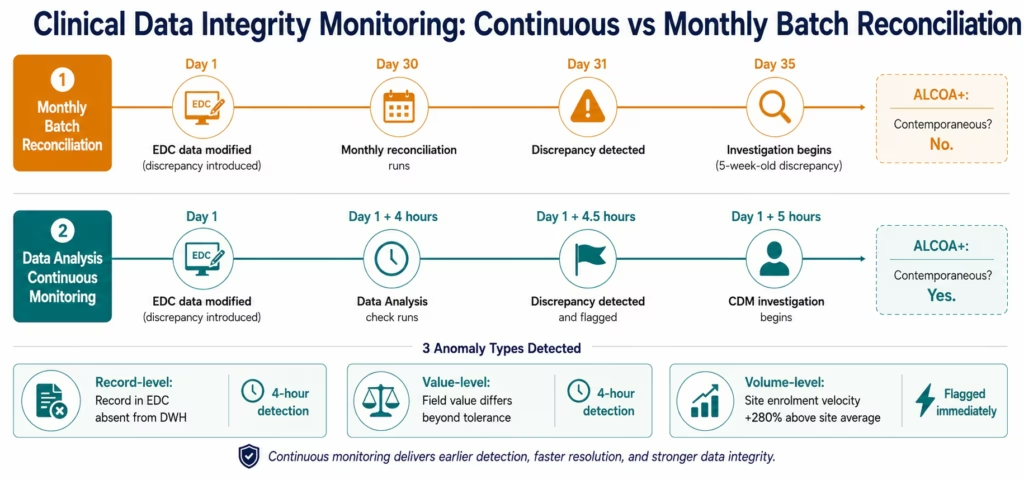
The problem: your clinical data management team reconciles data between the electronic data capture (EDC) system (Medidata Rave or Veeva EDC) and the internal clinical data warehouse on a monthly or study-milestone basis. Reconciliation identifies records that exist in one system but not the other, values that differ between systems beyond expected variance, and data points that have been modified after database lock.
Monthly reconciliation catches problems late: after they have had time to compound into systematic discrepancies that take weeks to investigate. The root cause of a data discrepancy discovered 30 days after it was introduced is difficult to trace.
The AI workflow solution: Data Analysis monitors EDC-to-data warehouse synchronisation continuously: not monthly: and flags discrepancies within hours of their occurrence.
What Data Analysis Monitors in Clinical Workflows
Record-level integrity:
- Records present in EDC but absent from the data warehouse: flagged within the configured check interval (typically 4-6 hours)
- Records present in the data warehouse but absent from EDC: flagged as potential phantom records requiring investigation
- Post-lock data modifications: any change to an EDC record after database lock is flagged immediately for CDM investigation
Value-level integrity:
- Field values that differ between EDC and data warehouse beyond expected transformation tolerance (accounting for known derivation rules)
- Laboratory values that fall outside the specified normal range for the site and study
- Visit dates in the EDC that fall outside the protocol-specified visit window
Volume-level integrity:
- Subject enrolment velocity per site that deviates significantly from the site’s historical rate (potential data fabrication signal)
- Query response rates per site that drop significantly below the study average (site compliance risk signal)
The GxP benefit: continuous monitoring transforms data integrity from a milestone activity to a continuous state. Discrepancies detected within hours satisfy the ALCOA+ requirement for contemporaneous detection. Each detected discrepancy generates an issue record with the source data, the comparison point, the deviation magnitude, and the timestamp: fully traceable for regulatory inspection.
Use Case 4: Regulatory Submission Data Assembly
The problem: preparing a regulatory submission package: an NDA, BLA, IND Annual Report, DSUR, or a Type II variation: requires assembling data from multiple source systems: clinical study reports from Veeva Vault eTMF, biostatistics outputs from the statistical analysis environment, CMC data from SAP quality management, nonclinical data from LIMS, and labelling documents from the document management system.
The submission team’s current process: a project coordinator with a submission checklist works through each data requirement, manually locating the appropriate documents in each system, verifying completeness, and assembling the package in the eCTD authoring tool. For a complex NDA, this assembly process takes 3-5 days and is the critical path for submission timing.
The AI workflow solution: an intelligent aggregation workflow queries each source system for the required data elements based on the submission type, assembles them into the eCTD structure, and performs an AI-powered completeness check before the submission team begins their review.
The Regulatory Submission Assembly Workflow
Trigger: submission project milestone event in the project management system, or manual initiation by the regulatory affairs team.
Step 1: Source system query: based on the submission type and product, the workflow queries each connected source system:
- Veeva Vault eTMF: clinical study reports, investigator brochure, protocol and amendments
- Veeva Vault RegulatoryOne: prior correspondence with health authorities, previous submission documents
- SAP QM: CMC batch data, analytical method validation reports
- LIMS: stability data, raw test results
- Statistical analysis environment: integrated summary of safety and efficacy datasets
Step 2: Document Intelligence (completeness assessment): each retrieved document is scanned by Document Intelligence to verify:
- The document version matches the submission-required version
- The document’s regulatory designation (e.g., final, approved, signed) matches the submission requirement
- Required data fields within structured documents (tables, datasets) are populated and within expected ranges
Step 3: LLM Classification (gap identification): any missing or non-conforming document is classified by gap type: version mismatch, approval status pending, data range anomaly, or required section absent: with a suggested resolution action.
Step 4: eCTD assembly draft: conforming documents are assembled into the eCTD folder structure in the document management system. The submission team receives a structured gap report alongside the partially assembled eCTD package.
Step 5: Regulatory review workflow: the assembled package is routed through the configured review and approval workflow in Veeva Vault: with electronic signature capture for regulatory sign-off.
The result: submission assembly time reduces from 3-5 days of manual data gathering to 6-8 hours of AI-assisted assembly, with the submission team’s remaining time focused on gap resolution and regulatory review rather than document hunting.
Use Case 5: LIMS-to-ERP Quality Data Sync with AI Anomaly Detection
The problem: your quality control laboratory runs tests on in-process and finished product samples. Test results are recorded in the LIMS (LabVantage, LabWare, or STARLIMS). Batch release decisions require comparing those test results against the approved specifications stored in the ERP (SAP QM). This comparison currently happens manually: a quality reviewer pulls the LIMS test result report and the SAP specification, compares each result against each specification, and signs the batch record.
When an out-of-specification (OOS) result is identified, an investigation must be initiated within 24 hours. The delay between the LIMS recording the OOS result and the quality team being notified: which in a manual process may be hours or until the next scheduled batch review: is both a compliance risk and a manufacturing productivity cost.
The AI workflow solution: eZintegrations maintains a real-time connection between the LIMS and SAP QM, with Data Analysis monitoring the test result stream for OOS and out-of-trend (OOT) conditions as results are recorded.
The LIMS-to-ERP Quality Data Workflow
Trigger: new test result recorded in the LIMS.
Step 1: Result retrieval: the test result (sample ID, test method, result value, unit, analyst, instrument, date/time) is retrieved from the LIMS via REST API or database connector.
Step 2: Specification retrieval: the corresponding specification is retrieved from SAP QM (material, test characteristic, upper specification limit, lower specification limit, acceptance criteria).
Step 3: Data Analysis comparison:
- Result within specification: batch record updated in SAP. No alert.
- Out of specification (OOS): immediate alert to QC manager and laboratory director. OOS investigation workflow triggered in the quality management system.
- Out of trend (OOT): Data Analysis compares the result against the historical distribution for this material and test characteristic. Results trending toward the specification limit trigger a proactive alert: before OOS occurs.
Step 4: Audit trail: the result, specification, comparison outcome, and any alert generated are logged in the 21 CFR Part 11-compliant audit trail. The analyst who recorded the LIMS result and the automated system action are both recorded.
Step 5: Batch release aggregation: when all in-process and release tests are complete and within specification, the batch record aggregation workflow assembles the full test result package for QA review. The QA reviewer’s electronic approval of the batch record constitutes the final electronic signature for batch release.
The result: OOS detection goes from hours (when the next scheduled review occurs) to minutes (when the result is recorded). OOT trending provides early warning before OOS occurs: typically identifying potential issues 2-3 batch cycles before a specification breach. LIMS-to-SAP reconciliation errors: which require deviations and corrections: reduce by 80-85% as manual transcription is eliminated.
Key Outcomes and Results
Pharmaceutical operations teams deploying AI workflows with eZintegrations report the following outcomes within 90-120 days of validated deployment:
Pharmacovigilance:
- PV coordinator time per ICSR: 2-4 hours (manual) → 30-60 minutes (AI-assisted)
- Case volume processed per coordinator: increases 3-4x
- Expedited reporting deadline compliance: improves to 99%+ (from 92-95% with manual processing)
- MedDRA coding consistency: improves significantly: AI applies the same coding logic to every case
Clinical Data Management:
- Discrepancy detection time: 30 days (monthly batch) → 4-6 hours (continuous)
- Reconciliation items requiring investigation: reduces 60-70% as discrepancies are caught earlier
- CDM team time on reconciliation: reduces 50-60%
Regulatory Affairs:
- Submission data assembly time: 3-5 days → 6-8 hours
- Submission completeness errors found post-assembly: reduces 70-80% with AI completeness check
- Regulatory team time on data gathering: reduces 60-70%
Quality and Manufacturing:
- OOS detection time: hours → minutes from result recording
- OOT early warning: 2-3 batch cycles before specification breach
- LIMS-to-SAP transcription errors: reduces 80-85%
- Batch release review time: reduces 30-40% as pre-aggregated test result packages eliminate manual compilation
Compliance:
- 21 CFR Part 11 audit trail: complete, immutable, millisecond-precision for every AI action
- Regulatory inspection readiness: improved: every automated action is documented and retrievable
- Validation documentation: accelerated by pre-built validation templates for standard workflow configurations
How to Get Started
Pharmaceutical AI workflow validation follows a structured approach that is different from general-purpose automation deployment: but it is not as long or as expensive as a custom system validation, particularly with pre-built validation templates for standard workflow configurations.
Step 1: Compliance architecture assessment
Before any configuration begins, your validation team and eZintegrations review the intended use cases against 21 CFR Part 11, GxP, and HIPAA requirements. The output is a Compliance Architecture Assessment documenting: which AI workflow actions generate regulated electronic records, which require electronic signature, which data elements are subject to data residency requirements, and the validation approach for the intended configuration.
For regulated use cases, this assessment typically takes 3-5 business days.
Step 2: Book a technical demo with your validation team
The compliance architecture and audit trail functionality are best evaluated in a live demonstration: including showing the immutable audit trail for a sample AI action, the electronic record output format, and the system access control configuration. Book a free demo and include your validation lead, your quality informatics team, and any regulatory affairs stakeholders.
Step 3: Configure the first use case under validation controls
Start with a single, bounded use case: adverse event document pre-population, LIMS-to-SAP OOS alerting, or clinical data reconciliation monitoring are all well-defined starting points with clear regulatory requirements and measurable ROI.
Configure the workflow following your organisation’s change control procedure. The functional specification for the workflow (input, processing logic, output, audit trail content) is documented as part of the validation package.
Step 4: Execute IQ/OQ/PQ validation
eZintegrations provides IQ/OQ/PQ protocol templates for standard workflow configurations, significantly reducing the validation effort compared to custom system development. The IQ (Installation Qualification) confirms the platform is installed as specified. The OQ (Operational Qualification) tests that the workflow functions as designed under expected conditions. The PQ (Performance Qualification) confirms the workflow performs consistently under production conditions.
Step 5: Deploy and monitor
Go live under the validated configuration. Workflow changes require change control and re-validation of affected functions. The periodic review schedule confirms the validated configuration has not deviated and that the audit trail remains intact.
FAQs
21 CFR Part 11 requires that automated systems generating electronic records produce immutable audit trails, use controlled access, and support electronic signature workflows. eZintegrations satisfies these requirements through millisecond-precision immutable audit trail entries for every AI action, including every Document Intelligence extraction, every LLM Classification output, and every Data Analysis flag, native AI inference that processes regulated data within the platform's own infrastructure without sending data to external AI providers, structured and reproducible AI outputs with typed JSON, model version, confidence score, and timestamp, and electronic signature routing for regulated approvals. GxP validation support also includes IQ/OQ/PQ protocol templates for standard configurations.
The implementation timeline depends on the use case complexity and the organisation's internal validation procedures. A single well-defined use case, such as LIMS-to-SAP OOS alerting or adverse event document pre-population, using standard IQ/OQ/PQ protocols typically completes validation within 6-10 weeks. This usually includes 2-3 weeks for compliance assessment and functional specification, 3-5 weeks for validation execution, and 1-2 weeks for validation reporting and management review. This timeline is significantly faster than validating a custom-built integration from scratch, which often requires 4-6 months. Standard IQ/OQ/PQ protocol templates reduce validation protocol authoring time by approximately 40-50%.
Yes, eZintegrations connects to Veeva Vault through REST APIs across all major Vault application families, including eTMF for document retrieval and metadata updates, QMS for quality event and CAPA workflows, RegulatoryOne for submission tracking and health authority correspondence, and Vault Safety for ICSR and aggregate report management. The Vault connector manages OAuth 2.0 authentication lifecycle requirements and supports Vault's structured content model for both document and object record access. For submission assembly workflows, the connector can retrieve document packages from eTMF using study, document type, and status filters.
Yes, provided the architecture is designed appropriately for regulated pharmacovigilance workflows. Document Intelligence extracts patient demographics, adverse event verbatim terms, suspect product information, causality assessments, and seriousness criteria from MedWatch PDFs, CIOMS forms, and investigator site reports. MedDRA pre-coding is applied to verbatim terms using confidence-scored suggestions. The processing architecture keeps adverse event data entirely within eZintegrations' HIPAA-compliant infrastructure without transmitting patient information to external AI providers. Every extraction action is logged in the 21 CFR Part 11 audit trail, enabling traceability and compliance. Pharmacovigilance coordinators then review pre-populated drafts rather than manually entering all data from scratch.
Yes, eZintegrations connects to LabVantage, LabWare, and STARLIMS through REST APIs and direct database connectors. The LIMS-to-ERP quality data automation workflow retrieves laboratory test results from the LIMS, retrieves specification data from SAP QM, compares results against specifications, and triggers OOS investigation workflows within minutes of result recording. Data Analysis also supports OOT trending by comparing current results against historical distributions for the same material and test characteristic, providing early warning signals before specification breaches occur. All LIMS-to-SAP data exchanges are recorded within the GxP audit trail for compliance traceability. 1. How does AI workflow automation work for pharma compliance under 21 CFR Part 11?
2. How long does it take to validate and deploy a pharma AI workflow?
3. Does eZintegrations connect to Veeva Vault for pharma workflows?
4. Can AI workflows handle adverse event document processing under pharmacovigilance regulations?
5. Does eZintegrations work with LIMS systems for quality data automation?
Conclusion: The Regulation Doesn’t Block AI. It Specifies What AI Must Do.
Pharmaceutical organisations that treat 21 CFR Part 11 and GxP as barriers to AI adoption are misreading the regulatory landscape. The regulations specify what automated systems must do to be compliant: not that automated systems cannot be used. Immutable audit trails, electronic record controls, native data processing, and validated system configurations are requirements to be designed for, not obstacles to avoid.
The pharmaceutical operations that will have the most effective AI workflow automation in 2027-2028 are the ones that begin their compliance architecture assessment and first use case validation in 2026. The PV coordinator time saved on ICSR processing, the clinical data discrepancies caught in hours rather than months, the regulatory submission assembly time compressed from days to hours, and the OOS alerts fired within minutes of result recording are all achievable within a validated 21 CFR Part 11-compliant architecture.
eZintegrations is built for this environment. Native AI inference within the compliance boundary. Immutable audit trails for every AI action. IQ/OQ/PQ validation support for standard configurations. Veeva Vault, SAP, LIMS, and Medidata connectors in the same platform.
Book a free demo and bring your validation lead, your quality informatics team, and your most complex regulatory data workflow. We will walk through the compliance architecture, the audit trail, and the specific connector configuration for your pharma system stack.