Agentic AI for Industrial Manufacturing: Autonomous Production Intelligence
June 8, 2026Agentic AI for industrial manufacturing deploys coordinated networks of specialist AI agents, aligned with Multi-agent system architecture, that monitor production, quality, and maintenance operations continuously across ERP and MES systems: detecting emerging anomalies, correlating signals across domains, orchestrating responses, and delivering synthesised intelligence to plant managers and operations executives via natural language Chat UI. eZintegrations’ Goldfinch AI coordinates specialist worker agents through a Chat UI and Workflow Node: moving manufacturing from reactive exception management to autonomous production intelligence that surfaces issues before they become line stoppages, quality escapes, or customer delivery failures.
TL;DR
- Reactive manufacturing management means discovering production problems after they cost money: the machine failure you find when the line stops, the quality trend you see when the reject pile grows, the supplier risk you discover when the incoming inspection fails and the production orders are already queued. The lag between event and discovery is where manufacturing costs accumulate.
- Agentic AI closes that lag, aligning with McKinsey & Company Industry 4.0 and autonomous manufacturing operations research. Not by handling individual exceptions faster: that is Level 3 AI Agents: but by monitoring your entire manufacturing operation continuously at population level: all lines, all machines, all quality characteristics, all suppliers, all simultaneously.
- Goldfinch AI is eZintegrations’ Level 4 multi-agent coordination platform. The Chat UI gives plant managers and operations executives natural language access to live production intelligence in under 60 seconds. The Workflow Node runs autonomous intelligence programmes: coordinator agents dispatching parallel worker agents continuously, delivering structured operational briefs automatically.
- Four agentic programmes in this guide: the Production Operations Intelligence Network, the Quality Assurance Intelligence Programme, the Maintenance and Asset Reliability Network, and the Manufacturing Supply Risk Programme.
- Deployment builds on existing Level 1-3 eZintegrations manufacturing integration: Goldfinch AI coordination layers on top of an already-connected manufacturing stack.
The Reactive Manufacturing Plant: Where Costs Accumulate in the Lag
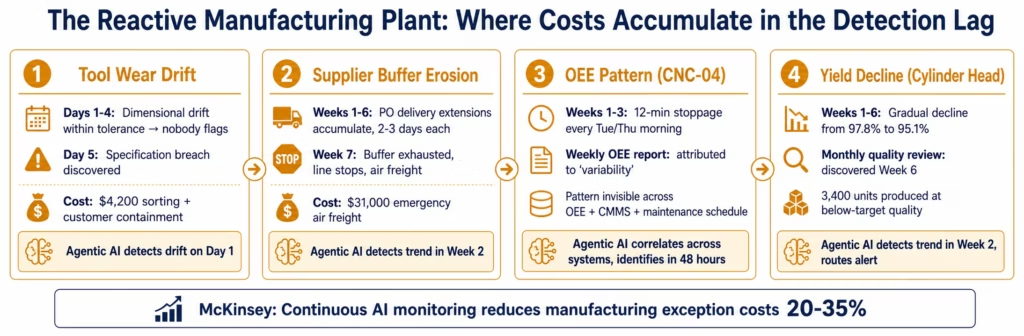
Consider four manufacturing events that most plants discover in the wrong order:
Event 1: A cutting tool on Line 3’s grinding operation begins wearing faster than its rated life due to a slight change in the incoming material hardness. The first indication is a dimensional drift in the journal bearing bore measurement: 0.02mm above nominal, still within tolerance. The drift continues over 4 days. On day 5, the bore exceeds the upper specification limit. Seventeen parts in the last shift’s production are out of tolerance. Sorting costs $4,200. Three parts already shipped to the assembly customer require a containment field action.
Event 2: The primary supplier for a critical forging begins running 2-3 day delivery extensions on purchase orders: not enough to miss the delivery date confirmation in the ERP, but consistent enough to reduce the effective buffer between material arrival and production need from 5 days to 2 days. Six weeks later, a logistics delay compounds with the reduced buffer and the line runs out of material. Emergency air freight: $31,000.
Event 3: Production Line 1 has been running at 91% OEE for the past 3 weeks. The targets show 94%. The 3% gap has been attributed to “general variability” in the weekly OEE report. In fact, 2.1 percentage points of the gap is from a recurring 12-minute unplanned stoppage on CNC-04 every Tuesday and Thursday morning, correlated with the first production run after the Monday and Wednesday night maintenance window. Nobody made the connection because the pattern requires correlating data across the OEE system, the CMMS work orders, and the maintenance schedule: which nobody does continuously.
Event 4: First-pass yield on the cylinder head product family has declined from 97.8% to 95.1% over the past 6 weeks. The decline is real but gradual enough that no individual week triggered an alert. It appears in the monthly quality review: 6 weeks after it began. By then, 3,400 units have been produced at below-target quality rates, with the associated rework cost and customer satisfaction risk.
In each case, the data existed. The tool wear showed in the measurement data. The supplier delivery extensions appeared in the PO confirmation records. The OEE pattern existed in the production logs. The yield decline appeared in the weekly quality data. The data just was not being monitored continuously, correlated across systems, and routed to the right decision-maker in time.
McKinsey estimates that manufacturers with continuous AI monitoring across production, quality, and maintenance reduce total manufacturing exception management costs by 20-35% versus those relying on periodic reporting. Gartner projects that by 2028, 55% of large manufacturing enterprises will operate with autonomous AI monitoring across at least three ISA-95 manufacturing operations management domains.
What Agentic AI Means for Manufacturing (and Why It Is Different from AI Agents)
The distinction between individual AI agents and agentic AI is the same distinction as between a plant quality engineer and a quality operations function.
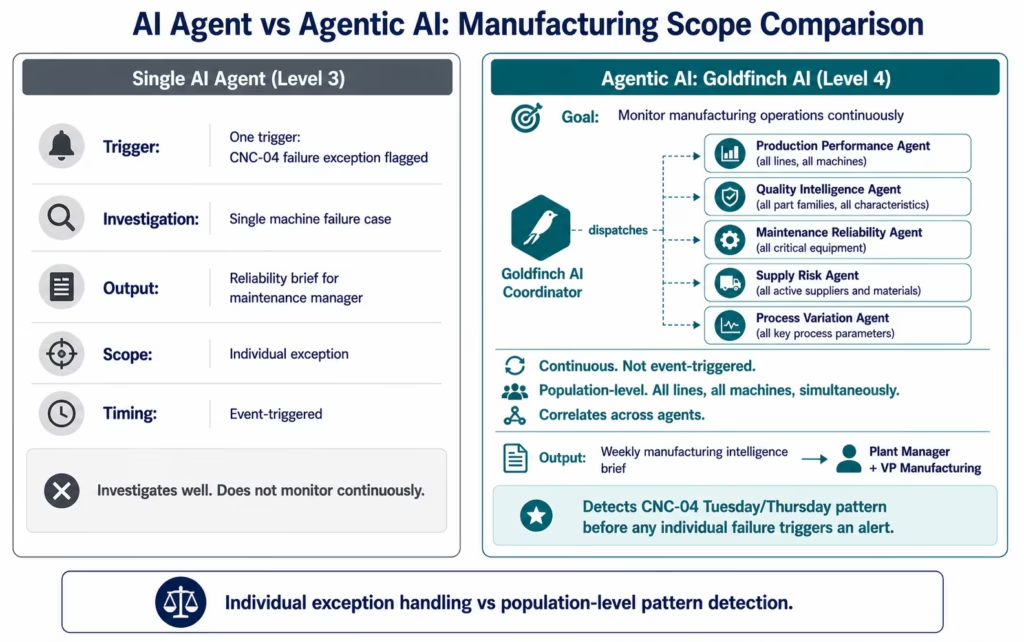
An individual AI agent (Level 3) handles one exception at a time: one production schedule deviation, one quality CAPA initiation, one maintenance reliability pattern. The agent investigates comprehensively and fast, delivering a pre-researched brief to the engineer or planner. This is covered in the AI agents for manufacturing guide.
Agentic AI (Level 4, Goldfinch AI) operates at the programme level. A coordinator agent receives a complex monitoring goal: not “investigate this OEE exception” but “monitor our production operations continuously and surface emerging risks before they become line stoppages.” The coordinator decomposes this into parallel monitoring workstreams, dispatches specialist worker agents for each domain, receives their findings, correlates across domains, and synthesises a unified intelligence picture for manufacturing leadership.
The practical manufacturing differences:
Single AI agent: a CNC-04 failure generates an unplanned downtime exception. The Maintenance Reliability Agent investigates the failure, retrieves the maintenance history, identifies that this is the third occurrence in 90 days, and routes a reliability brief recommending PM. Individual case. Event-triggered. Excellent.
Agentic AI: the Production Operations Intelligence coordinator monitors all machines on all lines simultaneously. It detects that CNC-04 has a recurring 12-minute stoppage every Tuesday and Thursday morning: a pattern that spans data from the OEE system, the CMMS, and the maintenance schedule. No individual failure event is severe enough to trigger an individual agent. The coordinator identifies the pattern from aggregate data and correlates it with the maintenance window schedule: something that individual agents, each handling individual cases, never surface.
Population-level pattern detection versus individual case investigation. That is the distinction.
Agentic AI does not replace individual AI agents. It coordinates them and adds the population-level monitoring that individual agents cannot provide. The individual CAPA Investigation Agent still handles specific CAPA requests. The Goldfinch AI coordinator monitors the aggregate quality performance of all product families on all lines: identifying the 6-week yield decline trend that no individual quality exception was severe enough to trigger.
Before vs After: The Agentic AI Transformation in Manufacturing
| Manufacturing Domain | Before Agentic AI | After Agentic AI (Goldfinch AI) |
|---|---|---|
| OEE monitoring | Weekly OEE report, patterns visible 1-2 weeks after they start | Continuous line-level monitoring, emerging patterns flagged within 48 hours |
| Tool wear and process drift | Specification breach discovered when measurement fails inspection | Statistical drift detected days before specification limit, PM flagged proactively |
| Quality yield trend | Monthly quality review discovers 6-week decline | Continuous yield monitoring, week-2 trend detection and alert |
| Supplier delivery buffer | Emergency air freight when buffer exhausted | Supplier buffer erosion detected in week 2, procurement alerted proactively |
| Cross-domain correlation | OEE, CMMS, and maintenance schedule in silos, patterns invisible | Coordinator correlates CNC-04 stoppage pattern with maintenance window schedule |
| Production capacity constraint | Operations manager manually evaluates weekly | Capacity Intelligence Agent monitors live MES work centre loads continuously |
| Shift handover report | Shift manager compiles from 3-4 systems, 30-45 min | Workflow Node coordinator auto-generates structured brief before shift change |
| Executive production query | 2-4 hour analyst exercise for current state data | Chat UI: natural language query answered from live MES + ERP in under 60 seconds |
| Quality escape risk | Discovered when customer complaint arrives | Quality Intelligence Agent flags statistically unusual process variables before escape |
| Maintenance PM compliance | Monthly maintenance review identifies overdue PMs | Watcher Tool flags PM due dates 30/14/7 days in advance across all critical equipment |
The Goldfinch AI Architecture for Manufacturing
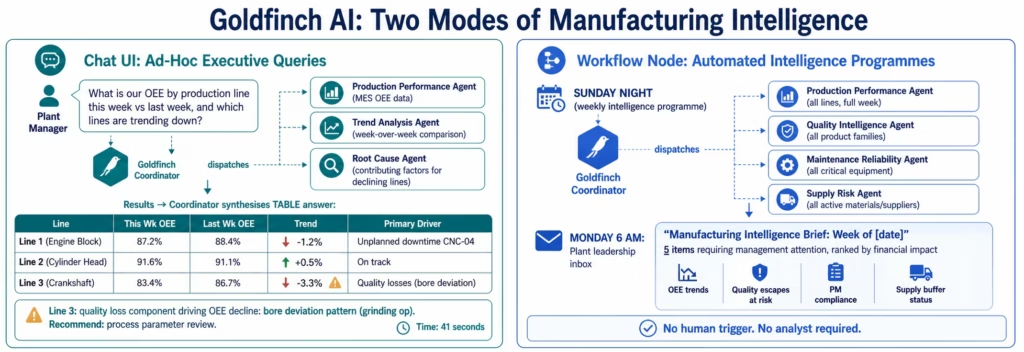
Goldfinch AI operates in manufacturing through two interfaces that together create continuous autonomous production intelligence:
The Chat UI: natural language access to live manufacturing data for plant managers and operations executives. The plant manager types a question. Goldfinch AI interprets the intent, identifies which MES, ERP, quality, and maintenance data sources are needed, dispatches the appropriate worker agents, receives results, synthesises across agents, and returns a structured answer: typically within 30-60 seconds.
The Chat UI does not query cached data. When the VP of Manufacturing asks about first-pass yield by product family, Goldfinch AI dispatches agents that retrieve current quality data from the live MES and SAP QM. The answer reflects the state of those systems at the moment of the query.
The Workflow Node: coordinator intelligence embedded inside automated manufacturing intelligence programmes. The Workflow Node is how agentic monitoring runs continuously without executive prompting.
A Workflow Node deployed in the production operations programme runs every shift end: it dispatches the production performance agent, the quality intelligence agent, the maintenance reliability agent, and the supply risk agent across all current production data. The coordinator receives findings from all four, correlates across domains, and produces the shift handover brief: delivered to the incoming shift manager automatically, before the shift change.
A Workflow Node deployed in the weekly manufacturing intelligence programme runs every Sunday night: the coordinator dispatches parallel agents across the full week’s production data, identifies emerging trends and risks, and delivers a Monday morning intelligence brief to plant leadership: with the week’s production performance ranked by financial impact and recommended management attention.
Agentic Programme 1: Production Operations Intelligence Network
The Production Operations Intelligence Network monitors all production lines simultaneously: not just the lines that generate exceptions, but all lines, looking for the patterns that individual exception monitoring misses.
Worker Agent 1: Production Performance Agent Monitors OEE by component (availability, performance, quality) across all production lines in real time. Tracks actual output versus planned output, cycle time versus standard cycle time, and downtime events by type. The Watcher Tool triggers when any line’s OEE drops below the configured threshold for a sustained period (not a single event but a trend). The agent calculates: which OEE component is driving the gap? Is the gap isolated to a specific shift, a specific work centre, or a specific operator pattern? Population-level OEE intelligence, not individual incident reporting.
Worker Agent 2: Process Variation Agent Monitors key process parameters across production lines: temperatures, pressures, feed rates, cycle times, tool life consumption rates, and any sensor data available via OPC-UA or the MES process data store. Detects statistical drift: parameters trending away from the nominal operating window: and flags drift patterns before they cause specification violations. This is the agent that catches the tool wear drift on Day 1 rather than Day 5.
For Statistical Process Control (SPC) applications: the agent monitors control chart patterns using established Western Electric rules, flagging patterns that suggest assignable causes (trends, shifts, oscillation patterns) even when individual points remain within control limits.
Worker Agent 3: Production Schedule Compliance Agent Monitors production order progress against the planned schedule across all work orders in all lines. Tracks: schedule adherence rate by line and work centre, average schedule gap for behind-schedule orders, the distribution of exception causes (material, machine, capacity, quality), and the trend in schedule compliance week over week. At the population level, this agent identifies systemic scheduling or capacity issues: not just individual order exceptions.
Worker Agent 4: Shift Performance Agent Monitors performance differences across shifts for the same equipment and work centres. Identifies whether OEE, quality, or output differences across shifts suggest training, procedure adherence, or supervision issues. This cross-shift comparison is systematically invisible in standard reporting because shift data is typically reviewed within the shift: not across shifts for the same work centre.
Coordinator synthesis: The production coordinator receives findings from all four agents continuously. It correlates across domains: does the Line 3 OEE decline (from the Production Performance Agent) correlate with the process parameter drift on the grinding operation (from the Process Variation Agent)? Is the schedule compliance gap on Line 2 driven by machine availability issues that the Process Variation Agent has flagged as potential early failure indicators?
The weekly production intelligence brief presents: a ranked production risk register by financial impact, cross-domain correlations identified, and recommended management actions.
Agentic Programme 2: Quality Assurance Intelligence Programme
Individual quality exceptions are handled by Level 3 AI Agents: the CAPA Investigation Agent assembles the investigation context, the Supplier Quality Risk Agent assesses the supply exposure. Quality Assurance Intelligence operates at a level above individual exceptions: continuous population monitoring to detect quality trends before they generate individual exceptions at scale.
Quality Trend Monitoring Agent: Monitors first-pass yield, defect rates, and key quality characteristics across all product families and all production operations. Tracks yield trends using statistical trend detection (not just threshold alerts): identifying yield declines that are gradual enough that no individual data point triggers an alert but that represent a statistically significant deterioration over time. This is the agent that catches the 6-week cylinder head yield decline in week 2.
For individual quality characteristics: the agent monitors the distribution of measured values over time for key characteristics, detecting whether the process mean is shifting toward a specification limit (even while still within control limits) and routing a proactive alert before the limit is breached.
Quality Escape Risk Agent: Monitors in-process quality data for patterns that suggest elevated risk of customer-visible quality escape. When in-process measurements show systematic bias toward specification limits across a product family, the agent calculates the statistical probability of an escape to the customer under current process conditions and routes a risk alert: before the escape occurs.
Customer Complaint Pattern Agent: Monitors incoming customer complaint data for patterns across part numbers, production periods, and process operations. When a complaint pattern is identified (multiple complaints for the same part family, correlated with a specific production window), the agent retrieves the production and process data for the implicated period and routes a structured pattern brief for quality engineering review.
Supplier Quality Trend Agent: Monitors incoming inspection results across all active suppliers and materials. Tracks first-pass incoming inspection yield by supplier and material, detecting trends in supplier quality performance before they reach the level of formal non-conformance. A supplier whose incoming inspection pass rate has declined from 98% to 94% over 8 weeks represents a systemic quality risk: the Supplier Quality Trend Agent surfaces this 4-6 weeks before the formal NCR process would.
Coordinator synthesis: The quality coordinator correlates findings across the four quality agents and across the production operations agents. The yield decline detected by the Quality Trend Monitoring Agent correlated with the process parameter drift detected by the Process Variation Agent? That correlation is the root cause hypothesis that the CAPA Investigation Agent would need weeks of manual investigation to develop: the coordinator surfaces it within days of the trend beginning.
Agentic Programme 3: Maintenance and Asset Reliability Network
Asset reliability is the single largest driver of unplanned OEE loss in most manufacturing operations. Most plants have CMMS data, maintenance history data, and OEE data that could support reliability analytics: but the analysis to convert this data into proactive reliability intelligence requires more engineering time than most maintenance teams have.
The Maintenance and Asset Reliability Network automates this analysis continuously.
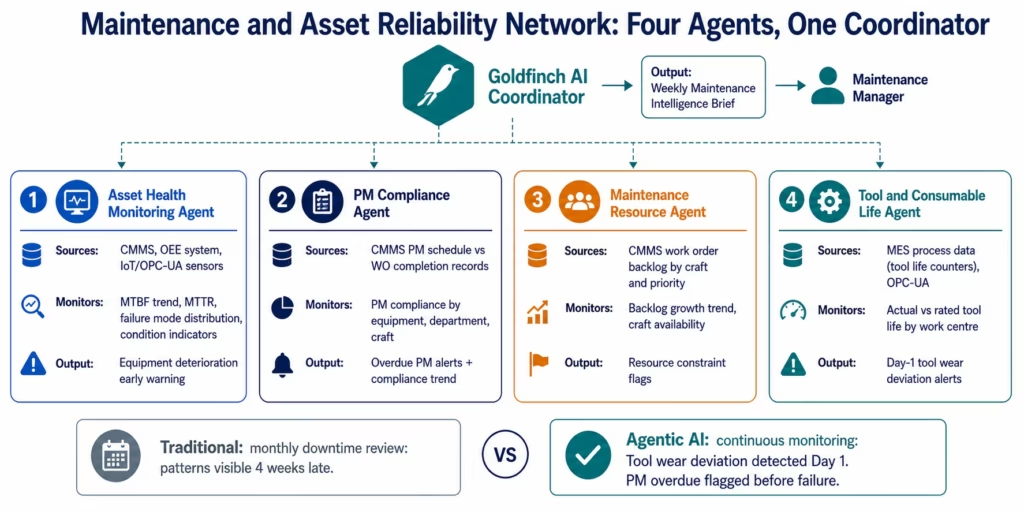
Asset Health Monitoring Agent: Uses the Watcher Tool to monitor equipment performance metrics: unplanned downtime frequency, mean time between failures (MTBF) by failure mode, mean time to repair (MTTR) by equipment and craft, and preventive maintenance compliance rates. Identifies equipment whose MTBF is shortening, whose repair time is increasing, or whose failure mode distribution is changing relative to FMEA-predicted failure modes : all early indicators of asset condition deterioration before the deterioration causes a line stoppage.
For equipment with IoT sensor connectivity (via OPC-UA or direct sensor API): the agent monitors process parameters that serve as condition indicators: vibration amplitude, temperature rise, current draw, pressure differential: and detects trends that historically precede failure events in that equipment class.
PM Compliance Agent: Monitors the preventive maintenance schedule across all critical equipment against the CMMS work order completion records. Flags equipment where planned PM intervals have elapsed without completed PM work orders. Tracks PM compliance rates by department, work centre, and craft: identifying patterns in PM non-compliance that predict future reliability degradation.
Maintenance Resource Agent: Monitors maintenance work order backlogs by craft and priority. Identifies situations where the maintenance backlog is growing beyond manageable levels (leading to PM deferral and reactive maintenance spirals) and routes a resource brief to the maintenance manager with the backlog trend and the at-risk equipment list.
Tool and Consumable Life Agent: Monitors tool life consumption rates against rated tool life by work centre and operation. Detects when actual tool life is falling below rated life: the signal that either material properties, process parameters, or tool quality has shifted. Routes a proactive alert with the consumption rate, the deviation from expected life, and the production schedule impact of an unplanned tool change.
This is the agent that catches the Day 1 tool wear drift in the opening example: the consumption rate deviated from the expected life curve on Day 1, not Day 5 when the measurement went out of specification.
Agentic Programme 4: Manufacturing Supply Risk Programme
Manufacturing supply risk sits at the intersection of procurement, production, and quality: and it is systematically undermonitored in most operations because each function sees only its slice of the risk picture.
Procurement sees PO delivery performance. Production sees material availability at the point of need. Quality sees incoming inspection results. Nobody continuously monitors the composite risk picture: a supplier whose delivery is slipping, whose quality is declining, and who is facing financial pressure simultaneously represents a different risk level than any single signal would suggest.
The Manufacturing Supply Risk Programme deploys three specialist agents coordinated by the supply risk coordinator.
Material Availability Intelligence Agent: Monitors the buffer between projected material availability (current inventory plus confirmed in-transit POs) and projected production demand (from the MES production schedule) for all direct materials. Calculates the number of days of production coverage for each material at current consumption rates. Flags materials where the coverage buffer is shrinking below the configured alert threshold: the supplier buffer erosion that leads to emergency air freight if discovered too late.
For single-source materials (no qualified alternative supplier): applies a higher risk flag and a shorter alert window. For materials with qualified alternatives: includes the alternative sourcing lead time in the coverage calculation.
Supplier Performance Risk Agent: Monitors delivery on-time performance trends across all active suppliers. Tracks the trailing 12-week OTD rate by supplier and material, detecting suppliers whose delivery reliability is declining: even where each individual delivery is still within the promised delivery date’s tolerance window. A supplier delivering 2 days late on every PO is technically “on time” if the PO window is wide enough, but the pattern signals a reliability problem.
Uses the Web Crawling tool to monitor supplier news signals: financial distress, labour relations issues, facility disruptions, geopolitical events affecting supplier locations, and regulatory actions that might affect the supplier’s ability to ship.
Component Quality Risk Agent: Monitors incoming inspection first-pass yield trends by supplier and material. Detects declining incoming quality trends before they reach the level of formal NCR initiation. A supplier whose incoming first-pass yield has declined from 98.5% to 95.2% over 8 weeks is a proactive risk signal: not yet a formal quality failure, but a leading indicator.
When declining incoming quality trends correlate with declining delivery performance from the same supplier (detected by the Supplier Performance Risk Agent), the coordinator flags a composite supply risk that neither individual signal would generate alone.
Coordinator synthesis: The supply risk coordinator synthesises findings across all three agents. Its composite risk assessment identifies suppliers where two or more risk signals converge: declining OTD performance AND declining incoming quality AND external financial risk news. Each signal individually might be within tolerance. Together they represent a supply continuity risk that warrants proactive procurement action.
The weekly supply risk brief routes to the manufacturing and procurement leadership: a ranked supplier risk register, the at-risk production orders for each high-risk material, and the recommended actions (expedite current PO, qualify alternative, increase safety stock, initiate formal supplier review).
Manufacturing Executive Intelligence via Chat UI
The Goldfinch AI Chat UI makes manufacturing intelligence accessible to plant management and operations leadership in natural language: without report requests, analyst intermediaries, or waiting for the next scheduled review.
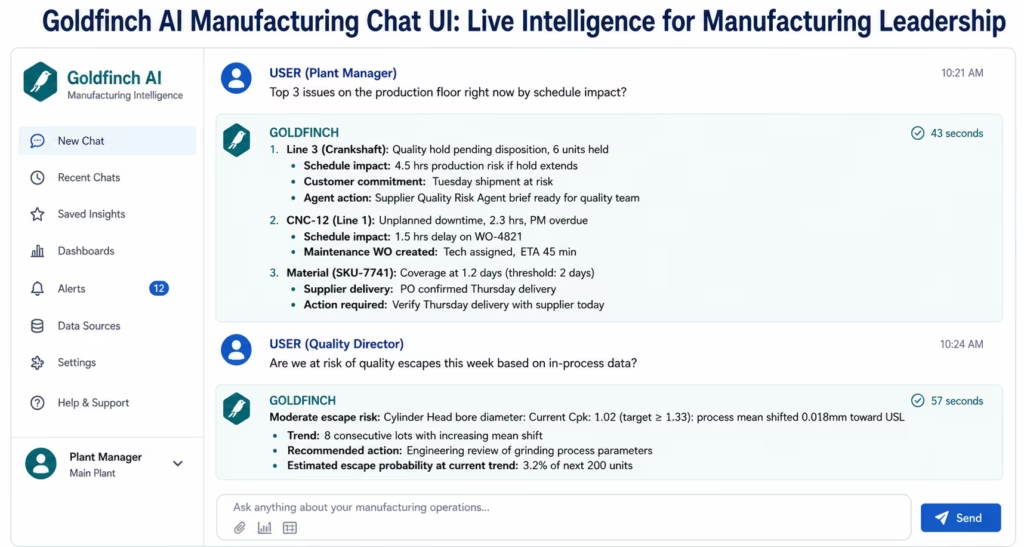
Plant Manager: 7 AM daily: “What are the top three issues on the production floor right now by impact on today’s schedule?”
Goldfinch AI queries the Production Operations Intelligence Network for the current exception queue, ranks by schedule impact and customer commitment, and returns a structured brief in under 45 seconds. The plant manager makes three calls before 7:30 AM.
VP of Manufacturing: Monday morning: “What happened last week in production: OEE, quality, and any issues I should know about for this week?”
Goldfinch AI queries the weekly intelligence data from all four agentic programmes, synthesises the week’s production performance, quality trends, maintenance events, and supply risks, and returns a structured executive brief in under 60 seconds. The Monday morning leadership review is data-driven from the first sentence.
Quality Director: “Are we at risk of any quality escapes this week based on our current in-process quality data?”
Goldfinch AI queries the Quality Escape Risk Agent’s current assessments across all product families, identifies any product families where the in-process quality data suggests elevated escape risk, and returns a ranked risk list with the specific process operations and characteristic trends driving each risk assessment.
Maintenance Director: “Which of our critical production assets have had MTBF shortening this month and are approaching a PM milestone?”
Goldfinch AI queries the Asset Health Monitoring Agent and PM Compliance Agent data, identifies critical equipment meeting both conditions (MTBF shortening AND PM milestone approaching), and returns a prioritised maintenance attention list with the production schedule impact of scheduling PM for each.
CFO: “What is the total financial exposure from our current top supply risk materials and what is the production impact if any of these fail to deliver this month?”
Goldfinch AI queries the Material Availability Intelligence Agent and the ERP for the value of dependent production orders, calculates the financial exposure for each at-risk material, and returns a supply risk financial summary in under 60 seconds.
Governance for Agentic AI in Regulated Manufacturing
Agentic AI in manufacturing introduces governance considerations proportionate to the number of domains being monitored simultaneously and the regulatory environment of the manufacturing operation.
Data access scope per agent:
Each worker agent is configured with the minimum data access required for its monitoring domain. The Quality Trend Monitoring Agent accesses quality measurement data and product family records: it does not access financial data, HR records, or supplier contract terms. The Material Availability Intelligence Agent accesses ERP inventory and purchasing data: it does not access quality records or machine process data. Data access scope is defined at configuration and enforced at the API Tool Call level.
Human-in-the-loop gates for quality and safety actions:
The agentic intelligence programmes surface findings and route recommendations. They do not autonomously execute consequential manufacturing actions:
- The Quality Escape Risk Agent identifies elevated escape risk: the quality engineer makes the decision to implement additional inspection, process adjustment, or production hold.
- The Tool and Consumable Life Agent flags accelerated tool wear: the production supervisor decides whether to change the tool immediately or at the next planned break.
- The Supplier Quality Risk Agent identifies declining supplier quality: the quality manager initiates the formal supplier corrective action request.
For IATF 16949, AS9100, and ISO 13485 regulated manufacturers: every agent finding, coordinator correlation, and human decision is logged with timestamps in an immutable audit trail. For FDA-regulated medical device manufacturers: the agentic intelligence programme’s monitoring records support the Quality Management System’s statistical techniques requirement (21 CFR Part 820.250) and the CAPA system’s trend analysis requirements.
SOC 2 Type II and GDPR:
eZintegrations is SOC 2 Type II certified. All Goldfinch AI processing runs within eZintegrations’ infrastructure: manufacturing process data, quality records, and supplier information are not sent to external AI providers. For manufacturing operations with EU facilities, GDPR compliance applies to all manufacturing data processing. For pharmaceutical and medical device manufacturers where manufacturing data intersects with patient information, HIPAA-compliant integration with a signed BAA is available.
Key Outcomes and Results
Manufacturing organisations deploying agentic AI programmes across production operations, quality assurance, maintenance reliability, and supply risk report measurable improvements within 90-120 days:
Production Operations:
- Emerging OEE pattern detection: 2-3 weeks (weekly report) → 24-72 hours
- Cross-domain pattern identification (OEE + process + maintenance): systematic → automated by coordinator
- Schedule compliance monitoring: weekly report → continuous
- Shift handover report preparation: 30-45 minutes (manual) → automated (Workflow Node)
Quality Intelligence:
- Yield trend detection: 6 weeks (monthly review) → 1-2 weeks (continuous monitoring)
- Process drift detection: specification breach → pre-breach statistical alert
- Quality escape probability visibility: not monitored → real-time by product family
- Customer complaint pattern correlation: reactive discovery → proactive early pattern detection
Maintenance and Reliability:
- Tool wear / process drift detection: Day 5 (specification breach) → Day 1 (drift detection)
- PM compliance monitoring: monthly review → continuous real-time
- MTBF shortening detection: monthly report → continuous trend monitoring
- Asset health at risk visibility: periodic inspection → continuous sensor and CMMS monitoring
Supply Risk:
- Supplier buffer erosion detection: emergency at zero → 2-4 week advance alert
- Composite supplier risk identification: siloed signals → coordinated multi-signal assessment
- At-risk production financial exposure: manual calculation → real-time Chat UI query
Executive Intelligence:
- Plant manager morning brief: 30-45 min manual assembly → automated Chat UI query in 45 seconds
- VP Manufacturing weekly review: 2-hour analyst preparation → automated Monday brief
- Cross-domain risk correlation: rarely performed → systematic weekly coordinator output
How to Get Started
Step 1: Confirm your Level 1-3 manufacturing foundation
Agentic AI monitoring builds on existing eZintegrations manufacturing integration. The Production Operations Intelligence Network requires live MES data, ERP production order data, and CMMS maintenance data connected to eZintegrations. If these connections are not in place, start with the AI workflow manufacturing guide and the AI agent templates. Goldfinch AI coordination is most valuable on top of an already-connected manufacturing stack.
Step 2: Choose your first agentic programme
The Production Operations Intelligence Network provides the broadest visibility and is typically the first deployment: OEE monitoring, process variation detection, and schedule compliance monitoring affect every line and create immediate executive value. The Quality Assurance Intelligence Programme has the highest regulatory impact for IATF, medical device, or aerospace manufacturers. The Maintenance and Asset Reliability Network has the highest ROI for operations with significant unplanned downtime. Choose based on your operation’s highest financial exposure domain.
Step 3: Configure the coordinator and worker agents
Import the Goldfinch AI manufacturing programme template from the Automation Hub. Configure each worker agent with its data source connections and minimum necessary data access scope. Configure the coordinator’s synthesis rules: how to rank production risks, how to correlate findings across agents, and what format the intelligence brief should take.
Step 4: Set up the Chat UI for your leadership team
Configure Goldfinch AI Chat UI access for each manufacturing leadership role: Plant Manager, VP Manufacturing, Quality Director, Maintenance Director, CFO. Set the data access scope for each role. Brief the leadership team on query patterns and how to interpret structured responses.
Step 5: Activate Workflow Node intelligence programmes
Configure the Workflow Node for the shift-end brief (automated shift handover) and the weekly manufacturing intelligence brief (Monday morning delivery). Set the coordinator’s schedule, the worker agent dispatch configuration, and the output routing. Activate: the first automated intelligence brief runs on the configured schedule.
Book a free demo and bring your current production monitoring blind spots. We will map your MES, ERP, CMMS, and quality system data to a Goldfinch AI programme and demonstrate the Chat UI with your actual manufacturing use cases.
Frequently Asked Questions
Agentic AI coordinates multiple AI agents working in parallel toward complex monitoring goals. Individual AI workflows (Level 2) add intelligence at specific processing steps. Individual AI agents (Level 3) handle one exception at a time: one production schedule deviation, one CAPA initiation, one maintenance reliability pattern. Agentic AI (Level 4, Goldfinch AI) deploys a coordinator that dispatches specialist worker agents across your entire manufacturing population simultaneously, monitoring OEE on all lines, quality on all product families, and maintenance on all critical equipment, then synthesises their findings into unified manufacturing intelligence for leadership. The distinction is individual exception handling versus population-level continuous monitoring with cross-domain correlation.
Goldfinch AI operates through two interfaces. The Chat UI answers natural language manufacturing leadership queries from live MES, ERP, CMMS, and quality data in under 60 seconds, such as identifying top production issues or quality risks. The Workflow Node runs autonomous scheduled intelligence programmes: at each shift end, the coordinator dispatches parallel agents and delivers an automated shift handover brief, and weekly it delivers a consolidated manufacturing intelligence report. Both use the same coordinator-worker architecture with full audit trails and data access controls.
With Level 1-3 manufacturing integration foundation in place (MES, ERP, CMMS connected), it takes 4-6 weeks to configure the Goldfinch AI programme, worker agent data access scopes, Chat UI access, and Workflow Node intelligence briefs. For a full greenfield deployment starting from integration, it takes 14-20 weeks. Automation Hub provides programme-level templates for production operations intelligence, quality assurance intelligence, maintenance and asset reliability, and supply risk monitoring.
Yes, with appropriate governance configuration. For IATF 16949, monitoring records and trend analysis support CAPA and evaluation requirements. For AS9100, cross-domain correlation supports statistical analysis requirements. For 21 CFR Part 820 and ISO 13485, agent monitoring records and human reviewer decisions are logged with immutable timestamps, supporting QSR compliance. Human-in-the-loop gates ensure no autonomous quality disposition actions occur without authorised human review, and SOC 2 Type II certification validates security controls.
The system deploys four worker agents: Production Performance Agent monitors MES OEE, production output, and downtime; Process Variation Agent monitors process parameters, SPC data, and OPC-UA sensor streams; Production Schedule Compliance Agent tracks MES work order progress and ERP production requirements; Shift Performance Agent compares cross-shift performance across OEE, quality, and output. All processing occurs within eZintegrations' SOC 2 certified infrastructure.
Both. By default, Goldfinch AI provides aggregate manufacturing intelligence such as ranked risk lists, OEE summaries, and quality trends. Users can drill down into specific production lines, equipment, part numbers, or work orders through follow-up queries. Access to detailed data is governed by role-based access controls, and all queries and responses are logged to maintain a complete audit trail.1. What is agentic AI for industrial manufacturing and how is it different from AI agents?
2. How does Goldfinch AI work for manufacturing operations?
3. How long does it take to set up agentic AI for manufacturing?
4. Is Goldfinch AI manufacturing intelligence compliant with IATF 16949, AS9100, and medical device regulations?
5. What manufacturing data sources does the Production Operations Intelligence Network monitor?
6. Can Goldfinch AI answer questions about individual production lines or only aggregate performance?
Conclusion: From Reactive Plant to Intelligent Manufacturing Operation
The four manufacturing events in this guide’s opening were not exceptional. They were routine. Tool wear drifts gradually before it becomes a specification failure. Supplier buffers erode gradually before they become a line stoppage. OEE patterns exist in the data for weeks before they appear in the monthly report. Quality yields decline gradually before they appear in the quarterly review.
Agentic AI for manufacturing is the architecture that closes the gap between data existence and decision visibility. The Production Operations Intelligence Network does not wait for a line to generate a severe exception before flagging it: it detects the emerging pattern across all lines, all machines, simultaneously. The Quality Assurance Intelligence Programme does not wait for a quality escape to report a yield problem: it detects the statistical drift before the escape. The Tool and Consumable Life Agent does not wait for a specification breach to flag tool wear: it detects the deviation from expected tool life on Day 1.
The result: manufacturing leadership stops managing crises and starts managing trends. The plant manager arrives Monday morning with an intelligence brief that covers the week’s production performance, quality risks, maintenance priorities, and supply vulnerabilities: synthesised automatically, ranked by financial impact, with recommended actions. The VP of Manufacturing asks the Chat UI a question and receives a live answer in 45 seconds.
eZintegrations deploys Goldfinch AI manufacturing intelligence on top of your existing manufacturing integration stack: with SOC 2 Type II certified infrastructure, immutable audit trails for regulated manufacturing environments, human-in-the-loop gates on all quality and safety actions, and pre-built coordinator and worker agent templates for your MES, ERP, and CMMS environment.
Book a free demo and bring your current production monitoring blind spots. We will show you what continuous manufacturing intelligence looks like for your specific MES, ERP, and quality system stack.
Browse agentic AI manufacturing templates in the Automation Hub to see the programme templates for the Production Operations Intelligence Network, Quality Assurance Intelligence Programme, and Maintenance and Asset Reliability Network.