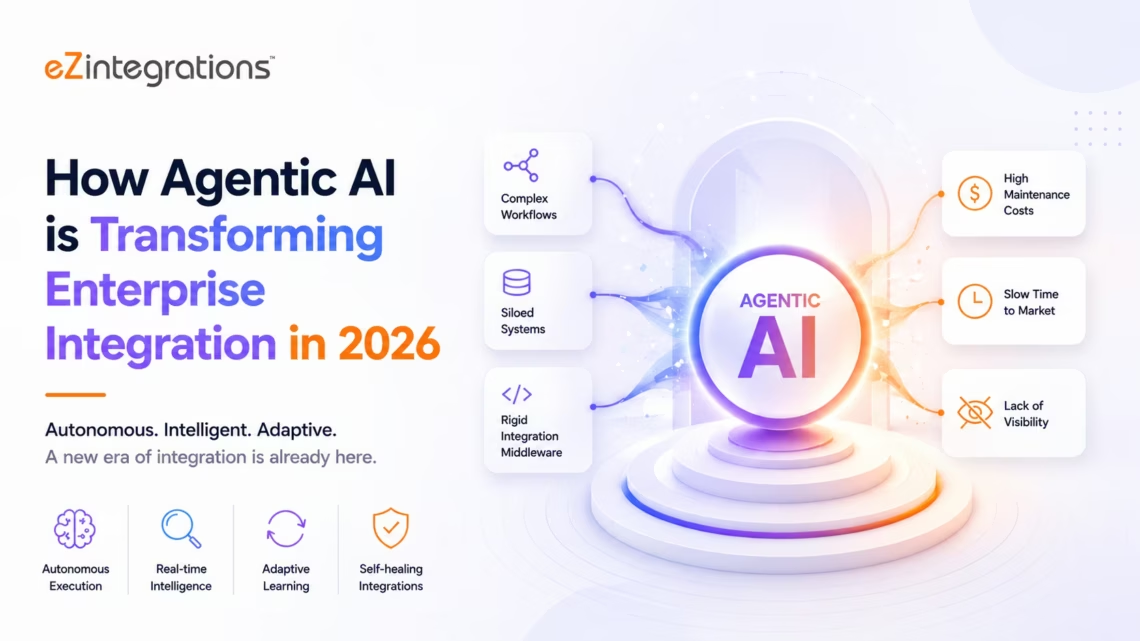
How Agentic AI is Transforming Enterprise Integration in 2026
June 7, 2026Agentic AI refers to AI systems that pursue goals autonomously: perceiving their environment, planning multi-step actions, calling tools (APIs, databases, search), and adapting based on results without predefined sequences. In enterprise integration, agentic AI replaces rule-based automation for tasks requiring judgment: investigating business exceptions, orchestrating multi-system workflows, and delivering intelligence from connected system estates in natural language.
TL;DR:
- Agentic AI describes AI systems that pursue goals autonomously: planning, executing multi-step actions, calling tools, and adapting based on what they find: without predefined sequences. Gartner named agentic AI its #1 strategic technology trend for 2025 and 2026.
- In enterprise integration, agentic AI changes the fundamental question from “what data should move where?” (the automation question) to “what does this business situation require and how should we respond?” (the intelligence question).
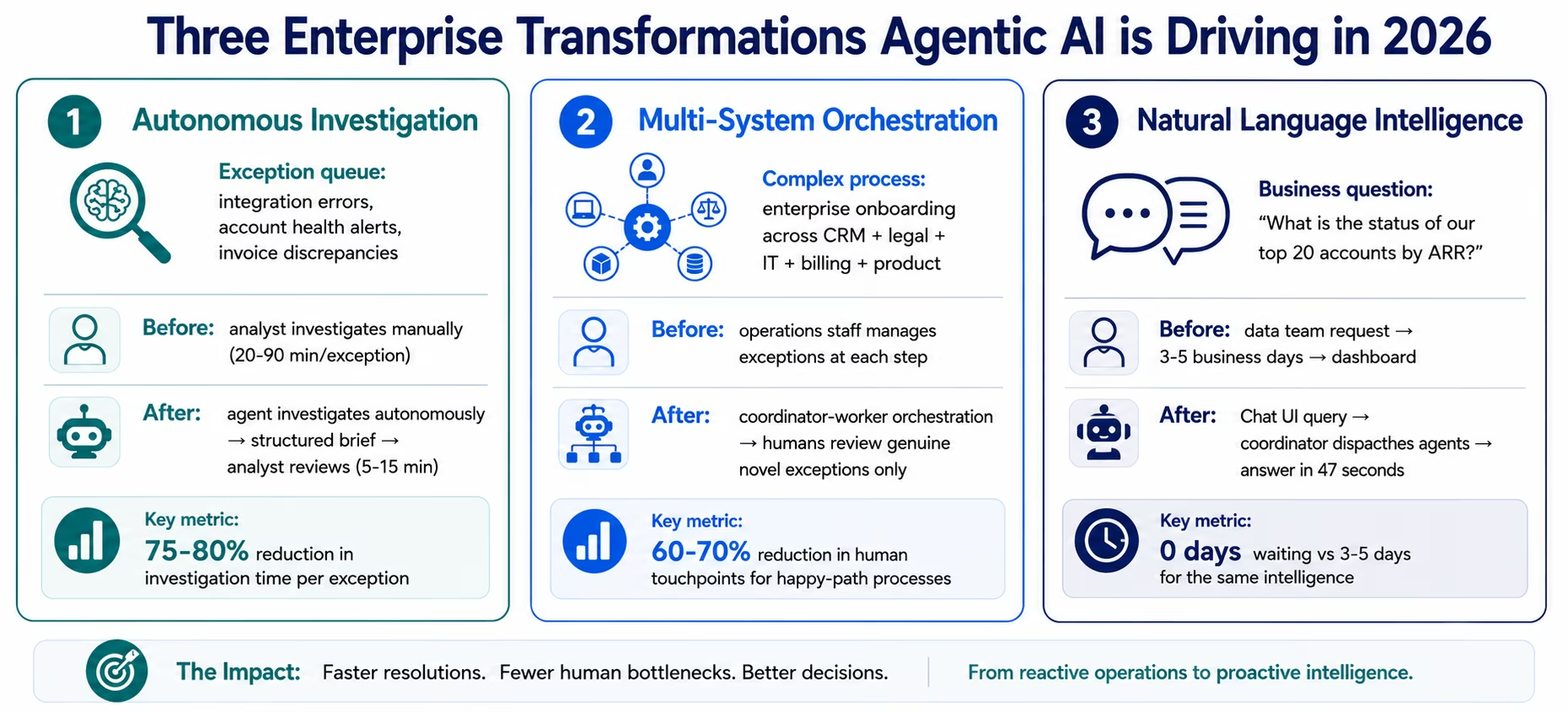
- The three transformations happening in 2026: enterprises are deploying agentic AI for autonomous investigation (replacing manual root cause analysis and exception handling), for multi-system orchestration (coordinating complex business processes across ERP, CRM, and operational systems without predefined workflows), and for natural language enterprise intelligence (giving executives and operators direct, conversational access to live business data across connected systems).
- Multi-agent architecture: coordinator agents dispatching and synthesising from specialist worker agents: is the production pattern that makes agentic AI scalable and governable at enterprise scale.
- eZintegrations’ Goldfinch AI delivers agentic AI natively within the enterprise integration platform: coordinator-worker architecture, 9 native enterprise tools, Chat UI for natural language queries, and Workflow Node for automated intelligence programmes: with SOC 2 Type II certification and HIPAA BAA available.
What is Agentic AI? The Definition That Actually Makes Sense
Agentic AI describes AI systems that pursue goals autonomously: perceiving their environment, planning the sequence of actions needed to achieve a goal, executing those actions using available tools, evaluating results, and adapting the plan based on what they find: without a human defining each step.Wikipedia defines an intelligent agent as a system that perceives its environment and takes actions to maximise its chances of achieving a goal.
Agentic AI applies this principle to enterprise computing: the agent’s “environment” is the connected system estate (CRM, ERP, analytics platforms, databases), its “tools” are the APIs and capabilities it can call, and its “goals” are business objectives expressed in natural language or structured goal specifications.
The critical distinction from other forms of AI: an LLM that answers a question is not agentic. It responds to a prompt. An agentic system receives a goal, determines what information it needs to achieve that goal, queries the appropriate systems to retrieve it, evaluates the results, decides whether additional investigation is needed, and delivers the outcome: all without a human defining the investigation sequence.
According to Gartner, which named agentic AI its #1 strategic technology trend for 2025 and extended this to 2026: “Agentic AI systems can take actions, make decisions, and complete goals with varying degrees of human involvement.” Gartner estimates that by 2028, 33% of enterprise software applications will include agentic AI capabilities, up from less than 1% in 2024.
The Three Properties That Make AI Agentic
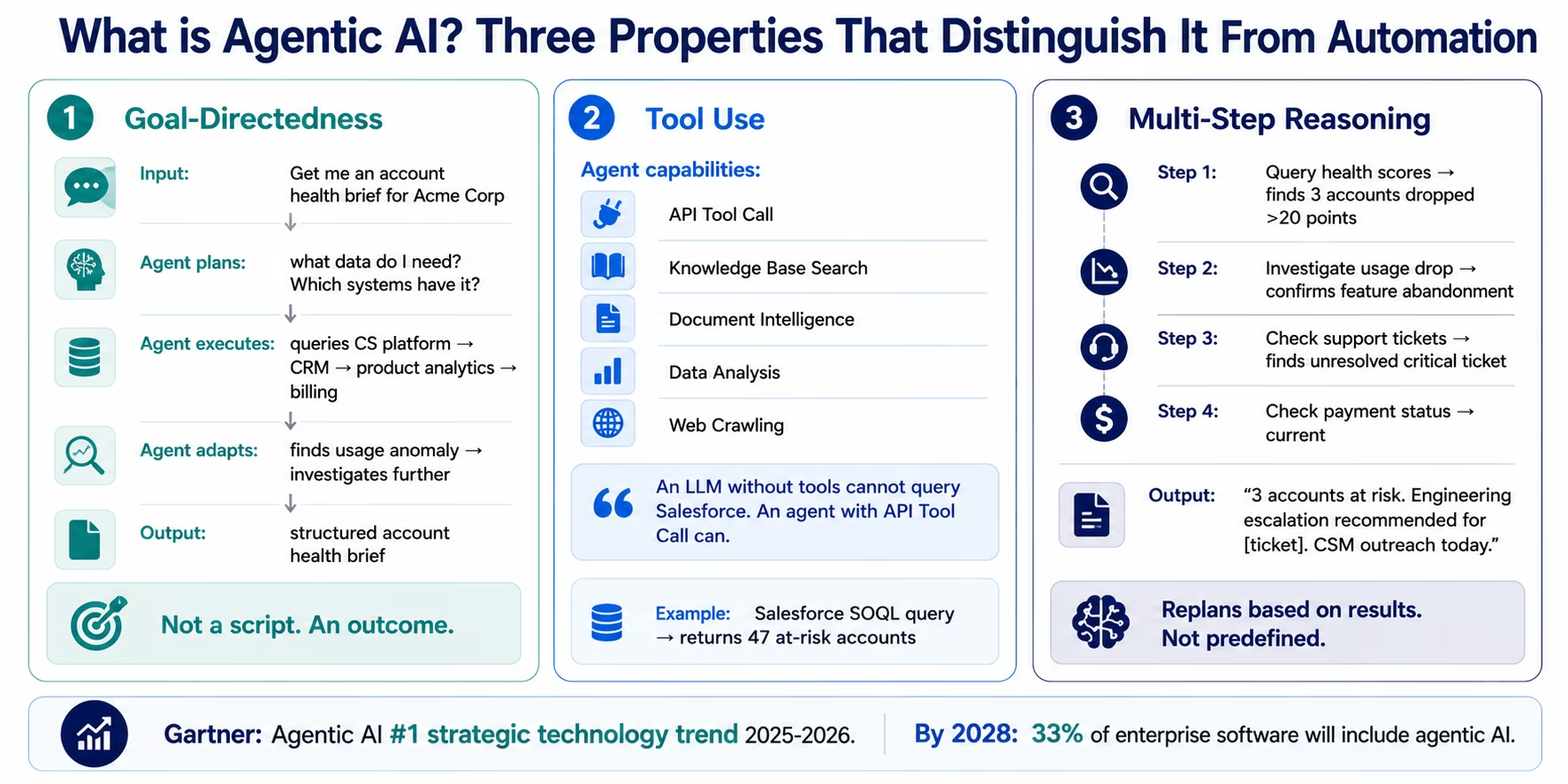
1. Goal-directedness: the agent operates toward an outcome, not a script. The same agent configured to investigate account health will query different systems for different accounts, follow different investigation paths based on what it finds, and produce different output structures depending on the situation: because it is optimising for the goal, not executing a fixed procedure.
2. Tool use: the agent calls external capabilities, APIs, databases, search engines, document readers, other agents: to retrieve information it cannot produce internally. An LLM without tool access cannot query Salesforce. An agentic system with an API Tool Call capability can.
3. Multi-step reasoning: the agent plans across multiple steps and adapts based on results. If the first query reveals an anomaly, the agent investigates the anomaly rather than continuing the original plan. If a tool call fails, the agent tries an alternative approach. This dynamic replanning is what separates agents from workflows.
Agentic AI vs Traditional Automation: The Capability Gap
The gap between traditional automation and agentic AI is not one of speed or scale: it is one of what kinds of tasks can be handled at all.
Traditional automation (RPA, iPaaS, rule-based workflows) operates on tasks with defined inputs, defined logic, and defined outputs. “When a new order arrives, create a WMS pick order.” The task is deterministic. The same input produces the same output every time. The human defines every step in advance. Traditional automation is excellent at this: reliable, auditable, scalable.
Traditional automation fails on tasks that require:
- Judgment about what information is relevant
- Investigation whose path depends on intermediate findings
- Synthesis across multiple sources into a coherent analysis
- Responses to situations that were not anticipated when the workflow was designed
McKinsey’s 2025 State of AI research quantifies this: traditional automation has addressed roughly 25-30% of enterprise knowledge work tasks: the highly structured, rule-definable fraction. Agentic AI is designed for a portion of the remaining 70-75%: tasks that require multi-step reasoning, contextual judgment, and multi-source synthesis.
| Dimension | Traditional Automation | Agentic AI |
|---|---|---|
| Task type | Deterministic, predefined | Goal-directed, adaptive |
| Input handling | Structured data in expected format | Structured + unstructured, any format |
| Investigation path | Fixed sequence | Determined dynamically based on findings |
| Novel situations | Fails or routes to human | Adapts plan and attempts resolution |
| Multi-system synthesis | Predefined joins and mappings only | Dynamic multi-source investigation |
| Natural language interface | No (APIs or UI only) | Yes (Chat UI, voice, structured goal spec) |
| Appropriate for | High-volume recurring structured tasks | Complex, variable, judgment-intensive tasks |
| Human involvement | Defines every step before execution | Defines goal and governance policy |
| Scalability | Linear with volume | Scales with goal complexity, not volume |
Why 2026 is the Inflection Point for Enterprise Agentic AI
Three converging forces make 2026 the year when agentic AI moves from enterprise experiment to enterprise production deployment.
Force 1: Tool-calling reliability crossed the production threshold.
The fundamental technical requirement for useful enterprise agents is reliable tool use: the agent must call APIs, interpret responses, handle errors, and retry intelligently, consistently enough that production business workflows can depend on it. In 2023, tool-calling reliability from frontier models was approximately 60-70% on complex multi-tool tasks. In 2026, frontier models achieve 90-95% reliability on the same tasks. This crosses the production viability threshold for enterprise workflows where consistent execution is required.
Force 2: Enterprise API estates are agent-ready.
The decade of enterprise SaaS adoption: Salesforce, HubSpot, NetSuite, Workday, Snowflake, and hundreds of others, has created a connected API estate that agents can query with standardised authentication (OAuth 2.0), standardised query patterns (REST, GraphQL), and documented schemas. Agents do not need custom integration code for each system, they need the authenticated API connection and the API documentation. The enterprise API estate built for human developers is the same API estate agents use. Forrester estimates that 78% of enterprise SaaS applications now expose REST APIs with OAuth 2.0 authentication: sufficient for agent tool use.
Force 3: Governance frameworks have matured.
The first wave of agentic AI enterprise experimentation (2023-2024) revealed the governance requirements: autonomous action policies (what agents can do without human approval), audit trails (immutable logs of every agent action), and human review gates (configured escalation conditions). These governance patterns are now well-understood and platform-implemented: not custom-built by each enterprise. The existence of mature governance infrastructure makes enterprise deployment safe rather than speculative.
According to McKinsey’s State of AI 2025 report, 34% of enterprises have at least one AI agent programme in production, up from 12% in 2024. The organisations reporting production deployment: not pilot, not POC, but production: are concentrated in three industries, financial services (fraud detection, compliance monitoring), healthcare (clinical documentation, prior authorisation), and technology (code review, integration monitoring).
The Three Enterprise Transformations Agentic AI is Driving
Three specific transformations are happening across enterprise operations: each representing a category of work that was previously either manual, partially automated, or not addressed at all.
Transformation 1: Autonomous Investigation and Exception Handling
The first transformation is the autonomous investigation of business exceptions: situations where something has gone wrong or deviated from normal, and understanding why requires querying multiple systems, correlating data, and forming a diagnosis.
Every enterprise has exception queues: integration error queues, account health monitoring queues, fraud investigation queues, claims adjudication queues. Each item in these queues represents a business situation that rule-based automation could not resolve, because the resolution requires judgment, multi-system investigation, or a response to a situation that the rules did not anticipate.
Before agentic AI, these queues are worked manually. An analyst opens the exception, reads the available context, manually queries the relevant systems, forms a hypothesis, and either resolves the exception or escalates it with a recommendation. Time per exception: 20-90 minutes, depending on complexity.
With agentic AI: the agent receives the exception, conducts the investigation autonomously (querying relevant systems, correlating findings, applying classification logic), and either resolves it (if the resolution is within the autonomous action policy) or delivers a structured investigation brief to the human analyst (if escalation is required). Human time per exception: 5-15 minutes of review and decision, not 20-90 minutes of investigation.
Enterprise examples:
- Integration failure investigation: agent queries source API, transformation log, and destination system; classifies root cause; recommends or executes remediation
- Account health exception: agent investigates usage, support, billing, and engagement data; delivers churn signal brief to CS team
- Invoice discrepancy: agent cross-references invoice against PO, delivery receipt, and vendor master; flags specific discrepancy with supporting evidence
- Claims adjudication exception: agent retrieves policy, clinical documentation, and prior authorisation; classifies the exception and recommends disposition
Transformation 2: Multi-System Orchestration Without Predefined Workflows
The second transformation is orchestrating complex business processes across multiple systems: without needing every step of the process predefined in a workflow tool.
Complex enterprise business processes have always been difficult to automate: they involve too many conditional branches, too many system interactions, and too many edge cases for predefined workflows to handle completely. Onboarding a new enterprise customer involves CRM, legal (contract management), IT provisioning, billing setup, onboarding communication, and product configuration, each with its own system, its own logic, and its own edge cases. Predefined workflows handle the happy path; the exceptions require human intervention.
Agentic AI orchestrates these processes dynamically. The coordinator agent decomposes the goal into tasks, assigns tasks to specialist worker agents, monitors completion, handles exceptions through investigation and adaptive replanning, and escalates to humans only when genuinely novel situations arise.
The enterprise impact: complex processes that currently require dedicated operations staff to manage the exceptions are handled by the agent orchestration layer, with humans reviewing the exceptions the agent escalates, not managing every step.
Enterprise examples:
- Enterprise customer onboarding: coordinator orchestrates 12-step process across CRM, legal, IT provisioning, billing, and product: adapting to each customer’s specific configuration requirements
- Procurement event management: coordinator orchestrates supplier qualification, RFP distribution, response collection, scoring, and award, across supplier portals, ERP, and legal systems
- Clinical trial patient screening: coordinator queries EMR for eligibility criteria across multiple clinical and demographic fields, documents qualification assessment, routes to study coordinator
- M&A integration planning: coordinator maps source and target system estates, identifies integration requirements, and produces a structured integration backlog: across both organisations’ connected systems
Transformation 3: Natural Language Enterprise Intelligence
The third transformation is giving business users direct, conversational access to enterprise intelligence: without waiting for data team reports, without BI dashboard navigation, and without knowing which system holds which data.
The information locked in enterprise systems: CRM, ERP, product analytics, financial systems, operational databases. has always been theoretically accessible through BI tools, SQL queries, and API calls. In practice, it is accessible to the technical users who know which system to query and how, and inaccessible to the business users who need it most.
Natural language enterprise intelligence changes this. A coordinator agent receives a natural language question (“what is the current status of our top 20 accounts by ARR?”), determines which systems contain the relevant data, dispatches worker agents to retrieve it, synthesises the results, and delivers a structured answer in plain language: in under 60 seconds.
Who benefits most:
- Executives: real-time answers to strategic questions without waiting for analyst reports (“what are the top three reasons for pipeline decline in Q2?”)
- Sales leaders: live intelligence on accounts, deals, and team performance across CRM, product usage, and revenue data (“which enterprise deals have gone dark in the last 14 days and what was the last engagement?”)
- Operations managers: immediate situational awareness across operational systems (“what is the current SLA status for our top 10 enterprise customers and are any at risk?”)
- Integration teams: live visibility into integration estate health (“how many pipeline failures occurred last night, what were the root causes, and which have been resolved?”)
The Multi-Agent Architecture: How Production Systems Are Built
Production enterprise agentic AI does not run as a single monolithic agent. It runs as a multi-agent system, coordinator and worker agents with distinct responsibilities: because this architecture is more reliable, more scalable, and more governable than single-agent designs.
The Coordinator Agent
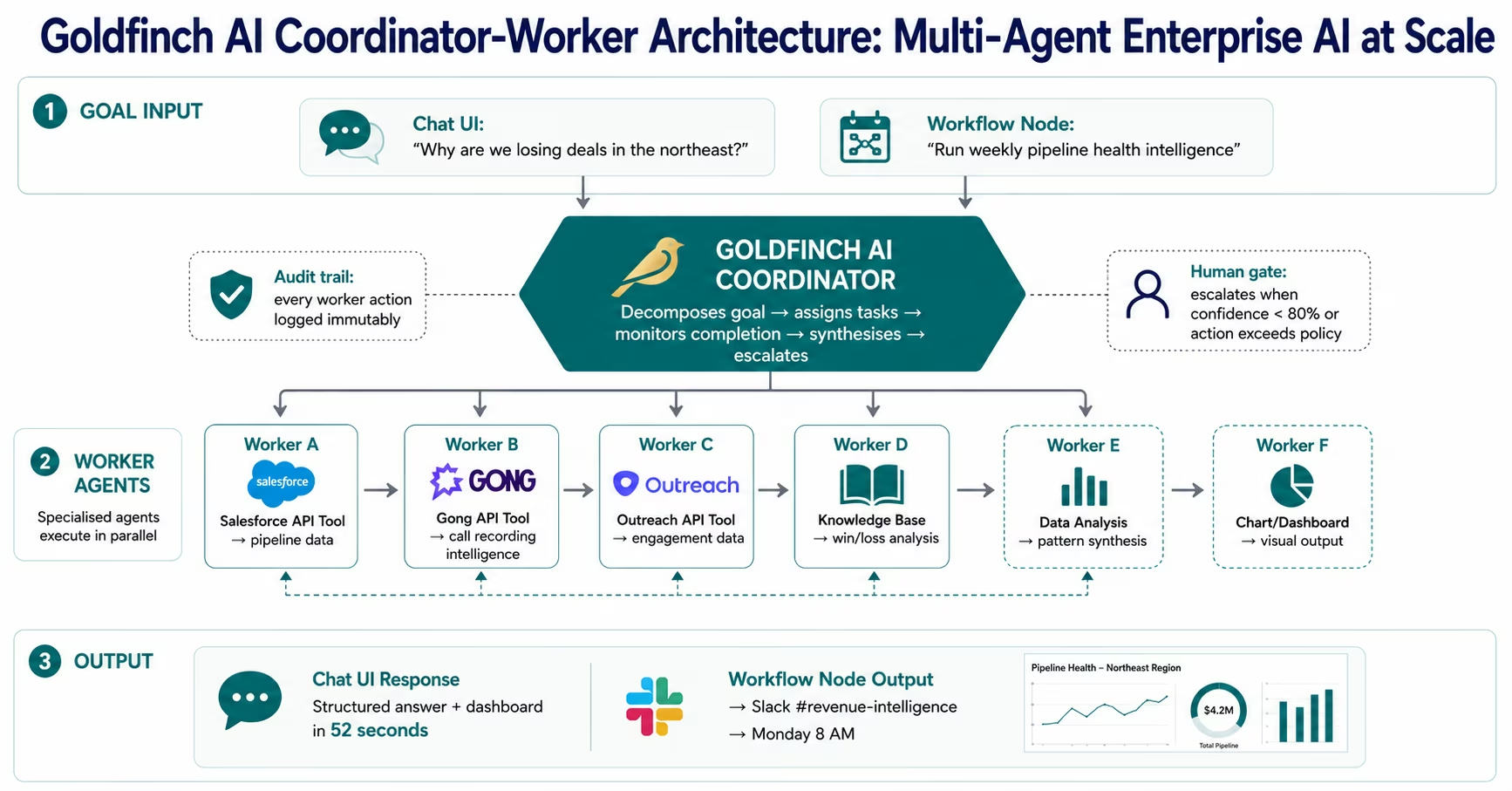
The coordinator receives the goal (from a human via Chat UI, or from a trigger via Workflow Node) and is responsible for:
- Decomposing the goal into parallel subtasks
- Assigning subtasks to appropriate worker agents
- Monitoring worker completion and handling worker failures
- Synthesising worker outputs into a unified result
- Escalating to humans when the situation exceeds the autonomous action policy
The coordinator does not execute tool calls directly (in most implementations). Its role is orchestration and synthesis, not execution.
Worker Agents
Worker agents execute specific subtasks using the tools appropriate to those subtasks. A worker agent assigned to “retrieve Salesforce account data for the top 20 accounts by ARR” calls the Salesforce API Tool, executes the SOQL query, and returns the structured result to the coordinator. A worker agent assigned to “detect anomalies in Q1 revenue data” calls the Data Analysis node and returns the anomaly findings.
Workers are specialist: each is configured with the tools and context appropriate to its domain. A finance worker agent has access to financial system APIs and financial data schemas. A clinical worker agent has access to FHIR endpoints and clinical data models.
Why Multi-Agent Is Superior to Single-Agent for Enterprise
Parallelism: a coordinator can dispatch 8 worker agents simultaneously. A single agent works sequentially. For a goal that requires querying 8 systems, multi-agent reduces total investigation time by 70-80% compared to a sequential single agent.
Specialisation: different worker agents can be configured with domain-specific tools, prompts, and context. A clinical worker agent optimised for FHIR data interpretation performs better than a general agent handling the same task.
Fault isolation: if one worker agent fails, the coordinator can retry it, substitute an alternative approach, or escalate the specific worker’s failure, without failing the entire investigation. Single-agent failure terminates the entire goal.
Governability: worker agents can be individually audited, individually governed (different autonomous action policies for different worker types), and individually improved. Debugging a specific worker’s performance does not require understanding the entire agent system.
The Goldfinch AI Coordinator-Worker Implementation
Goldfinch AI of eZintegrations implements coordinator-worker architecture with:
- A coordinator that receives goals from Chat UI (natural language) or Workflow Node (automated programmes)
- Worker agents drawing from 9 native enterprise tools: Knowledge Base Vector Search, Document Intelligence, Data Analysis, Data Analytics with Charts/Graphs/Dashboards, Web Crawling, Watcher Tools, API Tool Call, Integration Workflow as Tool, and Integration Flow as MCP
- User-extensible tool registry: organisations add custom tools beyond the 9 native as self-service
- Per-worker autonomous action policies configurable by the operations team
- Immutable audit trails for every coordinator and worker action
- Human escalation gates at configurable confidence and impact thresholds
The Five Industries Being Transformed First
Agentic AI is not transforming all industries simultaneously. Five industries are leading enterprise deployment in 2026: concentrated in sectors where complex investigation, cross-system data synthesis, and high-stakes judgment calls create the highest value from agentic AI.
1. Financial Services
Financial services has three natural agentic AI use cases: fraud investigation (agents that query transaction data, customer history, and external fraud signals to classify and prioritise fraud alerts), compliance monitoring (agents that continuously monitor transactions and communications for compliance signals, escalating exceptions for human review), and client intelligence (agents that synthesise portfolio data, client interaction history, and market data to produce relationship manager briefings before client calls).
2. Healthcare
Healthcare agents address the administrative burden that consumes 30-40% of clinical staff time: Prior authorisation agents query clinical data and payer policies to assemble authorisation requests with supporting documentation. Denials management agents investigate claim denials, identify the specific denial reason, and determine the appropriate appeal pathway. Clinical documentation agents synthesise encounter notes, lab results, and care history to produce structured clinical summaries for care transitions.
3. Enterprise Technology
Technology enterprises deploy agentic AI for engineering operations: incident investigation agents that diagnose production failures across distributed systems, integration pipeline health agents that monitor and report on data pipeline status, and customer success intelligence agents that synthesise product usage, support history, and engagement data to identify expansion and churn risks.
4. Manufacturing and Supply Chain
Supply chain agentic AI addresses the coordination complexity of multi-tier supplier networks: procurement agents that monitor supplier performance, detect delivery risk signals, and surface prioritised issues to procurement managers; quality intelligence agents that correlate production quality data with supplier lot data and logistics events; and demand signal agents that monitor sell-through velocity anomalies and route reorder recommendations.
5. Professional Services
Professional services firms deploy agentic AI for knowledge work acceleration: research agents that synthesise client background, industry context, and prior engagement data for new business development; engagement intelligence agents that monitor project health indicators across client data and internal systems; and expertise location agents that search knowledge bases and engagement history to identify relevant internal expertise for client situations.
Governance and Risk: What Enterprise Leaders Must Get Right
The enterprise leaders who deploy agentic AI successfully in 2026 are the ones who define governance before they need it: not after the first autonomous action with unintended consequences.
The Five Governance Requirements
1. Autonomous action policy
Define explicitly, per agent and per action type, what agents are permitted to do autonomously. A principled framework: agents may read freely (query systems, retrieve data), may write under policy (create records, update fields, trigger notifications, with conditions and limits), and may never act outside explicit policy (financial transactions, access changes, system configuration).
2. Audit trails
Every agent action: every tool call, every data retrieval, every decision node, must generate an immutable, timestamped log entry. This is not optional in regulated industries. SOX requires audit trails for any automated action affecting financial data. HIPAA requires audit trails for PHI access. 21 CFR Part 11 requires audit trails for automated actions in clinical data systems. The audit trail is the evidence that the agent acted within its authorised scope.
3. Human escalation gates
Define the conditions that trigger human review rather than autonomous action. Confidence thresholds (if the agent’s classification confidence is below 80%, escalate), impact thresholds (if the recommended action affects more than N records or exceeds $X in value, escalate), and novelty thresholds (if the situation does not match any known pattern in the knowledge base, escalate).
4. Data residency and processing
For regulated industries: where does the agent’s reasoning occur? If agent tool calls send enterprise data (PHI, PII, financial records) to external AI providers (OpenAI, Anthropic, Google), each external call requires a data processing agreement with that provider and a privacy impact assessment. Native AI inference: where the agent’s reasoning runs within the enterprise’s integration platform, eliminates this compliance surface. This is a platform selection criterion, not just a policy question.
5. Scope limitation
Agents should have access only to the systems and data they need for their configured purpose. A customer success agent should not have access to employee HR data. A procurement agent should not have access to clinical records. Least-privilege tool access is the architectural implementation of the compliance principle of data minimisation.
The Risk of Moving Too Slowly
Governance requirements are real but should not be paralysing. The risk of moving too slowly on agentic AI deployment is also real: competitors who deploy agentic investigation and intelligence capabilities gain compounding advantages, their exception queues clear faster, their executives make decisions on better intelligence, their teams spend more time on judgment work and less on investigation work. According to Forrester’s 2026 enterprise AI adoption research, organisations that deploy production agentic AI in 2026 are projected to achieve 20-35% productivity improvement in knowledge work functions within 18 months of deployment: a gap that widens against organisations that delay.
How eZintegrations’ Goldfinch AI Delivers Agentic Integration
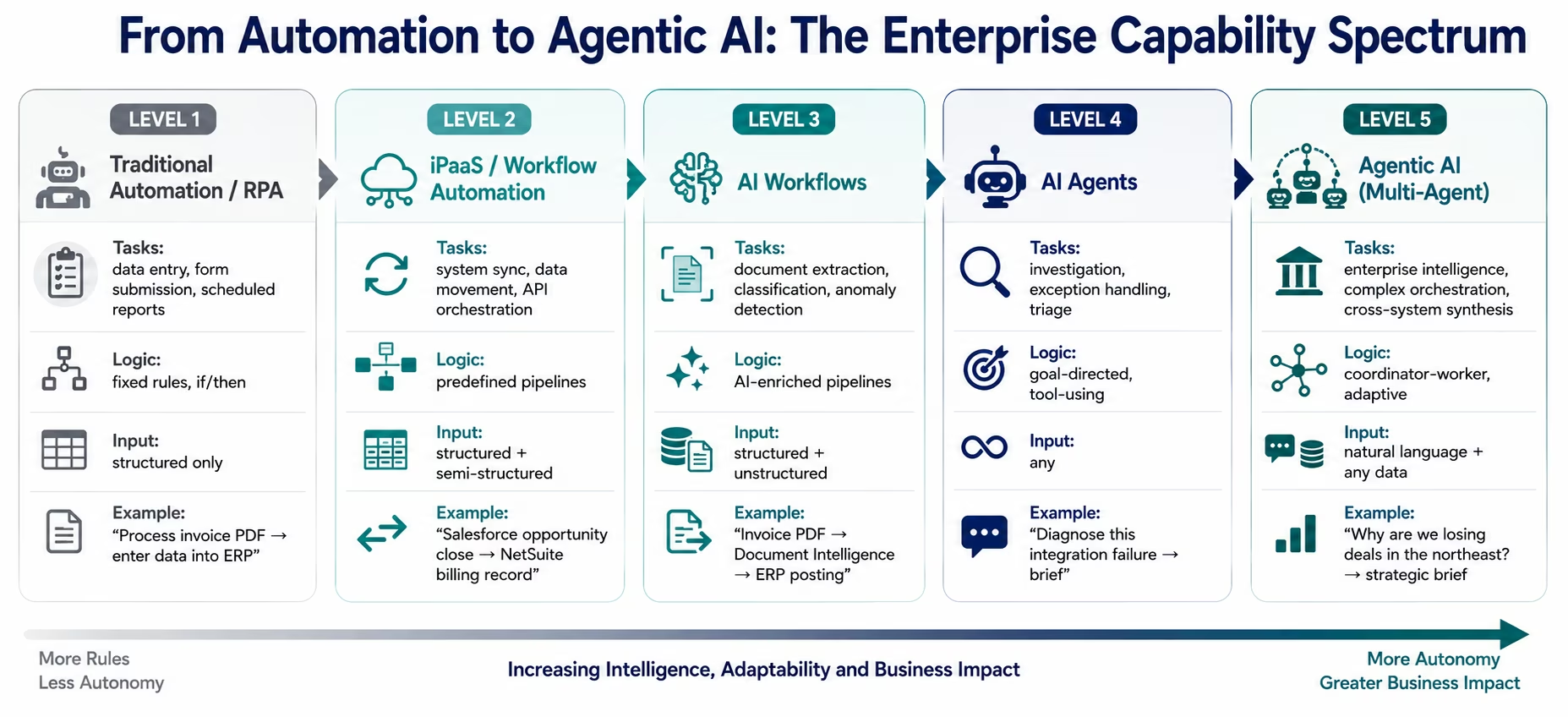
Goldfinch AI of eZintegrations is the Level 4 agentic AI platform: delivering coordinator-worker multi-agent architecture natively within the enterprise integration platform that handles Level 1 iPaaS workflows, Level 2 AI Workflow enrichment, and Level 3 AI Agent capabilities.
The four-level architecture advantage: Goldfinch AI agents operate on top of: and call directly into. the same Level 1 integration infrastructure that moves data between enterprise systems. A Goldfinch AI worker agent that needs Salesforce data does not require a separate Salesforce API integration; it calls the Salesforce connector that already exists in the Level 1 layer. The agentic intelligence is additive to the data movement foundation, not separate from it.
9 native enterprise tools:
- Knowledge Base Vector Search: semantic search across connected knowledge bases, documentation repositories, and enterprise content
- Document Intelligence: read and extract structured data from any document format in real time
- Data Analysis: statistical computation, pattern detection, and anomaly identification across connected data sources
- Data Analytics with Charts/Graphs/Dashboards: generate visual analytical outputs within agent responses
- Web Crawling: real-time retrieval of information from external sources (competitor data, API changelogs, market intelligence)
- Watcher Tools: continuous monitoring of configured metrics with threshold-based alerting
- API Tool Call: direct REST and GraphQL API calls to any authenticated connected system
- Integration Workflow as Tool: call any Level 1/2 integration workflow as a tool within the agent investigation sequence
- Integration Flow as MCP: expose integration capabilities via Model Context Protocol for external AI tool consumption
Users extend the tool registry beyond these 9 as self-service: adding custom tools, custom knowledge bases, and custom integration endpoints.
Chat UI: business users, executives, and operators query the connected system estate in natural language. Questions that previously required a data team request and 3-5 days of wait time are answered in under 60 seconds by Goldfinch AI coordinator dispatching workers to the relevant systems.
Workflow Node: automated agentic intelligence programmes run on configured schedules or trigger conditions. The Monday morning integration estate health brief, the weekly account health monitor, the nightly pipeline intelligence report, all delivered without human request, to configured Slack channels or email distributions.
Compliance: SOC 2 Type II certified. HIPAA BAA available for healthcare data. GDPR compliant for EU customer and patient data. 21 CFR Part 11 support for life sciences agentic AI deployments. All agent reasoning and tool calls execute natively within eZintegrations’ compliant infrastructure: no enterprise data sent to external AI providers during agent operation.
IPSec Tunnel: Goldfinch AI agents can query on-premises systems (SAP on-premises, Oracle ERP on-premises, on-premises databases, on-premises clinical systems) through the same IPSec Tunnel connection used for Level 1 pipeline connectivity.
Book a free demo agentic AI and bring your most complex cross-system business question. We will show you Goldfinch AI answering it live: coordinator dispatching workers across your connected systems, synthesising results, and delivering intelligence in natural language.
Frequently Asked Questions
Agentic AI describes AI systems that pursue goals autonomously: planning multi-step actions, calling tools such as APIs, databases, and search systems, and adapting based on results without human-defined sequences. Regular AI, such as chatbots or LLMs generating text, responds to prompts without taking actions in connected systems. Agentic AI retrieves real data, executes investigation sequences, and delivers structured intelligence or completes tasks across enterprise systems. Gartner has identified agentic AI as the number one strategic technology trend for both 2025 and 2026.
Traditional automation executes predefined sequences where every step is designed in advance and runs identically each time. Agentic AI, by contrast, receives a goal and dynamically determines the execution path based on intermediate findings. Traditional automation is suited for deterministic, rule-based tasks such as data synchronisation and report generation. Agentic AI is suited for investigation, orchestration, and intelligence tasks where the path cannot be fully predefined and must adapt to real-time conditions.
Multi-agent architecture uses a coordinator agent that orchestrates multiple specialised worker agents instead of relying on a single monolithic system. This is the production pattern for enterprise agentic AI because it enables parallel execution, reducing investigation time by 70–80%, domain specialisation for higher accuracy, fault isolation so that one agent failure does not disrupt the entire process, and granular governance with individual policies and audit trails per agent. This architecture supports scalable and reliable enterprise intelligence operations.
Goldfinch AI is eZintegrations’ Level 4 agentic AI platform built on a coordinator-worker multi-agent architecture operating above the enterprise integration layer. It provides a Chat UI for natural language queries answered in under 60 seconds across connected systems, a Workflow Node for automated intelligence programmes on scheduled or triggered execution, a suite of nine native enterprise tools including knowledge base search, document intelligence, data analysis, web crawling, API tool execution, and integration workflows as callable tools, along with a user-extensible tool registry for enterprise-specific capabilities.
Enterprises govern agentic AI through five core controls. First, autonomous action policies define what actions agents can take without human approval. Second, audit trails provide immutable logs of every agent decision and action. Third, human escalation gates trigger review based on confidence, impact, or novelty thresholds. Fourth, data residency ensures that AI processing occurs within compliant infrastructure boundaries. Fifth, scope limitation enforces least-privilege access so agents interact only with the systems required for their function. Together, these controls enable safe and accountable autonomous operation.
Yes, when implemented with the correct governance architecture. Platforms such as Goldfinch AI are designed to meet enterprise compliance requirements including SOC 2 Type II, HIPAA BAA for healthcare, GDPR for EU data protection, and 21 CFR Part 11 for life sciences. The critical requirement is that all AI reasoning and processing occur natively within the compliant platform, ensuring that sensitive data such as PHI, PII, and financial records is not transmitted to external AI providers. This architecture enables regulated industries to safely adopt agentic AI while maintaining compliance obligations.1. What is agentic AI and how is it different from regular AI?
2. What is the difference between agentic AI and traditional automation?
3. What is multi-agent architecture and why does enterprise agentic AI use it?
4. What is Goldfinch AI and what does it do for enterprise integration?
5. How do enterprises govern agentic AI that acts autonomously?
6. Is agentic AI safe for regulated industries like healthcare and financial services?
Conclusion: Agentic AI Is Not the Future of Enterprise Integration. It Is the Present.
McKinsey’s projection that 34% of enterprises have production agentic AI deployment in 2026: up from 12% in 2024: is not a forecast of future adoption. It is a measurement of current deployment. The enterprises in that 34% are answering questions in 47 seconds that previously required 5-day data team requests. They are clearing exception queues that previously required dedicated analyst capacity. They are giving their executives conversational access to live enterprise intelligence that previously required custom BI dashboards and scheduled reports.
The transformation has three fronts: autonomous investigation (exceptions handled by agents, humans review what agents escalate), multi-system orchestration (complex business processes managed by coordinator-worker agents, humans handle genuinely novel situations), and natural language intelligence (business questions answered directly from the connected system estate, in seconds, in plain language).
The governance requirements are real and must be designed before deployment: autonomous action policy, audit trails, human escalation gates, native data processing, and scope limitation. These requirements are well-understood and platform-implemented: not barriers to deployment but conditions for safe deployment.
The four-level architecture that connects deterministic data pipelines (Level 1), AI-enriched workflows (Level 2), autonomous investigation agents (Level 3), and multi-agent coordination (Level 4) is the integration architecture of the enterprise in 2026. eZintegrations is built on this architecture, with Goldfinch AI as the agentic AI layer that turns the connected enterprise system estate into a source of natural language intelligence and autonomous operational capability.
Book a free demo agentic AI and bring your most complex business question. We will show you Goldfinch AI answering it live from your connected systems, in under 60 seconds.