How to Automate Supply Chain Operations Using a Multi-Agent AI Command Center
$150.00
| System Name: |
Autonomous Supply Chain Command Center |
|---|---|
| Architecture: |
Hierarchical Multi-Agent System – 1 Supply Chain Orchestrator Coordinator + 7 specialized Worker Agents (Sensing; Demand; Inventory; Supplier; Replenishment; Logistics; Report) operating through goal decomposition; event-based inter-agent messaging; and shared vector knowledge base memory; 8 total agents |
| Coordinator Agent: |
Supply Chain Orchestrator – receives external disruption signals and internal performance events; decomposes the supply chain optimization goal into sub-tasks; routes tasks to the appropriate Worker Agent; manages cross-agent tradeoffs (e.g. cost vs. speed in logistics vs. replenishment decisions); and triggers the human-in-the-loop safety gate when cross-agent conflict or low-confidence conditions arise |
| Safety Layer: |
Human-in-the-loop gate triggers when: any single PO value exceeds the configured autonomous authority threshold (default $100,000); Orchestrator cross-agent confidence falls below 0.72 on any tradeoff decision; Supplier Agent flags a Critical-severity supplier risk event; Inventory Agent detects a below-minimum stock position for an A-class SKU. At max retry (3 attempts); unresolved exceptions escalate to VP Operations with full agent context. |
| Extensibility Note: |
Beyond the 9 native Goldfinch AI tools; users can add custom tools self-service – including customs broker APIs; freight audit systems; demand sensing IoT feeds; ESG scoring APIs; and production scheduling connectors. |
| On-Premise Supported: |
Yes – eZintegrations connects to on-premises systems (SAP ECC; SAP IBP on-prem; SAP MM on-prem; Blue Yonder on-prem; WMS on-prem; TMS on-prem; Oracle SCM on-prem; and others) via IPSec Tunnel. eZintegrations is a browser-based; cloud-hosted platform and does not require any on-premises software installation. |
| Tags: |
Goldfinch AI supply chain; supply chain command center AI; multi-agent supply chain; SAP IBP AI agent; autonomous replenishment AI; supply chain risk intelligence; Goldfinch AI agentic; supply chain disruption AI; inventory optimization AI agent; logistics AI agent; demand forecasting AI agent; supply chain orchestration AI |
| AI Credits Required: |
Yes – Goldfinch AI agentic systems consume credits across all 8 agents (Coordinator + 7 Worker Agents) per planning cycle, per tool invocation, and per reflection/retry loop |
| Worker Agents: |
Inventory Agent: Monitors global stock positions across all warehouse and distribution nodes in WMS – computing days-of-stock per SKU per node, identifying at-risk positions, and recommending rebalancing or expedite actions to the Orchestrator; Supplier Agent: Tracks supplier performance metrics from Ariba SRM (on-time delivery, quality scores, capacity signals) and external risk signals for at-risk supplier relationships – flagging qualification status changes and performance deterioration to the Orchestrator, Replenishment Agent: Executes purchase order creation in SAP MM for approved replenishment recommendations – applying Min/Max rules, safety stock policy, and lead time data from the shared vector KB to generate correctly sized and timed POs; Logistics Agent: Optimizes carrier selection and route planning in the TMS – evaluating cost, capacity, and transit time tradeoffs per shipment against current disruption context from the Sensing Agent, Report Agent: Compiles the daily supply chain command center digest – generating the Goldfinch AI Data Analytics dashboard and executive brief from the aggregated multi-agent status outputs of all 7 Worker Agents, Sensing Agent: Monitors external risk intelligence feeds (Resilinc, Everstream, DHL Supply Watch), POS sales velocity data, weather disruption alerts, and port status feeds – detecting and structuring disruption signals for Orchestrator routing; Demand Agent: Ingests POS data, historical sales patterns, promotional calendars, and external demand signals to update the real-time demand forecast in SAP IBP or Blue Yonder – surfacing demand deviations that require replenishment or logistics response |
| Goldfinch AI Native Tools Used: |
API Tool Call: Used by all 7 Worker Agents – Demand Agent (SAP IBP/Blue Yonder forecast update), Inventory Agent (WMS stock position query), Supplier Agent (Ariba SRM performance pull), Replenishment Agent (SAP MM PO creation), Logistics Agent (TMS carrier query and route update), Report Agent (Snowflake DW data aggregation), and Orchestrator (inter-agent event dispatch and human escalation); Data Analysis: Demand Agent runs demand deviation scoring; Inventory Agent computes days-of-stock and at-risk position analysis; Supplier Agent scores supplier risk; Orchestrator runs cross-agent tradeoff scoring (cost vs. speed vs. reliability), Data Analytics with Charts/Graphs/Dashboards: Report Agent generates the daily command center dashboard – multi-KPI executive view showing supply chain health score, active disruptions, inventory risk positions, and replenishment pipeline status; Knowledge Base Vector Search: All 8 agents share a persistent supply chain vector knowledge base containing supplier qualification records, Min/Max policies, safety stock rules, lead time norms, carrier performance history, and prior disruption response outcomes – each agent queries the KB for context relevant to its current task, Document Intelligence: Supplier Agent analyzes supplier contract documents, capacity change notices, and regulatory restriction announcements – extracting structured signals for Orchestrator routing; Integration Workflow as Tool: Orchestrator and Replenishment Agent call pre-built integration sub-workflows for SAP MM PO creation, Ariba supplier notification, and TMS shipment creation, Watcher Tools: Sensing Agent’s primary tool for continuous monitoring of risk feed APIs, POS data streams, weather APIs, and port status feeds – triggering the multi-agent coordination cycle within 60 minutes of any disruption event; Web Crawling: Sensing Agent uses Web Crawling to gather supplier news, port authority announcements, and trade press disruption signals not yet available in structured API feeds |
Table of Contents
| Planning: |
The Supply Chain Orchestrator uses LLM-hybrid goal decomposition – the Orchestrator receives a supply chain state snapshot every 60 minutes; decomposes the current optimization goal (minimize disruption cost; maintain service level; optimize working capital) into sub-tasks per Worker Agent; and routes tasks via event-based inter-agent messaging. Schema-driven rules govern the replenishment and logistics execution agents to ensure policy compliance; LLM reasoning governs cross-agent tradeoff decisions where schema alone is insufficient. |
|---|---|
| Messaging: |
All 8 agents communicate via structured event messages through the Goldfinch AI agentic messaging layer – each Worker Agent publishes its output (e.g. Inventory Agent: “SKU-4820; Node-Chicago; 3.2 days of stock; below MIN threshold”) as a structured event that the Orchestrator consumes; evaluates against cross-agent context; and routes to the appropriate response agent (Replenishment Agent for expedite PO; Logistics Agent for priority routing; or human escalation for Critical-severity events). |
| Reflection: |
The Orchestrator applies a reflection loop before any ERP write action – if the cross-agent confidence score falls below 0.72; the Orchestrator re-queries the Knowledge Base Vector Search for relevant precedents; adjusts the task parameters; and retries up to 3 times before escalating to the VP of Operations with the full agent context briefing. At max retries; the action is held in a human review queue – no ERP write proceeds without either high-confidence autonomous confirmation or human approval. |
| Knowledge: |
All 8 agents share a persistent supply chain vector knowledge base – containing supplier qualification records; Min/Max inventory policies; safety stock rules; lead time norms by lane and carrier; prior disruption response outcomes; and the organization’s trade-off preference history (cost vs. speed weighting). The Knowledge Base is indexed by SKU; supplier; lane; and node – each agent retrieves only the context relevant to its current task; reducing LLM token overhead and improving response specificity. |
| Execution: |
The Replenishment Agent creates SAP MM purchase orders via Goldfinch AI Integration Workflow as Tool on approved recommendations. The Logistics Agent updates TMS carrier selections and route plans via API Tool Call. The Demand Agent pushes updated forecasts to SAP IBP or Blue Yonder via API Tool Call. All ERP writes are confirmed via API response code before the Orchestrator marks the task complete. The Report Agent generates the daily command center dashboard in Goldfinch AI Data Analytics and delivers the executive digest via SMTP. |
| Business Impact: |
Gartner documents Fortune 500 average supply chain disruption cost at $184M/year; organizations with autonomous multi-agent supply chain response reduce those costs by 35 to 50%. The Goldfinch AI supply chain command center compresses the disruption-to-response window from 5 to 10 days (manual) to under 4 hours (autonomous); increases inventory turns; improves on-time delivery; and delivers the CSCO a real-time command view rather than a lagging weekly S&OP report |
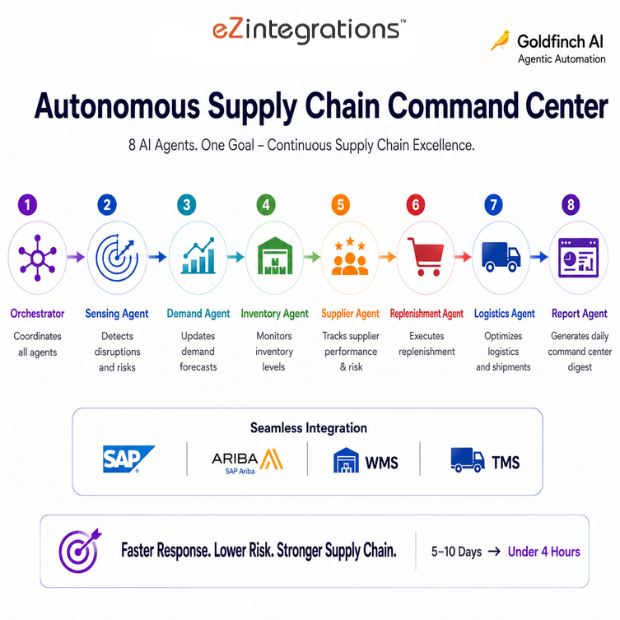
The Goldfinch AI supply chain command center from eZintegrations deploys 8 coordinated AI agents — a Supply Chain Orchestrator plus 7 specialized Worker Agents — to continuously sense disruptions, update demand forecasts, monitor global inventory, track supplier risk, execute replenishment, optimize logistics, and generate the daily command center digest, all within a single agentic architecture. eZintegrations is an enterprise automation platform covering iPaaS, AI Workflows, AI Agents, and Goldfinch AI agentic automation.
What Is Goldfinch AI Supply Chain Automation?
Goldfinch AI supply chain automation is a hierarchical multi-agent system where a Supply Chain Orchestrator decomposes the goal of continuous supply chain optimization into specialized sub-tasks — routing each to a Worker Agent configured with the tools, data access, and decision authority appropriate for that domain. Unlike traditional automation (which executes fixed sequences) or single-model AI (which produces recommendations without acting), the Goldfinch AI supply chain command center operates across 8 agents simultaneously, shares a persistent vector knowledge base, and writes to SAP, Ariba, WMS, and TMS autonomously within configured authority limits.
How Does Goldfinch AI Supply Chain Automation Use Multiple Agents to Monitor Disruptions, Optimize Inventory, and Execute Replenishment Across SAP, Ariba, and TMS?
The Sensing Agent monitors risk APIs, POS data, and port status continuously via Goldfinch AI Watcher Tools. The Demand Agent updates SAP IBP forecasts. The Inventory Agent monitors WMS stock positions. The Supplier Agent tracks Ariba SRM performance. The Replenishment Agent creates SAP MM POs. The Logistics Agent updates TMS routes. The Report Agent generates the daily Goldfinch AI dashboard. The Orchestrator coordinates all 8 agents through the shared supply chain vector knowledge base.
Goldfinch AI ships with 9 native out-of-the-box agent tools — Watcher Tools, Web Crawling, API Tool Call, Data Analysis, Data Analytics with Charts/Graphs/Dashboards, Knowledge Base Vector Search, Document Intelligence, Integration Workflow as Tool, and Integration Flow as MCP. Users can add custom tools self-service beyond the 9 native tools. Gartner: Fortune 500 average disruption cost $184M/year; this Goldfinch AI supply chain system compresses the response window from 5 to 10 days to under 4 hours.
Watch Demo
| Video Title: |
Goldfinch AI Supply Chain Command Center | 8 Agents; Real-Time Sensing to SAP MM Execution in Under 4 Hours |
|---|---|
| Duration: |
7 to 10 minutes |
Outcome & Benefits
| Autonomy: |
85%+ of supply chain events handled autonomously end-to-end without Supply Chain Analyst manual intervention; Critical-severity disruptions and above-threshold POs route to human review; Replenishment Agent STP (straight-through processing) rate: 82%+ for standard reorder events |
|---|---|
| Time Saved: |
Disruption-to-response from 5 to 10 business days (manual) to under 4 hours; demand forecast update from weekly S&OP cycle to real-time continuous update; replenishment cycle from analyst-initiated (3 to 5 days per category) to autonomous same-day execution within configured policy |
| Cost Reduction: |
35 to 50% reduction in annual supply chain disruption cost (Gartner $184M Fortune 500 baseline); 8 to 12% working capital improvement from inventory optimization (reduction in excess and obsolete stock); 4 to 7% logistics cost reduction from AI-optimized carrier selection |
| Reliability: |
100% of active supply chain positions monitored continuously vs. weekly S&OP sampling; on-time delivery improvement: 6 to 12 percentage points from proactive disruption response; supplier qualification events detected within 60 minutes vs. next S&OP cycle |
Performance Metrics
| KPI | Before (Manual/Batch) | After (Real-Time Sync) | Impact |
|---|---|---|---|
| O2C Cycle Time | 45 days average | Under 5 days | 89% faster |
| Days Sales Outstanding (DSO) | 45 to 60 days | 15 to 20 days | 30 to 40 days reduction |
| Straight-Through Processing Rate | 0% (100% manual) | 95% | 95 percentage points |
| Billing Error Rate | 8 to 12% | Under 1% | 90%+ reduction |
| Cost per Order Processed | $25 to $50 | Under $5 | 80 to 90% reduction |
COMPARISON TABLE: Goldfinch AI vs. Alternatives
| Capability | Goldfinch AI O2C Agentic System | Traditional Automation | RPA | Custom LLM Agents |
|---|---|---|---|---|
| Cross-system orchestration | SAP, Oracle, Salesforce, WMS, Bank API | Single system at a time | Rule-based scripts | Custom development required |
| Native agent tools | 9 OOTB tools + self-service extensibility | N/A | None | Build all tools from scratch |
| Exception handling | AI reasoning + Knowledge Base + HITL | Fixed rules only | Re-routes to human immediately | Custom development required |
| Deployment timeline | Under 3 weeks | 3 to 6 months | 4 to 8 weeks | 4 to 8 months |
| Audit trail + compliance | SOC Type II, GDPR, HIPAA-eligible | Varies | Minimal | Must build custom |
Technical Details
| Scheduling: |
Sensing Agent runs continuously (Watcher Tools polling at 30-minute intervals for standard feeds; immediate trigger on high-priority risk events); Demand Agent runs on POS data arrival (near-real-time) and weekly S&OP cycle; Inventory Agent runs every 4 hours and on Sensing Agent disruption event; Replenishment Agent runs daily and on Inventory Agent at-risk flag; Logistics Agent runs on Replenishment Agent PO creation and Sensing Agent port/route disruption; Report Agent runs daily at 6am and on-demand CSCO request. |
|---|---|
| Tool Router: |
The Supply Chain Orchestrator selects which Worker Agent to invoke based on event type classification (disruption event → Sensing + Inventory + Supplier Agents simultaneously; demand deviation → Demand + Replenishment Agents; logistics congestion → Logistics Agent; supplier failure → Supplier + Replenishment + Logistics Agents). Each Worker Agent selects its tool based on its task type: API Tool Call for ERP reads and writes; Data Analysis for scoring; Watcher Tools for monitoring; Document Intelligence for document extraction. |
| Evaluation Metrics: |
Supply chain health score (composite metric updated every 4 hours across all agent domains); agent task success rate per agent; cross-agent coordination latency; replenishment STP rate; forecast accuracy MAD/MAPE; supplier qualification event detection time; disruption cost avoidance (realized savings from proactive response vs. reactive baseline). |
| Auditability: |
Every agent action is logged with: agent name; task received; tool invoked; data retrieved; decision made; confidence score; action taken (or held for human review); ERP write confirmation (API response code); and timestamp. The Supply Chain Orchestrator maintains a cross-agent session log per optimization cycle. Compliance and audit teams access the full agent execution log via the Goldfinch AI audit dashboard – exportable to Snowflake for long-term retention. Human review events log the reviewer identity; decision made; and the original agent recommendation for every HITL instance. |
| Planner Type: |
LLM-hybrid planning – the Supply Chain Orchestrator uses schema-driven rules for execution agents (Replenishment, Logistics) where policy compliance is deterministic, and LLM reasoning for cross-agent tradeoff decisions (e.g. cost vs. speed vs. service level in a disruption response scenario). Goal decomposition is LLM-planned per optimization cycle; individual agent tasks are schema-driven for ERP write actions. |
| Agent Roles: |
Inventory Agent: API Tool Call to WMS for stock position query; Data Analysis for at-risk position scoring; Supplier Agent: API Tool Call to Ariba SRM (https://help.sap.com/docs/SAP_ARIBA) + Document Intelligence for supplier risk analysis; Replenishment Agent: Integration Workflow as Tool for SAP MM (https://help.sap.com/docs/SAP_S4HANA_ON-PREMISE) PO creation; Logistics Agent: API Tool Call to TMS for carrier query and route update, Report Agent: Data Analytics with Charts/Graphs/Dashboards for command center dashboard; API Tool Call to Snowflake (https://docs.snowflake.com/) for KPI aggregation, Supply Chain Orchestrator (Coordinator): goal decomposition, inter-agent routing, cross-agent tradeoff scoring, HITL escalation; Sensing Agent: Watcher Tools + Web Crawling for external risk monitoring, disruption classification, and event publishing; Demand Agent: API Tool Call to SAP IBP (https://help.sap.com/docs/SAP_IBP) or Blue Yonder (https://docs.blueyonder.com/) for forecast update |
Connectivity and Deployment
| Supported Protocols: |
REST API (SAP IBP; SAP MM OData; Ariba SRM; TMS carrier APIs; risk feed APIs – Resilinc; Everstream; DHL Supply Watch); JDBC (Snowflake DW); OData v2/v4 (SAP MM; SAP IBP); Web Crawling (supplier news; port alerts; trade policy); SMTP (executive digest and HITL escalation notifications); HTTPS; OAuth 2.0; IPSec Tunnel (on-premises SAP; Blue Yonder; WMS; and TMS connectivity) |
|---|---|
| Security & Compliance: |
SOC Type II certified; GDPR-compliant data handling (supplier and operational data processed under GDPR Article 6 legitimate interest for commercial supply chain management); HIPAA-eligible configuration for pharmaceutical supply chains with controlled substance requirements. All ERP write actions (PO creation; forecast updates; carrier selection) require authenticated API credentials within the agent’s configured authorization scope. RBAC enforced on agent authority limits (PO value ceiling; carrier selection scope; forecast modification authority). Full immutable agent execution log per optimization cycle for supply chain audit and SOX compliance documentation. |
| Tenancy Model: |
Both single-tenant and multi-tenant deployments are supported. Single-tenant is strongly recommended for organizations where supply chain intelligence; supplier relationships; PO data; and disruption response strategy are commercially sensitive. Single-tenant provides dedicated infrastructure per customer. |
| On-Premise Supported: |
Yes – eZintegrations connects to on-premises systems (SAP ECC; SAP IBP on-prem; SAP MM on-prem; Blue Yonder on-prem; WMS on-prem; TMS on-prem; Oracle SCM on-prem; and others) via IPSec Tunnel. eZintegrations is a browser-based; cloud-hosted platform and does not require any on-premises software installation. |
AI Credits
| Credit Consumption Model: |
Per optimization cycle (scheduled daily + event-triggered by Sensing Agent disruption detection); per agent tool invocation within the cycle; per reflection/retry loop; monthly Report Agent digest Estimated Credits per End-to-End Run: Standard daily cycle (no active disruption; routine replenishment and reporting): ~45 to 85 credits per full 8-agent cycle Disruption event cycle (active disruption; cross-agent coordination; alternate sourcing): ~120 to 200 credits per event cycle Complex multi-disruption cycle (multiple simultaneous events; HITL escalations; multi-region impact): ~200 to 350 credits per cycle |
|---|---|
| Retry / Reflection Credit Cost: |
Each Orchestrator reflection/retry cycle: ~4 to 6 additional credits per retry. At 10% exception rate across all agents; add approximately 12 to 15% to the monthly credit estimate. |
| Monthly Credit Estimate (at Typical Volume): |
Mid-market supply chain (1 to 5 disruption events per month; daily replenishment cycles): ~3,000 to 6,000 credits per month Large enterprise (10 to 20 disruption events per month; multi-region): ~8,000 to 18,000 credits per month Global enterprise (50+ disruption events; complex multi-tier supply chain): ~25,000 to 50,000 credits per month |
| Pricing Model: |
Static Platform Fee + AI Credits. Platform fee covers unlimited non-LLM orchestration steps across all agents (ERP connection management; WMS polling; event routing; SMTP dispatch; audit log writes). AI Credits consumed by LLM reasoning; Goldfinch AI tool invocations; and Knowledge Base retrieval across all agents. |
| Credit Optimization Notes: |
Configure Watcher Tools monitoring at 30-minute intervals for standard risk feeds (not continuous) – reduces Sensing Agent credits 50 to 70% without degrading event detection. Batch Inventory Agent WMS queries across all SKUs in a single API Tool Call rather than per-SKU calls. Cache Knowledge Base vector search results for 24 hours per supplier and lane combination – lead time norms and Min/Max policies change infrequently within a day. Configure Replenishment Agent to process PO batches rather than individual POs to reduce Integration Workflow as Tool credit overhead per item. |
| AI Credits Required: |
Yes – Goldfinch AI agentic systems consume credits across all 8 agents (Coordinator + 7 Worker Agents) per planning cycle, per tool invocation, and per reflection/retry loop |
| LLM Steps Count: |
12 to 20 LLM-invoking steps per full optimization cycle (Orchestrator goal decomposition: 2 to 3 LLM steps; each Worker Agent tool invocation: 1 to 2 steps; cross-agent tradeoff reasoning: 1 to 2 steps; Report Agent dashboard generation: 2 steps; reflection/retry: 1 to 2 steps per retry) |
| Goldfinch AI Tool(s) Consuming Credits: |
Watcher Tools (Sensing Agent – continuous monitoring credits per cycle), Web Crawling (Sensing Agent – per page crawled), API Tool Call (all 7 Worker Agents – per ERP/SCM/SRM/TMS call), Data Analysis (Demand, Inventory, Supplier Agents, Orchestrator – per scoring cycle), Data Analytics with Charts/Graphs/Dashboards (Report Agent – per dashboard render), Knowledge Base Vector Search (all 8 agents – per query), Document Intelligence (Supplier Agent – per document analyzed), Integration Workflow as Tool (Replenishment Agent – per PO batch sub-workflow) |
FAQ
1. What is the Autonomous Supply Chain Command Center and what does it automate end to end?
The Goldfinch AI supply chain command center from eZintegrations deploys 8 coordinated AI agents — a Supply Chain Orchestrator and 7 Worker Agents — to continuously sense external disruptions, update demand forecasts in SAP IBP or Blue Yonder, monitor global WMS inventory positions, track supplier performance in Ariba SRM, execute replenishment POs in SAP MM, optimize TMS logistics routing, and generate the daily command center dashboard. The system operates autonomously within configured authority limits, compressing the disruption-to-response window from 5 to 10 business days to under 4 hours and achieving 82%+ straight-through replenishment without analyst intervention.
2. How does the multi-agent architecture work?
The Supply Chain Orchestrator (Coordinator) receives supply chain state events, decomposes the current optimization goal into sub-tasks, and routes each task to the appropriate Worker Agent via event-based inter-agent messaging. Worker Agents — Sensing, Demand, Inventory, Supplier, Replenishment, Logistics, and Report — execute their specialized tasks using Goldfinch AI native tools and publish structured output events back to the Orchestrator. All 8 agents share a persistent supply chain vector knowledge base containing supplier records, inventory policies, and disruption response precedents — ensuring each agent's decisions are grounded in the organization's current operational context.
3. Which Goldfinch AI tools does this system use?
The system uses 8 of Goldfinch AI's 9 native tools: Watcher Tools (Sensing Agent — continuous risk feed and POS monitoring), Web Crawling (Sensing Agent — unstructured disruption signal gathering), API Tool Call (all 7 Worker Agents — ERP, SRM, WMS, TMS reads and writes), Data Analysis (Demand, Inventory, Supplier Agents, Orchestrator — scoring and at-risk classification), Data Analytics with Charts/Graphs/Dashboards (Report Agent — daily command center dashboard), Knowledge Base Vector Search (all 8 agents — shared supply chain KB), Document Intelligence (Supplier Agent — contract and notice analysis), and Integration Workflow as Tool (Replenishment Agent — SAP MM PO creation sub-workflow). Beyond these 9 native tools, users can add custom tools self-service — including customs broker APIs, ESG scoring systems, and production scheduling connectors.
4. How does the system ensure data accuracy and handle errors?
The Orchestrator applies a reflection loop before any ERP write action — if cross-agent confidence falls below 0.72, the Orchestrator re-queries the Knowledge Base, adjusts parameters, and retries up to 3 times before escalating to the VP of Operations. All ERP writes (PO creation, forecast updates, carrier selection) are confirmed via API response codes before the Orchestrator marks the task complete. Failed writes trigger retry or human escalation with full agent context. The HITL safety gate prevents any PO above $100,000 (configurable) from being created without VP of Operations approval regardless of agent confidence score.
5. What types of data and documents does this system process?
The system processes: real-time risk feed API data (Resilinc, Everstream, DHL Supply Watch), POS sales transaction data, weather and logistics disruption feeds, SAP IBP/Blue Yonder demand forecasts, WMS global inventory positions by SKU and node, Ariba SRM supplier performance scorecards, SAP MM open purchase orders, TMS carrier availability and routing data, supplier capacity change notices and contract documents (Document Intelligence), and Snowflake DW historical transaction data for the daily Report Agent digest.
6. Who uses this system and in which departments?
The system is primarily configured and governed by Supply Chain Operations and Procurement teams (daily operators: S&OP Director, Supply Chain Analyst, Category Manager). Executive stakeholders — the Chief Supply Chain Officer (CSCO), VP of Operations, and CFO — review the daily command center digest and receive HITL escalation requests for critical decisions. The CFO monitors working capital impact (inventory turns, excess and obsolete reduction). The COO monitors on-time delivery and service level outcomes.
7. How does the safety layer and human oversight work?
The HITL safety gate triggers when: a PO value exceeds the configured authority threshold (default $100,000); Orchestrator confidence falls below 0.72 on any cross-agent tradeoff; Supplier Agent classifies a Critical-severity risk event; or Inventory Agent detects a below-minimum stock position for an A-class SKU. In each case, the Orchestrator pauses execution, packages the full agent briefing (event context, impact assessment, recommended action, confidence score, and agent reasoning), and routes to the VP of Operations via Teams and SMTP. The CSCO has a real-time command center dashboard view of all active HITL requests. After max retries, all unresolved exceptions remain in the human review queue — no autonomous action proceeds without either high-confidence completion or human approval.
8. What are the key business benefits and executive KPIs improved?
Key executive KPIs improved include: supply chain disruption response window from 5 to 10 days to under 4 hours, disruption cost reduction of 35 to 50% ($64M to $92M avoided at Fortune 500 scale per Gartner $184M baseline), inventory turns improvement of 2 to 4 turns per year (8 to 12% working capital improvement), on-time delivery improvement of 6 to 12 percentage points, replenishment STP rate from 0% (manual) to 82%+, and the CSCO moves from lagging weekly S&OP reporting to real-time continuous supply chain intelligence.
Resources
| Blog: |
UPS Supply Chain Integration with SAP and NetSuite: Automate Fulfilment for Beauty Brands |
|---|---|
| Platform Overview: |
eZintegrations Platform – Enterprise iPaaS, AI Workflows & Agentic AI |
| Demo: |
Book a Demo |
| Goldfinch AI Platform: |
Agentic AI Platform — Goldfinch AI by eZintegrations |
Case Study
| Industry: |
Consumer Packaged Goods / Global CPG Manufacturer |
|---|---|
| Problem: |
A global CPG manufacturer with $4.2B annual revenue operated an S&OP process across 340 active suppliers in 28 countries; 18 distribution centers; and 6 manufacturing sites. Supply chain planning ran on a weekly S&OP cycle – meaning disruption events detected on Monday were not fully assessed and responded to until the following Thursday at the earliest. In the prior fiscal year; 14 supply chain disruption events (port closures; supplier failures; logistics congestion) had cost a combined $68M in expediting; air freight upgrades; lost sales; and customer penalty claims. The CSCO had identified that 9 of the 14 events could have been contained at significantly lower cost if the response had begun within 24 hours of the disruption event rather than 6 to 8 days after. The supply chain planning team of 24 analysts spent an estimated 65% of their time on data gathering; status reporting; and exception management rather than strategic planning. |
| Outcome: |
After 6 months: Average disruption event detection-to-response from 6.8 business days to 3.7 hours. Replenishment STP rate: 84% (previously 0% automated). Supply chain analyst data gathering and exception management time from 65% to 18% of working hours (46% capacity reallocation to strategic planning). On-time delivery: from 88.4% to 94.1% (+5.7 percentage points). Inventory turns: from 8.2 to 10.6 (+2.4 turns per year; 29% improvement). Working capital released from inventory optimization: $34M in the 6-month period. |
| ROI: |
Disruption cost avoidance (6-month period; 8 active disruptions vs. 7 in prior-year same period): $24.2M vs. $38.6M prior-year disruption cost for comparable events – $14.4M avoidance. Working capital released from inventory turns improvement: $34M (one-time cash release). Supply chain analyst capacity reallocation value: 24 analysts x 46% time freed x $78,000 average fully-loaded cost = $862,000 annually (6-month: $431,000). On-time delivery improvement customer penalty reduction: estimated $8.2M in avoided penalty clauses and customer deductions. Total 6-month |
| Solution: |
Deployed eZintegrations Goldfinch AI Supply Chain Command Center in 21 business days across 6 product categories and 18 distribution centers. Integrated Resilinc, Everstream, weather, and port APIs for risk sensing; connected SAP IBP, SAP MM, Ariba SRM, TMS, WMS, and Snowflake for end-to-end operations. Knowledge base includes 3 years of disruption data, SKU policies, lead times, and supplier records. HITL approvals set at $250K (CSCO) and $100K (VP Ops). Daily 6am executive report and real-time escalation enabled. |