How to Automate Supply Chain Disruption Detection and Response Using an AI Agent
$150.00
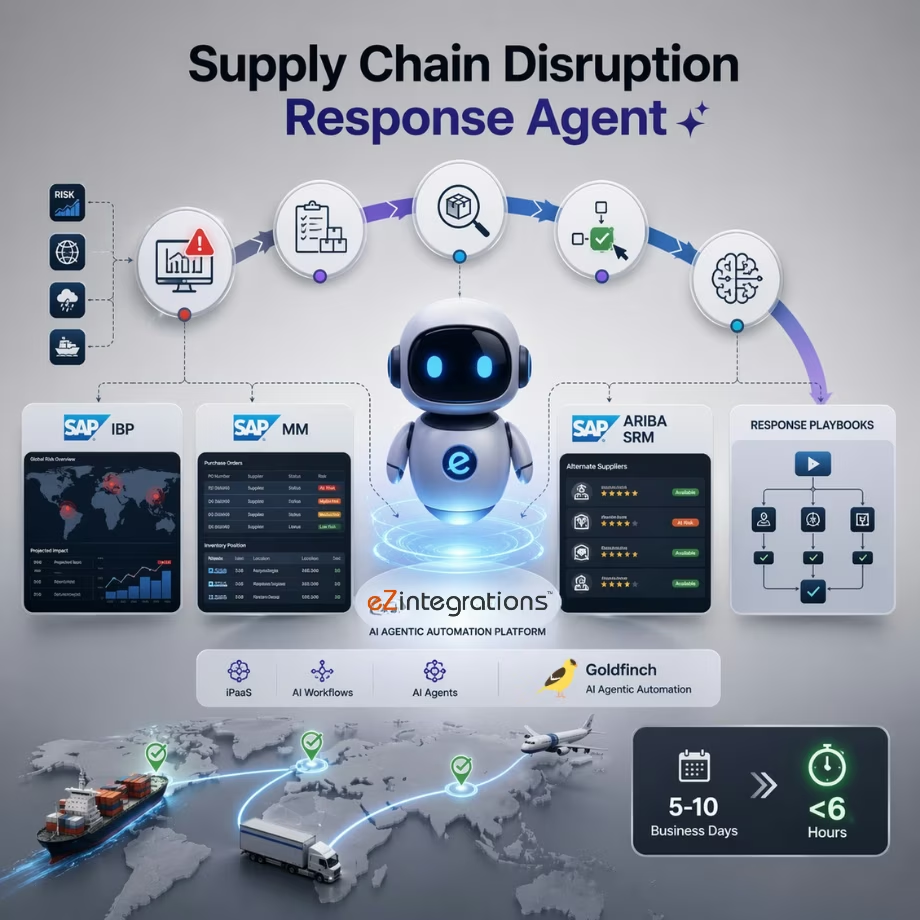
Supply Chain Disruption Response Agent Continuously monitor supply chain risk feeds (supplier financial news; port status alerts; tariff and trade policy databases; weather and logistics disruption feeds) for disruption events; assess affected purchase orders and inventory in SAP IBP and SAP MM; evaluate alternate supplier options from Ariba SRM; compute safety stock duration; recommend and execute approved response actions (expedite existing POs; issue alternate-source POs; update ATP availability in ERP); and notify Sales and Customer Service of customer-facing delivery impacts – compressing the disruption detection-to-response window from days to hours Supply chain disruption detection-to-response compressed from 3 to 10 days (manual analysis) to under 6 hours; 100% of open POs and inventory positions assessed against each detected disruption vs. 20 to 30% manual spot-check coverage; alternate supplier sourcing analysis completed in hours vs. weeks; Gartner research: organizations with automated supply chain risk response reduce average disruption cost by 35 to 50% vs. manual response Supply Chain Director; Chief Procurement Officer (CPO); Demand Planner; VP of Operations; Chief Supply Chain Officer (CSCO) AI Agent (autonomous; goal-oriented; adaptive – continuously monitors risk signals; adapts its impact assessment based on current inventory and open PO positions; selects the response playbook based on disruption type and severity; and executes approved actions across SAP MM; Ariba; and customer communication systems) Yes – eZintegrations connects to on-premises systems (SAP ECC; SAP MM on-prem; SAP IBP on-prem; Oracle SCM on-prem; JDA/Blue Yonder on-prem; MSSQL; and others) via IPSec Tunnel. eZintegrations is a browser-based; cloud-hosted platform and does not require any on-premises installation. REST API (SAP IBP; SAP MM; Ariba SRM; Salesforce/CRM customer notification); OData v2/v4 (SAP MM and IBP); JDBC (Snowflake DW); Web Crawling (supplier news; port alert feeds; trade policy announcements); REST API (risk feed APIs – Resilinc; Everstream; DHL Supply Watch; or custom); SMTP (Sales and Customer Service notifications); HTTPS; OAuth 2.0; IPSec Tunnel (on-premises SAP; Oracle SCM; and JDA/Blue Yonder connectivity) Both single-tenant and multi-tenant deployments are available. Single-tenant is recommended for organizations where supply chain intelligence; supplier relationships; and response strategy are commercially sensitive (competitive intelligence risk). Multi-tenant is the default shared-cloud deployment. Both support on-premises SCM and ERP connectivity via IPSec Tunnel. Manufacturing; Pharmaceuticals; Automotive; Aerospace and Defense; Consumer Goods Disruption detection-to-response under 6 hours; 100% open PO and inventory position impact assessment per disruption; alternate supplier analysis in hours vs. weeks; Fortune 500 average supply chain disruption cost $184M/year reduced by 35 to 50% with automated response (Gartner) supply chain risk agent; supply chain disruption AI; supply chain risk response AI; SAP IBP disruption agent; Goldfinch AI supply chain; alternate supplier AI agent; procurement risk response AI; port closure response automation; tariff impact AI analysis; supply chain visibility AI; SAP MM AI agent; supply chain resilience AI Yes – the supply chain risk agent invokes multiple Goldfinch AI tools per disruption event: Watcher Tools (continuous risk feed monitoring across all sources); Web Crawling (disruption signal gathering from public sources); Document Intelligence (disruption document extraction); API Tool Call (SAP IBP/MM/Ariba parallel impact retrieval + ERP response execution); Data Analysis (impact assessment; days-of-stock computation; and alternate supplier scoring); Knowledge Base Vector Search (response playbook and precedent retrieval); and Integration Workflow as Tool (alternate-source PO; customer notification; and incident record sub-workflows). Credits consumed per disruption event processed. API Tool Call: Queries SAP IBP for current demand forecasts, safety stock positions, and ATP (Available to Promise) availability per affected SKU; queries SAP MM for all open purchase orders with affected suppliers (PO number, quantity, scheduled delivery date, cost center, plant); queries Ariba SRM for qualified alternative suppliers per affected commodity or category (supplier name, qualification status, lead time, prior performance, capacity availability); updates the SAP MM ATP availability when alternate sourcing is confirmed; creates alternate-source purchase orders in SAP MM when executive approval is granted; triggers customer notification workflows in the CRM or customer service platform, Data Analysis: Calculates the business impact of the detected disruption – identifying affected SKUs and their downstream customer orders (via cross-reference of open POs against demand plan), computing days-of-safety-stock-remaining per affected SKU at current demand run rate, scoring alternate supplier options (lead time to first delivery, estimated cost premium vs. primary supplier, qualification status, capacity availability), and recommending the optimal response action (expedite existing PO, issue alternate-source PO, customer communication required, production line impact flagged), Document Intelligence: Analyzes supplier disruption notices, government trade restriction documents, port authority announcements, and logistics carrier alerts – extracting structured disruption details: affected location, scope (which products, commodities, or routes are affected), estimated duration, and any partial mitigation information (partial capacity available, alternative routes announced) that is not available in structured risk API fields, Knowledge Base Vector Search: Retrieves the response playbook matching the detected disruption type (supplier failure, port closure, tariff imposition, weather disruption, logistics congestion, geopolitical event) and severity level – including the approved response sequence, escalation thresholds (which disruption severity levels require CSCO approval vs. Supply Chain Director approval vs. automatic execution), customer communication templates per impact severity, and prior disruption response outcomes for similar events that inform the current recommendation, Watcher Tools: Continuously monitors configured supply chain risk intelligence feeds – risk feed APIs (Resilinc https://www.resilinc.com/, Everstream Analytics, DHL Supply Watch, or custom risk API), Web Crawling for supplier financial news and press releases, port status and vessel tracking feeds, tariff and trade policy announcement databases, and weather and logistics disruption alerts – triggering the impact assessment workflow within 60 minutes of a disruption event being detected; also monitors pending alternate-source PO approvals and customer communication task queues during active disruption response cycles, Web Crawling: Crawls supplier company websites, financial news sources, port authority announcements, trade press publications, and regulatory body websites for supply chain disruption signals not yet captured in structured risk API feeds – including supplier capacity announcements, facility closure notices, labor action news, government export restriction announcements, and logistics congestion reports; also crawls for alternative supplier capability and certification information when evaluating substitution options
Workflow Name:
Purpose:
Benefit:
Who Uses It:
System Type:
On-Premise Supported:
Supported Protocols:
Tenancy Model:
Industry:
Outcome:
Tags:
AI Credits Required:
Goldfinch AI Tool(s) Used:
The Supply Chain Disruption Response Agent from eZintegrations monitors risk signals continuously and compresses the detection-to-response window from days to under 6 hours. Goldfinch AI Watcher Tools monitors configured risk feed APIs; Web Crawling gathers disruption signals from public sources; and Goldfinch AI Document Intelligence extracts structured disruption details from unstructured notices. Goldfinch AI API Tool Call retrieves affected open POs from SAP MM; inventory and ATP positions from SAP IBP; and alternate supplier options from Ariba SRM. Goldfinch AI Data Analysis computes the impact assessment and response recommendation. Goldfinch AI Knowledge Base Vector Search retrieves the response playbook for the disruption type. With Supply Chain Director or CSCO approval; the agent executes: Goldfinch AI Integration Workflow as Tool creates alternate-source POs in SAP MM and notifies Sales and Customer Service of delivery impacts. 24/7 multi-source risk signal monitoring: Watcher Tools monitors structured risk feed APIs (Resilinc, Everstream, DHL Supply Watch) and Goldfinch AI Web Crawling gathers signals from unstructured public sources simultaneously – ensuring disruption events are detected within 60 minutes regardless of whether they appear in a structured API feed or in a news article; Real-time PO and inventory impact assessment: Data Analysis cross-references detected disruptions against all open SAP MM purchase orders and SAP IBP inventory positions to identify every affected SKU, compute days-of-safety-stock remaining, and quantify the downstream customer order at risk – turning a disruption event into a specific impact map within hours, not days, Alternate supplier evaluation and scoring: Data Analysis scores alternate supplier options retrieved from Ariba SRM — evaluating lead time to first delivery, cost premium vs. primary supplier, qualification status, prior performance, and estimated capacity availability – producing a ranked alternate sourcing recommendation for Supply Chain Director review; Playbook-grounded response execution: Knowledge Base Vector Search retrieves the approved response playbook for the disruption type and severity – ensuring the agent’s recommended response reflects the organization’s documented response strategy rather than ad hoc analysis; once approved, Integration Workflow as Tool executes the response actions in SAP MM and CRM without manual hand-offs, Automated customer delivery impact notification: When the response assessment confirms customer-facing delivery delays, the agent generates and sends impact notifications to affected customers via the CRM or customer service platform – including specific affected order references and revised delivery estimates – before customers discover the delay themselves Fortune 500 average supply chain disruption cost: $184M/year (Gartner); automated response reduces this 35 to 50% = $64M to $92M at Fortune 500 scale; for mid-market manufacturers with $5M to $20M average annual disruption cost (Gartner proportional benchmark); 35 to 50% reduction = $1.75M to $10M annually; response speed is the primary differentiator between organizations that contain disruption costs and those that absorb them Supply chain analyst disruption response from 5 to 10 business days (manual assessment) to under 6 hours (AI-assessed and response-ready for approval); alternate supplier evaluation from 2 to 3 weeks (manual RFQ and lead time assessment process) to hours (automated Ariba SRM query and scoring); CSCO disruption briefing from incomplete analyst notes to a structured impact assessment with specific PO references; days-of-stock remaining; ranked alternate options; and response recommendation 35 to 50% reduction in annual supply chain disruption costs from response speed improvement (Gartner); alternate sourcing cost optimization from Data Analysis scoring (selecting the alternate supplier with the best lead time-to-cost tradeoff; not just the first available option); customer communication cost avoidance from proactive delay notification (avoiding the cost of customer service escalation; penalty clauses; and relationship damage from customers discovering delays independently) SOC Type II certified; GDPR-compliant data handling (supplier and customer data processed under GDPR Article 6 legitimate interest for commercial supply chain management); HIPAA-eligible configuration for pharmaceutical supply chains with controlled substance supply requirements. Supply chain intelligence data; open PO data; and alternate supplier information processed in customer-isolated eZintegrations tenant – not shared cross-tenant. RBAC enforced on SAP MM PO creation authority (alternate-source PO creation requires Supply Chain Director or CSCO approval – agent cannot create POs above the configured autonomous authority limit without explicit approval); Ariba SRM supplier data access; and customer notification dispatch. All disruption response actions logged immutably to Snowflake DW for post-disruption analysis and audit. During supply chain disruptions, response is manual and slow-taking 5-10 days across analysis, supplier outreach, and leadership review. This delay impacts decision-making and increases costs. Research shows companies face high disruption costs, but faster, automated responses can reduce these by 35–50%, mainly due to improved response speed
Solution Overview:
Key Features:
Business Impact:
Productivity Gain:
Cost Savings:
Security & Compliance:
Problem Before:
Description
The supply chain risk agent from eZintegrations continuously monitors risk feeds, assesses affected POs and inventory positions in SAP IBP and SAP MM, evaluates alternate supplier options from Ariba SRM, and activates approved response playbooks – compressing supply chain disruption response from 5 to 10 business days to under 6 hours. eZintegrations is an enterprise automation platform covering iPaaS, AI Workflows, AI Agents, and Goldfinch AI agentic automation.
What Is a Supply Chain Risk Agent?
A supply chain risk agent is an AI Agent that takes continuous supply chain risk monitoring as its goal and autonomously executes the full disruption detection-to-response cycle – monitoring risk feeds for disruption signals, assessing which open POs and inventory positions are affected, evaluating alternate sourcing options, computing days-of-safety-stock remaining, recommending the optimal response, executing approved actions in SAP MM and ERP, and notifying Sales and Customer Service of customer-facing impacts. It is reactive (triggers within 60 minutes of disruption detection), adaptive (it assesses each disruption’s specific impact against current inventory and PO positions), and autonomous (it executes approved response actions without Supply Chain Analyst manual coordination between steps).
How Does a Supply Chain Risk Agent Monitor Disruption Signals, Assess PO and Inventory Impact, and Activate Response Playbooks Without Manual Analysis?
The supply chain risk agent monitors risk feed APIs and crawls public sources continuously via Goldfinch AI Watcher Tools and Web Crawling. When a disruption is detected, Document Intelligence extracts structured details. Goldfinch AI API Tool Call retrieves affected open POs from SAP MM, inventory positions from SAP IBP, and alternate supplier options from Ariba SRM simultaneously. Data Analysis computes days-of-safety-stock remaining, scores alternate sourcing options, and generates the response recommendation. Knowledge Base Vector Search retrieves the response playbook. With approval, Integration Workflow as Tool creates alternate-source POs in SAP MM and triggers customer notification.
Gartner documents Fortune 500 average disruption cost at $184M/year. This supply chain risk agent compresses the response window that determines whether that cost is $184M or $92M.
Watch Demo
| Video Title: |
Supply Chain Risk Agent |
|---|---|
| Duration: |
6 to 8 minutes |
Outcome & Benefits
| Throughput: |
Monitors 100% of configured risk feeds and public sources continuously 24/7; processes up to 50 concurrent active disruption events per day at standard configuration; scales to 500+ per day at enterprise tier across global supply chain environments |
|---|---|
| Cost Reduction: |
35 to 50% reduction in annual supply chain disruption costs from automated response speed (Gartner); $1.75M to $10M at mid-market manufacturer scale ($5M to $20M average disruption cost); $64M to $92M at Fortune 500 scale ($184M average disruption cost) |
| Accuracy: |
Open PO and inventory impact identification completeness: 100% of active positions assessed per disruption vs. 20 to 30% manual spot-check coverage; alternate supplier scoring accuracy (Data Analysis ranking agreement with Supply Chain Director manual selection): 87%+; disruption event classification accuracy (correct disruption type classification for playbook routing): 92%+ |
| Time Saved: |
Disruption detection-to-response from 5 to 10 business days to under 6 hours (95%+ compression); alternate supplier evaluation from 2 to 3 weeks to hours; CSCO disruption briefing from day-old analyst notes to structured real-time impact assessment |
Performance Metrics
| Metric | Before (Manual/Batch) | After (Real-Time Sync) | Improvement |
|---|---|---|---|
| Detection-to-Response Time | 5 to 10 business days | Under 6 hours | 95%+ compression |
| PO and Inventory Coverage | 20 to 30% manual spot-check | 100% of active positions | Full coverage |
| Alternate Supplier Evaluation | 2 to 3 weeks RFQ process | Hours (automated Ariba query + scoring) | 95%+ faster |
| Disruption Cost Reduction | $184M average Fortune 500 | 35 to 50% reduction (Gartner) | $64M to $92M savings |
Technical Details
| Data Validation: |
Three-stage validation per disruption response: disruption confirmation – the agent cross-references the detected disruption signal against at least 2 independent sources (risk API + web crawl; or 2 independent news sources) before triggering the full impact assessment; preventing false positive response cycles from single-source unreliable alerts; impact assessment completeness – the agent verifies that SAP IBP inventory data; SAP MM open PO data; and Ariba SRM alternate supplier data are all retrieved successfully before generating the response recommendation; if any data source fails; the assessment is marked Incomplete and escalated to the Supply Chain Director with the available data; pre-execution authorization – all ERP actions (PO creation; ATP update) above the configured autonomous authority threshold require Supply Chain Director or CSCO explicit approval before Integration Workflow as Tool executes the SAP MM action. |
|---|---|
| Real-Time Support: |
Yes – the supply chain risk agent monitors risk feeds continuously; 24/7; across all configured jurisdictions; commodity categories; and logistics corridors. A disruption event detected at 3am (port closure during overnight operations; weekend tariff announcement; after-hours supplier insolvency filing) triggers the full impact assessment pipeline and delivers the briefing to the Supply Chain Director and CSCO before the team arrives at work. For Critical-severity disruptions (days-of-stock below 5-day threshold; production line impact imminent); the agent triggers immediate push notification to the CSCO regardless of business hours. The agent operates identically across global time zones – a disruption in an APAC supplier detected at midnight EST is assessed and briefed to the team by 2am EST. |
| Knowledge Retrieval: |
Goldfinch AI Knowledge Base Vector Search (https://ezintegrations.ai/agentic-ai-platform/) retrieves supply chain disruption response playbooks; alternate sourcing authorization rules; customer communication templates; and prior disruption response outcomes (Weaviate https://weaviate.io/developers/weaviate or Pinecone https://docs.pinecone.io/ as vector store) – matching the detected disruption’s type (supplier failure; port closure; tariff change; weather disruption; geopolitical event); severity level; commodity category; and geographic region against the configured response playbook library and historical disruption incident records. Supply Chain leadership maintains the response playbook library in the Goldfinch AI knowledge base editor – new playbooks for new commodity categories; geopolitical risk scenarios; or regulatory requirements take effect immediately for subsequent disruption events. |
| Agent Architecture: |
Single autonomous agent with parallel multi-source risk monitoring (Watcher Tools monitors all configured risk feed APIs and Web Crawling executes across public sources simultaneously) followed by sequential per-disruption assessment (Document Intelligence extraction; then API Tool Call ERP/SCM/SRM impact retrieval in parallel; then Data Analysis impact scoring; then Knowledge Base playbook retrieval) and then approval-gated response execution (Integration Workflow as Tool executes only after Supply Chain Director or CSCO approval for actions above the configured autonomous authority threshold). For global organizations managing multi-region supply chains with region-specific response playbooks and escalation paths; hierarchical multi-agent mode is available – one orchestrator agent manages the disruption monitoring pipeline and routes detected events to region-specific sub-agents configured with regional playbooks; local supplier databases; and appropriate escalation routing. |
AI Credits
| AI Credits Required: |
Yes – the supply chain risk agent invokes multiple Goldfinch AI tools per disruption event: Watcher Tools (continuous risk feed monitoring across all sources); Web Crawling (disruption signal gathering from public sources); Document Intelligence (disruption document extraction); API Tool Call (SAP IBP/MM/Ariba parallel impact retrieval + ERP response execution); Data Analysis (impact assessment; days-of-stock computation; and alternate supplier scoring); Knowledge Base Vector Search (response playbook and precedent retrieval); and Integration Workflow as Tool (alternate-source PO; customer notification; and incident record sub-workflows). Credits consumed per disruption event processed. |
|---|---|
| LLM Steps Count: |
6 to 8 Goldfinch AI tool invocations per disruption event (Watcher Tools detection + Web Crawling signal gathering + Document Intelligence extraction + API Tool Call x3 parallel SAP/Ariba retrieval + Data Analysis impact assessment + Knowledge Base playbook retrieval + Integration Workflow as Tool x3 sub-workflows) |
| Credit Consumption Model: |
Per disruption event detected and processed – bundle of 6 to 8 tool invocations per event; disruption severity (scope of affected POs and SKUs); number of alternate supplier options evaluated; and customer notification volume affect total credits per event; ongoing monitoring credits accumulate continuously across all active risk feeds Estimated Credits per Disruption Event: Minor disruption (single supplier; 1 to 3 affected SKUs; standard commodity): ~80 to 140 credits per event Major disruption (multi-SKU impact; 5 to 20 affected POs; alternate sourcing analysis): ~140 to 280 credits per event Critical disruption (production-line impact; 20+ affected POs; multi-region alternate sourcing; customer notification required): ~280 to 500 credits per event Ongoing risk feed monitoring (per month; all active feeds): ~3,000 to 8,000 credits per month depending on feed count and monitoring frequency |
| Monthly Credit Estimate (at Typical Volume): |
5 disruption events per month + ongoing monitoring (small/mid manufacturer): ~4,000 to 9,400 credits per month 20 disruption events per month + ongoing monitoring (large manufacturer; multi-region): ~8,800 to 21,600 credits per month 50 disruption events per month (global enterprise; high-disruption-frequency environment): ~18,000 to 41,000 credits per month |
| Pricing Model: |
Static Platform Fee + AI Credits. Platform fee covers unlimited non-LLM orchestration (risk feed polling; SAP connection management; Ariba connection management; SMTP notification dispatch; Snowflake DW incident record writes; audit log writes). AI Credits consumed only by Goldfinch AI tool invocations and LLM reasoning cycles. |
| Credit Optimization Notes: |
Configure risk feed monitoring at 30-minute intervals for standard risk feeds (Resilinc; Everstream API) rather than continuous polling – reduces Watcher Tools monitoring credits 50 to 70% without meaningfully degrading detection latency for non-real-time feeds. Use the disruption source cross-verification step (confirming against 2 independent sources) as a credit gate – only proceed to the full SAP/Ariba impact assessment after confirmation; avoiding credit spend on false positive single-source alerts (estimated 15 to 25% of raw alerts are false positives). Configure Web Crawling depth to a maximum of 2 pages per supplier or logistics source per monitoring cycle. Cache Knowledge Base response playbook retrievals per disruption type for 14 days – supply chain response playbooks change infrequently and the same playbook applies to multiple events of the same type within a period. |
| Goldfinch AI Tool(s) Consuming Credits: |
Watcher Tools: continuous risk feed monitoring across all configured sources – credits per monitoring cycle per active feed Web Crawling: disruption signal gathering from public sources – credits scale with pages crawled per monitoring cycle Document Intelligence: disruption notice and announcement text analysis – credits per document analyzed API Tool Call: 3 parallel data retrieval calls (SAP IBP inventory; SAP MM open POs; Ariba SRM alternate suppliers) + ERP response execution calls – credits per tool execution Data Analysis: impact assessment computation; days-of-stock calculation; and alternate supplier scoring – credits per disruption event assessed (LLM reasoning intensive) Knowledge Base Vector Search: response playbook and prior disruption outcome retrieval – credits per search query Integration Workflow as Tool: alternate-source PO creation + customer notification + incident record sub-workflows – credits per sub-task invocation |
FAQ
1. What is the Supply Chain Disruption Response Agent?
The supply chain risk agent by eZintegrations continuously monitors risk feeds from Resilinc, Everstream, and configured sources via Goldfinch AI Watcher Tools and Web Crawling — detecting disruption events within 60 minutes of occurrence. Goldfinch AI Document Intelligence extracts structured disruption details. API Tool Call retrieves affected open POs from SAP MM, inventory positions from SAP IBP, and alternate supplier options from Ariba SRM simultaneously. Data Analysis computes impact and response recommendation. Knowledge Base Vector Search retrieves the response playbook. With Supply Chain Director approval, Integration Workflow as Tool creates alternate-source POs and triggers customer notification. Gartner: Fortune 500 average disruption cost $184M/year; automated response reduces by 35 to 50%.
2. How does the agent handle task orchestration?
The supply chain risk agent uses a severity-gated execution model — disruption events are classified Critical/Major/Minor based on days-of-stock-remaining, customer order at risk value, and production line impact. Critical and Major disruptions trigger immediate escalation to the Supply Chain Director or CSCO with the full impact assessment. Minor disruptions queue for the next team review cycle. Execution actions (PO creation, ATP update) require explicit approval for actions above the configured autonomous authority limit; below the limit with pre-qualified suppliers, the agent executes per the approved playbook.
3. What Goldfinch AI tools does the supply chain risk agent use?
Seven native Goldfinch AI tools: Watcher Tools (continuous risk feed API monitoring 24/7), Web Crawling (disruption signal gathering from supplier news, port alerts, and trade policy sources), Document Intelligence (disruption notice and announcement text extraction), API Tool Call (SAP IBP inventory + SAP MM open PO + Ariba SRM alternate supplier parallel retrieval + ERP response execution), Data Analysis (impact assessment, days-of-stock computation, alternate supplier scoring), Knowledge Base Vector Search (response playbook and disruption precedent retrieval), and Integration Workflow as Tool (alternate-source PO creation, customer notification, incident record sub-workflows). Goldfinch AI is self-service extensible — your Supply Chain team adds customs data APIs, logistics tracking systems, or production scheduling tools without coding.
4. Can the supply chain risk agent be customized for my supply chain environment?
Yes — all parameters configurable via eZintegrations no-code Agent Builder: risk feed sources (Resilinc, Everstream, DHL Supply Watch, custom APIs), commodity and supplier monitoring scope, disruption severity thresholds, response playbook library (Supply Chain leadership manages in Goldfinch AI Knowledge Base editor), autonomous execution authority limits (PO value ceiling, pre-qualified supplier scope), escalation routing per severity type, and customer notification templates. Supply Chain Operations manages playbooks without IT involvement.
5. How is data validated before the agent creates alternate-source POs or notifies customers?
Three-stage validation: disruption confirmation — cross-references detected event against at least 2 independent sources before triggering full impact assessment, preventing false positive response cycles; impact assessment completeness — verifies SAP IBP, SAP MM, and Ariba SRM data all retrieved successfully before generating response recommendation; pre-execution authorization — all ERP actions above the configured autonomous authority threshold require Supply Chain Director or CSCO approval before Integration Workflow as Tool executes. The agent cannot create POs or notify customers for Major or Critical disruptions without explicit human approval.
6. Does the supply chain risk agent support real-time execution?
Yes — the agent monitors risk feeds continuously 24/7 across all configured time zones, commodity categories, and logistics corridors. A disruption detected at 3am (port closure, overnight tariff announcement, after-hours supplier insolvency filing) triggers the full impact assessment and delivers the briefing to the Supply Chain Director and CSCO before the team arrives at work. For Critical-severity disruptions (days-of-stock below 5-day threshold), the agent triggers immediate push notification regardless of business hours.
7. What are the key benefits of the supply chain risk agent?
Key benefits include disruption detection-to-response from 5 to 10 business days to under 6 hours (95%+ compression), 100% of open PO and inventory positions assessed per disruption vs. 20 to 30% manual spot-check, alternate supplier evaluation from 2 to 3 weeks to hours, 35 to 50% annual disruption cost reduction (Gartner), $1.75M to $10M at mid-market scale, proactive customer delay notification before customers discover delays independently, and 24/7 coverage of global supply chain risk signals including weekend and overnight events.
8. How does the supply chain risk agent compare to Resilinc or LangChain?
Resilinc and Everstream Analytics provide excellent supply chain risk intelligence feeds and dashboards but require supply chain analysts to manually assess impact against open PO and inventory positions — they surface the event but do not execute the response. SAP IBP provides control tower capabilities but does not monitor external risk feeds or create autonomous alternate-source POs. Blue Yonder and Kinaxis require manual analyst intervention to translate disruption events into ERP actions. LangChain requires 4 to 8 months to build risk API, SAP IBP/MM, and Ariba connectors. The supply chain risk agent ships 7 Goldfinch AI tools pre-connected and deploys in under 3 weeks. Goldfinch AI is self-service extensible for additional supply chain systems.
Resources
| Blog: |
From Manual to Automated: How Lumière Cosmetics Scaled Amazon and Walmart Operations in 90 Days |
|---|---|
| Platform Overview: |
eZintegrations Platform – Enterprise iPaaS, AI Workflows & Agentic AI |
| Demo: |
Book a Demo |
| Goldfinch AI Platform: |
Agentic AI Platform — Goldfinch AI by eZintegrations |
Case Study
| Industry: |
Manufacturing; Pharmaceuticals; Automotive; Aerospace and Defense; Consumer Goods |
|---|---|
| Outcome: |
Disruption detection-to-response under 6 hours; 100% open PO and inventory position impact assessment per disruption; alternate supplier analysis in hours vs. weeks; Fortune 500 average supply chain disruption cost $184M/year reduced by 35 to 50% with automated response (Gartner) |
| Problem: |
A specialty pharma company with $640M revenue managed 280 suppliers globally, monitoring risks manually across multiple sources. Disruption analysis took 4-7 days, delaying response and alternate sourcing. With limited approved substitutes, this led to high impact-averaging $23M annually in disruption costs and occasional FDA reportable issues due to delays. |
| Solution: |
Deployed eZintegrations supply chain risk agent in 18 days across API and excipient categories. Integrated risk feeds, SAP IBP/MM, and Ariba to monitor disruptions, inventory, and alternate suppliers. Enabled severity-based analysis, automated response playbooks, and workflows for PO creation, regulatory alerts, and customer notifications, with approval controls for critical actions. |
| ROI: |
Disruption cost reduction: estimated $8.1M (35% reduction on $23M baseline; reflecting improved response speed across all 14 detected events including 4 Critical events). FDA reportable issue avoidance: 2 avoided events x $1.8M average regulatory response and supply remediation cost (pharma industry estimate) = $3.6M avoided. Supply Chain analyst labor savings: 8 analysts x (4.5-day average manual assessment freed per disruption) x 14 events x $58/hour x 8-hour days = $234,000. Total 6-month value: $11.93M. Deployment cost: $128,000. Payback period: under 2 weeks. |
Related products
-
Automated Lead Sourcing and Enrichment-16X More Leads
 $0.00
Download
$0.00
Download
-
How to Automate Meeting Scheduling Using AI for Calendly
 $0.00
Download
$0.00
Download
-
How to Automate Month-End Financial Close for Reconciliation and Close Orchestration
 $150.00
Download
$150.00
Download
-
Reddit Data Extraction: Automated Lead Sourcing
 $0.00
Download
$0.00
Download