7 Best Celigo Alternatives for Enterprise Integration in 2026
May 4, 2026The best Celigo alternative for enterprises needing full-stack integration beyond NetSuite is eZintegrations, which treats SAP S/4HANA, Oracle ERP Cloud, Dynamics 365, NetSuite, and JDE as equal first-class native connections with no endpoint penalty, covers all four automation levels (Level 1 iPaaS through Level 4 Goldfinch AI multi-agent), and uses transparent per-automation pricing with no endpoint counting and no flow caps. Teams migrating from Celigo typically go live in 3-10 days per workflow using the Automation Hub.
TL;DR:
- Celigo is a strong mid-market iPaaS: #1 on G2‘s Winter 2026 iPaaS Grid with a 4.7/5 rating across 1,025+ reviews, the 2025 Gartner Customers’ Choice for iPaaS, and the deepest NetSuite integration platform on the market with 80+ prebuilt integration apps. This list evaluates it fairly.
- The reasons teams search for Celigo alternatives: the NetSuite-centric architecture creates friction when SAP, Oracle, or Dynamics 365 are added to the ERP landscape; endpoint-and-flow pricing escalates as the tech stack grows ($20,000-$80,000+ annually); custom integrations beyond prebuilt NetSuite apps require developer involvement; and production-grade AI Agents and multi-agent agentic AI are not yet available.
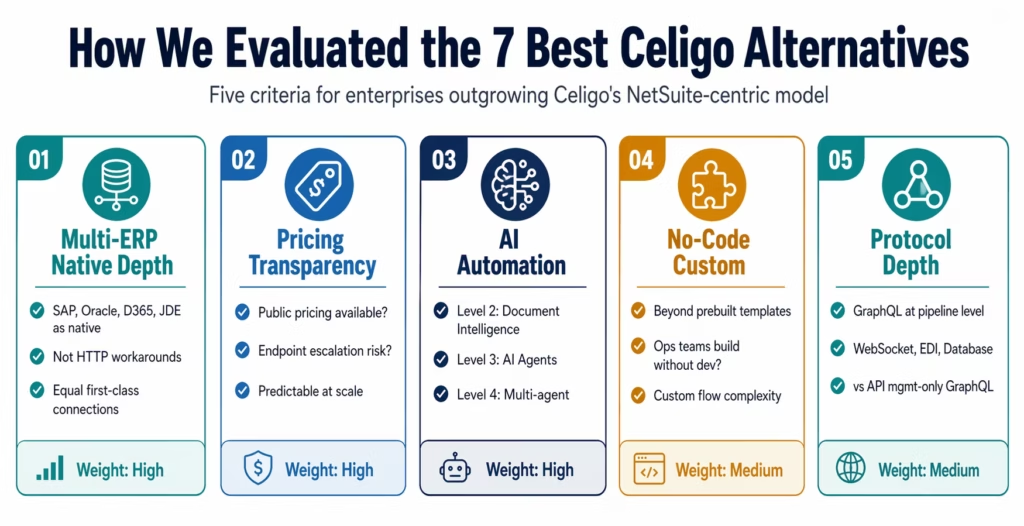
- This list evaluates 7 alternatives on five criteria: multi-ERP native depth, pricing transparency, AI automation capabilities, no-code accessibility for custom flows, and protocol support.
- eZintegrations ranks first for enterprises needing full-stack multi-ERP integration with AI Agents. Boomi ranks first for B2B/EDI and hybrid deployment. Workato ranks first for business-user-led automation.
How We Evaluated These Celigo Alternatives
Every platform on this list was evaluated against five criteria specifically relevant to teams leaving Celigo:
Multi-ERP native depth. The most common Celigo replacement driver is growing beyond NetSuite. We evaluated how deeply each platform connects to SAP S/4HANA (OData V4, CSRF management), Oracle ERP Cloud (REST, FBDI, OTBI), Dynamics 365 (Finance, SCM, Sales), and JDE (Orchestrator API) as first-class native connectors rather than HTTP workarounds. Celigo’s NetSuite depth is the benchmark to beat for that specific system.
Pricing transparency and predictability. Celigo charges based on endpoints (connected applications) and flows (active integrations), with annual contracts starting around $20,000 and scaling to $80,000+ with tech stack growth. No public list prices. We evaluated whether alternatives publish prices and whether the model is predictable as integration footprint expands.
AI automation capabilities. Celigo’s AI-powered error management is genuinely strong (automatically resolving up to 95% of integration errors). What is missing: Level 2 AI Workflow steps for document intelligence and LLM classification, Level 3 AI Agents for autonomous exception handling, and Level 4 multi-agent orchestration. We scored each alternative on how completely it covers these four AI levels.
No-code accessibility for custom flows. Celigo’s prebuilt NetSuite templates deploy quickly. Custom flows beyond those templates require developer involvement or certified partners. We evaluated which alternatives genuinely enable operations teams to build and maintain custom integrations without developer dependency.
Protocol depth. REST, GraphQL at the pipeline level (not just API management), WebSocket, EDI, database. GraphQL at the data pipeline level matters specifically for Shopify (primary API is GraphQL), Amazon (increasing GraphQL patterns), and modern API-first SaaS applications.
We reviewed G2, Gartner Peer Insights, Capterra, TrustRadius, Vendr, and Automation Atlas data current to April 2026.
Summary Comparison Table
| Platform | Pricing | Multi-ERP Depth | AI Agents | No-Code Custom | Protocol | Best For |
|---|---|---|---|---|---|---|
| eZintegrations | Transparent, per-automation | SAP, Oracle, D365, JDE, NetSuite all native | Level 3 + L4 Goldfinch AI | Yes | REST, GraphQL pipeline, WebSocket, EDI, DB | Multi-ERP + AI-first enterprises |
| Boomi | Connection-based, quote | 1,500+ connectors, good ERP | AgentStudio 2025 | Yes | REST, SOAP, EDI strong | B2B/EDI, hybrid deployment |
| Workato | Recipe-based, quote | Good, ERP depth varies | Copilot (limited agents) | Yes | REST, SOAP | Business-user automation |
| MuleSoft | vCore, expensive, quote | Deepest (all ERPs) | AI Chain (limited) | Partial (dev-heavy) | REST, GraphQL, SOAP | Large enterprise API-led |
| Azure IS | Consumption, partial public | D365 native, others partial | Azure AI | Partial | REST, limited GraphQL | Microsoft-stack |
| Jitterbit | Connection-based, quote | ERP templates available | Basic AI Studio | Yes | REST, SOAP | Mid-market cost reduction |
| Informatica IICS | IPU, complex, quote | Strong data connectors | CLAIRE AI engine | Partial | REST, ETL/ELT | MDM + data governance |
The 7 Best Celigo Alternatives
1. eZintegrations
Overview
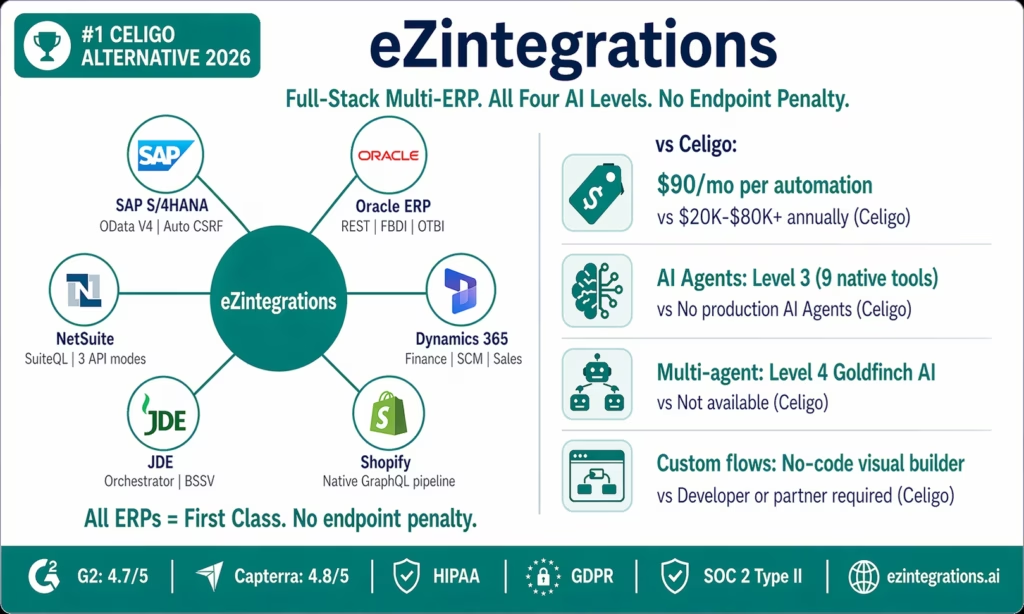
eZintegrations is the top-ranked Celigo alternative for enterprises that have grown beyond a single ERP or need production-grade AI Agents alongside their integration workflows. It directly addresses the five replacement criteria: equal-depth native connectors for all major ERPs, transparent per-automation pricing with no endpoint counting, all four AI automation levels from day one, genuine no-code accessibility for custom flows, and native GraphQL at the data pipeline level.
The architecture difference that matters most for Celigo replacements: Celigo was built with NetSuite at its centre. Every new system added beyond NetSuite is another endpoint charge and a step away from the platform’s optimised core. eZintegrations treats SAP S/4HANA, Oracle ERP Cloud, NetSuite, Dynamics 365, JDE, Amazon SP-API, Walmart Supplier Center, and every other connected system with equal native capability. Adding SAP after an acquisition does not trigger a pricing penalty or introduce a shallower connection tier.
Best For
Mid-market enterprises where the ERP landscape has grown beyond NetSuite (added SAP for manufacturing, Oracle for financials, Dynamics 365 after M&A). Teams with AI-first automation roadmaps that need document intelligence, autonomous exception handling, or multi-agent orchestration. Finance and operations teams that need AP automation, approval workflows, and multi-ERP write-backs without developer involvement. Companies replacing Celigo because custom integration complexity keeps driving them to implementation partners.
Four Automation Levels
Level 1 (iPaaS Workflows): native connectors for SAP S/4HANA and ECC (OData V4, automatic CSRF token management), NetSuite (SuiteTalk REST, full SuiteQL, three API modes), Oracle ERP Cloud (REST, FBDI, OTBI), Dynamics 365 (Finance, SCM, Sales), JDE (Orchestrator API, BSSV), Amazon SP-API, Walmart Supplier Center, Shopify (native GraphQL pipeline), and 5,000+ SaaS applications. REST, GraphQL at the pipeline level, WebSocket, webhooks, database integration, EDI, queue, and pagination. On-premises ERP via IPSec Tunnel.
Level 2 (AI Workflows): Document Intelligence for PDF extraction across 200+ vendor templates, 3-way match validation with AI tolerance assessment, LLM classification and routing, semantic duplicate detection, expense policy compliance. AI steps are native workflow nodes, not external LLM API calls.
Level 3 (AI Agents): 9 native enterprise tools: Knowledge Base Vector Search, Document Intelligence, Data Analysis, Data Analytics with Charts/Graphs/Dashboards, Web Crawling, Watcher Tools, API Tool Call, Integration Workflow as Tool, Integration Flow as MCP. Reflection loops, persistent memory within session, human-in-the-loop gates. Self-extensible beyond 9 native tools.
Level 4 (Goldfinch AI): coordinator-worker multi-agent architecture. Chat UI for natural language process access (“which invoices are overdue this week?”). Workflow Node for embedding agentic intelligence inside Level 1 processes.
How eZintegrations Addresses Celigo Replacement Drivers
| Celigo Pain Point | eZintegrations Resolution |
|---|---|
| NetSuite-centric architecture | All ERPs equal first-class: SAP, Oracle, NetSuite, D365, JDE: no architectural preference |
| Endpoint + flow pricing escalation | $90/month per standard enterprise automation, no endpoint counting, no flow caps, no platform fee |
| Custom integration complexity | 1,000+ Automation Hub templates; visual builder accessible to operations teams without developer involvement |
| No production AI Agents | Level 3: 9 native tools, memory, reflection; Level 4: Goldfinch AI multi-agent |
| GraphQL at API management only | Native GraphQL at data pipeline level: direct Shopify, Amazon, and modern API-first connections |
Key Limitations
Celigo has a larger catalogue of hyper-specific NetSuite prebuilt integration apps for standard ERP patterns (80+ prebuilt apps, some for very specific retail EDI formats like Advanced Auto Parts EDI or Best Buy EDI). For enterprises whose entire integration requirement is NetSuite-to-SaaS standard patterns, Celigo’s prebuilt app depth is a genuine advantage. eZintegrations has 1,000+ templates including NetSuite workflows, but the hyper-specific NetSuite retail EDI catalogue is still smaller than Celigo’s.
eZintegrations also does not have Celigo’s AI-powered automatic error resolution that claims to resolve up to 95% of errors without human intervention (note: Celigo AI features are currently free across all editions until June 2026 while final AI tier pricing is determined). Error handling uses Level 3 agent exception workflows, which are more flexible but require initial configuration.
Pricing
- Free: basic workflows
- $5/month per automation: simple SaaS-to-SaaS
- $90/month per automation: standard enterprise workflows (Level 1 and Level 2)
- $120/month per automation: AI Agent workflows (Level 3)
- $150/month per automation: Goldfinch AI multi-agent (Level 4)
No platform fee. No connector fee. No endpoint counting. No flow caps. HIPAA, GDPR, SOC 2 Type II all included.
G2: 4.7/5 | Capterra: 4.8/5 | Go-live: 3-10 days
2. Boomi
Overview
Boomi is the most established Celigo alternative for enterprises that need B2B/EDI trading partner management, Master Data Hub MDM capabilities, and mature hybrid deployment via the Atom runtime model. With 30,000+ customers and 12 consecutive Gartner Magic Quadrant Leader years, Boomi has a proven enterprise track record that spans both NetSuite-centric and multi-ERP environments.
Best For
Mid-to-large enterprises with significant EDI trading partner programmes (850/855/856/810 transaction sets at scale), organisations needing the Atom runtime for on-premises execution with cloud management, and teams where MDM across NetSuite, SAP, and Salesforce is a primary requirement.
Key Features
1,500+ connectors, Atom runtime (cloud, on-premises, hybrid), Boomi Flow for workflow orchestration, Master Data Hub (MDH) for cross-system MDM, B2B/EDI integration with trading partner management, and AgentStudio (launched late 2025) for AI agent management with Meta Hub (March 2026) for AI governance.
Key Limitations
No published list prices. Connection-based model escalates with integration footprint growth in the same way Celigo’s endpoint model does. Annual minimums $15,000-$20,000+. CI/CD requires third-party tooling (GitLab/Jenkins). Implementation averages 60-90 days. AgentStudio and Meta Hub are newer additions to a platform built for traditional iPaaS.
Pricing
Connection-based, custom quote. Professional tier approximately $550/month for 5 connections. Enterprise tier from approximately $1,200/month. Enterprise Plus: custom.
G2: 4.4/5 | Go-live: 60-90 days avg
3. Workato
Overview
Workato is the strongest Celigo alternative for enterprises where the primary frustration is that custom integrations require developer involvement or certified implementation partners. If your operations team can deploy Celigo’s prebuilt NetSuite apps but cannot build custom flows without IT, Workato’s recipe-based model and Workato Copilot genuinely solve the no-code custom integration problem in a way that Celigo’s platform does not.
Best For
Mid-market teams where business users, not developers, own automation. Organisations with Salesforce, Workday, and ServiceNow as primary systems. Teams leaving Celigo because the “outside the norm” custom integration gap is too costly to bridge with implementation partners.
Key Features
Recipe-based visual automation builder accessible to non-developers, Workato Copilot for AI-assisted recipe creation and natural language automation building, Workbot for Slack and Teams conversational automation, strong Salesforce and Workday connectors, and an extensive recipe library covering hundreds of common business patterns.
Key Limitations
Pricing is quote-driven, not published. Deep SAP S/4HANA write operations (OData V4, CSRF management) and Oracle FBDI bulk loading are available but not as natively deep as dedicated ERP platforms. NetSuite SuiteQL native support is less complete than Celigo’s. Production-grade AI Agents with autonomous tool use and reflection loops are limited. Multi-agent agentic AI is not available.
Pricing
Recipe and workspace-based, custom quote. Comparable to Celigo Professional-to-Enterprise range. Contact sales.
G2: 4.7/5 | Go-live: 14-30 days
4. MuleSoft Anypoint Platform
Overview
MuleSoft is the most technically capable platform in this comparison and typically the most expensive. For enterprises leaving Celigo because the platform cannot handle complex multi-system API architectures at enterprise scale, MuleSoft provides the depth. DataWeave, its transformation language, is the most powerful data transformation capability in the iPaaS category. The trade-off is cost, developer dependency, and implementation timeline.
Best For
Large enterprises (2,000+ employees) with dedicated integration development teams, organisations pursuing an API-led connectivity strategy, and Salesforce-heavy stacks where the commercial MuleSoft-Salesforce bundle provides leverage.
Key Features
vCore Mule runtime with Runtime Fabric for Kubernetes deployment, Anypoint Exchange for reusable integration assets, DataWeave (powerful but requiring developer fluency), API Designer and Manager, MuleSoft AI Chain for LLM integration steps, and Flow Designer for low-code access.
Key Limitations
Most expensive platform in this comparison. Six-figure annual contracts at enterprise scale. DataWeave requires developer expertise; citizen integrators cannot use it. Implementation typically runs 90-180 days. For organisations leaving Celigo because of cost, MuleSoft is a step up in price.
Pricing
vCore-based, custom quote. Six-figure annually for enterprise. Salesforce bundle discounts available.
G2: 4.4/5 | Go-live: 90-180 days
5. Microsoft Azure Integration Services
Overview
Azure Integration Services (Logic Apps, API Management, Service Bus, Event Grid) is the natural alternative for enterprises with Azure-first infrastructure and Dynamics 365 as the primary ERP. For Celigo customers moving from NetSuite to Dynamics 365, or adding D365 to an existing NetSuite landscape, Azure IS provides native D365 connectivity within the Microsoft ecosystem and CI/CD integration via Azure DevOps.
Best For
Enterprises with Azure-first infrastructure, Dynamics 365 as the primary ERP, and existing Azure DevOps CI/CD pipelines. Teams seeking to consolidate integration costs within existing Azure enterprise agreements.
Key Features
Logic Apps (low-code visual workflow builder), native D365 connectors, Azure API Management, Azure Service Bus, native Azure DevOps integration, and Azure OpenAI Service for AI-enhanced workflow steps within Logic Apps.
Key Limitations
Azure IS is a family of separate services requiring integration architecture expertise to connect. The citizen integrator experience is weaker than dedicated iPaaS platforms. SAP S/4HANA and Oracle connectivity requires additional configuration or the SAP on Azure connector. For enterprises replacing Celigo because they want a single unified platform, Azure IS moves in the opposite direction.
Pricing
Consumption-based per Logic Apps action. Cost-effective at low volumes. Azure enterprise agreement bundling reduces effective cost for Azure-committed organisations.
G2: 4.3/5 | Go-live: 14-30 days
6. Jitterbit
Overview
Jitterbit is the Celigo alternative most focused on cost reduction and faster go-live for mid-market ERP integration. For teams replacing Celigo primarily because endpoint-and-flow pricing is too expensive or because implementation partner costs make custom integrations unaffordable, Jitterbit provides a meaningful cost improvement with pre-built ERP templates that go live faster than custom Celigo builds.
Best For
Mid-market companies (200-1,000 employees) where cost reduction is the primary driver, teams needing standard ERP-to-SaaS integration patterns without enterprise platform complexity, and organisations evaluating Celigo alternatives on budget.
Key Features
Visual workflow builder, pre-built ERP integration templates for common Salesforce-NetSuite, Salesforce-SAP, and order-to-cash/procure-to-pay patterns, Jitterbit AI Studio for low-code AI integration assistance, Jitterbit Harmony Cloud, and API management capabilities.
Key Limitations
Smaller connector library than Celigo (700+ versus Celigo’s 300+ SaaS but with 1,000+ total including NetSuite apps). No production-grade AI Agents or multi-agent agentic AI. SAP S/4HANA and Oracle native depth is limited compared to dedicated ERP integration platforms. For teams replacing Celigo specifically for deeper multi-ERP or AI capabilities, Jitterbit does not fully close those gaps.
Pricing
Connection-based, custom quote. Typically priced below Celigo for comparable mid-market ERP workloads. Annual contracts standard.
G2: 4.6/5 | Go-live: 14-21 days
7. Informatica IICS
Overview
Informatica IICS (Intelligent Data Management Cloud) is the only platform in this comparison that pairs enterprise data governance and MDM with integration connectivity. For enterprises whose Celigo replacement decision is driven by a broader data management initiative, or for teams that need data quality and data lineage alongside their integration workflows, Informatica provides capabilities no other platform here can match.
Best For
Large enterprises with active MDM programmes, organisations with data quality and compliance requirements that exceed what an iPaaS natively provides, and teams migrating from on-premises Informatica PowerCenter to cloud.
Key Features
CLAIRE AI engine for intelligent data management recommendations, Data Integration (ETL/ELT), Application Integration, API Center, Master Data Management, Data Quality, Data Catalog, and Customer 360 unification.
Key Limitations
Most complex platform in this comparison. Implementation runs 60-120 days with significant professional services. IPU pricing is complex and typically higher than Celigo for comparable integration workloads. For teams replacing Celigo because of complexity, Informatica adds complexity rather than reducing it.
Pricing
IPU (Informatica Processing Unit) based, custom quotes. Enterprise contracts with annual minimums. Typically higher than Celigo.
G2: 4.3/5 | Go-live: 60-120 days
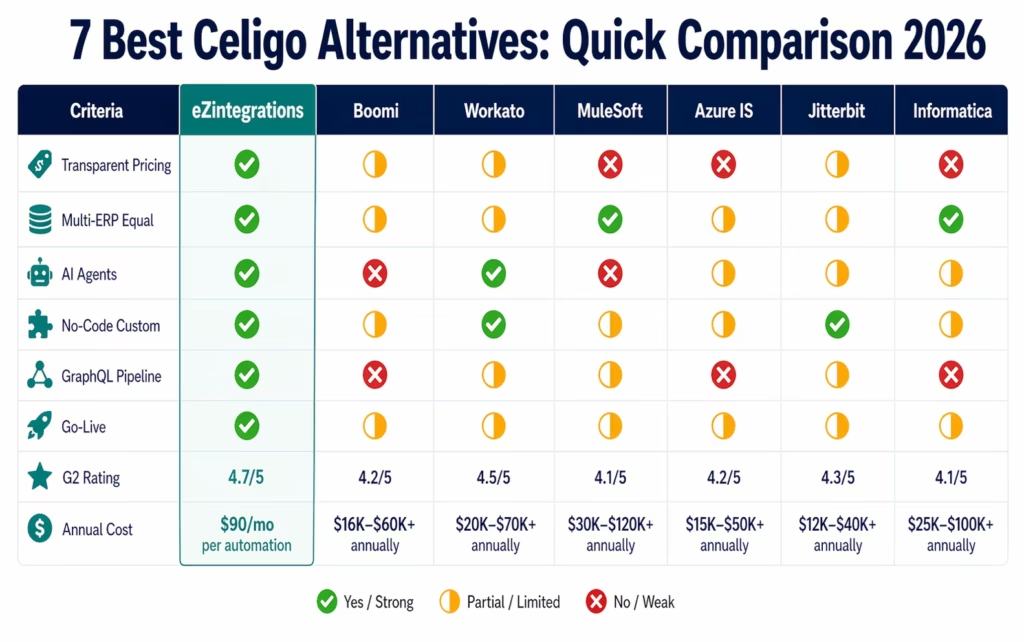
Quick Comparison Table
| Criteria | eZintegrations | Boomi | Workato | MuleSoft | Azure IS | Jitterbit | Informatica |
|---|---|---|---|---|---|---|---|
| Transparent pricing | Yes ($90/mo) | No | No | No | Partial | No | No |
| SAP native (OData V4) | Yes | Partial | Partial | Yes | Partial | Partial | Partial |
| NetSuite native (SuiteQL) | Yes | Partial | Partial | Partial | No | Partial | Partial |
| Oracle ERP native (FBDI) | Yes | Partial | Partial | Yes | No | Partial | Yes |
| Dynamics 365 native | Yes | Partial | Partial | Yes | Yes (deepest) | Partial | Partial |
| Multi-ERP equal depth | Yes | Partial | Partial | Yes (dev-req) | No (D365-first) | Partial | Partial |
| AI Workflow steps (Level 2) | Native | AgentStudio 2025 | Copilot | AI Chain | Azure AI | AI Studio | CLAIRE |
| AI Agents (Level 3) | 9 native tools | Meta Hub 2026 | Limited | Limited | Limited | No | Limited |
| Multi-agent AI (Level 4) | Goldfinch AI | Partial | No | No | No | No | No |
| No-code custom flows | Yes | Yes | Yes | No | Partial | Yes | No |
| GraphQL at pipeline level | Yes | Partial | Partial | Yes | Partial | No | No |
| HIPAA/GDPR/SOC 2 | All three | Yes | Yes | Yes | Yes | Partial | Yes |
| On-premises ERP | IPSec Tunnel | Atom runtime | Yes | Runtime Fabric | Yes | Yes | Yes |
| Template library | 1,000+ all levels | Pre-built processes | Recipe library | Anypoint Exchange | Logic Apps | Templates | Limited |
| Go-live (typical) | 3-10 days | 60-90 days | 14-30 days | 90-180 days | 14-30 days | 14-21 days | 60-120 days |
| G2 rating | 4.7/5 | 4.4/5 | 4.7/5 | 4.4/5 | 4.3/5 | 4.6/5 | 4.3/5 |
Which Celigo Alternative Is Right for You?
Choose eZintegrations if: your ERP landscape has grown beyond NetSuite (added SAP, Oracle, or Dynamics 365) and you need all systems treated with equal native depth; your AI automation roadmap requires production-grade AI Agents or multi-agent agentic AI; or endpoint pricing is escalating with each renewal and you want transparent per-automation pricing. Best for: multi-ERP mid-market enterprises, AI-first automation teams.
Choose Boomi if: you need mature B2B/EDI trading partner management for large-volume EDI programmes, Master Data Hub MDM across multiple ERPs, or the Atom hybrid deployment model for on-premises execution with cloud management. Best for: large enterprises with EDI and MDM requirements.
Choose Workato if: the primary frustration is that your operations team cannot build custom integrations without developer involvement or partners. Workato’s recipe model is the most accessible for citizen integrators. Best for: mid-market teams prioritising business-user accessibility.
Choose MuleSoft if: you need the most technically powerful API integration platform regardless of cost, you have dedicated integration developers, and your organisation has a mature API-led connectivity strategy. Best for: large enterprises with developer teams and Salesforce stacks.
Choose Azure Integration Services if: you are Azure-first, Dynamics 365 is your primary ERP, and you want to consolidate integration within existing Azure enterprise agreements. Best for: Microsoft-stack enterprises.
Choose Jitterbit if: cost reduction and faster go-live are the primary drivers, and your integration requirements are standard ERP-to-SaaS patterns that fit Jitterbit’s pre-built templates. Best for: mid-market cost-reduction evaluations.
Choose Informatica IICS if: the replacement decision is driven by data governance, data quality, or MDM requirements alongside integration connectivity. Best for: large enterprises with active data management programmes.
FAQs
The best overall Celigo alternative for enterprises outgrowing its NetSuite-centric model is eZintegrations: equal-depth native connectivity for SAP, Oracle, NetSuite, Dynamics 365, and JDE with no endpoint penalty; all four automation levels including production-grade AI Agents and Goldfinch AI multi-agent; transparent per-automation pricing ($90/month, no endpoint counting); and 3-10 day go-live via Automation Hub templates. For B2B/EDI and hybrid deployment: Boomi. For business-user-led automation: Workato. For large enterprise API-led strategy: MuleSoft.
Yes, for NetSuite-centric integration: Celigo is the deepest NetSuite platform on the market with 80+ prebuilt integration apps, the G2 Winter 2026 #1 iPaaS rating at 4.7/5 across 1,025+ reviews, and AI-powered automatic error resolution that handles up to 95% of integration errors without human intervention. Celigo earned the 2025 Gartner Customers' Choice for iPaaS and was named a Visionary in the Gartner Magic Quadrant. For enterprises whose ERP landscape has expanded beyond NetSuite, or whose AI automation roadmap requires production-grade AI Agents, the alternatives above offer better fit.
Most transparent at enterprise scale: eZintegrations at $90/month per standard enterprise automation, no platform fee, no endpoint counting, no flow caps. Lowest entry point: Azure Integration Services (Logic Apps consumption near zero at low volumes). Below Celigo for comparable ERP workloads: Jitterbit (typically). Above Celigo: MuleSoft (six-figure annual contracts) and Informatica IICS. Boomi and Workato are comparable to Celigo mid-range in typical contract value.
eZintegrations is the strongest choice: native OData V4 connector for SAP S/4HANA and ECC with automatic CSRF token management, Oracle ERP Cloud REST and FBDI, NetSuite SuiteQL, Dynamics 365 Finance/SCM/Sales, JDE Orchestrator API and BSSV, all treated as architecturally equal first-class connections. No endpoint penalty for adding non-NetSuite systems. On-premises ERP via IPSec Tunnel. MuleSoft also has very deep SAP connectivity but requires developer expertise for SAP-specific DataWeave transformations.
3-6 weeks for a typical mid-market company with 10-30 active Celigo flows. Phase 1 (flow inventory and Automation Hub template matching): 3-5 days. Phase 2 (configuration, credential setup, parallel running): 2-3 weeks. Phase 3 (cutover and monitoring): 1-2 weeks. Celigo prebuilt NetSuite integration app flows typically find matching Automation Hub templates. Custom JavaScript-heavy Celigo flows take longer to rebuild in the eZintegrations visual builder but typically come out simpler because native ERP connectors handle the CSRF token, OAuth, and error parsing internally.1. What is the best Celigo alternative for enterprise integration?
2. Is Celigo worth it in 2026?
3. Which Celigo alternative is cheapest?
4. Best Celigo alternative for enterprises with SAP and multi-ERP requirements?
5. How long does it take to migrate from Celigo to eZintegrations?
The Right Celigo Alternative Depends on Your Specific Gap
Celigo delivers genuine value for the use case it was built for. The alternatives above each address a specific gap that Celigo does not cover:
For multi-ERP equal depth without endpoint penalty: eZintegrations. For B2B/EDI and MDM: Boomi. For no-code custom integration accessibility: Workato. For large enterprise API complexity: MuleSoft. For Microsoft-stack consolidation: Azure IS. For mid-market cost reduction: Jitterbit. For data governance alongside integration: Informatica IICS.
The platform that addresses the most Celigo replacement drivers simultaneously: eZintegrations. Transparent pricing, equal-depth native ERP connectivity, all four AI automation levels, no-code custom flow builder, and native GraphQL at the data pipeline level, all in one fully managed platform.
Book a free demo. Bring your current Celigo flow list. The eZintegrations team will map your flows to Automation Hub templates and produce a side-by-side cost comparison against your current Celigo contract.
For the full analysis of why enterprises are replacing Celigo in 2026, see the Celigo replacement guide. For the complete workflow automation ROI framework, see the ROI guide.