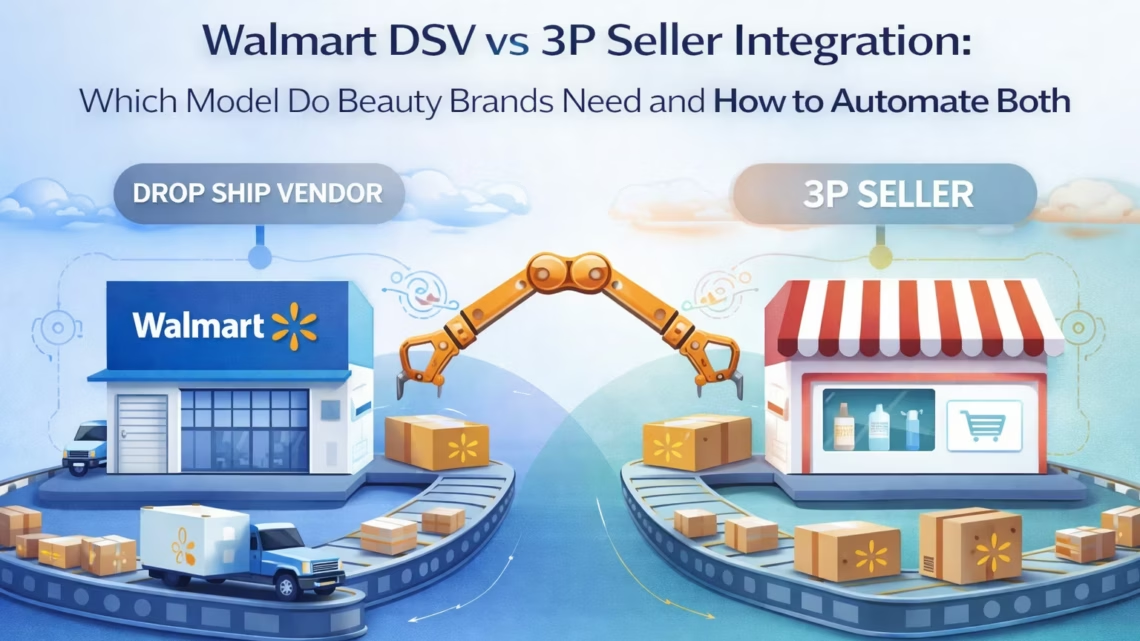
Walmart DSV vs 3P Seller Integration: Which Model Do Beauty Brands Need and How to Automate Both
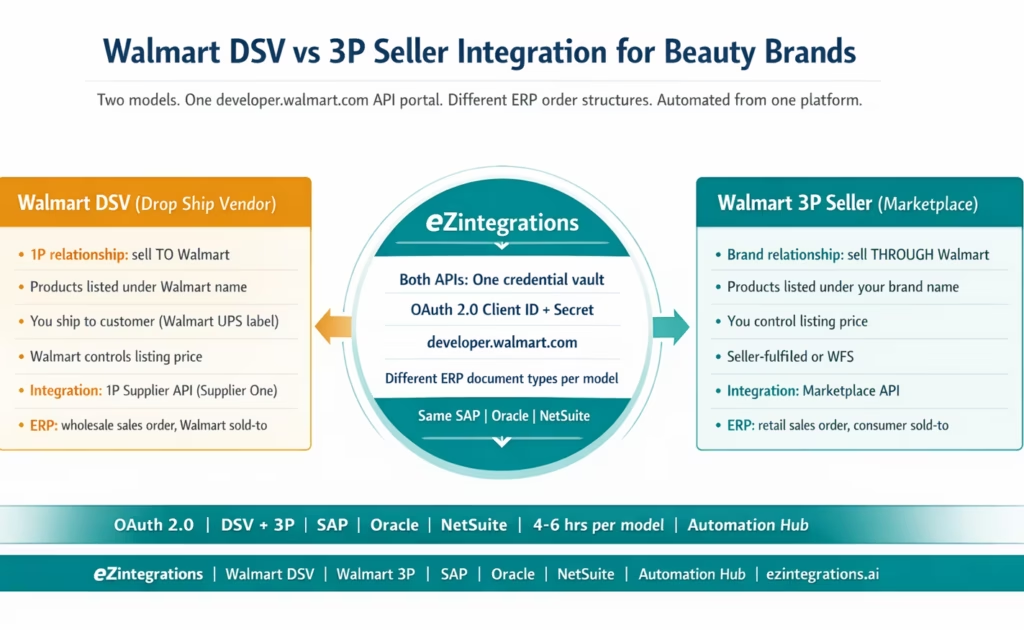
April 15, 2026Walmart DSV vs 3P Seller. Walmart DSV (Drop Ship Vendor) is a 1P relationship where the beauty brand sells products to Walmart at wholesale and ships orders directly to Walmart.com customers using Walmart’s label, with products listed under Walmart’s name. Walmart 3P Seller (Marketplace) is a seller relationship where the brand lists directly on Walmart.com under their own brand name, controls pricing, and fulfils orders themselves or via Walmart Fulfillment Services (WFS). Both integrate via the Walmart Developer Portal (developer.walmart.com) using OAuth 2.0 (Client ID and Client Secret), but different API sets: DSV uses the 1P Supplier API (Supplier One) for orders, inventory, and tracking; 3P uses the Marketplace API for orders, inventory, listings, and fulfilment. eZintegrations handles both from a single platform, connecting each to SAP S/4HANA, Oracle Fusion Cloud, or NetSuite with the correct ERP document types, pricing treatment, and inventory tracking per model.
TL;DR
- Walmart DSV (Drop Ship Vendor): you sell TO Walmart at wholesale. Products list under Walmart’s name. You ship to the end customer when ordered. Walmart pays UPS shipping. You have no control over your listing price. Integration: Walmart Supplier One API (1P) or EDI.
- Walmart 3P Seller (Marketplace): you sell THROUGH Walmart.com to consumers. Products list under your brand name. You control pricing. You fulfil (seller-fulfilled) or Walmart fulfils (WFS). Integration: Walmart Marketplace API.
- Many beauty brands run both models simultaneously: DSV for high-volume hero SKUs (better buy-box placement), 3P for new products, specialty shades, or premium SKUs where price control matters.
- The ERP integration is different for each: DSV orders create ERP sales orders with Walmart as the sold-to party and individual customer as ship-to (wholesale pricing). 3P orders create ERP sales orders with individual customers as sold-to party (retail pricing with Walmart referral fee deduction).
- Both models use
developer.walmart.comwith OAuth 2.0. DSV: 1P Supplier API. 3P: Marketplace API. eZintegrations handles both in one credential vault. - Walmart Fulfillment Services (WFS) for 3P sellers works similarly to Amazon FBA: brand sends inventory to WFS centres, Walmart picks/packs/ships. ERP integration mirrors the FBA pattern.
- Automation Hub templates for Walmart DSV and Walmart 3P. 4-6 hours to configure per model.
The Three Ways to Sell on Walmart and Why Beauty Brands Need to Know the Difference
Three beauty brands walk into Walmart.com. They all sell Rose Gloss. But their relationship with Walmart is completely different.
Brand A is a Walmart 1P Warehouse Supplier. They ship pallets of Rose Gloss to Walmart DCs every quarter. Walmart stocks the shelves, prices the product, runs the listing, and ships to customers. This is the traditional Walmart supplier relationship (covered in depth in the Walmart EDI guide and Walmart NetSuite integration guide).
Brand B is a Walmart Drop Ship Vendor (DSV). Rose Gloss is listed on Walmart.com under Walmart’s name. When a customer orders it, Walmart notifies Brand B, Brand B ships the Rose Gloss directly to the customer using a Walmart-provided UPS label, and Walmart pays Brand B at wholesale. Brand B never touches a Walmart DC.
Brand C is a Walmart 3P Marketplace Seller. Rose Gloss is listed on Walmart.com under Brand C’s name. Brand C sets the price, manages the listing, fulfils the order from their own warehouse or via Walmart Fulfillment Services (WFS). Brand C pays Walmart a referral fee on each sale (typically 10-15% for beauty).
The integration architecture for each model is completely different, as also outlined in third-party comparisons of Walmart selling models. The ERP treatment is different. The pricing and revenue recognition are different. Many beauty brands at scale operate as both DSV and 3P simultaneously: DSV for their hero SKUs (better organic visibility under Walmart’s name, faster buy-box placement), 3P for specialty shades, premium SKUs, or new product launches (where price control and brand presentation matter more than organic placement).
This post covers both: what DSV and 3P mean for your ERP, and how eZintegrations automates both from a single platform.
Walmart DSV: How It Works and What the ERP Integration Looks Like
The DSV Model
In the Walmart DSV programme, you (the beauty brand) are a first-party supplier. Walmart treats you as their vendor: they issue purchase orders or order notifications when a customer buys your product on Walmart.com, they pay you at the agreed wholesale price, and they cover the UPS shipping cost (Walmart provides you with a pre-paid UPS label for each order).
Your product is listed on Walmart.com under Walmart’s name. The listing says “Sold by Walmart” or “Fulfilled by Walmart.” You have minimal control over the listing content and no control over the retail price (Walmart sets it).
The DSV model is typically invite-only: Walmart’s category specialist reaches out to brands that are already selling at scale on their marketplace or have strong distribution relationships with Walmart.
What happens operationally:
- A Walmart.com customer orders your Rose Gloss.
- Walmart sends you an order notification via the Supplier One API (or EDI, if you have that configured).
- You (or your 3PL) pick, pack, and ship using the Walmart-provided UPS label.
- You upload the tracking number back to Walmart via the Supplier One API.
- Walmart pays you at wholesale on the next settlement cycle.
DSV ERP Treatment
Revenue recognition: DSV revenue is recognised at wholesale prices (not retail). When a DSV order is fulfilled, the ERP books: revenue at the agreed wholesale price, COGS at your manufacturing cost, and gross margin at wholesale (typically 40-60% for beauty, lower than DTC, higher than retail warehouse supply).
Customer master: the sold-to party in SAP or NetSuite is “WALMART-DSV” (a generic customer representing Walmart as your 1P buyer), not the individual end consumer. The ship-to address per order is the individual consumer’s address (passed from the Supplier One API order payload).
Sales order type: a dedicated SAP document type (e.g., ZDSV) or NetSuite sales order subtype for Walmart DSV distinguishes these orders from Walmart warehouse EDI 850 orders and from 3P marketplace orders in reporting and pricing procedures.
Inventory: the fulfilment order goes to your 3PL, which ships using Walmart’s UPS label. Your ERP tracks the inventory at your 3PL location, not at Walmart (no Walmart DC is involved).
Walmart 3P Seller: How It Works and What the ERP Integration Looks Like
The 3P Marketplace Model
As a Walmart 3P Marketplace Seller, you list your products directly on Walmart.com. Your brand name appears on the listing. You set the retail price (subject to Walmart’s price parity requirements). Walmart charges you a referral fee (8-15% of the sale price for beauty and personal care).
You control the listing content (images, copy, attributes) and can run Walmart Sponsored Products advertising. Your buy-box placement depends on your price, fulfilment speed, and seller performance metrics, competing with other 3P sellers and Walmart’s own 1P listings.
What happens operationally:
- A Walmart.com customer orders your Rose Gloss from your 3P listing.
- Walmart Marketplace API sends you the order.
- You fulfil the order from your warehouse or 3PL (seller-fulfilled), or Walmart Fulfillment Services (WFS) fulfils it if you use WFS.
- You upload tracking (seller-fulfilled) or WFS posts fulfilment automatically.
- Walmart settles with you weekly or biweekly: sale price minus referral fee.
3P ERP Treatment
Revenue recognition: 3P revenue is recognised at retail prices (the price the consumer paid). The referral fee (Walmart’s cut) is recognised as a cost of sale or selling expense. Net revenue is the consumer price minus the referral fee.
Customer master: the sold-to party for 3P orders can be configured two ways:
- A generic “WALMART-3P” customer (similar to the “AMAZON-US” customer used for Amazon orders), with individual consumer addresses as ship-to.
- Or, for brands that want consumer-level AR tracking, individual consumer records (not recommended for most beauty brands at scale due to the volume of new customers).
The generic customer approach is cleaner: all 3P Walmart orders post to the “WALMART-3P” customer, settlement reports clear the AR, and the referral fee is posted as a marketing or sales expense.
Sales order type: a separate document type from DSV (e.g., ZWMP for Walmart Marketplace in SAP, or a specific class/channel in NetSuite) keeps 3P orders distinct in reporting.
Pricing condition: the retail price on the 3P order is higher than the DSV wholesale price. If your ERP has a pricing procedure, ensure the 3P order uses a retail price condition type, not the wholesale condition type used for DSV and warehouse EDI 850 orders.
Walmart WFS: The 3P FBA-Equivalent
Walmart Fulfillment Services (WFS) is Walmart’s answer to Amazon FBA. As a 3P seller, you can send inventory to WFS fulfillment centers. When a customer orders, WFS picks, packs, and ships. You get the 2-day shipping badge (which significantly improves buy-box placement).
WFS ERP integration:
Like FBA, WFS inventory at Walmart’s fulfillment centres is tracked separately from your 3PL inventory. The ERP setup:
- Create a dedicated ERP plant (SAP) or location (NetSuite) for WFS (e.g., Plant
WFSUSor LocationWalmart WFS). - When you send inventory to WFS: Transfer Order (NetSuite) or STO (SAP) from your 3PL to the WFS location. Your 3PL location decreases, WFS location increases.
- When WFS sells and ships: WFS sell-through decrements the WFS location. Tracked via Walmart Marketplace API
GET /inventory. - When you need more WFS inventory: replenishment order from your 3PL to WFS (same pattern as FBA replenishment in Row 150).
WFS vs FBA inventory management comparison:
| Feature | Amazon FBA | Walmart WFS |
|---|---|---|
| ERP virtual location | AMZFC plant or Amazon FC location | WFSUS plant or Walmart WFS location |
| Sell-through tracking | SP-API afnFulfillableQuantity |
Walmart API GET /inventory WFS quantity |
| Inbound shipment | SP-API POST /inbound/vnd/shipments |
Walmart Marketplace API inbound |
| Replenishment alert | Level 3: fulfillable < reorder threshold | Level 3: WFS quantity < reorder threshold |
| Beauty shelf-life minimum | Amazon FC: 90 days | WFS: confirm with Walmart WFS guide |
Why Beauty Brands Often Run Both DSV and 3P Simultaneously
Many beauty brands operate as both DSV and 3P Marketplace sellers on Walmart.com for the same products. This hybrid approach is legitimate: Walmart explicitly allows it.
The strategic logic for beauty brands:
DSV is typically better for:
- Hero SKUs with proven high velocity (Walmart’s organic listing performance is stronger for DSV items listed under Walmart’s name)
- Products where price control is less critical (Walmart sets the price)
- Situations where Walmart’s supply chain (shipping labels, customer service) reduces operational burden
- High-volume, low-customisation SKUs
3P is typically better for:
- New product launches (you control the listing content and pricing from day one)
- Premium or specialty SKUs where the brand presentation and retail price positioning matters
- Limited editions and seasonal products (faster to list and delist than DSV programme updates)
- SKUs where you want margin control (you set the retail price, not Walmart)
The integration implication: if you run both, you need both the 1P Supplier API and the Marketplace API configured simultaneously. Orders from both models arrive and need to be routed to the ERP with different document types, pricing structures, and inventory flows. eZintegrations handles both in one platform.
Comparing DSV vs 3P Integration Architecture
| Feature | Walmart DSV | Walmart 3P Seller |
|---|---|---|
| API Portal | developer.walmart.com (1P Supplier tab) | developer.walmart.com (Marketplace tab) |
| Authentication | OAuth 2.0 Client ID + Secret (Supplier One) | OAuth 2.0 Client ID + Secret (Marketplace) |
| Order API | Supplier One API: orders endpoint | Marketplace API: GET /v3/orders |
| Inventory update | Supplier One API: PUT /inventory |
Marketplace API: PUT /v3/inventory/feeds |
| Tracking upload | Supplier One API: POST /tracking |
Marketplace API: POST /v3/orders/{purchaseOrderId}/shipping |
| Settlement | Supplier One settlement report | Marketplace settlement report (weekly/biweekly) |
| Walmart EDI alternative | Yes (EDI 850 + 856 + 846) | No (API only for Marketplace) |
| Product listing | Walmart controls | Brand controls |
| Retail price control | Walmart sets price | Brand sets price |
| Shipping cost | Walmart pays UPS label | Brand pays (unless WFS) |
| Buy-box advantage | DSV listings prioritised | Competes with all 3P sellers |
| ERP sold-to party | WALMART-DSV (Walmart as buyer) | WALMART-3P (consumer as buyer, brand as seller) |
| ERP order type | SAP ZDSV or NetSuite DSV class | SAP ZWMP or NetSuite Marketplace class |
| Revenue level | Wholesale | Retail minus referral fee |
| Returns to | Brand or brand 3PL | Brand 3PL or WFS returns |
DSV Integration: Walmart Supplier One API to ERP
Authentication
Both DSV (1P Supplier API) and 3P (Marketplace API) use OAuth 2.0 Client Credentials from developer.walmart.com. The credential sets are separate: your DSV Client ID and Secret are issued under the 1P Supplier tab, your 3P Client ID and Secret under the Marketplace tab.
POST https://marketplace.walmartapis.com/v3/token
Content-Type: application/x-www-form-urlencoded
Authorization: Basic {base64(ClientId:ClientSecret)}

grant_type=client_credentials
The token endpoint is the same for both DSV and 3P. The Client ID and Secret differ.
DSV Order Retrieval (Supplier One API)
GET https://supplier.walmart.com/v1/orders
    ?createdStartDate={timestamp}
    &limit=100
Authorization: Bearer {dsv_access_token}
WM_SVC.NAME: Walmart Marketplace
WM_TENANT_ID: {tenant_id}
The DSV order response includes:
purchaseOrderId: the Walmart order reference (unique per DSV order)shipToAddress: the consumer’s shipping address (where the brand must ship)orderLines: items ordered (Walmart item number, quantity, wholesale price)shippingInfo: the Walmart-provided UPS tracking label information
Key mapping: the Walmart item number in the DSV order maps to your ERP Material Number or NetSuite item via the cross-reference table (Walmart item number → ERP item).
DSV SAP Sales Order Creation
POST /sap/opu/odata/sap/API_SALES_ORDER_SRV/A_SalesOrder
{
  "SalesOrderType": "ZDSV",
  "SalesOrganization": "1000",
  "DistributionChannel": "20",
  "SoldToParty": "WALMART-DSV",
  "PurchaseOrderByCustomer": "{purchaseOrderId}",
  "to_Item": [{
    "Material": "{sap_material}",
    "RequestedQuantity": "{quantity}",
    "to_PricingElement": [{ "ConditionType": "ZDWP", "ConditionRateValue": "{wholesale_price}" }]
  }],
  "to_Partner": [{
    "PartnerFunction": "WE",
    "CustomerName1": "{consumer_name}",
    "StreetName": "{ship_to_street}",
    "CityName": "{ship_to_city}",
    "Region": "{ship_to_state}",
    "PostalCode": "{ship_to_zip}",
    "Country": "US"
  }]
}
Note: SalesOrderType: "ZDSV" and condition type ZDWP (Walmart DSV Wholesale Price) are SAP document types configured once in SAP Customising (no ABAP), distinguishing DSV orders from warehouse EDI 850 orders (ZAM) and 3P orders (ZWMP).
DSV Tracking Upload
When your 3PL ships the DSV order (using the Walmart UPS label):
POST https://supplier.walmart.com/v1/orders/{purchaseOrderId}/tracking
Authorization: Bearer {dsv_access_token}

{
  "trackingInfo": {
    "shipDateTime": "2026-01-30T14:00:00Z",
    "carrierName": "UPS",
    "trackingNumber": "1Z9W4872XXXX"
  }
}
This tracking upload is the DSV equivalent of the Walmart EDI 856 ASN or Amazon SP-API shipment confirmation. It must be submitted within Walmart’s required window (confirm with your DSV programme guide).
3P Integration: Walmart Marketplace API to ERP
3P Order Retrieval (Marketplace API)
GET https://marketplace.walmartapis.com/v3/orders
    ?createdStartDate={timestamp}
    &status=Created
Authorization: Bearer {marketplace_access_token}
WM_SVC.NAME: Walmart Marketplace
WM_QOS.CORRELATION_ID: {uuid}
The Marketplace API order response is structurally different from the DSV API:
purchaseOrderId: Walmart’s order referencebuyerInfo: consumer’s name and address (ship-to)orderLines: items (Walmart item number, quantity, charge amount = retail price paid by consumer)estimatedDeliveryDate: expected delivery date (drives SLA)
The referral fee: the charge.amount in the 3P order is the consumer’s retail price. Walmart deducts the referral fee on settlement. The ERP should record the full retail price as revenue and the referral fee as a deduction (when the settlement is processed).
3P NetSuite Sales Order Creation
POST /services/rest/record/v1/salesOrder
{
  "entity": { "id": "{walmart_3p_customer_id}" },
  "tranDate": "{order_date}",
  "otherRefNum": "{purchaseOrderId}",
  "class": { "id": "{walmart_marketplace_class_id}" },
  "memo": "Walmart 3P Order {purchaseOrderId}",
  "item": {
    "items": [{
      "item": { "id": "{netsuite_item_id}" },
      "quantity": {quantity},
      "rate": {retail_price_from_order},
      "description": "Walmart Marketplace | Retail price"
    }]
  }
}
Note: rate uses the consumer retail price, not wholesale. The Walmart referral fee is a separate deduction posted during settlement reconciliation.
3P Fulfilment Confirmation (Seller-Fulfilled)
When your 3PL ships a 3P order:
POST https://marketplace.walmartapis.com/v3/orders/{purchaseOrderId}/shipping
Authorization: Bearer {marketplace_access_token}
{
  "orderShipment": {
    "packageASNList": [{
      "trackingInfo": {
        "shipDateTime": "2026-01-30T14:00:00Z",
        "carrierName": { "otherCarrier": "UPS" },
        "methodCode": "Standard",
        "trackingNumber": "1Z9W4872XXXX"
      },
      "itemASNList": [{ "lineNumber": "1", "unitPrice": {retail_price}, "amount": 1 }]
    }]
  }
}
3P Settlement Reconciliation
Walmart 3P settlements include: gross sales (retail prices), referral fees (deducted), any adjustments, and net payout. Settlement is reconciled against ERP in a process similar to the Walmart EDI settlement described in the Walmart NetSuite integration guide: referral fees post to a marketing expense account, net settlement clears the AR balance.
WFS Integration: Inventory Tracking in the ERP
For beauty brands using WFS, the inventory management pattern mirrors Amazon FBA:
Sending inventory to WFS:
POST https://marketplace.walmartapis.com/v3/fulfillment/inbound-shipments
Authorization: Bearer {marketplace_access_token}
{
  "shipmentInfo": {
    "shipFromAddress": { ...your 3PL address... },
    "destinationFulfillmentCenterId": "{WFS_FC_code}"
  },
  "items": [{ "sku": "{walmart_sku}", "quantity": 500 }]
}
ERP transfer order created: 3PL location → WFS location. 3PL inventory decremented. WFS inventory incremented on WFS confirmation.
WFS inventory query:
GET https://marketplace.walmartapis.com/v3/inventory
    ?sku={walmart_sku}&shipNode=WFS
Authorization: Bearer {marketplace_access_token}
Returns: quantity available at WFS. eZintegrations polls this every 30-60 minutes and updates the ERP WFS location accordingly.
WFS replenishment: Level 3 monitors WFS available quantity. When below the reorder threshold (calculated from average daily 3P sales velocity), a replenishment alert fires and an ERP Transfer Order is created.
Before vs After: Manual Walmart DSV/3P vs Automated
| Process Step | Manual DSV/3P Management | Automated with eZintegrations |
|---|---|---|
| DSV order detection | Check Supplier One portal (1-2x daily) | DSV API polled every 2-5 minutes |
| 3P order detection | Check Marketplace portal or email notification | Marketplace API polled every 2-5 minutes |
| Walmart item to ERP item mapping | Manual lookup per order | Cross-reference dataset: auto-applied |
| DSV ERP sales order | Manual: 10-20 min per order (wholesale pricing, Walmart as sold-to) | SAP ZDSV or NetSuite DSV class: auto-created in seconds |
| 3P ERP sales order | Manual: similar, with retail pricing and different customer | SAP ZWMP or NetSuite Marketplace class: auto-created in seconds |
| DSV 3PL fulfilment routing | Manual: ops team sends to 3PL after ERP entry | Auto-routed to 3PL on DSV order receipt |
| DSV tracking upload to Walmart | Manual: enter tracking in Supplier One portal | Auto: 3PL shipment event → POST /tracking |
| 3P fulfilment confirmation | Manual: enter tracking in Marketplace portal | Auto: 3PL shipment event → POST /orders/{id}/shipping |
| DSV vs 3P order routing | Manual: ops team identifies which model each order belongs to | Auto: separate API endpoints, separate ERP document types |
| WFS inventory sync | Manual: check WFS portal | Marketplace API GET /inventory?shipNode=WFS every 30-60 min |
| WFS replenishment | Reactive: noticed when buy-box suppressed for low stock | Level 3: WFS quantity < threshold → ERP Transfer Order |
| DSV settlement reconciliation | Manual: Supplier One settlement vs ERP AR | Auto: settlement parsed → GL posting → AR cleared |
| 3P settlement + referral fee posting | Manual: settlement download + GL coding | Auto: settlement parsed → referral fee → GL 692000 → AR cleared |
| Running both DSV and 3P | Two separate tools, two teams | One eZintegrations platform, both models |
Step-by-Step: A DSV Order and a 3P Order on the Same Day
eZintegrations handles both Walmart DSV and 3P flows using all four platform levels.
Level 1 (iPaaS Workflows) manages OAuth 2.0 token refresh, Supplier One API and Marketplace API order polling, ERP sales order creation with correct document types (ZDSV/ZWMP in SAP, DSV/Marketplace class in NetSuite), 3PL routing, tracking upload to Walmart, and settlement reconciliation.
Level 2 (AI Workflows) validates DSV tracking upload timing, reconciles referral fee amounts, and flags settlement discrepancies.
Level 3 (AI Agents) monitors WFS inventory levels against reorder thresholds and detects DSV/3P channel inventory imbalances.
Level 4 (Goldfinch AI) orchestrates both Walmart channel flows as a Workflow Node and provides the Goldfinch AI Chat UI: “What DSV orders await tracking upload?”, “What is my 3P referral fee total this period?”, or “Which WFS SKUs are below reorder threshold?”
Here is how eZintegrations handles both order types simultaneously for Lumière Cosmetics, which runs DSV for Rose Gloss (high-velocity hero SKU) and 3P Marketplace for their premium Velvet Foundation line.
Setup: Lumière uses SAP S/4HANA. DSV credentials in eZintegrations: dsv_client_id and dsv_client_secret. 3P credentials: mkt_client_id and mkt_client_secret. 3PL is Kenco Atlanta for both channels.
10:14 AM: DSV order arrives. eZintegrations polls Supplier One API. New DSV order detected: purchaseOrderId: WM-DSV-2026-00441. Product: Rose Gloss, Walmart item #004-17-0142, quantity 2, wholesale price $6.99 each. Ship to: Sarah M., 247 Maple Ave, Austin TX 78701.
SAP sales order created: SalesOrderType: ZDSV, SoldToParty: WALMART-DSV, ship-to: Sarah M., 2 units LGLOSS-04 at $6.99 (wholesale). SAP sales order SO-DSV-2026-00441 created. Time: 2 seconds.
Kenco DTC fulfilment request sent with Walmart-provided UPS label info. Time: 1 second.
10:17 AM: 3P Marketplace order arrives. eZintegrations polls Marketplace API. New 3P order: purchaseOrderId: WM-3P-2026-07829. Product: Velvet Foundation Shade 5, Walmart item #WLM-VFDN-05, quantity 1, consumer retail price $32.99. Ship to: James K., 891 Oak Street, Denver CO 80203.
SAP sales order created: SalesOrderType: ZWMP, SoldToParty: WALMART-3P, ship-to: James K., 1 unit VFDN-05 at $32.99 (retail). SAP sales order SO-3P-2026-07829 created. Time: 2 seconds.
Kenco DTC fulfilment request sent. Time: 1 second.
2:30 PM: Kenco ships both orders. Kenco processes both orders and ships. Two shipment push events fire at 2:30 PM.
DSV order: Walmart tracking upload.
POST /v1/orders/WM-DSV-2026-00441/tracking
{ "trackingNumber": "1Z9W4872AAAA", "carrierName": "UPS", "shipDateTime": "2026-01-30T14:30:00Z" }
Walmart marks DSV order as shipped. SAP goods issue posted: SO-DSV movement type 601 from Kenco plant.
3P order: Walmart fulfilment confirmation.
POST /v3/orders/WM-3P-2026-07829/shipping
{ "trackingNumber": "1Z9W4872BBBB", "carrierName": "UPS" }
Walmart marks 3P order as shipped. SAP goods issue posted: SO-3P movement type 601 from Kenco plant.
End of week: Settlement reconciliation. DSV settlement: Lumière receives 6.99×2=13.98 for order WM-DSV-2026-00441. AR for SO-DSV cleared.
3P settlement: Lumière receives 32.99−1528.04 for order WM-3P-2026-07829. Referral fee $4.95 posted to GL 692000 (Walmart Referral Fees). AR for SO-3P cleared.
Total ops team involvement: zero manual touchpoints for either order.
Key Outcomes and Results
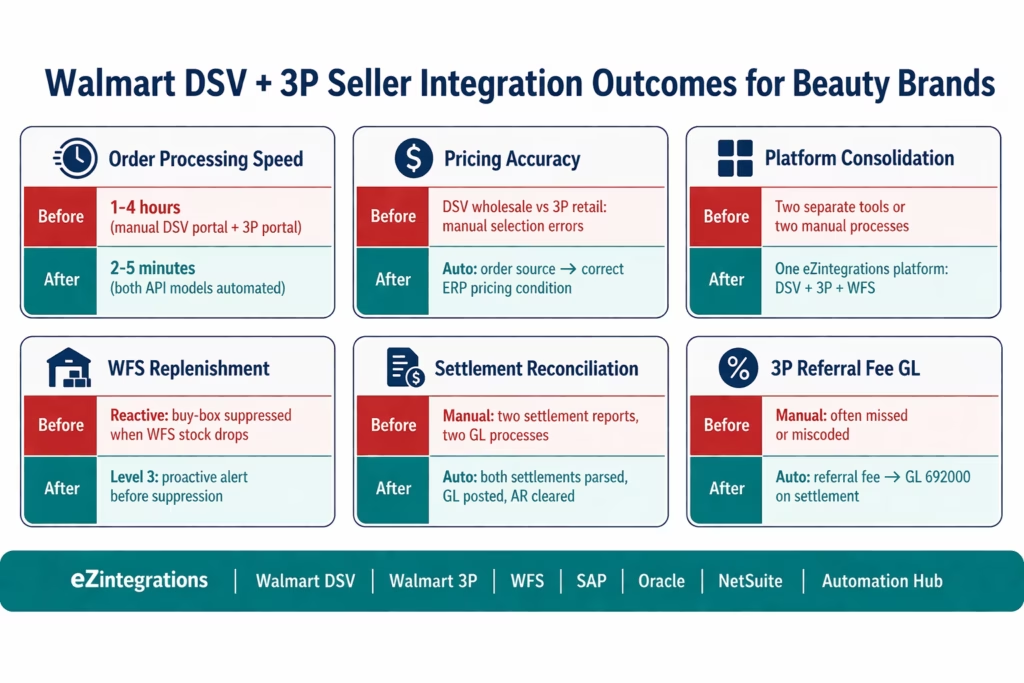
Both models, one platform: beauty brands that previously managed DSV and 3P with separate tools (or with two manual processes) consolidate both into a single eZintegrations workflow. One credential vault, one mapping table, one ERP connection.
Order processing speed: DSV and 3P orders both detected and SAP/NetSuite sales orders created within 2-5 minutes of the Walmart API order appearing. Manual processes: 1-4 hours depending on ops team availability.
Pricing accuracy: DSV orders use wholesale pricing conditions in SAP/NetSuite. 3P orders use retail pricing. Automatic routing by order source ensures the wrong pricing condition is never applied to the wrong order type.
Settlement accuracy: DSV and 3P settlements both reconciled automatically. 3P referral fees posted to the correct expense GL account. DSV wholesale payments clear AR correctly. Finance close includes all Walmart revenue without manual settlement import.
WFS replenishment: Level 3 monitoring of WFS inventory prevents the 3P buy-box suppression that occurs when WFS stock drops below Walmart’s threshold. WFS replenishment alerts fire before the suppression, not after.
Running both simultaneously: beauty brands that run both DSV and 3P report that the manual complexity of managing two separate Walmart relationships is the primary reason they under-invest in one of the models. With both automated in one platform, both channels can be managed without proportionally increasing ops headcount.
How to Get Started
Step 1: Identify Which Walmart Models You Operate
Confirm whether you are a Walmart DSV, a Walmart 3P Marketplace Seller, or both. Log into developer.walmart.com and check which portals are available to you: the 1P Supplier tab (DSV) and/or the Marketplace tab (3P). If you operate both, you will have separate Client ID and Client Secret credentials for each. Request both credential sets from the Walmart Developer Portal. Also confirm whether you use WFS for any 3P SKUs: if so, identify which Walmart SKUs are WFS-fulfilled and their current WFS inventory levels.
Step 2: Import the Walmart DSV and/or 3P Integration Templates
Go to the Automation Hub and import:
- Walmart DSV Integration template (if you are a DSV): covers Supplier One API order polling, Walmart item to ERP item mapping, SAP
ZDSVor NetSuite DSV class sales order creation with wholesale pricing, 3PL fulfilment routing with Walmart UPS label, Supplier One tracking upload, and DSV settlement reconciliation. - Walmart 3P Marketplace Integration template (if you are a 3P seller): covers Marketplace API order polling, SAP
ZWMPor NetSuite Marketplace class sales order creation with retail pricing, 3PL seller-fulfilled or WFS routing, Marketplace fulfilment confirmation, WFS inventory sync and replenishment monitoring, and 3P settlement reconciliation with referral fee GL posting.
Import both if you operate both models. They share the same ERP credentials and item mapping infrastructure.
Step 3: Configure Credentials, Item Mapping, and ERP Document Types
Add DSV Client ID and Secret (tagged as “Walmart DSV”) and 3P Client ID and Secret (tagged as “Walmart 3P”) to the eZintegrations credential vault. Add ERP credentials (SAP BTP Communication Arrangement or NetSuite TBA). Upload the Walmart item number to ERP item cross-reference table (one table, used for both DSV and 3P if your items exist in both models). Configure the SAP document types (ZDSV for DSV, ZWMP for 3P) or NetSuite classes. Set up the generic customer records (WALMART-DSV and WALMART-3P) in your ERP. Map GL accounts: wholesale revenue account for DSV, retail revenue account for 3P, referral fee expense for 3P.
Step 4: Test Each Model Separately
Test DSV first: place a test order in Walmart’s DSV sandbox environment, confirm the SAP or NetSuite sales order is created with correct document type and wholesale pricing, confirm the 3PL fulfilment request fires, and confirm the tracking upload reaches Walmart’s portal. Then test 3P: place a test order in the Marketplace sandbox, confirm the sales order is created with retail pricing, confirm fulfilment, and confirm the Marketplace shipment confirmation is posted.
Total configuration time: 4-6 hours per Walmart model (DSV or 3P) from template import to live automation.
FAQs
Walmart DSV (Drop Ship Vendor) is a 1P (first-party) relationship: you sell your product to Walmart at wholesale prices, products are listed on Walmart.com under Walmart's name, and when a customer orders, you ship directly to the customer using a Walmart-provided UPS label. Walmart controls the retail price and listing content. Walmart 3P Seller (Marketplace) is a seller relationship: your products are listed on Walmart.com under your brand name, you set the retail price (subject to Walmart's price parity requirements), and you fulfil orders from your own warehouse or via Walmart Fulfillment Services (WFS). DSV uses the Walmart 1P Supplier API (Supplier One); 3P uses the Walmart Marketplace API. Both authenticate via OAuth 2.0 at developer.walmart.com. Both can be automated from eZintegrations simultaneously.
4-6 hours per Walmart model from Automation Hub template import to live automation. Breakdown: credential setup (30-60 minutes for each model), Walmart item to ERP item cross-reference table (1-2 hours, shared across both models), SAP document type or NetSuite class configuration (30-60 minutes), settlement GL account configuration (30 minutes), and test validation (1-2 hours per model). If you configure both DSV and 3P together, the item mapping and ERP setup is shared, reducing total time.
Yes, eZintegrations maintains separate OAuth 2.0 credential sets for Walmart DSV (1P Supplier API) and Walmart 3P (Marketplace API), both from developer.walmart.com. DSV orders create ERP sales orders with the DSV document type (SAP ZDSV, NetSuite DSV class) and wholesale pricing. 3P orders create ERP sales orders with the 3P document type (SAP ZWMP, NetSuite Marketplace class) and retail pricing. Both models use the same ERP connection and item mapping table. Both settlements are reconciled automatically with the correct GL treatment per model.
DSV orders: sold-to party is the generic "WALMART-DSV" customer (representing Walmart as the 1P buyer). Revenue is recognised at wholesale prices. SAP sales order type ZDSV or NetSuite DSV class. Fulfilment ships with Walmart-provided UPS labels. No referral fee deduction (Walmart pays at wholesale). 3P orders: sold-to party is the generic "WALMART-3P" customer. Revenue is recognised at retail prices. SAP order type ZWMP or NetSuite Marketplace class. Fulfilment ships with brand-provided carrier (or WFS). Referral fee (8-15%) posted to selling expense on settlement. Reporting distinguishes the two: DSV revenue shows wholesale margin, 3P revenue shows retail margin with referral fee deduction.
Walmart Fulfillment Services (WFS) is Walmart's 3P fulfillment programme, similar to Amazon FBA. As a 3P Marketplace Seller, you send inventory to WFS fulfillment centres. Walmart picks, packs, and ships orders placed on your 3P listing. WFS orders get the 2-day shipping badge. ERP integration: a dedicated plant (SAP WFSUS) or location (NetSuite) tracks WFS inventory separately from your 3PL. Inventory sent to WFS creates an ERP Transfer Order. WFS sell-through decrements the WFS location via GET /inventory?shipNode=WFS polling. Level 3 monitors WFS inventory and fires replenishment alerts before buy-box suppression occurs. 1. What is the difference between Walmart DSV and Walmart 3P Seller for beauty brands?
2. How long does it take to set up Walmart DSV and 3P integration with SAP or NetSuite?
3. Does eZintegrations work with both Walmart DSV (Supplier One API) and Walmart Marketplace API simultaneously?
4. How does the ERP treat DSV orders differently from 3P orders?
5. What is Walmart WFS and how does it integrate with the ERP?
One Walmart. Two Models. One Integration Platform.
Walmart DSV and Walmart 3P are not competing choices. For many beauty brands, they are complementary strategies for different parts of the product portfolio. DSV for the hero SKUs with proven velocity and buy-box advantage. 3P for the premium and specialty SKUs where brand control and retail pricing matter.
The problem is that running both manually doubles the operational overhead: two portals, two tracking upload processes, two settlement reports, two GL reconciliation workflows. Two sets of errors. Two sets of corrections at month-end.
eZintegrations handles both from one platform: Supplier One API and Marketplace API in the same credential vault, the same item mapping table, the same ERP connection. DSV orders post at wholesale. 3P orders post at retail. Both settlements reconcile to the same ERP GL. WFS inventory monitors automatically.
Import the Walmart DSV and 3P Integration Templates from the Automation Hub. Or book a free demo with your Walmart account type (DSV, 3P, or both), ERP type, and SKU count. We will confirm your Developer Portal credentials and walk through the document type configuration in the session.
For the Walmart store supplier (EDI 850/856 to DC) integration, see the Walmart EDI guide and the Walmart NetSuite integration guide.