How to Automate Regulatory Change Monitoring and Impact Assessment Using an AI Agent
$150.00
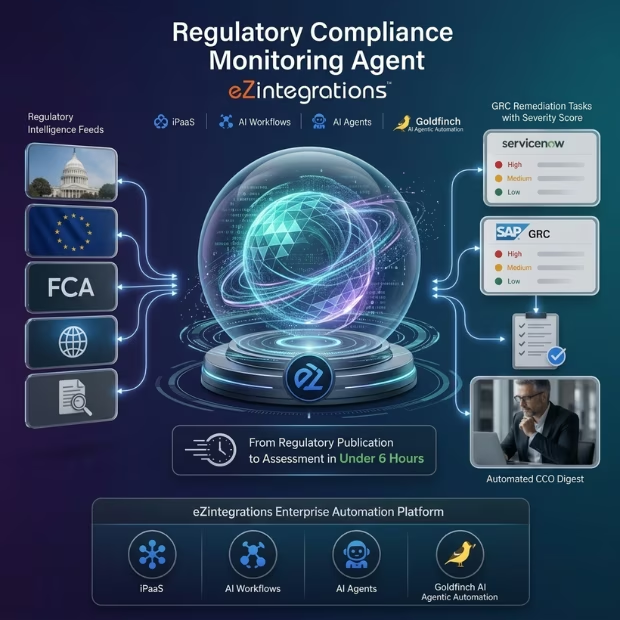
Regulatory Compliance Monitoring Agent Continuously monitor regulatory feeds from Thomson Reuters; Wolters Kluwer; and configured regulatory APIs; extract structured change details via NLP; assess impact against internal policies and processes stored in the vector knowledge base; create remediation tasks in GRC systems (ServiceNow GRC or SAP GRC) with assigned Compliance Owners; track remediation to completion; and deliver a monthly regulatory change digest to the CCO – without manual regulatory scanning; ad hoc impact assessment; or spreadsheet-based tracking Regulatory change monitoring coverage from 60 to 70% (manual scanning capacity) to 100% of configured regulatory domains; impact assessment turnaround from 5 to 10 business days (manual) to under 6 hours per change; Compliance Analyst research time reduced from 70% to under 15% of working hours; systemic compliance risk from missed regulatory changes eliminated; CCO regulatory visibility transformed from monthly lagging report to continuous real-time dashboard Chief Compliance Officer (CCO); GRC Manager; Compliance Analyst; Chief Risk Officer (CRO) AI Agent (autonomous; goal-oriented; adaptive – continuously monitors regulatory feeds; adapts its impact assessment based on what it finds in the internal policy knowledge base; and escalates based on severity and remediation SLA status without human instruction per regulatory change) Yes – eZintegrations connects to on-premises systems (SAP GRC on-prem; ServiceNow on-prem; Oracle GRC; MSSQL compliance databases; and others) via IPSec Tunnel. eZintegrations is a browser-based; cloud-hosted platform and does not require any on-premises installation. REST API (Thomson Reuters Regulatory Intelligence API; Wolters Kluwer TeamMate+ API; ServiceNow GRC REST API; SAP GRC via OData); Web Crawling (regulatory body websites; CFPB; EBA; EMA; EPA; and configured jurisdiction sources); HTTPS; OAuth 2.0; SMTP (Compliance Owner task notification; CCO digest delivery); JDBC (compliance database); IPSec Tunnel (on-premises GRC; compliance database; and SAP GRC connectivity) Both single-tenant and multi-tenant deployments are available. Single-tenant is strongly recommended for financial services; healthcare; and pharmaceutical organizations where regulatory intelligence; policy documents; and remediation task data are subject to strict data confidentiality and audit segregation requirements. Multi-tenant is the default shared-cloud deployment. Both support on-premises GRC connectivity via IPSec Tunnel. Financial Services; Pharmaceuticals; Healthcare; Energy; Insurance 100% regulatory change coverage across configured domains; impact assessment in under 6 hours per change; GRC task auto-created and Compliance Owner assigned within 2 hours of impact detection; CCO regulatory digest automated from manual monthly assembly to auto-generated report regulatory compliance agent; regulatory change monitoring AI; compliance monitoring automation; GRC automation AI agent; Goldfinch AI compliance; regulatory impact assessment AI; ServiceNow GRC AI agent; SAP GRC automation; CCO compliance digest AI; regulatory intelligence AI; policy impact assessment automation; compliance task automation AI Yes – the regulatory compliance agent invokes multiple Goldfinch AI tools per regulatory change: Watcher Tools (continuous feed monitoring); Web Crawling (full text retrieval where needed); Document Intelligence (regulatory document NLP extraction); Knowledge Base Vector Search (internal policy impact matching); Data Analysis (impact assessment and severity scoring); API Tool Call (GRC task creation and status tracking); and Integration Workflow as Tool (CCO digest and Compliance Owner notification sub-workflows). Credits consumed per regulatory change processed. Data Analysis: Generates the structured impact assessment per regulatory change – impact severity (Critical/High/Medium/Low) based on the degree of alignment gap between the new regulatory requirement and the current internal policy state, estimating remediation effort (policy update, process change, system change, training), calculating the compliance deadline risk (days to deadline relative to estimated remediation effort), and identifying the appropriate Compliance Owner based on the impacted business unit and policy domain; API Tool Call: Creates the remediation task in ServiceNow GRC or SAP GRC – populating task fields with regulatory change details, impact assessment, severity score, compliance deadline, recommended remediation actions, and assigned Compliance Owner; queries GRC for open task status to track remediation progress; and triggers the CCO monthly digest report generation workflow, Document Intelligence: Analyzes each detected regulatory document – extracting structured change details: effective date, jurisdiction, regulatory body, affected product/service categories, specific regulatory obligation changes (new requirements added, existing requirements modified, deadlines changed, penalties updated), and the compliance deadline. For complex multi-article regulations, Document Intelligence identifies which specific articles and sections represent material changes vs. non-material technical corrections, Integration Workflow as Tool: Calls the CCO monthly regulatory digest sub-workflow – compiling all regulatory changes monitored, assessed, and tasked during the reporting period into a structured executive summary with severity distribution, remediation status by domain, approaching deadline alerts, and jurisdictional change volume trends; also calls the Compliance Owner notification sub-workflow to deliver task assignments via SMTP with full regulatory context, Knowledge Base Vector Search: Queries the internal policy and process knowledge base – matching the regulatory change’s affected categories, obligation types, and jurisdiction against the organization’s internal policies, operating procedures, business processes, and prior compliance assessments to determine which internal documents are impacted and to what degree; also retrieves prior regulatory changes in the same jurisdiction and category to support the impact assessment context, Watcher Tools: Continuously monitors configured regulatory intelligence feeds (Thomson Reuters Regulatory Intelligence API, Wolters Kluwer TeamMate+ API, and direct regulatory body RSS/API feeds from CFPB, EBA, EMA, EPA, SEC, FCA, and other configured jurisdictions) for new regulatory publications, proposed rules, final rules, guidance documents, and enforcement actions – triggering the impact assessment workflow within 60 minutes of a new regulatory publication being detected; Web Crawling: Crawls the official websites of regulatory bodies and relevant legal news sources for regulatory developments not yet captured in paid regulatory intelligence feeds – including consultation papers, supervisory guidance letters, regulatory speeches signaling forthcoming changes, and enforcement actions that may not appear in structured API feeds for 24 to 48 hours; also crawls to retrieve the full text of referenced regulations when the API feed returns only a summaryWorkflow Name: Purpose: Benefit: Who Uses It: System Type: On-Premise Supported: Supported Protocols: Tenancy Model: Industry: Outcome: Tags: AI Credits Required: Goldfinch AI Tool(s) Used:
Table of Contents
The Regulatory Compliance Monitoring Agent from eZintegrations monitors regulatory intelligence feeds 24/7 via Goldfinch AI Watcher Tools – detecting new publications from Thomson Reuters; Wolters Kluwer; and configured regulatory body feeds within 60 minutes of release. Goldfinch AI Web Crawling retrieves full regulatory text when feeds return summaries only. Goldfinch AI Document Intelligence extracts structured change details from each regulatory document. Goldfinch AI Knowledge Base Vector Search matches the regulatory change against the organization’s internal policy and process knowledge base to identify impacted documents. Goldfinch AI Data Analysis generates a severity-scored impact assessment. Goldfinch AI API Tool Call creates the remediation task in ServiceNow GRC or SAP GRC with the assigned Compliance Owner. Goldfinch AI Integration Workflow as Tool delivers the CCO monthly digest. 24/7 continuous regulatory monitoring: Watcher Tools monitors all configured regulatory intelligence feeds continuously – detecting new publications within 60 minutes of release and triggering the impact assessment workflow automatically, without Compliance Analyst manual scanning of regulatory feeds each morning; Policy-matched impact assessment: Knowledge Base Vector Search queries the internal policy knowledge base to identify exactly which internal policies, procedures, and business processes are materially impacted by each regulatory change – producing a specific, evidence-based impact assessment rather than a generic regulatory summary, Automated CCO regulatory digest: Integration Workflow as Tool generates a monthly executive digest for the CCO -regulatory change volume by jurisdiction and severity, remediation status by domain, approaching deadlines, and year-over-year change volume trends – assembled automatically from GRC data rather than manually compiled by the Compliance team, Severity-scored GRC task creation: Data Analysis scores each regulatory change as Critical, High, Medium, or Low based on the alignment gap between the new requirement and the current internal policy state – and API Tool Call immediately creates the correctly severity-scored, deadline-dated GRC task with the assigned Compliance Owner, eliminating the manual GRC entry step; Remediation SLA tracking: The agent monitors open GRC tasks via API Tool Call and escalates approaching-deadline tasks to the GRC Manager when remediation progress falls behind the compliance deadline timeline – not after the deadline passes Systemic compliance risk from missed regulatory changes eliminated (100% coverage vs. 60 to 70% manual); compliance exposure window from publication to assessment reduced from 5 to 10 business days to under 6 hours; Compliance Analyst capacity freed from feed scanning and manual assessment for policy writing and complex regulatory interpretation Compliance Analyst regulatory scanning and manual assessment time from 70% to under 15% of working hours; GRC task creation from manual Analyst entry (30 to 60 minutes per change) to automated within 2 hours; CCO monthly digest from 8 to 12 hours of manual compilation to auto-generated Compliance Analyst labor reduction: 3 to 4 FTE equivalent monitoring and assessment capacity per 100 regulatory changes per month – at $95,000 blended fully-loaded Compliance Analyst cost per year; 3 FTE equivalent = $285,000 annually. Regulatory penalty avoidance: a single regulatory enforcement action in financial services averages $4M to $150M+ (Federal Reserve; OCC; and CFPB enforcement data). The agent’s 100% coverage and sub-6-hour assessment window materially reduces the probability of a missed-change enforcement event. External regulatory intelligence consulting fees: $60,000 to $200,000 annual retainer per jurisdiction replaced by AI monitoring. Regulatory change volumes have increased 500% since 2010, with large institutions tracking 50–100 updates monthly across jurisdictions. Compliance teams manually review feeds, assess policy impact, document findings, and assign tasks-taking 5-10 days and creating a risk window. Missing key changes can lead to penalties and reputational damage, while CCO visibility relies on manual reports that are often outdated.Solution Overview: Key Features: Business Impact: Productivity Gain: Cost Savings: Problem Before:
Description
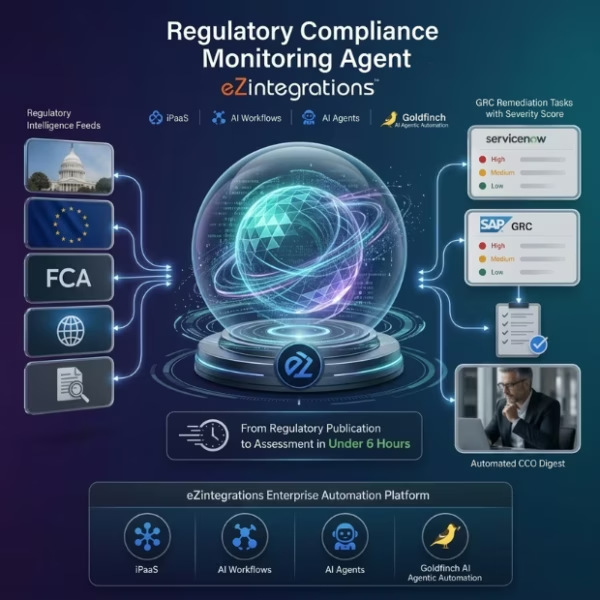
The regulatory compliance agent from eZintegrations continuously monitors regulatory intelligence feeds, extracts change details via NLP, matches new requirements against your internal policy knowledge base, creates severity-scored GRC remediation tasks in ServiceNow or SAP GRC, and delivers an automated CCO digest – compressing the regulatory publication-to-assessment window from days to under 6 hours. eZintegrations is an enterprise automation platform covering iPaaS, AI Workflows, AI Agents, and Goldfinch AI agentic automation.
What Is a Regulatory Compliance Agent?
A regulatory compliance agent is an AI Agent that takes continuous regulatory change monitoring as its goal and autonomously executes the full monitor-to-remediate cycle – detecting new regulatory publications from configured feeds, extracting structured obligation details from regulatory documents, matching new requirements against the organization’s internal policy knowledge base to identify impacted processes, scoring impact severity, creating remediation tasks in the GRC system with assigned Compliance Owners, tracking remediation to deadline, and delivering executive compliance reporting. It is reactive (triggers within 60 minutes of a new regulatory publication), adaptive (it adjusts its impact assessment based on each organization’s specific policy library), and autonomous (it acts without Compliance Analyst instruction per regulatory change for covered jurisdictions and obligation types).
How Does a Regulatory Compliance Agent Continuously Monitor Regulatory Changes, Assess Policy Impact, and Create GRC Remediation Tasks Automatically?
The regulatory compliance agent monitors configured regulatory intelligence feeds 24/7 via Goldfinch AI Watcher Tools. When a new publication is detected, Goldfinch AI Web Crawling retrieves the full regulatory text if needed. Goldfinch AI Document Intelligence extracts structured change details – effective date, jurisdiction, affected categories, and specific obligation changes. Goldfinch AI Knowledge Base Vector Search queries the internal policy knowledge base to identify which policies are materially impacted. Goldfinch AI Data Analysis generates the severity-scored impact assessment and remediation estimate. Goldfinch AI API Tool Call creates the GRC task in ServiceNow or SAP GRC with the Compliance Owner assigned. Goldfinch AI Integration Workflow as Tool delivers the CCO monthly digest.
Thomson Reuters Cost of Compliance Survey documents that regulatory change volume has increased 500% since 2010. This regulatory compliance agent makes 100% coverage of that volume operationally achievable without proportional headcount growth.
Watch Demo
| Video Title: | Regulatory Compliance Agent |
|---|---|
| Duration: | 5 to 7 minutes |
Outcome & Benefits
| Throughput: | Up to 500 regulatory changes processed per day at standard configuration; scales to 5,000+ per day at enterprise tier for global organizations monitoring multiple jurisdictions simultaneously; agent operates 24/7 across all configured time zones and regulatory calendar cycles |
|---|---|
| Cost Reduction: | 3 to 4 FTE equivalent Compliance Analyst monitoring and assessment capacity = $285,000 to $380,000 annually; $60,000 to $200,000 external regulatory consulting fee elimination per jurisdiction; regulatory penalty exposure reduction from improved coverage and assessment speed (average enforcement action in financial services: $4M to $150M+ per Federal Reserve and OCC enforcement data) |
| Accuracy: | Regulatory change detection coverage: 100% of configured feeds and jurisdictions; policy impact match accuracy (Knowledge Base Vector Search identifying correct internal policies as materially impacted): 91%+ on held-out validation; impact severity scoring agreement with Compliance Lead review: 87%+ for High and Critical classifications |
| Time Saved: | Regulatory publication-to-assessment from 5 to 10 business days to under 6 hours; GRC task creation from 30 to 60 minutes manual entry per change to automated within 2 hours; CCO monthly digest from 8 to 12 hours of manual compilation to auto-generated in under 30 minutes |
Performance Metrics
| Metric | Before (Manual/Batch) | After (Real-Time Sync) | Improvement |
|---|---|---|---|
| Regulatory Change Coverage | 60 to 70% of changes tracked | 100% of configured feeds | Full coverage |
| Publication-to-Assessment Window | 5 to 10 business days | Under 6 hours | 95%+ faster |
| GRC Task Creation Time | 30 to 60 min manual entry | Automated within 2 hours | Fully automated |
| CCO Monthly Digest Compilation | 8 to 12 hours manual | Auto-generated under 30 min | 97%+ time saving |
Technical Details
| Data Validation: | Three-stage validation per regulatory change: source verification – the agent verifies the regulatory publication is from a configured authoritative source before triggering assessment (preventing false positives from unofficial regulatory commentary); materiality threshold – Document Intelligence classification confidence must exceed 0.72 before the change is assessed as a potential policy impact; changes below threshold are flagged for Compliance Analyst review rather than auto-assessed; impact assessment review gate – for Critical-severity impacts; the agent presents the draft assessment to the GRC Manager for review before the GRC task is created and Compliance Owner notified. High; Medium; and Low severity impacts are automatically processed without review gate. |
|---|---|
| Real-Time Support: | Yes – the agent monitors regulatory feeds continuously; 24/7; across all configured time zones and jurisdictions. Regulatory publications released on weekends; public holidays; and outside business hours are detected within 60 minutes of publication and processed through the full assessment pipeline. For organizations in time-sensitive regulatory environments (financial services under active regulatory scrutiny; pharmaceutical companies in active approval processes); the agent can be configured for immediate escalation notification to the CCO and GRC Manager for Critical-severity changes regardless of business hours. |
| Customization: | Configurable per deployment via eZintegrations no-code Agent Builder: regulatory feed sources (Thomson Reuters Regulatory Intelligence API; Wolters Kluwer TeamMate+; direct regulatory body feeds per jurisdiction; custom RSS or API feeds); jurisdiction scope (configure monitoring to specific jurisdictions; regulatory bodies; and regulatory categories relevant to the organization); Knowledge Base policy document library (internal policies; procedures; business processes; and prior regulatory assessments loaded and maintained by the Compliance team in the Goldfinch AI editor); impact severity scoring parameters; GRC system target (ServiceNow GRC; SAP GRC; or both in hybrid); Compliance Owner assignment matrix (which regulatory category maps to which Compliance Owner); CCO digest format and delivery cadence; and Critical change escalation notification list. Compliance team manages jurisdiction scope and policy knowledge base without IT involvement. |
| Knowledge Retrieval: | Goldfinch AI Knowledge Base Vector Search (https://ezintegrations.ai/agentic-ai-platform/) queries the internal policy and process knowledge base (Pinecone https://docs.pinecone.io/ or Weaviate https://weaviate.io/developers/weaviate as vector store) – matching the regulatory change’s affected product/service categories; obligation type; jurisdiction; and effective date against the organization’s internal policy library to identify materially impacted documents and the specific policy sections that require review or revision. The Compliance team loads and maintains policy documents; operating procedures; and prior regulatory assessments in the Goldfinch AI knowledge base editor – new policies added or updated immediately inform future impact assessments without any development cycle. |
| Agent Architecture: | Single autonomous agent with parallel multi-feed monitoring (Watcher Tools monitors all configured regulatory feeds simultaneously) followed by sequential per-change processing (Web Crawling if needed; then Document Intelligence; then Knowledge Base Vector Search; then Data Analysis; then API Tool Call GRC task creation). For global organizations monitoring 20+ regulatory jurisdictions simultaneously; hierarchical multi-agent mode is available – one orchestrator agent manages the monitoring pipeline and delegates per-change impact assessment to jurisdiction-specific sub-agents configured with jurisdiction-specific knowledge bases and GRC routing rules. |
| Task Orchestration: | Goldfinch AI orchestrates the regulatory change processing using a structured assessment pipeline – Watcher Tools detection triggers the pipeline for each new change; Document Intelligence extraction gates the Knowledge Base query (the structured change details inform the vector search query); Knowledge Base results gate the Data Analysis assessment (the policy match results are the primary input to impact scoring); and the Data Analysis severity score gates the GRC task parameters (Critical severity triggers immediate notification; Low severity queues to the weekly batch). The agent maintains a regulatory change registry (structured log of all changes detected; assessed; tasked; and remediated) in the configured compliance database for audit and trend reporting. |
AI Credits
| AI Credits Required: | Yes – the regulatory compliance agent invokes multiple Goldfinch AI tools per regulatory change: Watcher Tools (continuous feed monitoring); Web Crawling (full text retrieval where needed); Document Intelligence (regulatory document NLP extraction); Knowledge Base Vector Search (internal policy impact matching); Data Analysis (impact assessment and severity scoring); API Tool Call (GRC task creation and status tracking); and Integration Workflow as Tool (CCO digest and Compliance Owner notification sub-workflows). Credits consumed per regulatory change processed. |
|---|---|
| LLM Steps Count: | 5 to 7 Goldfinch AI tool invocations per regulatory change (Watcher Tools detection + Web Crawling if needed + Document Intelligence + Knowledge Base Vector Search + Data Analysis + API Tool Call GRC task creation + Integration Workflow as Tool notification) |
| Credit Consumption Model: | Per regulatory change processed – bundle of 5 to 7 tool invocations per change; document length and number of impacted policies affect total credits per change; monthly CCO digest generation adds a fixed credit cost per report cycle |
| Estimated Credits per Task: | Simple regulatory change (brief guidance update; single jurisdiction; clear impact to 1 to 2 policies): ~30 to 50 credits per change Standard regulatory change (new rule or amended regulation; multiple policy impacts; 2 to 5 page document): ~50 to 90 credits per change Complex regulatory change (major new regulation; 20+ page document; multiple jurisdictions; broad policy impact): ~90 to 150 credits per change Monthly CCO digest report generation: ~25 to 45 credits per report |
| Monthly Credit Estimate (at Typical Volume): | 50 regulatory changes per month (single jurisdiction; focused sector): ~2,500 to 4,500 credits per month 100 regulatory changes per month (multi-jurisdiction; financial services): ~5,000 to 9,000 credits per month 300 regulatory changes per month (global enterprise; multiple sectors): ~15,000 to 27,000 credits per month |
| Pricing Model: | Static Platform Fee + AI Credits. Platform fee covers unlimited non-LLM orchestration (feed polling schedule; GRC connection management; compliance database logging; SMTP notification dispatch; audit trail writes). AI Credits consumed only by Goldfinch AI tool invocations and LLM reasoning cycles. |
| Credit Optimization Notes: | Configure Watcher Tools to poll high-volume feeds (e.g. CFPB; SEC EDGAR) at 2-hour intervals rather than continuous polling for feeds where near-real-time is not required – reduces monitoring credits for lower-urgency jurisdiction feeds. Apply Document Intelligence to material sections of long regulatory documents (preamble; specific articles flagged by the feed metadata as changed) rather than full-document processing – reduces extraction credits 40 to 60% on lengthy omnibus regulations. Cache Knowledge Base policy impact queries for regulatory changes in the same category and jurisdiction within a 7-day window (regulatory packages often contain multiple publications in sequence and the same policies are likely impacted). Configure the materiality confidence threshold at 0.78 for auto-assessment – changes below threshold go to a Compliance Analyst review queue rather than consuming full assessment credits on ambiguous signal |
| Goldfinch AI Tool(s) Consuming Credits: | Watcher Tools: continuous regulatory feed monitoring – credits per monitoring cycle per active feed Web Crawling: full regulatory text retrieval (when feed returns summary only) – credits per crawl per regulatory publication Document Intelligence: regulatory document NLP extraction and structured change detail output – credits per regulatory document page Knowledge Base Vector Search: internal policy impact matching – credits per search query per regulatory change Data Analysis: impact assessment generation and severity scoring – credits per change assessed (LLM reasoning per assessment) API Tool Call: GRC task creation + status polling – credits per GRC task created and per status check Integration Workflow as Tool: CCO digest compilation + Compliance Owner SMTP notification – credits per sub-task invocation |
Watch Demo
1. What is the Regulatory Compliance Monitoring Agent?
The regulatory compliance agent by eZintegrations continuously monitors regulatory intelligence feeds from Thomson Reuters, Wolters Kluwer, and configured regulatory body sources via Goldfinch AI Watcher Tools — detecting new publications within 60 minutes of release. Goldfinch AI Document Intelligence extracts structured change details. Goldfinch AI Knowledge Base Vector Search matches the change against internal policies to identify impacted documents. Goldfinch AI Data Analysis generates a severity-scored impact assessment. Goldfinch AI API Tool Call creates the GRC task in ServiceNow or SAP GRC with the Compliance Owner assigned. Thomson Reuters Cost of Compliance Survey: regulatory change volume has increased 500% since 2010.
2. How does the agent handle task orchestration?
The regulatory compliance agent uses a structured assessment pipeline — Watcher Tools detection triggers per-change processing, Document Intelligence extraction gates the Knowledge Base query, Knowledge Base impact match results feed the Data Analysis severity scoring, and the severity score determines GRC task parameters and notification urgency. Critical-severity changes trigger an immediate GRC Manager review gate before task creation. The agent maintains a regulatory change registry in the compliance database for audit trail, trend analysis, and CCO digest generation.
3. What Goldfinch AI tools does the regulatory compliance agent use?
Seven native Goldfinch AI tools: Watcher Tools (continuous regulatory feed monitoring across all configured sources 24/7), Web Crawling (full regulatory text retrieval from official regulatory body websites), Document Intelligence (regulatory document NLP extraction and structured change detail output), Knowledge Base Vector Search (internal policy impact matching), Data Analysis (severity-scored impact assessment generation and remediation effort estimation), API Tool Call (GRC task creation in ServiceNow or SAP GRC + remediation status tracking), and Integration Workflow as Tool (CCO monthly digest and Compliance Owner notification sub-workflows). Goldfinch AI supports self-service extensibility — your Compliance team adds ESG regulatory feeds, jurisdiction-specific legal databases, or custom compliance systems without coding.
4. Can the regulatory compliance agent be customized for my compliance program?
Yes — all parameters configurable via eZintegrations no-code Agent Builder: regulatory feed sources (Thomson Reuters, Wolters Kluwer, direct regulatory body feeds per jurisdiction, custom feeds), jurisdiction scope, Knowledge Base policy library (Compliance team loads and maintains policies in the Goldfinch AI editor), impact severity scoring parameters, GRC target (ServiceNow GRC, SAP GRC, or hybrid), Compliance Owner assignment matrix, CCO digest format and cadence, and Critical change escalation notification list. Compliance team manages jurisdiction scope and policy knowledge base without IT involvement.
5. How is data validated before the agent creates GRC tasks or sends notifications?
Three-stage validation: source verification — regulatory publication confirmed from configured authoritative source before triggering assessment; materiality threshold — Document Intelligence confidence must exceed 0.72 before auto-assessment (below threshold routes to Compliance Analyst review queue); Critical-severity review gate — Critical-severity impact assessments are presented to the GRC Manager for review before GRC task creation and Compliance Owner notification. High, Medium, and Low severity impacts are processed automatically.
6. Does the regulatory compliance agent support real-time execution?
Yes — the agent monitors regulatory feeds continuously 24/7 across all configured jurisdictions and time zones. Regulatory publications released on weekends, public holidays, or outside business hours are detected within 60 minutes and processed through the full assessment pipeline. For financial services and pharma organizations under active regulatory scrutiny, the agent supports immediate Critical-change escalation notifications to CCO and GRC Manager regardless of business hours.
7. What are the key benefits of the regulatory compliance agent?
Key benefits include 100% regulatory change coverage vs. 60 to 70% manual, publication-to-assessment from 5 to 10 business days to under 6 hours, GRC task creation automated within 2 hours (vs. 30 to 60-minute manual entry), Compliance Analyst scanning time from 70% to under 15% of working hours, $285,000 to $380,000 annual labor savings at 3 to 4 FTE equivalent capacity, $60,000 to $200,000 external consulting fee elimination per jurisdiction, CCO digest from 8 to 12-hour manual compilation to auto-generated, and material reduction in enforcement risk from missed regulatory change coverage gaps.
8. How does the regulatory compliance agent compare to Thomson Reuters Regulatory Intelligence or LangChain?
Thomson Reuters Regulatory Intelligence and Wolters Kluwer TeamMate+ provide excellent regulatory intelligence feeds but require Compliance Analysts to manually read, assess impact, and enter GRC tasks — the feeds are the inputs, not the workflow. Compliance.ai and Ascent RegTech provide regulatory change management but require manual policy mapping. LangChain requires 4 to 8 months to build regulatory API connectors, policy knowledge base architecture, GRC integration, and impact assessment model. The regulatory compliance agent ships 7 Goldfinch AI tools pre-connected and deploys in under 3 weeks. Goldfinch AI is self-service extensible for additional regulatory data sources and compliance systems.
Resources
| Blog: | AI Agents: Memory & Planning Guide | eZintegrations |
|---|---|
| Platform Overview: | eZintegrations Platform – Enterprise iPaaS, AI Workflows & Agentic AI |
| Demo: | Book a Demo |
| Goldfinch AI Platform: | Agentic AI Platform — Goldfinch AI by eZintegrations |
Case Study
| Industry: | Financial Services; Pharmaceuticals; Healthcare; Energy; Insurance |
|---|---|
| Outcome: | 100% regulatory change coverage across configured domains; impact assessment in under 6 hours per change; GRC task auto-created and Compliance Owner assigned within 2 hours of impact detection; CCO regulatory digest automated from manual monthly assembly to auto-generated report |
| Problem: | A regional bank and insurance group with $8.2B in assets tracked ~68 regulatory changes monthly across 6 jurisdictions using a team of 4 analysts. Most time (72%) was spent on manual monitoring, assessment, and documentation across tools like Thomson Reuters and ServiceNow. Impact assessments took ~7.8 days, and monthly reporting required significant manual effort. Limited capacity led to delayed assessments, including one that triggered a regulator inquiry. |
| Solution: | Deployed eZintegrations regulatory compliance agent in 16 days with automated feeds from Thomson Reuters, regulators, and RSS sources, plus web crawling for updates. Integrated internal policies, historical assessments, and process mappings for impact analysis. Automated assessment, owner assignment, and ServiceNow GRC task creation with review controls for critical changes. Enabled automated monthly CCO digest and real-time compliance dashboard. |
| ROI: | Compliance Analyst labor savings: 4 Analysts x (72% – 9%) x 2,080 hours/year x $62/hour blended cost = $325,000 annually. CCO digest compilation savings: 11 hours/month x 12 months x $110/hour (Compliance Ops Manager) = $14,500 annually. External regulatory advisory reduction (eliminated 1 of 3 jurisdiction advisory retainers due to improved internal monitoring capacity): $85,000 annually. Regulatory enforcement risk reduction value (quantified as probability-weighted expected value of avoided inquiry based on prior 18-month incident): $240,000 estimated avoided cost. Total year-1 |
Related products
-
How to Automate Supply Chain Disruption Detection and Response Using an AI Agent
 $150.00
Download
$150.00
Download
-
How to Automate Accounts Receivable Collections Using an Autonomous AI Agent to Reduce DSO
$150.00
Download
-
Automated Lead Sourcing and Enrichment-16X More Leads
$0.00
Download
-
How to Automate P2P from Requisition to Payment with AI
$150.00
Download