How to Build an AI Agentic Order-to-Cash System
$150.00
| System Name: |
End-to-End Order-to-Cash Agentic System |
|---|---|
| Architecture: |
Hierarchical multi-agent system — one O2C Orchestrator Coordinator Agent managing 7 specialized Worker Agents, with shared persistent vector memory, event-based inter-agent messaging, Reflection/retry loops, and human-in-the-loop safety gates |
| Coordinator Agent: |
O2C Orchestrator Agent — decomposes the order-to-cash goal into phase-specific sub-goals at runtime, assigns tasks to Worker Agents, monitors outputs against expected schemas, routes exceptions to the Exception Orchestrator Agent, and triggers the Analytics Agent at cycle close |
| Worker Agents: |
Exception Orchestrator Agent: receives escalated exceptions from any agent, queries Knowledge Base for resolution policy, resolves autonomously where possible, routes unresolvable items to human reviewer Analytics Agent: reads cycle data from Snowflake after each O2C run, generates O2C KPI dashboards, delivers to CFO and VP Sales, Fulfillment Agent: routes confirmed orders to WMS, monitors shipment status, fires a confirmation event on ship completion Billing Agent: generates and posts invoice to ERP billing module upon ship confirmation from Fulfillment Agent AR Agent: applies incoming cash receipts from bank API to open AR items, monitors aging, initiates collection sequences for overdue accounts, Order Agent: captures and validates orders from all channels (EDI, CRM, portal) against product catalog, pricing rules, and customer master Credit Agent: retrieves credit limit and payment history from ERP and CRM, approves or holds orders above risk threshold |
| Safety Layer: |
Human-in-the-loop review required for orders above $250,000, credit holds on accounts with zero payment history, any agent output below 0.82 confidence after 3 Reflection retries, and all exceptions the Exception Orchestrator cannot resolve within the Knowledge Base rule set. Confidence threshold: 0.82. Failed API calls retry up to 3 times with exponential backoff before escalating. |
| On-Premise Supported: |
Yes — eZintegrations connects to on-premises systems (Oracle EBS, SAP on-prem, MSSQL, Infor LN, and others) via IPSec Tunnel. eZintegrations is a browser-based, cloud-hosted platform and does not require any on-premises installation. |
| Tags: |
order-to-cash automation, O2C agentic AI, Goldfinch AI, multi-agent O2C, DSO reduction AI, AR automation, invoice automation AI, SAP O2C automation, Oracle order-to-cash, cash application AI, enterprise agentic AI, O2C orchestration |
| AI Credits Required: |
Yes — Goldfinch AI agentic systems consume credits across the O2C Orchestrator and all 7 Worker Agents. LLM Steps Count (Total Across All Agents): 14 to 18 LLM reasoning steps or Goldfinch AI tool invocations per standard O2C cycle. Exception cycles add 4 to 6 steps. |
Table of Contents
| Planning: |
The O2C Orchestrator uses LLM-assisted goal decomposition to map each order event to the correct agent sequence at runtime. Deterministic rules govern credit thresholds, payment terms, and collection escalation for high-volume decisions. |
|---|---|
| Messaging: |
Agents communicate via event-based messaging on the Goldfinch AI message bus. Each agent publishes a completion event with output payload and confidence score. The Orchestrator routes the next sub-goal based on the event outcome — no polling, fully reactive. |
| Reflection: |
Agent outputs evaluated against expected schemas after every step. Outputs below 0.82 confidence trigger Reflection: the agent retries up to 3 times with exponential backoff. After 3 failed retries, the Exception Orchestrator takes over. Unresolvable items escalate to the human reviewer with a plain-language context summary. |
| Knowledge: |
All agents share a persistent context store via Goldfinch AI Knowledge Base Vector Search. Customer pricing agreements, credit policies, and exception resolution procedures are stored as vector-indexed documents. Cycle outcomes are written to Snowflake for cross-session analytics. |
| Execution: |
7 Worker Agents execute sequentially with event-driven handoffs: Order, Credit, Fulfillment, Billing, AR, Exception Orchestrator, and Analytics. Tools invoked: API Tool Call, Integration Workflow as Tool, Document Intelligence, Knowledge Base Vector Search, Data Analytics with Charts/Graphs/Dashboards, Watcher Tools, and Data Analysis. |
| Business Impact: |
O2C cycle from 45 days to under 5 days, 95% STP rate, DSO reduced by 30 to 40 days, billing error rate from 8 to 12% to under 1% (McKinsey O2C automation benchmark data). |
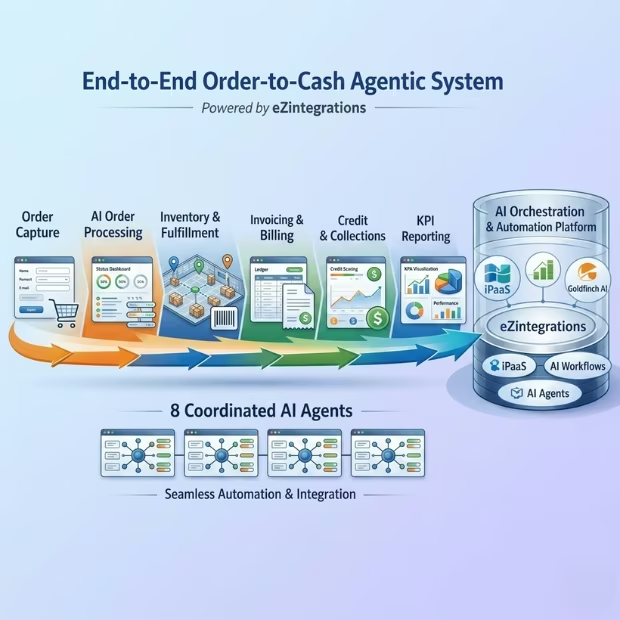
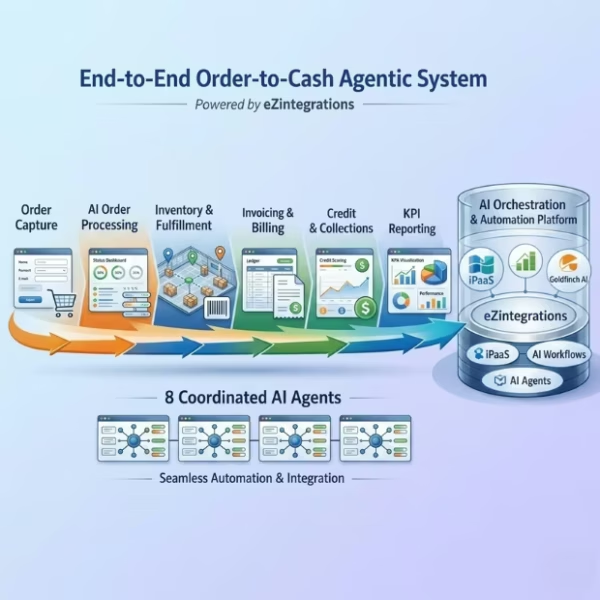
The Goldfinch AI O2C agentic system by eZintegrations orchestrates your entire order-to-cash process using 8 coordinated AI agents — from order capture through cash application and KPI reporting. eZintegrations is an enterprise automation platform covering iPaaS, AI Workflows, AI Agents, and Goldfinch AI agentic automation.
How Does the Goldfinch AI O2C Agentic System Orchestrate the Full Order-to-Cash Cycle Across SAP, Oracle, and Salesforce?
In this Goldfinch AI O2C agentic system, the O2C Orchestrator Agent decomposes each order event into sub-goals and assigns them to 7 Worker Agents in sequence. Watcher Tools detect the order the moment it arrives in Salesforce CRM or your EDI inbox. API Tool Call handles ERP credit checks, PO creation, invoice posting, and cash receipt application. Knowledge Base Vector Search retrieves customer pricing agreements and credit policies to resolve exceptions autonomously. Data Analytics with Charts/Graphs/Dashboards delivers live DSO, STP rate, and billing error reports to the CFO after every cycle.
Goldfinch AI ships with 9 native out-of-the-box agent tools. This system uses 7 of them. Users can add custom tools self-service beyond the 9 native tools. At 95% STP rate, your order management, AR, and finance teams work only on the 5% of exceptions requiring genuine human judgment.
McKinsey research benchmarks O2C automation at 30 to 40% DSO reduction and 40 to 60% cost per order reduction. Deploy this Goldfinch AI O2C agentic system in under 3 weeks.
Watch Demo
| Video Title: |
Goldfinch AI Order-to-Cash Agentic System | From Order Capture to Cash Application in Under 5 Days with 8 AI Agent |
|---|---|
| Duration: |
6 to 10 minutes |
Outcome & Benefits
| Autonomy: |
95% straight-through processing (STP) rate — 95% of O2C cycles complete end-to-end without human intervention |
|---|---|
| Time Saved: |
O2C cycle from 45 days to under 5 days; billing cycle from 3 to 5 days to under 4 hours; AR aging review from weekly manual to real-time automated |
| Cost Reduction: |
40 to 60% reduction in cost per order processed (McKinsey O2C automation benchmark); $150,000 to $450,000 annual savings at 500 orders per month mid-enterprise volume |
| Reliability: |
Billing error rate reduced from 8 to 12% (industry average without automation) to under 1%; zero missed cash receipts with Watcher Tool real-time monitoring; full audit trail for every agent decision |
| KPI | Before (Manual) | After (AI Agent) | Improvement |
|---|---|---|---|
| O2C Cycle Time | 45 days average | Under 5 days | 89% faster |
| DSO | 45–60 days | 15–20 days | 30–40% reduction |
| STP Rate | 0% (manual) | 95% | 95 percentage points |
| Billing Error Rate | 8–12% | Under 1% | 90%+ reduction |
| Cost per Order | $25–$50 | Under $5 | 80–90% reduction |
COMPARISON TABLE: Goldfinch AI vs. Alternatives
| Capability | Goldfinch AI O2C Agentic System | Traditional Automation | RPA | Custom LLM Agents |
|---|---|---|---|---|
| Cross-system orchestration | SAP, Oracle, Salesforce, WMS, Bank API | Single system at a time | Rule-based scripts | Custom development required |
| Native agent tools | 9 OOTB tools + self-service extensibility | N/A | None | Build all tools from scratch |
| Exception handling | AI reasoning + Knowledge Base + HITL | Fixed rules only | Re-routes to human immediately | Custom development required |
| Deployment timeline | Under 3 weeks | 3 to 6 months | 4 to 8 weeks | 4 to 8 months |
| Audit trail + compliance | SOC Type II, GDPR, HIPAA-eligible | Varies | Minimal | Must build custom |
Technical Details
| Planner Type: |
Hybrid LLM + rules-based planning. The O2C Orchestrator uses LLM-assisted goal decomposition to map order events to agent sequences at runtime. Deterministic rules govern credit thresholds, payment terms, and collection escalation for consistency on high-volume decisions. |
|---|---|
| Scheduling: |
Fully event-driven via Watcher Tools on Salesforce CRM, EDI inbox, WMS, and bank API. Batch mode available at configurable intervals for high-volume end-of-day processing. |
| Tool Router: |
O2C Orchestrator selects tools and sub-agents based on the output schema of the preceding agent and a pre-defined tool routing map. Standard O2C steps follow a deterministic sequence. Exception handling and Knowledge Base queries are LLM-reasoned. API failures automatically reroute to retry queue before escalating. |
| Evaluation Metrics: |
Per-agent confidence scores (threshold 0.82); order validation pass/fail rate; credit decision accuracy vs. actual payment outcomes; invoice match rate on first posting; cash application hit rate; exception resolution rate (autonomous vs. human); STP rate per cycle; end-to-end cycle time. |
| Auditability: |
Every agent action, tool invocation, input payload, output result, confidence score, decision rationale, and system write is logged with timestamp and immutable hash to the Goldfinch AI audit trail. Compliance teams query the full decision log per order, per agent, or per time period. Logs are exportable to Snowflake for external audit and regulatory reporting. Default 7-year retention for financial transactions. |
Connectivity & Deployment
| Supported Protocols: |
REST API, OData v2/v4, EDI (850, 856, 810, 820), HTTPS, SMTP, SFTP, OAuth 2.0, SAML 2.0, JDBC (Snowflake), ISO 20022 (bank payment messaging), IPSec Tunnel |
|---|---|
| Security & Compliance: |
HIPAA-eligible configuration available, GDPR-compliant data handling with configurable retention and right-to-erasure, SOC Type II certified. TLS 1.3 encryption in transit, AES-256 at rest. RBAC on agent configuration, exception approval, and audit log access. Immutable audit trail per O2C cycle per agent step. |
| Tenancy Model: |
Both single-tenant and multi-tenant deployments are available. Single-tenant provides dedicated infrastructure with full data isolation — recommended for regulated industries. Multi-tenant is the default shared-cloud deployment. Both support on-premises connectivity via IPSec Tunnel. |
| On-Premise Supported: |
Yes — eZintegrations connects to on-premises systems (Oracle EBS, SAP on-prem, MSSQL, Infor LN, and others) via IPSec Tunnel. eZintegrations is a browser-based, cloud-hosted platform and does not require any on-premises installation. |
AI Credits
| LLM Steps Count: |
Standard O2C cycles include 14–18 LLM reasoning steps across 8 agents. Exception handling adds 4–6 additional steps for deeper reasoning and knowledge base queries. |
|---|---|
| Credit Consumption Model: |
Per agent task execution — per order per agent, per exception handled, per dashboard cycle, per Reflection retry |
| Retry / Reflection Credit Cost: |
Each Reflection retry consumes the same credits as the original invocation. At 5% exception rate on 500 orders per month, add approximately 5% to total monthly credits. |
| Monthly Credit Estimate (at Typical Volume): |
500 orders/month x 23 credits average = 11,500 base credits. Exception handling at 5% rate (25 x 10 credits) = 250 additional credits. Analytics dashboards at 4 credits x 20 runs = 80 credits. Total: approximately 11,830 credits/month at 500 orders/month. |
| Pricing Model: |
Static Platform Fee + AI Credits. Platform fee covers unlimited non-AI steps: EDI ingestion, ERP connections, WMS routing, data routing, Snowflake archival. AI Credits consumed only by Goldfinch AI tool invocations and LLM reasoning cycles. |
| Credit Optimization Notes: |
Assign LLM reasoning only to O2C Orchestrator and Exception Orchestrator — keep Order, Fulfillment, and Billing Agents as deterministic executors for standard paths (saves 30 to 40% credits). Cache Knowledge Base results for top 20% accounts by volume. Use Integration Workflow as Tool (Unlimited) for WMS routing and Snowflake writes. Batch Analytics Agent to twice daily for high order volumes. |
| AI Credits Required: |
Yes — Goldfinch AI agentic systems consume credits across the O2C Orchestrator and all 7 Worker Agents. LLM Steps Count (Total Across All Agents): 14 to 18 LLM reasoning steps or Goldfinch AI tool invocations per standard O2C cycle. Exception cycles add 4 to 6 steps. |
FAQ
Resources
Case Study
| Industry: |
Industrial Distribution / Manufacturing |
|---|---|
| Problem: |
Mid-market industrial distributor processed 800 orders per month across SAP S/4HANA, Salesforce CRM, and a third-party WMS. O2C cycle averaged 41 days. Billing error rate was 11%. DSO ran at 52 days. AR team spent 14 FTE days per month on cash application and collections. Order exceptions resolved through email chains averaging 4.5 days each. Finance had no real-time O2C visibility. |
| Solution: |
Deployed the Goldfinch AI O2C agentic system in 18 business days. Watcher Tools configured on Salesforce CRM, EDI inbox, and bank API. Knowledge Base loaded with customer pricing agreements, credit policies, and collection escalation rules for the top 80 accounts (74% of revenue). Safety Layer at $250,000 threshold and 0.82 confidence floor. Analytics Agent delivering daily O2C dashboards to CFO and VP Sales. |
| Outcome: |
O2C cycle from 41 days to 4.6 days by week 6. STP rate: 91% month 1, 94% month 3. Billing error rate from 11% to 0.8%. DSO from 52 to 18 days. Cash application from 14 FTE days to 1.5 FTE days per month. Exception resolution from 4.5 days to 3.8 hours. |
| ROI: |
$380,000 annual savings (12.5 FTE days reclaimed/month). DSO reduction freed $11.2M in working capital (based on $400M annual revenue). Deployment cost recovered in 11 weeks. |
Related products
-
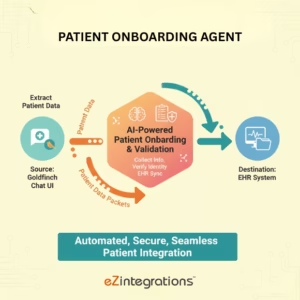
Patient Onboarding Agent
 $0.00
Download
$0.00
Download
-
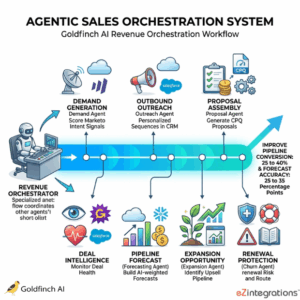
How to Automate Revenue Operations Using Multi-Agent AI Sales Orchestration Systems
 $150.00
Download
$150.00
Download
-
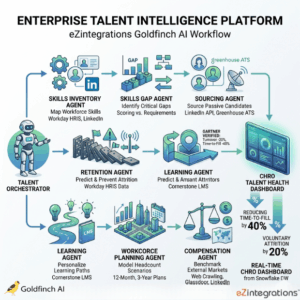
How to Automate Workforce Planning and Talent Intelligence Using Multi-Agent AI Systems
 $150.00
Download
$150.00
Download
-
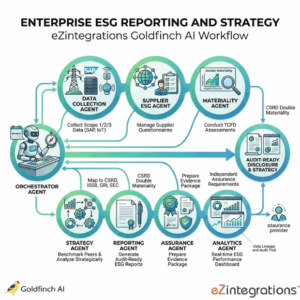
How to Automate ESG Reporting and Sustainability Strategy Using Multi-Agent AI Systems
 $150.00
Download
$150.00
Download