- You cannot add another "Resume Screening Agent" to your cart. View cart
How to Automate New Product Development Using Multi-Agent AI Stage-Gate Orchestration
$150.00
| System Name: |
Autonomous New Product Development System |
|---|---|
| Architecture: |
Hierarchical Multi-Agent System – 1 NPD Orchestrator (Coordinator) + 8 specialized Worker Agents (Ideation; R&D Coordination; IP; Regulatory; Supply Chain; Marketing; Launch; Analytics) operating through stage-gate goal decomposition; cross-functional inter-agent dependency management; shared product knowledge base memory; and human-in-the-loop stage-gate approval gates; 9 total agents |
| Coordinator Agent: |
NPD Orchestrator – maintains the master stage-gate plan and cross-functional task dependency graph across all 8 Worker Agents; decomposes each gate phase (concept; feasibility; development; validation; launch) into sub-tasks per function; enforces cross-agent dependencies (IP filing must be progressing before R&D Coordination Agent can move the product to development gate; Regulatory Agent must confirm submission pathway before Supply Chain Agent commits to BOM); monitors each agent’s milestone completion against the launch timeline; flags stage-gate hold conditions (open IP conflicts; regulatory submission not filed; BOM not qualified); and routes stage-gate decisions to the Chief Product Officer for human approval |
| Safety Layer: |
Human-in-the-loop stage-gate approval triggers when: any stage-gate transition (concept to feasibility; feasibility to development; development to validation; validation to launch) requires Chief Product Officer sign-off – no gate advancement without CPO approval regardless of agent confidence; IP Agent identifies a freedom-to-operate risk above the configured severity threshold – Legal Director review required before R&D Coordination Agent can advance the milestone; Regulatory Agent flags a submission gap that would delay market authorization; Orchestrator confidence falls below 0.75 on any cross-agent dependency assessment. Max 3 retries before escalation to CPO with full agent context. All HITL decisions logged with reviewer identity; decision; and rationale for product governance and FDA/CE audit documentation. |
| On-Premise Supported: |
Yes – eZintegrations connects to on-premises systems (PTC Windchill on-prem; Siemens Teamcenter on-prem; SAP MM on-prem; Ariba on-prem; Oracle Agile PLM on-prem; and others) via IPSec Tunnel. eZintegrations is a browser-based; cloud-hosted platform and does not require any on-premises software installation. |
| Tags: |
Goldfinch AI NPD orchestrator; new product development AI; multi-agent NPD system; PLM AI agent Windchill; time-to-market AI acceleration; regulatory submission AI agent; IP monitoring AI NPD; BOM qualification AI agent; product launch automation AI; Goldfinch AI product management; stage-gate automation AI; NPI AI orchestration |
| AI Credits Required: |
Yes – Goldfinch AI agentic systems consume credits across all 9 agents per stage-gate cycle, per tool invocation, per document analysis, and per reflection/retry loop. |
| Worker Agents: |
Ideation Agent: Aggregates market signals, customer feedback from CRM, competitive intelligence from web crawling, and internal innovation submissions – scoring idea viability against the product strategy in the Knowledge Base and surfacing the top-ranked concepts to the Product Director for stage-gate 0 (concept) review; R&D Coordination Agent: Manages PLM task assignments, milestone tracking, and BOM version control in Windchill or Teamcenter – alerting the Orchestrator when R&D milestones slip, retrieving engineering change orders, and flagging technical risk items for the Product Director’s attention, IP Agent: Monitors the patent landscape for the product’s technology domain via web crawling and patent database API, identifies freedom-to-operate risks, tracks the organization’s IP filing status and deadlines, and alerts Legal when IP action is required before the product’s development gate milestone Regulatory Agent: Tracks regulatory submission requirements and timelines for the product’s target markets (FDA 510(k)/PMA, CE marking, EMA, PMDA, FCC, or equivalent) from the Knowledge Base and regulatory database, monitors submission status, identifies documentation gaps, and alerts the Regulatory Affairs Director of approaching submission deadlines, Launch Agent: Coordinates Day-1 launch readiness across all functions – verifying that the eCommerce platform is configured, the PIM records are published, distribution channel partners have been notified, Sales enablement materials are available, and Customer Service is trained – and publishing the launch readiness checklist status to the Orchestrator; Analytics Agent: Tracks launch KPIs from the DW and CRM — including units sold vs. forecast, revenue vs. plan, customer acquisition cost, product return rate, NPS for the new product, and market share trend — generating the post-launch performance dashboard for the CPO and VP of R&D, Supply Chain Agent: Qualifies suppliers for the product’s BOM components by querying Ariba SRM for supplier qualification status and verifying component availability and lead times from SAP MM – flagging BOM risk items (single-source components, long-lead materials, unqualified suppliers) to the Orchestrator before the supply chain readiness gate; Marketing Agent: Prepares go-to-market content using the product data from PLM and PIM – generating product descriptions, feature messaging, launch assets briefs, and channel-specific content for the Marketing team’s review, and populating the PIM system with product metadata ahead of the launch date |
Table of Contents
| Planning: |
The NPD Orchestrator uses stage-gate goal decomposition – each gate phase (concept; feasibility; development; validation; launch) is decomposed into function-specific sub-tasks routed to the appropriate Worker Agent. Schema-driven rules govern stage-gate advancement criteria (all gate conditions must be satisfied before CPO approval is requested); LLM reasoning governs cross-functional risk assessment; IP freedom-to-operate scoring; regulatory gap analysis; and ideation viability scoring where deterministic rules are insufficient. |
|---|---|
| Messaging: |
All 9 agents communicate via structured stage-gate event messages – each Worker Agent publishes a gate-readiness event (e.g. “Supply Chain Agent: BOM validated; all 47 components sourced; 3 single-source risk items flagged for CPO awareness; supply chain gate readiness: PASS with conditions”) that the Orchestrator evaluates against the stage-gate criteria before requesting CPO approval. Gate advancement is blocked when any agent’s readiness status is FAIL or when an agent has flagged an open risk item that has not been reviewed by the appropriate stakeholder. |
| Reflection: |
Before publishing any gate-readiness assessment to the CPO; the Orchestrator applies a reflection loop – if the cross-agent gate readiness confidence score falls below 0.75; the Orchestrator re-queries the Knowledge Base for the relevant stage-gate criteria; re-evaluates each agent’s submission; and retries up to 3 times before escalating to the CPO with an incomplete assessment flag. The IP Agent applies an additional reflection cycle when a patent claim has borderline relevance to the product – retrieving additional claim context and prior art before classifying the freedom-to-operate risk level. |
| Knowledge: |
All 9 agents share a persistent product knowledge base containing: product strategy and target market specifications per active project; stage-gate criteria and scoring rubrics per gate and product category; IP portfolio records and claim maps; regulatory submission requirements per target market and product classification (FDA device class; EMA therapeutic area; CE category); preferred supplier qualification records and lead times; BOM design and component standards; product messaging frameworks and brand guidelines; launch readiness checklists per channel; and prior product launch outcomes (successful and failed) that inform current risk scoring. The KB is indexed by project; gate phase; function; market; and product category. |
| Execution: |
The R&D Coordination Agent updates PLM milestone statuses and creates engineering change orders via Integration Workflow as Tool. The Marketing Agent populates the PIM system and pushes product content to the eCommerce platform via Integration Workflow as Tool. The Launch Agent executes the cross-functional Day-1 readiness checklist via API Tool Call across all launch systems. The Analytics Agent aggregates launch KPIs from Snowflake DW and CRM via API Tool Call and delivers the CPO dashboard via Data Analytics. The IP Agent and Regulatory Agent produce structured risk reports for Legal and Regulatory Affairs Director review at each gate – they do not file IP or regulatory submissions autonomously; all submissions require human professional action. |
| Business Impact: |
McKinsey research: companies that coordinate NPD cross-functionally reduce time-to-market by 30 to 50% and improve launch success rate by 40%. The average cost of a 3 to 6-month NPD coordination delay: $5M to $50M in delayed revenue; competitive window erosion; and sunk engineering cost (McKinsey Product Development survey). The Goldfinch AI NPD orchestrator eliminates coordination failures by monitoring all 8 NPD functions simultaneously and surfacing gate-blocking conditions before they become timeline crises. |
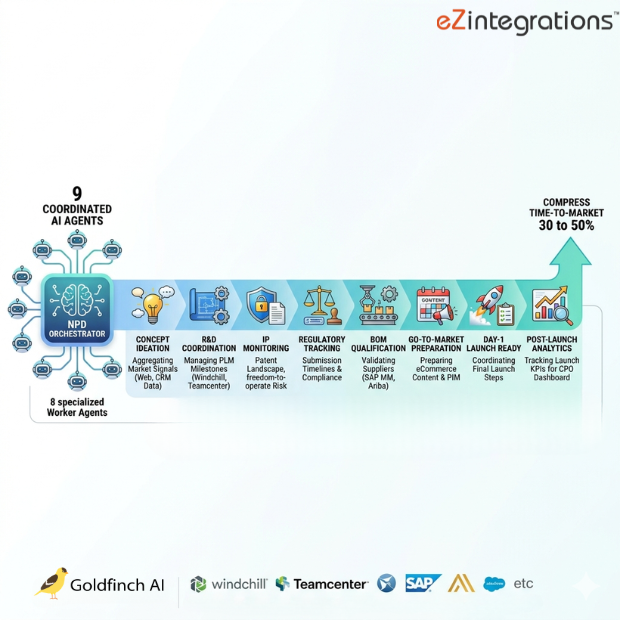
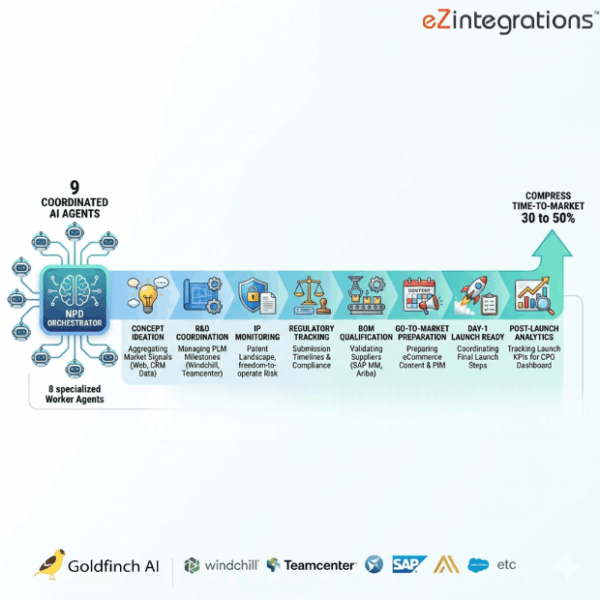
The Goldfinch AI NPD orchestrator from eZintegrations deploys 9 coordinated AI agents – an NPD Orchestrator plus 8 specialized Worker Agents – to coordinate every stage of new product development from concept ideation through post-launch analytics: aggregating market signals, managing PLM milestones in Windchill or Teamcenter, monitoring the patent landscape, tracking regulatory submission timelines, qualifying BOM suppliers in SAP and Ariba, preparing go-to-market content, coordinating Day-1 launch readiness, and tracking launch KPIs – compressing time-to-market by 30 to 50%. eZintegrations is an enterprise automation platform covering iPaaS, AI Workflows, AI Agents, and Goldfinch AI agentic automation.
What Is Goldfinch AI NPD Orchestration?
Goldfinch AI NPD orchestration is a hierarchical multi-agent system where an NPD Orchestrator maintains the master stage-gate plan across all product development functions – routing R&D milestones to the R&D Coordination Agent, IP monitoring to the IP Agent, regulatory tracking to the Regulatory Agent, BOM validation to the Supply Chain Agent, and launch preparation to the Marketing and Launch Agents. Unlike PLM platforms that track product data for project managers to coordinate manually, the Goldfinch AI NPD orchestrator monitors all 8 NPD functions simultaneously, surfaces cross-functional gate-blocking risks before they delay the timeline, and presents the CPO with a structured gate-readiness assessment rather than a manually compiled status update.
How Does Goldfinch AI NPD Orchestrator Coordinate 9 Agents Across PLM, Regulatory Databases, IP Systems, and Supply Chain to Compress Time-to-Market by 30 to 50%?
The Ideation Agent aggregates market signals via Web Crawling and CRM data. The R&D Coordination Agent manages PLM milestones in Windchill or Teamcenter. The IP Agent monitors patent databases and scores freedom-to-operate risk via Document Intelligence. The Regulatory Agent tracks submission timelines from regulatory databases. The Supply Chain Agent validates BOM qualification in Ariba and SAP MM. The Marketing Agent populates PIM and eCommerce content. The Launch Agent executes the Day-1 readiness checklist. The Analytics Agent delivers the CPO launch KPI dashboard. The Orchestrator coordinates all 8 agents through stage-gate dependency enforcement and routes gate decisions to the CPO.
Goldfinch AI ships with 9 native out-of-the-box agent tools. Users can add custom tools self-service beyond the 9 native tools. McKinsey: cross-functional NPD coordination reduces time-to-market 30 to 50% and improves launch success rate by 40%. This Goldfinch AI NPD orchestrator delivers that outcome without manual project manager coordination across R&D, Legal, Regulatory, Supply Chain, and Marketing simultaneously.
Watch Demo
| Video Title: |
Goldfinch AI NPD Orchestrator | 9 Agents; Concept to Commercial Launch Across PLM; Regulatory; IP; and Supply Chain |
|---|---|
| Duration: |
8 to 12 minutes |
Outcome & Benefits
| Autonomy: |
75%+ of NPD coordination tasks handled autonomously within configured scope (milestone monitoring; IP landscape updates; regulatory deadline tracking; BOM qualification status; PIM content population); all stage-gate advancement decisions require CPO sign-off; IP filings and regulatory submissions always require qualified professional action; high-risk items (FTO risk; regulatory submission gap; single-source BOM) are surfaced to the appropriate stakeholder before they block the gate |
|---|---|
| Time Saved: |
Time-to-market compressed 30 to 50% from coordination failure elimination (McKinsey NPD benchmark); stage-gate decision meetings compressed from multi-day cross-functional status compilation to structured Orchestrator-generated gate readiness report; IP freedom-to-operate assessment from 4 to 8-week manual patent review to continuous automated landscape monitoring with flagged risks surfaced immediately; regulatory submission tracking from manual Regulatory Affairs calendar to continuous automated deadline monitoring |
| Cost Reduction: |
30 to 50% time-to-market compression = $5M to $50M in recovered delayed revenue per product launch (McKinsey); 40% improvement in launch success rate from earlier risk detection; R&D project management coordination overhead reduced 35 to 45% from automated cross-functional status monitoring; IP conflict resolution cost reduction from earlier FTO risk detection (pre-design-freeze is 10 to 50x cheaper to remediate than post-design-freeze) |
| Reliability: |
100% of PLM milestone events monitored and surfaced to the Orchestrator; zero missed regulatory submission deadlines through continuous Regulatory Agent monitoring; zero uncaught patent landscape changes in the product’s technology domain through continuous IP Agent web crawling; 100% BOM component qualification status tracked before supply chain gate |
Performance Metrics
| KPI | Before | After | Impact |
|---|---|---|---|
| Time-to-Market | Full cycle duration | 30 to 50% compression (McKinsey) | $5M to $50M recovered delayed revenue |
| Stage-Gate Decision Prep | 3 to 7 days manual compilation | Orchestrator report in hours | 95%+ faster gate decision readiness |
| IP Risk Detection | Post-design-freeze discovery | Continuous FTO monitoring | 10 to 50x cheaper remediation window |
| Regulatory Deadline Misses | Manual calendar (miss rate 15%) | Continuous monitoring (miss rate 0%) | Full submission compliance |
| Launch Success Rate | Baseline | +40% improvement (McKinsey) | Competitive differentiation |
| BOM Risk Items | Discovered at supply chain gate | Flagged continuously before gate | Earlier remediation, no gate delays |
Technical Details
| Scheduling: |
NPD Orchestrator monitors PLM; regulatory database; and patent database via Watcher Tools continuously (60-minute intervals for standard milestone events; immediate trigger for gate-blocking events – FTO conflict detected; regulatory submission deadline within 14 days; critical path PLM milestone slip); Ideation Agent runs on configurable cadence (weekly market signal aggregation) and on-demand for new product concepts; IP Agent runs weekly patent landscape scan plus immediate on new prior art publication alerts; Regulatory Agent runs daily deadline monitoring and immediately on regulatory guidance update publications; Supply Chain Agent runs at each BOM version update and weekly component availability check; Marketing Agent activates at marketing gate milestone; Launch Agent activates 30 days pre-launch; Analytics Agent runs weekly post-launch for the configured post-launch monitoring window. |
|---|---|
| Tool Router: |
The NPD Orchestrator selects which Worker Agent to activate based on stage-gate phase and event type – new prior art patent published in product technology domain triggers IP Agent; PLM critical path milestone slip triggers R&D Coordination Agent + Orchestrator cross-agent impact assessment; regulatory guidance update triggers Regulatory Agent; BOM component availability risk triggers Supply Chain Agent; stage-gate advancement requested triggers all agents simultaneously for gate readiness assessment. Each Worker Agent selects its tools based on task type: Web Crawling for patent and regulatory landscape monitoring; API Tool Call for PLM/ERP/regulatory database reads and writes; Document Intelligence for patent; regulatory; and engineering document analysis; Data Analysis for risk scoring and viability assessment; Knowledge Base for product strategy and gate criteria context; Integration Workflow as Tool for PLM updates and launch coordination sub-workflows. |
| Evaluation Metrics: |
Time-to-market per stage-gate phase (actual vs. planned); gate decision cycle time (time from gate-readiness report to CPO decision); IP risk detection lead time (days before gate at which FTO risk is identified); regulatory submission on-time rate (% of target markets with on-time submission); BOM risk item resolution rate (% of flagged items resolved before supply chain gate); launch readiness score at Day-1 (% of launch checklist items complete); post-launch KPI variance (revenue and units actual vs. forecast at 30/60/90 days). |
| Auditability: |
Every agent action is logged with: agent name; project ID and product name; gate phase; trigger event; tool invoked; data retrieved; assessment produced; confidence score; HITL status (autonomous monitoring or stakeholder-reviewed risk item); and timestamp. The NPD Orchestrator assembles a per-project audit trail covering all agent interactions from concept through post-launch – formatted to support FDA 21 CFR Part 11; ISO 13485; and CE Technical File documentation requirements for regulated industries. Gate decisions are logged with CPO identity; decision (advance; hold; or kill); and rationale for product governance and regulatory audit. IP Agent FTO assessments are stored with the patent claim analysis basis for legal defensibility. |
| Planner Type: |
Stage-gate decomposition with LLM-hybrid execution – the NPD Orchestrator uses schema-driven stage-gate criteria for gate advancement decisions (deterministic checklist: all gate conditions must be satisfied before CPO approval is requested) and LLM reasoning for cross-functional risk assessment, IP freedom-to-operate scoring from patent claim analysis, regulatory submission gap scoring, and ideation viability scoring where deterministic rules are insufficient. |
| Agent Roles: |
Analytics Agent: API Tool Call (Snowflake DW https://docs.snowflake.com/ KPI aggregation, CRM sales data), Data Analytics with Charts/Graphs/Dashboards (post-launch KPI dashboard and Orchestrator gate status dashboard), Knowledge Base Vector Search (launch KPI benchmark data), IP Agent: Web Crawling (USPTO https://www.uspto.gov/, EPO https://www.epo.org/en, WIPO https://www.wipo.int/portal/en/ patent databases), API Tool Call (patent database API), Document Intelligence (patent claim analysis for FTO), Data Analysis (FTO risk scoring by claim and jurisdiction), Knowledge Base Vector Search (IP portfolio and claim maps); Regulatory Agent: Web Crawling (FDA https://www.fda.gov/, EMA https://www.ema.europa.eu/, PMDA, CDSCO, and other regulatory body sites), API Tool Call (regulatory submission tracking database), Document Intelligence (submission dossier gap analysis, prior submission template analysis), Data Analysis (submission readiness scoring), Knowledge Base Vector Search (regulatory requirements per market and product class), NPD Orchestrator (Coordinator): stage-gate plan management, cross-agent dependency enforcement, gate readiness scoring, CPO approval routing, gate status dashboard; Ideation Agent: Web Crawling (market signals, competitor intelligence, customer reviews), API Tool Call (CRM feedback, NPS data), Data Analysis (idea viability scoring), Knowledge Base Vector Search (product strategy and target market); R&D Coordination Agent: API Tool Call (PTC Windchill https://www.ptc.com/en/products/windchill or Siemens Teamcenter https://plm.sw.siemens.com/en-US/teamcenter/ PLM milestone and BOM), Document Intelligence (engineering specification documents and test reports), Integration Workflow as Tool (PLM milestone update and ECO sub-workflow), Knowledge Base Vector Search (stage-gate R&D criteria), Supply Chain Agent: API Tool Call (Ariba SRM https://help.sap.com/docs/SAP_ARIBA supplier qualification, SAP MM https://help.sap.com/docs/SAP_S4HANA_ON-PREMISE component availability and lead time), Data Analysis (BOM risk scoring: single-source, long-lead, unqualified), Knowledge Base Vector Search (preferred supplier records, BOM standards); Marketing Agent: API Tool Call (PIM system product data population, eCommerce platform content check), Integration Workflow as Tool (PIM content push and eCommerce configuration sub-workflow), Knowledge Base Vector Search (product messaging frameworks and brand guidelines); Launch Agent: API Tool Call (eCommerce readiness, CRM partner notification, Sales enablement platform), Integration Workflow as Tool (Day-1 launch readiness sub-workflow), Knowledge Base Vector Search (launch readiness checklist per channel) |
Connectivity and Deployment
| Supported Protocols: |
REST API (PTC Windchill; Siemens Teamcenter; Ariba SRM; SAP MM OData; CRM/Salesforce; PIM platform; eCommerce platform; NPS/feedback platform); Web Crawling (USPTO; EPO; WIPO patent databases; FDA; EMA; PMDA; CE regulatory body sites; market intelligence publications; competitor product announcement monitoring); SMTP (CPO gate decision requests; stakeholder risk alerts; cross-functional milestone notifications); JDBC (Snowflake DW launch analytics); HTTPS; OAuth 2.0; IPSec Tunnel (on-premises PLM; SAP MM; Ariba; Oracle Agile PLM connectivity) |
|---|---|
| Security & Compliance: |
SOC Type II certified; FDA 21 CFR Part 11-compatible audit trail for Pharma and Medical Device NPD (electronic records and signatures; immutable audit log per agent action; CPO approval chain documented); ISO 13485-compatible quality management process documentation for Medical Device development; GDPR-compliant handling of customer feedback data (used by Ideation Agent for market signal aggregation); SOX-compliant IP and product governance documentation; HIPAA-eligible for healthcare product development environments with patient-data-adjacent research. Single-tenant deployment isolates all product intelligence; IP records; and regulatory submission content per customer. RBAC enforced: CPO has full project portfolio view; Product Directors have project-scoped access; IP Agent FTO assessments accessible only to Legal and CPO; Regulatory Agent submissions accessible only to Regulatory Affairs Director and CPO. |
| Tenancy Model: |
Both single-tenant and multi-tenant deployments are supported. Single-tenant is strongly recommended for NPD deployments – product roadmap data; IP portfolio records; regulatory submission content; and competitive intelligence are among the most commercially sensitive data in the enterprise. Single-tenant provides dedicated infrastructure with full data segregation and no cross-tenant data exposure. |
| On-Premise Supported: |
Yes – eZintegrations connects to on-premises systems (PTC Windchill on-prem; Siemens Teamcenter on-prem; SAP MM on-prem; Ariba on-prem; Oracle Agile PLM on-prem; and others) via IPSec Tunnel. eZintegrations is a browser-based; cloud-hosted platform and does not require any on-premises software installation. |
AI Credits
| Credit Consumption Model: |
Stage-gate-driven – credit consumption peaks at each gate phase when all agents simultaneously assess readiness; ongoing weekly monitoring credits for IP Agent (patent landscape); Regulatory Agent (submission deadline tracking); and Ideation Agent (market signal aggregation); event-triggered credits for PLM milestone events and BOM version updates Estimated Credits per End-to-End Run: Per gate review cycle (all 9 agents producing readiness assessments): ~80 to 160 credits per gate (5 gates per product = ~400 to 800 credits per full NPD cycle) Weekly ongoing monitoring (IP landscape + regulatory deadlines + market signals; between gates): ~60 to 120 credits per week Per post-launch weekly analytics cycle: ~15 to 25 credits per week (configurable post-launch monitoring window) Full NPD cycle cost (concept to 13-week post-launch; 52-week average cycle): ~2,500 to 5,500 credits per product launch |
|---|---|
| Retry / Reflection Credit Cost: |
Each Orchestrator reflection/retry cycle: ~5 to 8 additional credits per retry. IP Agent reflection on borderline patent claims: ~4 to 6 additional credits per reflection cycle. At 10% exception rate across all agents and gates; add approximately 12 to 18% to the per-cycle credit estimate. |
| Monthly Credit Estimate (at Typical Volume): |
1 active product in development (mid-cycle; weekly monitoring only): ~400 to 600 credits per month 5 active products across different stage-gate phases: ~1,800 to 3,500 credits per month 20 active products (large product portfolio; enterprise CPG or Pharma): ~6,000 to 14,000 credits per month |
| Pricing Model: |
Static Platform Fee + AI Credits. Platform fee covers unlimited non-LLM orchestration across all agents (PLM event monitoring; regulatory database connection; patent database connection; ERP connection; SMTP milestone notifications; audit log writes). AI Credits consumed only by Goldfinch AI tool invocations and LLM reasoning cycles. |
| Credit Optimization Notes: |
IP Agent Web Crawling is the highest per-cycle credit consumer – configure patent monitoring to focus on the product’s specific International Patent Classification (IPC) codes rather than broad technology domain crawling (reduces Web Crawling credits 50 to 70% while maintaining FTO coverage relevance). Batch Supply Chain Agent SAP MM component availability queries for the full BOM in a single API Tool Call rather than per-component sequential queries. Cache Knowledge Base stage-gate criteria and regulatory submission requirements per market and product category for 30 days (they change infrequently). Configure Regulatory Agent daily monitoring only during the active submission preparation window (30 to 60 days pre-submission); reduce to weekly for products in early development stages. |
| AI Credits Required: |
Yes – Goldfinch AI agentic systems consume credits across all 9 agents per stage-gate cycle, per tool invocation, per document analysis, and per reflection/retry loop. |
| LLM Steps Count: |
14 to 24 LLM-invoking steps per active stage-gate cycle (Orchestrator gate decomposition: 2 to 3 steps; Worker Agent tool invocations: 1 to 3 steps each; IP Agent patent claim analysis: 3 to 5 steps; Regulatory Agent gap analysis: 2 to 4 steps; Analytics Agent dashboard generation: 2 to 3 steps; reflection/retry: 1 to 2 steps per retry) |
| Per-Agent Credit Breakdown: |
NPD Orchestrator: 4 to 8 credits per gate cycle (gate decomposition + cross-agent readiness scoring + CPO approval packaging + gate status dashboard); Ideation Agent: 5 to 10 credits per weekly ideation cycle (Web Crawling market signals + CRM feedback + Data Analysis viability scoring); R&D Coordination Agent: 3 to 6 credits per milestone event (PLM API query + Document Intelligence spec review + Knowledge Base gate criteria) IP Agent: 8 to 16 credits per weekly landscape scan (Web Crawling USPTO/EPO/WIPO + Document Intelligence patent claim analysis + Data Analysis FTO risk scoring), Regulatory Agent: 5 to 10 credits per regulatory monitoring cycle (Web Crawling regulatory sites + Document Intelligence dossier gap analysis + Knowledge Base submission requirements); Supply Chain Agent: 3 to 6 credits per BOM review cycle (Ariba + SAP MM API queries + Data Analysis BOM risk scoring); Marketing; Agent: 3 to 6 credits per gate activation (Knowledge Base messaging + PIM content generation + eCommerce check); Launch Agent: 4 to 8 credits per launch coordination cycle (multi-system readiness check + Day-1 sub-workflow); Analytics Agent: 4 to 8 credits per weekly post-launch report (Snowflake DW aggregation + Data Analytics dashboard render + CPO digest delivery) |
| Goldfinch AI Tool(s) Consuming Credits: |
Watcher Tools (Orchestrator – PLM, regulatory database, patent database event monitoring), Web Crawling (Ideation, IP, Regulatory Agents – per page crawled; highest credit consumer due to patent and regulatory monitoring breadth), API Tool Call (all 8 Worker Agents — per PLM/ERP/regulatory/CRM/PIM/eCommerce call), Document Intelligence (IP Agent patent analysis; Regulatory Agent dossier gap analysis; R&D Coordination Agent spec review – per document analyzed), Data Analysis (Ideation, IP, Regulatory, Supply Chain, Analytics Agents – per scoring cycle), Knowledge Base Vector Search (all 9 agents – per query), Data Analytics with Charts/Graphs/Dashboards (Analytics Agent – per dashboard render), Integration Workflow as Tool (R&D Coordination, Marketing, Launch, Analytics Agents – per sub-workflow) |
FAQ
1. What is the Autonomous New Product Development System and what does it automate end to end?
The Goldfinch AI NPD orchestrator from eZintegrations deploys 9 coordinated AI agents — an NPD Orchestrator and 8 Worker Agents — to coordinate every stage of new product development from concept ideation through post-launch analytics. The system covers: market signal aggregation and idea scoring (Ideation Agent), PLM milestone management in Windchill or Teamcenter (R&D Coordination Agent), patent landscape monitoring and FTO risk assessment (IP Agent), regulatory submission tracking across FDA/EMA/CE markets (Regulatory Agent), BOM supplier qualification in Ariba and SAP MM (Supply Chain Agent), go-to-market content and PIM population (Marketing Agent), Day-1 launch readiness coordination (Launch Agent), and post-launch KPI tracking (Analytics Agent). McKinsey: cross-functional NPD coordination reduces time-to-market 30 to 50% and improves launch success rate by 40%.
2. How does the multi-agent architecture work?
The NPD Orchestrator maintains a master stage-gate plan and cross-functional task dependency graph. Each gate phase (concept, feasibility, development, validation, launch) is decomposed into function-specific sub-tasks routed to the appropriate Worker Agent. Each Worker Agent produces a structured gate-readiness assessment published back to the Orchestrator, which evaluates cross-agent readiness before requesting CPO approval for gate advancement. Gate advancement is blocked when any agent's status is FAIL or when an open risk item has not been reviewed. All 9 agents share a persistent product knowledge base containing stage-gate criteria, IP records, regulatory requirements, and prior launch outcomes.
3. Which Goldfinch AI tools does this system use?
The system uses 7 of Goldfinch AI's 9 native tools: Watcher Tools (Orchestrator — PLM milestone, regulatory database, and patent database event monitoring), Web Crawling (Ideation, IP, and Regulatory Agents — market signals, USPTO/EPO/WIPO patent databases, FDA/EMA/CE regulatory sites), API Tool Call (all 8 Worker Agents — PLM, Ariba SRM, SAP MM, CRM, PIM, eCommerce, Snowflake DW), Document Intelligence (IP Agent patent claim analysis; Regulatory Agent dossier gap analysis; R&D Coordination Agent spec review), Data Analysis (Ideation, IP, Regulatory, Supply Chain, and Analytics Agents — viability scoring, FTO risk, submission readiness, BOM risk, launch KPI variance), Knowledge Base Vector Search (all 9 agents — product strategy, gate criteria, IP portfolio, regulatory requirements), Data Analytics with Charts/Graphs/Dashboards (Analytics Agent launch KPI dashboard; Orchestrator gate status dashboard), and Integration Workflow as Tool (R&D PLM update, Marketing PIM push, Launch Day-1 coordination, Analytics CPO digest). Beyond these 9 native tools, users can add custom tools self-service — CTMS for clinical trials, substance compliance databases, localization management systems.
4. How does the system ensure data accuracy and handle errors?
The Orchestrator applies a reflection loop before publishing any gate-readiness assessment — if cross-agent confidence falls below 0.75, it re-queries the Knowledge Base for relevant gate criteria, re-evaluates agent submissions, and retries up to 3 times before escalating to the CPO with an incomplete assessment flag. The IP Agent applies an additional reflection cycle on borderline patent claims before classifying FTO risk. All stage-gate advancement decisions require CPO sign-off regardless of agent confidence — no gate advances without human approval. IP filings and regulatory submissions are always flagged as requiring qualified professional action; the system never autonomously files patents or regulatory submissions.
5. What types of data and documents does this system process?
The system processes: CRM customer feedback and NPS data (Ideation Agent), PLM BOM and milestone data from Windchill or Teamcenter (R&D Coordination Agent), patent documents from USPTO, EPO, and WIPO (IP Agent Document Intelligence), regulatory guidance documents and prior submission templates (Regulatory Agent Document Intelligence), Ariba SRM supplier qualification records and SAP MM component availability data (Supply Chain Agent), PIM product metadata and eCommerce content (Marketing Agent), launch readiness status across all systems (Launch Agent), and Snowflake DW and CRM post-launch sales and KPI data (Analytics Agent).
6. Who uses this system and in which departments?
Daily operators include Product Directors and PLM Administrators (R&D Coordination milestones), IP Counsel (IP Agent FTO alerts), Regulatory Affairs Directors (Regulatory Agent submission tracking), Supply Chain Managers (Supply Chain Agent BOM risk), Marketing Managers (Marketing Agent content review), and Sales/Channel teams (Launch Agent readiness). Executive stakeholders — the Chief Product Officer (CPO), VP of R&D, and CEO — approve stage-gate decisions and receive Orchestrator gate readiness reports. The CFO monitors launch financial performance from the Analytics Agent dashboard.
7. How does the safety layer and human oversight work?
Every stage-gate transition requires CPO sign-off — the Orchestrator never advances a product to the next gate without explicit CPO approval regardless of agent confidence scores. IP Agent FTO risks above the configured severity threshold require Legal Director review before R&D can advance the milestone. Regulatory submission gaps that would delay market authorization are escalated to the Regulatory Affairs Director immediately. Orchestrator confidence below 0.75 triggers retry (max 3) before CPO escalation with full agent context. IP filings and regulatory submissions always require qualified professional action — the system never files autonomously. All gate decisions are logged with CPO identity, decision, and rationale for product governance and FDA audit documentation.
8. What are the key business benefits and executive KPIs improved?
Key executive KPIs improved include: time-to-market compressed 30 to 50% (McKinsey benchmark, recovering $5M to $50M in delayed revenue per product); launch success rate improved 40% from earlier cross-functional risk detection; stage-gate decision preparation from 3 to 7 days manual compilation to Orchestrator gate report in hours; IP FTO risk detected continuously before design freeze (10 to 50x cheaper to remediate than post-design-freeze); zero missed regulatory submission deadlines from continuous Regulatory Agent monitoring; and the CPO shifts from assembling cross-functional status updates to reviewing a structured Orchestrator gate readiness report with all risk items pre-identified.
Resources
Case Study
| Industry: |
Medical Devices / Global MedTech Manufacturer |
|---|---|
| ROI: |
Delayed revenue recovery (3 products launched on-time vs. 6-month prior delay estimate): estimated $28M in recovered revenue (prior-year baseline). IP conflict remediation cost reduction: 12 pre-design-freeze conflicts x ($380,000 – $38,000 savings per conflict) = $4.1M savings. Regulatory gap avoidance: 18 projects x 1.8 gaps per project (prior year rate) x 6-week delay x estimated $520,000 revenue per week per average product = value of 194 weeks of avoided regulatory delay. CPO and cross-functional coordination time savings: estimated 120 hours per month per product across 18 active projects at $95/hour blended cost = $2.05M annually. Total year-1 conservative |
| Problem: |
IP conflicts discovered post-design-freeze (average remediation cost: $380,000 per conflict, 2.1 conflicts per product); Regulatory submission documentation gaps identified at submission gate (average 6-week delay per gap, 1.8 gaps per product per market); BOM component qualification failures at supply chain gate (average 10-week delay per failure, 1.2 failures per product); and Marketing content and PIM data not ready at launch gate (average 3-week launch delay for 60% of products). In the prior fiscal year, 3 product launches had been delayed by 6 months or more, representing an estimated $28M in combined delayed revenue., A global MedTech manufacturer with $1.4B revenue and an active product portfolio of 340 SKUs across 28 regulated markets operated its NPD process across R&D (120 engineers in 4 countries), Regulatory Affairs (22 staff), Legal/IP (8 IP Counsel), Supply Chain (34 staff), and Marketing (45 staff). The NPD program averaged 18 active development projects per year, with an average time-to-market of 32 months per Class II medical device. The CPO had identified that an average of 4.8 months of each product’s development timeline was attributable to coordination failures – primarily: |
| Solution: |
Deployed the eZintegrations Goldfinch AI NPD orchestrator in 22 business days across all 18 active development projects. PTC Windchill connected via REST API (BOM versions, milestone status, ECO events across all 18 projects). Ariba SRM connected for Supply Chain Agent supplier qualification queries. SAP MM connected via OData for component availability and lead time. Salesforce CRM connected for Ideation Agent feedback aggregation. Patent database API (Derwent Innovation) connected for IP Agent landscape monitoring., FDA CBER/CDRH database, EMA, and CE marking guidance sites configured for Regulatory Agent web crawling. Snowflake DW connected for Analytics Agent. Knowledge Base Vector Search loaded with: stage-gate criteria for Class I, II, and III medical devices (FDA, CE, and PMDA requirements), IP portfolio records for all 340 active SKUs (claim maps for 847 patents), regulatory submission requirements for all 28 markets, BOM design standards and preferred supplier qualification records, product messaging frameworks, and 5 years of launch outcome data for 94 prior product launches. HITL authority matrix: CPO sign-off required for all stage-gate advancement decisions; IP FTO risk above Medium severity requires IP Counsel review before design freeze; Regulatory submission gap above Minor severity requires Regulatory Affairs Director review; BOM risk above Medium severity requires Supply Chain Director review. |
| Outcome: |
After 12 months across all 18 active projects: Average coordination-attributable timeline delay reduced from 4.8 months to 0.9 months per product (81% reduction). IP conflicts discovered: 12 identified pre-design-freeze (vs. 0 pre-design-freeze and all post-design-freeze in prior year) – remediation cost at pre-design-freeze stage: average $38,000 per conflict vs. $380,000 post-design-freeze (90% cost reduction per conflict). Regulatory submission documentation gaps:, gap detection moved from submission gate (6-week delay per gap) to development gate (average 14 weeks earlier) – zero submission-stage documentation gaps in the 12-month period. BOM component qualification failures at supply chain gate: 0 in 12 months (all 3 potential single-source risks identified and alternative sources qualified 8 to 18 weeks before the supply chain gate). Product launch delays attributable to marketing content or PIM data: 0 in the 12-month period (Marketing Agent activated 30 days pre-gate; content review completed before gate). 3 products that had previously been forecast for 6-month launch delays successfully launched on or before target date. |