How to Automate ESG Reporting and Sustainability Strategy Using Multi-Agent AI Systems
$150.00
| System Name: |
Enterprise ESG Reporting and Strategy |
|---|---|
| Architecture: |
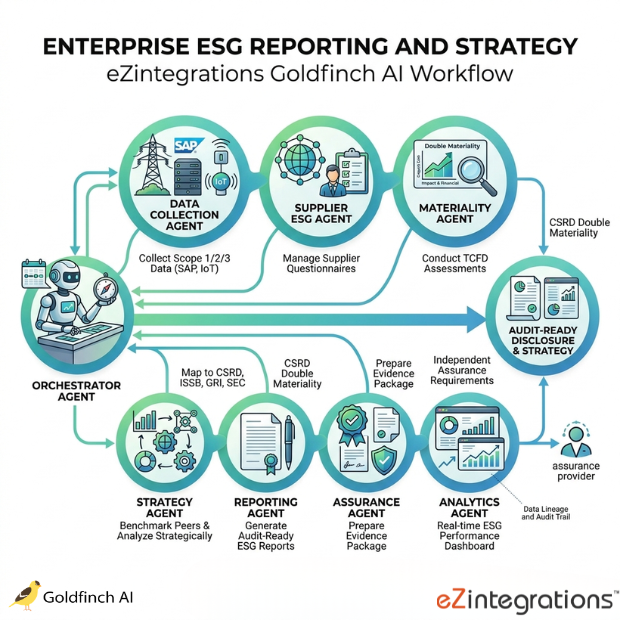
Hierarchical Multi-Agent System – 1 ESG Orchestrator (Coordinator) + 7 specialized Worker Agents (Data Collection; Supplier ESG; Materiality; Regulatory; Strategy; Reporting; Assurance; Analytics) operating through continuous ESG data ingestion; shared ESG vector knowledge base; and human-in-the-loop review gates at materiality assessment; regulatory mapping; and final report sign-off; 8 total agents |
| Coordinator Agent: |
ESG Orchestrator – maintains the enterprise ESG data pipeline and reporting calendar across all 7 Worker Agents; decomposes the ESG reporting and strategy goal into domain-specific sub-tasks (data collection; supplier engagement; materiality assessment; regulatory mapping; target-setting; report generation; assurance preparation); enforces data quality gates before each reporting stage; and routes the final ESG report and assurance package to the CSO; CFO; and Board ESG Committee for human sign-off |
| Worker Agents: |
Assurance Agent: Prepares the evidence package for external assurance (limited or reasonable) – assembling the data lineage documentation, calculation methodology justifications, supplier data validation records, and internal control documentation required by the external assurance provider (Big 4 ESG assurance team or specialist ESG assurer); Analytics Agent: Maintains the real-time ESG performance dashboard – tracking KPIs (Scope 1/2/3 emissions vs. target, water consumption, waste diversion rate, supplier ESG compliance rate, Board diversity, pay gap, safety incident rate) continuously against the organization’s ESG targets and regulatory thresholds, and delivering the monthly ESG performance brief to the CSO and Board ESG Committee, Data Collection Agent: Pulls Scope 1 (direct emissions from owned sources), Scope 2 (purchased electricity, heat, cooling), and Scope 3 (value chain emissions) data from SAP ERP energy and procurement modules, IoT sensor feeds, utility bill data, logistics provider APIs, and business travel data – calculating GHG emissions using GHG Protocol methodology and storing computed results in the ESG DW (Snowflake); Supplier ESG Agent: Collects, chases, and validates supplier ESG questionnaires for the Scope 3 supply chain assessment – sending automated questionnaire requests via the supplier portal, tracking response rates, validating submitted data against the ESG DW benchmark ranges, and flagging non-responding or non-compliant suppliers for procurement team follow-up, https://www.ifrs.org/groups/international-sustainability-standards-board/, EU CSRD https://finance.ec.europa.eu/capital-markets-union-and-financial-markets/company-reporting-and-auditing/company-reporting/corporate-sustainability-reporting_en, and SEC Climate Disclosure Rule https://www.sec.gov/rules/final/2024/33-11275.pdf – identifying disclosure gaps and mapping each data point to its regulatory citation, Materiality Agent: Identifies financially material ESG issues for the organization using the TCFD (Task Force on Climate-related Financial Disclosures) double materiality framework – assessing both the financial impact of ESG issues on the organization and the organization’s impact on the environment and society, and producing the materiality matrix for Board ESG Committee review; Regulatory Agent: Maps the organization’s ESG data and disclosures against the applicable reporting standards and regulatory requirements – GRI Standards https://www.globalreporting.org/, SASB Standards https://sasb.org/, ISSB S1 and S2, Strategy Agent: Benchmarks the organization’s ESG performance against sector peers using public disclosure data, identifies target-setting opportunities (Science Based Targets initiative https://sciencebasedtargets.org/ pathways, net-zero alignment), and recommends short-term and long-term ESG strategy actions for the CSO’s annual sustainability strategy presentation; Reporting Agent: Generates the audit-ready ESG report – assembling all data points, regulatory citations, methodology documentation, and narrative from all 6 domain agents into a structured, standard-compliant ESG report (GRI/SASB/ISSB/CSRD format) with full data lineage (every data point traceable to its source system, collection methodology, and calculation formula) |
| Extensibility Note: |
Beyond the 9 native Goldfinch AI tools; users can add custom tools self-service – including CDP disclosure platform connectors (for direct CDP questionnaire population); MSCI ESG data APIs (for peer benchmarking enrichment); EcoVadis supplier rating APIs (for supplier ESG score import); building management system APIs (for real-time Scope 2 energy consumption data); and XBRL taxonomy connectors (for structured ESG data tagging for regulatory submission). |
| On-Premise Supported: |
Yes – eZintegrations connects to on-premises systems (SAP ERP on-prem; on-premises IoT data platforms; on-premises ESG data management systems) via IPSec Tunnel. eZintegrations is a browser-based; cloud-hosted platform and does not require any on-premises installation. |
| Tags: |
Goldfinch AI ESG intelligence; ESG reporting AI; CSRD compliance AI; ISSB S1 S2 AI reporting; Scope 1 2 3 emissions AI; supplier ESG AI agent; ESG materiality AI; ESG assurance AI; real-time ESG dashboard AI; GRI SASB AI reporting; Goldfinch AI sustainability; SEC climate disclosure AI |
| Safety Layer: |
Human-in-the-loop gate triggers when: Materiality Agent completes the double materiality assessment – Board ESG Committee review required before the materiality matrix is finalized and used as the basis for the ESG report scope; Regulatory Agent identifies a disclosure gap against CSRD, SEC, or ISSB requirements where the organization does not have the data to meet the standard – CSO and Legal Counsel review required before the gap is disclosed in the report;, Reporting Agent completes the draft ESG report – CSO and CFO sign-off required before the Assurance Agent packages the report for external verification; Assurance Agent flags a data quality issue that the external assurance provider is likely to reject – CSO and finance data owner review required before the report proceeds to external assurance; ESG Orchestrator confidence falls below 0.75 on any cross-agent data validation. Max 3 retries before CSO escalation. All HITL decisions logged with reviewer identity, decision, and timestamp for regulatory audit trail and external assurance documentation. |
| Goldfinch AI Native Tools Used: |
API Tool Call: Data Collection Agent (SAP ERP energy and procurement data via OData https://help.sap.com/docs/SAP_S4HANA_ON-PREMISE, IoT sensor data APIs, utility provider APIs, logistics provider emissions APIs, business travel management platform APIs); Supplier ESG Agent (supplier portal API for questionnaire distribution and response collection, Snowflake ESG DW for supplier data storage); Analytics Agent (Snowflake DW https://docs.snowflake.com/ continuous KPI query and dashboard update); ESG Orchestrator (Snowflake ESG DW write for all computed ESG metrics, SMTP report delivery to CSO and Board distribution), Data Analysis: Data Collection Agent computes GHG emissions (Scope 1/2/3) using GHG Protocol methodology with emission factor databases; Supplier ESG Agent validates supplier questionnaire data against benchmark ranges and computes supply chain emissions concentration risk; Materiality Agent scores ESG issue materiality by financial impact and impact materiality dimensions; Strategy Agent scores peer ESG performance benchmarks and computes the organization’s relative positioning; Analytics Agent computes ESG KPI variance vs. target and regulatory threshold proximity; ESG Orchestrator computes cross-agent ESG data quality score, Integration Workflow as Tool: ESG Orchestrator calls pre-built ESG sub-workflows – Data Collection Agent (SAP ERP energy data extraction and GHG calculation sub-workflow), Supplier ESG Agent (supplier questionnaire distribution and chase sub-workflow), Reporting Agent (ESG report assembly and regulatory citation mapping sub-workflow), Assurance Agent (evidence package assembly and external assurance handoff sub-workflow), Analytics Agent (Snowflake ESG DW KPI write and Board digest delivery sub-workflow), Knowledge Base Vector Search: All 8 agents share a persistent ESG knowledge base containing: GHG Protocol emission factor databases and methodology documentation, GRI/SASB/ISSB/CSRD/SEC disclosure requirement matrices, organization’s approved ESG targets and commitments (SBTi pathway, net-zero commitment, water targets, diversity commitments), supplier qualification criteria and ESG benchmark ranges, TCFD double materiality assessment framework and prior-year materiality matrix, industry-specific ESG materiality benchmarks, prior ESG report disclosures and assurance findings – each agent retrieves context relevant to its current ESG domain task, Watcher Tools: ESG Orchestrator monitors the ESG data pipeline continuously – SAP ERP for new energy consumption records, IoT sensor feeds for real-time emissions data, supplier portal for new questionnaire responses, Snowflake ESG DW for KPI threshold breaches, and the regulatory calendar for upcoming disclosure deadlines – triggering the appropriate Worker Agent within 24 hours of each data event or deadline trigger, Web Crawling: Regulatory Agent monitors regulatory body websites (EFRAG https://www.efrag.org/ for CSRD technical standards, ISSB https://www.ifrs.org/groups/international-sustainability-standards-board/ for IFRS S1/S2 updates, SEC https://www.sec.gov/ for climate disclosure rule implementation guidance, GRI https://www.globalreporting.org/ for standard updates) for new disclosure requirements and guidance updates; Strategy Agent crawls peer company ESG reports (CDP https://www.cdp.net/ disclosures, published sustainability reports, SBTi https://sciencebasedtargets.org/ target registry) for benchmarking data |
Table of Contents
| Planning: |
The ESG Orchestrator uses reporting-calendar-driven goal decomposition – the annual ESG reporting cycle is decomposed into sequenced milestones (data collection window; materiality assessment; regulatory gap analysis; strategy benchmarking; report draft; assurance preparation; Board sign-off; external publication). Each milestone activates the appropriate Worker Agent(s) and enforces a data quality gate before advancing to the next stage. Continuous monitoring runs in parallel for real-time ESG KPI tracking and regulatory update monitoring throughout the year. Schema-driven rules govern data collection methodology (GHG Protocol); disclosure mapping rules per regulatory standard; and materiality threshold criteria; LLM reasoning governs materiality narrative; regulatory gap assessment; strategy recommendation generation; and ESG report narrative synthesis. |
|---|---|
| Messaging: |
All 8 agents communicate via structured ESG data and finding messages – the Data Collection Agent publishes computed emissions records with methodology documentation; the Supplier ESG Agent publishes validated supplier data with response rate and quality flags; the Materiality Agent publishes the scored materiality matrix with financial impact and impact materiality dimensions; the Regulatory Agent publishes the disclosure gap register with regulatory citation mapping. Each structured output feeds the Reporting Agent’s report assembly and the ESG Orchestrator’s cross-agent data quality score. |
| Reflection: |
The ESG Orchestrator applies a reflection cycle when cross-agent data quality falls below 0.75 – for example; when the Data Collection Agent’s computed Scope 3 emissions differ materially from prior-year values without a documented business change explanation; the Orchestrator re-queries the Knowledge Base for prior-year methodology documentation; re-evaluates the calculation inputs; and retries up to 3 times before escalating to the CSO with a data quality flag. The Supplier ESG Agent applies an additional reflection cycle when a supplier’s submitted questionnaire data deviates materially from the ESG DW benchmark range – retrieving comparable supplier benchmarks before classifying the submission as valid or requiring follow-up. |
| Knowledge: |
All 8 agents share a persistent ESG vector knowledge base containing: GHG Protocol Scope 1/2/3 emission factor databases and calculation methodology documentation (updated annually with the latest IPCC and IEA emission factors); GRI/SASB/ISSB/CSRD/SEC disclosure requirement matrices (updated continuously via Regulatory Agent Web Crawling); the organization’s approved ESG targets and commitments (SBTi pathway; net-zero target year; water reduction target; diversity commitments); supplier qualification criteria and ESG benchmark ranges per sector and geography; TCFD double materiality assessment framework and prior-year materiality matrix; industry-specific ESG materiality benchmarks; and prior ESG report disclosures with assurance findings. Indexed by ESG topic; reporting standard; data source; and reporting year. |
| Execution: |
The Data Collection Agent pulls Scope 1/2/3 data continuously from SAP ERP; IoT sensors; and utility APIs via API Tool Call and Integration Workflow as Tool. The Supplier ESG Agent distributes and manages supplier questionnaires via the supplier portal API. The Materiality Agent conducts the annual TCFD double materiality assessment using Document Intelligence on industry guidance and Data Analysis on business impact scoring. The Regulatory Agent maps disclosures to CSRD/ISSB/GRI/SASB/SEC requirements via Document Intelligence and Web Crawling. The Strategy Agent benchmarks peer performance via Web Crawling and Document Intelligence. The Reporting Agent assembles the audit-ready ESG report via Integration Workflow as Tool. The Assurance Agent packages evidence for external verification. The Analytics Agent maintains the real-time ESG dashboard via Data Analytics on the Snowflake ESG DW. |
| Business Impact: |
EU CSRD applies to approximately 50,000 EU companies from 2024 to 2028 in phased implementation, requiring auditable double materiality assessment, Scope 1/2/3 emissions data, and independent assurance. ISSB S1 and S2 standards have been adopted by 20+ jurisdictions including UK, Australia, Canada, and Singapore as mandatory disclosure requirements. SEC’s climate disclosure rule requires Scope 1 and 2 emissions disclosure with assurance for large accelerated filers from 2026., The average cost of manual ESG reporting for a large company: $1.5M to $4M annually in internal staff time, data management, and external assurance fees. Companies with poor ESG data quality at assurance receive qualified opinions – the reputational and regulatory cost of a qualified ESG assurance opinion averages $8M to $15M in investor confidence impact (MSCI ESG research). The Goldfinch AI ESG intelligence system converts ESG reporting from an annual, backward-looking cost center into a continuously monitored, audit-ready, strategy-informing intelligence capability. |
The Goldfinch AI ESG intelligence system from eZintegrations deploys 8 coordinated AI agents – an ESG Orchestrator plus 7 specialized Worker Agents – to continuously collect Scope 1/2/3 emissions data from SAP and IoT sources, manage supplier ESG questionnaires, conduct TCFD double materiality assessments, map disclosures against CSRD, ISSB S1/S2, GRI, SASB, and SEC climate rules, generate audit-ready ESG reports, prepare external assurance evidence packages, and maintain a real-time ESG performance dashboard – converting annual, backward-looking ESG reporting into a continuously auditable intelligence capability. eZintegrations is an enterprise automation platform covering iPaaS, AI Workflows, AI Agents, and Goldfinch AI agentic automation.
What Is Goldfinch AI ESG Intelligence Automation?
Goldfinch AI ESG intelligence automation is a hierarchical multi-agent system where an ESG Orchestrator maintains the annual ESG reporting calendar and data quality pipeline across 7 domain agents simultaneously – the Data Collection Agent pulling emissions data from SAP and IoT, the Supplier ESG Agent managing value chain questionnaires, the Materiality Agent conducting TCFD assessments, the Regulatory Agent mapping disclosures to CSRD and ISSB standards, the Strategy Agent benchmarking peers, the Reporting Agent generating the audit-ready report, and the Analytics Agent maintaining the real-time dashboard. Unlike ESG platforms that require sustainability teams to manually input data, assess materiality, and map disclosures to standards, the Goldfinch AI ESG intelligence system automates the full data-to-disclosure pipeline while maintaining the audit trail and data lineage required for CSRD independent assurance.
How Does Goldfinch AI ESG Intelligence Automate End-to-End ESG Reporting with 8 Agents Across Scope 1/2/3 Data Collection, Supplier ESG, Materiality Assessment, CSRD and ISSB Regulatory Mapping, and Audit-Ready Report Generation?
The Data Collection Agent pulls Scope 1/2/3 data from SAP ERP and IoT via API Tool Call. The Supplier ESG Agent manages questionnaire distribution and validation. The Materiality Agent applies TCFD double materiality via Document Intelligence and Data Analysis. The Regulatory Agent maps to CSRD/ISSB/GRI/SASB/SEC via Web Crawling and Document Intelligence. The Strategy Agent benchmarks peers via Web Crawling. The Reporting Agent assembles the audit-ready report. The Assurance Agent prepares the evidence package. The Analytics Agent delivers the real-time ESG dashboard via Data Analytics on Snowflake.
Goldfinch AI ships with 9 native out-of-the-box agent tools. Users can add custom tools self-service beyond the 9 native tools. EU CSRD applies to 50,000 companies with independent assurance requirements – this Goldfinch AI ESG intelligence system was built to meet the data lineage and auditability standard that assurance providers require.
Watch Demo
| Video Title: |
Goldfinch AI ESG Intelligence System | 8 Agents; Scope 1/2/3 Collection to Audit-Ready CSRD and ISSB Report |
|---|---|
| Duration: |
8 to 12 minutes |
Outcome & Benefits
| Autonomy: |
85%+ of ESG data collection; calculation; validation; regulatory mapping; and report assembly executed autonomously within configured scope; materiality matrix; final ESG report; and external assurance package require CSO and Board ESG Committee HITL sign-off; all data points include full audit trail and data lineage documentation suitable for external assurance without additional manual documentation |
|---|---|
| Time Saved: |
Annual ESG reporting cycle from 6 to 9 months of manual effort (data collection; consolidation; materiality assessment; report writing) to 8 to 12 weeks for the full audit-ready report; supplier ESG questionnaire chase from 3 to 4 months of procurement team manual follow-up to automated reminders with response rate tracking; regulatory gap analysis from 4 to 6 weeks of manual standard-by-standard review to automated continuous monitoring |
| Cost Reduction: |
Internal ESG reporting cost from $1.5M to $4M annually (staff time + data management + assurance preparation) to 60 to 75% reduction from automated data collection; calculation; and report assembly; external assurance fee reduction from scope limitation qualifications (data quality issues) – organizations with clean data lineage and complete audit trails reduce external assurance fees by 20 to 35% vs. organizations with manual data; regulatory penalty avoidance from CSRD non-compliance (CSRD penalties: up to 5% of annual turnover per EU member state) |
| Reliability: |
100% of Scope 1/2/3 emissions data points computed with documented GHG Protocol methodology and traceable to source system; 100% of regulatory disclosure requirements mapped per applicable standard (CSRD/ISSB/GRI/SASB/SEC) with gap register maintained continuously; supplier ESG response rate improved from industry average of 35 to 45% (manual questionnaire) to 65 to 80% (automated distribution and chase with supplier portal integration); all ESG data stored in Snowflake ESG DW with immutable audit trail for regulatory examination |
Performance Metrics
| Metric | Before (Manual/Batch) | After (Real-Time Sync) | Improvement |
|---|---|---|---|
| Spend Analysis Cycle | 3 to 6 months | Under 2 weeks | 85%+ faster |
| Transaction Coverage | 20 to 30% sample | 100% of AP volume | Full coverage |
| Category Strategy Prep | 4 to 8 weeks per category | Under 3 days (AI findings) | 90%+ faster |
| Savings Identified | Incomplete (partial data) | 5 to 15% of addressable spend | $2.5M to $7.5M at $50M spend |
Technical Details
| Evaluation Metrics: |
Scope 1/2/3 data completeness rate (% of required emission categories with sufficient data to compute); supplier ESG questionnaire response rate (% of tier-1 suppliers responding within deadline); regulatory disclosure coverage rate (% of applicable CSRD/ISSB/GRI/SASB/SEC disclosure requirements with sufficient data vs. gap); ESG report data lineage completeness (% of reported data points with documented source system; methodology; and calculation); external assurance qualification rate (limited vs. reasonable assurance achievement vs. prior year); materiality matrix stability (% of material topics consistent year-over-year; validated by Board ESG Committee); ESG KPI vs. target trajectory (% of commitments on track vs. off track at mid-year). |
|---|---|
| Planner Type: |
Reporting-calendar-driven goal decomposition with LLM-hybrid analysis – the ESG Orchestrator uses schema-driven rules for data collection methodology (GHG Protocol Scope 1/2/3 calculation rules, emission factor selection criteria), disclosure mapping rules per regulatory standard (CSRD ESRS topic mapping, ISSB S2 climate disclosure mapping), and materiality threshold criteria; LLM reasoning governs materiality narrative generation, regulatory gap assessment narrative, strategy recommendation text, ESG report narrative synthesis, and assurance evidence adequacy assessment. |
| Scheduling: |
ESG Orchestrator manages the annual ESG reporting calendar via Watcher Tools – Scope 1/2 data collection continuous (monthly pull from SAP ERP and IoT sensors); Scope 3 data collection quarterly (supplier questionnaire annual + logistics and procurement data quarterly); Supplier ESG Agent distributes questionnaires at the annual reporting window (configurable: Q1 for calendar-year reporters) and sends automated reminders at 30, 60, and 90 days before the supplier response deadline;, Materiality Agent conducts the annual TCFD assessment at the start of the reporting cycle and on-demand when a material business change occurs; Regulatory Agent monitors regulatory body websites for new guidance continuously (weekly crawl); Strategy Agent runs the annual peer benchmarking review when peer ESG reports are published (typically Q2 after the prior-year annual reporting season); Reporting Agent assembles the draft ESG report at the configured report assembly milestone; Assurance Agent activates when the draft report is approved by the CSO for assurance preparation; Analytics Agent runs continuously for real-time ESG dashboard. |
| Tool Router: |
continuous KPI monitoring maintained by the Analytics Agent. Each Worker Agent selects its tools: API Tool Call for SAP/IoT/supplier portal/Snowflake DW reads and writes; Document Intelligence for regulatory standards, peer reports, and assurance documents; Web Crawling for regulatory guidance and peer disclosure monitoring; Data Analysis for GHG calculation, scoring, and validation; Knowledge Base for methodology, standards, and target context; Data Analytics for ESG dashboards; Integration Workflow as Tool for multi-system ESG data pipeline sub-workflows., The ESG Orchestrator routes each ESG data and reporting task to the appropriate Worker Agent based on task type and reporting calendar milestone – new SAP ERP energy consumption records trigger the Data Collection Agent; new supplier questionnaire responses trigger the Supplier ESG Agent validation workflow; start of annual materiality assessment window triggers the Materiality Agent; new regulatory guidance publication triggers the Regulatory Agent gap re-assessment; peer ESG report publication triggers the Strategy Agent benchmarking update; report assembly milestone triggers the Reporting Agent; CSO draft approval triggers the Assurance Agent; |
| Auditability: |
Every agent action is logged with: agent name, ESG topic, data source (SAP document number, IoT device ID, supplier questionnaire reference, regulatory guidance URL), calculation methodology applied (GHG Protocol scope and emission factor used), data value computed, confidence score, HITL status (autonomous or CSO/Board ESG Committee/Legal Counsel-reviewed), and timestamp. The ESG Orchestrator maintains a full ESG data lineage registry – every data point in the published ESG report is traceable through the audit trail to its source system read, calculation step, and agent action., This data lineage registry is the primary deliverable for external assurance providers (ISAE 3000 limited or reasonable assurance). Regulatory examination readiness: the Regulatory Agent’s disclosure gap register, updated continuously, provides evidence of the organization’s regulatory monitoring process for CSRD supervisory authority examination. All ESG data and audit trail stored in Snowflake ESG DW with immutable write protection and configurable retention per jurisdiction (EU: 10-year retention for CSRD; US: 7-year for SEC). |
| Agent Roles: |
Analytics Agent: API Tool Call (Snowflake ESG DW continuous KPI query), Data Analytics with Charts/Graphs/Dashboards (real-time ESG performance dashboard: Scope 1/2/3 emissions vs. target, water and waste KPIs, supplier ESG compliance rate, Board diversity and pay gap metrics, safety incident rate – all vs. target and regulatory threshold), Knowledge Base Vector Search (ESG target commitments and regulatory thresholds per KPI), Integration Workflow as Tool (Snowflake ESG DW KPI write and Board ESG digest delivery sub-workflow), Assurance Agent: Document Intelligence (external assurance engagement letter and prior-year assurance management letter for evidence requirement extraction), Data Analysis (data lineage completeness scoring per ESG topic: is every reported data point traceable to a source system with documented methodology?), Integration Workflow as Tool (evidence package assembly and external assurance handoff sub-workflow), Knowledge Base Vector Search (assurance standard requirements per engagement type: ISAE 3000 limited assurance vs. reasonable assurance), ESG Orchestrator (Coordinator): reporting calendar management, data quality gate enforcement, cross-agent coordination, CSO/Board ESG Committee escalation routing, ESG report and assurance package delivery; Data Collection Agent: API Tool Call (SAP ERP OData for energy consumption, procurement spend, and fleet data https://help.sap.com/docs/SAP_S4HANA_ON-PREMISE; IoT sensor data APIs for real-time emissions data; utility provider APIs for Scope 2 electricity; logistics provider emissions APIs for Scope 3 transport; business travel management platform APIs), Data Analysis (GHG Protocol Scope 1/2/3 emissions computation using IPCC AR6 emission factors, market-based vs. location-based Scope 2 methodology), Knowledge Base Vector Search (GHG Protocol methodology documentation, emission factor databases), Integration Workflow as Tool (SAP ERP energy data extraction and GHG calculation sub-workflow, Snowflake ESG DW write), Materiality Agent: Document Intelligence (TCFD framework guidance https://www.fsb-tcfd.org/, CSRD ESRS materiality guidance, industry-specific SASB materiality guidance for structured materiality criteria extraction), Data Analysis (ESG issue materiality scoring: financial impact dimension and impact materiality dimension, materiality matrix construction), Knowledge Base Vector Search (TCFD double materiality assessment framework, prior-year materiality matrix, industry-specific ESG materiality benchmarks), Regulatory Agent: Web Crawling (EFRAG https://www.efrag.org/ CSRD technical standards, ISSB https://www.ifrs.org/groups/international-sustainability-standards-board/ IFRS S1/S2 updates, SEC https://www.sec.gov/ climate rule implementation guidance, GRI https://www.globalreporting.org/ standard updates), Document Intelligence (organization’s prior ESG reports, regulatory filing requirement checklists, standard-specific disclosure requirements), Data Analysis (disclosure gap scoring per regulatory standard: CSRD ESRS, ISSB S1/S2, GRI Universal Standards and Topic Standards, SASB applicable industry standard, SEC climate rule), Knowledge Base Vector Search (GRI/SASB/ISSB/CSRD/SEC disclosure requirement matrices), Reporting Agent: Document Intelligence (prior-year ESG report for consistency review and year-over-year comparison), Data Analysis (ESG data consistency and completeness validation across all reported topics), Integration Workflow as Tool (ESG report assembly and regulatory citation mapping sub-workflow – assembles all data points, methodology documentation, regulatory citations, and narrative into structured CSRD/ISSB/GRI format), Knowledge Base Vector Search (report templates and prior-year disclosures), Strategy Agent: Web Crawling (CDP disclosures https://www.cdp.net/ for peer benchmarking, published peer sustainability reports, SBTi target registry https://sciencebasedtargets.org/ for target benchmarking), Document Intelligence (peer ESG reports for benchmarking data extraction), Data Analysis (peer performance scoring across all material ESG topics, relative positioning computation, target gap analysis vs. SBTi pathway and peer median), Data Analytics with Charts/Graphs/Dashboards (peer benchmarking dashboard), Knowledge Base Vector Search (organization’s approved ESG targets and SBTi commitments), Supplier ESG Agent: API Tool Call (supplier portal API for questionnaire distribution, response tracking, and Snowflake ESG DW storage), Data Analysis (supplier questionnaire data validation against ESG DW benchmark ranges, supply chain emissions concentration risk computation, supplier ESG score computation), Knowledge Base Vector Search (supplier qualification criteria and ESG benchmark ranges per sector), Integration Workflow as Tool (supplier questionnaire distribution and chase sub-workflow) |
Connectivity and Deployment
| Supported Protocols: |
REST API (SAP ERP OData v2/v4; IoT sensor data APIs; utility provider APIs; logistics provider APIs; business travel platform APIs; supplier portal APIs; Snowflake DW JDBC); Web Crawling (EFRAG; ISSB; SEC; GRI; SASB; TCFD regulatory body sites; CDP disclosure platform; SBTi target registry; peer company published sustainability reports); SMTP (CSO ESG performance brief; Board ESG Committee digest; supplier questionnaire distribution and reminders; regulatory deadline notifications); HTTPS; OAuth 2.0; IPSec Tunnel (on-premises SAP ERP; IoT platforms; and ESG data management systems) |
|---|---|
| Tenancy Model: |
Single-tenant is strongly recommended for all ESG reporting deployments. ESG data (emissions intensity; supplier ESG scores; executive compensation gap data; safety incident rates) constitutes material non-public information for listed companies and is subject to regulatory confidentiality; securities law constraints; and external assurance confidentiality. Single-tenant provides dedicated infrastructure with full data segregation; configurable data residency per regulatory jurisdiction (EU: CSRD data residency; US: SEC data); and immutable audit trail protection. |
| On-Premise Supported: |
Yes – eZintegrations connects to on-premises systems (SAP ERP on-prem; on-premises IoT data platforms; on-premises ESG data management systems) via IPSec Tunnel. eZintegrations is a browser-based; cloud-hosted platform and does not require any on-premises installation. |
| Security & Compliance: |
SEC Regulation FD-compliant ESG data handling for listed companies (material ESG data maintained in controlled access environment until public disclosure). RBAC enforced: CSO has full ESG portfolio view; ESG Analyst team accesses data collection and validation domains; CFO and Board ESG Committee access materiality matrix and financial impact assessments; external assurance provider accesses the assurance evidence package only (read-only, scoped to the reporting period); Legal Counsel accesses regulatory gap register., SOC Type II certified; CSRD-compliant data lineage and auditability (the Goldfinch AI ESG intelligence system’s audit trail architecture was designed to the ISAE 3000 and IAASB ISSA 5000 assurance evidence standards – every data point is source-referenced, methodology-documented, and agent-action-timestamped); GDPR-compliant handling of employee ESG data (pay gap, diversity, health and safety – processed under GDPR Article 9 with explicit legitimate interest documentation and data minimization); |
AI Credits
| Retry / Reflection Credit Cost: |
Each ESG Orchestrator data quality reflection/retry: ~4 to 7 additional credits per retry. Supplier ESG Agent data validation reflection: ~3 to 5 additional credits. At 12% data quality exception rate; add approximately 12 to 15% to the annual credit estimate. |
|---|---|
| Monthly Credit Estimate (at Typical Volume): |
Mid-market listed company (standard annual ESG reporting; single framework): ~100 to 200 credits per month (lower in non-reporting months; higher during report assembly and assurance months) Large listed company (multi-framework reporting: CSRD + ISSB + GRI; 200+ suppliers): ~200 to 450 credits per month average (600 to 900 credits in peak reporting months) Financial institution or real estate company (complex multi-entity; multi-jurisdiction ESG reporting): ~400 to 800 credits per month average |
| Pricing Model: |
Static Platform Fee + AI Credits. Platform fee covers unlimited non-LLM orchestration across all agents (SAP ERP connection; IoT data pipeline; supplier portal connection; Snowflake ESG DW writes; regulatory calendar management; SMTP notification dispatch; audit log writes). AI Credits consumed only by Goldfinch AI tool invocations and LLM reasoning cycles. |
| Credit Optimization Notes: |
Configure Regulatory Agent Web Crawling to target specific regulatory body publication sections (new standards; technical guidance updates; enforcement actions) rather than full site crawls – reduces Regulatory Agent Web Crawling credits 40 to 60%. Cache Knowledge Base GHG Protocol emission factors per energy category for 12 months (emission factors update annually – no benefit from more frequent re-query). Batch Data Collection Agent SAP ERP API calls for all emission categories in a single monthly extraction rather than per-category sequential pulls. For organizations reporting to a single framework (GRI only or ISSB only); configure Regulatory Agent gap assessment to focus on the applicable standard only rather than all 5 standards simultaneously – reduces Regulatory Agent credits by 60 to 70%. |
| Credit Consumption Model: |
Calendar-driven: continuous low-credit monthly monitoring (Data Collection, Analytics Agents) with annual high-credit peaks for Materiality Agent assessment, Supplier ESG Agent questionnaire cycle, Reporting Agent report assembly, and Assurance Agent evidence preparation; continuous Regulatory Agent monitoring (weekly low credit) |
| LLM Steps Count: |
15 to 28 LLM-invoking steps per monthly ESG cycle (ESG Orchestrator calendar management and data quality scoring: 2 to 3 steps; Data Collection Agent GHG computation: 2 to 3 steps; Regulatory Agent gap assessment: 3 to 5 steps; Materiality Agent annual assessment: 4 to 6 steps; Reporting Agent report assembly: 3 to 5 steps; Assurance Agent evidence preparation: 2 to 4 steps; reflection/retry cycles: 1 to 2 steps per retry) |
| Per-Agent Credit Breakdown: |
ESG Orchestrator: 3 to 6 credits per monthly cycle (data quality scoring + calendar milestone routing + Board digest assembly); Data Collection Agent: 4 to 8 credits per monthly data collection cycle (SAP API Tool Call + IoT data aggregation + GHG Protocol Data Analysis + Snowflake write) Supplier ESG Agent: 8 to 16 credits per annual supplier questionnaire cycle (questionnaire distribution + response validation Data Analysis + Knowledge Base benchmark retrieval), Materiality Agent: 12 to 25 credits per annual materiality assessment (Document Intelligence TCFD/CSRD guidance + materiality Data Analysis + matrix construction);Regulatory Agent: 6 to 12 credits per monthly gap re-assessment cycle (Web Crawling regulatory sites + Document Intelligence standard analysis + gap Data Analysis); Strategy Agent: 8 to 15 credits per annual benchmarking cycle (Web Crawling peer reports + Document Intelligence benchmarking data + Data Analytics peer dashboard), Reporting Agent: 10 to 20 credits per annual report assembly (Document Intelligence prior report review + report assembly Integration Workflow + Knowledge Base template retrieval); Assurance Agent: 8 to 15 credits per annual assurance preparation (Document Intelligence engagement letter + data lineage Data Analysis + evidence package Integration Workflow); Analytics Agent: 2 to 4 credits per monthly KPI dashboard update (Snowflake API Tool Call + Data Analytics dashboard render + Board digest delivery) |
| Goldfinch AI Tool(s) Consuming Credits: |
Data Analysis (Data Collection Agent GHG computation; Supplier ESG Agent validation; Materiality Agent scoring; Regulatory Agent gap scoring; Strategy Agent peer benchmarking; Assurance Agent lineage completeness – per computation), Knowledge Base Vector Search (all 8 agents per ESG methodology and standards context query), Data Analytics (Analytics Agent real-time dashboard; Strategy Agent peer benchmarking; Reporting Agent gap heat map – per render), Integration Workflow as Tool (Data Collection GHG sub-workflow; Supplier questionnaire sub-workflow; Reporting assembly sub-workflow; Assurance package sub-workflow; Analytics KPI write sub-workflow – per invocation), Watcher Tools (ESG Orchestrator continuous data pipeline and regulatory calendar monitoring), API Tool Call (Data Collection Agent SAP/IoT/utility/logistics APIs; Supplier ESG Agent supplier portal; Analytics Agent Snowflake DW – per cycle), Document Intelligence (Materiality Agent TCFD/CSRD guidance; Regulatory Agent standards and prior reports; Strategy Agent peer reports; Assurance Agent engagement letters – per document analyzed), Web Crawling (Regulatory Agent regulatory body sites weekly; Strategy Agent peer CDP/sustainability report monitoring – per crawl cycle), |
FAQ
1. What is the Enterprise ESG Reporting and Strategy system and what does it automate end to end?
The Goldfinch AI ESG intelligence system from eZintegrations deploys 8 coordinated AI agents to continuously collect Scope 1/2/3 emissions data from SAP and IoT (Data Collection Agent), manage supplier ESG questionnaires (Supplier ESG Agent), conduct TCFD double materiality assessments (Materiality Agent), map disclosures against CSRD/ISSB/GRI/SASB/SEC requirements (Regulatory Agent), benchmark ESG strategy against peers (Strategy Agent), generate the audit-ready ESG report (Reporting Agent), prepare external assurance evidence packages (Assurance Agent), and maintain the real-time ESG performance dashboard (Analytics Agent). CSRD applies to 50,000 EU companies with independent assurance requirements from 2024 to 2028 — this system was designed to meet that auditability standard.
2. How does the multi-agent architecture work?
The ESG Orchestrator manages the annual ESG reporting calendar and enforces data quality gates before each reporting stage. The Data Collection and Analytics Agents run continuously throughout the year for real-time monitoring. The Supplier ESG, Materiality, Strategy, Reporting, and Assurance Agents activate at their respective annual reporting calendar milestones. All 8 agents share a persistent ESG Knowledge Base containing GHG Protocol methodology, disclosure requirement matrices, the organization's approved ESG targets, and prior-year disclosures — ensuring every agent's output is consistent with the organization's reporting methodology and regulatory obligations.
3. Which Goldfinch AI tools does this system use?
The system uses all 8 of Goldfinch AI's 9 native tools (missing only one): Watcher Tools (ESG Orchestrator continuous pipeline and regulatory calendar monitoring), API Tool Call (Data Collection SAP/IoT/utility/logistics APIs; Supplier ESG supplier portal; Analytics Snowflake DW), Document Intelligence (Materiality TCFD/CSRD guidance; Regulatory standards and prior reports; Strategy peer reports; Assurance engagement letters), Web Crawling (Regulatory Agent EFRAG/ISSB/SEC/GRI; Strategy Agent CDP disclosures and SBTi registry), Data Analysis (GHG computation; supplier validation; materiality scoring; regulatory gap scoring; peer benchmarking; assurance lineage assessment), Knowledge Base Vector Search (all 8 agents — GHG methodology, disclosure matrices, ESG targets, assurance standards), Data Analytics (real-time ESG dashboard; peer benchmarking; regulatory gap heat map), and Integration Workflow as Tool (GHG calculation; questionnaire distribution; report assembly; assurance package; KPI write sub-workflows). Users can add CDP direct submission, EcoVadis supplier scoring, XBRL taxonomy, and building management system APIs self-service.
4. How does the system ensure data accuracy and handle errors?
The ESG Orchestrator applies a reflection cycle when cross-agent data quality falls below 0.75 — if the Data Collection Agent's computed Scope 3 emissions differ materially from prior year without a documented business change, it re-queries the Knowledge Base for prior methodology, re-evaluates calculation inputs, and retries up to 3 times before CSO escalation with a data quality flag. The Supplier ESG Agent applies additional reflection when supplier questionnaire data deviates from ESG DW benchmark ranges. The Assurance Agent scores data lineage completeness before the report proceeds to external assurance — data quality issues are surfaced to the CSO before the external assurance provider sees them.
5. What types of data and documents does this system process?
The system processes: SAP ERP energy, procurement, and fleet data (Data Collection Agent); IoT sensor real-time emissions data; utility bill and logistics provider emissions data; supplier ESG questionnaire responses (Supplier ESG Agent); TCFD framework and CSRD/ISSB/SASB materiality guidance documents (Materiality Agent); regulatory standard disclosure requirement documents, EFRAG/ISSB/SEC/GRI publications (Regulatory Agent); peer company CDP disclosures and published sustainability reports (Strategy Agent); and external assurance engagement letters and prior-year assurance management letters (Assurance Agent).
6. Who uses this system and in which departments?
Daily operators include the Chief Sustainability Officer (full ESG portfolio view, HITL for materiality matrix, report sign-off), ESG/Sustainability Analysts (data collection validation, supplier follow-up oversight), and IR/Finance team (CSRD and SEC regulatory compliance monitoring). The CFO and Board ESG Committee receive the quarterly ESG performance brief and annual report for sign-off. Legal Counsel accesses the Regulatory Agent's disclosure gap register. External assurance providers access the Assurance Agent's evidence package (read-only, scoped to the reporting period) for their ISAE 3000 engagement.
7. How does the safety layer and human oversight work?
HITL gates trigger when: Materiality Agent completes double materiality assessment — Board ESG Committee review required before finalization; Regulatory Agent identifies a disclosure gap where the organization lacks data to meet the standard — CSO and Legal Counsel review required; Reporting Agent completes draft ESG report — CSO and CFO sign-off required before external assurance; Assurance Agent flags a data quality issue likely to receive a qualified assurance opinion — CSO and data owner review required; ESG Orchestrator confidence below 0.75. After 3 retries, CSO escalation with full context. The published ESG report always requires Board ESG Committee human approval — no autonomous public disclosure.
8. What are the key business benefits and executive KPIs improved?
Key benefits: annual reporting cycle from 6 to 9 months to 8 to 12 weeks (75%+ faster), supplier ESG response rate from 35 to 45% to 65 to 80%, regulatory gap detection from annual manual review to continuous real-time monitoring, 100% data lineage traceability for CSRD and ISSB assurance (vs. partial lineage in manual processes), internal ESG cost reduction of 60 to 75% ($900K to $3M annually), CSRD penalty avoidance (up to 5% of annual turnover per EU member state for non-compliance), and the CSO shifts from managing a 9-month annual reporting project to reviewing a continuously updated ESG intelligence hub year-round.
Resources
| Blog: |
Salesforce Enterprise Integration: Connect Salesforce to Any System |
|---|---|
| Platform Overview: |
eZintegrations Platform – Enterprise iPaaS, AI Workflows & Agentic AI |
| Demo: |
Book a Demo |
| Goldfinch AI Platform: |
Agentic AI Platform — Goldfinch AI by eZintegrations |
Case Study
| Industry: |
Financial Services / Pan-European Asset Manager |
|---|---|
| ROI: |
CSRD penalty avoidance: regulatory non-compliance with CSRD (failure to file or qualified disclosure) carries penalties of up to 5% of annual global turnover in EU member states – estimated penalty avoidance value: €2.4M to €6M for the organization’s size. External assurance qualification avoidance: unqualified vs. qualified ISAE 3000 opinion – estimated investor confidence impact of a qualified ESG assurance opinion: €3M to €8M in AUM impact (MSCI ESG research on qualified ESG assurance reactions). Internal ESG team cost reduction: 4 FTE ESG team members x 60% time freed from manual data collection and report compilation x €85,000 blended cost = €204,000 annually. Supplier ESG response rate improvement: 37% to 79% response rate; improved Scope 3 Category 15 data quality reduces climate risk pricing adjustment in the fund’s institutional investor mandates (estimated: €1.2M in mandate fee protection). Total year-1 |
| Problem: |
A pan-European asset manager with €48B AUM, 340 employees, operations in 6 EU member states, and a large real estate portfolio became subject to CSRD reporting obligations from January 2025 (large listed company, first reporting year: FY2024 report due June 2025). The Sustainability team of 4 (1 Head of Sustainability, 2 ESG Analysts, 1 ESG Data Analyst) faced the following CSRD compliance gaps identified by a Big 4 CSRD readiness assessment: Scope 1/2/3 data completeness: Scope 1 and 2 data existed in fragmented form across 3 ERP systems and 12 building management systems – no unified calculation methodology; Scope 3 Category 15 (investments – financed emissions) not calculated; Supplier ESG data:, no systematic supplier ESG questionnaire process for the 180 material service providers; Double materiality assessment: not conducted to CSRD ESRS standard – prior materiality assessment had been conducted under GRI only and did not meet ESRS requirements; Assurance: CSRD requires limited assurance from FY2024 – the Big 4 assurance team had noted the organization’s current data processes would receive a qualified opinion due to incomplete data lineage; Regulatory monitoring: the team was manually reviewing CSRD technical standards and ISSB updates on a quarterly basis – 3 guidance updates had been missed in the prior year. |
| Solution: |
Deployed the eZintegrations Goldfinch AI ESG intelligence system in 19 business days. SAP ERP (primary ERP for the asset management operations) connected via OData for Scope 1 and 2 energy data. Building management system APIs connected for all 12 buildings (real-time electricity and heating data). Logistics provider API connected for Scope 3 Category 4 (upstream transportation). Business travel management platform (Concur) connected via REST API for Scope 3 Category 6 (business travel). Financed emissions (Scope 3 Category 15) calculation configured using PCAF (Partnership for Carbon Accounting Financials) methodology for the real estate portfolio., Supplier portal API connected for the 180 material supplier questionnaire distribution (aligned with CSRD ESRS E1 supply chain requirements). Knowledge Base Vector Search loaded with: CSRD ESRS technical standards (all topical ESRS: E1-E5, S1-S4, G1), ISSB IFRS S1 and S2 full standard text, GRI Universal Standards and topic standards applicable to asset management sector, SASB Asset Management and Custody Activities standard, PCAF financed emissions methodology, TCFD double materiality assessment framework, organization’s investment stewardship policy, and prior-year sustainability report. HITL: double materiality matrix requires Head of Sustainability and Board Sustainability Committee review; draft CSRD report requires CSO and CFO sign-off; Assurance Agent data quality flags require Head of Sustainability and relevant data owner review. |
| Outcome: |
67 of 180 material suppliers (37%) had responded manually in prior year; 142 of 180 (79%) responded via automated distribution and reminders. Double materiality assessment: conducted to CSRD ESRS double materiality standard – 18 material topics identified (vs. 11 in prior GRI-only assessment); Board Sustainability Committee reviewed and approved. External assurance (Big 4 limited assurance): issued without qualification – assurance provider confirmed that the data lineage and audit trail produced by the Goldfinch AI ESG intelligence system met ISAE 3000 limited assurance evidence requirements. Prior-year assessment had warned that a qualified opinion was likely with manual processes., FY2024 CSRD report (the organization’s first) submitted on time to the statutory deadline (June 2025, 11 months after deployment). CSRD-required ESRS disclosures: 100% coverage (all applicable ESRS topical standards mapped with data; 3 disclosure gaps identified and disclosed with explanation in the report per CSRD ESRS 1 requirements). Scope 1/2/3 data: Scope 1 and 2 computed across all 3 ERP systems and 12 buildings with documented GHG Protocol methodology; Scope 3 Category 15 (financed emissions) computed using PCAF methodology – first time this had been calculated (prior-year reports had disclosed this as not calculated). Supplier ESG questionnaire response rate: |
Related products
-
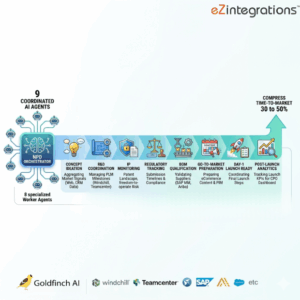
How to Automate New Product Development Using Multi-Agent AI Stage-Gate Orchestration
 $150.00
Download
$150.00
Download
-
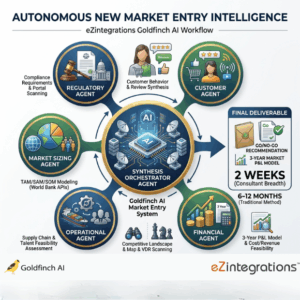
How to Automate Market Entry Research and Expansion Strategy Using Multi-Agent AI Systems
 $150.00
Download
$150.00
Download
-
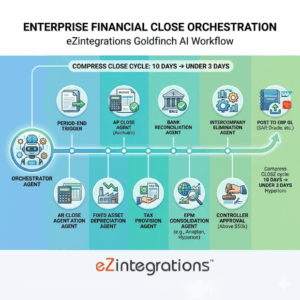
How to Automate Enterprise Financial Close Using Multi-Agent AI Orchestration
 $150.00
Download
$150.00
Download
-
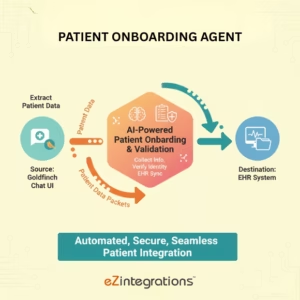
Patient Onboarding Agent
 $0.00
Download
$0.00
Download