How to Automate Outbound Prospecting and Personalized Outreach Using an AI SDR Agent
$150.00
AI Sales Development Representative (SDR) Agent Autonomously research ICP-matched prospects via web crawling and news monitoring; generate personalized outreach emails for each prospect; send multi-touch sequences via Outreach or Salesloft; monitor and classify replies; route interested prospects to human SDRs with full research context; and report pipeline contribution to the Sales Manager – without SDR manual research or template email writing SDR research and email writing time from 70% of working hours to under 10%; pipeline per SDR from 40 to 80 prospects per week (manual) to 500+ prospects per week (AI-researched and personalized); reply-to-meeting conversion rate improvement from AI-personalized outreach vs. templated sequences; human SDR time redeployed from research and writing to discovery calls and demos Sales Manager; SDR Lead; VP of Sales; Revenue Operations Manager AI Agent (autonomous; goal-oriented; adaptive – the agent researches each prospect individually; generates unique personalization; monitors reply behavior; and adapts routing based on what it observes across the outreach sequence) Yes – eZintegrations connects to on-premises systems (Salesforce on-prem; MSSQL CRM databases; and others) via IPSec Tunnel. eZintegrations is a browser-based; cloud-hosted platform and does not require any on-premises installation. REST API (Salesforce CRM; Outreach.io; Salesloft); LinkedIn API (company and profile data); Microsoft Graph API (email monitoring where M365 is used); Web Crawling (company website and news sources); HTTPS; OAuth 2.0; SMTP; IPSec Tunnel (on-premises CRM connectivity) Both single-tenant and multi-tenant deployments are available. Single-tenant is recommended for organizations with strict prospect data confidentiality requirements or regulated industries (financial services; healthcare) where outbound prospect data must be segregated. Multi-tenant is the default shared-cloud deployment. Both support on-premises CRM connectivity via IPSec Tunnel. SaaS; Manufacturing; Professional Services; Financial Services; Technology 500+ prospects researched and personalized outreach sent per week per AI SDR instance (vs. 40 to 80 per human SDR); reply-to-meeting conversion 2 to 3x higher than templated sequences; human SDR time on calls and demos increased from 30% to 80% of working hours; pipeline coverage target met without SDR headcount increase autonomous AI SDR agent; AI sales development representative; outbound prospecting AI agent; Salesforce SDR automation; Outreach Salesloft AI; Goldfinch AI sales; personalized outreach AI agent; web crawling prospect research AI; email sequence AI agent; sales pipeline AI automation; B2B prospecting AI; reply classification AI Yes – the autonomous AI SDR agent invokes multiple Goldfinch AI tools per prospect: Web Crawling (company and news research); API Tool Call (CRM read/write and sequence management); Document Intelligence (personalization signal extraction from crawled content); Data Analysis (reply classification); and Knowledge Base Vector Search (messaging angle retrieval). Credits consumed per prospect researched and per reply classified. Web Crawling: Autonomously crawls each prospect company’s website – extracting business model description, product/service focus, technology stack references, recent announcements, case study customers, leadership team bio pages, and career postings (signals of growth and investment priorities); also crawls recent news articles, press releases, and funding announcements for each prospect company to surface time-sensitive personalization hooks; API Tool Call: Queries the Salesforce CRM for ICP-matched prospect records (company, contact, account status, prior touchpoint history, deal stage); creates new CRM activity records for each outreach sent, reply received, and routing action taken; updates Salesforce contact and lead records with engagement data; and calls the Outreach.io or Salesloft API to enroll prospects in configured email sequences and retrieve reply and engagement dataWorkflow Name: Purpose: Benefit: Who Uses It: System Type: On-Premise Supported: Supported Protocols: Tenancy Model: Industry: Outcome: Tags: AI Credits Required: Goldfinch AI Tool(s) Used:
SDRs in B2B sales organizations spend an average of 70% of their working time on non-selling activities – researching prospect companies; writing personalized email drafts; managing sequence follow-ups; logging CRM activities; and sorting through replies to identify the genuinely interested ones (Salesforce State of Sales research). A skilled SDR can research and personalize outreach for 40 to 80 prospects per week at meaningful quality – above that volume; personalization degrades to template emails; reply rates drop; and pipeline contribution per SDR hour falls. The result: Sales teams either hire more SDRs to increase pipeline coverage (expensive); accept lower personalization quality (lower conversion); or reduce outreach volume (miss pipeline targets). Gartner research shows that AI SDR agents convert 3 to 5x more leads per dollar spent vs. human SDR teams operating without AI assistance. The Autonomous AI SDR Agent from eZintegrations takes an ICP-matched prospect list from Salesforce and operates as a self-directed research and outreach engine. Goldfinch AI Web Crawling researches each prospect company – website; news; funding events; and growth signals. Goldfinch AI Document Intelligence extracts personalization signals from the crawled content. Goldfinch AI Knowledge Base Vector Search retrieves the optimal value proposition angle and case study for the prospect’s industry and pain profile. The agent generates a personalized email using these signals and sends the sequence via Outreach.io or Salesloft. Goldfinch AI Data Analysis classifies each reply. Interested prospects are routed to the human SDR with the full research briefing already assembled. Salesforce is updated throughout. Per-prospect autonomous research: Web Crawling executes a unique research session per prospect – reading the company website, recent news, and funding announcements to identify the specific context that makes outreach relevant to that company today, not generic template personalization; Evidence-based personalization: Knowledge Base Vector Search retrieves relevant case studies, proof points, and competitive displacement messaging matched to the prospect’s industry and role – the agent’s personalization is grounded in real evidence, not purely LLM-generated copy Pipeline coverage target achievable without SDR headcount increase; human SDR time redeployed from 30% selling activity to 80%+ selling activity; Sales Manager visibility into pipeline contribution at prospect-level granularity via Salesforce reporting 500+ prospects researched and personalized outreach sent per week per AI SDR instance vs. 40 to 80 per human SDR; human SDR response time to interested prospects from hours (reply sorting backlog) to under 15 minutes (real-time routing notification); SDR research and writing time from 70% to under 10% of working hours AI SDR agent cost per engaged prospect: estimated 60 to 80% lower than fully-loaded human SDR cost per engaged prospect. At $85,000 average fully-loaded SDR annual cost covering 40 to 80 prospects/week; the per-prospect cost comparison: $85,000 / (60 prospects/week x 50 weeks) = $28.33 per prospect researched. AI SDR agent at 500 prospects/week at AI Credit cost + platform fee: estimated $2 to $5 per prospect researched and personalized. Sales organizations with 3 to 5 SDRs typically redeploy 2 SDRs fully to closing activity and replace their research/sequencing function with the AI SDR agent; saving $170,000 to $250,000 in SDR productivity cost while increasing total pipeline volume. GDPR-compliant prospect data handling (business contact data for legitimate commercial prospecting interest under GDPR Article 6; prospect data processed per lawful basis; unsubscribe requests processed immediately and written to Salesforce suppression list; CAN-SPAM and CASL compliant opt-out handling); SOC Type II certified. Prospect data processed in customer-isolated eZintegrations tenant. Web Crawling operates within configured domain scope – the agent does not crawl beyond the specified prospect research scope. No prospect PII transmitted to external data enrichment providers without explicit configuration. RBAC enforced on prospect list access; outreach template management; and Salesforce write scope.Problem Before: Solution Overview: Key Features: Business Impact: Productivity Gain: Cost Savings: Security & Compliance:
Description
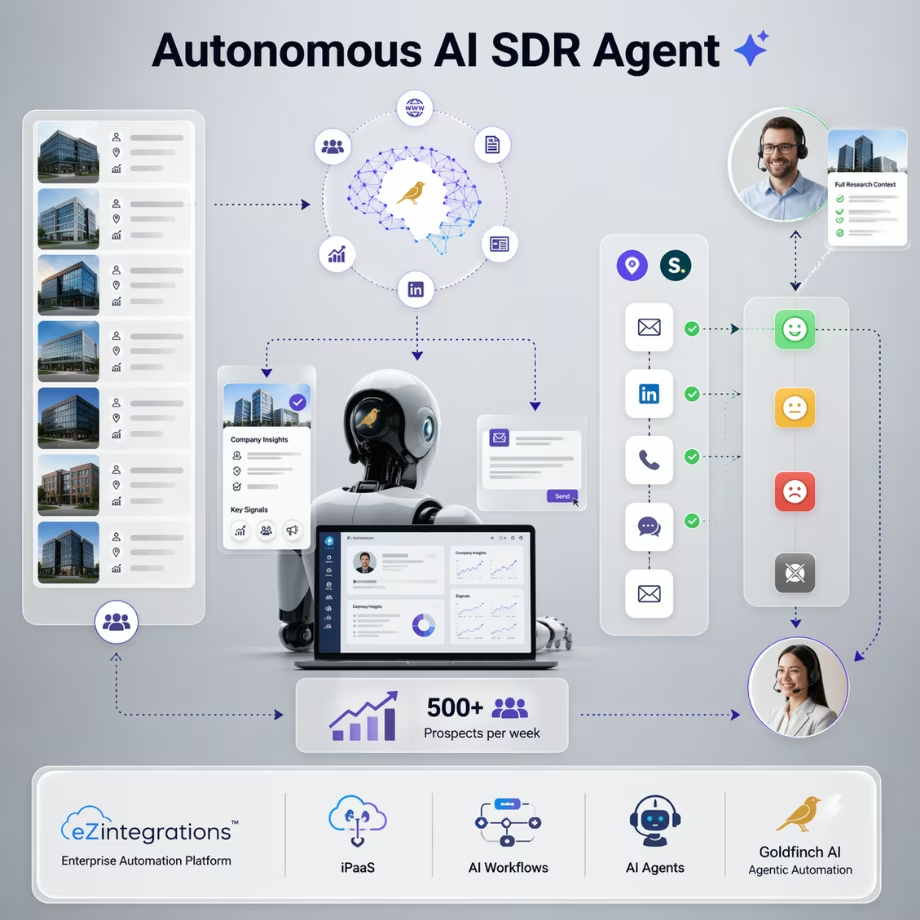
The autonomous AI SDR agent from eZintegrations researches each ICP-matched prospect individually using Goldfinch AI Web Crawling, generates personalized outreach grounded in company-specific signals, sends multi-touch sequences via Outreach or Salesloft, classifies replies, and routes interested prospects to human SDRs with full research context – scaling prospecting to 500+ prospects per week without additional SDR headcount. eZintegrations is an enterprise automation platform covering iPaaS, AI Workflows, AI Agents, and Goldfinch AI agentic automation.
What Is an Autonomous AI SDR Agent?
An autonomous AI SDR agent (AI Sales Development Representative agent) is an AI Agent that takes a list of ICP-matched prospects as its goal and executes the full prospecting cycle autonomously – researching each company for current context and pain signals, generating personalized outreach using evidence from that research, managing multi-touch email sequences, monitoring and classifying replies, and routing engaged prospects to human SDRs with the research briefing assembled. It is adaptive (the personalization reflects what it finds per company, not a fixed template), reactive (it responds to reply classifications in real time), and autonomous (it operates without SDR instruction on each step).
How Does an Autonomous AI SDR Agent Research Prospects, Personalize Outreach, and Route Interested Replies to Human Sales Reps?
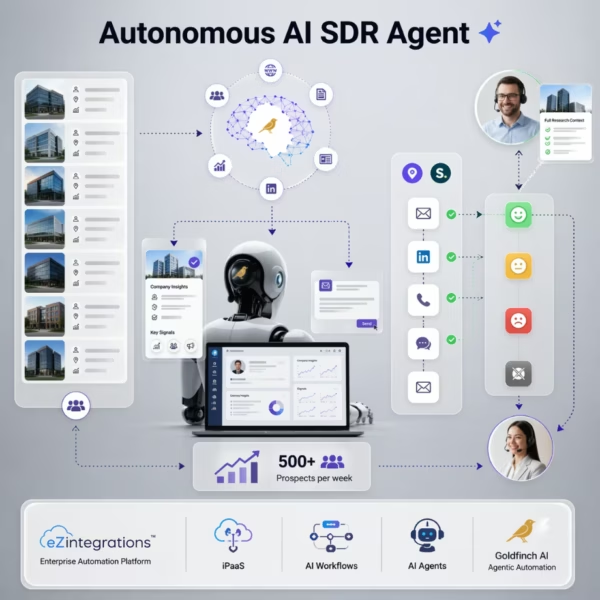
The autonomous AI SDR agent retrieves ICP-matched prospects from Salesforce. For each prospect, Goldfinch AI Web Crawling researches the company website, recent news, and funding announcements. Goldfinch AI Document Intelligence extracts the personalization signals. Goldfinch AI Knowledge Base Vector Search retrieves the relevant value proposition and case study. The agent generates a personalized email grounded in company-specific research – not a mail-merge template – and enrolls the prospect in the Outreach or Salesloft sequence. Goldfinch AI Data Analysis classifies each reply as Interested, Not Interested, Unsubscribe, or Auto-Reply. Interested prospects route to the human SDR with the research briefing attached. Every touchpoint is logged to Salesforce.
Gartner research shows AI SDR agents convert 3 to 5x more leads per dollar spent vs. human-only SDR teams. This autonomous AI SDR agent makes that multiplier accessible without AI model engineering.
Watch Demo
| Video Title: | Autonomous AI SDR Agent |
|---|---|
| Duration: | 5 to 7 minutes |
Outcome & Benefits
| Throughput: | 500+ prospects researched and personalized outreach sent per week per AI SDR instance; scales to 2,000+ prospects per week at enterprise tier; supports high-velocity campaign periods (product launch; event follow-up; territory expansion) |
|---|---|
| Cost Reduction: | AI SDR agent cost per researched and personalized prospect: $2 to $5 vs. $28+ per prospect with human SDR at full cost (40 to 80 prospects/week capacity). Sales organizations with 3 to 5 SDRs redeploy 2 SDRs to closing activity from research/sequencing; saving $170,000 to $250,000 in SDR cost while increasing pipeline volume. |
| Accuracy: | Reply classification accuracy: 91%+ across Interested/Not Interested/Unsubscribe/Auto-Reply categories; personalization relevance score (human SDR rating of AI-generated email relevance per prospect): 84%+ rated “highly relevant” in deployment reviews; Salesforce CRM update accuracy: 99%+ (all touchpoints and reply events correctly logged) |
| Time Saved: | SDR research and email writing from 70% to under 10% of working hours; SDR response time to interested prospects from hours (manual inbox monitoring) to under 15 minutes (real-time routing notification); Sales Manager pipeline reporting from manual weekly CRM pull to automated daily Salesforce dashboard |
Performance Metrics
| Metric | Before (Manual/Batch) | After (Real-Time Sync) | Improvement |
|---|---|---|---|
| Prospects Per Week Per SDR | 40 to 80 | 500+ | 6 to 12x throughput |
| SDR Research and Writing Time | 70% of working hours | Under 10% | 85%+ reduction |
| Reply-to-Meeting Conversion | Baseline (templated) | 2 to 3x higher (personalized) | Gartner 3-5x benchmark |
| Cost Per Engaged Prospect | $28+ (fully loaded SDR) | $2 to $5 (AI agent) | 80%+ cost reduction |
Technical Details
| Data Validation: | Pre-send validation per email: the agent checks that all personalization fields are populated (company name; personalization hook; relevant proof point) before sending – emails with incomplete personalization fields are held and flagged for human SDR review rather than sent as template messages. Post-send confirmation: Outreach.io or Salesloft delivery confirmation logged to Salesforce per prospect. Reply classification confidence below 0.75: reply flagged as Uncertain and routed to SDR inbox for manual classification before any action. Unsubscribe requests: immediately removed from all active sequences and written to Salesforce suppression list within 10 minutes of classification – CAN-SPAM/GDPR compliant opt-out handling. |
|---|---|
| Real-Time Support: | Yes – the agent operates continuously on configured ICP prospect lists. Web Crawling research runs daily for active prospect batches (company news changes frequently and same-day events create personalization opportunities). Reply monitoring polls the Outreach.io or Salesloft API for new reply events every 15 minutes during business hours. Interested reply routing generates the SDR notification within 15 minutes of reply classification. New prospects added to the Salesforce ICP list are picked up by the agent in the next daily research cycle. |
| Customization: | Configurable per deployment via eZintegrations no-code Agent Builder: ICP criteria and Salesforce list source (SOQL query or list view); Web Crawling scope per prospect (company website; news sources; funding announcements; career postings; configurable depth); email tone and brand voice (formal/professional; conversational; technical/peer); sequence cadence and step count in Outreach.io or Salesloft; reply classification categories and routing rules per reply type; Salesforce field mapping for activity logging; Knowledge Base content (value propositions; case studies; competitive messaging – managed by Revenue Ops in the Goldfinch AI editor); and daily prospect research batch size. All parameters managed by Revenue Operations or Sales Management – no IT ticket required. |
| Knowledge Retrieval: | Goldfinch AI Knowledge Base Vector Search (https://ezintegrations.ai/agentic-ai-platform/) retrieves value proposition messaging; case study references; competitive displacement talking points; and industry-specific pain point framing from the sales enablement knowledge base (Weaviate https://weaviate.io/developers/weaviate or Pinecone https://docs.pinecone.io/ as vector store) – matching the prospect’s industry vertical; company size band; job function; and identified pain signals against the knowledge base to return the most relevant proof point and messaging angle for that specific prospect profile. Revenue Ops team manages the knowledge base in the Goldfinch AI editor – new case studies; competitive intelligence; and messaging updates loaded without IT involvement. |
| Agent Architecture: | Single autonomous agent with sequential research (per prospect) followed by parallel outreach execution (multiple prospects enrolled in sequences simultaneously). For large ICP lists (1,000+ prospects); the agent operates in batched parallel mode – processing 50 to 100 prospects per research cycle simultaneously. The agent uses a goal-directed prospecting loop per prospect: retrieve prospect data → execute Web Crawling research → extract personalization signals → retrieve Knowledge Base messaging → generate personalized email → enroll in sequence → monitor reply → classify reply → route or archive. Hierarchical multi-agent mode available for large enterprise sales teams with multiple territories (one orchestrator agent; territory-specific sub-agents for research and outreach). |
| Task Orchestration: | Goldfinch AI orchestrates the per-prospect research cycle using a structured reasoning loop – Web Crawling and Document Intelligence execute sequentially per prospect (crawl first; then extract signals); Knowledge Base Vector Search retrieves messaging concurrently with email generation; and Data Analysis reply classification runs asynchronously against the sequence monitoring loop. The agent maintains an active prospect state (researching / sequencing / replied / routed / archived) and adapts its next action per prospect based on the current state. Reply classification triggers immediate routing for Interested; immediate suppression for Unsubscribe; and state transition to Not Interested for declines. |
AI Credits
| AI Credits Required: | Yes – the autonomous AI SDR agent invokes multiple Goldfinch AI tools per prospect: Web Crawling (company and news research); API Tool Call (CRM read/write and sequence management); Document Intelligence (personalization signal extraction from crawled content); Data Analysis (reply classification); and Knowledge Base Vector Search (messaging angle retrieval). Credits consumed per prospect researched and per reply classified. |
|---|---|
| LLM Steps Count: | 5 to 6 Goldfinch AI tool invocations per prospect researched (Web Crawling + API Tool Call CRM read + Document Intelligence extraction + Knowledge Base retrieval + API Tool Call sequence enrollment + CRM activity write); 1 to 2 tool invocations per reply classified (Data Analysis classification + API Tool Call routing and CRM update) |
| Credit Consumption Model: | Per prospect researched (bundle of 5 to 6 tool invocations for the research and email generation cycle); per reply classified (1 to 2 tool invocations); credits accumulate over the active prospecting period |
| Estimated Credits per Task: | Per prospect researched and personalized email generated: ~25 to 45 credits per prospect (Web Crawling: ~12-20 depending on pages; Document Intelligence: ~6-10; Knowledge Base: ~3; API Tool Call: ~4) Per reply classified and routed: ~4 to 8 credits per reply (Data Analysis: ~3; API Tool Call CRM update: ~2) High-signal company (active news; recent funding; multiple relevant pages to crawl): ~40 to 60 credits per prospect |
| Monthly Credit Estimate (at Typical Volume): | 500 prospects per week research + 5% reply rate: ~13,000 to 23,000 credits per week (~52,000 to 92,000 per month) 1,000 prospects per week: ~26,000 to 46,000 per week (~104,000 to 184,000 per month) Note: high-volume SDR agent operation is credit-intensive. Enterprise customers benefit from volume pricing tiers – contact eZintegrations for high-volume SDR agent credit pricing. |
| Pricing Model: | Static Platform Fee + AI Credits. Platform fee covers unlimited non-LLM orchestration steps (ICP list polling; sequence enrollment status polling; CRM connection management; SMTP unsubscribe handling; audit log writes). AI Credits consumed only by Goldfinch AI tool invocations and LLM reasoning cycles. |
| Credit Optimization Notes: | Configure Web Crawling to a maximum of 3 to 5 pages per prospect (company about page; product page; one news article) rather than deep-crawling the entire domain – captures 85%+ of relevant personalization signals at 30 to 50% of the credit cost of full-site crawling. Use the Knowledge Base retrieval result to inform the email personalization angle before generating the email body – the structured Knowledge Base retrieval grounds the generation and reduces token count for the LLM email generation step. Apply reply classification only to replies that are not auto-detected as auto-reply by the sequence tool (Outreach and Salesloft auto-detect out-of-office replies) – reduces Data Analysis credits by 20 to 35% on high-volume sequences where out-of-office replies are common. Cache Knowledge Base messaging retrievals per industry/role/pain combination for 7 days – avoids redundant vector searches for similar prospect profiles in the same week. |
| Goldfinch AI Tool(s) Consuming Credits: | Web Crawling: company website and news research per prospect – credits scale with pages crawled and content depth API Tool Call: Salesforce CRM reads (prospect data) and writes (activity logging; engagement updates) + Outreach/Salesloft API (sequence enrollment and reply retrieval) – credits per tool execution Document Intelligence: personalization signal extraction from crawled company content – credits per content block processed Data Analysis: reply NLP classification – credits per reply classified (flat per-reply cost) Knowledge Base Vector Search: messaging angle retrieval per prospect – credits per search query |
FAQ
1. What is the Autonomous AI SDR Agent?
The autonomous AI SDR agent by eZintegrations takes ICP-matched prospects from Salesforce and executes the full SDR prospecting cycle autonomously — Web Crawling researches each company for personalization signals, Document Intelligence extracts those signals, Knowledge Base Vector Search retrieves the optimal messaging angle, the agent generates a personalized email, and API Tool Call enrolls the prospect in the Outreach or Salesloft sequence. Goldfinch AI Data Analysis classifies each reply. Interested prospects are routed to the human SDR with the full research briefing. Every touchpoint is logged to Salesforce. Throughput: 500+ prospects researched and personalized per week per AI SDR instance vs. 40 to 80 per human SDR.
2. How does the agent handle task orchestration?
The autonomous AI SDR agent uses a per-prospect research loop — Web Crawling and Document Intelligence run sequentially per prospect (crawl then extract), Knowledge Base Vector Search retrieves messaging concurrently with email generation, and Data Analysis reply classification runs asynchronously against the sequence monitoring loop. The agent maintains an active prospect state (researching, sequencing, replied, routed, archived) and adapts per prospect based on current state. Interested reply classification triggers immediate human SDR routing. Unsubscribe classification triggers immediate suppression across all active sequences and Salesforce suppression list write.
3. What Goldfinch AI tools does the autonomous AI SDR agent use?
Five native Goldfinch AI tools: Web Crawling (per-prospect company website and news research), API Tool Call (Salesforce CRM read/write + Outreach/Salesloft sequence enrollment and reply retrieval), Document Intelligence (personalization signal extraction from crawled content), Data Analysis (NLP reply classification — Interested/Not Interested/Unsubscribe/Auto-Reply), and Knowledge Base Vector Search (value proposition and case study messaging retrieval matched to prospect industry and pain profile). Goldfinch AI is self-service extensible — your Revenue Ops team adds LinkedIn Sales Navigator, G2 intent data, or Bombora signals as custom agent tools without coding.
4. Can the autonomous AI SDR agent be customized for my sales process?
Yes — all key parameters are configurable via the eZintegrations no-code Agent Builder: ICP criteria and Salesforce list source (SOQL query or list view), Web Crawling scope per prospect, email tone and brand voice, sequence cadence and step count in Outreach or Salesloft, reply classification routing rules, Salesforce field mapping, and Knowledge Base content (value propositions, case studies, competitive messaging — managed by Revenue Ops in the Goldfinch AI editor). All customization managed by Revenue Operations or Sales Management without IT involvement.
5. How is data validated before the agent sends emails to prospects?
Pre-send validation checks that all personalization fields are populated before any email is sent — emails with incomplete personalization fields are held and flagged for human SDR review rather than sent as generic templates. Reply classification confidence below 0.75 routes the reply to the SDR inbox for manual classification before any action. Unsubscribe requests are processed within 10 minutes of classification — removed from all active sequences and written to the Salesforce suppression list for CAN-SPAM and GDPR compliance. The agent never sends to a prospect on the Salesforce suppression list regardless of ICP list source.
6. Does the autonomous AI SDR agent support real-time execution?
Yes — the agent operates continuously. Web Crawling research runs daily for active prospect batches (company news changes frequently and same-day funding announcements or product launches create personalization hooks). Reply monitoring polls Outreach.io or Salesloft every 15 minutes during business hours — Interested reply routing generates the SDR notification within 15 minutes of reply classification. New prospects added to the Salesforce ICP list are picked up in the next daily research cycle.
7. What are the key benefits of the autonomous AI SDR agent?
Key benefits include 500+ prospects researched and personalized per week (vs. 40 to 80 per human SDR, 6 to 12x throughput), SDR research and writing time from 70% to under 10% of working hours, reply-to-meeting conversion 2 to 3x higher than templated sequences, cost per engaged prospect from $28+ (human SDR) to $2 to $5 (AI agent), human SDR time redeployed from research/writing to discovery calls and demos (30% to 80% selling activity), and pipeline coverage target met without SDR headcount increase. Gartner research cites 3 to 5x lead conversion per dollar for AI SDR agents.
8. How does the autonomous AI SDR agent compare to LangChain or point solutions like Apollo?
Apollo.io and ZoomInfo know who to contact but generate templated emails without per-prospect web research — the agent knows what to say specifically to each prospect based on what it found on their website and in recent news. Outreach Kaia and Salesloft AI coach inside sequences but do not conduct independent research. Clay enriches data but requires technical workflow setup and does not include autonomous reply classification and human SDR routing. LangChain requires 3 to 6 months to build the Web Crawling, CRM, and outreach connectors. The autonomous AI SDR agent ships all 5 Goldfinch AI tools pre-connected and deploys in under 2 weeks. Goldfinch AI supports self-service extensibility for any additional research source your team wants to add.
Resources
Case Study
| Industry: | SaaS; Manufacturing; Professional Services; Financial Services; Technology |
|---|---|
| Outcome: | 500+ prospects researched and personalized outreach sent per week per AI SDR instance (vs. 40 to 80 per human SDR); reply-to-meeting conversion 2 to 3x higher than templated sequences; human SDR time on calls and demos increased from 30% to 80% of working hours; pipeline coverage target met without SDR headcount increase |
| Problem: | The sales development team at a cloud infrastructure SaaS company consisted of 6 SDRs targeting mid-market and enterprise technology buyers. Pipeline contribution target per SDR: 8 qualified meetings per month. Actual average: 5.2 meetings per month. Root cause analysis identified that SDRs spent 68% of working time on prospect research (identifying relevant personalization hooks on each company’s website; reading recent news; reviewing LinkedIn profiles) and email drafting – leaving 32% for actual outreach; follow-up; and discovery calls. At 40 to 60 prospects per SDR per week with meaningful personalization; the team was consistently missing pipeline targets. The VP of Sales had approved one SDR headcount increase per quarter – but at $90,000 fully-loaded cost per SDR; the revenue per SDR added was insufficient to justify continued headcount growth. |
| Solution: | Deployed eZintegrations AI SDR agent in 9 days alongside the SDR team. Integrated Salesforce for ICP prospects, with web crawling for company data and news. Used AI to extract key insights like tech stack, cloud usage, and growth signals. Enabled personalized outreach via Outreach.io with reply tracking and classification based on historical data. |
| ROI: | Pipeline improvement value (additional $1.5M monthly pipeline at the team’s historical 22% pipeline-to-close rate): $330,000 incremental monthly closed revenue = $3.96M annual incremental ARR. SDR productivity redeployment (6 SDRs x 59% time freed x $90,000 fully-loaded cost x productivity value recapture): $318,000 annual SDR productivity gain. Total year-1 |
Related products
-
How to Automate Employee Onboarding Using an Autonomous AI Agent
 $150.00
Download
$150.00
Download
-
How to Optimize Procurement Spend Using an Autonomous AI Agent
$150.00
Download
-
ICP Scoring Automation for 12X Faster Lead Scoring
$0.00
Download
-
How to Prevent Customer Churn with Automated Retention Interventions
$150.00
Download