How to Automate IT Support Ticket Resolution Using an AI Agent
$150.00
Autonomous IT Incident Resolution Agent Autonomously resolve common IT incidents – password resets; VPN access; application provisioning; software deployment; and account unlocks – by classifying tickets via NLP; retrieving resolution steps from the knowledge base; executing system actions in IAM (Okta/Azure AD); MDM (Intune); and ITSM (ServiceNow); confirming resolution with the user; and closing the ticket – without L1 agent involvement for covered incident types 40 to 60% of IT support tickets resolved autonomously without L1 agent involvement; mean time to resolution (MTTR) for covered incidents from 4 to 24 hours (ticket queue) to under 8 minutes (immediate AI execution); IT service desk agent capacity freed from repetitive L1 tasks and redeployed to infrastructure; security; and strategic IT work; service desk cost per ticket from $22 (HDI benchmark) to under $3 for AI-resolved incidents IT Service Desk Manager; CIO; ITSM Admin; IT Operations Manager AI Agent (autonomous; goal-oriented; adaptive – classifies each incident independently; retrieves the appropriate resolution procedure; executes system API calls; confirms resolution; and escalates with full context when the incident falls outside its resolution authority) Yes – eZintegrations connects to on-premises systems (ServiceNow on-prem; Active Directory on-prem; SCCM on-prem; and others) via IPSec Tunnel. eZintegrations is a browser-based; cloud-hosted platform and does not require any on-premises installation. REST API (ServiceNow ITSM); SCIM (Okta and Azure AD account management); Microsoft Graph API (Azure AD; Intune MDM); LDAP (on-premises Active Directory via IPSec Tunnel); SMTP (user confirmation and resolution notification); HTTPS; OAuth 2.0; IPSec Tunnel (on-premises ServiceNow; Active Directory; SCCM) Both single-tenant and multi-tenant deployments are available. Single-tenant is recommended for government; financial services; and healthcare organizations with strict IT data segregation requirements or security clearance-adjacent IT environments. Multi-tenant is the default shared-cloud deployment. Both support on-premises IAM and ITSM connectivity via IPSec Tunnel. All Industries – Enterprise (highest ROI in Financial Services; Healthcare; Government; Manufacturing; Retail with large employee populations and high L1 ticket volume) 40 to 60% autonomous ticket resolution rate; MTTR for covered incidents from 4 to 24 hours to under 8 minutes; IT service desk cost per ticket from $22 (HDI benchmark) to under $3 for AI-resolved incidents; L1 agent capacity freed from repetitive tickets redeployed to L2/L3 infrastructure work AI IT incident resolution agent; IT helpdesk automation AI; autonomous IT support agent; ServiceNow AI automation; Okta password reset AI; Azure AD provisioning agent; Goldfinch AI IT service desk; L1 ticket automation AI; ITSM AI agent; IT support AI agent; MDM automation Intune AI; IT ticket resolution automation Yes – the AI IT incident resolution agent invokes multiple Goldfinch AI tools per ticket: Document Intelligence (ticket NLP classification and field extraction); Knowledge Base Vector Search (resolution procedure retrieval); API Tool Call (IAM/MDM/ITSM system action execution and ticket updates); Watcher Tools (SLA monitoring and action confirmation); and Data Analysis (escalation routing and incident pattern analysis). Credits consumed per ticket processed. API Tool Call: Executes system actions per the retrieved resolution procedure — resetting user passwords in Okta or Azure AD via SCIM/Graph API, provisioning application access by adding the user to the correct Azure AD or Okta group, triggering software deployment packages via Microsoft Intune MDM, unlocking user accounts, updating ServiceNow ITSM ticket status (in-progress, resolved, closed), assigning tickets to L2 groups for escalation, and writing resolution notes to the ticket record, Document Intelligence: Analyzes each incoming ServiceNow ticket — classifying the incident type (password reset, VPN access, application access request, software install request, account unlock, network connectivity, hardware issue) and extracting structured fields (affected user, affected system, error description, urgency level, prior ticket history for the same user/system) that inform the resolution procedure selection and escalation priority, Knowledge Base Vector Search: Retrieves the resolution procedure for each classified incident type from the IT knowledge base — matching the ticket’s NLP classification (incident category, severity, system involved) against the configured resolution playbook to return the exact resolution steps, required system API calls, confirmation steps, and escalation criteria for that incident type. The knowledge base is maintained by the IT Operations team in the Goldfinch AI editor and updated when resolution procedures change — no IT development required for playbook updates., Watcher Tools: Monitors open ticket queues in ServiceNow for newly submitted incidents and resolution confirmation responses from users; tracks SLA windows per ticket priority (P1/P2/P3/P4) and triggers escalation to the L2 team when a ticket approaches its SLA breach threshold without resolution; monitors API Tool Call execution confirmations to verify system actions were successfully applied (e.g. confirms the Okta password reset API returned success before closing the ticket)Workflow Name: Purpose: Benefit: Who Uses It: System Type: On-Premise Supported: Supported Protocols: Tenancy Model: Industry: Outcome: Tags: AI Credits Required: Goldfinch AI Tool(s) Used:
L1 IT support teams in enterprise organizations spend 60% or more of their working hours on repetitive incidents that require no diagnostic skill – password resets; account unlocks; VPN access problems; application provisioning requests; and software installation requests. According to HDI (Help Desk Institute); the average fully-loaded cost per L1 IT support ticket is $22. The typical enterprise IT service desk processes 500 to 5,000 tickets per month – 60% of which are resolvable with a fixed procedure requiring only an API call to IAM or MDM. These tickets consume $66,000 to $660,000 annually in L1 agent time at typical volumes. Gartner research shows that organizations deploying AI IT agents autonomously resolve 40 to 60% of their ticket volume within 90 days of deployment – the fastest-documented ROI window in enterprise IT automation. The Autonomous IT Incident Resolution Agent from eZintegrations monitors the ServiceNow ITSM ticket queue and resolves eligible incidents without L1 agent involvement. Goldfinch AI Document Intelligence classifies each incoming ticket and extracts the affected user; system; and error context. Goldfinch AI Knowledge Base Vector Search retrieves the correct resolution procedure from the IT knowledge base. Goldfinch AI API Tool Call executes the required system action – resetting the password in Okta or Azure AD; provisioning access by adding the user to the correct group; triggering an Intune software deployment; or unlocking the account. The agent confirms resolution with the user via SMTP; closes the ticket with resolution notes; and routes escalations to the L2 team with the full investigation context attached. ServiceNow SLA timers are honored via Goldfinch AI Watcher Tools. IT service desk cost per ticket from $22 (HDI) to under $3 for AI-resolved incidents; L1 agent capacity freed from repetitive tickets redeployed to L2/L3 infrastructure; security; and strategic IT work; IT employee satisfaction improvement from same-day/same-hour self-service resolution for common issues vs. overnight queue 40 to 60% of tickets resolved without L1 agent involvement (Gartner benchmark); MTTR from 4 to 24 hours (ticket queue) to under 8 minutes for covered incidents; L1 agents refocused from rote ticket processing to proactive infrastructure monitoring and system improvement L1 ticket processing cost from $22 per ticket (HDI) to under $3 per AI-resolved ticket; at 2,000 tickets per month with 50% AI resolution rate: $19 savings per ticket x 1,000 AI-resolved tickets = $19,000 per month / $228,000 annually; at 5,000 tickets per month with 55% rate: $19 x 2,750 = $52,250 per month / $627,000 annually. Documented ROI within 90 days for most deployments (Gartner IT automation benchmark). HIPAA-eligible configuration (healthcare IT with patient system access controls); GDPR-compliant data handling (employee IT request data processed under GDPR Article 6 employment contract necessity); SOC Type II certified; ISO 27001-compatible security controls for IAM actions (all agent API calls to Okta; Azure AD; and Intune use authenticated service accounts with minimum required privilege scope; agent cannot exceed its configured authorization boundary). Password reset operations: passwords generated to comply with the organization’s configured Active Directory or Okta password policy – the agent does not set or log plaintext passwords. All IAM actions logged to the immutable audit trail in ServiceNow and the Goldfinch AI agent execution log. RBAC enforced on knowledge base content; incident category resolution authority; and escalation routing configuration.Problem Before: Solution Overview: Business Impact: Productivity Gain: Cost Savings: Security & Compliance:
Description
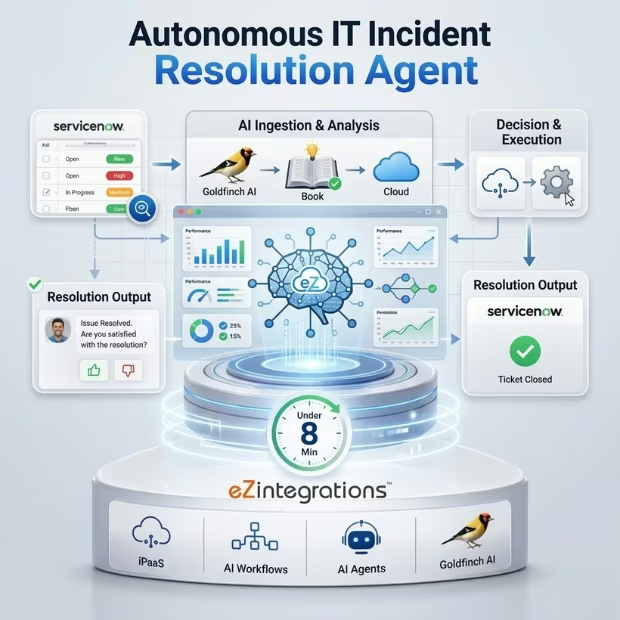
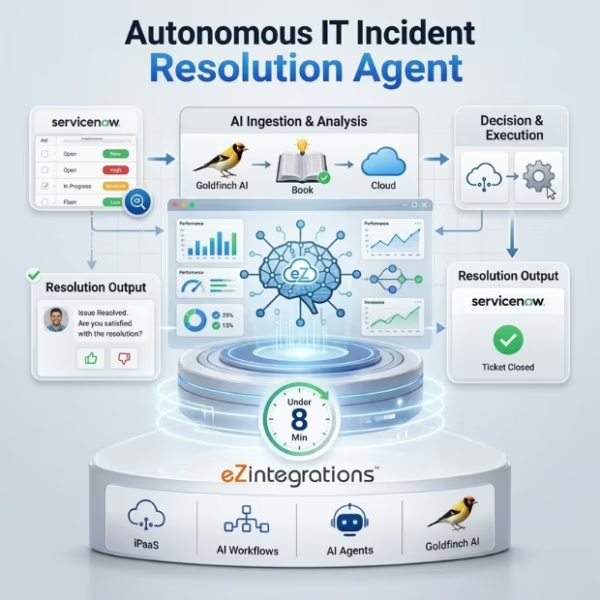
The AI IT incident resolution agent from eZintegrations monitors the ServiceNow ticket queue, classifies each incident with Goldfinch AI NLP, retrieves the resolution procedure from the IT knowledge base, executes system actions in Okta, Azure AD, or Intune, confirms resolution with the user, and closes the ticket – all in under 8 minutes, without L1 agent involvement for covered incident types. eZintegrations is an enterprise automation platform covering iPaaS, AI Workflows, AI Agents, and Goldfinch AI agentic automation.
What Is an AI IT Incident Resolution Agent?
An AI IT incident resolution agent is an AI Agent that takes each incoming ITSM ticket as its goal and autonomously executes the full resolution cycle – classifying the incident type, retrieving the documented resolution procedure, executing the required system action (password reset, access provisioning, software deployment), confirming resolution with the affected user, and closing the ticket – or escalating with full diagnostic context when the incident falls outside its resolution authority. It is reactive (it triggers on new ticket events), adaptive (it retrieves the correct resolution procedure per classified incident type), and autonomous (it acts without L1 agent instruction per ticket).
How Does an AI IT Incident Resolution Agent Autonomously Resolve Password Resets, Access Requests, and Software Installs Without L1 Helpdesk Involvement?
When a ticket is submitted in ServiceNow, the AI IT incident resolution agent triggers within 5 minutes. Goldfinch AI Document Intelligence classifies the incident type and extracts the affected user, system, and error context. Goldfinch AI Knowledge Base Vector Search retrieves the resolution procedure for that incident category. Goldfinch AI API Tool Call executes the required action: Okta or Azure AD password reset via SCIM/Graph API, application access provisioning by group assignment, or Intune software deployment trigger. The agent confirms resolution with the user via email and closes the ServiceNow ticket with resolution notes. Goldfinch AI Watcher Tools monitors SLA timers and escalates proactively. For tickets outside resolution authority, Goldfinch AI Data Analysis routes to the correct L2 team with the full diagnostic context assembled.
HDI benchmarks the average fully-loaded L1 IT ticket cost at $22. This AI IT incident resolution agent brings that cost to under $3 for covered incident types – without reducing the user’s service experience. The user gets a faster resolution, not a worse one.
Watch Demo
Outcome & Benefits
| Throughput: | Up to 1,000 tickets processed per day at standard configuration; scales to 10,000+ per day at enterprise tier; agent operates 24/7 – P1 incidents on Saturday night are addressed with the same response time as Monday morning |
|---|---|
| Cost Reduction: | L1 ticket cost from $22 per ticket (HDI benchmark) to under $3 for AI-resolved incidents; $228,000 to $627,000 annual savings at 2,000 to 5,000 tickets per month with 50 to 55% AI resolution rate; Gartner documents ROI within 90 days for IT agent deployments |
| Accuracy: | Incident classification accuracy: 93%+ across 8 standard L1 incident categories; resolution success rate on covered incident types: 97%+ (system action executed and confirmed); false escalation rate (resolvable incidents incorrectly escalated to L2): under 5% |
| Time Saved: | MTTR for covered incidents from 4 to 24 hours (ticket queue) to under 8 minutes; P1 incident response from queue-dependent to within 5 minutes regardless of business hours; L2 resolution time per escalated ticket from 45 to 90 minutes (re-investigation from scratch) to under 15 minutes (reviewing agent-assembled context) |
Performance Metrics
| Metric | Before (Manual/Batch) | After (Real-Time Sync) | Improvement |
|---|---|---|---|
| MTTR for Covered Incidents | 4 to 24 hours (queue) | Under 8 minutes | 95%+ faster |
| L1 Agent Time on Repetitive Tickets | 60% of working hours | Under 15% | 75% reduction |
| Cost Per Ticket (Covered Types) | $22 (HDI benchmark) | Under $3 | 85%+ reduction |
| 24/7 Resolution Coverage | Business hours only | 24/7 including weekends | Full coverage |
Technical Details
| Data Validation: | Three-stage validation per resolution action: pre-action authority check – the agent verifies the requested action is within its configured resolution authority (e.g. password reset is authorized; privileged account access provisioning above a configured sensitivity level requires L2 approval regardless of Knowledge Base procedure); pre-execution field validation – all required parameters are present for the API call (username; target system; access group; software package ID) before the IAM or MDM API call is executed; post-execution confirmation – API response codes verified after each system action and resolution confirmation received from the user before ticket closure. Failed API calls trigger retry (up to 3 attempts) before L2 escalation with error context. |
|---|---|
| Real-Time Support: | Yes – the agent monitors the ServiceNow ticket queue continuously and processes new tickets within 5 minutes of submission; 24/7. P1 incidents trigger immediate processing on priority interrupt regardless of batch queue position. Watcher Tools monitors SLA timers continuously for P1 and P2 incidents and at 30-minute intervals for P3 and P4 – escalation fires before SLA breach; not after. The agent operates identically at 2am Saturday as at 10am Monday – no overnight ticket backlog accumulation. |
| Customization: | Configurable per deployment via eZintegrations no-code Agent Builder: supported incident categories and resolution authority per category (which incident types the agent can resolve autonomously vs. must escalate); IAM system target (Okta; Azure AD; on-premises Active Directory; or hybrid); MDM system target (Intune; Jamf; or SCCM); software deployment package catalog for automated installs; SLA windows per priority level (P1/P2/P3/P4); user confirmation communication template; escalation routing rules per incident type and complexity score; L2 team assignment matrix; and ServiceNow field mapping for ticket updates and closure notes. IT Operations team manages knowledge base resolution procedures in the Goldfinch AI editor – no development required for procedure updates. |
| Knowledge Retrieval: | Goldfinch AI Knowledge Base Vector Search (https://ezintegrations.ai/agentic-ai-platform/) retrieves IT incident resolution procedures from the IT knowledge base (Weaviate https://weaviate.io/developers/weaviate or Pinecone https://docs.pinecone.io/ as vector store) – matching the Document Intelligence ticket classification (incident category; affected system; error type) against the configured resolution playbook to return the exact resolution steps; required API calls; success confirmation criteria; and escalation triggers for that incident type. Resolution procedures maintained by IT Operations in Goldfinch AI editor – updates take effect immediately; no deployment cycle required. |
| Agent Architecture: | Single autonomous agent with sequential incident processing (per ticket: classify → retrieve procedure → execute action → confirm → close or escalate). For P1 incidents and high-volume periods; the agent supports parallel processing of multiple tickets simultaneously with dedicated execution threads per ticket. The agent uses a goal-directed resolution loop per ticket: receive ticket event → classify incident → retrieve procedure → check resolution authority → execute system action → confirm with user → close or escalate. For tickets outside resolution authority or with classification confidence below 0.72; the agent switches to a diagnostic assembly loop – gathering system state information before routing to L2 rather than escalating with just the original ticket text. |
| Task Orchestration: | Goldfinch AI orchestrates the resolution cycle using a procedure-following reasoning loop – Document Intelligence classification feeds the Knowledge Base retrieval query; the retrieved procedure specifies which API Tool Call actions to execute in what sequence; Watcher Tools confirms successful execution of each API action before proceeding to the next step; and Data Analysis escalation routing fires when the procedure indicates escalation is required. For multi-step resolutions (e.g. VPN access requiring both account verification and group assignment); the agent executes steps in the procedure-specified sequence with intermediate verification between steps. The escalation assembly loop gathers relevant system state information before routing – the L2 engineer receives a pre-diagnosed ticket; not a raw user complaint. |
AI Credits
| AI Credits Required: | Yes – the AI IT incident resolution agent invokes multiple Goldfinch AI tools per ticket: Document Intelligence (ticket NLP classification and field extraction); Knowledge Base Vector Search (resolution procedure retrieval); API Tool Call (IAM/MDM/ITSM system action execution and ticket updates); Watcher Tools (SLA monitoring and action confirmation); and Data Analysis (escalation routing and incident pattern analysis). Credits consumed per ticket processed. |
|---|---|
| LLM Steps Count: | 4 to 6 Goldfinch AI tool invocations per ticket (Document Intelligence classification + Knowledge Base procedure retrieval + API Tool Call system action + Watcher Tools confirmation + API Tool Call ticket closure + Data Analysis for escalated tickets) |
| Credit Consumption Model: | Per ticket processed – bundle of 4 to 6 tool invocations per ticket; multi-step resolutions and escalated tickets consume more credits than single-action auto-resolutions |
| Estimated Credits per Task: | Simple single-action resolution (password reset; account unlock): ~14 to 22 credits per ticket Standard resolution (application access provisioning; software install): ~22 to 35 credits per ticket Escalated ticket with diagnostic assembly (L2 context package prepared): ~35 to 55 credits per ticket Weekly incident pattern analysis report: ~15 to 25 credits per report |
| Monthly Credit Estimate (at Typical Volume): | 500 tickets per month (small enterprise; 50% AI resolution): ~5,000 to 8,750 credits per month 2,000 tickets per month (mid-market IT): ~20,000 to 35,000 credits per month 5,000 tickets per month (large enterprise IT): ~50,000 to 87,500 credits per month |
| Pricing Model: | Static Platform Fee + AI Credits. Platform fee covers unlimited non-LLM orchestration steps (ServiceNow queue polling; SLA timer tracking; SMTP user confirmation dispatch; retry logic; audit log writes). AI Credits consumed only by Goldfinch AI tool invocations and LLM reasoning cycles. |
| Credit Optimization Notes: | Configure Document Intelligence to process ticket title and first 200 words of description for classification (captures 90%+ of classification signal at 40 to 60% of full-ticket processing credit cost for verbose tickets). For high-volume repetitive incident types (password resets often come in clusters during Monday mornings); configure a lightweight pattern-match pre-screen before full Document Intelligence classification – reduces full NLP calls by 25 to 40% on high-confidence obvious ticket types. Cache Knowledge Base procedure retrievals per incident category for 24 hours – the resolution procedure for a standard password reset does not change day-to-day; eliminating redundant vector searches for the same incident category. Configure Watcher Tools at hourly intervals for P3 and P4 tickets (vs. continuous for P1/P2) – reduces monitoring credits for low-priority tickets that typically resolve within hours. |
| Goldfinch AI Tool(s) Consuming Credits: | Document Intelligence: NLP ticket classification and structured field extraction – credits per ticket (scales with ticket description length and complexity) Knowledge Base Vector Search: resolution procedure retrieval – credits per search query (one per ticket classification) API Tool Call: system action execution (IAM/MDM) + ServiceNow ticket update (status; notes; closure) – credits per tool execution; multi-step resolutions (e.g. VPN requiring account + group action) consume 2 to 3 API Tool Call credits Watcher Tools: SLA monitoring and API action confirmation monitoring – credits per monitoring cycle per active ticket Data Analysis: escalation routing score and incident pattern analysis (weekly report) – credits per escalated ticket scored and per weekly report generated |
FAQ
1. What is the Autonomous IT Incident Resolution Agent?
The AI IT incident resolution agent by eZintegrations monitors the ServiceNow ticket queue, classifies each incoming incident using Goldfinch AI Document Intelligence NLP, retrieves the resolution procedure from the IT knowledge base via Knowledge Base Vector Search, executes the required system action (Okta/Azure AD password reset, application access provisioning, Intune software deployment) via API Tool Call, confirms resolution with the user via email, and closes the ServiceNow ticket — all in under 8 minutes without L1 agent involvement for covered incident types. Goldfinch AI Watcher Tools monitors SLA timers and escalates proactively. 40 to 60% of tickets are resolved autonomously.
2. How does the agent handle task orchestration?
The AI IT incident resolution agent uses a procedure-following reasoning loop — Document Intelligence classification feeds the Knowledge Base retrieval query, the retrieved procedure specifies which API Tool Call actions to execute in sequence, Watcher Tools confirms successful execution before proceeding to the next step, and Data Analysis escalation routing fires when the procedure indicates escalation is required. For escalated tickets, the agent switches to a diagnostic assembly loop — gathering relevant system state information before routing to L2 rather than escalating with just the original ticket text. L2 engineers receive pre-diagnosed tickets, not raw user complaints.
3. What Goldfinch AI tools does the AI IT incident resolution agent use?
Five native Goldfinch AI tools: Knowledge Base Vector Search (IT knowledge base procedure retrieval per classified incident type), API Tool Call (IAM/MDM/ITSM system action execution — password reset, access provisioning, Intune deployment, ServiceNow ticket updates), Document Intelligence (ticket NLP classification and structured field extraction), Watcher Tools (SLA timer monitoring and API action confirmation), and Data Analysis (L2 escalation routing scoring and weekly incident pattern analysis). Goldfinch AI supports self-service extensibility — your IT Operations team adds SIEM, CMDB, endpoint detection, or any API-accessible IT system as a custom agent tool without coding.
4. Can the AI IT incident resolution agent be customized for my IT environment?
Yes — all parameters configurable via eZintegrations no-code Agent Builder: supported incident categories and resolution authority per category; IAM system target (Okta, Azure AD, on-premises Active Directory, or hybrid); MDM target (Intune, Jamf, SCCM); software deployment package catalog; SLA windows per priority level (P1/P2/P3/P4); user confirmation template; escalation routing rules per incident type; L2 team assignment matrix; ServiceNow field mapping. IT Operations team manages resolution procedures in the Goldfinch AI knowledge base editor — procedure updates take effect immediately with no deployment cycle required.
5. How is data validated before the agent executes system actions in IAM or MDM?
Three-stage validation: pre-action authority check — the agent verifies the action is within its configured resolution authority (privileged account access provisioning above a configured sensitivity level requires L2 approval regardless of Knowledge Base procedure); pre-execution field validation — all required parameters present for the API call before IAM or MDM execution; post-execution confirmation — API response codes verified and user confirmation received before ticket closure. Failed API calls trigger up to 3 retries before L2 escalation. Passwords are generated per the organization's configured password policy — no plaintext password logging.
6. Does the AI IT incident resolution agent support real-time execution?
Yes — the agent monitors ServiceNow continuously and processes new tickets within 5 minutes of submission, 24/7. P1 incidents trigger immediate processing on priority interrupt. Watcher Tools monitors P1 and P2 SLA timers continuously and P3/P4 at 30-minute intervals — escalation fires before SLA breach. The agent operates identically at 2am Saturday as at 10am Monday — no overnight ticket backlog, no weekend coverage gap.
7. What are the key benefits of the AI IT incident resolution agent?
Key benefits include 40 to 60% of tickets resolved autonomously (Gartner), MTTR for covered incidents from 4 to 24 hours to under 8 minutes (95%+ reduction), L1 ticket cost from $22 (HDI) to under $3 for AI-resolved incidents, $228,000 to $627,000 annual savings at 2,000 to 5,000 tickets per month, 24/7 P1 coverage without on-call L1 staffing, L1 agent capacity freed from repetitive work and redeployed to L2/L3 infrastructure, and documented ROI within 90 days (Gartner IT automation benchmark).
8. How does the AI IT incident resolution agent compare to ServiceNow Virtual Agent or LangChain?
ServiceNow Virtual Agent and Freshservice Freddy AI provide chatbot-based IT support where the user navigates a decision tree — they do not autonomously execute system actions (Okta password reset, Azure AD provisioning, Intune deployment) without human agent involvement. Microsoft Copilot for IT assists L1 agents but does not resolve tickets without an agent in the loop. LangChain requires 3 to 6 months to build ServiceNow, IAM, and MDM connectors from scratch. The AI IT incident resolution agent ships 5 Goldfinch AI tools pre-connected to ServiceNow, Okta, Azure AD, and Intune and deploys in under 2 weeks. Goldfinch AI is self-service extensible — your IT team adds SIEM, CMDB, or endpoint detection tools without vendor involvement.
Resources
| Blog: | Top 20 AI Agent Templates for Enterprise Automation in 2026 |
|---|---|
| Platform Overview: | eZintegrations Platform – Enterprise iPaaS, AI Workflows & Agentic AI |
| Demo: | Book a Demo |
| Goldfinch AI Platform: | Agentic AI Platform — Goldfinch AI by eZintegrations |
Case Study
| Industry: | All Industries – Enterprise (highest ROI in Financial Services; Healthcare; Government; Manufacturing; Retail with large employee populations and high L1 ticket volume) |
|---|---|
| Outcome: | 40 to 60% autonomous ticket resolution rate; MTTR for covered incidents from 4 to 24 hours to under 8 minutes; IT service desk cost per ticket from $22 (HDI benchmark) to under $3 for AI-resolved incidents; L1 agent capacity freed from repetitive tickets redeployed to L2/L3 infrastructure work |
| Problem: | The IT service desk of a regional bank and insurance group processed an average of 3,200 IT support tickets per month across 4,800 employees and contractors. 9 L1 service desk agents handled all tickets across business hours only (8am to 6pm Monday through Friday). Ticket volume distribution: 34% password resets; 18% application access requests; 14% VPN access issues; 9% software installation requests; 8% account unlocks; 17% other (hardware; network; complex incidents). L1-resolvable incident types represented 83% of total volume. Average MTTR across all ticket types: 6.4 hours (including overnight queue accumulation for after-hours submissions). Cost per ticket: $24.80 (above HDI benchmark due to regulatory compliance overhead). Employee complaints about IT service: 38% of quarterly employee survey respondents rated IT support response time as “poor” or “very poor.” CIO target: reduce MTTR to under 2 hours for L1-resolvable issues and reduce cost per ticket by 70%. |
| ROI: | L1 ticket cost reduction: $24.80 reduced to $2.90 per AI-resolved ticket x 1,856 AI-resolved tickets/month x 12 months = $484,000 annually. L1 agent capacity redeployment: 7 of 9 L1 agents partially redeployed to L2 infrastructure and security work – estimated $168,000 in L2 project work completion previously outsourced. After-hours incident resolution value: estimated $96,000 annually from employee productivity recovery (after-hours access issues resolved before next morning vs. waiting until 8am). Total year-1 |
| Solution: | Deployed eZintegrations AI IT incident resolution agent in 12 days, integrating ServiceNow, Okta, Azure AD, and Intune. Automated handling of common incidents like password resets, access provisioning, and software installs with defined approval levels. Configured SLA-based response, incident classification, and escalation routing, supported by a knowledge base of resolution procedures. |
Related products
-
How to Create a Multimodal AI Chat Assistant
 $0.00
Download
$0.00
Download
-
Automated Lead Sourcing and Enrichment-16X More Leads
$0.00
Download
-
How to Prevent Customer Churn with Automated Retention Interventions
$150.00
Download
-
How to Automate Supply Chain Disruption Detection and Response Using an AI Agent
$150.00
Download