How to Automate HR Policy Questions and Grievance Routing Using an Autonomous AI Agent
$150.00
HR Policy Q&A and Grievance Routing Agent Autonomously answer employee HR policy questions using a vector knowledge base of the employee handbook; benefits guides; and policy documents – generating personalized answers with specific policy citations; detect grievance signals in employee messages; classify grievance severity; provide self-resolution steps for low-severity issues; create Workday HRIS cases and route high-severity grievances to the HR Business Partner; track case resolution; and log all interactions for HR policy gap analysis – without HR generalist manual response for 60 to 70% of employee queries HR generalist time on repetitive policy queries from 30% to under 5% of working hours; employees receive policy answers in under 2 minutes 24/7 vs. average 2 to 4-hour HR response time during business hours and no response outside business hours; grievance case creation and routing automated from ad hoc email to structured HRIS case within minutes; HR Business Partner relieved from routine queries to focus on strategic employee relations work HR Business Partner; CHRO; HR Service Center Manager; HRIS Administrator AI Agent (autonomous; goal-oriented; adaptive – the agent retrieves policy content per question context; adapts its answer to the employee’s specific situation; classifies grievance signals; and escalates based on severity without HR team instruction per query) Yes – eZintegrations connects to on-premises systems (Workday on-prem; SAP HCM on-prem; Oracle HCM on-prem; ServiceNow on-prem; and others) via IPSec Tunnel. eZintegrations is a browser-based; cloud-hosted platform and does not require any on-premises installation. REST API (Workday HRIS; Microsoft Teams Bot Framework; ServiceNow HR case management); Microsoft Graph API (Teams message handling and channel routing); SMTP (HR Business Partner notification and case assignment); HTTPS; OAuth 2.0; IPSec Tunnel (on-premises HRIS and HR case management connectivity) Both single-tenant and multi-tenant deployments are available. Single-tenant is strongly recommended for all HR deployments – employee grievance data; policy interaction history; and case records require strict data isolation and confidentiality. Multi-tenant is available but single-tenant is the default recommendation for HR use cases. Both support on-premises HRIS connectivity via IPSec Tunnel. All Industries – Enterprise (highest impact in Financial Services; Healthcare; Manufacturing; Technology; and Retail with large hourly or distributed workforces generating high HR query volumes) 60 to 70% of HR policy queries answered without HR generalist involvement; policy answers in under 2 minutes 24/7; grievance cases auto-created and HR BP-routed within minutes of severity classification; HR generalist capacity freed from repetitive queries for strategic employee relations AI HR policy agent; HR policy Q&A automation; employee grievance routing AI; Goldfinch AI HR; HR chatbot AI agent; Workday HR AI agent; Teams HR bot AI; employee policy automation; grievance classification AI; HR self-service AI; HR business partner automation; HRIS case creation AI Yes – the AI HR policy agent invokes multiple Goldfinch AI tools per employee interaction: Knowledge Base Vector Search (policy content retrieval per question); Document Intelligence (grievance signal extraction per message); Data Analysis (severity classification for grievance messages); API Tool Call (Workday HRIS case creation and HR BP routing); Watcher Tools (open case SLA monitoring); and Integration Workflow as Tool (case creation; HR BP notification; and policy gap logging sub-workflows). Credits consumed per employee query and per grievance case processed. API Tool Call: Creates the structured HR case in Workday HRIS or the configured case management system (ServiceNow HR module) when the severity classification triggers case creation – populating case fields with the employee details, grievance classification, interaction summary, and severity score; queries Workday for the employee’s HR Business Partner assignment to route the case to the correct HR BP; and creates a Microsoft Teams message or SMTP notification to the assigned HR BP with the case details and employee context, Data Analysis: Classifies the detected grievance (if any) by severity level (Low: policy clarification or administrative complaint with no safety or legal risk; Medium: interpersonal conflict or manager behavior concern requiring HR BP awareness; High: potential discrimination, harassment, retaliation, workplace safety violation, or legal risk requiring immediate HR BP involvement and formal case creation) and determines the appropriate response path (self-service resolution steps, HR BP awareness notification, or immediate HRIS case creation and urgent routing), Document Intelligence: Analyzes the employee’s message for grievance signals – extracting sentiment indicators (distress language, complaint framing, interpersonal conflict references, workplace safety concerns, discrimination or harassment language, retaliation concerns), the subject matter of the grievance (manager behavior, pay dispute, working conditions, leave denial, performance review concern, health and safety), and any escalation language (threatening legal action, HR complaint intent) that informs the severity classification; also analyzes HR case documents when case context needs to be retrieved for follow-up interactions, Integration Workflow as Tool: Calls the Workday HRIS case creation and routing sub-workflow (populates the HRIS case management record with structured grievance data, assigns to HR BP, sets resolution SLA timers); calls the HR BP notification sub-workflow (sends structured case briefing to the HR BP via Teams message or SMTP with the full interaction transcript, grievance classification, severity score, and recommended immediate actions per the severity playbook); and calls the policy gap analysis logging sub-workflow (writes each interaction – question, retrieved policy sections, answer generated, employee satisfaction signal if available – to the configured analytics store for HR leadership review of policy coverage gaps), Knowledge Base Vector Search: Retrieves the specific policy content relevant to each employee question from the HR policy knowledge base – matching the employee’s question against the vector-indexed employee handbook, benefits guides, leave policies, workplace conduct policies, performance management procedures, compensation FAQs, and any other HR policy documents loaded by the HR team; returns the most relevant policy sections with source document and section references so the agent’s answer includes specific policy citations the employee can verify, Watcher Tools: Monitors open grievance cases for resolution progress – tracking whether the HR Business Partner has acknowledged the case, whether the employee has received a response, and whether the case has been closed within the configured SLA window per severity level; triggers escalation to the HR Service Center Manager when a case exceeds its SLA without resolution; also monitors the Teams Bot conversation channel for follow-up messages from employees on open casesWorkflow Name: Purpose: Benefit: Who Uses It: System Type: On-Premise Supported: Supported Protocols: Tenancy Model: Industry: Outcome: Tags: AI Credits Required: Goldfinch AI Tool(s) Used:
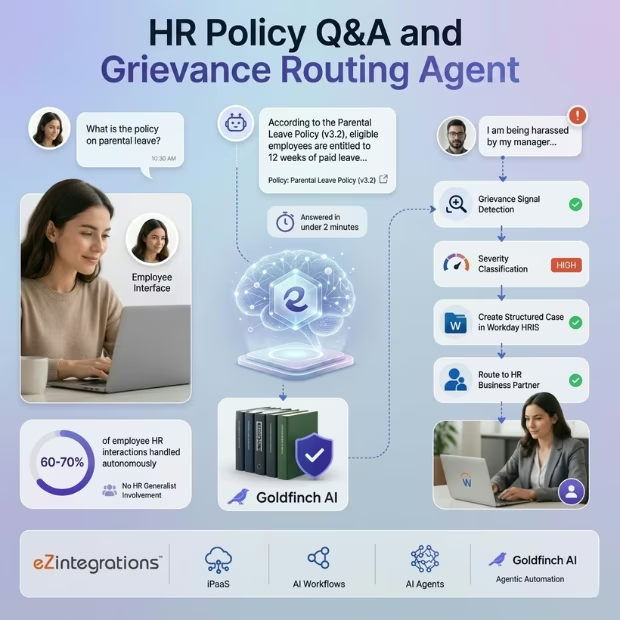
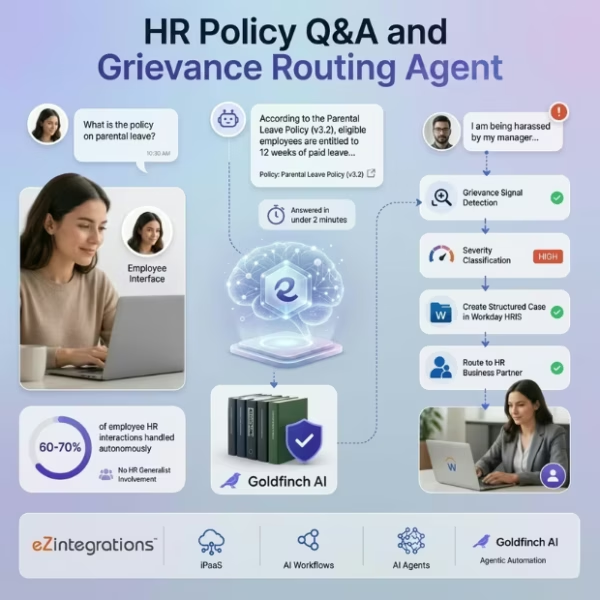
The HR Policy Q&A and Grievance Routing Agent from eZintegrations deploys as a Microsoft Teams bot or web portal chatbot and autonomously handles employee interactions. For policy questions; Goldfinch AI Knowledge Base Vector Search retrieves the specific relevant policy section and generates a personalized answer with document citation – giving the employee the exact policy reference; not a generic redirect to “check the handbook.” For messages with grievance signals; Goldfinch AI Document Intelligence extracts the grievance content and Goldfinch AI Data Analysis classifies severity. Low-severity grievances receive self-resolution guidance. High-severity grievances trigger automatic Workday HRIS case creation; HR BP assignment lookup; and structured case routing via Goldfinch AI API Tool Call. Goldfinch AI Watcher Tools monitors case SLA compliance. HR generalist capacity on repetitive policy queries from 30% to under 5% of working hours; 60 to 70% of HR queries deflected from HR generalist queue (SHRM AI HR automation benchmark); grievance response time for high-severity issues from ad hoc email response (1 to 5 days) to structured HRIS case with HR BP assignment within minutes; legal and regulatory risk from undocumented grievances significantly reduced through automatic case creation HR Business Partner capacity freed from routine policy query response for strategic employee relations; workforce planning; and talent management; HR Service Center Manager visibility into case volume; resolution SLAs; and policy gap patterns from real-time analytics dashboard; CHRO visibility into organization-wide grievance patterns from structured HRIS case data vs. ad hoc email tracking SHRM data: HR generalist cost at $65,000 to $85,000 average fully-loaded; 30% of working hours on policy queries = $19,500 to $25,500 per HR generalist per year on repetitive queries; at 60 to 70% query deflection: $11,700 to $17,850 annual savings per HR generalist redeployed to strategic work; for a 10-HR-generalist team: $117,000 to $178,500 annually. Legal risk reduction: undocumented grievances that escalate to employment tribunal or EEOC complaints cost $50,000 to $300,000+ per case in legal fees; settlements; and management time – automatic HRIS case creation with timestamped documentation materially reduces this exposure. HIPAA-eligible configuration (healthcare organizations with employee health-adjacent HR queries); GDPR-compliant employee data handling (employee questions and grievance content processed under GDPR Article 6 employment contract necessity; strict data minimization applied; employee interaction data accessible only to the employee’s HR Business Partner and HR Service Center Manager within RBAC scope); SOC Type II certified. Employee grievance data and interaction transcripts processed in customer-isolated eZintegrations tenant – not shared cross-tenant. Grievance case records in Workday HRIS subject to the organization’s HR data retention and access policy. RBAC enforced: HR Business Partners access only cases assigned to them; HR Service Center Manager has portfolio view; CHRO has organization-wide view. All interactions logged immutably for employment law compliance documentation. 24/7 availability across time zones and work patterns: The agent responds to employee queries immediately regardless of business hours, shift schedule, or geographic location – an overnight worker, a remote employee in a different time zone, or an employee with an urgent question on a public holiday receives the same quality of policy guidance as a query during peak HR office hours, Citation-backed policy answers from the organizational knowledge base: Knowledge Base Vector Search retrieves answers from the organization’s actual HR policies – employee handbook, benefits guide, leave policy, code of conduct — and includes the specific document name and section number in the answer, so employees can verify the policy reference and HR does not need to fact-check AI-generated answers; Autonomous grievance signal detection and severity classification: Document Intelligence analyzes every employee message for grievance indicators – the agent does not wait for an employee to formally submit a grievance form; it detects workplace safety concerns, discrimination language, manager behavior complaints, and harassment indicators from the natural language of the conversation, immediately classifying severity without requiring the employee to use formal grievance vocabulary, Immediate structured HRIS case creation for high-severity issues: For grievances classified as High severity (potential discrimination, harassment, safety violation, retaliation), API Tool Call creates a structured Workday HRIS case within minutes of classification – ensuring the grievance is documented, timestamped, and in the formal case management system before it can be lost in an email inbox, protecting both the employee and the organization; Policy gap analysis from interaction logs: Every unanswered or low-confidence policy retrieval is logged via Integration Workflow as Tool to the policy gap analytics store – enabling HR leadership to see which employee questions the knowledge base cannot answer and which policies need to be added, updated, or clarified, turning every interaction into an improvement signal for the HR policy librarySolution Overview: Business Impact: Productivity Gain: Cost Savings: Security & Compliance: Key Features:
Description
The AI HR policy agent from eZintegrations answers employee HR policy questions in under 2 minutes using a cited knowledge base retrieval via Goldfinch AI, detects grievance signals in employee messages, classifies severity, creates structured Workday HRIS cases for high-severity issues, and routes to the HR Business Partner – autonomously handling 60 to 70% of employee HR interactions without HR generalist involvement. eZintegrations is an enterprise automation platform covering iPaaS, AI Workflows, AI Agents, and Goldfinch AI agentic automation.
What Is an AI HR Policy Agent?
An AI HR policy agent is an AI Agent that takes each employee HR interaction as its goal and autonomously handles the full response cycle – retrieving the relevant policy from the HR knowledge base, generating a personalized answer with policy citation, detecting grievance signals in the employee’s message, classifying grievance severity, providing self-service resolution steps for low-severity issues, creating structured HRIS cases and routing to the HR Business Partner for high-severity issues, and monitoring case resolution. It is reactive (responds within minutes of the employee’s message), adaptive (retrieves policy content relevant to the specific context of the employee’s question), and autonomous (acts without HR generalist instruction for each interaction).
How Does an AI HR Policy Agent Answer Employee Questions Using a Policy Knowledge Base and Automatically Route Grievances to HR Business Partners?
When an employee sends a message to the Teams HR bot or web portal, the AI HR policy agent triggers. Goldfinch AI Knowledge Base Vector Search retrieves the relevant policy sections from the HR policy knowledge base and generates a personalized cited answer. Goldfinch AI Document Intelligence analyzes the message for grievance signals. For grievances, Goldfinch AI Data Analysis classifies severity. High-severity issues trigger Goldfinch AI API Tool Call to create a Workday HRIS case and route to the HR Business Partner. Goldfinch AI Watcher Tools monitors case SLA compliance. Integration Workflow as Tool logs interactions for policy gap analysis.
SHRM documents that HR generalists spend 30% of their time on repetitive policy queries. This AI HR policy agent returns that capacity to the strategic HR work that requires human judgment.
Watch Demo
| Video Title: | AI HR Policy Agent |
|---|---|
| Duration: | 4 to 6 minutes |
Outcome & Benefits
| Throughput: | Unlimited concurrent employee interactions – the agent responds to every employee question simultaneously regardless of query volume; handles organizational peak periods (open enrollment; policy change announcements; performance review cycles) without queue delay |
|---|---|
| Cost Reduction: | $117,000 to $178,500 annually for a 10-HR-generalist team from query deflection; legal risk reduction from documented grievance cases vs. ad hoc email tracking; benefits plan cost optimization data from policy gap analysis (identifying which benefits questions employees ask most frequently signals plan design or communication gaps) |
| Accuracy: | Policy retrieval relevance (answer based on correct policy section): 93%+ on standard HR policy question categories; grievance severity classification accuracy (agreement with HR BP manual review): 88%+; HRIS case creation completeness (all required fields populated on case creation): 99%+ |
| Time Saved: | Employee policy question response from 2 to 4 hours (business hours HR queue) to under 2 minutes 24/7; grievance case creation from ad hoc email response (1 to 5 days) to structured HRIS case within minutes; HR BP morning inbox review from unsorted employee email to prioritized structured case queue |
Performance Metrics
| Metric | Before (Manual/Batch) | After (Real-Time Sync) | Improvement |
|---|---|---|---|
| Policy Query Response Time | 2 to 4 hours (business hours only) | Under 2 minutes (24/7) | 98%+ faster |
| HR Generalist Query Capacity | 30% of working hours | Under 5% of working hours | 25% capacity freed |
| Grievance Case Creation | Ad hoc email (1 to 5 days) | Structured HRIS case within minutes | 98%+ faster + documented |
| Policy Q&A Deflection Rate | 0% (all manual) | 60 to 70% (SHRM AI HR benchmark) | New capability |
Technical Details
| Data Validation: | Three-stage validation per interaction: knowledge base answer confidence – the agent presents a Knowledge Base Vector Search answer only when the retrieval confidence exceeds the configured threshold (default 0.75); below threshold; the agent responds with a partial answer acknowledging the limitation and offers to connect the employee to an HR generalist – it does not generate confident answers when the policy coverage is ambiguous; grievance severity confirmation – for Medium and High severity classifications; the agent applies a secondary confirmation check (does the classified severity make sense given the full conversation context and the employee’s role and department?) before triggering case creation; HRIS case completeness – all required Workday case fields are populated and validated before the case is created; incomplete case data triggers the agent to prompt the employee for clarifying information rather than creating an incomplete HRIS case. |
|---|---|
| Real-Time Support: | Yes – the agent responds to employee messages within seconds of submission; 24/7; including weekends and public holidays. Grievance case creation and HR BP routing trigger within minutes of severity classification; regardless of business hours. For Critical-severity grievances (immediate safety concern; active threat); the agent triggers an immediate push notification to the HR Service Center Manager and HR BP via SMTP and Teams message rather than waiting for the standard case routing workflow. Watcher Tools monitors open cases continuously – SLA breach escalation fires before the SLA expires; not after. |
| Customization: | Configurable per deployment via eZintegrations no-code Agent Builder: HR policy knowledge base documents (HR team loads and maintains all policy documents – employee handbook; benefits guides; leave policies; code of conduct; workplace conduct policies – in the Goldfinch AI Knowledge Base editor; updates take effect immediately for subsequent interactions); grievance severity classification thresholds and taxonomy (standard 3-level taxonomy or custom); HRIS system target (Workday; SAP HCM; Oracle HCM; ServiceNow HR; or custom); HR BP routing logic (Workday employee-to-HR-BP assignment or custom routing matrix); SLA windows per severity level (High-severity: 4-hour acknowledgment; 24-hour initial response; Medium: 48-hour response; Low: 5-day response – all configurable); Teams Bot or web portal channel configuration; and policy gap analysis logging schema. HR Operations team manages policy knowledge base and classification thresholds without IT involvement. |
| Knowledge Retrieval: | Goldfinch AI Knowledge Base Vector Search (https://ezintegrations.ai/agentic-ai-platform/) retrieves relevant policy sections from the HR policy knowledge base (Pinecone https://docs.pinecone.io/ or Weaviate https://weaviate.io/developers/weaviate as vector store) – matching the employee’s question context; employment type (full-time; part-time; contractor); department; location; and seniority level against the vector-indexed HR policy library to return the most relevant policy sections with document name and section reference. HR Operations and HR Business Partners maintain the policy knowledge base in the Goldfinch AI knowledge base editor – policy updates; new handbook versions; benefits guide revisions; and new policies take effect immediately for all subsequent employee interactions without any IT development cycle. |
| Agent Architecture: | Single autonomous agent with synchronous interaction processing (responds to each employee message within the Microsoft Teams or web portal session; maintaining conversation context within the session). The agent handles unlimited concurrent sessions – each employee interaction is processed independently with session context maintained per conversation thread. For organizations with multi-region or multi-language employee populations; hierarchical multi-agent mode is available – one orchestrator agent routes employee interactions to language-specific sub-agents configured with the relevant jurisdiction’s policy knowledge base and employment law compliance requirements (e.g. EU works council requirements; US state-specific leave policies; APAC jurisdiction-specific employment regulations). |
| Task Orchestration: | Goldfinch AI orchestrates each employee interaction using a detect-classify-route model – every incoming message is first assessed for policy question content vs. grievance signal content; pure policy questions proceed directly to Knowledge Base Vector Search and response generation; messages with grievance signals proceed to Document Intelligence extraction before Data Analysis severity classification gates the response path. The agent maintains conversation context across a session to handle follow-up questions (e.g. an employee who asks a benefits eligibility question and then asks a follow-up about the appeal process receives a contextually aware answer that references the prior exchange). High-severity grievance detection in any message within the conversation overrides the pure policy question response path and triggers the grievance workflow immediately. |
AI Credits
| AI Credits Required: | Yes – the AI HR policy agent invokes multiple Goldfinch AI tools per employee interaction: Knowledge Base Vector Search (policy content retrieval per question); Document Intelligence (grievance signal extraction per message); Data Analysis (severity classification for grievance messages); API Tool Call (Workday HRIS case creation and HR BP routing); Watcher Tools (open case SLA monitoring); and Integration Workflow as Tool (case creation; HR BP notification; and policy gap logging sub-workflows). Credits consumed per employee query and per grievance case processed. |
|---|---|
| LLM Steps Count: | 2 to 5 Goldfinch AI tool invocations per interaction (Knowledge Base Vector Search for policy questions + Document Intelligence for grievance analysis + Data Analysis for severity classification if grievance detected + API Tool Call for case creation and routing if High severity + Integration Workflow as Tool for case and logging sub-workflows) |
| Credit Consumption Model: | Per employee interaction – Knowledge Base Vector Search and Document Intelligence invoked on every interaction; Data Analysis; API Tool Call; and Integration Workflow as Tool invoked only on grievance-detected interactions; Watcher Tools credits accumulate over the SLA monitoring period per open case Estimated Credits per Interaction: Standard policy Q&A (no grievance signal): ~6 to 12 credits per interaction (Knowledge Base Vector Search + Document Intelligence) Grievance-detected; Low severity (self-service guidance provided): ~14 to 22 credits per interaction Grievance-detected; High severity (HRIS case created; HR BP routed): ~22 to 38 credits per interaction Open case SLA monitoring (per case per day): ~3 to 6 credits per case per day |
| Monthly Credit Estimate (at Typical Volume): | 500 employee interactions per month; 5% grievance rate (small enterprise): ~4,000 to 7,500 credits per month 2,000 interactions per month; 5% grievance rate (mid-market): ~14,000 to 27,000 credits per month 10,000 interactions per month; 5% grievance rate (large enterprise): ~65,000 to 120,000 credits per month |
| Pricing Model: | Static Platform Fee + AI Credits. Platform fee covers unlimited non-LLM orchestration (Teams Bot message handling; HRIS connection management; SMTP notification dispatch; policy gap analytics writes; audit log writes). AI Credits consumed only by Goldfinch AI tool invocations and LLM reasoning cycles. |
| Credit Optimization Notes: | Configure Document Intelligence to analyze for grievance signals only on interactions that exceed the minimum message length threshold (e.g. messages under 15 words rarely contain structured grievance content – applying a length pre-screen reduces Document Intelligence invocations by 20 to 30% for short confirmation-type queries). Cache Knowledge Base policy retrievals per frequently asked question category for 24 hours – the same benefits eligibility question asked by different employees on the same day retrieves the same policy section; and caching eliminates redundant vector searches (estimated 30 to 40% cache hit rate during peak HR periods like open enrollment). Apply Watcher Tools SLA monitoring at 4-hour intervals for Low-severity cases and hourly for High-severity cases rather than continuous polling – reduces monitoring credits while maintaining appropriate response urgency per severity level. |
| Goldfinch AI Tool(s) Consuming Credits: | Knowledge Base Vector Search: policy content retrieval per employee question – credits per search query (one or more per multi-question interaction) Document Intelligence: grievance signal extraction per employee message – credits per message analyzed (applied to all messages; not just those with visible grievance indicators) Data Analysis: grievance severity classification – credits per classification (only invoked when Document Intelligence detects potential grievance signals) API Tool Call: Workday HRIS case creation + HR BP assignment lookup + Teams/SMTP notification – credits per tool execution (only invoked for Medium and High severity grievances) Watcher Tools: open case SLA monitoring – credits per monitoring cycle per active open case Integration Workflow as Tool: case creation sub-workflow + HR BP notification + policy gap logging – credits per sub-task invocation |
Resources
Case Study
| Industry: | All Industries – Enterprise (highest impact in Financial Services; Healthcare; Manufacturing; Technology; and Retail with large hourly or distributed workforces generating high HR query volumes) |
|---|---|
| Outcome: | 60 to 70% of HR policy queries answered without HR generalist involvement; policy answers in under 2 minutes 24/7; grievance cases auto-created and HR BP-routed within minutes of severity classification; HR generalist capacity freed from repetitive queries for strategic employee relations |
| Problem: | The HR team of a regional bank with 4,200 employees and 18 HR Business Partners managed employee HR queries primarily through a shared HR inbox and ad hoc Teams messages to HR BPs. Average HR query volume: 380 queries per week. Types: benefits eligibility (31%); leave policy questions (24%); performance review process (18%); expense and compensation queries (14%); workplace conduct and grievances (8%); other (5%). HR Business Partners and HR generalists spent an estimated 32% of their working time answering policy questions – time the CHRO had identified as the single largest opportunity for HR capacity reallocation. For grievances: the bank had experienced 3 employment tribunal cases in the prior 2 years where HR documentation was challenged because grievance concerns had been raised informally via email and never formally case-managed in the HRIS. External legal counsel fees on those 3 cases totaled $340,000. |
| ROI: | HR generalist capacity reallocation: 18 HRBPs + 4 generalists x 25% time freed (32% to 7%) x $72,000 average fully-loaded HR generalist cost x 12 months = $396,000 annually. Employment tribunal legal cost avoidance: estimated 2 cases avoided per year (from structured case documentation) x $113,000 average per case (prior 3-case average) = $226,000 annually. Employee productivity recovery: estimated 380 employees per week x average 2.8 hours saved per year in HR query resolution time x $42/hour average employee cost = $44,688 annually (employees can get policy answers at 1am without waiting for next-day HR). Total year-1 |
| Solution: | Deployed eZintegrations AI HR policy agent in 13 days with a Microsoft Teams bot for employee queries. Integrated a knowledge base of HR policies and enabled automated responses with grievance classification. Connected to Workday for case creation, HR assignment, and SLA tracking, with analytics for policy gaps and leadership reporting. |
Related products
-
How to Create a Multimodal AI Chat Assistant
 $0.00
Download
$0.00
Download
-
How to Prevent Customer Churn with Automated Retention Interventions
$150.00
Download
-
How to Automate Month-End Financial Close for Reconciliation and Close Orchestration
$150.00
Download
-
How to Automate Technical SEO Audits Using an AI Agent
$0.00
Download