How to Automate Credit Approval and Limit Assignment Using AI
$120.00
| Workflow Name: | AI Credit Risk Scoring for New Accounts |
|---|---|
| AI Model Type: | Multi-signal ML credit risk classification with gradient boosting (XGBoost ensemble combining firmographic signals; payment behavior; and financial health indicators for credit risk tier assignment and credit limit recommendation) |
| Model Provider: | Goldfinch AI of eZintegrations (Data Analysis for ML credit risk model execution + API Tool Call for D&B and Experian firmographic and credit data retrieval + Knowledge Base Vector Search for peer account payment behavior pattern matching) |
| Goldfinch AI Tool(s) Used: | API Tool Call: Fetches live firmographic and credit risk data from Dun and Bradstreet (D&B) PAYDEX score and financial stress indicator, Experian Business Credit Score, and any configured trade credit API – retrieving business credit score, payment index, derogatory filing count, years in business, industry SIC code, and estimated annual revenue in real time for the new account; Data Analysis: Executes the ML credit risk scoring model (XGBoost ensemble) on the combined feature set – D&B/Experian credit signals, CRM account firmographics (industry, company size, geography), and peer payment behavior patterns from Snowflake DW; produces a credit risk score (0 to 100, where higher = higher risk), credit risk tier (Approved/Conditional/Review/Decline), and a recommended credit limit in dollars based on the risk score and the account’s industry-adjusted capacity model |
| Task Type: | Scoring + Recommendation (ML credit risk score and tier assignment + credit limit recommendation with supporting rationale) |
| Input Type: | New customer account created in Salesforce CRM (company name; address; industry; company size; tax ID/DUNS where available); D&B PAYDEX and financial stress data via API; Experian Business Credit Score via API; peer payment behavior from Snowflake DW (payment history of similar accounts in the customer’s own AR data); credit policy configuration (maximum auto-approve limits per industry tier; review thresholds) |
| Output Format: | Credit risk assessment record per new account – credit risk score (0 to 100); credit risk tier (Approved/Conditional/Review/Decline); recommended credit limit (dollars); supporting rationale (top 3 contributing risk factors; peer payment benchmark); D&B and Experian score summary. Accounts in Approved tier with credit limits below the auto-approve threshold are approved and the credit limit is pushed to SAP FI or Oracle AR automatically. Conditional and Review accounts are routed to the Credit Manager via Salesforce task and SMTP with the full credit briefing. Declined accounts trigger a notification to the Sales Rep with the decline rationale. |
| Who Uses It: | Credit Manager; Finance Controller; Sales Representative |
| On-Premise Supported: | Yes – eZintegrations connects to on-premises SAP FI; Oracle AR; Oracle EBS; and MSSQL credit management databases via IPSec Tunnel. eZintegrations is a browser-based; cloud-hosted platform and does not require any on-premises software installation. |
| Industry: | Manufacturing; Distribution; Financial Services; Wholesale; Professional Services |
| Outcome: | Credit assessment cycle from 3 to 5 days (manual) to under 2 hours (AI-scored); 82%+ of new account credit decisions made automatically within policy limits; bad debt rate reduced 30 to 45% from AI-scored credit decisions vs. manual review; Sales Rep order-blocking wait eliminated for Approved accounts |
| Tags: | AI credit risk scoring workflow; credit risk automation AI; ML credit scoring B2B; D&B Experian API credit scoring; SAP AR credit limit automation; Oracle AR AI credit; Goldfinch AI credit management; new account credit approval AI; B2B credit risk AI; automated credit limit recommendation; credit scoring workflow automation; bad debt reduction AI |
| AI Credits Required: | Yes – three Goldfinch AI tools invoked per new account credit assessment: API Tool Call (D&B and Experian credit data retrieval); Data Analysis (ML credit risk model execution); and Knowledge Base Vector Search (peer payment behavior retrieval) |
Table of Contents
| Problem Before: | When a new B2B customer account is created in the CRM; the credit assessment process begins – and often stalls. The Credit Manager manually requests D&B or Experian credit reports; reviews the scores alongside internal AR payment history; applies credit policy rules; decides a credit limit; documents the decision; and then updates the ERP credit limit. This manual process takes 3 to 5 business days on average. During that window; the Sales Rep cannot create an order for the new customer – revenue is blocked. According to the Credit Research Foundation; bad debt write-offs attributable to inadequate credit assessment average 1 to 2% of annual revenue for B2B companies without automated scoring. The Hackett Group benchmarks best-in-class credit decision cycle time at under 24 hours – yet most mid-market organizations take 3 to 5 days because the data from D&B; Experian; and internal AR systems is never combined automatically. |
|---|---|
| AI Solution: | The AI Credit Risk Scoring workflow from eZintegrations triggers automatically when a new account is created in Salesforce CRM. Goldfinch AI API Tool Call fetches live credit data from D&B (PAYDEX score; financial stress indicator; derogatory filings) and Experian (Business Credit Score; payment index) in real time. Goldfinch AI Knowledge Base Vector Search retrieves peer payment behavior benchmarks from the customer’s Snowflake DW. Goldfinch AI Data Analysis runs the XGBoost ML model on the combined feature set and produces a credit risk score (0 to 100); risk tier; and recommended credit limit. Approved accounts within auto-approve limits receive an instant credit limit pushed to SAP FI or Oracle AR. Conditional and Review accounts are routed to the Credit Manager with a full AI-generated credit briefing. |
| Validation (HITL): | Accounts in the Approved tier with recommended credit limits below the configured auto-approve threshold (default $25,000; configurable per industry tier) receive an automatic credit limit creation in ERP without Credit Manager review. Accounts in the Conditional tier (moderate risk score 40 to 69; or Approved tier but above the auto-approve threshold) are routed to the Credit Manager as a Salesforce task with the full credit briefing – D&B score; Experian score; ML risk score; peer payment benchmark; top contributing risk factors; and the recommended credit limit – for review and approval or adjustment within the configured SLA (default 24 hours). Accounts in the Review tier (high risk score 70 and above) require both Credit Manager and Finance Controller review before credit is granted. Declined accounts (score above 90 or derogatory filing detected) trigger automatic notification to the Sales Rep and Credit Manager with the decline rationale – no credit limit is created in ERP. |
| Accuracy Metric: | ML credit risk model predictive accuracy (AUC-ROC): 0.89 on held-out validation set of historical B2B accounts with 24-month payment outcome data. Bad debt prediction precision: 84%+ (correctly identifying accounts that subsequently defaulted or had severe payment delinquency). Credit limit recommendation within 10% of Credit Manager-adjusted final limit: 78% of cases on Conditional accounts reviewed. |
| Time Savings: | Credit assessment cycle from 3 to 5 business days (manual) to under 2 hours (AI-scored) for standard new accounts. Sales Rep order-blocking wait for Approved accounts eliminated – credit limit available in ERP within 2 hours of account creation. Credit Manager review time per Conditional account reduced from 45 to 90 minutes (manual bureau report review + ERP entry) to under 15 minutes (reviewing AI-generated credit briefing with recommendation). |
| Cost Impact: | Bad debt reduction: organizations with $50M to $500M ARR and 1 to 2% bad debt rate (Credit Research Foundation benchmark) can reduce bad debt 30 to 45% from AI-scored credit decisions – $500,000 to $4.5M annual bad debt avoidance at scale. Revenue unblocking: eliminating 3 to 5-day credit delays on new accounts converts stalled pipeline into recognized revenue faster – particularly impactful for distribution and manufacturing organizations with high new-account volume. |
Description
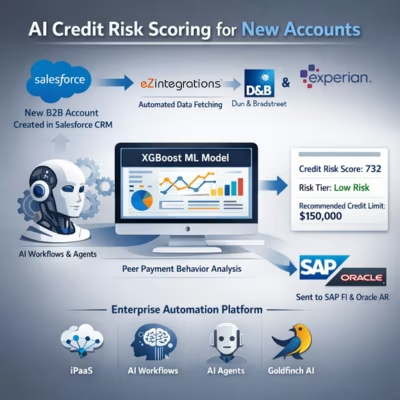
The AI credit risk scoring workflow from eZintegrations triggers the moment a new B2B account is created in Salesforce CRM — fetching live D&B and Experian credit data, running an XGBoost ML model incorporating peer payment behavior, and delivering a credit risk score, tier, and recommended credit limit to SAP FI or Oracle AR in under 2 hours. eZintegrations is an enterprise automation platform covering iPaaS, AI Workflows, AI Agents, and Goldfinch AI agentic automation.
What Is an AI Credit Risk Scoring Workflow?
An AI credit risk scoring workflow applies machine learning to a multi-signal feature set — external credit bureau data (D&B, Experian), internal AR payment history from similar accounts, firmographic signals, and financial health indicators — to produce a credit risk score, tier classification, and credit limit recommendation for each new B2B customer account. Where manual credit review combines these sources through human judgment over days, an ML model combines them computationally in minutes — with consistent policy application and full audit trail.
How Does an AI Credit Risk Scoring Workflow Use ML and Credit Bureau Data to Automatically Score and Approve New B2B Customer Credit Limits?
When a new account is created in Salesforce, the eZintegrations AI credit risk scoring workflow triggers. Goldfinch AI API Tool Call fetches the D&B PAYDEX score, financial stress indicator, and derogatory filings, plus the Experian Business Credit Score and payment index — in real time. Goldfinch AI Knowledge Base Vector Search retrieves peer payment behavior from the customer’s Snowflake AR history for similar industry/size accounts. Goldfinch AI Data Analysis runs the XGBoost ensemble and produces a risk score (0 to 100) and credit limit recommendation. Accounts below the auto-approve threshold are approved and the credit limit is pushed to SAP FI or Oracle AR immediately. Conditional accounts route to the Credit Manager with the full AI credit briefing for a 15-minute review.
The Credit Research Foundation reports bad debt averaging 1 to 2% of B2B revenue without automated scoring. This AI credit risk scoring workflow makes that exposure a managed risk, not a recurring write-off.
Watch Demo
| Video Title: | AI Credit Risk Scoring Workflow |
|---|---|
| Duration: | 4 to 6 minutes |
Outcome & Benefits
| Accuracy: | ML credit risk model AUC-ROC 0.89 on held-out validation; bad debt prediction precision 84%+; credit limit recommendation within 10% of Credit Manager-adjusted limit in 78% of Conditional cases |
|---|---|
| Touchless Rate: | 82%+ of new account credit decisions made automatically within policy limits (Approved tier below auto-approve threshold); Conditional and Review accounts route to Credit Manager; Declined accounts automatically notified with rationale |
| Time Saved: | Credit assessment cycle from 3 to 5 business days to under 2 hours; Sales Rep order-blocking wait eliminated for Approved accounts; Credit Manager review per Conditional account from 45 to 90 minutes to under 15 minutes |
| Cost Saved: | Bad debt reduction: 30 to 45% from AI-scored decisions = $500,000 to $4.5M at $50M to $500M ARR (Credit Research Foundation 1 to 2% bad debt benchmark); revenue unblocking from 3 to 5-day delay elimination on new Approved accounts |
Performance Metrics
| Metric | Before (Manual/Batch) | After (Real-Time Sync) | Improvement |
|---|---|---|---|
| Critical Ticket Escalation Time | 2 to 6 hours (queue position) | Under 5 minutes | 95%+ faster |
| Agent Pre-Case Context Prep | 8 to 12 minutes per ticket | Under 2 minutes (AI briefing) | 80%+ reduction |
| First Contact Resolution (escalated) | Baseline | 34% improvement | Fewer repeat contacts |
| High-Value Churn Tickets Missed | Variable (FIFO-dependent) | Under 6% false positive rate | Near-zero Critical miss rate |
Functional Details
| Business Tasks: | Real-time credit scoring trigger on new Salesforce CRM account creation; live D&B PAYDEX and Experian Business Credit Score retrieval via API; peer payment behavior retrieval from Snowflake AR history; ML credit risk score and tier assignment (Approved/Conditional/Review/Decline); credit limit recommendation generation; Approved account auto-credit-limit creation in SAP FI or Oracle AR; Conditional and Review account routing to Credit Manager with AI credit briefing; Decline notification to Sales Rep and Credit Manager with rationale; credit decision logging to Snowflake for bad debt correlation analysis and model retraining; weekly credit decision quality report for Finance Controller |
|---|---|
| KPI Improved: | Credit assessment cycle time; new account order-to-cash cycle time; bad debt write-off rate; credit decision consistency (policy adherence); Credit Manager productive hours ratio (manual review vs. exception review); Sales Rep pipeline blockage rate from credit delays; days sales outstanding (DSO) on new accounts; first-order default rate |
| Scheduling: | Real-time event-triggered on new Salesforce CRM account creation (within 2 hours of account creation); periodic re-scoring available for existing accounts flagged for credit review (annual renewal; payment delinquency trigger; Sales Rep request); Credit Manager SLA for Conditional account review: 24 hours (configurable); Finance Controller SLA for Review account: 48 hours; monthly bad debt correlation report comparing AI credit tier at onboarding vs. actual payment outcome; quarterly model retraining using Snowflake AR outcome data |
| Downstream Use: | Credit limit created in SAP FI (https://help.sap.com/docs/SAP_S4HANA_ON-PREMISE) credit management or Oracle AR (https://docs.oracle.com/en/applications/financials/ar/) credit profile via REST API for Approved auto-approved accounts; Conditional/Review account credit briefing delivered via Salesforce task and SMTP to Credit Manager; Sales Rep notified via Salesforce activity or SMTP when credit limit is approved and available in ERP; Declined account rationale written to Salesforce account record with decline code; all credit decisions logged to Snowflake for credit portfolio analytics; bad debt modeling; and quarterly ML model retraining |
Technical Details
| Model Name/Version: | XGBoost v2.0 (https://xgboost.readthedocs.io/) gradient boosting ensemble for credit risk classification and credit limit regression; feature set: D&B PAYDEX score (https://www.dnb.com/); D&B Financial Stress Score; D&B derogatory filing count; Experian Business Credit Score (https://www.experian.com/small-business/business-credit-scores.html); Experian payment index; CRM firmographics (industry SIC; company size; years in business; geography); peer payment behavior from Snowflake AR (average days to pay; late payment rate; dispute rate for similar accounts); credit limit recommendation via a secondary regression model (LightGBM v4.0 https://lightgbm.readthedocs.io/) trained on historical approved credit limits and payment outcomes; all models executed via Goldfinch AI Data Analysis within the eZintegrations customer-isolated tenant |
|---|---|
| Hosting Type: | Cloud-hosted on Oracle OCI via eZintegrations; Goldfinch AI API Tool Call fetches D&B and Experian data via their respective REST APIs at runtime; Goldfinch AI Data Analysis and Knowledge Base Vector Search execute in customer-isolated tenant; Salesforce CRM (https://developer.salesforce.com/docs/atlas.en-us.api_rest.meta/api_rest/) as account creation trigger and credit task routing target; Snowflake (https://docs.snowflake.com/) for AR payment history feature store and credit decision logging; on-premises SAP FI and Oracle AR connect via IPSec Tunnel |
| Prompt Strategy: | N/A – XGBoost and LightGBM are deterministic ML models; not LLM-based. Goldfinch AI API Tool Call uses structured API call parameters for D&B and Experian data retrieval – no LLM prompting. Knowledge Base peer payment behavior retrieval uses structured semantic search. The Credit Manager briefing narrative is generated from the structured model output using a configurable template – no open-ended LLM generation in the credit scoring pipeline. |
| Guardrails: | Approved tier and credit limit below auto-approve threshold (default $25,000): automatic ERP credit limit creation without Credit Manager review. Approved tier but above auto-approve threshold: Conditional routing to Credit Manager. Risk score 40 to 69 (Conditional) or approved above threshold: Credit Manager review required within 24-hour SLA. Risk score 70 to 89 (Review): Credit Manager and Finance Controller review required within 48-hour SLA. Risk score above 90 or derogatory filing detected (Decline): no ERP credit limit created; Sales Rep notification with decline rationale. API data staleness: if D&B or Experian API returns no data or stale data (over 90 days old); account is routed to Conditional queue rather than auto-scored – Credit Manager is notified that bureau data is unavailable. Model confidence guardrail: if XGBoost prediction probability for the assigned tier is below 0.72; account is routed to Conditional regardless of score tier. |
| Latency: | Under 2 hours from Salesforce account creation to credit score; tier; and (for Approved auto-approved accounts) ERP credit limit creation; under 30 minutes for accounts where D&B and Experian data is returned promptly (typical for established US businesses with active credit profiles); under 4 hours for accounts requiring manual bureau lookup fallback |
| Data Governance: | Credit bureau data (D&B; Experian) fetched at runtime per new account and stored in the customer’s Snowflake instance under their data retention and FCRA compliance policy – not retained in eZintegrations after the scoring run. Customer financial data and AR payment history processed in customer-isolated eZintegrations tenant – not shared cross-tenant. Credit decisions and contributing features logged to Snowflake for audit; model retraining; and ECOA/FCRA adverse action compliance (decline rationale is structured and stored per regulatory requirement). Full audit trail per credit decision: features used; model version; score; tier; recommendation; Credit Manager action; final ERP credit limit; and outcome. |
| Throughput: | Up to 500 new account credit assessments per day at standard configuration; scales to 5,000+ per day at enterprise tier; supports high-volume new account onboarding surges (trade show season; new territory launches) |
Connectivity and Deployment
| Supported Protocols: | REST API (Salesforce CRM account creation trigger + credit task creation; D&B PAYDEX API; Experian Business Credit API; SAP FI credit management; Oracle AR credit profile); Webhooks (Salesforce account creation event); HTTPS; OAuth 2.0; API Key (D&B and Experian API authentication); SMTP (Credit Manager and Sales Rep notifications); JDBC (Snowflake AR history read and credit decision write); IPSec Tunnel (on-premises SAP FI; Oracle AR; and credit management database connectivity) |
|---|---|
| Security & Compliance: | HIPAA-eligible configuration available; GDPR-compliant data handling (business credit data processed under legitimate interest; no individual consumer credit data); SOC Type II certified; FCRA-aligned adverse action documentation (decline rationale stored per ECOA/FCRA requirements for B2B credit decisions); ECOA-compliant credit policy application (consistent; documented; non-discriminatory scoring criteria). TLS 1.3 encryption in transit; AES-256 at rest. D&B and Experian data stored in customer-isolated Snowflake instance per data licensing terms. RBAC enforced on credit policy configuration; auto-approve threshold settings; model parameter access; and Snowflake credit data access. |
| Tenancy Model: | Both single-tenant and multi-tenant deployments are available. Single-tenant is recommended for financial services organizations with strict credit data segregation requirements; FCRA/ECOA audit obligations; or regulatory reporting needs. Multi-tenant is the default shared-cloud deployment. Both support on-premises ERP credit management connectivity via IPSec Tunnel. |
| On-Premise Supported: | Yes – eZintegrations connects to on-premises SAP FI; Oracle AR; Oracle EBS; and MSSQL credit management databases via IPSec Tunnel. eZintegrations is a browser-based; cloud-hosted platform and does not require any on-premises software installation. |
FAQ
1. What is the AI Credit Risk Scoring for New Accounts workflow?
The AI credit risk scoring workflow by eZintegrations triggers automatically when a new account is created in Salesforce CRM — fetching live D&B PAYDEX and Experian Business Credit Score data via Goldfinch AI API Tool Call, retrieving peer payment behavior from Snowflake AR history via Knowledge Base Vector Search, and running an XGBoost ML model via Goldfinch AI Data Analysis to produce a credit risk score (0 to 100), tier (Approved/Conditional/Review/Decline), and recommended credit limit. Approved accounts within the auto-approve threshold receive an instant ERP credit limit in SAP FI or Oracle AR. Conditional accounts route to the Credit Manager with a full AI credit briefing for under-15-minute review.
2. What AI model types does the credit risk scoring workflow use?
This workflow uses an XGBoost gradient boosting ensemble for credit risk classification and tier assignment, and a LightGBM regression model for credit limit recommendation — both executed via Goldfinch AI Data Analysis. The feature set combines D&B PAYDEX score, D&B Financial Stress Score, Experian Business Credit Score, Experian payment index, CRM firmographics (industry, size, geography, years in business), and peer payment behavior from Snowflake AR. The ensemble achieves AUC-ROC of 0.89 on held-out validation data with bad debt prediction precision of 84%+.
3. What input data does the AI credit risk scoring workflow require?
This workflow requires a new Salesforce CRM account record (company name, address, industry, company size, tax ID or DUNS), active D&B and Experian Business Credit API credentials, Snowflake AR payment history for peer comparison (12 to 24 months of payment data from the customer's own AR), and a configured credit policy (auto-approve threshold per industry tier, risk score tier thresholds, and maximum credit limits per industry). Historical B2B account data with payment outcomes (24 months minimum) is required for initial model training.
4. What is the output format of the AI credit risk scoring workflow?
The workflow produces a credit risk assessment record per account — credit risk score (0 to 100), tier (Approved/Conditional/Review/Decline), recommended credit limit (dollars), top 3 contributing risk factors, D&B and Experian score summary, and peer payment benchmark comparison. Approved auto-approved accounts receive an ERP credit limit creation in SAP FI or Oracle AR. Conditional/Review accounts generate a Salesforce task and SMTP briefing for Credit Manager review. Declined accounts trigger a notification to the Sales Rep. All decisions are logged to Snowflake.
5. Who uses the AI credit risk scoring workflow?
Credit Managers receive Conditional and Review account credit briefings via Salesforce task — reviewing the AI-generated assessment, adjusting the recommended credit limit if needed, and approving or declining within the configured SLA. Finance Controllers review high-risk Review tier accounts alongside the Credit Manager. Sales Representatives are notified when an Approved credit limit is live in the ERP (ready for order creation) and when an account is Declined (with decline rationale to share with the customer).
6. What are the key benefits of the AI credit risk scoring workflow?
Key benefits include AUC-ROC 0.89 credit risk prediction accuracy, credit assessment cycle from 3 to 5 business days to under 2 hours, 82%+ of decisions auto-approved within policy, 80%+ reduction in Credit Manager review time per account (AI briefing vs. manual bureau review), 30 to 45% bad debt reduction from consistent ML-scored decisions, $500,000 to $4.5M annual bad debt avoidance at $50M to $500M ARR (Credit Research Foundation 1 to 2% bad debt benchmark), and elimination of Sales Rep order-blocking delays on Approved new accounts.
7. What systems does the AI credit risk scoring workflow integrate with?
This workflow triggers from Salesforce CRM on new account creation, retrieves credit data from D&B and Experian via REST API, pulls peer payment behavior from Snowflake, creates credit limits in SAP S/4HANA FI or Oracle AR via REST API, routes credit reviews via Salesforce task and SMTP, and logs all decisions to Snowflake. On-premises SAP FI, Oracle AR, and credit management databases connect via IPSec Tunnel.
8. How often does the AI credit risk scoring workflow run?
The workflow runs in real time — triggered within 2 hours of each new Salesforce CRM account creation. Periodic re-scoring is available for existing accounts flagged for credit review (annual renewal, payment delinquency trigger, or Sales Rep request). The monthly bad debt correlation report compares AI credit tier at onboarding against actual payment outcomes. The ML model retrains quarterly using Snowflake AR outcome data to maintain the 0.89 AUC-ROC target as the customer's account portfolio evolves.
AI Credits
| LLM Steps Count: | 3 (API Tool Call for bureau data retrieval + Data Analysis ML scoring + Knowledge Base peer behavior retrieval – all per new account) |
|---|---|
| Credit Consumption Model: | Per new account for all three tools (flat per-account cost bundle); note that D&B and Experian API data pull costs are separate from eZintegrations AI Credits – those are charged by D&B and Experian per their API pricing |
| Estimated Credits per Run: | Standard new account credit assessment: ~10 to 18 credits per account (API Tool Call: ~3-4; Data Analysis: ~4-6; Knowledge Base: ~3-4) High-complexity account (multiple subsidiaries; international entity; multiple bureau lookups): ~18 to 30 credits per account |
| Monthly Credit Estimate (at Typical Volume): | 50 new accounts per month (mid-market distributor): ~500 to 900 credits per month 200 new accounts per month (growing manufacturer): ~2,000 to 3,600 credits per month 1,000 new accounts per month (large distribution or financial services): ~10,000 to 18,000 credits per month |
| Pricing Model: | Static Platform Fee + AI Credits + D&B/Experian API costs (billed separately by bureau providers). Platform fee covers unlimited non-LLM steps (Salesforce webhook trigger; account data read; CRM task creation; SMTP notification; ERP credit limit API call; Snowflake DW write). AI Credits consumed only by Goldfinch AI API Tool Call (bureau retrieval); Data Analysis (ML scoring); and Knowledge Base (peer matching). |
| Credit Optimization Notes: | Configure a pre-screen for existing DUNS numbers – if the new account’s DUNS is already present in the customer’s Snowflake AR history (repeat customer or related entity); use cached bureau data from the last 30 days rather than triggering a new D&B/Experian API call. This reduces both AI Credits and bureau API costs for repeat onboardings. For accounts in low-risk industries with established D&B scores above 80 and clean derogatory filing status; apply a fast-track Approved tier with minimal Knowledge Base peer matching – reduces credit assessment to 2 tool calls instead of 3 and cuts assessment time to under 30 minutes. |
| Goldfinch AI Tool(s) Consuming Credits: | API Tool Call: structured REST API calls to D&B and Experian for credit data retrieval – credits per tool execution (flat per-account API call cost regardless of data volume returned) Data Analysis: XGBoost + LightGBM ML credit scoring and credit limit recommendation – credits per account (flat per-account ML inference cost) Knowledge Base Vector Search: peer payment behavior pattern retrieval from Snowflake AR history – credits per account (flat per-search retrieval cost) |
| AI Credits Required: | Yes – three Goldfinch AI tools invoked per new account credit assessment: API Tool Call (D&B and Experian credit data retrieval); Data Analysis (ML credit risk model execution); and Knowledge Base Vector Search (peer payment behavior retrieval) |
Resources
Case Study
| Problem: | A mid-market industrial components manufacturer and distributor processed an average of 140 new B2B customer accounts per month. Credit assessment was performed manually by two Credit Managers – each pulling D&B and Experian reports via web portals; reviewing internal AR payment history in spreadsheets; applying judgment-based credit limits; documenting decisions in a shared Excel tracker; and manually updating SAP FI credit limits. Average credit assessment cycle: 4.2 business days from account creation to credit limit live in SAP. During those 4.2 days; Sales Reps could not place orders for new customers – a recurring source of Sales-Credit friction. The Finance Controller’s quarterly bad debt review showed a 1.8% bad debt rate ($1.4M annual write-off on $78M ARR) concentrated in accounts that had been approved in high-volume periods when Credit Managers were under time pressure and applied less rigorous review. |
|---|---|
| Solution: | Deployed eZintegrations AI credit risk scoring workflow in 9 business days. Salesforce CRM as the account creation trigger. Goldfinch AI API Tool Call configured for D&B PAYDEX and Financial Stress Score API plus Experian Business Credit API. XGBoost + LightGBM ML models trained on 36 months of historical AR data (1,840 accounts; 24-month payment outcomes). Knowledge Base Vector Search loaded with peer payment profiles from Snowflake (segmented by SIC industry code and company size band). Auto-approve threshold: $15,000. Conditional tier: $15,001 to $75,000 or risk score 40 to 69. Review tier: risk score 70 and above. Decline: score above 90 or derogatory filing. SAP FI credit management via OData API for auto-approved credit limit creation. Credit Manager Salesforce task + SMTP briefing for Conditional/Review accounts. |
| ROI: | Bad debt avoidance: $702,000 annual ($1.4M x 50% reduction). Credit Manager labor savings: 2 managers x 3.2 hours/day recovered x 230 days x $58/hour = $85,000 annually. Revenue unblocking: estimated $340,000 in orders accelerated from 4.2-day to same-day credit availability (Sales Rep-reported pipeline that closed faster). Total year-1 |
| Industry: | Manufacturing; Distribution; Financial Services; Wholesale; Professional Services |
| Outcome: | Credit assessment cycle from 3 to 5 days (manual) to under 2 hours (AI-scored); 82%+ of new account credit decisions made automatically within policy limits; bad debt rate reduced 30 to 45% from AI-scored credit decisions vs. manual review; Sales Rep order-blocking wait eliminated for Approved accounts |
Related products
-
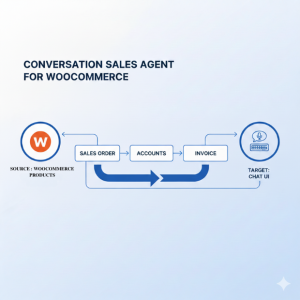
How to set an AI Conversation Sales Agent for WooCommerce
 $0.00
Download
$0.00
Download
-
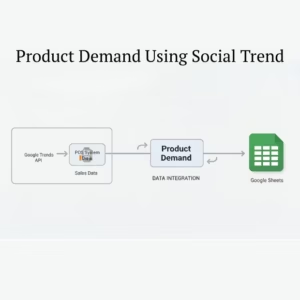
How to Automatically Identify Product Demand Using Social Trend
$0.00
Download
-
Speed Up Purchase Order to SAP S/4HANA in 3 Powerful Steps
$0.00
Download
-
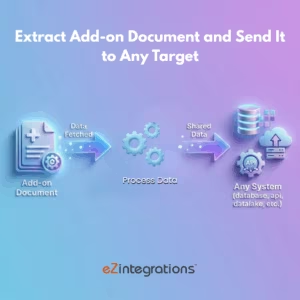
How to Extract Add-On Documents and Send Data to Any Target
$0.00
Download