How to Prevent Customer Churn with Automated Retention Interventions
$150.00
Customer Churn Intervention Agent Autonomously monitor customer health signals from CRM; product usage data; NPS platform; support history; and billing – detect the specific churn trigger per at-risk account (usage decline; support spike; pricing complaint; executive relationship gap); select the optimal intervention playbook; draft personalized CSM outreach; schedule Executive Business Reviews; trigger discount approval workflows in CPQ; log all actions to Salesforce; and monitor post-intervention account health – without waiting for CSM capacity to initiate Churn intervention initiated within 24 hours of ML risk flag vs. 5 to 14-day manual CSM response lag; 100% of high-risk accounts receive structured intervention vs. 40 to 60% with manual CSM prioritization; CSM capacity freed from triage and outreach drafting for strategic relationship management; 5% churn reduction increases SaaS company valuation 25 to 50% (Bain and Company SaaS research) Customer Success Manager (CSM); VP of Customer Success; Chief Revenue Officer (CRO) AI Agent (autonomous; goal-oriented; adaptive – the agent detects churn trigger type per account; selects the matching intervention playbook; adapts outreach content per account context; and monitors post-intervention health signals without CSM instruction per account) Yes – eZintegrations connects to on-premises systems (Salesforce on-prem; MSSQL customer databases; Oracle on-prem; and others) via IPSec Tunnel. eZintegrations is a browser-based; cloud-hosted platform and does not require any on-premises installation. REST API (Salesforce CRM; CPQ; NPS platform); Microsoft Graph API (M365 Calendar scheduling); JDBC (Snowflake DW for usage and billing data); SMTP (CSM outreach and internal notifications); HTTPS; OAuth 2.0; IPSec Tunnel (on-premises CRM and customer database connectivity) Both single-tenant and multi-tenant deployments are available. Single-tenant is recommended for financial services and healthcare SaaS organizations where customer health data and intervention communications are subject to strict data confidentiality requirements. Multi-tenant is the default shared-cloud deployment. Both support on-premises CRM connectivity via IPSec Tunnel. SaaS; Telecom; Financial Services; Healthcare IT; Enterprise Software Churn intervention initiated within 24 hours of ML risk flag; 100% of high-risk accounts receive structured intervention; CSM strategic relationship time from 30% to 70% of working hours; 5% churn reduction unlocks 25 to 50% SaaS valuation improvement AI churn intervention agent; customer churn prevention AI; SaaS churn reduction AI; Goldfinch AI customer success; CSM automation AI agent; customer health monitoring AI; Salesforce churn agent; NPS churn analysis AI; EBR scheduling automation; CPQ discount workflow AI; account health AI agent; customer retention AI automation Yes – the AI churn intervention agent invokes multiple Goldfinch AI tools per at-risk account intervention cycle: API Tool Call (multi-system customer context retrieval and CRM/CPQ/Calendar write actions); Data Analysis (churn trigger classification and playbook selection); Knowledge Base Vector Search (playbook and prior intervention outcome retrieval); Document Intelligence (NPS verbatim and support ticket sentiment extraction); Watcher Tools (ML flag and post-intervention health monitoring); and Integration Workflow as Tool (CPQ discount routing; EBR scheduling; and escalation sub-workflows). Credits consumed per at-risk account per intervention cycle. API Tool Call: Retrieves the full customer account context from Salesforce CRM (account health score, open support tickets, contract value, renewal date, executive sponsor, CSM assignment, prior interaction history); pulls product usage metrics from Snowflake DW (daily active users, feature adoption rate, login frequency trend, core workflow completion rate); fetches NPS survey results from the configured NPS platform (score, verbatim comment, survey date, trend); retrieves billing history and payment status from the billing system; creates Salesforce CRM activity records for all agent actions taken; triggers the CPQ discount approval workflow when the intervention playbook specifies a pricing offer; and creates the M365 Calendar EBR meeting invitation via Microsoft Graph API, Data Analysis: Classifies the specific churn trigger for each flagged account – analyzing the combined signal set (usage trend, support ticket frequency and severity, NPS score and verbatim sentiment, billing status, contract renewal proximity, executive relationship recency) to determine the primary churn driver from the configured trigger taxonomy (Usage Decline, Support Dissatisfaction, Pricing Pressure, Executive Disengagement, Competitive Displacement, Onboarding Stall, Expansion Ceiling); also scores the intervention urgency and recommended playbook based on the trigger type, account tier, and contract value, Document Intelligence: Analyzes the NPS verbatim comments and open support ticket descriptions – extracting sentiment signals, specific product complaints, feature request language, and competitive reference mentions that are not captured in structured data fields; these qualitative signals inform the personalization of the CSM outreach draft and the identification of competitive displacement risk that may not appear in usage or billing data alone; Watcher Tools: Monitors the ML churn model output feed for newly flagged high-risk accounts (triggering the intervention workflow within 60 minutes of flag); monitors post-intervention account health signals (usage trend, support ticket creation rate, NPS improvement, EBR scheduled and held) to determine whether the intervention is working or whether escalation to VP of Customer Success is required; monitors CSM draft review queue for overdue reviews (outreach not approved within 24 hours escalates to CSM Manager), Integration Workflow as Tool: Calls the Salesforce CPQ discount approval sub-workflow (routes the pricing offer to the appropriate approver based on account tier and discount depth); calls the EBR scheduling sub-workflow (creates M365 calendar invitations for the customer executive, internal Account Executive, and CSM); and calls the CSM escalation sub-workflow (routes the account to VP of Customer Success for direct involvement when the agent’s intervention confidence is below the configured threshold or when the account is in the highest-value tier), Knowledge Base Vector Search: Retrieves the intervention playbook matching the classified churn trigger and account tier – including the recommended outreach sequence (email cadence, EBR request, escalation to CSM leadership), the talking points and value re-articulation messaging relevant to the trigger type, the discount authorization level appropriate for the account tier, and the success metrics for post-intervention health monitoring; also retrieves prior intervention outcomes for similar accounts (same trigger type, same product tier, same industry) to inform the intervention recommendationWorkflow Name: Purpose: Benefit: Who Uses It: System Type: On-Premise Supported: Supported Protocols: Tenancy Model: Industry: Outcome: Tags: AI Credits Required: Goldfinch AI Tool(s) Used:
CSM teams in SaaS; telecom; and financial services organizations know which customers are at risk – the ML churn model flags them. What they lack is the capacity to act on every flag; immediately; with the right intervention for each account’s specific churn trigger. A CSM managing 80 to 120 accounts manually triages the risk queue; researches account context across Salesforce; Snowflake usage data; NPS results; and support history; decides on the intervention approach; drafts the outreach; and initiates the EBR or pricing discussion – over 5 to 14 days per account per intervention cycle. By then; the customer’s decision is often already made. Bain and Company SaaS research documents that a 5% reduction in customer churn increases company valuation by 25 to 50%. The intervention timing; not the intervention quality; is the primary determinant of whether a at-risk customer is saved. The Customer Churn Intervention Agent from eZintegrations triggers within 60 minutes of the ML churn model flagging a high-risk account and autonomously executes the full intervention workflow. Goldfinch AI API Tool Call retrieves complete customer context from Salesforce; Snowflake DW (usage); NPS platform; and billing. Goldfinch AI Data Analysis classifies the specific churn trigger and selects the matching intervention playbook. Goldfinch AI Document Intelligence extracts qualitative signals from NPS verbatims and support tickets. Goldfinch AI Knowledge Base Vector Search retrieves playbook tactics and prior intervention precedents. The agent drafts personalized CSM outreach for review; schedules the EBR; and triggers the CPQ discount workflow via Integration Workflow as Tool. Goldfinch AI Watcher Tools monitors post-intervention health. Churn trigger classification per account: Data Analysis identifies the specific churn driver per account – usage decline, support dissatisfaction, pricing pressure, executive disengagement, competitive displacement, or onboarding stall – ensuring the agent selects the intervention playbook that addresses the actual cause rather than sending a generic retention email; Playbook-grounded intervention execution: Knowledge Base Vector Search retrieves the intervention playbook matched to the trigger type, account tier, and contract value – including the recommended outreach sequence, value re-articulation messaging, discount authorization level, and post-intervention monitoring metrics – grounding the agent’s actions in the CS team’s own documented best practice, Post-intervention health monitoring: Goldfinch AI Watcher Tools continuously monitors account health signals after intervention – detecting recovery (usage trend improving, NPS score increase, EBR held) and stall (no usage recovery 14 days post-intervention) and escalating to the CSM or VP of Customer Success with specific signal context when the intervention is not showing results, Qualitative signal extraction from NPS and support tickets: Document Intelligence analyzes NPS verbatim comments and support ticket descriptions for competitive reference mentions, product complaint language, and feature request signals that structured health score data cannot surface – enabling the agent to detect competitive displacement risk before it appears in usage decline; Multi-system intervention execution: The agent does not just draft outreach – it schedules the EBR in M365 Calendar via Microsoft Graph API, triggers the CPQ discount approval workflow via Integration Workflow as Tool, creates Salesforce activity records, and routes high-value accounts to VP of Customer Success escalation – all in a single intervention cycle 5% churn reduction increases SaaS company valuation 25 to 50% (Bain and Company); 100% of ML-flagged high-risk accounts receive structured intervention within 24 hours vs. 40 to 60% with manual CSM prioritization; intervention timing compressed from 5 to 14 days to under 24 hours – the variable most correlated with retention outcome CSM time on account triage; context research; and outreach drafting from 60 to 70% to under 15% of working hours; VP of Customer Success visibility into at-risk portfolio from weekly manual review to real-time Goldfinch AI dashboard; intervention coverage from partial (CSM capacity-limited) to 100% of ML-flagged accounts Each percentage point of churn reduction at $10M ARR = $100,000 in retained ARR annually; CSM capacity redeployment from triage to strategic relationship management and expansion (CSMs who intervene on fewer accounts per period close more expansions – Gainsight benchmarks expansion ARR at 1.5x new ARR for CS-led growth motions). At $120,000 average CSM fully-loaded cost; redeploying 60% of CSM capacity from triage to strategic work is equivalent to adding 0.6 FTE of strategic CSM capacity per CSM without additional headcount. SOC Type II certified; GDPR-compliant customer data handling (customer health data and communication content processed under GDPR Article 6 legitimate interest for commercial customer relationship management; unsubscribe and contact preference handling built-in for customer communications); HIPAA-eligible configuration for healthcare IT SaaS organizations. Customer account data processed in customer-isolated eZintegrations tenant. NPS verbatim data and support ticket content processed per the customer’s data residency policy. RBAC enforced on intervention playbook access (CSM and CS leadership); CPQ discount approval scope (discount authorization limited by configured account tier and depth limits – the agent cannot approve discounts beyond its configured authority); and post-intervention health data access.Problem Before: Solution Overview: Key Features: Business Impact: Productivity Gain: Cost Savings: Security & Compliance:
Description
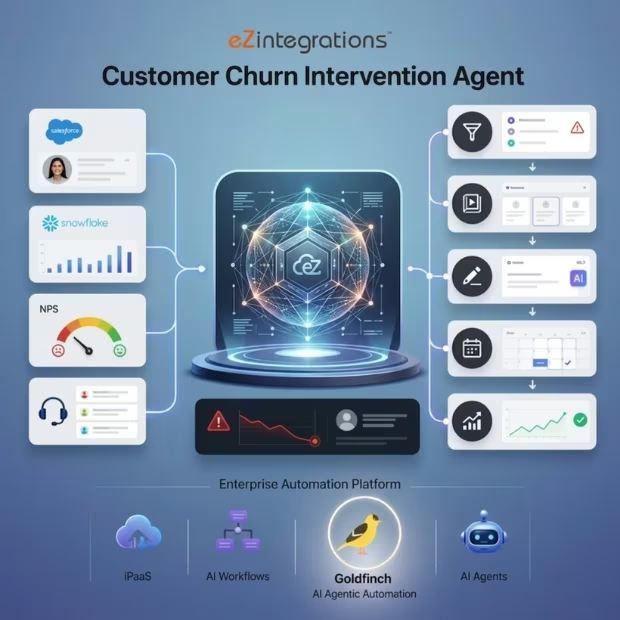
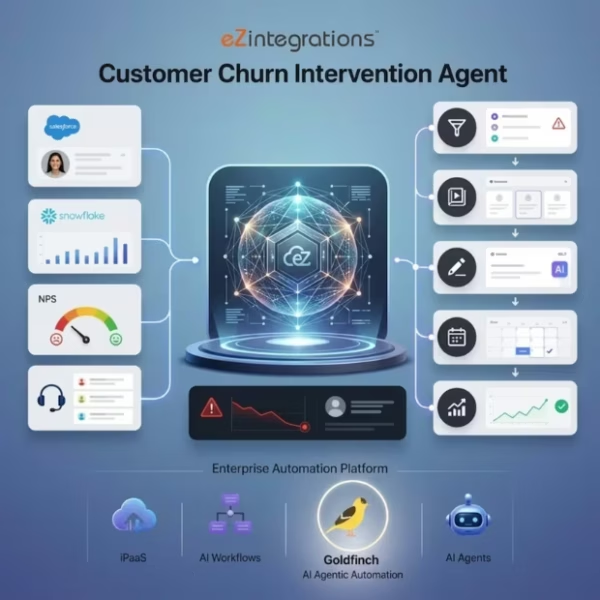
The AI churn intervention agent from eZintegrations triggers within 60 minutes of an ML churn model flag – retrieving full customer context from Salesforce, Snowflake usage data, NPS results, and support history, classifying the specific churn trigger, selecting the matching intervention playbook, drafting CSM outreach, scheduling the EBR, and monitoring post-intervention health – without waiting for CSM capacity to initiate. eZintegrations is an enterprise automation platform covering iPaaS, AI Workflows, AI Agents, and Goldfinch AI agentic automation.
What Is an AI Churn Intervention Agent?
An AI churn intervention agent is an AI Agent that takes a high-risk account ML flag as its goal and autonomously executes the full retention intervention – retrieving customer context across CRM, usage, NPS, and support systems, classifying the specific churn trigger, selecting the optimal intervention playbook, drafting personalized CSM outreach, scheduling executive business reviews, triggering discount approval workflows, and monitoring post-intervention account health. It is reactive (triggers within 60 minutes of the ML flag), adaptive (it selects a different playbook per trigger type and account tier), and autonomous (it acts without CSM instruction per account for standard intervention types).
How Does an AI Churn Intervention Agent Detect Customer Churn Triggers, Select Intervention Playbooks, and Autonomously Execute Retention Actions?
When the ML churn model flags a high-risk account, the AI churn intervention agent triggers immediately. Goldfinch AI API Tool Call retrieves the complete customer context from Salesforce, Snowflake DW, NPS platform, and billing. Goldfinch AI Document Intelligence analyzes NPS verbatim comments and support tickets for qualitative signals. Goldfinch AI Data Analysis classifies the churn trigger and selects the playbook. Knowledge Base Vector Search retrieves playbook tactics and prior intervention outcomes. The agent drafts personalized outreach for CSM review, schedules the EBR via Microsoft Graph API, triggers the CPQ discount workflow via Integration Workflow as Tool, and logs everything to Salesforce. Watcher Tools monitors post-intervention health.
Bain and Company research: a 5% churn reduction increases SaaS valuation 25 to 50%. This AI churn intervention agent makes structured, timely intervention standard practice for every flagged account.
.
Watch Demo
| Video Title: | AI Churn Intervention Agent |
|---|---|
| Duration: | 5 to 7 minutes |
Outcome & Benefits
| Throughput: | Up to 200 at-risk account intervention cycles initiated per day at standard configuration; scales to 2,000+ per day at enterprise tier; agent monitors 100% of ML-flagged accounts continuously 24/7 |
|---|---|
| Cost Reduction: | Each percentage point of churn reduction at $10M ARR = $100,000 retained ARR; 5% churn reduction at $10M ARR = $500,000 retained ARR (Bain and Company SaaS valuation benchmark); CSM capacity reallocation equivalent to adding 0.6 FTE of strategic relationship management per CSM without headcount increase |
| Accuracy: | Churn trigger classification accuracy: 88%+ across 7 trigger categories; playbook selection match with CS leadership manual review: 84%+; NPS sentiment extraction accuracy: 92%+ for competitive mention detection and product complaint classification |
| Time Saved: | Intervention initiation from 5 to 14 days (manual CSM response lag) to within 24 hours of ML flag; CSM context research and outreach drafting from 2 to 4 hours per account to under 15 minutes (reviewing AI-drafted outreach); VP of Customer Success portfolio review from weekly manual to real-time dashboard |
Performance Metrics
| Metric | Before (Manual/Batch) | After (Real-Time Sync) | Improvement |
|---|---|---|---|
| Intervention Initiation Time | 5 to 14 business days | Within 24 hours of ML flag | 95%+ faster |
| High-Risk Account Coverage | 40 to 60% of ML-flagged accounts | 100% of ML-flagged accounts | Full coverage |
| CSM Research and Drafting Time | 2 to 4 hours per account | Under 15 minutes (AI draft review) | 90%+ reduction |
| 5% Churn Reduction Value | Unrealized (timing lag) | $500K retained ARR at $10M ARR | Bain benchmark |
Technical Details
| Data Validation: | Three-stage validation per intervention: context completeness – the agent verifies that at least 3 of the 4 data sources (Salesforce; usage data; NPS; support history) are populated before proceeding with trigger classification; accounts with insufficient data context are flagged for CSM manual review rather than auto-classified; playbook authority check – the agent verifies that the selected intervention actions are within its configured authority (discount depth; calendar scheduling authority; escalation routing rules) before execution; CSM review gate – for all accounts above the configured contract value threshold (default $50,000 ACV; configurable) and for all Critical-urgency interventions; the agent presents the draft outreach and intervention plan to the CSM for review before any external customer communication is sent. The agent never sends external customer communication without CSM approval for high-value accounts. |
|---|---|
| Real-Time Support: | Yes – the agent triggers within 60 minutes of the ML churn model flagging a high-risk account; 24/7. Watcher Tools monitors the ML model output feed continuously and initiates the context retrieval and analysis pipeline immediately on flag detection. Post-intervention health monitoring is continuous – the agent detects recovery or stall signals within the same monitoring cycle as the account flag; ensuring the CSM is alerted to intervention outcomes in real time rather than waiting for weekly account review meetings. |
| Customization: | Configurable per deployment via eZintegrations no-code Agent Builder: ML churn model output feed connection and flag threshold; churn trigger taxonomy (standard 7-category taxonomy or custom categories); intervention playbook library (CS team loads and maintains playbooks in Goldfinch AI Knowledge Base editor – each playbook includes outreach sequence; messaging talking points; discount authorization level; EBR requirements; and success metrics); account tier and contract value definitions for routing rules; CSM review gate threshold (contract ACV above which external communication requires CSM approval); discount authorization matrix (maximum discount depth per account tier and renewal proximity); escalation routing rules per trigger type and urgency level; post-intervention monitoring window and recovery signal definitions. CS Operations team manages playbooks without IT involvement. |
| Knowledge Retrieval: | Goldfinch AI Knowledge Base Vector Search (https://ezintegrations.ai/agentic-ai-platform/) retrieves intervention playbooks; account tier messaging frameworks; prior intervention outcome precedents; and competitive displacement talking points (Weaviate https://weaviate.io/developers/weaviate or Pinecone https://docs.pinecone.io/ as vector store) – matching the current account’s classified trigger type; industry vertical; product tier; contract value; and renewal proximity against the configured playbook library and historical intervention outcomes. CS Operations team maintains the playbook library in the Goldfinch AI knowledge base editor – new playbooks added for new product lines; customer segments; or competitive scenarios take effect immediately for subsequent interventions. |
| Agent Architecture: | Single autonomous agent with parallel multi-system context retrieval (API Tool Call to Salesforce; Snowflake DW; NPS platform; and billing runs simultaneously) followed by sequential analysis (Document Intelligence for qualitative signals; then Data Analysis for trigger classification and playbook selection) and then intervention execution (Knowledge Base retrieval; outreach drafting; and Integration Workflow as Tool sub-tasks). For enterprise CS organizations managing 10,000+ accounts; hierarchical multi-agent mode is available – one orchestrator agent manages the at-risk account pipeline and routes to segment-specific sub-agents (Enterprise; Mid-Market; SMB) configured with segment-appropriate playbooks and escalation paths. |
| Task Orchestration: | Goldfinch AI orchestrates the intervention cycle using a trigger-and-playbook execution model – after parallel context retrieval; Data Analysis classifies the churn trigger and scores intervention urgency (Critical/High/Standard); which gates the intervention path (Critical accounts route directly to VP of Customer Success escalation; High-urgency accounts receive the full agent intervention with CSM review gate; Standard accounts receive agent intervention without review gate if below the configured contract value threshold). The agent maintains per-account intervention state in Salesforce CRM. Watcher Tools monitors post-intervention health signals and transitions account state (Intervention Active; Recovery Detected; Escalation Required; Churned). |
AI Credits
| AI Credits Required: | Yes – the AI churn intervention agent invokes multiple Goldfinch AI tools per at-risk account intervention cycle: API Tool Call (multi-system customer context retrieval and CRM/CPQ/Calendar write actions); Data Analysis (churn trigger classification and playbook selection); Knowledge Base Vector Search (playbook and prior intervention outcome retrieval); Document Intelligence (NPS verbatim and support ticket sentiment extraction); Watcher Tools (ML flag and post-intervention health monitoring); and Integration Workflow as Tool (CPQ discount routing; EBR scheduling; and escalation sub-workflows). Credits consumed per at-risk account per intervention cycle. |
|---|---|
| LLM Steps Count: | 5 to 7 Goldfinch AI tool invocations per at-risk account intervention (API Tool Call x4 parallel context sources + Document Intelligence NPS/support + Data Analysis trigger classification + Knowledge Base playbook retrieval + Integration Workflow as Tool sub-tasks + Watcher Tools monitoring) |
| Credit Consumption Model: | Per at-risk account per intervention cycle – bundle of 5 to 7 tool invocations per account; post-intervention monitoring credits accumulate over the monitoring window (typically 30 to 60 days per account) |
| Estimated Credits per Task: | Standard intervention cycle (context retrieval; trigger classification; outreach draft; CRM logging): ~35 to 55 credits per account Full intervention with EBR scheduling + CPQ discount trigger + escalation: ~55 to 85 credits per account Post-intervention monitoring (30-day monitoring window; daily health checks): ~15 to 30 additional credits per account per month |
| Monthly Credit Estimate (at Typical Volume): | 50 at-risk accounts per month flagged: ~2,500 to 5,750 credits per month (intervention + monitoring) 200 accounts per month (mid-market SaaS): ~10,000 to 23,000 credits per month 1,000 accounts per month (enterprise SaaS): ~50,000 to 115,000 credits per month |
| Pricing Model: | Static Platform Fee + AI Credits. Platform fee covers unlimited non-LLM orchestration (ML flag polling; CRM connection management; calendar connection; SMTP notification dispatch; audit log writes). AI Credits consumed only by Goldfinch AI tool invocations and LLM reasoning cycles. |
| Credit Optimization Notes: | Run API Tool Call context retrieval in parallel for all 4 data sources per account (Salesforce; Snowflake; NPS; billing) rather than sequentially – standard configuration but verify parallelism is enabled. Configure Document Intelligence to analyze only the most recent 3 NPS verbatim comments and the 5 most recent open support tickets per account rather than full history – captures 90%+ of current signal at 40 to 60% of the document processing credit cost. Cache Knowledge Base playbook retrievals per trigger type and account tier for 7 days – intervention playbooks do not change frequently and redundant retrieval can be avoided. Apply post-intervention monitoring at 48-hour intervals for the first 14 days (highest recovery signal density) and daily thereafter rather than continuous polling |
| Goldfinch AI Tool(s) Consuming Credits: | API Tool Call: 4 parallel context retrieval calls (Salesforce CRM; Snowflake usage; NPS platform; billing) + CRM activity logging + CPQ trigger + M365 Calendar creation – credits per tool execution Data Analysis: churn trigger classification and intervention urgency scoring – credits per account classified (LLM reasoning intensive) Knowledge Base Vector Search: playbook retrieval and prior outcome precedent matching – credits per search query Document Intelligence: NPS verbatim analysis and support ticket sentiment extraction – credits per document analyzed Watcher Tools: ML flag monitoring and post-intervention health signal monitoring – credits per monitoring cycle per active account Integration Workflow as Tool: CPQ discount sub-workflow + EBR scheduling sub-workflow + escalation routing – credits per sub-task invocation |
FAQ
1. What is the Customer Churn Intervention Agent?
The AI churn intervention agent by eZintegrations triggers within 60 minutes of an ML churn model flagging a high-risk account — retrieving complete customer context from Salesforce CRM, Snowflake usage data, NPS platform, and billing via Goldfinch AI API Tool Call; analyzing NPS verbatim comments and support tickets via Document Intelligence; classifying the specific churn trigger via Data Analysis; retrieving the matching intervention playbook via Knowledge Base Vector Search; drafting personalized CSM outreach; scheduling EBR meetings via Microsoft Graph API; triggering CPQ discount workflows; and monitoring post-intervention health via Watcher Tools. Bain and Company: 5% churn reduction increases SaaS company valuation 25 to 50%.
2. How does the agent handle task orchestration?
The AI churn intervention agent uses a trigger-and-playbook execution model — parallel context retrieval feeds Data Analysis trigger classification, which gates the intervention path (Critical accounts escalate to VP of Customer Success; High-urgency accounts receive full intervention with CSM review gate; Standard accounts receive intervention without review gate below the configured ACV threshold). The agent maintains per-account intervention state in Salesforce CRM. Watcher Tools transitions account state from Intervention Active to Recovery Detected or Escalation Required based on post-intervention health signals.
3. What Goldfinch AI tools does the AI churn intervention agent use?
Six native Goldfinch AI tools: API Tool Call (parallel Salesforce CRM, Snowflake DW, NPS platform, and billing context retrieval + CRM activity logging + CPQ discount trigger + M365 Calendar EBR scheduling), Data Analysis (churn trigger classification across 7 categories + intervention urgency scoring), Knowledge Base Vector Search (intervention playbook and prior outcome retrieval matched to trigger type and account tier), Document Intelligence (NPS verbatim and support ticket sentiment and competitive mention extraction), Watcher Tools (ML flag monitoring and 24/7 post-intervention health signal monitoring), and Integration Workflow as Tool (CPQ discount sub-workflow, EBR scheduling sub-workflow, VP of Customer Success escalation routing). Goldfinch AI is self-service extensible — your CS Operations team adds Gong conversation intelligence, G2 review signals, or product telemetry APIs as custom agent tools without coding.
4. Can the AI churn intervention agent be customized for my CS process?
Yes — all parameters configurable via eZintegrations no-code Agent Builder: ML churn model connection and flag threshold; churn trigger taxonomy (standard 7-category or custom); intervention playbook library (CS team manages in Goldfinch AI Knowledge Base editor); CSM review gate threshold (default $50,000 ACV); discount authorization matrix; escalation routing per trigger type and urgency; post-intervention monitoring window and recovery signal definitions. CS Operations team maintains playbooks without IT involvement — new playbooks for new customer segments or competitive scenarios take immediate effect.
5. How is data validated before the agent sends customer communications or triggers CPQ workflows?
Three-stage validation: context completeness — at least 3 of 4 data sources populated before trigger classification; insufficient context routes to CSM manual review rather than auto-classification; playbook authority check — all intervention actions verified against configured authority before execution (discount depth, calendar scheduling, escalation routing); CSM review gate — for all accounts above the configured ACV threshold (default $50,000) and all Critical-urgency interventions, the agent presents the draft outreach and intervention plan to the CSM before any external customer communication is sent. The agent never sends customer-facing communication for high-value accounts without CSM approval.
6. Does the AI churn intervention agent support real-time execution?
Yes — the agent triggers within 60 minutes of the ML churn model flag, 24/7. An account flagged at 11pm Sunday is receiving intervention context retrieval and trigger classification before Monday morning — not entered into the CSM review queue for the following week. Post-intervention health monitoring is continuous. Recovery signals (usage uptick, NPS improvement, EBR held) and stall signals (no recovery 14 days post-intervention) are detected and acted on in real time rather than waiting for weekly account review.
7. What are the key benefits of the AI churn intervention agent?
Key benefits include intervention initiation within 24 hours of ML flag vs. 5 to 14-day manual lag, 100% of ML-flagged accounts receive structured intervention (vs. 40 to 60% with manual CSM prioritization), 5% churn reduction increases SaaS valuation 25 to 50% (Bain and Company), $500,000 retained ARR at $10M ARR from 5% churn reduction, CSM context research and drafting from 2 to 4 hours to under 15 minutes per account, churn trigger-specific playbook selection (7 trigger categories), and NPS competitive mention detection enabling pre-usage-decline competitive displacement identification.
8. How does the AI churn intervention agent compare to Gainsight or LangChain?
Gainsight and Totango provide CS platform playbook management but require full suite licensing, 3 to 6-month implementation, and do not autonomously execute multi-system interventions (CPQ discount trigger, EBR calendar scheduling, Salesforce logging) without CSM manual initiation per account. ChurnZero provides automated journeys but within its own ecosystem without custom ML model integration or Snowflake DW connectivity. LangChain requires 3 to 6 months to build Salesforce, NPS, Snowflake, and CPQ connectors. The AI churn intervention agent ships 6 Goldfinch AI tools pre-connected and deploys in under 2 weeks without CS platform migration. Goldfinch AI is self-service extensible for additional CS data sources.
Resources
Case Study
| Industry: | SaaS; Telecom; Financial Services; Healthcare IT; Enterprise Software |
|---|---|
| Outcome: | Churn intervention initiated within 24 hours of ML risk flag; 100% of high-risk accounts receive structured intervention; CSM strategic relationship time from 30% to 70% of working hours; 5% churn reduction unlocks 25 to 50% SaaS valuation improvement |
| Problem: | A cloud analytics SaaS company managed 640 accounts with a team of 9 CSMs. Each month, 48 accounts were flagged as high-risk, but manual triage delayed interventions to 8.4 days on average, with only 62% receiving timely outreach. Delays increased churn risk significantly, resulting in 88% NRR-well below the 110-120% benchmark targeted for growth |
| Solution: | Deployed eZintegrations AI churn intervention agent in 11 days, integrating Salesforce, Amplitude, Delighted, and Zendesk for full customer insights. Configured churn triggers, automated intervention playbooks, and sentiment analysis. Enabled CPQ workflows, EBR scheduling, and CSM review for high-value accounts, with continuous post-intervention monitoring. |
| ROI: | Retained ARR from improved churn rate (6 percentage point NRR improvement x $8.4M ARR base): $504,000 retained ARR. CSM capacity reallocation: 9 CSMs x (68% – 12% = 56% time freed from triage) x $115,000 average fully-loaded CSM cost x productivity value factor = $294,000 in strategic CS capacity added without headcount. Early competitive detection value (6 accounts retained that would likely have churned to competitors at average $42,000 ACV): $252,000. Total year-1 |
Related products
-
How to Prepare Supplier Negotiations Using an AI Agent with Spend, Contract and Market Intelligence
 $150.00
Download
$150.00
Download
-
How to Automate P2P from Requisition to Payment with AI
$150.00
Download
-
How to Automate Month-End Financial Close for Reconciliation and Close Orchestration
$150.00
Download
-
How to Automate Employee Onboarding Using an Autonomous AI Agent
$150.00
Download