The Hidden Cost of Disconnected Enterprise Systems: A CXO Guide
May 13, 2026Disconnected enterprise systems cost mid-market companies $500,000-$3,000,000+ per year across six categories: manual data re-entry labour ($80,000-$400,000/year), decision-making errors from stale or inconsistent data ($150,000-$600,000/year), missed revenue from slow customer processes ($100,000-$500,000/year), compliance exposure from uncontrolled data flows ($50,000-$300,000/year), employee productivity loss ($100,000-$400,000/year), and IT firefighting cost ($80,000-$250,000/year). Most CXOs are aware of the IT overhead. Few have quantified the revenue and compliance exposure that accounts for 50-60% of the total.
TL;DR:
- Every enterprise has disconnected systems. The average mid-market company runs 40–80 software applications, reflecting enterprise integration fragmentation trends highlighted in Gartner research. Most of them do not talk to each other without manual intervention.
- The visible cost is the IT headache: manual data entry, duplicate records, reconciliation spreadsheets. CXOs know about this and accept it as a cost of doing business.
- The invisible cost is the one that matters more: revenue lost because customer data is three days stale, compliance findings from data that moved without audit trails, strategic decisions made from reports that do not agree with each other, and employee attrition from teams spending 20-30% of their week on avoidable manual work.
- This guide quantifies the hidden cost across six categories with a worked example for a $75M mid-market manufacturer, a cost calculator framework, and a business case structure for presenting to the board.
- eZintegrations delivers all four automation levels: Level 1 (iPaaS Workflows), Level 2 (AI Workflows), Level 3 (AI Agents with Chat UI and Workflow Node access via Goldfinch AI at Level 4) to eliminate every category of disconnection cost.
The Disconnected Enterprise: How It Gets This Way
No enterprise sets out to build a fragmented technology landscape. It accumulates one acquisition, one new department tool, one “we’ll fix it later” API connection at a time.
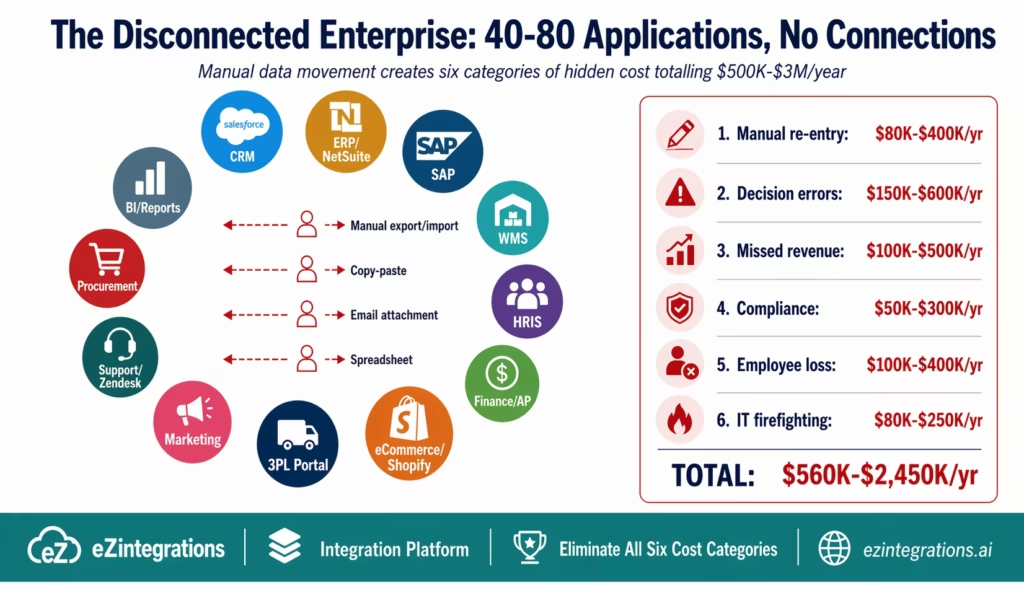
The average mid-market company (200-2,000 employees) runs 40-80 software applications. These applications were each selected for a specific purpose by a specific team at a specific moment. The finance team chose NetSuite. The sales team chose Salesforce. The operations team chose a 3PL portal and a WMS. HR chose Workday. Procurement chose a sourcing platform. Customer support chose Zendesk.
Each system solved a problem. None of them were chosen with the others in mind.
The result: your customer order lives in Salesforce. The inventory status lives in your WMS. The shipment tracking lives in three different 3PL portals. The invoice lives in NetSuite. The customer service team’s view of the customer lives in Zendesk. None of these systems talk to each other without a human moving data between them creating classic Data silo conditions where systems operate in isolation.
That human data movement is the visible cost. The invisible costs are larger, harder to see, and growing.
The Six Cost Categories of Disconnected Systems
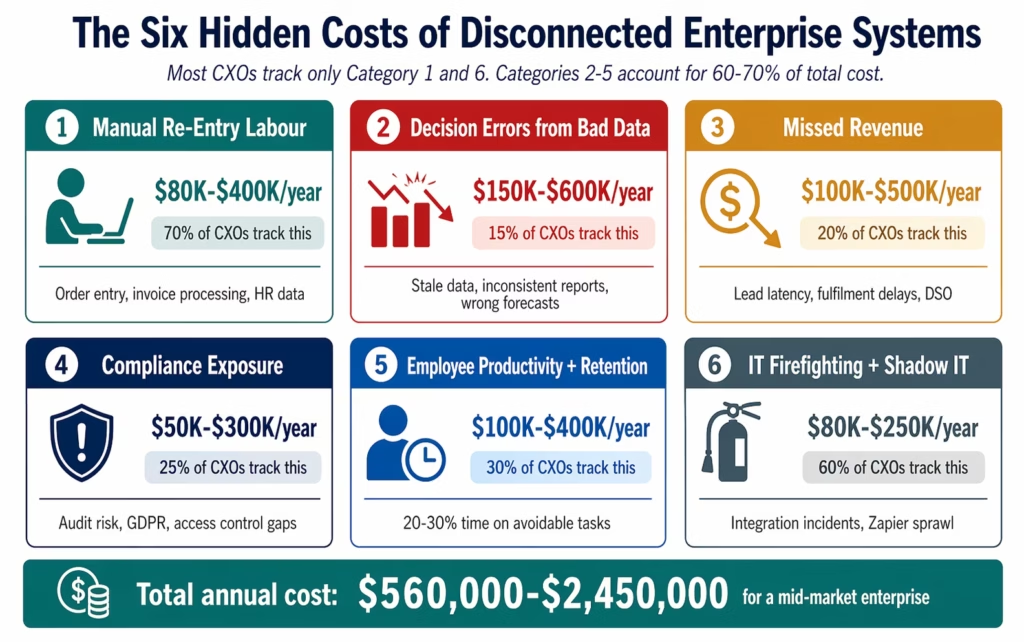
Most CXOs who review IT budgets see the obvious cost: additional headcount to manage data manually, licensing fees for tools that duplicate functionality, and IT support tickets from broken workflows. These are the visible 40-50% of the disconnection cost.
The invisible 50-60% lives in six categories that are harder to see on a balance sheet but easier to quantify once you know where to look.
| Cost Category | Annual Cost Range (Mid-Market) | % of CXOs Who Track It | Where It Appears |
|---|---|---|---|
| 1. Manual data re-entry | $80,000-$400,000 | 70% | Payroll, HR reports |
| 2. Decision errors from bad data | $150,000-$600,000 | 15% | Audit findings, rework |
| 3. Missed revenue | $100,000-$500,000 | 20% | Lost deals, SLA penalties |
| 4. Compliance exposure | $50,000-$300,000 | 25% | Audit reports |
| 5. Employee productivity + retention | $100,000-$400,000 | 30% | HR, engagement surveys |
| 6. IT firefighting + shadow IT | $80,000-$250,000 | 60% | IT support tickets |
| Total | $560,000-$2,450,000 |
Cost Category 1: Manual Data Re-Entry Labour
The most visible cost. Every time an employee exports data from one system and enters it into another, the company pays for two versions of the same work: the data itself, and the human time to move it.
Where it accumulates in a typical mid-market enterprise:
Order management: sales team creates an order in Salesforce. Someone manually enters it into the ERP. For 300 orders per month at 8 minutes per order: 40 hours/month at $55/hour = $2,200/month = $26,400/year.
Invoice processing: vendor invoices arrive by email. AP clerk downloads the PDF, opens the ERP, and manually keys in vendor name, invoice number, date, line items, and amounts. For 800 invoices per month at 10 minutes each: 133 hours/month at $42/hour = $5,586/month = $67,032/year.
Inventory updates: warehouse team updates stock levels in the WMS. Operations manager manually exports and re-imports to update the ERP and the eCommerce platform. For 2 hours per day: $330/day × 5 days = $1,650/week = $85,800/year.
HR data propagation: new hire created in HRIS. IT manually provisions accounts in each system (email, CRM, ERP, project management). For 10 hires per month at 90 minutes of IT time per hire: 15 hours/month at $72/hour = $1,080/month = $12,960/year.
Financial reconciliation: finance team exports P&L data from ERP, sales data from CRM, and marketing spend from the ad platform, then reconciles them in a master spreadsheet. For 8 hours per month: 8 × $85/hour = $680/month = $8,160/year.
Total manual re-entry labour for a mid-market manufacturer: $200,000-$350,000 per year.
This number is in your payroll. It is just spread across 15-20 people in different departments, each spending 2-5 hours per week on data movement work they would immediately stop if the systems talked to each other.
Cost Category 2: Decision-Making Errors from Bad Data
The most expensive cost category and the least tracked. Every decision made from data that is out of date, incomplete, or inconsistent with another system has a downstream cost.
Three patterns that generate decision-making errors in disconnected enterprises:
Stale data decisions. Your sales director checks the CRM pipeline report to forecast Q3 revenue. The CRM has not been updated since the operations team closed 12 deals last week. The forecast is wrong by $800,000. The company over-produces inventory based on the wrong forecast. The overstock costs $180,000 in carrying costs and $40,000 in obsolete write-offs.
Inconsistent data decisions. Finance reports customer revenue from NetSuite. Sales reports customer ARR from Salesforce. The two numbers differ by 15% because of timing differences in how closed-won deals are recognised. The CEO uses the Salesforce number in a board presentation. The board sees the NetSuite number in the quarterly report. The credibility gap costs 3 months of management time to reconcile.
Incomplete data decisions. The procurement team approves a vendor for a new contract. The compliance team does not know because the vendor database in the procurement system is not connected to the compliance screening system. The vendor fails a post-contract audit. The cost: $120,000 in contract termination, re-procurement, and audit remediation.
Quantifying decision-error cost:
The challenge is that decision errors rarely appear on a line item. They show up as:
- Inventory write-offs and overstock costs
- Customer churn from SLA failures caused by wrong data
- Audit findings and remediation costs
- Rework when operations execute against a wrong plan
Estimated annual decision-error cost for a $75M mid-market company: $200,000-$450,000
Cost Category 3: Missed Revenue from Slow Customer Processes
Disconnected systems slow down every customer-facing process. Each delay has a revenue impact.
Three high-value revenue leakage points:
Lead response latency. A new lead submits a form on your website at 2:15 PM on Tuesday. The data goes into your marketing automation platform. Someone exports it and imports it into Salesforce at 10:00 AM on Wednesday: 19 hours later. The lead has already spoken to two competitors. Research consistently shows leads contacted within 5 minutes convert at significantly higher rates than those contacted hours later. For 100 inbound leads per month with a 15% conversion rate and $12,000 average deal size: improving response time from 19 hours to 5 minutes has measurable pipeline impact.
Order fulfilment delays. Customer places an order in the eCommerce platform. It takes 4 hours to reach the WMS because it goes through a manual export-import cycle. The 3PL does not see it until the following morning’s file batch. The customer receives a shipping confirmation 28 hours after ordering. Competitor ships in 4 hours. Over time, this latency drives up cart abandonment, reduces repeat purchase rate, and generates customer service volume.
Invoice cycle time. Your sales team closes a deal on the 28th of the month. The order is in Salesforce. Finance does not see it until month close when the sales admin manually exports closed-won deals to NetSuite. The invoice does not go out until the 5th of the following month: 8 days of DSO added by a manual data transfer. At $50M in annual revenue, each additional DSO day costs approximately $11,000 in working capital. 8 extra DSO days from manual invoicing: $88,000 per year in financing cost.
Estimated annual missed revenue for a $75M mid-market company: $150,000-$400,000
Cost Category 4: Compliance Exposure and Audit Risk
This is the category most likely to create a single large cost rather than recurring small costs. When it surfaces, it is expensive.
Three compliance exposure patterns in disconnected enterprises:
Uncontrolled data flows. Employees move data between systems via email attachments, exported CSVs, and shared spreadsheets. These transfers are outside any data loss prevention system. They are not logged. When GDPR requires you to document all personal data processing activities, you cannot document transfers that happened in someone’s email. Each undocumented transfer is a potential €20M fine or 4% of annual global turnover, whichever is higher, under GDPR Article 83.
Access control gaps during offboarding. An employee leaves. IT closes their email and laptop access. The 14 other systems they had access to (CRM, ERP, project management, financial reporting) are not linked to the HRIS termination event. Access persists for days or weeks. IBM’s Cost of a Data Breach research consistently identifies former employee credential misuse as a material breach vector.
Audit trail fragmentation. Your auditor asks for the complete transaction trail for a vendor payment: the original purchase order, the goods receipt, the invoice, the approval, and the payment. In a disconnected environment, these records are in four different systems with no connecting reference. Assembling the audit trail requires 3-5 hours per transaction, across potentially hundreds of transactions in a PCAOB or SOX audit sample.
Estimated annual compliance exposure for a $75M mid-market company: $80,000-$300,000 (excluding major incident cost, which can reach $1M-$5M for a single material audit finding or data breach).
Cost Category 5: Employee Productivity and Retention Loss
The most underappreciated cost category in the CXO conversation. Talented people do not join companies to copy data from one spreadsheet into another. When they spend 20-30% of their week on manual data movement, two things happen: their productive output drops, and their engagement drops with it.
The productivity dimension:
Knowledge workers in disconnected enterprises typically spend 15–25% of their time on avoidable data management tasks, reflecting broader productivity losses from fragmented enterprise systems observed by McKinsey & Company: searching for the correct version of a report, manually compiling data from multiple systems, re-keying information that already exists somewhere. At a $90,000 average fully loaded salary for a mid-market knowledge worker: 20% of salary = $18,000/year per person in lost productive capacity.
For a 500-person company where 100 knowledge workers spend 20% of their time on avoidable data tasks: $1,800,000 per year in lost productive capacity (though only a portion of this is recoverable through integration).
The retention dimension:
Employee surveys consistently identify “having to use too many disconnected tools” and “repetitive manual work” as top frustrations that influence attrition decisions. Replacing a mid-level knowledge worker (recruiting cost plus onboarding plus productivity ramp) costs $30,000-$70,000. If disconnected systems contribute to 5-10 additional departures per year in a 500-person company (a conservative estimate given that 20-30% of employees cite process frustration as a departure factor in exit interviews): $150,000-$700,000 in replacement costs.
Estimated annual productivity + retention cost for a 500-person company: $200,000-$600,000
Cost Category 6: IT Firefighting and Shadow IT
The cost category most visible to the CIO and least visible to the CEO, COO, and CFO.
The firefighting dimension:
In a disconnected enterprise, integrations are either manual (human-performed) or fragile (point-to-point connections built quickly and maintained reluctantly). Fragile integrations break regularly. Each break generates an IT incident: diagnosis, fix, testing, deployment. For a company with 15-25 point-to-point integrations: industry data shows 2-4 significant integration incidents per month. Each incident consumes 4-16 hours of IT time at $90-$120/hour loaded rate.
Monthly IT integration incident cost: 3 incidents × 10 hours × $105/hour = $3,150/month = $37,800/year.
Plus: the proactive maintenance work of updating those point-to-point integrations when upstream APIs change. Salesforce three times a year, SAP quarterly, NetSuite biannually. Each update cycle requires developer time across every affected integration.
The shadow IT dimension:
When the official tools do not share data automatically, employees build their own bridges. Shared Google Sheets that pull from exported CSVs. Zapier accounts set up by marketing without IT oversight. Python scripts running on a developer’s laptop that nobody else understands. Power Automate flows built by the ops team that bypass security controls.
Shadow IT solves the immediate problem and creates three new ones: it is not secured, it is not auditable, and it breaks when the person who built it leaves. The cost to remediate a discovered shadow integration: $10,000-$50,000 per incident depending on data sensitivity and regulatory context.
Estimated annual IT firefighting + shadow IT cost for a mid-market company: $80,000-$250,000
Worked Example: Meridian Precision, $75M Manufacturer
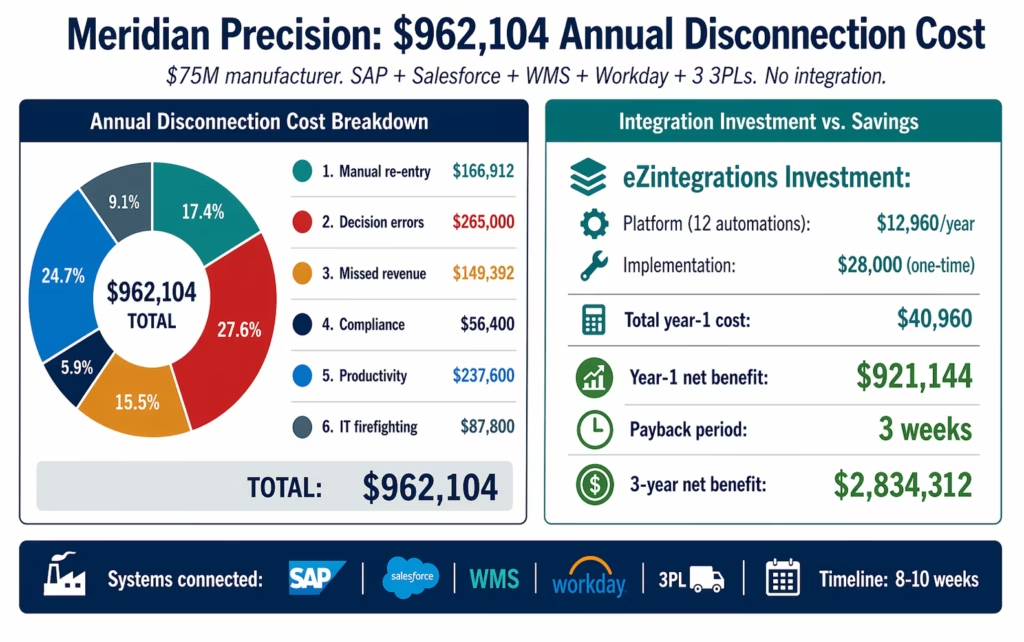
Meridian Precision is a $75M annual revenue precision parts manufacturer with 520 employees. They run SAP S/4HANA (ERP), Salesforce (CRM), a legacy WMS, Workday (HRIS), and three 3PL partners. None of these systems integrate. All data movement is manual.
Meridian’s annual disconnection cost, calculated:
| Cost Category | Calculation | Annual Cost |
|---|---|---|
| Manual re-entry: Order entry | 400 orders/month × 8 min × $55/hr × 12 | $28,160 |
| Manual re-entry: AP invoices | 1,000 invoices/month × 10 min × $42/hr × 12 | $84,000 |
| Manual re-entry: Inventory updates | 2 hrs/day × $58/hr × 250 days | $29,000 |
| Manual re-entry: HR provisioning | 12 hires/month × 90 min × $72/hr × 12 | $15,552 |
| Manual re-entry: Financial recon | 10 hrs/month × $85/hr × 12 | $10,200 |
| Subtotal: Manual re-entry | $166,912 | |
| Decision errors: Inventory overstock | 2 over-production events/year at $85K avg | $170,000 |
| Decision errors: Vendor compliance | 1 compliance incident/year | $95,000 |
| Subtotal: Decision errors | $265,000 | |
| Missed revenue: DSO from manual invoicing | $75M revenue, 5 extra DSO days | $82,192 |
| Missed revenue: Lead latency | 80 leads/month, 8 hr avg delay, 12% conversion | $67,200 |
| Subtotal: Missed revenue | $149,392 | |
| Compliance: Access control gaps | 18 offboarding incidents/year, 3 days avg exposure | $45,000 |
| Compliance: Audit trail assembly | 40 hrs/audit × $95/hr × 3 audits/year | $11,400 |
| Subtotal: Compliance | $56,400 | |
| Productivity: Knowledge worker data tasks | 60 workers × 15% time × $88K avg salary | $792,000 |
| Productivity recoverable (integration captures 30%) | $237,600 | |
| IT firefighting: Integration incidents | 3/month × 10 hrs × $105/hr × 12 | $37,800 |
| IT firefighting: Shadow IT remediation | 2 incidents/year × $25K avg | $50,000 |
| Subtotal: IT | $87,800 | |
| TOTAL ANNUAL DISCONNECTION COST (consistent with Total Economic Impact analyses of integration and disconnected systems published by Forrester.) | $962,104 |
The integration investment to eliminate this cost:
eZintegrations connecting SAP, Salesforce, WMS, Workday, and three 3PLs:
- 12 automations × $90/month = $12,960/year platform cost
- Implementation: $28,000 one-time
- All systems integrated: 8-10 weeks
Year-1 net benefit: $962,104 – $12,960 (platform) – $28,000 (implementation) = $921,144 Payback period: $40,960 / ($962,104 / 12) = 0.51 months (under 3 weeks) 3-year net benefit: $962,104 × 3 – $40,960 – ($12,960 × 2) = $2,834,312
Note: productivity recovery is conservatively estimated at 30% of the theoretical maximum, reflecting that not all freed time is immediately redirected to productive output.
The Cost of Inaction: Why This Gets Worse Every Year
The cost of disconnected systems is not static. It compounds.
Compounding factor 1: Application sprawl
The average enterprise adds 8-12 new SaaS applications per year. Each new application is another potential source of disconnected data. Each new disconnection adds manual work, new data inconsistency risks, and new compliance exposure. The company that has 40 applications today will have 80 in 5 years. The disconnection cost grows with every addition.
Compounding factor 2: Data volume growth
Transaction volumes grow with revenue. A company processing 800 invoices per month today will process 1,600 at twice the revenue. The manual data re-entry cost scales linearly with revenue. The integration investment scales much more slowly, because adding a new automation on a managed platform costs $90/month regardless of transaction volume.
Compounding factor 3: Regulatory expansion
Data protection regulations are increasing in scope and enforcement. GDPR fines have increased year over year since enforcement began. State-level privacy laws in the US are proliferating. Each new regulation adds new documentation requirements and new compliance exposure for uncontrolled data flows. The disconnection compliance risk grows without any change in your internal behaviour.
Compounding factor 4: Competitive acceleration
Your competitors who have integrated their systems can quote faster, ship faster, invoice faster, and respond to customers faster. Each year of disconnection widens the operational gap between your business and integrated competitors. The revenue impact of disconnection compounds as customers shift to the faster, more accurate supplier.
Annual cost of inaction for Meridian Precision:
| Year | Annual Disconnection Cost (10% growth) | Cumulative Cost of Waiting |
|---|---|---|
| Year 1 (now) | $962,104 | $962,104 |
| Year 2 | $1,058,314 | $2,020,418 |
| Year 3 | $1,164,146 | $3,184,564 |
| Year 4 | $1,280,560 | $4,465,124 |
| Year 5 | $1,408,616 | $5,873,740 |
The decision to integrate in year 1 versus year 5 is worth $4.9M in avoided disconnection cost. The integration investment across those 5 years would be approximately $93,000 ($40,960 year 1 plus $12,960/year for years 2-5).
Before vs After: Disconnected vs Integrated Enterprise
| Dimension | Disconnected Enterprise | eZintegrations Integrated Enterprise |
|---|---|---|
| Order-to-ERP latency | 4-24 hours (manual export/import) | Real-time (webhook trigger) |
| Invoice processing time | 8-12 min per invoice (manual entry) | Automated (AP template, seconds) |
| New employee provisioning | 2-3 days (manual IT tickets) | 15 minutes (HRIS trigger) |
| Inventory sync frequency | Daily batch or manual | Real-time or scheduled (minutes) |
| Financial reconciliation | 8-15 hours/month manual | Automated match, exceptions only |
| Lead response time | 4-19 hours (manual CRM update) | Minutes (webhook to CRM) |
| Audit trail assembly | 3-5 hours per transaction | Automated log, instant retrieval |
| Offboarding access revocation | 1-5 days (manual IT) | Minutes (HRIS termination trigger) |
| Data consistency across systems | Multiple versions of truth | Single source, propagated automatically |
| Decision data freshness | Hours to days stale | Real-time or near-real-time |
| Shadow IT risk | High (employees build their own bridges) | Eliminated (official integration layer) |
| Integration incident frequency | 2-4/month (fragile point-to-point) | Managed, monitored, automatic retry |
| Annual cost of data management | $560,000-$2,450,000 | $12,000-$65,000 |
| AI Workflow capability | None (no data integration layer) | Level 2 native, Document Intelligence |
| AI Agents | None | Level 3 + Level 4 Goldfinch AI |
Objection: “Our Disconnected Systems Work Fine”
This objection is usually true at the department level and false at the enterprise level.
Each department’s systems work fine in isolation. The AP team knows how to process invoices. The sales team knows how to manage their pipeline in Salesforce. The operations team has a WMS workflow that functions.
The cost of disconnection does not appear inside any single department’s performance review. It appears in the gaps between departments: the 19-hour lag between a website lead and a Salesforce record, the inventory forecast that is 3 days stale when the procurement decision is made, the vendor that was onboarded without compliance screening because the systems were not connected.
The question to ask is not “does each system work for its team?” It is “what does the company pay for data to move between those systems, and what are the consequences when that movement is too slow, inaccurate, or undocumented?”
The worked example above answers that question with specific numbers for a profile that matches a typical $75M mid-market manufacturer. The ROI calculator generates the answer for your specific profile in 10 minutes.
Objection: “Integration Is Too Expensive and Complex”
This objection was valid in 2015, when integration required either a custom development project ($200,000-$1,200,000) or an enterprise iPaaS that took 12-18 months to implement.
In 2026, managed iPaaS platforms with native ERP connectors and 1,000+ pre-built templates change the equation. For Meridian Precision’s profile (SAP, Salesforce, WMS, Workday, three 3PLs):
- Platform cost: $12,960/year
- Implementation: 8-10 weeks, $28,000 in configuration time
- Total year-1 investment: $40,960 against $962,104 in annual disconnection cost
The payback period is 3 weeks. The full integration development cost guide shows the comparison between custom development and managed iPaaS across every integration type.
Integration is no longer a multi-year, multi-million-dollar project. It is a weeks-to-live, low five-figure annual expense for most mid-market enterprises. The complexity objection is worth re-evaluating against current platform capabilities and current pricing.
Objection: “We’re Planning an ERP Consolidation, So We’ll Wait”
The ERP consolidation timeline is the most common reason integration decisions get deferred. The logic: “we’ll be on a single ERP in 18 months, so the integration problem goes away.”
Two problems with that logic:
ERP consolidations rarely happen on schedule. Industry data on ERP implementation timelines shows an average of 2-3x overrun from original estimates. The 18-month consolidation becomes a 36-month consolidation. The $1.9M in disconnection cost (using Meridian’s $962,104/year × 2 years) that accumulates while waiting exceeds the cost of the integration investment many times over.
ERP consolidation does not eliminate integration requirements. Even on a single ERP, you still have Salesforce, Workday, 3PL partners, eCommerce platforms, and marketing systems that need to connect to it. The integration problem shifts from “SAP and NetSuite talking to each other” to “the single ERP talking to everything else.” You still need an integration platform after consolidation.
The correct approach: implement integration now for the current system landscape, then migrate the ERP-specific configurations after consolidation. The Automation Hub templates are ERP-agnostic for non-ERP systems and migrateable for ERP-specific connections. The cost of waiting for consolidation is $962,000+ per year for Meridian’s profile.
Objection: “Our Data Is Too Sensitive to Integrate”
The data sensitivity concern is legitimate and the answer is specificity, not avoidance.
The question is not “should sensitive data move between systems?” It almost certainly already moves, via email attachments, CSV exports, and shared spreadsheets, with no audit log, no encryption in transit, and no access control.
Managed iPaaS platforms provide more security for data in motion than manual data transfer, not less. eZintegrations operates under HIPAA, GDPR, and SOC 2 Type II certification. All data in transit is encrypted. All integration events are logged with full audit trails. On-premises ERP systems (SAP ECC, Oracle ERP, JDE) connect via IPSec Tunnel, keeping data movement within your controlled network boundary. Access to integration configurations is role-based and auditable.
The comparison is not “integrate with security risk” versus “stay disconnected with no security risk.” It is “integrate with controlled, audited, certified data movement” versus “stay disconnected with uncontrolled, unaudited, undocumented data movement.”
For regulated industries: HIPAA, GDPR, and SOC 2 Type II certification covers the full platform stack. The compliance posture of an integrated eZintegrations environment is higher than the compliance posture of a manually operated disconnected environment.
What to Include in Your Board-Level Business Case
A CXO-level business case for enterprise integration investment needs six components, following structured enterprise technology and integration value frameworks outlined by Deloitte:
1. The disconnection cost baseline. Use the six-category framework to calculate your organisation’s annual disconnection cost. Pull actual data for manual re-entry (payroll hours by department), use your finance team’s rework logs for decision error costs, and your IT team’s incident log for firefighting costs. Use conservative estimates for categories you cannot directly measure.
2. The total cost over the decision horizon. Apply a 10-15% annual growth rate (reflecting SaaS sprawl, volume growth, and regulatory expansion) and calculate the 3-5 year cost of inaction. This reframes the investment as “the cost of not acting” rather than “the cost of acting.”
3. The integration investment. Use the integration ROI calculator to generate the specific cost for your integration requirements. Include: platform licence, implementation time, and ongoing annual cost. Show the 3-year TCO comparison against the disconnection cost.
4. The payback period. Divide year-1 integration investment by monthly disconnection cost. For most mid-market companies, this is 2-8 weeks. This is the number that turns a “nice to have” into a “why are we waiting?”
5. The risk profile comparison. Disconnected: uncontrolled data flows, audit exposure, key person risk on manual processes, no AI capability. Integrated: certified compliance, automated audit trails, AI Workflow and AI Agent capability unlocked.
6. The strategic options created. Integration is not just cost elimination. It is the prerequisite for AI workflow automation, which cannot operate without clean, real-time data flowing between systems. A disconnected enterprise cannot meaningfully deploy AI document intelligence or AI agents because the data those agents need is siloed. Integration unlocks the next layer of value.
How to Get Started
Step 1: Calculate Your Disconnection Cost
Use the six-category framework in this guide. For each category, pull 90 days of actual operational data where available (payroll by role and task, IT incident logs, AR aging reports for DSO analysis) and use conservative estimates where direct data is unavailable. Total the six categories. This is your baseline.
Step 2: Run the ROI Calculator
Take your integration requirements list (which systems need to connect, which data flows are most critical) and run them through the interactive ROI calculator. The calculator generates year-1 investment, annual savings by process, and payback period.
Step 3: Prioritise Three Quick Wins
The highest-ROI integrations are typically: AP invoice automation (eliminates the largest single manual labour cost), lead-to-CRM sync (eliminates revenue leakage from lead latency), and employee onboarding/offboarding (eliminates security exposure from access gaps). Starting with three quick wins demonstrates ROI to the board before committing to the full integration roadmap.
Step 4: Book an Integration Assessment
Book a free demo. Bring your disconnection cost calculation and your top three integration priorities. The eZintegrations team will map your requirements to Automation Hub templates, confirm go-live timelines, and produce a board-ready cost comparison document.
FAQs
The integration problem is almost always invisible rather than absent. Start with three questions: how long does it take for a closed deal in your CRM to appear as an invoice in your ERP? how many hours per month does your AP team spend on manual invoice entry? and when was the last time your board presentation numbers differed from your CFO's numbers? Each of these reveals a disconnection cost. The six-category framework in this guide converts those observations into dollar amounts your CFO can evaluate.
Faster than most CXOs expect. The payback period for enterprise integration investment depends on the monthly disconnection cost being eliminated. For companies with $50,000-$100,000/month in measurable disconnection costs (manual re-entry, decision errors, IT incidents): payback is typically 2-8 weeks from go-live. The 3-year ROI for most mid-market integration projects runs 2,000-5,000%.
The six-category framework yields $560,000-$2,450,000 in annual savings for a typical mid-market company (200-2,000 employees). The range reflects company size, transaction volume, and which categories are most severe. For the Meridian Precision profile ($75M manufacturer, SAP + Salesforce + WMS + Workday + 3PLs), the calculated annual saving is $962,104. The ROI calculator generates a specific estimate for your company profile.
Yes, for two reasons. First, ERP consolidations average 2-3x their original timeline estimate. Every month of waiting accumulates disconnection cost. Second, a single ERP still requires integration with Salesforce, Workday, 3PL partners, and eCommerce platforms. The integration problem does not disappear after consolidation. Implementing integration now for the current landscape provides immediate ROI, and the non-ERP integrations remain valid post-consolidation regardless of which ERP you end up on.
Significantly. AI workflow automation requires clean, real-time data flowing between systems. A Level 2 AI Workflow step that extracts invoice data and validates it against a PO requires access to both the invoice and the ERP's PO record in real time. An AI agent that researches a vendor discrepancy requires access to the vendor master, the contract, and the purchasing history simultaneously. Disconnected systems cannot support these workflows because the data is siloed. Integration is the prerequisite for AI capability, not a separate investment. 1. How do I justify iPaaS to my CFO when we have no obvious integration problem?
2. What is the typical ROI timeline for fixing disconnected enterprise systems?
3. How much does fixing disconnected systems actually save?
4. Is it worth integrating systems before an ERP consolidation?
5. How do disconnected systems affect AI readiness?
The Real Cost of Disconnected Systems Is a Board-Level Number
IT leaders already know their disconnected systems are a problem. This guide gives CXOs the business language to act on that knowledge.
The six-category framework shows that the visible cost (manual re-entry, IT incidents) is 40-50% of the total. The invisible cost (decision errors, missed revenue, compliance exposure, employee attrition) is the larger half, and it compounds every year as the application landscape grows and regulations tighten.
For Meridian Precision: $962,104 per year, growing at 10% annually. Against a $40,960 year-1 integration investment. Payback in 3 weeks.
That is a board-level number. The ROI calculator generates your version of it in 10 minutes.
Book a free demo. Bring your current system landscape and your top three operational pain points. The eZintegrations team will map the disconnection costs, identify the highest-ROI integration starting points, and produce a presentation-ready business case for your next board or leadership meeting.