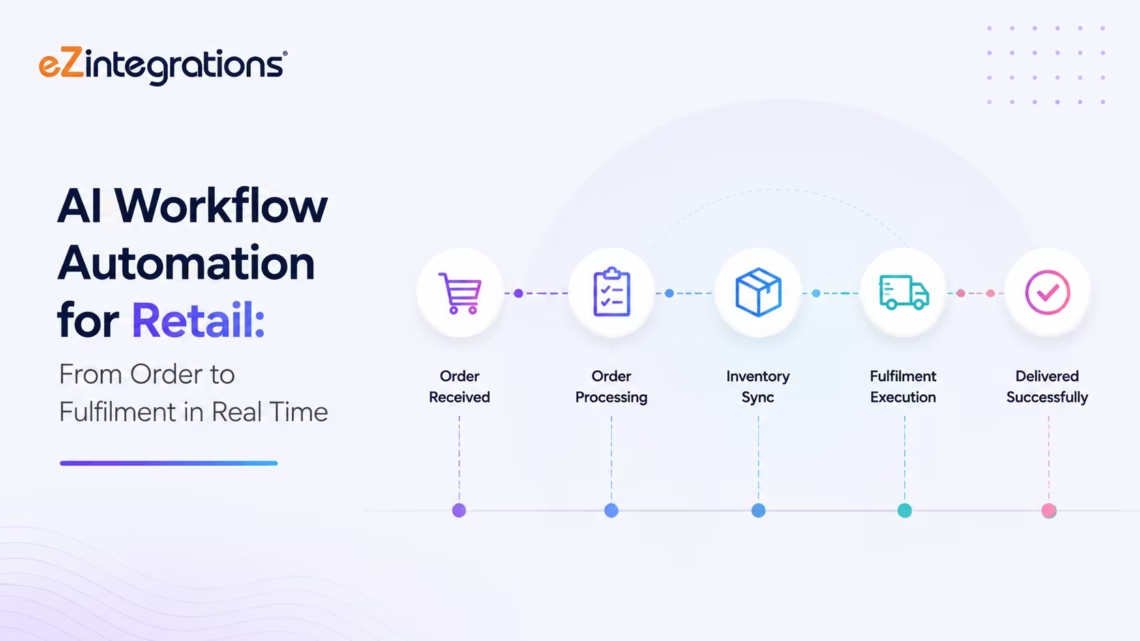
AI Workflow Automation for Retail: From Order to Fulfilment in Real Time
May 18, 2026AI workflow automation for retail connects eCommerce platforms (Shopify, Amazon, Walmart), order management systems, warehouse management systems, ERP, and carrier APIs with intelligent data pipelines that automate the entire order lifecycle: from real-time order capture through inventory reservation, warehouse routing, label generation, tracking, and returns processing: without manual touchpoints. eZintegrations delivers Level 1 iPaaS and Level 2 AI Workflows for retail across order-to-fulfilment, inventory synchronisation, returns intelligence, demand signal processing, and omnichannel inventory management: with pre-built templates that go live in days.
TL;DR
- The average retail operations team spends 15-30% of its capacity on manual data touchpoints across the order lifecycle: manually routing exceptions, reconciling inventory across channels, entering returns data into the ERP, and investigating order status discrepancies between the OMS, WMS, and carrier systems. None of this work requires human judgment: it requires data movement, classification, and routing.
- eZintegrations’ Level 1 iPaaS Workflows and Level 2 AI Workflows automate the entire retail order lifecycle without manual intervention. Document Intelligence reads unstructured order data. LLM Classification categorises exception types and returns reasons. Data Analysis detects inventory anomalies and demand signal shifts. All connected to Shopify, Amazon, Walmart, your OMS, WMS, ERP, and carrier APIs through pre-built templates.
- Five retail AI workflows in this guide: real-time order-to-fulfilment, intelligent inventory synchronisation, AI-powered returns processing, demand signal intelligence, and omnichannel inventory routing.
- Level 3 AI Agents investigate complex retail exceptions. Level 4 Goldfinch AI gives retail operations directors and merchandise buyers natural language access to live inventory, order, and fulfilment data.
- CTA: Import a retail AI workflow template from the Automation Hub and go live this week.
The Retail Operations Data Problem
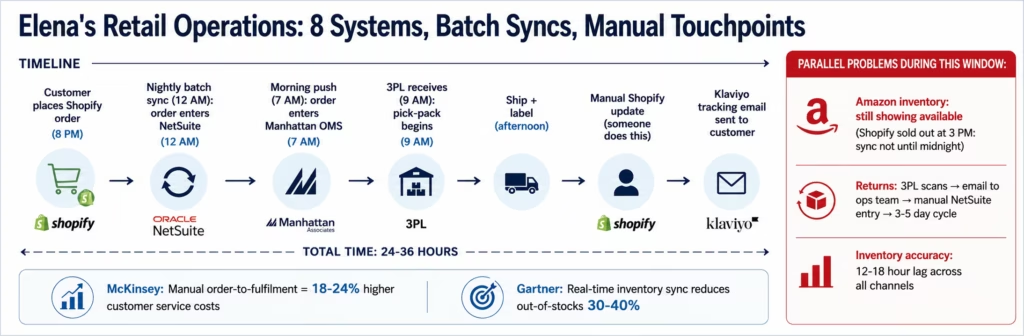
Elena runs retail operations for a mid-size apparel brand doing $120M in annual revenue across interconnected Order management system, WMS, ERP, and eCommerce platforms. Her technology stack: Shopify Plus for DTC, Amazon and Walmart Marketplace for wholesale channels, NetSuite for ERP, Manhattan Active OMS for order management, a 3PL using Blue Yonder WMS, UPS and FedEx for domestic shipping, a returns management platform, and Klaviyo for customer communications.
Eight systems. Four sales channels. One operations team.
When an order is placed on Shopify, here is what currently happens: Shopify captures the order. A nightly batch sync pushes the order to NetSuite. The next morning, NetSuite pushes the order to the OMS. The OMS routes it to the 3PL. The 3PL picks, packs, and ships. The tracking number comes back to the 3PL system. Manually, someone updates Shopify. Klaviyo pulls from Shopify to send the tracking email to the customer.
Total time from order placed to customer receiving a tracking email: up to 36 hours. For a customer who ordered at 8 PM and expects same-day or next-day visibility, this is a failure experience.
When Amazon receives an order, a similar chain runs: but inventory is not synchronised in real time between Amazon and Shopify. An item that sells out on Shopify at 3 PM may still show available on Amazon until the next nightly sync. Oversell exposure: real.
When a return arrives at the warehouse, the 3PL scans it in. Someone emails the returns data to Elena’s team. Someone enters the return in NetSuite and in the returns platform. The customer is waiting for a refund. Average returns processing time: 3-5 business days. Returns fraud rate without automated inspection: 8-12% of return volume.
McKinsey estimates retail operations with manual order-to-fulfilment processes spend 18-24% more on customer service costs than those with automated fulfilment pipelines. Gartner research shows that real-time inventory accuracy: inventory data synchronised within 60 seconds rather than batch cycles: reduces out-of-stock customer experiences by 30-40%.
Before vs After: AI Workflow Transformation in Retail
| Process | Before AI Workflows | After AI Workflows |
|---|---|---|
| Order to WMS | Nightly batch, 8-18 hour lag | Shopify/Amazon webhook → WMS order in under 90 seconds |
| Tracking number to customer | Manual Shopify update, 24-36 hour total cycle | Carrier label → tracking written to OMS → Klaviyo email sent: all within 5 minutes of ship |
| Inventory sync across channels | Nightly batch, oversell risk window | Real-time inventory reservation on order, broadcast to all channels within 60 seconds |
| Amazon/Walmart oversell prevention | Discovered next morning when sync runs | Inventory sold on any channel immediately reduces availability on all others |
| Returns data entry | Manual email → manual NetSuite entry (3-5 days) | 3PL scan → AI workflow → NetSuite return, refund triggered, customer notified |
| Returns fraud detection | Manual review, 8-12% fraud rate | Document Intelligence reads return item details, LLM flags suspected fraud for human review |
| Demand signal anomaly | Weekly planning review, 1-2 week reaction time | AI detects sell-through anomaly at ingestion, routes to buyer same day |
| OMS-to-ERP order sync | Batch file, financial close impacted by lag | Real-time order event → ERP revenue recognition posting |
| 3PL performance monitoring | Monthly 3PL scorecard | Watcher Agent monitors SLA compliance per shipment, flags systemic patterns |
| Low inventory alert | Weekly inventory report, often reacted too late | AI Workflow monitors safety stock continuously, routes purchase order recommendation |
The Four AI Automation Levels for Retail
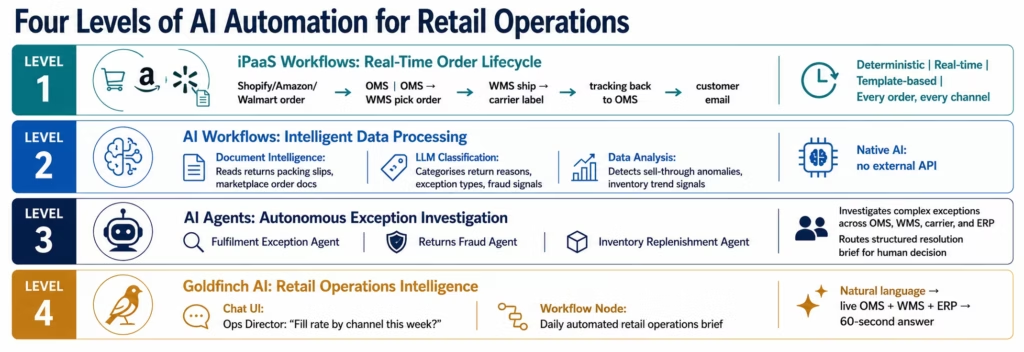
eZintegrations applies AI to retail data flows at all four automation levels:
Level 1 (iPaaS Workflows): deterministic, rule-based retail data flows. Shopify order placed → OMS order created → WMS pick order released → carrier label generated → tracking written back. These are the high-volume, consistent data flows that run automatically, every time, without exception. Template-based, go-live in days.
Level 2 (AI Workflows): AI nodes embedded in retail data pipelines. Document Intelligence reads return packing slips, marketplace order documents, and supplier invoices in variable formats. LLM Classification categorises return reasons into structured taxonomy (damaged, wrong item, sizing, preference change, suspected fraud). Data Analysis detects statistical anomalies in sell-through rates, inventory levels, and order patterns. These AI nodes run within existing integration pipelines: no separate AI platform.
Level 3 (AI Agents): autonomous exception investigation for complex retail cases. The Fulfilment Exception Agent investigates a failed delivery: retrieves the carrier event history, checks the customer address, assesses whether it is a carrier issue or address issue, and routes a resolution recommendation before the customer service team sees the complaint. The Returns Fraud Agent assembles evidence across the return history, the customer order history, and return item details to produce a structured fraud assessment.
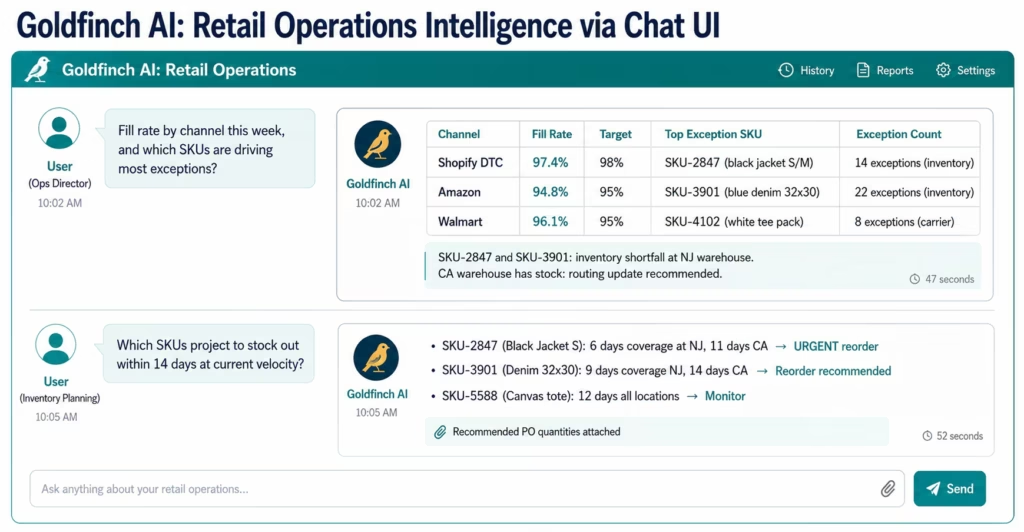
Level 4 (Goldfinch AI): multi-agent orchestration and executive intelligence. The Retail Operations Director asks the Chat UI: “What is our fill rate by channel this week and which SKUs are driving the most exceptions?” Goldfinch AI queries the OMS and WMS data via the Workflow Node and returns a formatted answer in under 60 seconds: without a data analyst building the report.
AI Workflow 1: Real-Time Order-to-Fulfilment
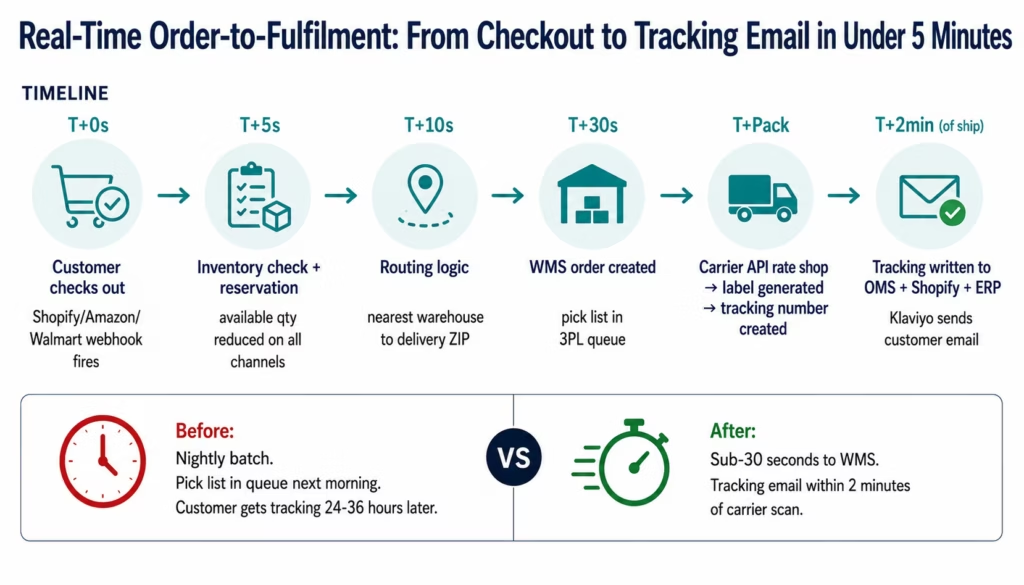
The order-to-fulfilment workflow is the commercial backbone of retail operations, consistent with McKinsey & Company research on retail operations automation. Every minute of latency between order capture and warehouse action is a minute of production throughput lost: and in competitive eCommerce, same-day or next-day ship commitment depends on sub-hour order-to-pick queue.
Elena’s current architecture turns a 9 PM Shopify order into a warehouse pick order the following morning: a 9-12 hour gap before the 3PL even knows the order exists. The AI workflow eliminates this gap entirely.
The Real-Time Order-to-Fulfilment Workflow:
Order capture (under 1 second): Shopify, Amazon SP-API, Walmart Seller API, and BigCommerce webhooks fire on every order event in real time. eZintegrations receives the order event and begins the fulfilment chain within seconds: not the next morning.
Inventory check and reservation (under 5 seconds): API Tool Call to the WMS retrieves real-time available inventory for each ordered SKU at each warehouse location. If the SKU is available, inventory is reserved immediately: reducing the available quantity shown to other channels. If inventory is unavailable at the primary fulfilment location, the routing logic checks secondary locations.
Routing logic (under 10 seconds): Data Analysis applies the routing rules: ship from the warehouse closest to the customer’s delivery ZIP code, subject to inventory availability. For orders with split-fulfilment requirements (some items at Location A, others at Location B), the workflow creates two warehouse orders and coordinates the tracking across both shipments.
WMS order creation (under 30 seconds): The warehouse order is created in the WMS (Manhattan Active WMS, Blue Yonder WMS, or your WMS via REST API). The pick list is in the 3PL’s queue within 30 seconds of the customer completing checkout. For a 9 PM Shopify order: the pick list is ready before the overnight shift begins processing.
Label generation and carrier selection (at pack confirmation): When the WMS confirms pack completion, the workflow calls the carrier API (UPS, FedEx, DHL) for rate shopping based on the customer’s service level selection and the warehouse’s current carrier availability. Label generated. Tracking number created.
Tracking propagation (under 2 minutes of ship): The tracking number is written back to: the OMS (for order status), the eCommerce platform (Shopify order updated), the ERP (for shipment confirmation), and the customer communication platform (Klaviyo triggers the tracking email). The customer receives the tracking email within 2 minutes of the carrier scan.
Total order-to-tracking time: under 5 minutes from carrier scan. Previously: 24-36 hours.
AI Workflow 2: Intelligent Inventory Synchronisation
Inventory accuracy is the single most operationally critical data quality challenge in retail, reflecting broader retail supply chain technology trends covered by SupplyChainBrain. An item that appears available but is actually sold out creates a negative customer experience: the cancelled order, the substitution, the delayed shipment. An item that appears out-of-stock but is actually available means a lost sale.
Elena’s current architecture has a 12-18 hour inventory sync lag between channels. This means her Amazon inventory availability is reflecting the stock position from yesterday, not the stock position after today’s Shopify sales. Oversell risk is persistent.
The Intelligent Inventory Synchronisation Workflow:
Real-time reservation on order: Every order event: regardless of the originating channel: immediately reduces the reserved inventory quantity for the ordered SKUs. This reservation happens at the WMS or ERP level (the single source of truth), not at the channel level. The inventory quantity that flows back to each channel always reflects the actual available-to-promise position.
Inventory broadcast on change: Every inventory movement event (goods receipt, pick confirmation, return receipt, inventory adjustment, inbound shipment confirmation) triggers an immediate inventory broadcast to all connected channels. If the WMS confirms receipt of 200 units of SKU-8821 at 2 PM, all channels are updated to reflect the new availability within 60 seconds: not at midnight.
LLM Classification for inventory anomalies: When the Data Analysis node detects an inventory quantity that is statistically inconsistent with expected movement patterns (a SKU whose inventory jumped by 300 units with no corresponding inbound receipt recorded, or a SKU whose inventory dropped by 150 units with no corresponding pick or adjustment), LLM Classification categorises the anomaly: likely system error, likely theft or shrinkage, likely duplicate receipt posting, or likely data entry error. The anomaly routes to the inventory control team with the classification and the specific data points that triggered the detection: not a raw data alert, but a structured investigation brief.
Multichannel inventory buffer management: For sellers on multiple channels, eZintegrations deploys configurable channel inventory buffers: reserving a percentage of total available inventory for each channel to prevent a single channel’s demand spike from causing an oversell event on another channel. When the buffer threshold for a channel is approached, an alert routes to the inventory planning team.
AI Workflow 3: AI-Powered Returns Processing
Returns are a structural cost of retail: particularly in eCommerce, where return rates run 15-30% for apparel and 10-15% for general merchandise. The financial impact is significant: the cost of processing a return (labour, shipping, restocking) typically runs $10-$25 per unit. The hidden cost is the delay in refund issuance: every day a returned item sits in the returns queue is a day the customer’s refund is outstanding and the inventory is unavailable for resale.
Elena’s returns process averages 3-5 business days from return arrival to customer refund. Industry leaders running automated returns processes complete the cycle in under 24 hours.
The AI-Powered Returns Processing Workflow:
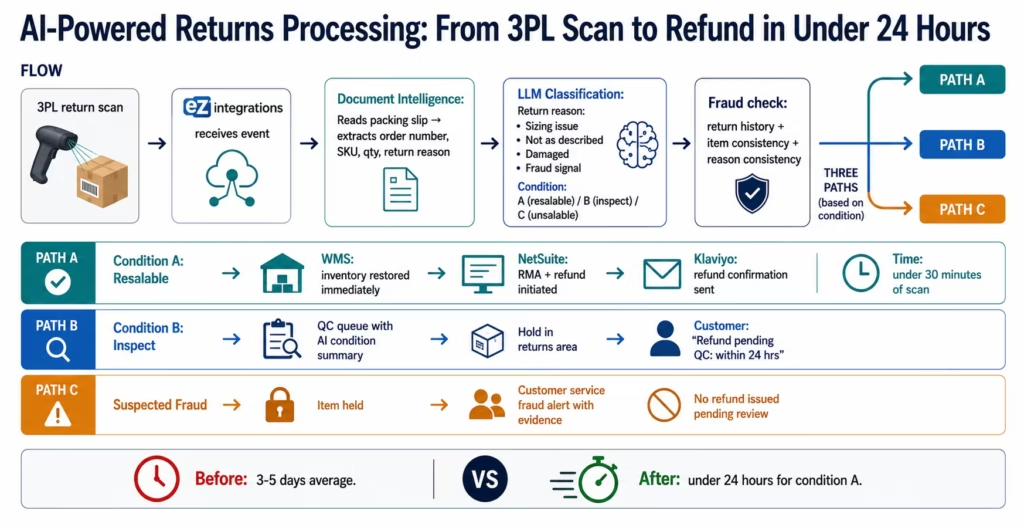
Return arrival and scan: When the 3PL scans the returned package, the scan event fires to eZintegrations via the WMS webhook or the returns management platform API.
Document Intelligence: packing slip and item reading: Document Intelligence reads the return packing slip (physical document photographed or scanned at the returns centre) or the digital return label data, extracting: the original order number, the customer information, the returned item details (SKU, quantity), and the customer-provided return reason.
LLM Classification: return reason and condition: LLM Classification processes the extracted return reason (both the structured reason code from the return portal and any free-text customer comments) and classifies:
- Return reason category: sizing/fit issue, product not as described, damaged on arrival, changed mind, wrong item received, suspected fraud
- Likely resalability: likely resalable (condition code A: return to stock immediately), needs inspection (condition code B: QC review before restock), likely unsalable (condition code C: refurbish or liquidate)
- Fraud signal: is there a pattern that suggests fraudulent return behaviour? (The item returned is inconsistent with what was ordered, the customer has an elevated return rate, the return reason is inconsistent across multiple returns from the same account)
Automated downstream actions (based on classification):
- Condition A: inventory immediately added back to available stock in the WMS and broadcast to all channels
- Condition B: item routed to QC queue with the AI classification summary
- Suspected fraud: item held, alert routed to customer service fraud team with the evidence summary
- For all non-fraud returns: NetSuite return merchandise authorisation (RMA) created and refund initiated automatically
Customer notification: Klaviyo (or your customer communication platform) receives the return processed event and sends the customer a refund confirmation email: within minutes of the return scan, not days later.
Returns analytics: Every processed return feeds the returns intelligence Data Analysis node: tracking return rates by SKU, return reason distribution by product category, and the correlation between return rate and product description accuracy. High return rate SKUs with concentrated “not as described” reason codes flag a product content problem, not a product quality problem: the buyer sees a structured returns intelligence report rather than a raw return rate.
AI Workflow 4: Demand Signal Intelligence
Retail demand signals arrive from multiple sources: POS sell-through data, eCommerce order velocity, wholesale replenishment orders, and distributor depletion reports. Most retail buyers review these signals on a weekly planning cycle. In fast-moving categories (trend apparel, seasonal goods, viral products), a week is too long: a sell-through acceleration that starts Monday and is reviewed the following Monday has already left the buyer 7 days behind the demand curve.
The Demand Signal Intelligence Workflow:
Continuous signal ingestion: eZintegrations ingests demand signals continuously from all sources: Shopify order events, Amazon SP-API sell-through reports, wholesale distributor EDI 852 (product activity data) feeds, and POS systems. Each signal is processed as it arrives: not batched.
Data Analysis: statistical anomaly detection: For every SKU and every channel, Data Analysis maintains a rolling baseline of expected daily order velocity (seasonal-adjusted). When incoming demand velocity deviates from the baseline by more than the configured threshold: upward (demand acceleration) or downward (demand deceleration): the anomaly is flagged.
The statistical methodology matters: a single day’s data can be noise; a 3-day trend is a signal. Data Analysis applies the appropriate statistical test based on the product’s velocity tier (high-velocity SKUs use tighter thresholds; slow-moving SKUs use wider thresholds to avoid false positives).
LLM Classification: signal type identification: When an anomaly is detected, LLM Classification analyses the context: is this demand signal consistent with a promotional event on the calendar? Is it consistent with known seasonal patterns? Is it isolated to one channel or consistent across all channels? This classification determines the urgency and routing of the signal alert.
Classification categories:
- Known promotional lift: demand is elevated, consistent with a scheduled promotion: no action needed
- Suspected unplanned event: demand elevated, no promotion on calendar: may be organic virality, PR pickup, or competitive event: alert to buyer
- Demand deceleration: sell-through is below baseline: alert to buyer and inventory planning for potential markdown risk
- Data quality issue: demand signal is inconsistent with other data sources, likely a data feed error: alert to data operations team
Buyer routing: The buyer receives a structured demand intelligence alert: the SKU, the channel, the current sell-through rate versus baseline, the projected inventory coverage at current velocity (how many days until stockout?), and the signal classification. The buyer responds to an alert with full context: not to a raw data dump that requires interpretation.
AI Workflow 5: Omnichannel Inventory Routing
For retail brands selling across DTC, marketplace, wholesale, and physical retail channels, inventory allocation is a continuous optimisation challenge. A product available in the NJ warehouse might be the ideal fulfilment source for an Amazon order (lower freight cost, faster delivery) or the ideal backup for the LA store (lower transfer cost than the CA warehouse). Making these routing decisions optimally, at order-event speed, requires automated intelligence.
The Omnichannel Inventory Routing Workflow:
Available-to-promise (ATP) calculation at order receipt: When an order is received, the routing workflow calculates the available-to-promise position for each ordered SKU across all fulfilment nodes: the NJ warehouse, the CA warehouse, the 3PL depot, and any in-store inventory available for ship-from-store. This calculation happens in real time: not from a cached ATP snapshot.
Routing rule engine: Data Analysis applies the configured routing priority rules:
- Fulfil from the warehouse with sufficient inventory that minimises the transit time to the delivery ZIP
- Within equivalent transit times, fulfil from the warehouse with the highest days-of-supply for this SKU (preserving inventory at nodes where the SKU is more likely to stock out)
- For split-inventory orders: minimise the number of shipments (consolidate to one location if possible)
- For ship-from-store: apply only when the store’s inventory exceeds the configured minimum floor threshold
Dynamic allocation for promotional events: When a promotional event is scheduled (flash sale, site-wide discount, email campaign), the workflow pre-stages inventory allocation across fulfilment nodes based on predicted demand by ZIP code: so when the campaign launches and order velocity spikes, the routing decisions are already pre-calculated rather than being computed under load.
Channel inventory rebalancing: When the Data Analysis node detects inventory concentration risk (too much inventory at one node, too little at another, based on current demand patterns by geography), it routes a structured rebalancing recommendation to the inventory planning team: which SKUs to transfer, from which node, to which node, and the estimated fulfilment improvement from the rebalance.
Level 3 AI Agents for Complex Retail Exceptions
Level 2 AI Workflows handle the processing layer: reading, classifying, and routing retail data through intelligent pipelines. Level 3 AI Agents handle the investigation layer: complex retail exceptions where the root cause requires assembling evidence from multiple systems before a human decision is needed.
Fulfilment Exception Agent:
When a customer reports a delivery failure (not delivered, damaged, wrong item), or when the carrier tracking shows an exception event (delivery attempted, address issue, returned to sender):
- API Tool Call (carrier): retrieves the full carrier event timeline: every scan, every status update, the delivery attempt details, and the agent notes.
- API Tool Call (OMS): retrieves the order record: the delivery address as entered, any address validation result at time of order, and the customer’s delivery instructions.
- API Tool Call (WMS): retrieves the pick and pack record: was the right item picked? Does the packed weight match the expected weight for the ordered items?
- Data Analysis: determines the exception root cause category: carrier delivery failure, address problem, incorrect item packed, or damaged in transit.
The customer service team receives a structured exception brief with the root cause category, the carrier event timeline, and the recommended resolution (reship, refund, carrier claim). Resolution decision time: 2 minutes from a complete brief versus 20 minutes of system-by-system investigation.
Returns Fraud Investigation Agent:
When the LLM Classification in the returns workflow flags a suspected fraud signal, the Returns Fraud Agent investigates:
- API Tool Call (OMS order history): retrieves the customer’s full order and return history: what was ordered, what was returned, and the return reason codes.
- Document Intelligence: reads any product photos submitted with the return (if the returns platform captures photos) and the item details from the original packing slip.
- Knowledge Base Vector Search: searches the fraud pattern knowledge base for similar cases: what return patterns have been identified as fraudulent in the past?
- Data Analysis: calculates the customer’s return rate, the financial value at risk, and the pattern match score against known fraud indicators.
The fraud review team receives a structured case brief with the evidence summary, the risk score, and the recommended action (approve refund, hold pending investigation, flag account). The analyst reviews in 5 minutes versus 30 minutes of manual investigation.
Level 4: Goldfinch AI for Retail Operations Intelligence
Goldfinch AI gives retail operations leadership natural language access to live order, inventory, and fulfilment data: without building reports or waiting for the weekly operations review.
Retail Operations Director: Monday morning: “What is our fill rate by channel this week, and which SKUs are driving the most exceptions?”
Goldfinch AI queries the OMS and WMS data via the Workflow Node, calculates fill rates by channel, identifies the SKU-level exception drivers, and returns a structured operational brief in under 60 seconds. The Director walks into the Monday morning review prepared, not waiting for the operations analyst to pull the data.
Head of Inventory Planning: “Which SKUs are projected to stock out within 14 days at current sell-through rates, and what are the reorder quantities?”
Goldfinch AI queries the WMS inventory positions, applies the current sell-through velocity from the OMS, calculates the projected stock-out date by SKU and warehouse, and returns a prioritised reorder list in under 60 seconds.
Merchandise Buyer: “What is the sell-through rate for the new spring collection SKUs this week versus the first week of last year’s spring collection?”
Goldfinch AI queries the OMS sell-through data for the current collection and the prior-year comparison period, calculates the sell-through rate by SKU, and returns the year-over-year comparison table in under 60 seconds.
VP of eCommerce: “What is our Amazon fill rate and on-time shipping compliance this month: are we at risk of any performance penalties?”
Goldfinch AI queries the Amazon SP-API fulfilment performance data and the OMS fulfilment records, calculates fill rate and on-time shipping compliance, flags any metrics approaching Amazon’s Late Shipment Rate or Order Defect Rate penalty thresholds, and returns the compliance dashboard in under 60 seconds.
Key Outcomes and Results
Retail organisations deploying AI workflows across order-to-fulfilment, inventory synchronisation, returns processing, and demand signal intelligence report measurable improvements within 30-60 days:
Order Fulfilment:
- Order-to-WMS latency: 8-18 hours (batch) → under 30 seconds (real-time webhook)
- Customer tracking email: 24-36 hours → under 5 minutes of carrier scan
- Oversell incident rate: reduced by 70-90% through real-time inventory reservation
- Pick queue during overnight hours: orders queued immediately, pick begins at shift start
Inventory:
- Inventory sync lag across channels: 12-18 hours → under 60 seconds
- Inventory accuracy rate: improved through real-time movement event broadcasting
- Out-of-stock customer experience: 30-40% reduction (Gartner benchmark)
- Inventory anomaly detection: periodic audit → continuous automated monitoring
Returns:
- Returns processing cycle: 3-5 business days → under 24 hours for standard returns
- Returns data entry: manual, error-prone → automated Document Intelligence extraction
- Returns fraud detection: manual review → automated LLM fraud signal classification
- Refund-to-customer time: improved by 60-80% for clean condition-A returns
Demand Signals:
- Demand anomaly detection: weekly planning review → same-day signal routing
- Buyer reaction time to demand shift: 5-7 days → same day
- Promotional demand prep: real-time ATP calculation pre-staged for campaign launch
Operations Intelligence:
- Fill rate visibility: weekly report → real-time Chat UI query
- Stock-out risk by SKU: weekly inventory review → continuous projection
- Channel performance compliance: monthly review → real-time Goldfinch AI query
How to Get Started
Step 1: Map your highest-latency order lifecycle touchpoints
Walk through your current order-to-fulfilment flow and mark every manual step, every batch sync, and every email handoff. Calculate the total time from order placed to warehouse aware. Calculate the time from return scan to customer refund. The steps with the most latency and the most manual handling are your first AI workflow targets.
Step 2: Connect your eCommerce and fulfilment systems
The real-time order-to-fulfilment workflow requires live webhook connections from your eCommerce platforms (Shopify, Amazon, Walmart) and live API access to your WMS and OMS. The Automation Hub templates include pre-configured connectors for: Shopify Plus (native webhook), Amazon SP-API, Walmart Seller API, Manhattan Active WMS, Blue Yonder WMS, NetSuite OMS/ERP, and all major carrier APIs (UPS, FedEx, DHL). For on-premises WMS systems, eZintegrations connects via IPSec Tunnel.
Step 3: Import the retail AI workflow template from the Automation Hub
Visit the Automation Hub and filter by Retail AI Workflows. Import the template for your target use case (order fulfilment, inventory sync, returns processing, or demand signal). Configure the field mappings for your specific OMS and WMS data models.
Step 4: Configure AI thresholds for your business
Set the inventory anomaly detection thresholds for your typical inventory movement patterns. Configure the return reason classification taxonomy to match your returns management system’s categories. Set the demand signal anomaly threshold appropriate for your velocity tier (fast-moving categories need tighter thresholds; slow-moving need wider). Configure the fraud signal criteria based on your historical returns fraud patterns.
Step 5: Activate in parallel with existing processes
Run the AI workflow alongside your existing batch process for two weeks. Compare the real-time AI workflow outputs against the batch process outputs for the same orders. Validate that every order routes correctly, every inventory reservation fires accurately, and every exception classifies appropriately. Then cut over and decommission the batch process.
Import a retail AI workflow template from the Automation Hub and have your first retail AI workflow live this week.
Frequently Asked Questions
Retail AI workflows embed AI nodes including Document Intelligence, LLM Classification, and Data Analysis inside data pipeline workflows connecting eCommerce platforms, OMS, WMS, ERP, and carrier systems. When a Shopify order is placed, a real-time webhook fires and triggers the fulfilment chain including inventory reservation, WMS order creation, carrier label generation, and tracking notification within seconds without manual touchpoints. When a return is scanned, Document Intelligence reads the packing slip, LLM Classification assigns the condition and fraud signal, and the workflow automatically creates the ERP return record and initiates the refund. All AI inference runs natively within eZintegrations and no retail order data is sent to external AI providers. eZintegrations is SOC 2 Type II certified. For retail operations with EU customer data, GDPR compliance applies to all customer data processed through eZintegrations workflows.
Standard Automation Hub retail AI workflow templates go live in 3-7 days for the core order-to-fulfilment flow. eCommerce webhook configuration takes approximately 1 day, WMS API connection 1-2 days, carrier API connection 1 day, field mapping review 1 day, and parallel validation 2-3 days. The returns AI workflow adds 3-5 days for returns platform connection and LLM classification threshold calibration. A full retail AI workflow programme including order fulfilment, inventory sync, returns, and demand signal processing typically deploys in 3-4 weeks. No custom development is required.
Yes, Shopify uses native webhook integration for all order lifecycle events including created, fulfilled, cancelled, and refunded with OAuth 2.0 maintained by eZintegrations. Amazon uses SP-API integration covering orders, inventory, FBA and FBM, and reports. Walmart Marketplace integration supports orders, inventory, and fulfilment via the Seller API. Supported WMS platforms include Manhattan Active WMS via REST API, Blue Yonder WMS via REST API, SAP EWM via OData V4, Oracle WMS Cloud via REST API, 3PL Central via REST API, Shipbob, and ShipHero. Carrier integrations include UPS Shipping, Tracking and Rating APIs, FedEx Ship, Track and Rate APIs, and DHL Express plus eCommerce APIs. For on-premises WMS deployments, eZintegrations connects via IPSec Tunnel.
The LLM Classification in the returns workflow produces a fraud signal score including low, medium, or high based on pattern matching across the customer's return history, consistency between the returned item description and what was ordered, return reason consistency across multiple returns from the same account, and the financial value of the return relative to order history. Medium and high fraud signals route to the fraud review team for human decision. The workflow does not automatically deny refunds. The fraud team reviews the AI-assembled evidence brief and makes the authorisation decision. Low fraud signal returns process automatically. This design keeps false positive rates low while surfacing the cases that warrant human review.
Level 2 AI Workflows handle high-volume consistent retail data inputs with AI at specific predetermined steps. For example: a return is scanned, Document Intelligence extracts the data, LLM Classification assigns condition, and the refund is initiated. The sequence is fixed. Level 3 AI Agents handle complex retail exceptions requiring adaptive investigation. The Fulfilment Exception Agent receives a failed delivery and decides which systems to query based on what it finds including carrier event timeline, OMS address record, and WMS pick confirmation to determine root cause. Workflows are best for high-volume consistent processing while agents are best for complex exception investigation.
Yes, eZintegrations maintains a single inventory truth layer from your WMS or ERP and broadcasts inventory changes to all connected channels in real time. When an order is received from any channel including Shopify DTC, Amazon, Walmart, or B2B wholesale, inventory is reserved immediately and the updated availability is broadcast to all other channels within 60 seconds. Channel inventory buffers are configurable to prevent a single channel's demand spike from generating oversells on other channels. The routing logic applies the same available-to-promise calculation across all channels simultaneously, routing each order to the optimal fulfilment node based on configured rules. 1. How does AI workflow automation work in retail operations?
2. How long does it take to set up retail AI workflows?
3. Does eZintegrations work with Shopify, Amazon, Walmart, and major WMS platforms?
4. How does the returns AI workflow detect fraud without blocking legitimate returns?
5. What is the difference between Level 2 AI Workflows and Level 3 AI Agents for retail?
6. Can eZintegrations handle omnichannel retail with both DTC and marketplace channels simultaneously?
Conclusion: Retail Operations That Run at Ecommerce Speed
Elena’s 36-hour order-to-tracking cycle is a 2019 problem. The technology to close it existed then. The AI workflow templates to deploy it in days exist now.
The order placed at 9 PM should have a pick list in the warehouse before the overnight shift starts. The return scanned Monday morning should trigger the customer’s refund notification before noon. The demand spike detected Tuesday should reach the buyer before end of day Tuesday: not the following Monday’s planning review.
eZintegrations delivers the complete retail AI workflow stack: Level 1 iPaaS for deterministic real-time order flows, Level 2 AI Workflows for intelligent returns processing and demand signal intelligence, Level 3 AI Agents for complex exception investigation, and Level 4 Goldfinch AI for operations director and buyer intelligence via Chat UI. Pre-built templates for Shopify, Amazon, Walmart, Manhattan, Blue Yonder, NetSuite, UPS, FedEx, and 30+ more retail systems.
Import a retail AI workflow template from the Automation Hub and have your first retail AI workflow live this week.
Book a free demo and bring your current order-to-fulfilment architecture. We will show you what real-time retail operations looks like for your specific eCommerce and fulfilment stack.