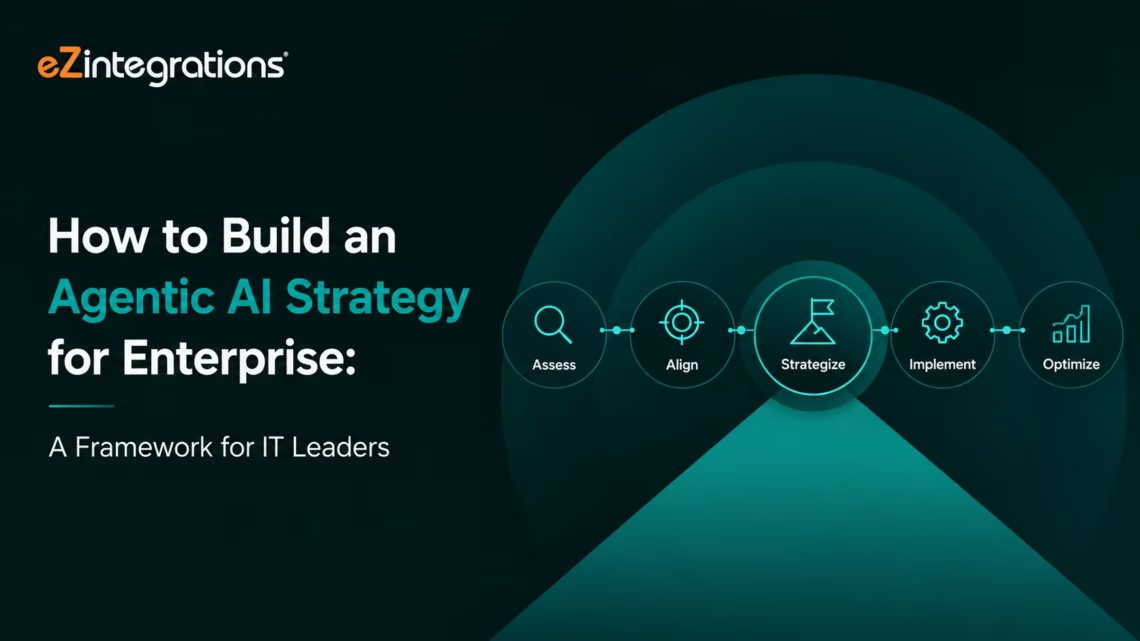
How to Build an Agentic AI Strategy for Enterprise: A Framework for IT Leaders
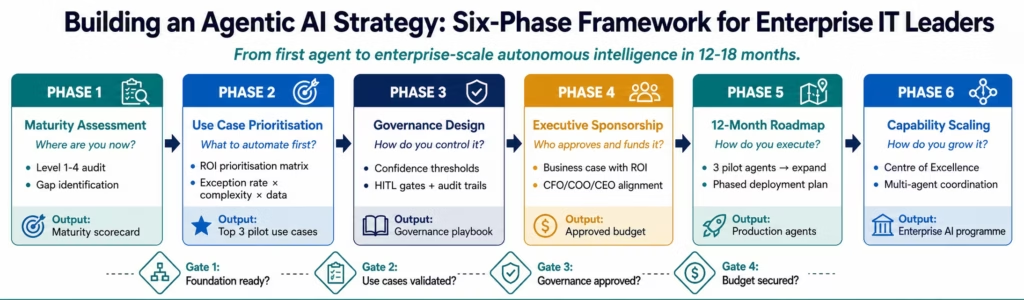
May 18, 2026To build an enterprise agentic AI strategy, work through six phases: assess your current automation maturity across the four levels (Level 1 iPaaS through Level 4 multi-agent), identify the highest-ROI agentic AI use cases using the prioritisation matrix (exception rate times decision complexity times data availability), establish your governance framework (confidence thresholds, human-in-the-loop gates, audit trails), secure executive sponsorship with a quantified business case, execute a phased 12-month roadmap starting with three pilot agents, and build the data infrastructure that all agentic AI depends on. Most enterprise IT leaders who follow this framework have their first agentic AI agent in production within 90 days.
TL;DR
- Agentic AI is not a product you buy. It is a capability layer you build, on top of your integration infrastructure, on top of your data quality, on top of your automation maturity, aligned with Gartner AI strategy and agentic AI market research. IT leaders who try to deploy agentic AI before these foundations are in place consistently fail.
- This framework has six phases: maturity assessment, use case prioritisation, governance design, executive sponsorship, phased implementation, and capability expansion. Each phase has specific outputs and decisions.
- The most common strategic mistake: treating agentic AI as an IT project rather than a business capability transformation. Agentic AI that the COO does not understand and the CFO has not approved a budget for does not survive the first incident review.
- eZintegrations delivers agentic AI across four levels: Level 1 (iPaaS Workflows), Level 2 (AI Workflows), Level 3 (AI Agents with 9 native tools), and Level 4 (Goldfinch AI multi-agent with Chat UI and Workflow Node). This guide is platform-agnostic in principle but uses eZintegrations as the reference implementation.
- Time to first production agent: 60-90 days using this framework. Time to enterprise-scale agentic AI programme: 12-18 months, consistent with McKinsey & Company State of AI enterprise adoption research.
Before You Start: Who This Framework Is For
This framework is for enterprise IT leaders who are responsible for automation and AI strategy at the platform level: CIOs, CTOs, IT directors, and enterprise architects at mid-market to large enterprises (200-5,000 employees).
It is not a framework for deploying a specific AI tool. It is a framework for making the strategic decisions that determine whether your organisation’s agentic AI investment delivers sustained business value or becomes an expensive experiment that gets cancelled after the first incident, reflecting trends identified in Deloitte enterprise AI technology strategy research.
You are ready for this framework if: – Your organisation already has Level 1 automation (some rule-based integrations connecting your core systems) – At least one business function (finance, procurement, HR, operations) has expressed a need for AI-assisted decision support – You have a budget conversation with the CFO or COO within the next quarter
You are not yet ready if: – Your core systems (ERP, CRM, HRIS) have no integration and no reliable data flows between them – Data quality in your primary ERP is known to be poor (the AI will inherit every data quality problem) – You have no human-in-the-loop processes for exception handling (agentic AI amplifies existing processes; it does not fix broken ones)
Understanding the Four Levels of Enterprise Automation Maturity
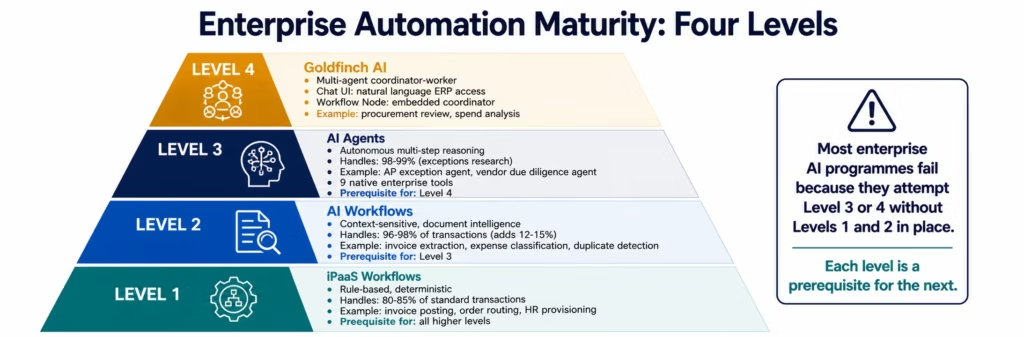
Before building an agentic AI strategy, map where your organisation sits on the four-level automation maturity model. Agentic AI (Level 3 and Level 4) requires Levels 1 and 2 as foundations. Skipping levels is the most common reason agentic AI programmes fail.
Level 1: iPaaS Workflows (Rule-Based Integration)
Systems talk to each other through rule-based triggers and actions. When a new order is created in Salesforce, it automatically creates a sales order in SAP. When an employee is added to Workday, the provisioning workflow fires. Deterministic, reliable, fast.
What this looks like in production: invoice processing runs automatically for the 80-85% of standard invoices. Order management routes standard orders without human touch. HR provisioning happens in 15 minutes instead of 2 days.
What it cannot do: handle exceptions, interpret documents in unfamiliar formats, make context-dependent decisions, or adapt when the data does not match the rule.
Level 2: AI Workflows (Context-Sensitive Automation)
AI reasoning steps are added to Level 1 workflows. Document Intelligence extracts invoice data from any vendor template, not just pre-mapped ones. LLM classification routes expense reports by policy compliance, not just by amount threshold. Semantic duplicate detection catches invoice resubmissions that share amounts but have different invoice numbers.
What this looks like in production: exception rate drops from 15-20% to 2-4%. The rule-based automation handles 96-98% of transactions. The remaining 2-4% are genuinely complex.
What it cannot do: autonomously research exceptions across multiple systems, make multi-step decisions without a predetermined path, or adapt its approach based on what it finds mid-process.
Level 3: AI Agents (Autonomous Multi-Step Reasoning), aligned with Intelligent agent frameworks.
Agents receive a goal, determine their own tool sequence, execute across multiple systems, evaluate results, retry if needed, and escalate only when confidence is below threshold. The AP Exception Agent retrieves the PO, checks the GR, searches the vendor contract, classifies the discrepancy, drafts a vendor query, and packages everything for one-click human approval. Autonomously.
What this looks like in production: 70-85% of the 2-4% residual exception rate is handled autonomously. Human AP manager spends 8 minutes on a packaged recommendation instead of 38 minutes on raw research.
What it cannot do: coordinate multiple specialised agents simultaneously, provide natural language analytics access to the CFO, or orchestrate complex multi-department processes involving parallel agent workstreams.
Level 4: Goldfinch AI (Multi-Agent Orchestration)
A coordinator agent decomposes complex enterprise tasks and assigns them to specialised worker agents running in parallel. The Chat UI gives the CFO or COO natural language access to live enterprise data (“what is our accounts payable aging by vendor tier this week?”). The Workflow Node embeds coordinator intelligence inside Level 1 automation processes.
What this looks like in production: a procurement review that previously required three analysts from three departments compiling data over two days is completed in 15 minutes by three specialised agents coordinated by a Goldfinch AI coordinator. The CPO asks the Chat UI for the analysis and receives it with supporting charts.
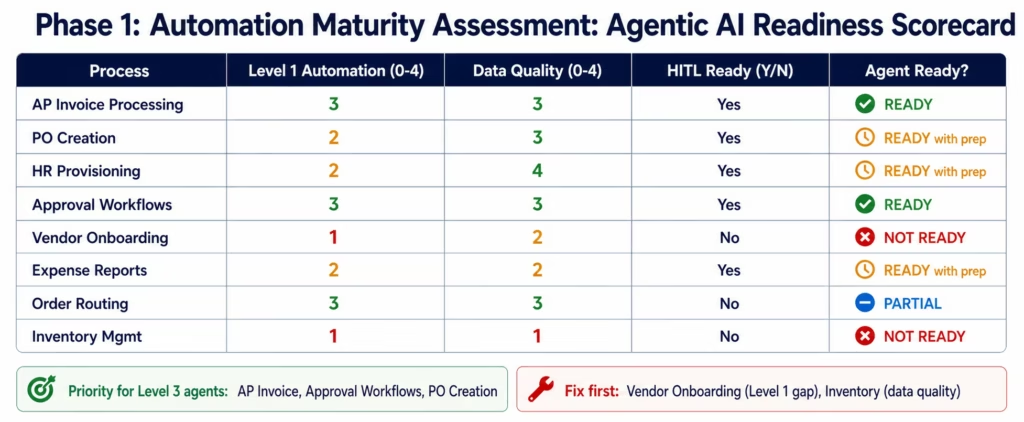
Phase 1: Assess Your Current Automation Maturity
What you will do: conduct a structured maturity assessment across all four automation levels to identify your current position and the gaps to address before deploying agentic AI.
Step 1a: Audit Level 1 (Integration) Coverage
For each core business process (AP, AR, order management, procurement, HR provisioning, inventory, customer data), answer: – Does this process have automated integration between its primary systems? – What percentage of transactions run without manual intervention? – What is the current exception rate?
Score each process 0-4: – 0: fully manual, no automation – 1: partial automation with significant manual exceptions – 2: majority automated, manageable exception queue – 3: high automation (90%+), low exception rate – 4: near-full automation with AI-enhanced exception handling
Target before Level 3 deployment: your three highest-priority processes should score 2 or above. A process that is still largely manual (score 0-1) will generate so many exceptions that even a Level 3 agent cannot handle the volume. Fix the Level 1 automation first.
Step 1b: Audit Data Quality
Agentic AI inherits your data quality. An AI agent that queries SAP for PO data and receives inconsistent, incomplete, or stale records cannot make reliable recommendations. Data quality gates:
- Vendor master completeness: what percentage of vendor records have all required fields (name, tax ID, payment terms, contact)?
- PO completeness: what percentage of POs have line items, quantities, and pricing populated?
- GR posting latency: how current is the goods receipt data? Is there a lag between physical receipt and GR posting?
- Cross-system consistency: does the vendor name in SAP match the vendor name in your CRM and payment system?
Target: 95%+ field completeness on the records the agent will query. Resolve critical data quality issues before deploying agents.
Step 1c: Identify Human-in-the-Loop Processes
Map which business processes currently have a human decision point for exceptions. These are your Level 3 agent candidates. A process with no existing human decision point (everything is automated or everything is manual with no escalation structure) is not ready for agentic AI.
Output of Phase 1: a maturity scorecard covering Level 1 integration coverage (by process), data quality rating (by system), and HITL process inventory.
Phase 2: Identify and Prioritise Agentic AI Use Cases
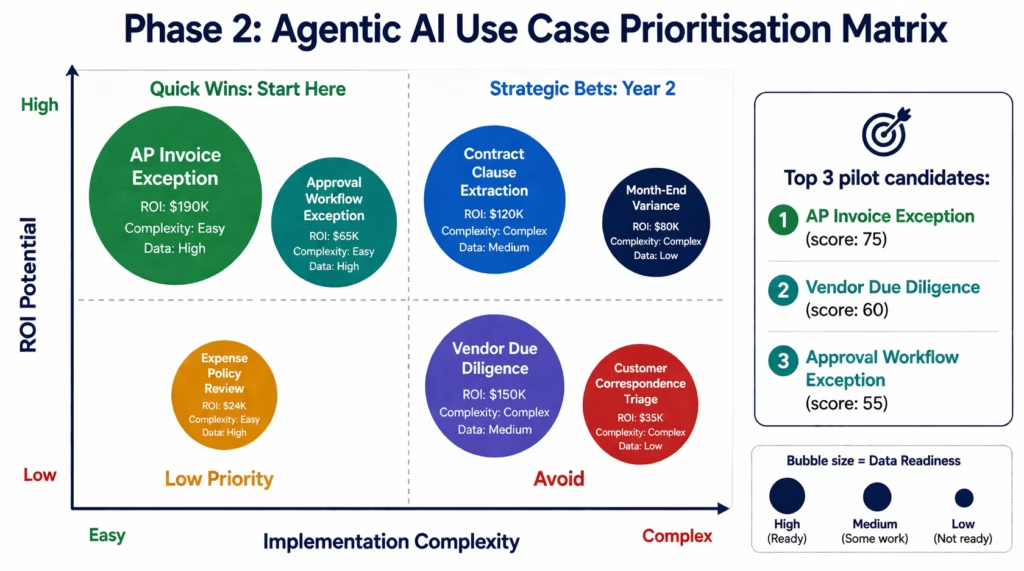
What you will do: identify all candidate agentic AI use cases and select the top three for your pilot programme using a structured prioritisation matrix.
Step 2a: Generate the Use Case Inventory
Work with each business function to identify processes that have all three of these characteristics:
High exception rate (above 8%): the process already generates significant manual exception handling. Agentic AI eliminates the exception queue. If the exception rate is below 8%, the ROI opportunity is smaller.
Variable decision requirements: the decision cannot be captured in a fixed rule because it depends on context gathered from multiple sources. If the correct action is always the same given the same data, Level 1 is sufficient.
Available data for agent retrieval: the agent must be able to get the context it needs from accessible systems. If the required data is in a system with no API, a paper archive, or a system your organisation does not control, the agent cannot retrieve it reliably.
Common high-priority use cases across enterprise departments:
Finance: – AP invoice exception handling (exception rate: 15-20%) – Expense report policy compliance review (18-28%) – Contract clause extraction and comparison (fully manual) – Month-end variance investigation (fully manual)
Procurement: – Vendor due diligence and onboarding screening (fully manual) – Purchase requisition to vendor matching (high manual effort) – Contract renewal risk assessment (fully manual) – Supplier performance review compilation (fully manual)
HR/IT: – Employee onboarding complexity cases (new hires with non-standard requirements) – Offboarding access verification (compliance-critical) – IT incident root cause research (correlation across systems)
Operations: – Order exception and fulfilment delay research (15-25%) – Customer complaint investigation and root cause (fully manual) – 3PL discrepancy resolution (exception rate: 10-18%)
Step 2b: Apply the Prioritisation Matrix
Score each candidate use case on three dimensions:
ROI potential (1-5): estimated annual saving if the exception queue is eliminated. Use the AI workflow automation ROI framework to calculate. Score 5 = above $200K/year potential, Score 1 = below $30K/year.
Implementation complexity (1-5, higher = easier): how straightforward is the agent to build? Score 5 = clear goal, 2-3 data sources with good APIs, established HITL process. Score 1 = ambiguous goal, many data sources with poor APIs, no existing HITL process.
Data readiness (1-5): how complete and accessible is the data the agent needs? Score 5 = all required data in systems with native connectors, 95%+ completeness. Score 1 = data in unstructured sources, poor quality, or restricted access.
Priority score = ROI × Implementation Complexity × Data Readiness
Top 3 use cases by priority score become your pilot programme.
Phase 3: Design Your Governance Framework
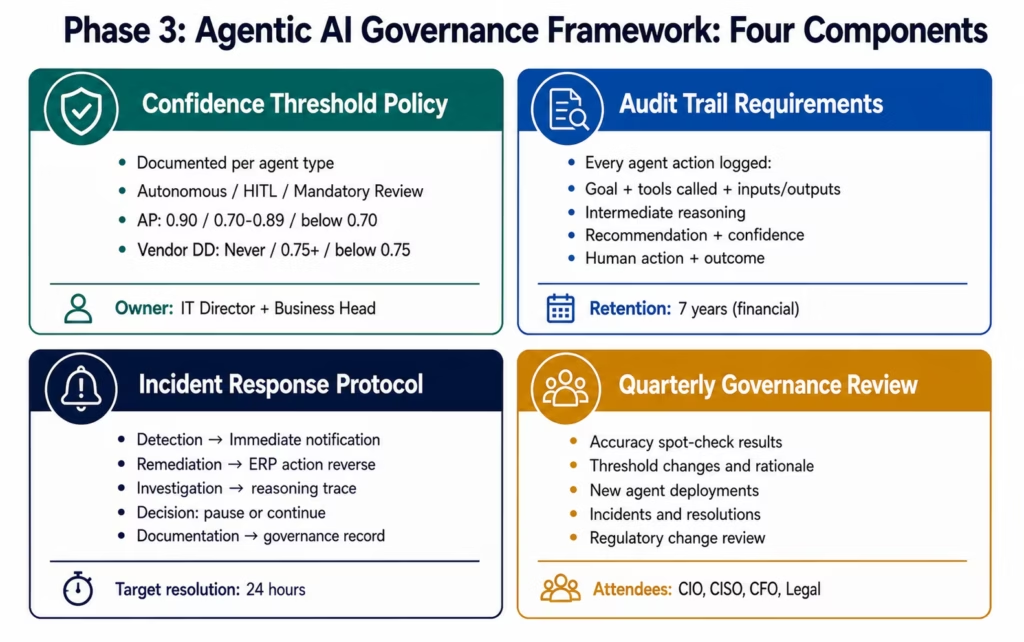
What you will do: design the governance structure that controls how agentic AI agents operate, make decisions, and are supervised: before the first agent goes live.
Governance is the most commonly skipped phase in enterprise AI deployments. Organisations that skip it face: an agent incident that generates a board-level review and programme cancellation, regulatory findings when an auditor discovers AI decisions were made without documented controls, and employee trust issues when the AI acts in ways that business users did not expect or sanction.
Step 3a: Confidence Threshold Policy
Every agent in your programme must have a documented confidence threshold policy. For each agent type, document: – Autonomous action threshold (minimum confidence for agent to act without human review) – Human-in-the-loop threshold (confidence range that routes to named reviewer) – Mandatory human review threshold (cases that always require human review regardless of confidence)
Recommended governance policy template:
| Agent Type | Autonomous Threshold | HITL Threshold | Mandatory Review |
|---|---|---|---|
| AP Invoice Exception | 0.90 | 0.70-0.89 | Below 0.70 |
| Vendor Due Diligence | Never (always HITL) | 0.75+ (expedited) | Below 0.75 |
| Procurement Matching | 0.88 | 0.65-0.87 | Below 0.65 |
| Contract Review | Never (always legal) | N/A | Always |
Step 3b: Audit Trail Requirements
Every agent action must be logged with: – The goal the agent received – The tools called, in order, with inputs and outputs – The intermediate reasoning at each step – The final recommendation and confidence score – The human action taken (if HITL: approved/rejected/modified) – The outcome (what actually happened in the downstream system)
This audit trail serves three purposes: debugging when the agent makes an unexpected decision, regulatory compliance (GDPR Article 22 requires meaningful information about automated decision-making, HIPAA requires audit trails for any AI-assisted decisions involving protected health information, and SOC 2 Type II auditors require evidence of controlled, monitored AI decision-making), and accuracy monitoring (the spot-check process uses the audit trail).
Step 3c: Incident Response Protocol
Define before going live what happens when an agent makes an incorrect autonomous action. The protocol must include: – Who is notified immediately (agent owner, IT director, business function head) – What the immediate remediation action is (reverse the ERP action if possible, manual review of affected records) – What the investigation process covers (reasoning trace review, data quality check, threshold review) – What the decision criteria are for pausing vs continuing the agent – How the incident is documented for future governance review
Step 3d: Quarterly Governance Review
Establish a quarterly review process covering: accuracy spot-check results for the past quarter, threshold changes made and rationale, new agent deployments and their governance documentation, incidents and resolutions, and regulatory or compliance changes that affect agent operation.
Output of Phase 3: a governance playbook covering confidence threshold policy, audit trail requirements, incident response protocol, and quarterly review structure. This document is what you present to the CISO, the legal team, and the board audit committee.
Phase 4: Secure Executive Sponsorship
What you will do: build and present the executive business case that secures budget approval and CXO sponsorship before beginning implementation.
Step 4a: The Business Case Structure
The agentic AI business case has five components. Present them in this order: the order of financial logic:
1. The current exception queue cost. Pull actual operational data: exception volume, resolution time, FTE cost per hour. This is your baseline.
2. The agentic AI benefit. Apply the AI workflow automation ROI framework: exception rate reduction (15-20% to 2-4% with Level 2, then 2-4% to 0.5-1% with Level 3 agents), resolution time reduction (38 minutes to 8 minutes per remaining exception), and the annual net benefit calculation.
3. The investment required. Platform cost (eZintegrations Level 3 at $120/month per agent automation), implementation effort (2-5 days per agent using Automation Hub templates), and governance overhead (quarterly review time).
4. The payback period. Year-1 investment divided by monthly net benefit. For most mid-market finance operations deployments: 2-6 weeks.
5. The strategic value. Frame agentic AI as the prerequisite for the Level 4 multi-agent capabilities that enable natural language analytics (the CFO asking the Chat UI operational questions directly) and complex multi-department process orchestration (the COO coordinating procurement, finance, and operations agents for a strategic decision).
Step 4b: The Sponsorship Structure
Every successful enterprise agentic AI programme has three sponsors:
Executive sponsor (CEO or COO): provides organisational authority and removes political obstacles. Makes the case that agentic AI is a strategic priority, not an IT project.
Budget sponsor (CFO): approves the investment based on the ROI calculation. Receives the payback period and 3-year net benefit. Authorises the OpEx budget for the platform.
Technical sponsor (CIO or IT Director): accountable for implementation, governance, and security. Presents the governance framework to the board audit committee.
Without all three, the programme is vulnerable: to budget cuts when the CFO does not understand the investment, to implementation stalls when IT is not resourced, and to organisational resistance when the COO has not been brought along.
Step 4c: The Board Presentation Framework
For board-level approval, frame the agentic AI strategy as three connected arguments:
Efficiency argument (for CFO): current exception handling costs $X/month across Y processes. Agentic AI reduces this to $Z/month. Payback period: N weeks. 3-year net benefit: $M.
Competitive argument (for CEO): companies with integrated data infrastructure and operational agentic AI are achieving N% faster cycle times, N% higher early payment discount capture, and N% lower procurement cost than companies still running manual exceptions. Each year of delay widens this gap.
Risk argument (for board/CISO): manual exception handling creates compliance exposure (undocumented decisions, inconsistent policy application, access control gaps). Agentic AI with audit trails, confidence thresholds, and HITL gates reduces this exposure while creating a documented record of every decision.
Phase 5: Execute the 12-Month Implementation Roadmap
What you will do: execute the phased implementation from first pilot agent to multi-department deployment.
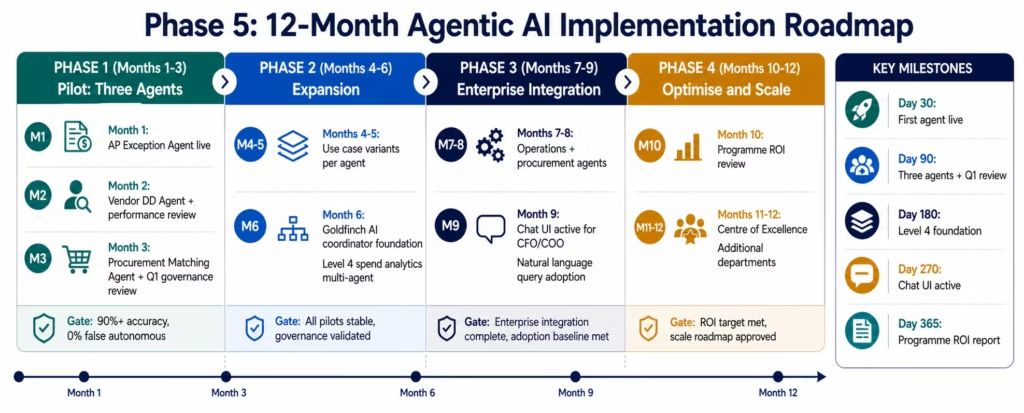
Months 1-3: Pilot Phase (Three Agents)
Month 1: deploy the highest-priority agent from the Phase 2 matrix. For most organisations: the AP Invoice Exception Agent. Import the Automation Hub template, configure ERP credentials, calibrate confidence thresholds with 20 representative exception cases, deploy to production. Target: first agent live in production by end of month 1.
Month 2: review pilot agent performance. Pull the accuracy spot-check data (10% of autonomous actions reviewed). Adjust confidence thresholds based on actual performance. Begin implementation of the second priority agent (typically vendor due diligence or procurement matching).
Month 3: second agent live. Review both agents’ performance. Begin implementing the third priority agent. Conduct the first quarterly governance review. Report pilot results to the executive sponsor.
Pilot success criteria: each agent must achieve 90%+ recommendation accuracy and 0% false autonomous action rate before proceeding to the expansion phase.
Months 4-6: Expansion Phase
Months 4-5: expand each of the three pilot agents to additional use case variants. The AP Invoice Exception Agent adds handling for credit memos, partial deliveries, and multi-currency invoices. The vendor due diligence agent adds deeper sanctions screening and ESG risk assessment.
Month 6: begin Level 4 (Goldfinch AI) foundation work. Configure the Goldfinch AI coordinator for your first multi-agent use case. The recommended starting point: the spend analytics use case, where a coordinator agent orchestrates three specialised worker agents (procurement data, vendor data, finance data) to produce a weekly spend analysis report. This is lower-risk than a decision-making multi-agent use case and demonstrates multi-agent capability to the executive team.
Months 7-9: Enterprise Integration Phase
Months 7-8: deploy agents across additional business functions. Expand from finance to operations (order exception agent, 3PL discrepancy agent) and from operations to procurement (purchase requisition matching agent, supplier performance agent).
Month 9: activate the Goldfinch AI Chat UI for the CFO and COO. Train both on natural language query patterns for the types of operational data available. Measure adoption and adjust the underlying agent tools based on query patterns.
Months 10-12: Optimisation and Scaling
Month 10: conduct comprehensive programme review. Measure total exception queue cost eliminated across all deployed agents. Calculate actual ROI against the business case projection. Present results to the board sponsor.
Month 11-12: expand the agentic AI programme based on demonstrated ROI. Additional use cases, additional departments, additional Goldfinch AI multi-agent coordination scenarios. Establish the Centre of Excellence (see Phase 6).
Phase 6: Build Capability and Scale
What you will do: establish the organisational structures that sustain and scale the agentic AI programme beyond the initial deployment.
The Agentic AI Centre of Excellence
By month 12, your organisation should establish a Centre of Excellence (CoE) that owns the agentic AI programme. The CoE is not a large team: for most mid-market organisations, 3-5 people covering:
AI Programme Manager: owns the roadmap, governs the deployment process, manages the quarterly review cycle, and coordinates between IT and business functions.
Business Analyst (AI): works with business functions to identify new use cases, document requirements, and evaluate agent output quality. This role does not need to build agents: they need to understand what agents can and cannot do.
Integration Engineer: configures and maintains agent tools and ERP connections. This role requires familiarity with enterprise APIs (SAP, NetSuite, Oracle) and the eZintegrations platform. Not a dedicated AI engineer: an integration specialist who has been trained on the agentic AI platform.
Scaling the Agent Library
Once the CoE is in place, scaling the agent library is significantly faster than the initial pilot. The second and third agent deployments leverage: – Established ERP connection configurations (reused across agents) – Calibrated confidence thresholds (starting points informed by pilot data) – Established governance process (quarterly review already running) – Business function buy-in (pilot successes build credibility for expansion)
Target: by month 18, have 8-15 active agents across 3-4 business functions, with 2-3 Goldfinch AI multi-agent coordination workflows in production.
The Agentic AI Data Infrastructure Requirement
This section addresses the most common strategic failure: deploying agentic AI on top of poor data infrastructure and being surprised when the agents produce unreliable recommendations.
Agentic AI requires four data infrastructure components. If any is missing, agent accuracy suffers:
1. Real-time data access: agents retrieve data at query time from live systems. If the SAP PO data is 24 hours stale because of a batch sync rather than real-time integration, the agent’s 3-way match analysis is wrong. Level 1 real-time integration is the prerequisite.
2. Semantic search capability: agents use Knowledge Base Vector Search to find relevant context from document collections (contracts, policies, vendor agreements). This requires those documents to be ingested, chunked, and indexed. Most enterprises have the documents: they are in SharePoint, in email archives, in vendor portals. The work is ingestion and indexing, not document creation.
3. Cross-system data consistency: when the vendor name in SAP is “TechEquip Inc.” and the vendor name in Salesforce is “TechEquip Incorporated” and the vendor name in the AP system is “TechEquip”: the agent cannot reliably identify the correct vendor record across systems. Master data management (even basic vendor name standardisation) is a prerequisite for reliable agent operation.
4. Structured audit logs: agents need to record every decision for governance review. This requires a log data store (a database or log aggregation system) that the platform can write to. eZintegrations provides native execution logging; connecting it to your existing log infrastructure (Datadog, Splunk, Azure Monitor) is the integration work required.
Measuring Agentic AI Programme Success
Track these six metrics quarterly to demonstrate programme value and identify optimisation opportunities:
1. Exception rate reduction: baseline exception rate per process before agent deployment versus current rate. Target: 80-90% reduction from baseline.
2. Exception resolution time: average time from exception detection to resolution. Baseline: 35-50 minutes manual. Target: 8-12 minutes agent-assisted or 0 minutes autonomous.
3. Autonomous action accuracy rate: percentage of agent autonomous actions validated correct by spot-check review. Target: 95%+ sustained. Alert threshold: below 90%.
4. HITL package utilisation rate: percentage of HITL packages where the human took the agent’s recommended action (versus overriding with a different action). High rate = agent recommendations are useful. Low rate = agent confidence calibration needs review.
5. Cost per exception resolved: total cost of the process (agent platform cost + human HITL time cost) divided by exceptions resolved. Compare to pre-agent cost per exception. Target: 70-85% reduction.
6. Agent library coverage: number of active agents and the percentage of total enterprise exception volume they cover. Target by month 12: 40-60% of total exception volume covered by agents.
Common Strategic Mistakes to Avoid
Mistake 1: Deploying agents before Level 1 integration is in place.
An AP Exception Agent that cannot reliably query the SAP PO because the SAP connection uses an HTTP node that breaks on quarterly updates is useless. Fix the integration foundation before building agents on top of it.
Mistake 2: Setting the confidence threshold too high or too low initially.
Too high (0.99): almost every case routes to HITL. The agent adds latency without reducing human work. Too low (0.70): the agent takes autonomous actions on cases it should not. False autonomous actions destroy business trust faster than any other failure mode.
Mistake 3: Skipping the representative case testing phase.
Testing with synthetic data or with cases the agent was designed for does not reveal how it handles the edge cases in your real exception queue. Use your actual exception data. The testing phase is where calibration problems are discovered safely.
Mistake 4: Building the programme as an IT project without business ownership.
The AP manager must own the AP Exception Agent. Not own the configuration: own the outcome. They define what correct recommendations look like, they do the spot-check reviews, they escalate when the agent behaviour does not match expectations. Without business ownership, the programme loses accountability.
Mistake 5: Not communicating with business users about what the agent does and does not do.
If the AP team believes the agent makes final payment decisions, they will not review HITL packages carefully. If they believe the agent is infallible, they will approve HITL recommendations without reading them. Clear, specific communication about the agent’s role (researcher and recommender, not decision-maker) determines whether the human-in-the-loop gate actually functions.
Before vs After: No Agentic AI Strategy vs This Framework
| Dimension | No Agentic AI Strategy | This Six-Phase Framework |
|---|---|---|
| First agent in production | Never or failed experiment | Day 30 |
| Time to measurable ROI | N/A | Month 2 (first spot-check results) |
| Exception queue size | Full manual queue | 10-30% of original volume |
| Exception resolution time | 38 minutes manual | 8 min (HITL) or 0 min (autonomous) |
| Governance documentation | None | Playbook approved pre-deployment |
| Board visibility | None | Quarterly ROI report |
| Data infrastructure | Unknown gaps | Assessed and remediated |
| Executive sponsorship | Absent | CFO, COO, CIO aligned |
| Agent library size by month 12 | 0 | 8-15 agents across 3-4 functions |
| Annual programme ROI | $0 | $300,000-$1,500,000 |
Objection: “We Need to Wait for AI Regulations to Stabilise”
EU AI Act, proposed US federal AI frameworks, sector-specific guidance from FCA, FINRA, FDA: the regulatory landscape for enterprise AI is evolving. This is a legitimate concern.
The practical answer: the governance framework in Phase 3 of this guide was designed specifically to satisfy the most likely requirements of current and emerging AI regulation. Confidence thresholds and HITL gates address GDPR Article 22 (human oversight of automated decision-making). Audit trails address the “meaningful information about the logic involved” requirement. Quarterly governance reviews satisfy ongoing monitoring requirements.
Organisations that wait for regulatory certainty will wait indefinitely: the regulations will continue to evolve. The organisations that deploy with strong governance documentation are better positioned in regulatory conversations than organisations that have not deployed at all, because they have evidence of controlled, auditable AI decision-making.
Objection: “Our Data Is Not Ready for Agentic AI”
Data readiness is a spectrum, not a binary. You do not need perfect data to deploy agentic AI: you need adequate data for the specific use cases you are targeting.
For the AP Invoice Exception Agent: you need SAP PO data with line items and pricing populated (typically 90-95% complete for active POs), GR data current within 24 hours, and vendor master records with consistent naming for your top 80% of vendors by invoice volume. You do not need perfect data across the entire vendor master.
Identify the data quality issues that will affect your top three use cases specifically. Fix those. Do not let enterprise-wide data quality perfectionism prevent deployment of use cases that have adequate data.
Objection: “We Don’t Have the Internal AI Expertise”
Enterprise agentic AI deployment on a managed platform (eZintegrations) does not require AI engineering expertise. It requires: – Integration engineering expertise (configuring ERP connectors) – Business analysis expertise (documenting use cases and defining correct agent behaviour) – Programme management expertise (running the governance review cycle)
The LLM selection, the agent framework, the tool orchestration, the confidence scoring mechanism, and the reflection loop are all provided by the platform. You configure them; you do not build them.
A team with an integration engineer, a business analyst familiar with your AP process, and an IT programme manager can deploy the first three pilot agents using this framework.
Objection: “We Should Build Our Own Agent Framework”
This is the build vs buy question applied to AI agents specifically. The analysis is the same as it is for integration platforms: building is the correct answer when your requirement is so unique that no managed platform can serve it.
For most enterprise exception handling use cases, the requirements are: ERP data retrieval (standard APIs), document extraction (standard document types), knowledge base search (standard vector search), and escalation routing (standard notification channels). These are not unique requirements. A managed platform with native enterprise tool support is the correct choice.
Build is appropriate for: proprietary AI model requirements (your organisation has trained domain-specific models that outperform general models for your use case), deeply custom agent architectures (your use case requires a control flow not supported by any platform), or regulatory requirements that prevent any third-party data processing.
For the 95% of enterprise exception handling use cases that do not meet these criteria: the managed platform option delivers agents in 2-5 days at a fraction of the build cost.
FAQs
1. How long does it take to develop an enterprise agentic AI strategy?
The six-phase framework takes 8-12 weeks from start to first production agent. Phase 1 (maturity assessment): 1-2 weeks. Phase 2 (use case prioritisation): 1 week. Phase 3 (governance design): 1-2 weeks. Phase 4 (executive sponsorship): 2-4 weeks (depends on budget cycle). Phase 5 implementation starts in parallel with Phase 4. The first pilot agent goes live in 30 days from the start of implementation.
2. Do I need coding skills to implement an agentic AI strategy?
No. The configuration work (goal statements, tool selection, confidence thresholds, ERP connections, output paths) is done through the eZintegrations visual interface. The strategy work (maturity assessment, use case prioritisation, governance design) requires business analysis and programme management skills, not AI engineering. ERP API credentials require the SAP or NetSuite admin team's involvement but not developer coding.
3. What is the typical ROI for an enterprise agentic AI programme?
The ROI varies by use case volume and exception rate. For a mid-market enterprise (500-2,000 employees) deploying the AP Exception Agent as the first agent: year-1 net benefit typically runs $150,000-$300,000 from exception queue reduction alone. A programme covering 8-12 agents across finance and procurement typically delivers $500,000-$1,500,000 in annual net benefit by month 18. The enterprise automation business case guide provides the complete ROI calculation framework.
4. How does agentic AI differ from the AI chatbots and copilots my team is already using?
Enterprise copilots (Microsoft Copilot, Salesforce Einstein, ServiceNow Now Assist) enhance individual productivity: they help an employee draft an email, summarise a document, or find information faster. They require a human to initiate every action. Enterprise agentic AI (Level 3 AI Agents and Level 4 Goldfinch AI) operates autonomously on business processes: it receives an exception, researches it across multiple systems, forms a recommendation, and routes it to a human only when confidence is below threshold. The productivity multiplier is different: copilots make individuals 10-30% more efficient. Agents eliminate entire manual process categories.
5. What is the difference between Level 3 AI Agents and Level 4 Goldfinch AI multi-agent orchestration?
Level 3 AI Agents are single-agent systems: one agent, one goal, one set of tools, one output. The AP Exception Agent is a Level 3 agent. Level 4 Goldfinch AI is a coordinator-worker architecture: a coordinator agent receives a complex goal, decomposes it into sub-tasks, assigns each sub-task to a specialised worker agent, and synthesises the results. The Chat UI is a Level 4 interface: when the CFO asks what is our vendor concentration risk this quarter, the Goldfinch coordinator assigns a procurement data agent, a financial data agent, and a market data agent to run in parallel, then synthesises their outputs into a consolidated risk assessment with supporting charts. The Workflow Node embeds coordinator intelligence inside Level 1 automation processes.
The Strategy Is the Work
Most organisations have identified that agentic AI is important. The ones that will realise its value are the ones that do the strategic work: assessing their maturity, selecting the right use cases, designing governance before deployment, securing the right sponsorship, and executing a disciplined phased roadmap.
The organisations that skip this work deploy an agent as a demonstration, experience an incident or a poor result, and conclude that “AI is not ready.” The organisations that follow this framework deploy an agent that delivers measurable ROI in the first billing cycle, builds executive confidence, and becomes the foundation for a programme that transforms how the enterprise operates.
Book a free demo with eZintegrations. Bring your maturity assessment results (or your gut sense of where you sit on the four-level model) and your top three candidate use cases. The session will produce: a maturity gap analysis, a use case prioritisation score for each candidate, and a draft pilot implementation plan with go-live timeline.
For the technical implementation of AI agent workflows, see the multi-step AI agent workflow implementation guide. For the Goldfinch AI multi-agent platform overview, see the Goldfinch AI agentic platform page.