Oracle Integration Platform Alternative: Move Beyond OIC Without Rearchitecting Everything
April 4, 2026Oracle EBS PL/SQL API Integration DocumentationTo connect Oracle Fusion Cloud, Oracle EBS, or JD Edwards to any enterprise system using eZintegrations, without Oracle Integration Cloud: add your Oracle system credentials to the eZintegrations API catalog (OAuth 2.0 for Oracle Fusion Cloud REST APIs, Basic Auth or certificate-based for Oracle EBS, or direct JDBC connection for Oracle EBS and JDE SQL/PL/SQL access), import the matching Automation Hub template, configure your REST query parameters and field mappings, and go live in days. The eZintegrations API catalog covers Oracle Fusion Cloud REST and SOAP APIs, Oracle EBS SQL and PL/SQL REST services (via Oracle Integrated SOA Gateway), and JD Edwards Orchestrator Framework APIs and direct SQL, without Oracle OIC message-pack billing, idle-instance charges, or the requirement for a certified Oracle Integration specialist.
TL; DR
Oracle Integration Cloud (OIC) is expensive to run and expensive to maintain. The instance billing model charges your organisation even when no messages are being processed, producing an idle baseline cost of approximately $30.97 per day for an Enterprise edition instance. The Enterprise edition is mandatory if you connect Oracle EBS, JD Edwards, Siebel, or SAP, because those adapters are Enterprise-only. Add an Oracle Integration specialist at $110,000-$170,000+ per year, certified OIC partner implementation fees, and the Gen 2-to-Gen 3 migration effort your team is still managing, and the full cost of Oracle OIC for a mid-market enterprise typically reaches $200,000-$450,000 in Year 1.
eZintegrations connects your Oracle landscape to any enterprise system using the full Oracle API catalog, without OIC’s message-pack billing, without an Oracle Integration specialist requirement, and at published pricing that starts at $5/month per automation.
Here is exactly what is available in the API catalog.
Connect Your Oracle Stack to Any System Today
Access Oracle Fusion Cloud REST and SOAP APIs, Oracle EBS SQL and PL/SQL APIs, and JD Edwards SQL and Orchestrator APIs from a no-code canvas. No Oracle OIC. No Oracle developer required. No idle-instance billing.
Every Oracle Fusion Cloud REST API module, every Oracle EBS PL/SQL procedure exposed via the Integrated SOA Gateway, every Oracle EBS SQL query and direct database access, and every JD Edwards Orchestrator Framework API and SQL query is accessible from the eZintegrations API catalog. Import an Automation Hub template, configure your credentials and query parameters, and go live.
Published pricing from $5/month per automation. No message-pack billing. No Oracle Integration specialist required.
Import the Oracle Integration Template from the Automation Hub | Book a Free Demo
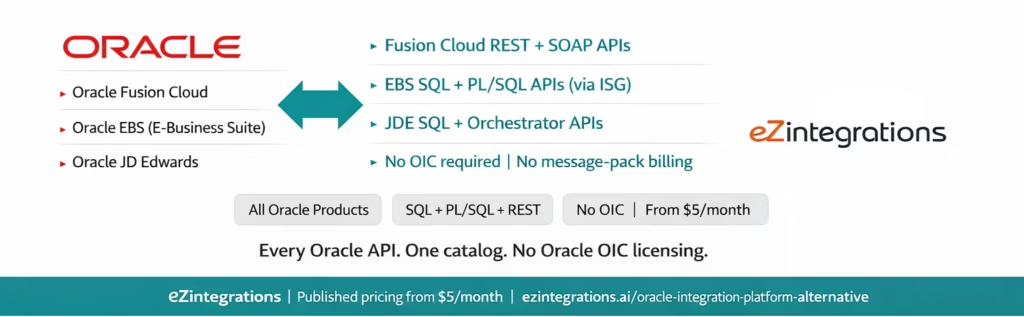
What You Can Do with Oracle Integration in eZintegrations
eZintegrations connects your Oracle landscape to every enterprise system in your stack through the Oracle API catalog. These are the six integration patterns Oracle customers most frequently need, all running without Oracle OIC.
Oracle Fusion Cloud Finance to Salesforce: Order-to-Cash and Account Sync Oracle Fusion Cloud REST APIs cover the full Finance Object Library: Accounts Receivable, General Ledger, Payables, Procurement, and Revenue Management. Connect Oracle Cloud Financials to Salesforce via the Fusion Cloud Finance REST APIs with limit and offset pagination for bulk extraction and date-based q query parameters (CreationDate >= and LastUpdateDate >=) for incremental sync. Salesforce Opportunity Closed Won creates Oracle Fusion Cloud Sales Orders via REST POST. Invoice status and payment terms from Oracle Payables update Salesforce Account fields on a configurable schedule.
Oracle Fusion Cloud or EBS to Data Warehouse: Extract Financial Data to Snowflake or BigQuery Oracle Fusion Cloud REST APIs for General Ledger journal entries, account balances, and AP/AR transactions support limit and offset pagination and date-range query parameters for incremental extraction. For Oracle EBS, eZintegrations uses direct SQL queries against the EBS database schema via JDBC (or Oracle EBS REST services via the Integrated SOA Gateway) to extract high-volume financial data to Snowflake, BigQuery, or Databricks. JD Edwards uses direct SQL against the JDE Business Data schema for financial and operational reporting extracts.
Oracle EBS PL/SQL APIs: Replace OIC EBS Adapter Without Rebuilding Oracle EBS exposes public PL/SQL APIs as REST web services via the Integrated SOA Gateway (ISG). These include the standard EBS business APIs: OE_ORDER_PUB (order processing), AR_INVOICE_API_PUB (invoice creation), PO_PURCHASES_GRP (purchase order processing), INV_ITEM_GRP (item master updates), and hundreds more from the EBS Integration Repository. The eZintegrations API catalog calls these PL/SQL REST services directly, without Oracle OIC and without the BPEL Process Manager overhead that traditional EBS integration required. The same integrations that used to run on OIC’s Enterprise EBS Adapter now run on eZintegrations at a fraction of the cost.
Oracle Fusion Cloud Business Events: Real-Time Change Data Capture Oracle Fusion Cloud publishes Business Events when records are created, changed, or deleted. eZintegrations subscribes to these events and fires integration workflows within seconds of the Oracle event. A new purchase order in Oracle Procurement fires an event. A journal entry posted in General Ledger fires an event. A new hire in Oracle HCM fires an event. No polling. Real-time downstream action in Salesforce, ServiceNow, Workday, or your notification system.
Oracle HCM Cloud and EBS HR to HRIS: Employee Lifecycle Sync Oracle Fusion HCM Cloud REST APIs expose Worker, Assignment, Position, and Employment resources. eZintegrations syncs Oracle HCM employee lifecycle events (new hire, role change, termination) to Workday, SAP SuccessFactors, ServiceNow, and Active Directory. For Oracle EBS HR (HRMS), direct SQL queries against the EBS HR schema (PER_ALL_PEOPLE_F, PER_ALL_ASSIGNMENTS_F) extract employee data for downstream ITSM provisioning and workforce management sync.
Oracle EBS and JDE Operations: Procurement, Inventory, and Manufacturing Sync Oracle EBS procurement workflows (purchase requisitions, purchase orders, goods receipts) sync to external procurement platforms (SAP Ariba, Coupa) via EBS PL/SQL REST APIs or SQL queries against EBS PO schema tables. JD Edwards inventory and manufacturing data is extracted via JDE Orchestrator Framework REST APIs or direct SQL against the JDE Business Data schema for reporting and external system sync. No Oracle OIC. No proprietary JDE integration middleware.
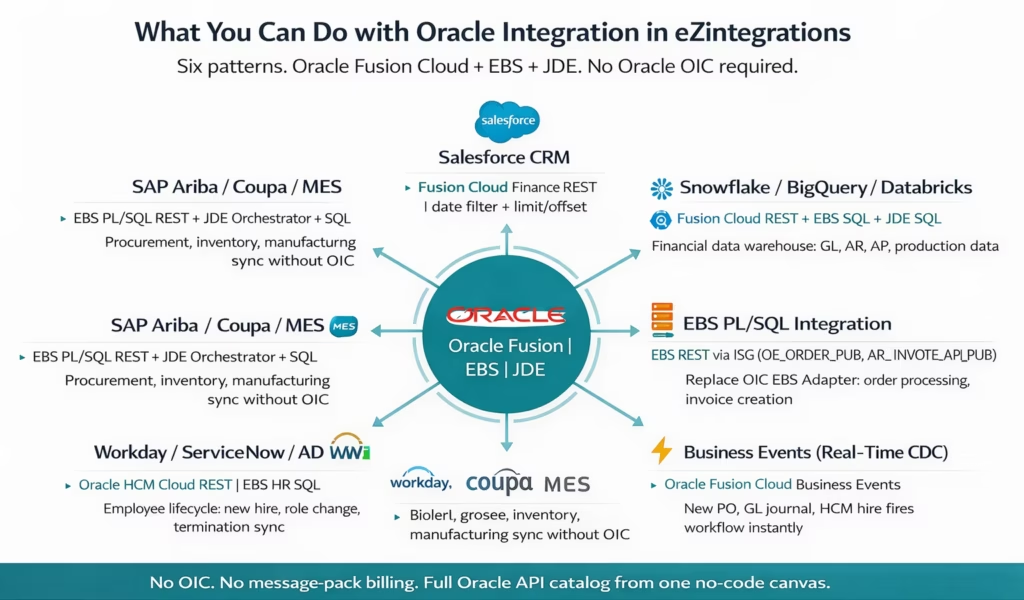
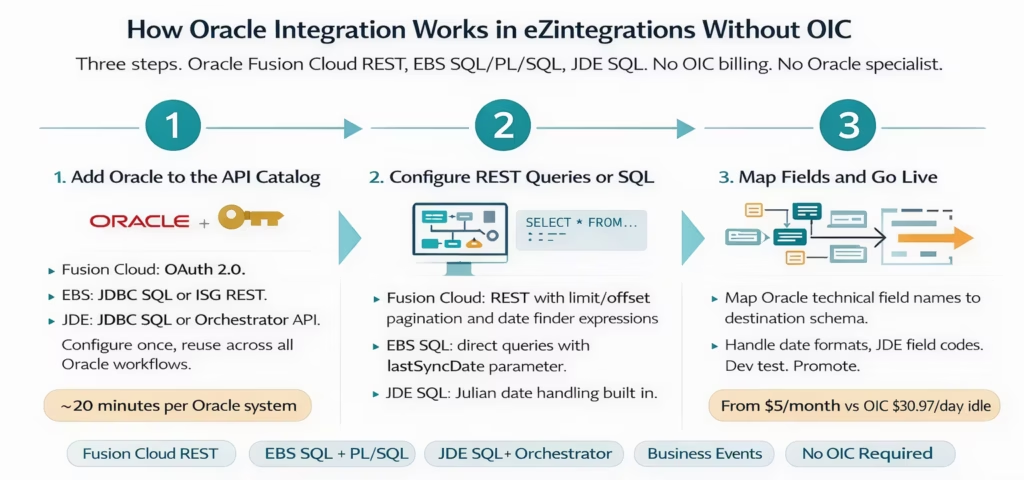
How Oracle Integration Works in eZintegrations Without OIC
Step 1: Add Your Oracle System to the API Catalog
Oracle Fusion Cloud: Configure OAuth 2.0 credentials from your Oracle Cloud environment (Client ID and Client Secret from the Oracle Applications cloud service). eZintegrations authenticates against the Oracle Identity Cloud Service token endpoint and accesses all Oracle Fusion Cloud REST APIs, including Finance, SCM, HCM, Procurement, and CX modules. Setup time: approximately 20 minutes.
Oracle E-Business Suite (EBS): Two connection options are available:
Option A: Direct SQL and PL/SQL via JDBC database connection. Connect to the Oracle EBS database directly using JDBC credentials (hostname, port, service name, username, and password for an EBS read user or integration user). This enables direct SQL queries against any EBS schema table (AP, AR, GL, PO, INV, HR, OE) and PL/SQL procedure calls for write operations.
Option B: EBS REST services via Integrated SOA Gateway (ISG). For organisations where the ISG is deployed and PL/SQL APIs are exposed as REST services, the eZintegrations API catalog calls these REST endpoints directly with EBS authentication credentials.
Oracle JD Edwards: Configure direct SQL access to the JDE Business Data schema via JDBC, or configure JDE Orchestrator Framework REST API credentials. Both are in the API catalog. SQL is available out of the box for all JDE tables including F42119 (order detail), F0911 (account ledger), F4101 (item master), and F4311 (purchase order detail).
Step 2: Configure API Calls, SQL Queries, and Sync Parameters
Oracle Fusion Cloud REST queries: Configure REST API calls with Oracle’s standard query parameters: limit and offset for pagination, q parameter with finder expressions (q=CreationDate >= "2026-03-17T00:00:00+00:00") for incremental sync, fields parameter for field projection. Oracle Fusion Cloud REST responses include a hasMore flag to indicate additional pages. The API catalog handles pagination automatically, cycling through pages until hasMore is false.
Oracle EBS SQL queries: Write direct SQL against EBS schema tables in the no-code canvas. Examples:
GET https://sellingpartnerapi-na.amazon.com/fba/inventory/v1/summaries
  ?details=true
  &granularityType=Marketplace
  &granularityId=ATVPDKIKX0Der
  &marketplaceIds=ATVPDKIKX0Der

Authorization: Bearer {lwa_access_token}
. Add date parameters for incremental sync: :lastSyncDate is set by the eZintegrations workflow scheduler from the previous run’s timestamp.
Oracle EBS PL/SQL calls: Configure calls to EBS PL/SQL APIs exposed via ISG:
POST https://ebs-server/webservices/rest/OE_ORDER_PUB/process_order
.
Map the PL/SQL procedure’s input parameters to your source system fields in the visual transformation step.
JDE SQL queries: Write direct SQL against JDE tables:
SELECT SHAN8, SHSOLD, SHDCTO, SHUPMJ
FROM F42119
WHERE SHUPMJ >= :lastSyncDateJulian
ORDER BY SHDOCO;
JDE uses Julian dates (stored as numeric YYYYDDD format), which the API catalog handles with configurable date format conversion from standard ISO dates.
Step 3: Map Fields, Connect Destination Systems, and Go Live
Add destination system credentials (Salesforce, Snowflake, SAP, ServiceNow) to the credential vault. Map Oracle field names to destination system schema in the visual transformation canvas. Oracle Fusion Cloud uses structured JSON field names (invoiceNumber, invoiceDate, totalAmount). Oracle EBS uses schema column names (INVOICE_NUM, INVOICE_DATE, INVOICE_AMOUNT). JDE uses field codes (SHAN8, SHUPMJ). The transformation canvas handles date format conversion, field renaming, and conditional logic without code.
Run test transactions in the Dev environment. Promote to production. The Oracle credential configurations you set up in Step 1 are reused across every subsequent Oracle integration without reconfiguration.
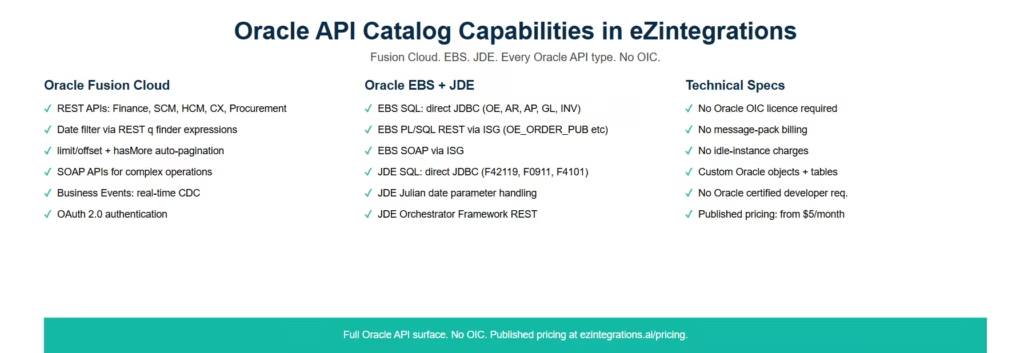
Oracle API Catalog Capabilities in eZintegrations
eZintegrations does not replicate Oracle OIC’s adapter architecture. The API catalog provides direct access to every Oracle API surface across all three Oracle product lines. Here is what is available.
| Oracle Product and Capability | Details |
|---|---|
| Oracle Fusion Cloud REST APIs | Full access to Finance (GL, AR, AP, FA, Revenue), Procurement, SCM, HCM, CRM modules. OAuth 2.0 authentication. Pagination using limit/offset with hasMore flag. |
| Oracle Fusion Cloud incremental sync | Incremental sync using q parameter (LastUpdateDate filters). Supports field projection to reduce API load and improve performance. |
| Oracle Fusion Cloud SOAP APIs | SOAP services for complex transactions, X.509 security, and legacy enterprise integrations. WSDL-based access. |
| Oracle Fusion Cloud Business Events | Real-time event subscriptions for Orders, Invoices, Workers, etc. Enables event-driven workflows and change data capture. |
| Oracle EBS SQL (direct database) | Direct JDBC queries across EBS schemas (OE, AR, AP, GL, PO, INV, HR). Supports parameterized queries and incremental extraction. |
| Oracle EBS PL/SQL APIs (via ISG) | Execute EBS public APIs (e.g., OE_ORDER_PUB, AR_INVOICE_API_PUB) via REST through ISG. No need for BPEL or OIC adapter. |
| Oracle EBS SOAP services | SOAP-based access to PL/SQL APIs via ISG for environments requiring WSDL-based integrations. |
| JD Edwards SQL (direct database) | Direct SQL access to JDE tables (F4211, F0911, F4311, F4101, F0101). Built-in support for Julian date handling. |
| JD Edwards Orchestrator Framework | REST APIs to trigger orchestrations, execute business logic, and access JDE data (JDE 9.2+). |
| Oracle Database (standalone) | JDBC connection to any Oracle DB for custom integrations, reporting, and warehouse pipelines. |
| Pagination handling | Fusion: auto limit/offset pagination. EBS & JDE: configurable paging using ROWNUM or row selection. |
| Authentication | Fusion: OAuth 2.0. EBS: Basic Auth, JDBC, SAML. JDE: JDBC & user credentials. Stored securely in encrypted vault. |
| Custom Oracle objects | Fusion extensible objects via REST. EBS custom tables/APIs via SQL or ISG. JDE custom tables via SQL. |
| Error handling and retry | Retry logic, rate-limit awareness, connection pooling, timeout configs, and dead-letter queue for failures. |
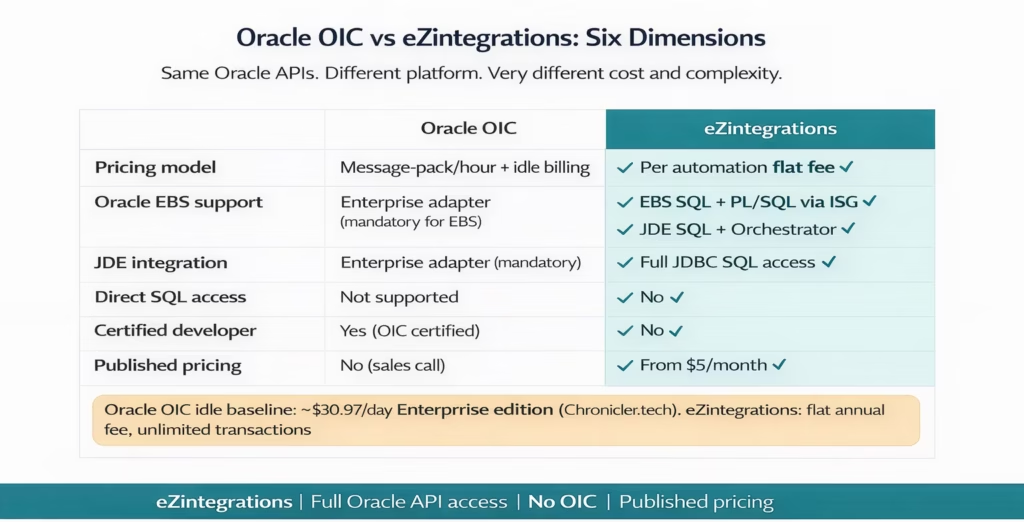
Why eZintegrations Instead of Oracle OIC
What Oracle OIC Costs You
Oracle OIC uses message-pack-per-hour billing. Your instance accumulates charges from the moment it is running, whether or not it is processing messages. An Enterprise edition instance (required for Oracle EBS, JD Edwards, Siebel, or SAP connections) costs approximately $30.97 per day at zero usage. That is $11,304 per year in idle charges before a single integration runs.
The Enterprise edition is not optional if your integration estate connects to Oracle EBS or JD Edwards. These adapters are Enterprise-only in Oracle OIC. If your use case requires both a Salesforce connection and an Oracle EBS connection, you pay Enterprise pricing for the entire instance.
Oracle OIC does not publish pricing. Every contract requires a direct conversation with Oracle sales. Third-party estimates consistently place Year 1 total cost of ownership for mid-market enterprises in the $200,000-$450,000 range including implementation through a certified Oracle partner, Oracle Integration specialist headcount, and the ongoing Gen 2-to-Gen 3 migration effort.
For the full cost analysis, see the Oracle OIC total cost analysis.
What You Get Instead with eZintegrations
The same Oracle APIs, without the OIC platform layer. Oracle OIC’s EBS Adapter calls the same Oracle EBS PL/SQL REST services and SOAP interfaces that the eZintegrations API catalog accesses directly. Oracle OIC’s Fusion Cloud Adapter calls the same Oracle Fusion Cloud REST APIs that the eZintegrations catalog calls directly. The Oracle OIC platform is a middleware layer between your integrations and these APIs. eZintegrations removes that middleware layer and connects to the Oracle APIs directly.
Direct SQL access for Oracle EBS and JDE that OIC cannot provide. Oracle OIC does not support direct SQL queries against the Oracle EBS or JDE database schema. The eZintegrations API catalog supports direct JDBC connections to Oracle EBS and JDE databases, enabling SQL-based data extraction patterns that OIC’s adapter architecture cannot replicate. This is particularly valuable for data warehouse extraction: a direct SQL query against the EBS GL schema extracts financial data orders of magnitude faster than an API-based extraction through the OIC EBS Adapter.
No certified Oracle Integration specialist required. Oracle OIC requires certified Oracle Integration specialists to design, build, and maintain integrations. eZintegrations works from the no-code canvas and Automation Hub templates. Your operations analyst or IT team configures Oracle integrations from pre-built templates. No OIC certification. No JDeveloper. No BPEL Designer.
Published pricing. eZintegrations pricing starts at $5/month per automation at annual billing and is visible at ezintegrations.ai/pricing before any sales conversation. Oracle OIC has no published pricing. The difference is not just financial. It is the difference between a procurement process and a configuration process.
Migration from OIC without rebuilding everything. If you are currently running integrations on Oracle OIC, eZintegrations provides a migration path that does not require rebuilding the integration logic from scratch. Oracle EBS PL/SQL REST service calls in OIC map directly to equivalent API catalog calls in eZintegrations. Oracle Fusion Cloud REST adapter configurations in OIC map to equivalent REST query configurations in the eZintegrations canvas. The field mapping and transformation logic transfers. The OIC platform layer is replaced. The Oracle API connections are the same.
Import the Oracle Integration Template
The eZintegrations Automation Hub contains pre-built templates for the most common Oracle enterprise integration patterns:
Oracle Fusion Cloud Finance to Salesforce: Invoice Status and Order Sync Oracle Fusion Cloud AR Invoice REST API with LastUpdateDate finder expression for incremental sync. Maps Oracle Invoice fields to Salesforce Account and Opportunity fields. Bidirectional: Salesforce Opportunity Closed Won creates Oracle Fusion Cloud Sales Order via REST POST.
Oracle EBS to Snowflake: Daily Financial Extract via SQL Direct SQL query against Oracle EBS GL schema:
SELECT gjl.je_line_num,
       gjh.je_category,
       gjh.effective_date,
       gjl.accounted_dr,
       gjl.accounted_cr,
       gcc.segment1 || '.' || gcc.segment2 AS account
FROM gl_je_lines gjl
JOIN gl_je_headers gjh
  ON gjl.je_header_id = gjh.je_header_id
JOIN gl_code_combinations gcc
  ON gjl.code_combination_id = gcc.code_combination_id
WHERE gjh.last_update_date >= :lastSyncDate;
Loads to Snowflake. Configurable schedule.
Oracle EBS OE_ORDER_PUB: Inbound Sales Order Creation Calls the Oracle EBS OE_ORDER_PUB.process_order PL/SQL API via ISG REST to create sales orders from external systems (eCommerce, Salesforce, EDI). Maps external order fields to OE API parameters. Handles BAPI-equivalent status response.
JD Edwards F42119 Extract to Data Warehouse
SELECT SHDOCO, SHAN8, SHSOLD, SHUPMJ, SHAEXP, SHUNCS
FROM F42119
WHERE SHUPMJ >= :lastSyncDateJulian
ORDER BY SHDOCO;
Julian date parameter conversion handled automatically. Loads to Snowflake or BigQuery for sales analytics.
Oracle HCM Cloud to ServiceNow: New Hire Provisioning Oracle HCM Cloud Workers REST API with lastUpdateDate finder expression. New hire event triggers ServiceNow User record creation via REST POST with role and department mapping from Oracle HCM attributes.
Import any of these templates in one click. Configure Oracle credentials. Go live in days without Oracle OIC.
Import Oracle Templates from the Automation Hub
Frequently Asked Questions
1. How do I integrate Oracle Fusion Cloud or Oracle EBS with eZintegrations
For Oracle Fusion Cloud configure OAuth 2.0 Client Credentials from your Oracle Cloud environment including Client ID and Client Secret in the eZintegrations credential vault. Import the Automation Hub template configure REST API query parameters with LastUpdateDate finder expressions and limit and offset pagination and go live. For Oracle EBS configure either a JDBC connection to the EBS database for direct SQL access or configure EBS ISG REST credentials to call PL SQL APIs as REST services. For JD Edwards configure a JDBC connection to the JDE Business Data schema or Orchestrator REST credentials. Standard templates go live in 1 to 3 business days.
2. Does eZintegrations support Oracle without Oracle Integration Cloud
Yes, eZintegrations connects directly to Oracle Fusion Cloud REST and SOAP APIs Oracle EBS via direct SQL and PL SQL REST services through Integrated SOA Gateway and JD Edwards via direct SQL and Orchestrator Framework REST. Oracle Integration Cloud is middleware that sits between integrations and these APIs but eZintegrations accesses the same APIs directly without message pack billing idle instance charges or enterprise edition requirements.
3. How long does Oracle integration take with eZintegrations
Oracle Fusion Cloud OAuth 2.0 credential setup takes approximately 20 minutes. Oracle EBS JDBC connection setup takes around 30 minutes. Standard integration templates such as Oracle Fusion to Salesforce EBS SQL to Snowflake and HCM to ServiceNow go live in 1 to 3 business days including Dev test transactions. Custom Oracle integrations using specific REST endpoints or SQL queries typically take 2 to 4 days compared to 4 to 12 weeks for traditional Oracle Integration Cloud implementations.
4. Is there a free Oracle integration template
The Automation Hub template library is included in every eZintegrations subscription. There is no separate template fee and no premium Oracle template tier. Subscriptions start at 5 dollars per month per automation at annual billing providing full access to all Oracle integration templates.
5. What Oracle EBS modules does eZintegrations support
eZintegrations supports all Oracle EBS modules accessible via direct SQL or PL SQL REST services through Integrated SOA Gateway. This includes Order Entry Accounts Receivable Accounts Payable General Ledger Purchasing Inventory Management Human Resources Work in Process Bills of Material Projects Accounting and all custom modules. If a PL SQL API is listed in the EBS Integration Repository it can be called via REST and any table in the EBS database can be queried via SQL.
6. Can eZintegrations connect to JD Edwards for enterprise integration
Yes, JD Edwards integration uses direct SQL against the JDE Business Data schema via JDBC covering all business object tables and JDE Orchestrator Framework REST APIs for environments with Orchestrator deployed. JDE Julian date formats are handled with configurable conversion and no Oracle Integration Cloud adapter is required.
Move Beyond Oracle OIC Today
Oracle OIC has served its purpose for many enterprises. But the message-pack billing model, the idle-instance cost, the Enterprise edition pricing requirement for EBS and JDE, and the dependency on certified Oracle Integration specialists are costs that compound every year.
eZintegrations provides direct Oracle API catalog access across all three Oracle product lines: Oracle Fusion Cloud REST and SOAP APIs, Oracle EBS SQL and PL/SQL REST services, and JDE SQL and Orchestrator APIs. The same Oracle integrations that run on OIC run on eZintegrations at a fraction of the cost, without the middleware layer, without per-message billing, and without the requirement for Oracle specialist headcount.
The ERP integration platform page covers the broader enterprise integration context. The Automation Hub has templates for your specific Oracle integration requirements.
Import an Oracle Integration Template from the Automation Hub and start your first Oracle integration today without OIC. Or book a free demo with your Oracle landscape details and current OIC configuration. We will map the API catalog configuration and identify the template that replaces your highest-cost OIC integration in the session.