eZintegrations vs MuleSoft: Why Enterprise Teams Are Switching in 2026
March 11, 2026eZintegrations vs MuleSoft: eZintegrations wins on pricing model, implementation speed, AI capability, and ease of use. MuleSoft’s Anypoint Platform requires a custom enterprise quote with no public pricing, needs certified DataWeave developers earning $113,000 to $175,000 per year, and has no native Agentic AI. eZintegrations has transparent per-automation pricing, no specialist required, and native Goldfinch AI.
TL;DR
MuleSoft Anypoint Platform uses a subscription model based on Mule Flows and Mule Messages with no publicly listed pricing. All quotes require a MuleSoft sales conversation. G2 and Capterra reviewers consistently describe it as “premium priced,” “expensive to renew,” and difficult to scale cost-efficiently. Beyond the platform subscription, MuleSoft deployments require certified DataWeave developers. According to Glassdoor data from January 2026, MuleSoft developers earn between $113,000 and $175,000 per year in the US market. Most enterprise deployments need at least two. That developer cost sits entirely outside the platform subscription. eZintegrations has no platform fee, no connector fees, and unlimited non-LLM transactions. Pricing is per automation annually, published transparently, starting from free up to $150 per month for complex workflows. AI automations are base plan plus AI credits. MuleSoft has zero native Agentic AI. Goldfinch AI of eZintegrations ships with 9 native agent tools out of the box, a Planner-Critic-Aggregator multi-agent architecture, and unlimited self-service extensibility. Implementation on eZintegrations takes 8 to 100 hours from 1,000+ Automation Hub templates. MuleSoft implementations run 3 to 12 months. eZintegrations is rated 4.7 stars on G2, Capterra, Software Advice, and GetApp across 50+ enterprise customers.
Summary Comparison Table
| Feature | eZintegrations | MuleSoft Anypoint |
|---|---|---|
| Pricing model | Per automation, published transparently | Subscription by Mule Flows and Messages, custom quote only |
| Public pricing | Yes, at ezintegrations.ai/pricing | No, requires MuleSoft sales engagement |
| Platform fee | None | Included in subscription (custom quote) |
| Connector fees | None | Included in subscription |
| Non-LLM transaction volume | Unlimited | Allotted by subscription tier |
| AI automation pricing | Base plan + AI credits | External AI services, developer-managed |
| Developer requirement | None (no-code first) | Certified DataWeave developer required |
| Developer salary cost (US) | Not applicable | $113,000 to $175,000 per year (Glassdoor 2026) |
| Implementation time | 8 to 100 hours | 3 to 12 months |
| Native Agentic AI | Yes (Goldfinch AI) | No |
| AI Agents | Yes, 9 native tools + self-service extensible | No (AI Chain is developer-only beta) |
| AI Workflows | Yes, native | No (bolt-on via external services) |
| GraphQL support | Full native | Partial |
| WebSocket support | Full native | Partial |
| MCP Protocol | Yes | No |
| gRPC support | Yes | No |
| Dynamic Tool Calling | Yes (unique) | No |
| Any workflow to MCP endpoint | Yes (1 click) | No |
| 1,000+ pre-built templates | Yes | No |
| Fully managed | Yes, Bizdata | Customer manages runtime |
| G2 rating | 4.7 stars | Premium-priced, widely noted in reviews |
| Uptime SLA | 99.9% | 99.9% |
eZintegrations vs MuleSoft: The Quick Verdict
eZintegrations outperforms MuleSoft on every dimension that matters for enterprise teams evaluating integration platforms in 2026: pricing model transparency, implementation speed, AI capability, no-code accessibility, and fully managed infrastructure.
MuleSoft built one of the best enterprise integration platforms of its era. Founded in 2006 and acquired by Salesforce in 2018, the Anypoint Platform defined what enterprise API-led connectivity looked like for a generation. Your IT team probably knows DataWeave, Anypoint Studio, and CloudHub by name.
The problem isn’t that MuleSoft is bad at what it was built to do. The problem is what it was built to do no longer matches what enterprise integration requires in 2026. It was built before AI agents existed. Before Agentic AI was a real capability. Before outcome-based pricing models made opaque platform subscriptions feel like a legacy relic. And it was built on a developer-dependency model that made sense when only large enterprises with dedicated integration teams needed it, but creates bottlenecks for the teams evaluating it today.
According to Gartner, the enterprise iPaaS market is shifting toward AI-native platforms that handle unstructured data, autonomous decision-making, and multi-agent coordination natively. MuleSoft’s architecture predates all three requirements.
The Pricing Model Difference: Platform Subscription vs Per-Automation Outcome-Based
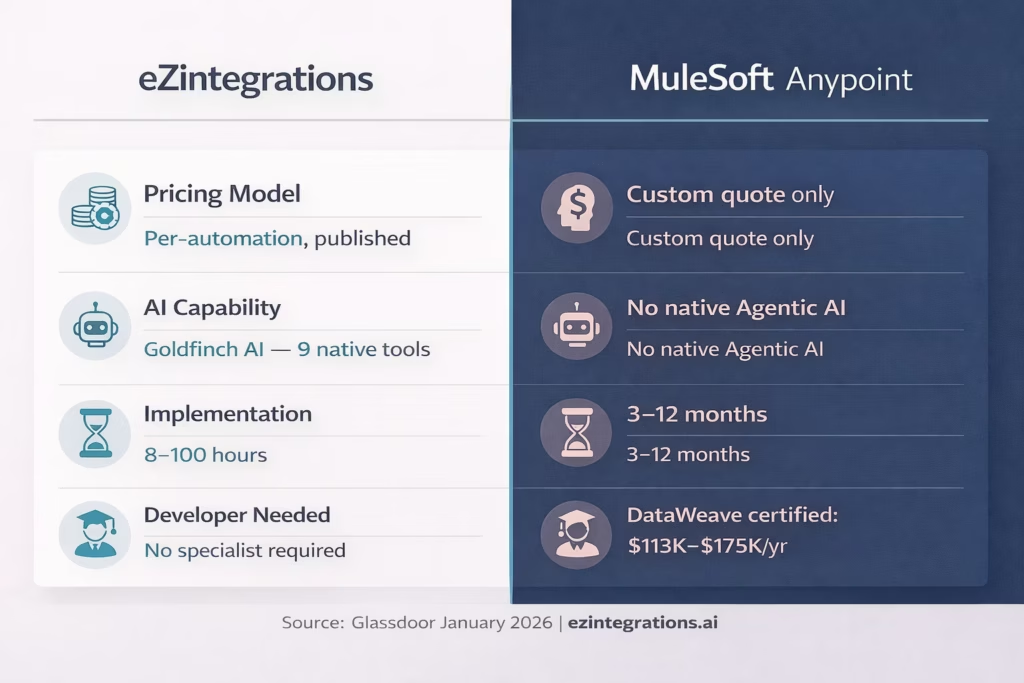
MuleSoft’s Anypoint Platform uses a subscription model charged by Mule Flows and Mule Messages with no publicly listed pricing. eZintegrations charges per automation annually with no platform fee, no connector fees, and unlimited non-LLM transactions – all prices published transparently before you commit.
As of March 2024, MuleSoft moved from its legacy vCore-based model to two new packages: Integration Starter and Integration Advanced. Both are measured by Mule Flows (the breadth of your integration deployment) and Mule Messages (the intensity of usage). Neither package lists a price on the Salesforce or MuleSoft website. Pricing requires contacting MuleSoft’s sales team for a custom quote.
This opacity is not accidental. MuleSoft is a premium enterprise platform and its sales process is designed around custom commercial conversations. According to verified user reviews on G2, enterprise customers regularly cite MuleSoft’s pricing as a point of friction: “During the years we realized that the platform is becoming quite expensive, making every renewal difficult to manage with Finance.” Multiple G2 reviewers note that the vCore-based legacy model “makes scaling both difficult and costly, particularly for non-production environments or smaller projects.”
Beyond the platform subscription itself, a real MuleSoft deployment carries additional cost layers that most buyers don’t fully account for before signing:
Certified DataWeave developers: Every MuleSoft integration requires someone who knows DataWeave, MuleSoft’s proprietary transformation language. This is not optional. Business users cannot build on MuleSoft without developer support. According to Glassdoor data from January 2026, MuleSoft developers earn between $113,000 (25th percentile) and $175,000 (75th percentile) per year in the US market. Most enterprise deployments need at least two.
Professional services: Mid-complexity MuleSoft implementations typically involve professional services from MuleSoft directly or from a certified SI partner such as Accenture, Deloitte, or Capgemini. These engagements are project-scoped and add cost beyond the platform subscription.
Ongoing maintenance overhead: MuleSoft customers own their runtime upgrades, CloudHub environment management, and patch cycles. According to Forrester Research, enterprises on legacy iPaaS platforms spend an average of 40% of their integration team’s time on maintenance rather than new development. At two developers, that’s effectively 0.8 FTE of pure maintenance cost annually.
eZintegrations works on a fundamentally different model. Everything is published at ezintegrations:
- No platform fee
- No connector fees
- Unlimited transactions for non-LLM automations regardless of volume
- Per-automation annual pricing: free for simple automations, $5, $90, $120, or $150 per month based on complexity
- Complex enterprise automations like Oracle FBDI or EHR/FHIR workflows are priced at the $150 per month tier
- AI-driven automations are priced as base plan plus AI credits, defined in advance for predictable budgeting
- Dev and Test environments at one-third of production cost
- No maintenance overhead: Bizdata manages all upgrades, patches, and lifecycle support
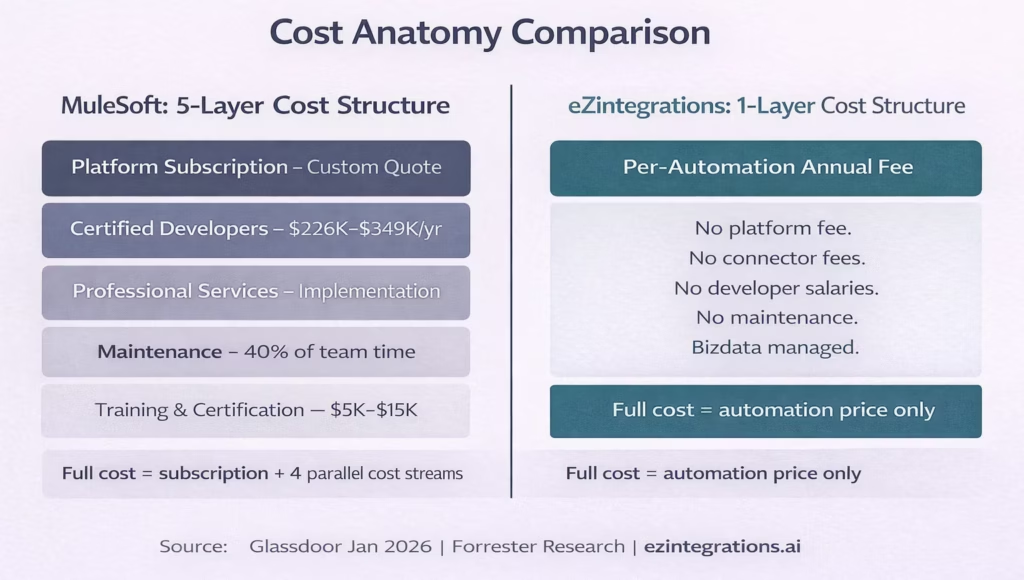
The structural difference is clear: MuleSoft’s total cost requires adding up an opaque platform subscription, certified developer salaries, professional services, and maintenance overhead. eZintegrations’ total cost is the per-automation annual price, nothing more.
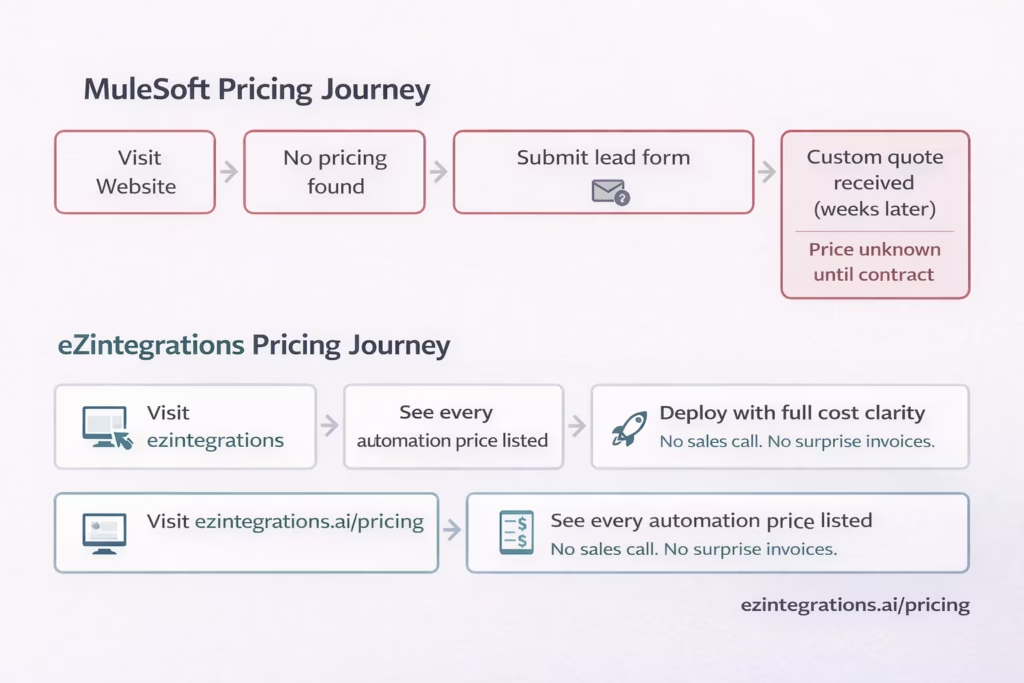 Want to see exactly what your automations cost before you commit? View eZintegrations pricing, every automation shows its annual price transparently with no sales conversation required.
The Real Total Cost of Ownership: What MuleSoft Deployments Actually Cost
MuleSoft does not publish its platform subscription pricing. What is publicly verifiable is the cost structure around the platform: certified developer salaries from Glassdoor, professional services from industry benchmarks, and maintenance overhead from Forrester. When you add all cost layers together, the picture is clear.
Enterprise IT leaders evaluating MuleSoft need to budget across five cost components, not just the platform license:
Component 1: Platform Subscription MuleSoft’s Integration Starter and Integration Advanced packages are priced by Mule Flows and Mule Messages. No public pricing is listed. A custom quote from MuleSoft’s sales team is required. Multiple G2 and Capterra reviewers describe the platform as “premium priced” and note that renewal cost has become a significant point of friction with finance teams. Based on the consistent pattern in independent analyst commentary, MuleSoft is positioned as a top-tier enterprise platform subscription, not a self-serve or mid-market tool.
Component 2: Certified DataWeave Developer Salaries MuleSoft’s DataWeave transformation language is proprietary. Every integration requires a developer who writes DataWeave code. According to Glassdoor salary data from January 2026, MuleSoft developers earn a median of $140,017 per year, with a typical range of $113,570 to $174,633 (25th to 75th percentile). Senior MuleSoft developers earn a Glassdoor median of $170,433. Most enterprise MuleSoft deployments need at least two certified developers. That is $226,000 to $349,000 in annual developer salary cost before any platform fees are counted.
Component 3: Professional Services Initial MuleSoft implementations involve either MuleSoft’s professional services team or certified SI partners. These engagements are scoped per project and add cost beyond the annual platform subscription.
Component 4: Ongoing Maintenance MuleSoft customers own their runtime upgrades, CloudHub environment management, and patch cycles. According to Forrester Research, enterprises on traditional iPaaS platforms spend 40% of integration team time on maintenance. At two developers earning median salaries, 40% maintenance allocation represents a substantial annual cost in developer time that produces no new business capability.
Component 5: Training and Certification MuleSoft Certified Developer exam fees are $400 per attempt. Preparation courses run $1,500 to $3,000 per developer. Recertification is required as the platform evolves.
The MuleSoft cost reality:
| Cost Component | Annual Cost |
|---|---|
| Platform subscription | Custom quote required, no public price |
| Certified developer salaries (2 FTE, Glassdoor median) | $226,000 to $349,000 |
| Professional services (Year 1 implementation) | Project-scoped, additional to subscription |
| Maintenance overhead (40% of 2 FTE developer time) | Significant annual cost in developer time |
| Training and certification | $5,000 to $15,000 |
| Total picture | Platform subscription + significant developer and maintenance costs running in parallel |
eZintegrations total cost for comparable scope:
| Cost Component | Annual Cost |
|---|---|
| Platform fee | None |
| Connector fees | None |
| Non-LLM transaction charges | None (unlimited) |
| Per-automation pricing (10 automations at $90 to $150/month) | $10,800 to $18,000 per year |
| AI credits (only for LLM automations, based on actual usage) | Defined in advance |
| Developer salaries for integration building | None required |
| Maintenance | None (Bizdata managed) |
| Total | Per-automation annual fee only |
Developer Dependency: Why MuleSoft Locks You Into Specialist Talent
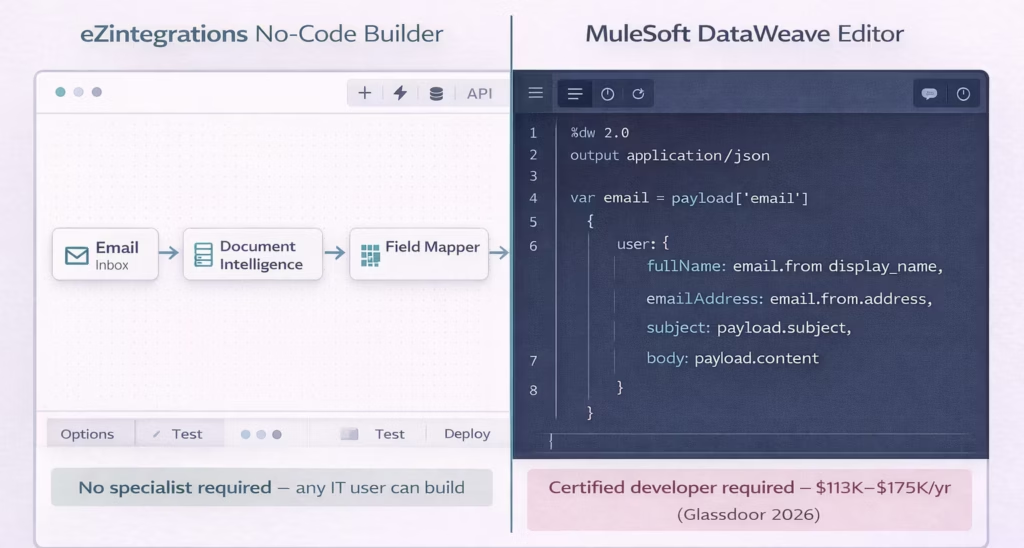
MuleSoft’s core architectural requirement is that every integration must be built, maintained, and modified by a developer who knows DataWeave, MuleSoft’s proprietary transformation language. Business users, IT generalists, and operations teams cannot build on MuleSoft without that specialist.
DataWeave is powerful. It’s also a hard barrier. Every time a field mapping needs updating, a workflow needs adjusting, or a new connector needs configuring, the request joins the backlog of your certified MuleSoft developer. That developer costs between $113,000 and $175,000 per year according to Glassdoor. Their backlog grows every time a business stakeholder requests an integration change.
This creates a structural bottleneck that doesn’t improve with time. As your integration needs grow, the bottleneck grows with them. The only solutions are hiring more certified developers or accepting longer delivery timelines.
According to verified G2 reviews, “It is extremely difficult to set up for those without a technical background. To truly get the most value from it, you really need an implementation partner.” Developer dependency and DataWeave complexity are the two most frequently cited limitations by enterprise users.
eZintegrations is no-code first. Your IT directors, business analysts, and operations managers build and deploy integrations on the same canvas without writing a single line of code. For complex customizations where developer involvement adds value, the platform supports low-code extensions. But developer involvement is always a choice, never a requirement.
The practical impact: an operations manager at a Pharma company imports an eZintegrations EDI supplier onboarding template, configures it through a point-and-click interface, and deploys. That same task on MuleSoft requires a certified developer to write DataWeave transformation scripts, configure the Anypoint connector framework, test across environments, and deploy to CloudHub. Weeks vs hours. Specialist cost vs no specialist cost.
Implementation Speed: Templates vs Custom Builds
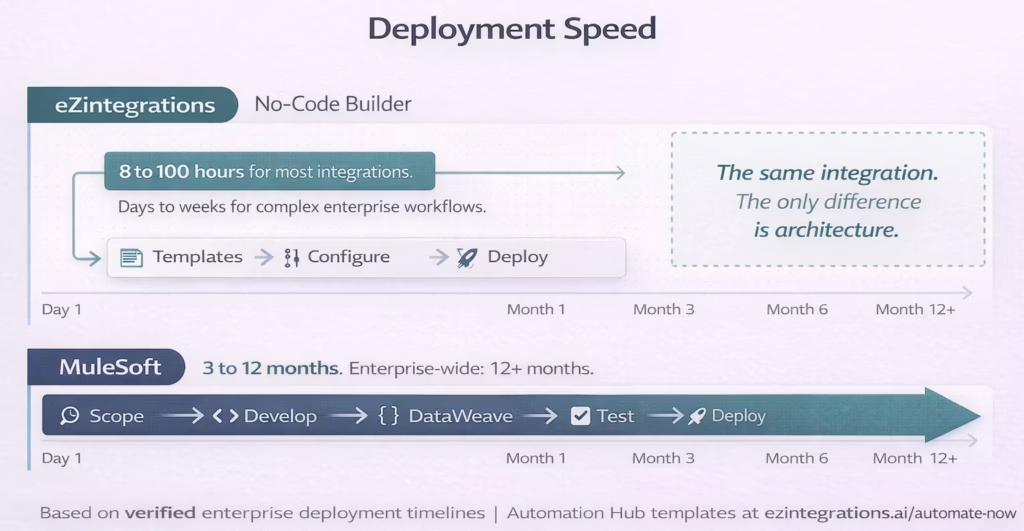
eZintegrations deployments go live in 8 to 100 hours using pre-built Automation Hub templates. MuleSoft implementations run 3 to 12 months for comparable workflows. The difference is structural, not a reflection of complexity.
Every MuleSoft integration starts from a blank canvas. Your developer opens Anypoint Studio, designs the integration architecture, writes DataWeave transformation logic, configures connectors, tests across environments, and deploys to CloudHub. For a straightforward Salesforce-to-ERP sync, that process takes 4 to 8 weeks. For a complex multi-system integration, it takes 3 to 6 months. Enterprise-wide deployments routinely hit 12 months or more.
eZintegrations starts from production-ready templates. The Automation Hub contains over 1,000 templates across all four automation pillars. Your team imports the template matching your use case, configures credentials and field mappings, and deploys. The build work is already done.
| Integration Use Case | MuleSoft | eZintegrations |
|---|---|---|
| Salesforce to SAP ERP sync | 4 to 8 weeks | 8 to 24 hours |
| EDI trading partner onboarding | 3 to 6 weeks | Hours from template |
| Email-to-ERP PO automation | 6 to 12 weeks | 1 to 3 days |
| 3-way invoice matching | 8 to 16 weeks | 2 to 5 days |
| Real-time WebSocket pipeline | 4 to 8 weeks | 1 to 2 days |
| Oracle FBDI complex integration | 3 to 6 months | Days to weeks |
| EHR/FHIR healthcare workflow | 4 to 8 months | Days to weeks |
| Full enterprise-wide deployment | 12+ months | Weeks to months |
For an IT Director whose business stakeholders are asking why an integration project is taking six months, this difference is the entire conversation.
AI Capabilities: Where the Gap Becomes a Chasm
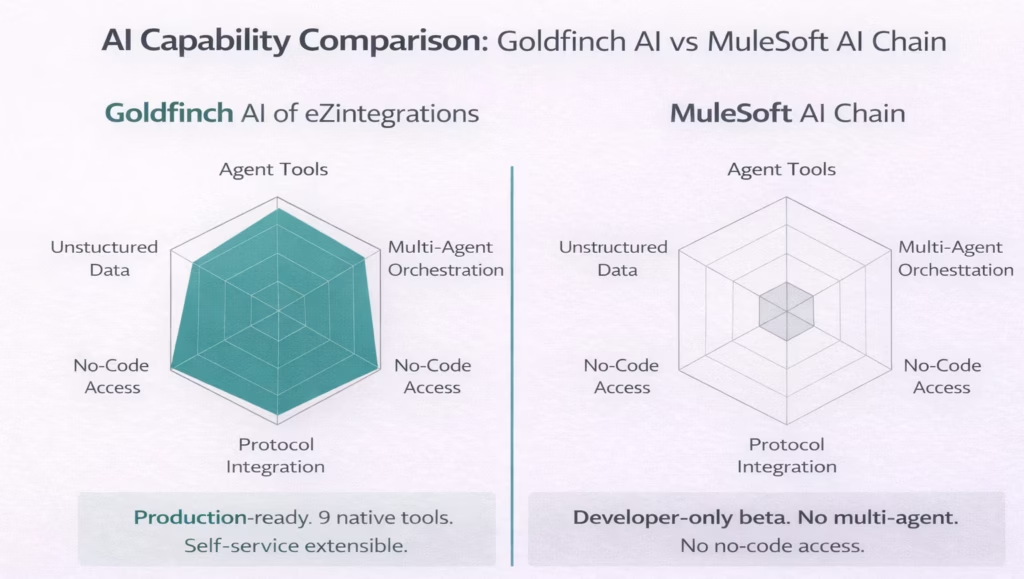
MuleSoft has zero native Agentic AI capability. MuleSoft AI Chain is a developer-only beta requiring custom code with no multi-agent orchestration. eZintegrations includes Goldfinch AI, a full Planner-Critic-Aggregator Agentic AI system natively in the platform, with 9 out-of-the-box agent tools and unlimited self-service extensibility.
This is the most decisive competitive difference in 2026. Not because AI is a nice-to-have, but because AI-native integration is becoming the baseline for what enterprise operations teams expect.
| AI Capability | eZintegrations | MuleSoft |
|---|---|---|
| AI native in workflow engine | Yes | No |
| AI Workflows (unstructured to structured) | Yes, native | No |
| Document Intelligence (email-to-ERP, EDI, invoice matching) | Yes, native | Partial, custom build required |
| AI Agents with tools | Yes, 9 native tools out of the box | Beta, developer-only |
| Self-service tool extensibility | Yes, users add more tools | No |
| Dynamic Tool Calling | Yes (unique to eZintegrations) | No |
| Goldfinch AI: Planner-Critic-Aggregator | Yes, native | No |
| MCP Protocol support | Yes | No |
| Any workflow to MCP endpoint | Yes, 1 click | No |
| Vector Knowledge Base | Yes | No |
| AI maintenance | Bizdata managed | Customer managed |
Goldfinch AI of eZintegrations ships with 9 native agent tools out of the box: Knowledge Base Vector Search, Document Intelligence, Data Analysis, Data Analytics with Charts and Dashboards, Web Crawling, Watcher Tools, API Tool Call (all auth types), Integration Workflow as a Tool, and Integration Flow as MCP. Beyond those 9, users add more tools as self-service without developer involvement or additional licensing.
MuleSoft AI Chain requires developers to write custom chain configurations in code. No no-code AI capability exists for business users. No multi-agent orchestration. No production path for Agentic AI at the platform level. The MuleSoft AI Chain is explicitly listed as a developer tool in Anypoint Exchange, not as a platform capability accessible to IT generalists or business users.
For IT leaders choosing which platform to build integration infrastructure on for the next five years, this difference in AI architecture defines whether your platform keeps pace with where enterprise automation is heading. According to Gartner, by 2026 over 65% of large enterprises are deploying AI-augmented integration tools to reduce manual pipeline maintenance. A platform with no native AI capability requires a parallel AI tooling investment on top of the platform subscription.
Protocol Support: Where eZintegrations Goes Further
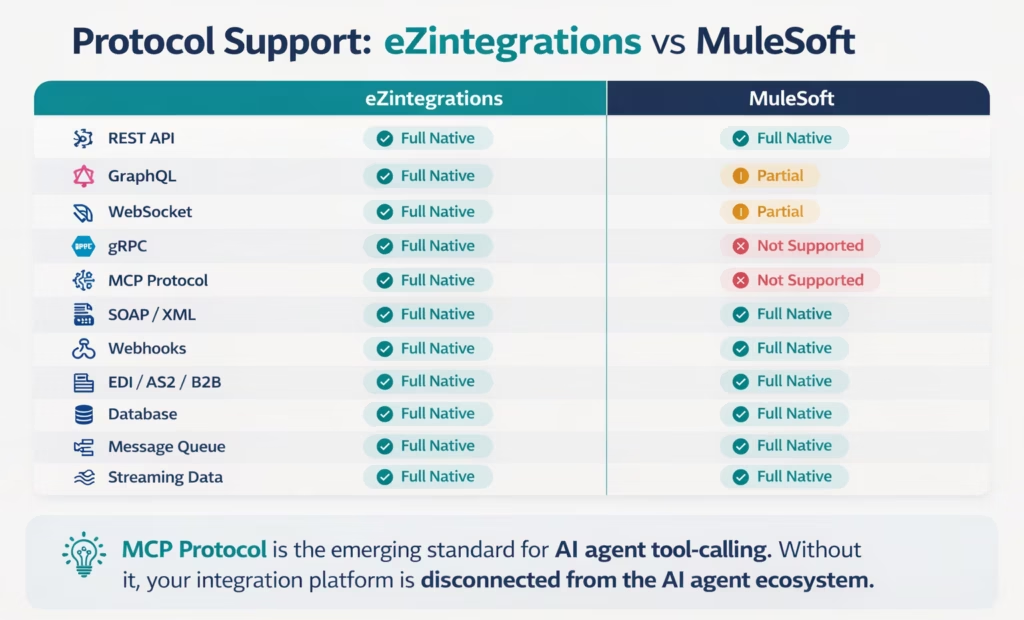
eZintegrations supports every protocol MuleSoft supports plus four that MuleSoft either doesn’t support at all or only partially supports: full native GraphQL, full native gRPC, full native MCP Protocol, and full native WebSocket.
| AI Capability | eZintegrations | MuleSoft |
|---|---|---|
| AI native in workflow engine | Yes | No |
| AI Workflows (unstructured to structured) | Yes, native | No |
| Document Intelligence (email-to-ERP, EDI, invoice matching) | Yes, native | Partial, custom build required |
| AI Agents with tools | Yes, 9 native tools out of the box | Beta, developer-only |
| Self-service tool extensibility | Yes, users add more tools | No |
| Dynamic Tool Calling | Yes (unique to eZintegrations) | No |
| Goldfinch AI: Planner-Critic-Aggregator | Yes, native | No |
| MCP Protocol support | Yes | No |
| Any workflow to MCP endpoint | Yes, 1 click | No |
| Vector Knowledge Base | Yes | No |
| AI maintenance | Bizdata managed | Customer managed |
The MCP gap is particularly significant in 2026. MCP (Model Context Protocol) is the emerging standard allowing AI agents to call external tools. Without MCP, your integration platform is architecturally disconnected from the AI agent ecosystem your business is building. eZintegrations not only supports MCP natively but converts any workflow to an MCP endpoint with a single click, making your entire integration library callable by external AI agents. MuleSoft has no MCP support.
Use Case Comparison: Five Real Scenarios
Use Case 1: Email-to-ERP Purchase Order Automation
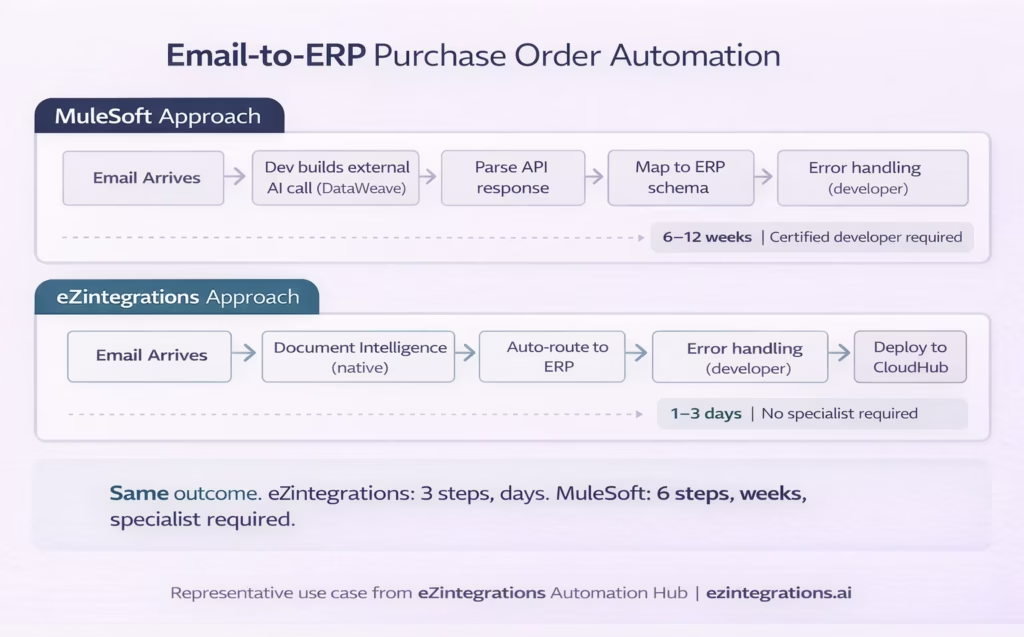
With MuleSoft: No native Document Intelligence. Your developer builds a custom integration calling an external AI service, handles API authentication and response parsing, maps extracted fields to your ERP schema in DataWeave, and builds error handling from scratch. Development time: 6 to 12 weeks. Ongoing maintenance: developer owned.
With eZintegrations: Import the email-to-ERP PO template from the Automation Hub. Document Intelligence runs natively inside the pipeline. Extraction accuracy exceeds 95% for standard PO formats. Exceptions route to human review automatically. Priced transparently per year with unlimited transaction volume as your PO count grows.
Use Case 2: EDI Trading Partner Onboarding
With MuleSoft: Supports AS2/EDI via the Enterprise tier but configuring EDIFACT-to-JSON or X12-to-JSON per trading partner requires a certified developer writing custom DataWeave per partner schema. Time per partner: 3 to 6 weeks.
With eZintegrations: Pre-built EDIFACT-to-JSON and X12-to-JSON templates cover all major transaction sets. Each trading partner onboards in hours. A global Industrial Goods company with 40+ pending trading partner integrations cleared their entire backlog in under two months.
Use Case 3: Real-Time WebSocket and GraphQL Pipelines
With MuleSoft: WebSocket support is partial. GraphQL support is partial. Building real-time bidirectional pipelines requires custom connector development and specialist configuration.
With eZintegrations: WebSocket and GraphQL are fully native. IT generalists configure real-time pipelines through the no-code canvas. No custom development required.
Use Case 4: End-to-End Procurement with Goldfinch AI
With MuleSoft: No Agentic AI capability. Procurement automation stops at structured data movement. Invoice matching, vendor decision logic, and exception handling all require human intervention or custom code.
With eZintegrations: Goldfinch AI runs the full procurement cycle autonomously. A Planner Agent creates the execution plan. Sub-agents handle vendor validation, PO generation, goods receipt monitoring, and 3-way invoice matching in parallel using all 9 native tools. The Critic Agent escalates genuine exceptions to the right human. The Aggregator delivers a complete reconciliation report. What took three AP team members a full day completes in 2 to 4 hours.
Use Case 5: Pharma, Manufacturing, and FMCG Enterprise Onboarding
With MuleSoft: A global Pharma company connecting Veeva, SAP, LIMS, and regulatory submission systems requires months of implementation, a dedicated certified development team, and ongoing maintenance as systems update.
With eZintegrations: Pre-built industry templates from the Automation Hub go live in days to weeks. Bizdata manages all upgrades and patches. A recognized global Pharma company, the world’s largest FMCG company, and a global Industrial Goods leader all run on eZintegrations today.
 See eZintegrations handle your specific use case. Explore 1,000+ production-ready templates – every template shows its annual price before you deploy.
Who Should Choose Each Platform
Choose MuleSoft if:
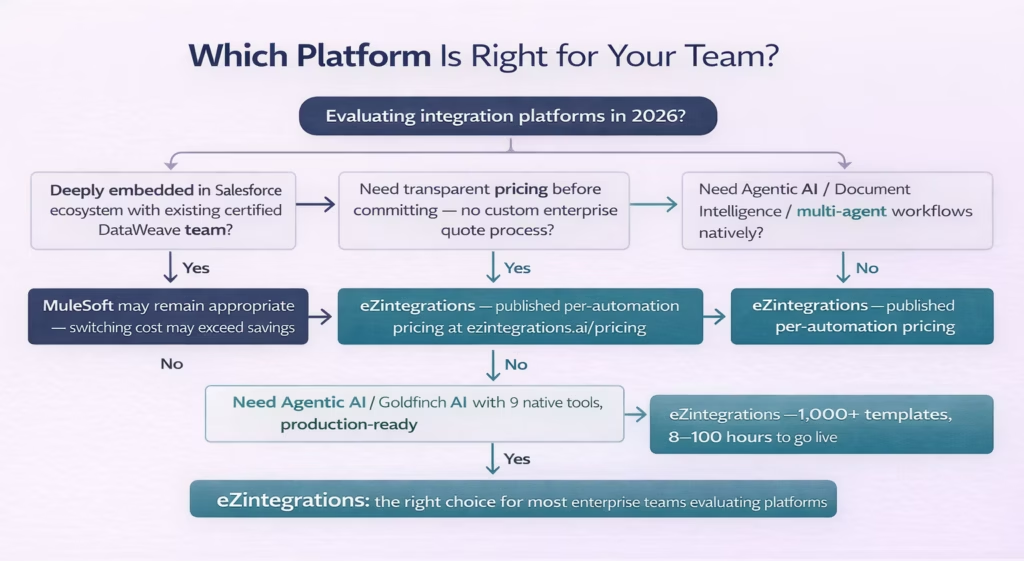
- Your organization is deeply embedded in the Salesforce ecosystem and Salesforce-to-Salesforce integration is your primary use case
- You have an existing certified MuleSoft development team already on payroll and switching costs exceed the savings from moving
- Your enterprise procurement has a mandate to stay on Salesforce-approved vendor lists
- You have an existing 18-month-plus MuleSoft implementation and your board has approved the ongoing investment
Choose eZintegrations if:
- You’re evaluating platforms for the first time or your MuleSoft contract is coming up for renewal
- You want transparent per-automation pricing with no opaque subscription requiring a sales conversation
- You need AI Workflows, AI Agents with 9 native tools, or Goldfinch AI natively in your integration platform
- Your team includes IT generalists or business users who need to build without certified DataWeave developer dependency
- Your stack spans SAP, Oracle, Infor, Salesforce, Veeva, and modern SaaS tools running mixed protocols
- You operate in Pharma, Retail, FMCG, Hi-Tech, CPG, Industrial Goods, or Industrial Manufacturing with industry-specific templates that go live in days
- You want Dev and Test environments at one-third of production cost with every automation price shown upfront
Bottom Line Verdict
eZintegrations is the right choice for the overwhelming majority of enterprise teams evaluating integration platforms in 2026. MuleSoft remains defensible only for organizations already deeply locked into Salesforce with existing certified development teams.
Pricing model: eZintegrations wins on transparency and predictability. Per-automation pricing published openly. No sales conversation required to understand your costs. MuleSoft requires a custom enterprise quote with no public pricing, and G2 and Capterra reviewers consistently flag renewal cost as a point of finance friction.
Total cost of ownership: eZintegrations wins structurally. MuleSoft’s full cost picture includes an opaque platform subscription plus certified developer salaries of $113,000 to $175,000 each (Glassdoor 2026), plus professional services, plus maintenance overhead consuming 40% of integration team time. eZintegrations’ total cost is the per-automation annual fee only.
Implementation speed: eZintegrations wins. 8 to 100 hours vs 3 to 12 months. For any team under delivery pressure, this difference makes or breaks projects.
No-code accessibility: eZintegrations wins. MuleSoft’s DataWeave dependency locks integration capability inside a specialist bottleneck that costs $113,000 to $175,000 per year per developer to maintain.
AI capability: eZintegrations wins by a significant margin. Goldfinch AI with 9 native tools and self-service extensibility has no equivalent on MuleSoft. MuleSoft AI Chain is a developer beta with no multi-agent orchestration and no Agentic AI on the platform roadmap.
The honest question for any enterprise IT leader: can your organization justify the combination of an opaque premium platform subscription, specialist developer salaries averaging $113,000 to $175,000 per person, professional services fees, and 40% maintenance overhead – for a platform with no native Agentic AI and 3 to 12 month implementation timelines?
For most teams, the answer is no.
FAQs
1. Is eZintegrations better than MuleSoft
For most enterprise teams in 2026 yes. eZintegrations has transparent per automation pricing with no platform fee no connector fees and unlimited non LLM transactions. MuleSoft requires a custom enterprise quote certified DataWeave developers earning $113000 to $175000 per year according to Glassdoor 2026 and has no native Agentic AI. eZintegrations includes Goldfinch AI with 9 native agent tools that MuleSoft does not have. The main exception is organizations already deeply embedded in the Salesforce ecosystem with existing MuleSoft development teams.
2. How does eZintegrations pricing compare to MuleSoft
The two platforms use fundamentally different pricing models. MuleSoft uses a subscription priced by Mule Flows and Mule Messages with no public pricing and requires a custom enterprise quote. eZintegrations publishes pricing transparently with no platform fee no connector fees unlimited non LLM transactions and per automation annual pricing from free to $150 per month. AI automations use a base plan plus AI credits and Dev and Test environments cost one third of production pricing. All pricing is publicly visible at ezintegrations.ai/pricing before signing a contract.
3. Can eZintegrations replace MuleSoft for enterprise integration
Yes, eZintegrations supports every protocol MuleSoft supports plus full native GraphQL gRPC WebSocket and MCP Protocol. It connects to SAP Oracle Infor Salesforce Veeva and other major enterprise systems using pre built templates. Migrations from MuleSoft are supported through Automation Hub templates that replace common DataWeave built integrations.
4. What is Goldfinch AI and does MuleSoft have an equivalent
Goldfinch AI is the Agentic AI capability of eZintegrations built on a Planner Critic Aggregator multi agent architecture. It includes 9 native tools out of the box including Knowledge Base Vector Search Document Intelligence Data Analysis Data Analytics with charts and dashboards Web Crawling Watcher Tools API Tool Call Integration Workflow as a Tool and Integration Flow as MCP. Users can extend this by adding additional tools through self service configuration. MuleSoft AI Chain is currently a developer only beta and does not include multi agent orchestration or an equivalent to the Goldfinch AI architecture.
5. Does eZintegrations charge per transaction or per connector
No, eZintegrations does not charge per transaction for non LLM automations and does not charge connector fees. Unlimited transactions run under the annual per automation pricing. AI driven automations that use Document Intelligence or Goldfinch AI use AI credits based on actual token usage which are defined in advance to ensure predictable budgeting.
6. How long does it take to migrate from MuleSoft to eZintegrations
Simple integrations can migrate in days using equivalent Automation Hub templates. Complex multi system deployments typically migrate in weeks. Oracle FBDI and EHR FHIR integrations have dedicated templates available in the $150 per month automation tier. Bizdata supports the migration process end to end and many customers report rebuilding integrations from templates is faster than the original MuleSoft implementation.
7. What is the difference between MuleSoft Anypoint Platform and eZintegrations
MuleSoft Anypoint Platform is a premium enterprise iPaaS that requires certified DataWeave developers uses an opaque subscription pricing model requiring a custom quote typically takes 3 to 12 months to implement and does not include native Agentic AI. eZintegrations is a no code enterprise iPaaS with Goldfinch AI transparent per automation annual pricing no platform fee unlimited non LLM transactions and implementation timelines of 8 to 100 hours using pre built templates.
Conclusion: The Renewal Decision Your Finance Team Is Already Asking About
If your MuleSoft contract is coming up for renewal, you already know what the conversation looks like. Finance is asking what the full cost picture is including developer salaries and professional services. Business stakeholders are asking why every integration request takes months. IT is asking why every change requires a certified developer whose backlog is six months long.
Those aren’t implementation problems. They’re architectural and pricing model problems. A premium opaque subscription, $113,000 to $175,000 developer salaries (Glassdoor 2026), professional services, and 40% maintenance overhead don’t get better with more investment in the platform.
eZintegrations was built to solve exactly those problems. Transparent per-automation pricing – no platform fee, no connector fees, unlimited non-LLM transactions – so you know exactly what you’re paying before you sign. No-code first so your whole team builds, not just certified specialists. 1,000+ production-ready templates so your first automation goes live in 8 to 100 hours, not months. Goldfinch AI with 9 native tools and self-service extensibility, natively built in, so your integration platform grows with your AI automation needs. Fully managed by Bizdata on a 99.9% uptime SLA so your team focuses on outcomes rather than infrastructure.
The world’s largest FMCG company runs on eZintegrations. A global Industrial Goods leader runs on eZintegrations. A recognized global Pharma company runs on eZintegrations. They chose it because the pricing model was transparent and fair, the implementation speed was decisive, and Goldfinch AI gave them capabilities the Anypoint Platform can’t deliver.
The most valuable hour your team can spend right now is seeing eZintegrations run the integrations your MuleSoft environment handles today.
Or start by exploring 1,000+ production-ready templates : every template shows its annual price before you deploy, with no platform subscription waiting on the other side.