AI Agents for Healthcare: Autonomous Clinical and Operational Data Workflows
June 8, 2026AI agents for healthcare connect Epic, Cerner, Athenahealth, payer portals, and revenue cycle systems to autonomously handle the high-volume, time-sensitive workflows that drive clinical and administrative burden: prior authorisation investigation and assembly, claim denial root cause analysis, care gap identification across patient panels, clinical documentation completeness checks, and discharge coordination across care settings. Every agent action runs within eZintegrations’ HIPAA BAA-covered infrastructure: PHI never leaves the compliant environment during processing.
TL;DR
- Healthcare organisations operate under the highest data compliance requirements in enterprise IT: HIPAA Business Associate Agreements, minimum necessary standard, access controls, and immutable audit trails for every PHI access event. These requirements do not prevent AI agent deployment. They specify what the architecture must provide.
- The administrative and clinical burden in healthcare is disproportionate: McKinsey estimates that 30% of healthcare costs in the US are administrative, and that 30-40% of clinical staff time is spent on documentation, prior authorisation, and data reconciliation: work that AI agents can handle while keeping PHI within the HIPAA BAA boundary.
- Five healthcare AI agent use cases with the highest operational ROI: prior authorisation investigation and assembly agent, claim denial analysis and appeal agent, care gap identification agent, clinical documentation completeness agent, and discharge coordination and post-acute handoff agent.
- eZintegrations connects Epic, Cerner, Athenahealth, and Meditech via FHIR R4 and HL7 v2; payer portals via REST; and revenue cycle systems via standard APIs: with HIPAA BAA in place and all agent processing running natively within the compliant infrastructure.
- CTA: Book a demo with your health IT team to see the HIPAA-compliant agent architecture and the FHIR R4 connector configuration for your specific EHR stack.
The Problem: Healthcare’s Administrative Burden is an AI Agent Problem
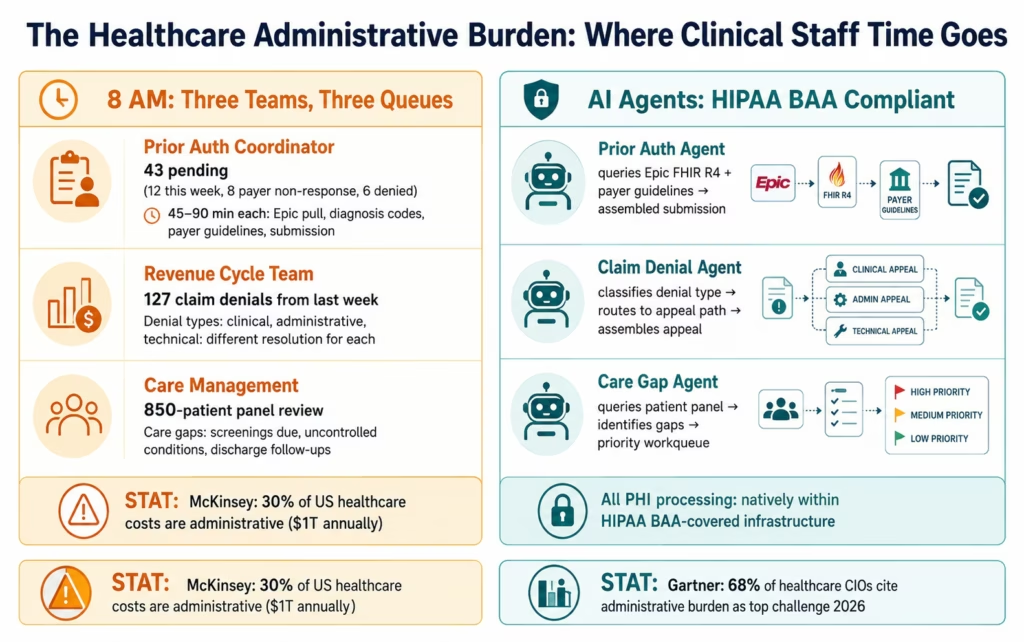
It is 8 AM at a regional health system. The prior authorisation coordinator opens her workqueue. She has 43 pending prior authorisations. Twelve are for procedures scheduled for this week. Eight have been pending for more than 5 days with no response from the payer. Six have been denied and need appeal documentation assembled. Three are for procedures already completed: the auth was submitted after the fact.
Each prior authorisation requires: pulling the clinical documentation from Epic, identifying the relevant diagnosis codes and procedure codes, locating the clinical evidence guidelines from the payer’s portal, assembling the clinical justification, and submitting through the payer’s prior auth portal or phone queue. Average time: 45-90 minutes per case. On a good day.
Three floors up, the revenue cycle team is working through 127 claim denials from last week’s remittance. Each denial has a reason code. Each reason code has a different investigation and resolution path. Some are clinical denials (medical necessity not established), some are administrative denials (prior auth not obtained, wrong plan, eligibility mismatch), and some are technical denials (incorrect billing code, modifier missing). Each requires querying the original claim, the patient record, the eligibility verification, and the payer’s denial reason documentation before the correct appeal can be constructed.
Meanwhile, the care management team is trying to work through a panel of 850 high-risk patients to identify care gaps: patients due for preventive screenings, patients with uncontrolled chronic conditions who have not had a recent follow-up, patients who were discharged from a hospital in the last 30 days and have not had a follow-up appointment scheduled. The care gap identification requires querying the EHR for each patient’s visit history, diagnostic history, medication list, and care plan.
According to McKinsey, 30% of US healthcare costs are administrative: $1 trillion annually. A significant fraction of that administrative cost is investigative work that AI agents can conduct: querying clinical data, assembling documentation, classifying denial reasons, and identifying gaps in care plans: all while maintaining HIPAA compliance.
According to Gartner, 68% of healthcare CIOs cite “administrative burden and manual data workflows” as the top operational challenge for 2026: ahead of cybersecurity, staffing, and reimbursement pressure.
The administrative burden is not primarily a staffing problem. It is an architecture problem. The data to investigate a prior auth, diagnose a claim denial, or identify a care gap exists in the EHR, the payer portal, and the revenue cycle system. AI agents can traverse these systems: within the HIPAA BAA boundary: and deliver the investigation in minutes, not hours.
The HIPAA Compliance Architecture for Healthcare AI Agents
Before describing any healthcare AI agent use case, the HIPAA compliance architecture must be explicitly addressed: because the wrong AI architecture creates significant legal and regulatory exposure, and many AI platforms that claim “HIPAA compliance” do not satisfy the requirements for PHI processing.
What HIPAA Requires of AI Agent Systems
Business Associate Agreement (BAA): any vendor or system that creates, receives, maintains, or transmits PHI on behalf of a covered entity must have a signed Business Associate Agreement with that covered entity. For AI agents that process patient data: reading EHR records, querying claim data, accessing diagnostic histories: the AI agent platform must have a signed HIPAA BAA in place.
Minimum Necessary Standard: covered entities must make reasonable efforts to limit PHI access to the minimum necessary for the purpose. AI agents must be scoped to access only the patient data required for the specific task: a prior authorisation agent should not access patient data unrelated to the authorisation being processed.
Audit Controls (45 CFR § 164.312(b)): covered entities must implement hardware, software, and procedural mechanisms that record and examine activity in information systems that contain or use PHI. Every AI agent action that involves PHI: every FHIR query, every patient record retrieval, every document assembly: must generate an audit trail.
Transmission Security: PHI transmitted between the AI agent and the EHR, payer portal, or revenue cycle system must be encrypted in transit. All eZintegrations API connections use TLS 1.2+ for data in transit.
The Critical Architecture Question: Where Does the AI Inference Run?
This is the most consequential compliance question for healthcare AI agents. When an AI agent processes a patient’s prior authorisation documentation: reading the clinical note, extracting the diagnosis codes, assembling the clinical justification: where does the AI computation happen?
Option A (non-compliant for PHI): external AI provider. The patient’s clinical note is sent to OpenAI, Anthropic, or Google for processing. The PHI travels to the external provider’s infrastructure. This requires a separate BAA with each external AI provider used. Many external AI providers do not offer HIPAA BAAs. Those that do require the covered entity to assess whether the provider’s BAA terms adequately protect the PHI: a legal review exercise that slows AI deployment.
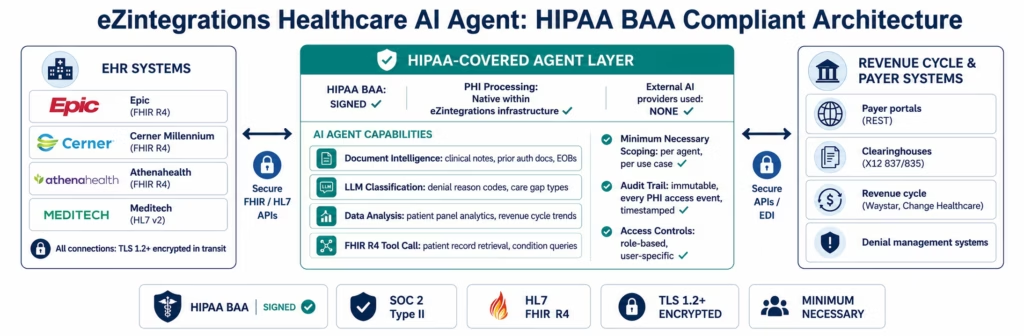
Option B (compliant): native inference within eZintegrations. All Document Intelligence, LLM Classification, and Data Analysis processing runs within eZintegrations’ own infrastructure: the same infrastructure covered by the existing HIPAA BAA. PHI does not leave the BAA-covered environment during AI processing. No additional BAA with an external AI provider is required.
eZintegrations processes all healthcare AI agent operations natively. Clinical documentation, patient records, diagnosis codes, and claim data processed by AI agents stay within eZintegrations’ HIPAA-covered infrastructure. The single HIPAA BAA with eZintegrations covers all AI processing for the platform.
Immutable audit trail for every AI action: every agent tool call: every FHIR query, every document extraction, every LLM classification of a denial reason code: generates an immutable, timestamped audit trail entry: what data was accessed, what processing was applied, what output was produced, what action was taken. This satisfies the HIPAA audit control requirement for AI-mediated PHI access.
Minimum necessary scoping: each agent is configured with access only to the patient data required for its specific use case. The prior authorisation agent has access to the patient’s clinical records relevant to the authorisation. It does not have access to the full patient record, the financial record, or the records of other patients.
Before vs After: AI Agents for Healthcare Workflows
| Workflow | Before AI Agents | After AI Agents | Impact |
|---|---|---|---|
| Prior auth assembly | Coordinator: 45-90 min/case (Epic pull, codes, guidelines, submission) | Agent assembles clinical justification from EHR + payer guidelines, submits via portal | 70-80% time reduction per auth |
| Prior auth status follow-up | Coordinator calls payer or checks portal manually (15-30 min each) | Agent monitors payer portal continuously, alerts when status changes | Real-time vs days of manual checking |
| Claim denial classification | RC team reads denial EOB, determines category and appeal path (20-40 min) | Agent classifies denial from EOB reason code + claim context in <5 min | 85-90% classification time reduction |
| Denial appeal assembly | RC analyst pulls original claim, clinical notes, coding documentation (45-90 min) | Agent assembles appeal package from EHR, claim, and payer guidelines | 60-75% assembly time reduction |
| Care gap identification | Care manager queries each patient record manually (15-20 min per patient) | Agent queries full panel of 850 patients, identifies all gaps, produces prioritised workqueue | 850 patients in 45 min vs weeks |
| Clinical documentation completeness | Coder queries physician documentation for missing elements (15-25 min/chart) | Agent scans chart for documentation completeness vs billing requirements, flags gaps | 80-85% of completeness checks automated |
| Discharge coordination | Social worker coordinates post-acute placement via phone and fax (2-4 hrs) | Agent queries SNF availability, benefit eligibility, care plan, assembles referral package | 60-70% coordination time reduction |
| Prior auth denial follow-up | Auth coordinator tracks pended/denied auths manually, varies by individual | Agent monitors all auth statuses continuously, escalates at configured SLA windows | 100% monitoring coverage vs sampling |
| Revenue cycle exception queue | RC team investigates each exception: eligibility, coverage, coding (30-60 min each) | Agent investigates, classifies, and stages resolution for RC manager review | 75-80% investigation time reduction |
| Eligibility verification | Staff verifies eligibility at check-in (5-10 min per patient) | Agent verifies 24-48 hrs before appointment, surfaces coverage gaps proactively | Proactive vs at point of service |
How eZintegrations AI Agents Connect the Healthcare Stack
eZintegrations Level 3 AI Agents (operating above the Level 1 iPaaS and Level 2 AI Workflow foundation) use 9 native enterprise tools to operate across the healthcare technology stack: within the HIPAA BAA boundary.
The 9 native agent tools for healthcare use cases:
- Knowledge Base Vector Search: semantic search across clinical guidelines, payer coverage policies, CMS LCD/NCD databases, drug formularies, coding references (ICD-10, CPT, HCPCS), and internal clinical protocols: essential for prior auth justification and denial appeal research.
- Document Intelligence: read and extract structured data from clinical documentation (physician notes, operative reports, diagnostic studies), Explanation of Benefits (EOB) documents, prior auth denial letters, and referral documentation. All processing natively within the HIPAA BAA boundary.
- Data Analysis: statistical analysis of patient panel data, revenue cycle performance metrics, denial rate trends, and care gap prevalence patterns across patient populations.
- Data Analytics with Charts/Graphs/Dashboards: generate patient panel dashboards, revenue cycle trend visualisations, and denial reason distribution charts embedded in agent intelligence briefs.
- Web Crawling: retrieve current payer coverage policies, updated CMS reimbursement guidelines, and formulary changes from payer portals and CMS.gov that affect clinical decision support and authorisation requirements.
- Watcher Tools: continuous monitoring of prior auth SLA windows, claim filing deadlines, appeal timely filing limits, and care gap intervention targets with threshold-based alerting.
- API Tool Call: direct REST calls to EHR FHIR R4 endpoints (Epic, Cerner, Athenahealth), payer REST APIs, revenue cycle system APIs, and health information exchanges.
- Integration Workflow as Tool: call any Level 1-2 workflow as a tool: for example, triggering the existing HL7 ADT notification workflow as part of the discharge coordination agent’s action sequence.
- Integration Flow as MCP: expose healthcare integration capabilities via Model Context Protocol for consumption by external clinical decision support tools.
Healthcare system connectors:
Epic (FHIR R4): Epic’s SMART on FHIR / FHIR R4 API for patient demographics, conditions, medications, allergies, immunisations, diagnostic results, care plans, and clinical notes. Supports Epic’s proprietary FHIR extensions for clinical workflow data. Requires Epic-specific OAuth 2.0 flow with patient-specific or system-level access tokens depending on use case.
Cerner Millennium (FHIR R4): Cerner’s FHIR R4 API for equivalent clinical data domains. Supports Cerner’s CDS Hooks integration for clinical decision support within the Cerner workflow.
Athenahealth (FHIR R4): Athenahealth’s FHIR R4 API for practice management and clinical data in ambulatory settings. REST API for appointment, billing, and insurance management.
Meditech (HL7 v2): HL7 v2 message handling for ADT (Admit/Discharge/Transfer), ORM (Order), ORU (Observation Result), and MDM (Medical Document Management) message types for legacy Meditech environments.
Payer portal connectivity: REST API connectivity to major payer prior auth portals and eligibility verification services. X12 EDI 278 (prior auth request/response), X12 EDI 270/271 (eligibility request/response), X12 EDI 837/835 (claim/remittance).
Revenue cycle systems: Waystar, Change Healthcare, Availity via REST API for claim status, denial management, and eligibility verification.
HIPAA compliance: HIPAA BAA in place. All agent tool calls process PHI natively within eZintegrations’ infrastructure: no PHI sent to external AI providers. SOC 2 Type II certified. GDPR compliant for international health data. Immutable audit trail for every PHI access event. Minimum necessary data scoping per agent and per use case. TLS 1.2+ for all data in transit. IPSec Tunnel for on-premises EHR and clinical systems behind hospital firewalls.
Use Case 1: Prior Authorisation Investigation and Assembly Agent
The problem in one sentence: your prior authorisation coordinators spend 45-90 minutes per case assembling clinical justifications that could be assembled by an agent: pulling the same information from Epic, matching it against the same payer guidelines, and submitting through the same portal: while a patient’s procedure is delayed and the coordinator could be working on complex cases that actually require clinical judgment.
The AI agent solution: the Prior Authorisation Investigation and Assembly Agent receives a prior auth request, queries the patient’s clinical record for the required documentation, identifies the applicable payer coverage criteria, assembles the clinical justification, and submits through the payer portal: flagging cases that require clinical reviewer input before submission.
The Agent Investigation Sequence: Prior Authorisation Assembly
Agent goal: “Assemble prior authorisation for patient Jane Doe, DOB 1965-03-14, for procedure CPT 27447 (total knee arthroplasty): United Healthcare plan, submission required by Friday.”
Step 1: Patient record query (Epic FHIR R4): the agent calls Epic’s FHIR Patient endpoint to retrieve the patient’s current conditions (ICD-10 codes for knee osteoarthritis, BMI, comorbidities), relevant diagnostic results (X-ray readings confirming joint space narrowing), current medications, and the ordering physician’s documentation.
Step 2: Conservative treatment history: the agent queries Epic for the patient’s encounter history and procedure history for evidence of conservative treatment (physical therapy, corticosteroid injections, NSAID therapy): which United Healthcare requires as a prerequisite for surgical authorisation. The agent identifies 6 months of documented conservative treatment.
Step 3: Payer coverage policy retrieval (Knowledge Base + Web Crawling): the agent searches the Knowledge Base for United Healthcare’s current coverage policy for CPT 27447: the clinical criteria, documentation requirements, and submission format. If the policy has been updated since the last knowledge base refresh, the agent uses Web Crawling to retrieve the current policy from United Healthcare’s provider portal.
Step 4: Coverage criteria matching: the agent compares the patient’s documented clinical findings against United Healthcare’s coverage criteria for total knee arthroplasty. Result: the patient meets all listed criteria: joint space narrowing documented on imaging, 6+ months conservative treatment, functional impairment documented in physician note.
Step 5: Clinical justification assembly: using Document Intelligence to read and synthesise the physician’s clinical note, the agent assembles a structured clinical justification letter: patient demographics, diagnosis codes, procedure code, treating physician, clinical findings (quoted from the physician’s note), conservative treatment history with dates, functional impairment assessment, and the specific United Healthcare coverage criteria met by each element of the clinical record.
Step 6: Submission routing:
- Cases that meet all criteria with high confidence: submission package routed to the prior auth coordinator for review and one-click submission to the payer portal
- Cases with missing documentation or ambiguous criteria matching: routed to the clinical reviewer with a gap analysis (what is missing and where it might be documented)
- Cases requiring physician attestation: routed to the ordering physician’s inbox with the assembled justification for signature
Agent assembly time: 8 minutes 22 seconds. Previous manual assembly: 45-90 minutes. For a coordinator handling 15 prior auths per week: 11-23 hours of assembly time reduced to 2.1 hours of review and submission oversight.
Use Case 2: Claim Denial Analysis and Appeal Agent
The problem: every denied claim represents lost or deferred revenue: and the path from denial to appeal to reimbursement runs through a multi-system investigation that most revenue cycle teams can only partially staff. The result: many denials are never appealed, not because the denial was correct, but because the appeal investigation takes too long relative to the revenue value of the claim.
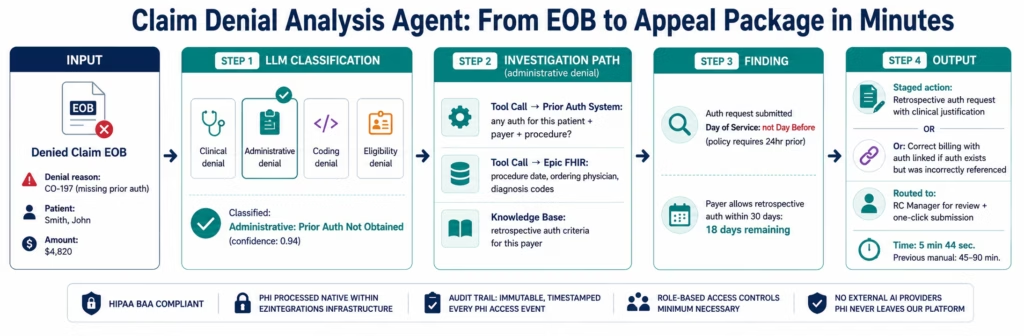
The AI agent solution: the Claim Denial Analysis and Appeal Agent receives each denied claim, classifies the denial type from the EOB reason code and claim context, determines the appeal pathway, assembles the appeal documentation, and routes to the appropriate revenue cycle staff for filing.
Denial Classification and Investigation Paths
The agent’s first action is always classification: because the correct investigation and appeal path depends entirely on the denial type.
Clinical denial (medical necessity not established):
- Agent queries the patient’s clinical record in the EHR for the documentation that establishes medical necessity for the billed service
- Agent queries the Knowledge Base for the payer’s medical necessity criteria for the denied service
- Agent compares: is the medical necessity documentation present? Does it meet the payer’s stated criteria?
- If yes: agent assembles the appeal package (clinical record excerpts, physician attestation request, payer medical necessity criteria met)
- If no: agent routes to clinical reviewer with gap analysis: what documentation is needed and from whom
Administrative denial (prior auth not obtained):
- Agent queries the prior auth workflow system for any auth request for this patient, payer, and procedure combination
- If an auth was obtained but not linked to the claim correctly: agent stages the correction for billing team review
- If no auth was obtained: agent assesses whether the procedure qualifies for retrospective authorisation and routes accordingly
Coding denial (incorrect procedure code, modifier missing, unbundling):
- Agent retrieves the original claim and the denial EOB
- Agent queries the Knowledge Base for the correct coding guidance (CPT coding guidelines, payer-specific billing rules)
- If the denial is correctable: agent stages the corrected claim for billing team review
- If the denial requires clinical documentation to support the original coding: routes to clinical reviewer
Eligibility denial (wrong payer, patient not covered at date of service):
- Agent queries the eligibility verification record for the patient’s coverage at the date of service
- Agent queries the current payer assignment in the patient’s insurance record
- If the patient had alternate coverage: agent identifies the correct payer and stages the rerouted claim
- If coverage was truly absent: routes to patient access for self-pay or charity care assessment
The result: denied claims are classified and investigation-complete within 5-8 minutes of denial posting. Revenue cycle staff review pre-assembled appeal packages rather than conducting 45-90 minute investigations per denial. Denial overturn rate improves as every denial receives systematic investigation rather than sampling.
Use Case 3: Care Gap Identification Agent
The problem: your care management team is responsible for a panel of 850 high-risk patients. Identifying which patients have care gaps: a diabetic patient who has not had an HbA1c in 12 months, a hypertensive patient whose blood pressure has not been measured in 6 months, a patient discharged from the hospital 28 days ago who has not had a follow-up appointment: requires querying each patient’s record individually. At 15-20 minutes per patient, reviewing the full panel is a 210-283 hour exercise.
The result: care gaps are identified through sampling, not systematic review. The patients who most need intervention are the ones most likely to fall through the gaps: because systematic review of 850 patients is not feasible with current staffing.
The AI agent solution: the Care Gap Identification Agent queries the full patient panel systematically, identifying care gaps against a configured set of quality measures and clinical protocols, and delivering a prioritised workqueue to the care management team: ranked by clinical urgency, care gap severity, and the patient’s risk score.
What the Care Gap Agent Identifies
Quality measure gaps (HEDIS/Stars):
For each patient in the panel, the agent queries the EHR for:
- HbA1c testing frequency (diabetic patients): last HbA1c date vs HEDIS 12-month requirement
- Blood pressure control (hypertensive patients): last BP reading date and value vs control threshold
- Annual wellness visit completion: last AWV date vs annual requirement
- Colorectal cancer screening: last colonoscopy or FOBT date vs screening frequency guidelines
- Mammography (female patients 50-74): last mammography date vs biennial requirement
- Medication adherence: refill records for chronic condition medications vs adherence thresholds
Transition of care gaps:
- Patients discharged from inpatient in the last 30 days without a scheduled follow-up appointment
- Patients referred to specialist care with no appointment confirmation recorded in the EHR
- Patients in the SDOH risk flag set with no social determinants screening in the past 12 months
Clinical deterioration signals:
- Patients with chronic conditions whose recent lab values are trending outside control thresholds
- Patients with two or more ED visits in the past 90 days without care coordination intervention
- Patients on high-risk medications (anticoagulants, insulin) with no recent safety monitoring labs
The Agent’s Query Sequence for 850 Patients
Trigger: scheduled weekly run (Monday at 5 AM) or manual trigger by care management lead.
Step 1: Panel query (FHIR R4): the agent queries Epic or Cerner FHIR for all patients in the care management panel. For each patient, it retrieves: current conditions (ICD-10), recent lab results with dates, appointment history, medication list with refill dates, and current care plan.
Step 2: Gap identification (Data Analysis): the Data Analysis node compares each patient’s retrieved data against the configured quality measure specifications and clinical protocol thresholds. Output: per-patient list of identified care gaps with supporting evidence.
Step 3: Prioritisation: the agent ranks identified gaps by: clinical urgency (a post-discharge patient with no follow-up scheduled ranks higher than a patient with a late annual wellness visit), gap severity (an HbA1c at 11.2 for an uncontrolled diabetic ranks higher than a mild control gap), and the patient’s risk score from the EHR’s risk stratification model.
Step 4: Care manager workqueue delivery: the agent delivers a prioritised workqueue to the care management system: patient name, care gap type, supporting evidence (last HbA1c date and value, last appointment date), recommended intervention (schedule HbA1c, schedule follow-up, engage for AWV), and the care manager’s contact note context.
Time for 850 patients: 43 minutes. Previous manual review of this panel: a 2-week rolling exercise that captured approximately 30% of the panel before cycling back to the beginning.
Use Case 4: Clinical Documentation Completeness Agent
The problem: incomplete clinical documentation at the point of care creates downstream problems for billing, coding, and quality reporting. A physician’s note that does not document the severity of a chronic condition, the response to treatment, or the clinical complexity of a visit results in a lower-coded E&M level: reducing reimbursement. CDI (Clinical Documentation Improvement) specialists review charts to identify these gaps and send queries back to physicians: but the CDI team reviews a fraction of the charts that need review, and the review often happens days after the encounter when physician recall is limited.
The AI agent solution: the Clinical Documentation Completeness Agent reviews charts at or near the time of encounter, identifies documentation gaps relative to the visit’s billing requirements and quality measure specifications, and routes targeted queries to physicians: reducing the lag between encounter and documentation improvement.
What the Agent Reviews
E&M level documentation requirements:
The agent reads the physician’s clinical note using Document Intelligence and evaluates:
- Medical decision making complexity documented (number of problems addressed, complexity of data reviewed, risk of complications)
- History and examination elements documented per the CPT E&M guidelines
- Whether the documented complexity is consistent with the billed E&M level
Chronic condition documentation:
- For each chronic condition on the patient’s problem list, the agent checks whether the current visit’s note documents the condition’s current status (controlled, uncontrolled, improving), any change in treatment, and the response to prior treatment
- Undocumented chronic conditions in a visit where they are clinically relevant generate a physician query
Quality measure capture:
- Whether PHQ-2/PHQ-9 screening is documented for at-risk patients
- Whether SDOH screening is documented per the payer’s quality measure requirements
- Whether smoking/tobacco cessation counselling is documented for tobacco users
Agent routing:
- High-confidence documentation gap with billable impact: physician query generated and routed to physician’s inbox within 4 hours of encounter completion
- Quality measure gap: flagged in the CDI workqueue for CDI specialist review
- E&M level inconsistency: routed to the coding team with the specific documentation gap identified
The result: CDI specialist time shifts from chart review to physician follow-up and complex case management. Documentation query response rates improve as queries are targeted and timely. E&M coding accuracy improves as documentation gaps are caught within hours of the encounter rather than days later.
Use Case 5: Discharge Coordination and Post-Acute Handoff Agent
The problem: hospital discharge coordination is among the most time-sensitive and multi-party workflows in healthcare: and the manual coordination burden is where readmission risk is created. A patient who needs skilled nursing facility (SNF) placement after a total hip replacement requires: SNF availability check, benefit eligibility verification (remaining SNF benefit days), insurance authorisation for the SNF placement, clinical summary preparation for the receiving facility, and family communication: all coordinated under a discharge date that may change 24-48 hours before it occurs.
When any of these steps is delayed by a morning of phone calls and fax messages, the patient stays an extra day. At $2,000-3,000 average cost per acute care day, discharge delays are among the most expensive administrative failures in hospital operations.
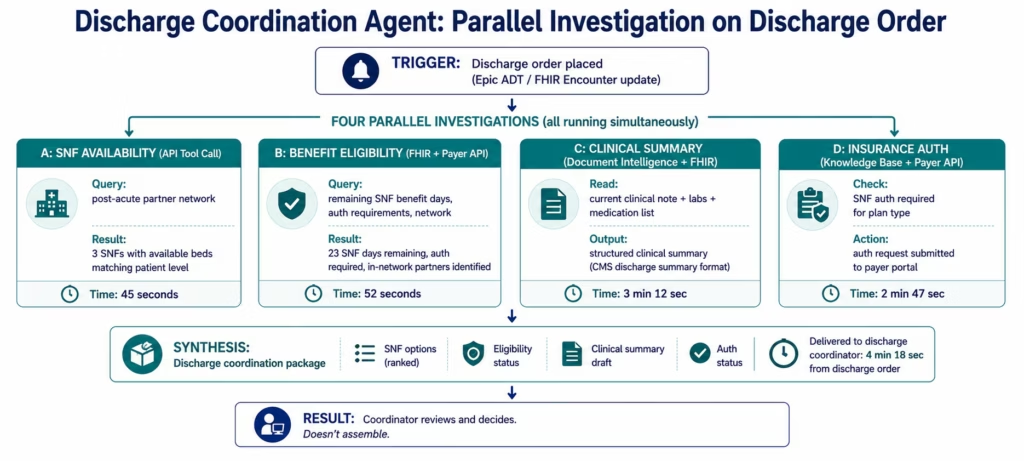
The AI agent solution: the Discharge Coordination Agent is activated when a discharge order is placed in the EHR, immediately beginning parallel investigation of all discharge requirements: so that by the time the care team is ready to discharge, the administrative coordination is complete.
The Agent’s Parallel Investigation on Discharge Order
Trigger: discharge order placed in Epic or Cerner (HL7 ADT event or FHIR Encounter resource update).
Parallel Step A: SNF availability (API Tool Call): the agent queries the SNF availability database or the health system’s preferred post-acute partner network for beds available within the patient’s geographic area and matching the patient’s care level requirements (skilled nursing, sub-acute rehab, wound care). Results ranked by proximity, contract status, and available bed date.
Parallel Step B: Benefit eligibility (FHIR + Payer API): the agent queries the payer’s eligibility API for the patient’s remaining SNF benefit days, any prior auth requirements for SNF admission, and any preferred network requirements.
Parallel Step C: Clinical summary preparation (Document Intelligence + FHIR): the agent reads the patient’s current clinical note, recent lab results, medication reconciliation list, and discharge medication orders from the EHR. Document Intelligence structures this into the standardised clinical summary format required by the receiving facility (CMS discharge summary requirements).
Parallel Step D: Insurance authorisation (Knowledge Base + Payer API): the agent checks whether SNF authorisation is required for the patient’s plan, and if so, begins the auth request process: retrieving the required documentation and submitting to the payer portal or flagging for the utilisation review team.
Synthesis: the agent assembles the discharge coordination package: SNF options ranked by fit and availability, benefit eligibility status, clinical summary draft, and auth status. The discharge coordinator reviews the pre-assembled package and executes the decisions: rather than spending 2-4 hours assembling it.
The result: discharge coordination time for standard post-acute placements reduces from 2-4 hours to 30-60 minutes of coordinator review and decision-making. Discharge delays attributable to coordination lag reduce 40-60% in facilities that deploy the discharge coordination agent.
Key Outcomes and Results
Healthcare organisations deploying eZintegrations AI Agents report the following outcomes within 90-120 days of HIPAA-compliant deployment:
Prior Authorisation:
- Assembly time per auth: 45-90 minutes (manual) → 8-12 minutes (agent-assembled, coordinator reviews)
- Coordinator capacity increase: 3-4x more auths handled per coordinator per week
- Auth denial rate from incomplete documentation: reduces as agent completeness check identifies gaps before submission
- Payer non-response follow-up: fully monitored vs sampled
Revenue Cycle:
- Denial classification time: 45-90 minutes (manual investigation) → 5-8 minutes (agent classification and investigation)
- Denial appeal initiation rate: increases as every denial receives systematic investigation rather than resource-based triage
- Denial overturn rate: improves 15-25% as appeal documentation quality and completeness improve
- RC team capacity for complex appeals and escalations: increases 40-50%
Care Management:
- Patient panel review: 850 patients in 43 minutes vs 2-week rolling manual exercise
- Care gap identification coverage: 100% of panel vs ~30% with manual sampling
- High-risk patient intervention lead time: improves by 1-2 weeks on average as gaps are identified sooner
Clinical Documentation:
- CDI query turnaround: same-day vs 2-7 days after encounter
- Physician response rate to CDI queries: improves as targeted, timely queries replace retrospective bulk reviews
- E&M coding accuracy: improves as documentation completeness improves
Discharge Coordination:
- Discharge coordination time: 2-4 hours (manual, serial) → 30-60 minutes (agent parallel investigation, coordinator review)
- Discharge delays from coordination lag: reduce 40-60%
- Acute care day cost avoidance: significant: every avoided discharge delay saves $2,000-3,000
How to Get Started
Healthcare AI agent deployment follows the same HIPAA compliance assessment and validation process as any PHI-handling system: but with the advantage that eZintegrations’ HIPAA BAA and audit trail architecture are pre-built, reducing the compliance build time significantly.
Step 1: HIPAA compliance and architecture assessment
Before any configuration: your health IT team and eZintegrations review the intended use cases for PHI handling requirements. The output is a data flow diagram showing: which PHI elements are accessed by each agent, from which systems, for what purpose, and what audit trail is generated. This takes 2-3 business days and is the prerequisite for all subsequent steps.
Step 2: Book a technical demo with your health IT and compliance team
Healthcare AI agent compliance is best evaluated in a live demonstration: showing the agent’s FHIR R4 query execution, the PHI audit trail generated for each query, and the minimum necessary scoping configuration. Book a free demo and include your health IT director, HIPAA privacy officer, and any revenue cycle or care management stakeholders.
Step 3: Configure EHR and payer connections
For Epic FHIR R4: register eZintegrations as a SMART on FHIR application in Epic’s App Orchard or via your Epic technical team. Obtain the necessary OAuth 2.0 credentials and configure the patient and system-level access scopes appropriate for each agent’s use case (minimum necessary scoping).
For Cerner: register via Cerner’s developer program and configure the appropriate FHIR access scopes.
For payer portals: configure REST API credentials or EDI trading partner agreements for eligibility (270/271), prior auth, and claim status (276/277).
Step 4: Load the knowledge base with clinical and payer policy content
The agent’s effectiveness for prior auth and denial management depends heavily on the knowledge base: payer coverage policies per procedure and plan type, clinical guidelines referenced by major payers, ICD-10 and CPT coding references, and internal clinical protocols. Populating the knowledge base takes 4-8 hours for an initial deployment scope and is the most important configuration step for agent accuracy.
Step 5: Deploy supervised with HIPAA audit trail active
For the first 30-60 days, all agent-assembled documents require clinical or revenue cycle reviewer approval before submission or action. The HIPAA audit trail is active from day one. Review the audit trail weekly to confirm that PHI access is appropriately scoped and that every agent action is correctly logged. Expand the pre-authorised autonomous action list gradually as confidence in agent accuracy and compliance is established.
FAQs
Yes, with the correct architecture. HIPAA requires that systems accessing PHI have a signed Business Associate Agreement with the covered entity, implement minimum necessary data access, maintain immutable audit trails for all PHI access, and use encryption in transit. eZintegrations satisfies all four requirements through a HIPAA BAA, configurable minimum necessary access scoping per agent, immutable PHI access audit trails for every agent action, and TLS 1.2+ encryption for all data in transit. The critical architectural requirement is that all AI inference runs natively within eZintegrations' infrastructure, ensuring no PHI is sent to external AI providers such as OpenAI, Anthropic, or Google during agent processing.
AI agents connect to Epic through SMART on FHIR and FHIR R4 APIs, and to Cerner through Cerner's FHIR R4 APIs. The eZintegrations API Tool Call queries FHIR resource endpoints including Patient, Condition, Observation, MedicationRequest, Encounter, and DiagnosticReport for the exact data elements required for each workflow. For Epic, the connection requires registration as a SMART on FHIR application through Epic App Orchard or direct enterprise configuration. The architecture supports both patient-level access for individual clinical workflows and system-level access for population health and care gap analysis. For on-premises Epic and Cerner deployments, eZintegrations connects through IPSec Tunnel connectivity without exposing the EHR to the public internet.
Deployment timelines are primarily driven by EHR connectivity setup and HIPAA compliance validation requirements. HIPAA architecture assessment typically requires 2-3 business days. Epic or Cerner FHIR R4 application registration and credential configuration generally takes 2-4 weeks due to EHR vendor registration processes, although enterprise direct connections may be faster. Knowledge base population for payer policies, clinical guidelines, and coding references usually requires 4-8 hours. Supervised deployment with active HIPAA audit trails is commonly maintained for 30-60 days before expanding autonomous action scope. Total time to first supervised deployment is generally 4-8 weeks.
AI agents can handle the documentation assembly and criteria-matching portions of prior authorisation workflows, which represent the majority of coordinator workload, while escalating cases requiring clinical judgment to human reviewers. The agent retrieves patient clinical records, retrieves current payer coverage criteria, matches clinical findings against those criteria, and assembles supporting clinical justification automatically. Cases where documentation is complete and criteria are clearly satisfied are prepared for coordinator review and submission. Cases involving missing documentation or borderline criteria matches are escalated to clinical reviewers with a structured gap analysis. This allows the agent to automate approximately 70-75% of standard prior authorisation assembly tasks while clinicians focus on the remaining complex cases.
Yes, eZintegrations connects to major payer REST APIs and EDI interfaces for eligibility verification using X12 270/271, prior authorisation using X12 278, claim submission using X12 837, and remittance processing using X12 835. For major payers including United Healthcare, Aetna, Cigna, and Humana, connectivity uses REST APIs secured through OAuth 2.0 authentication. For payers operating exclusively through EDI, eZintegrations connects through clearinghouse APIs such as Waystar, Change Healthcare, and Availity. Eligibility verification agents can proactively query payer systems 24-48 hours before scheduled appointments, surfacing coverage issues before the patient arrives for service.1. Is AI agent automation for healthcare operations compliant with HIPAA?
2. How do AI agents connect to Epic and Cerner for clinical data?
3. How long does it take to deploy healthcare AI agents?
4. Can AI agents handle prior authorisation for complex clinical cases?
5. Does eZintegrations work with payer APIs for eligibility and claim status?
Conclusion: Healthcare’s Administrative Burden Is Not Inevitable. It Is Addressable.
The 30% of US healthcare costs that McKinsey identifies as administrative is not a natural feature of healthcare delivery. It is the accumulated cost of decades of fragmented systems, paper-based workflows surviving digitisation, and the failure to connect the data that exists in Epic, in payer portals, and in revenue cycle systems into the investigation and assembly workflows that clinical and administrative staff repeat, manually, thousands of times per week.
AI agents can conduct these investigations compliantly: within the HIPAA BAA boundary, with immutable audit trails for every PHI access event, with minimum necessary data scoping, and with native AI inference that keeps patient data where it belongs. The prior authorisation that took 45-90 minutes to assemble takes 8 minutes when the agent queries the clinical record and the payer policy simultaneously. The claim denial that took 45 minutes to investigate and classify takes 5 minutes when the agent reads the EOB and traces through the eligibility, prior auth, and coding records in sequence. The 850-patient care gap review that took two weeks of manual sampling takes 43 minutes when the agent queries the full panel systematically.
The HIPAA compliance architecture is not a barrier to this. It is the design specification. eZintegrations is built to satisfy it.
Book a free demo and bring your health IT director, HIPAA privacy officer, and your most time-intensive administrative workflow. We will walk through the HIPAA BAA architecture, the FHIR R4 connection for your EHR, and the agent configuration for your specific use case.